
Trades & Construction Accounting in Idaho Falls, ID:
Books That Set Your Bid Ceiling
In Idaho, your financial statements literally decide how big a public job you're allowed to bid. Here's how an Idaho Falls contractor builds PWCL-ready, bonding-grade books — the consumer sales-tax rule, DOPL registration, job costing, and WIP — delivered remotely across Idaho.

Picture the job of your career coming up for bid in Idaho Falls — a facility package tied to the Idaho National Laboratory corridor, a new medical building near EIRMC, a municipal project in Bonneville County. You have the crews, the equipment, and the reputation to build it. And then you read the bid documents and learn you are not allowed to submit, because the public-works license class you hold caps you well below the contract price. Not because you can't do the work. Because of a number on a financial statement you don't have.
That is the piece of Idaho construction nobody warns a contractor about: in this state, your books don't just report the past — they literally set how big a public job you are allowed to bid. The Public Works Contractor License (PWCL), and the bid limit that rides on it, are determined by CPA-prepared financial statements. Clean, current, properly prepared financials raise your ceiling; thin or missing ones nail it to the floor. This guide walks the whole Idaho Falls construction picture — the PWCL ceiling, DOPL registration, the consumer-of-materials sales-tax rule, job costing, WIP, and bonding — delivered remotely across Idaho.
By Carrie Anderson — Co-Founder, 406 Consulting Group. Commercial banking and underwriting background — 300+ loan and credit reviews — serving contractors and trades across the Mountain West. I have sat on the other side of the table reading the financials that decide a bond line or a license class, and I know exactly what makes a contractor's file say yes.
Quick Answer: Accounting for an Idaho Falls Contractor
- →Your books set your bid ceiling. The Idaho Public Works Contractor License class — and your bid limit — are set by CPA-prepared financial statements (higher classes need Reviewed or Audited; lower a Compiled; all under 12 months old).
- →Register with DOPL for any construction with an aggregate contract price of about $2,000 or more — proof of $300,000+ general liability and workers' comp (or a signed exemption) gates registration. Electrical, plumbing, and HVAC are separately licensed.
- →You're the consumer of your materials: pay Idaho sales/use tax (6%) at purchase and don't bill the owner sales tax on real-property work. Idaho Falls has no local-option sales tax — a clean, flat 6%.
- →No state prevailing wage in Idaho — certified payroll only on federally funded (Davis-Bacon) work. Flat 5.3% income tax (verify). Workers' comp required once you have employees.
- →Bonding capacity is underwriting. Job costing and a clean WIP schedule are what a surety reads to decide how much work it will back — handled remotely, by a firm that has read those files from the other side.
Table of Contents
The Public Job You Can't Legally Bid
Most contractors think of their financial statements as homework — something the accountant does after the year is over, for the tax return and the file cabinet. In Idaho, that is a costly way to think. When public money is on the table, your financials move to the front of the project. They decide whether you are even eligible to put a number in the box.
Here is the chain, in plain terms. To bid a public works project in Idaho — anything funded by a public body above the state threshold (use roughly $50,000 as a mental marker, but verify the current figure, because it moves) — you need a Public Works Contractor License. That license comes in classes, and each class carries a maximum single-project and aggregate bid limit. The class you qualify for is set by the net worth and working capital shown on CPA-prepared financial statements that are less than twelve months old. Higher classes require Reviewed or Audited statements; lower classes accept a Compiled statement. No current, properly prepared statements? No higher class. No higher class? No bid.
In Idaho, your books are the terrain. The contractor who walks into bid season with clean, current, CPA-ready financials has already won ground the competitor scrambling to assemble statements in March simply cannot reach.
Think about what that means for an Idaho Falls builder watching the INL corridor, the hospital campuses, and Bonneville and Bingham county public work. The big jobs — the ones that change the trajectory of a company — are disproportionately public or bonded. If your books aren't built to carry you into the right license class, you are quietly fenced out of the exact work you got into business to chase. The fee you "saved" on a cheap bookkeeper was never the cost. The job you weren't allowed to bid was.

So the first move in Idaho construction accounting isn't reconciling the bank feed. It's understanding how the license class — your bid ceiling — is built. Start there.
How Idaho Sets Your Bid Ceiling: the PWCL & Your Books
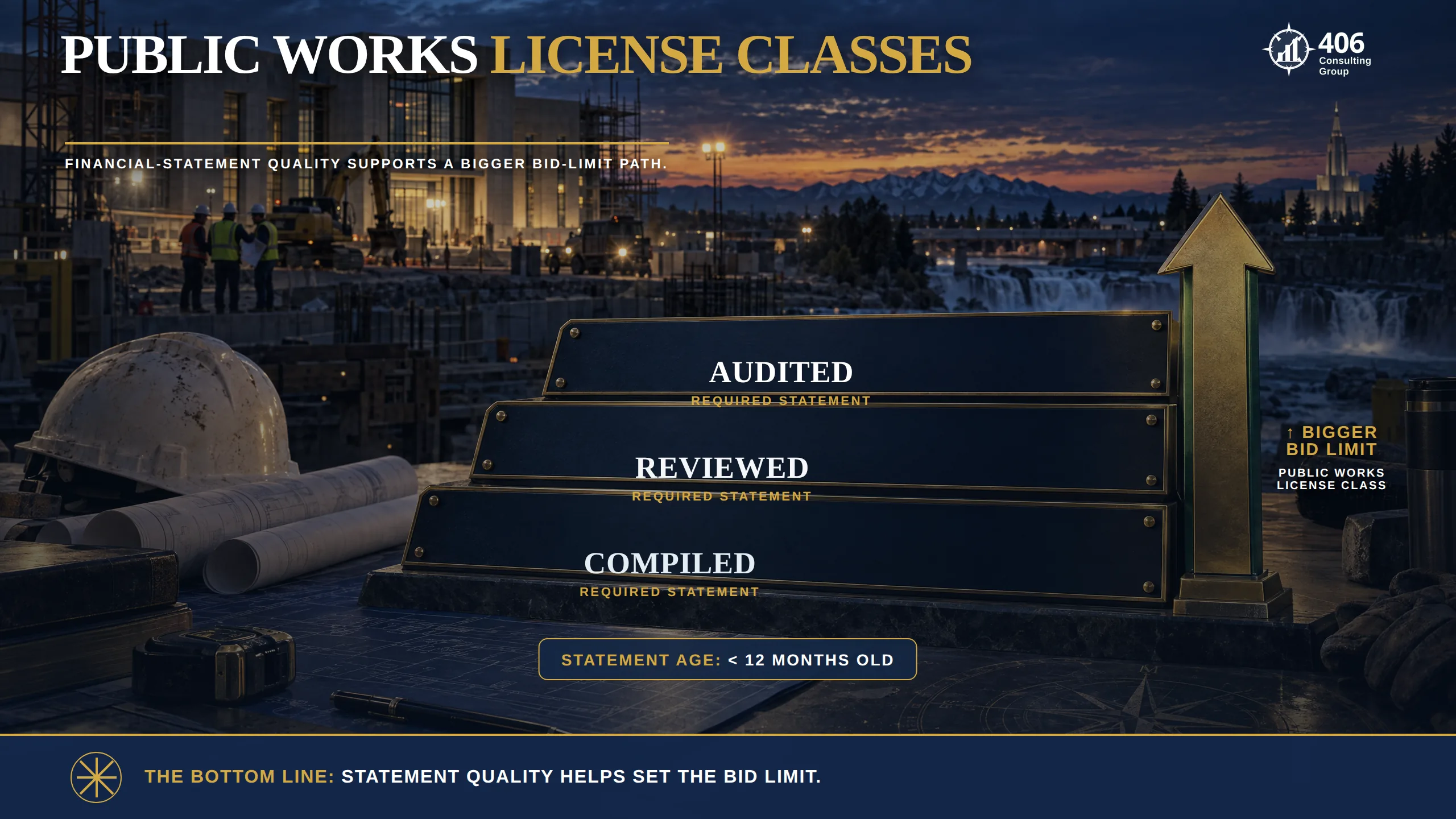
The Public Works Contractor License is where accounting and opportunity meet most directly in Idaho. The license is tiered into classes — commonly a limited entry class on the low end up through A, AA, and AAA — and each class sets the maximum size of a single public project you may bid and, often, your total aggregate at one time. You don't argue your way into a class or point at past jobs. You prove it with numbers, and the numbers come from a CPA.
The lever is the level of assuranceon your financial statement. That word — assurance — is the whole game, and it's worth understanding, because it's also what a banker and a surety read:
Compiled
The CPA assembles your numbers into proper statement format. No testing, no opinion. Enough for the lower license classes — and the floor you want to be above.
Reviewed
The CPA performs analytical procedures and inquiry, giving limited assurance nothing looks materially wrong. Typically required to reach the higher classes and bigger bid limits.
Audited
The deepest level — testing, verification, a formal opinion. What the top class and the largest bonded public work lean on. More cost, more ceiling.
Two details decide whether this works for you. First, the statements must be current — under twelve months old — so this is a rhythm, not a one-time errand; let them go stale and your ceiling drops at the worst possible moment. Second, a Reviewed or Audited statement is only as strong as the books beneath it. A CPA can't review chaos into a higher class. The working capital and net worth that qualify you are the outputof disciplined monthly bookkeeping, accurate WIP, and a clean balance sheet — which is exactly why the accounting and the bid ceiling are the same conversation.
Illustrative example (hypothetical). Say a growing Ammon site-work contractor wants to step up from scattered private jobs to the public work opening around Idaho Falls. On a Compiled statement cobbled together after year-end, the firm qualifies for a low class and keeps getting shut out of the projects worth chasing. Build the books properly through the year, carry a current Reviewed statement with real working capital, and the same company qualifies for a higher class and a far larger bid limit — the difference between watching the good jobs and bidding them.
Confirm current PWCL classes, limits, and statement requirements with the Idaho Division of Occupational & Professional Licenses (DOPL). Then make sure the books behind the statement can actually carry the class you want — that's our bookkeeping and controller work.
Before You Bid: DOPL Registration, Insurance & the Trades
Below the public-works layer, Idaho runs a registration regime for ordinary construction — and the gate is your insurance and comp compliance. Idaho does not make general contractors pass a licensing exam for private work. But any construction with an aggregate contract price of about $2,000 or more requires Idaho Contractor Registration (RCE)through the DOPL Contractors Board. And you can't register on good intentions.
To register, you must show proof of at least $300,000 in general liability insurance and workers' compensation coverage(or a signed exemption statement if you have no employees), plus the fee. Read that again: your insurance and comp compliance literally gate your ability to register and work legally. Contracting while unregistered can jeopardize your right to enforce a contract and bring penalties — it is not a paperwork nicety, it is permission to operate.
General construction (RCE)
Register with DOPL at roughly $2,000+ aggregate work. No GC exam, but you must carry $300K+ general liability and workers' comp (or a signed exemption). Keep both current — a lapse quietly unregisters you.
Specialty trades (licensed)
Electrical, plumbing, and HVAC contractors do require state licensing and exams through DOPL, with their own continuing requirements — on top of RCE and any local permits and inspections.
For the books, every one of these is a live, recurring obligation with a cost and a renewal date — insurance premiums, comp, registration, trade licenses — and they belong in your burdened cost of doing business, not forgotten until renewal season. Keeping proof of coverage current is also the unglamorous foundation under everything above it: you can't pursue a PWCL class or a bond line if your base registration isn't clean.
Confirm what applies to your trade and contract sizes with Idaho DOPL. Registration gets you working — the next rule shapes every invoice you write.
You're the Consumer: Idaho Sales Tax on Your Materials
Idaho's sales tax treats a contractor the opposite of how it treats a store, and getting it backwards poisons every estimate. When you install materials into real property, Idaho generally treats you as the final consumer of those materials. You pay sales or use tax when you buy the lumber, wire, pipe, and fixtures — and you do not turn around and charge the property owner sales tax on the construction. The tax is part of your job cost, not a line you collect and remit like a retailer.
Idaho Falls makes this cleaner than most places, and that's worth knowing. The rate is a flat 6% state tax, and Idaho Falls has no local-option sales tax— that add-on is reserved for resort cities like Sun Valley and McCall. So unlike a home-rule state where the rate shifts block to block, an Idaho Falls contractor prices against one predictable 6%. The discipline is simply to build that 6% into the bid at the real, tax-included cost of materials.
The whole trap: estimate materials at the shelf price and forget the 6% you already paid, and every bid comes in short by exactly the tax — on a big job, that's real margin you'll never see again.
Two wrinkles catch people. Use tax picks up purchases where no Idaho tax was charged — materials ordered from an out-of-state supplier, or pulled from your own stock into a job — and it's easy to miss on a fast project. And if you also sell items at retail without installing them, that side can be taxed like ordinary sales, so a mixed operation needs clean separation in the books. Handled right, the tax stays predictable and your pricing stays honest.

Confirm how the rule and use tax apply to your specific work with the Idaho State Tax Commission— especially if you both install and sell.
Building Idaho Falls: INL, Ag & the Boomtown
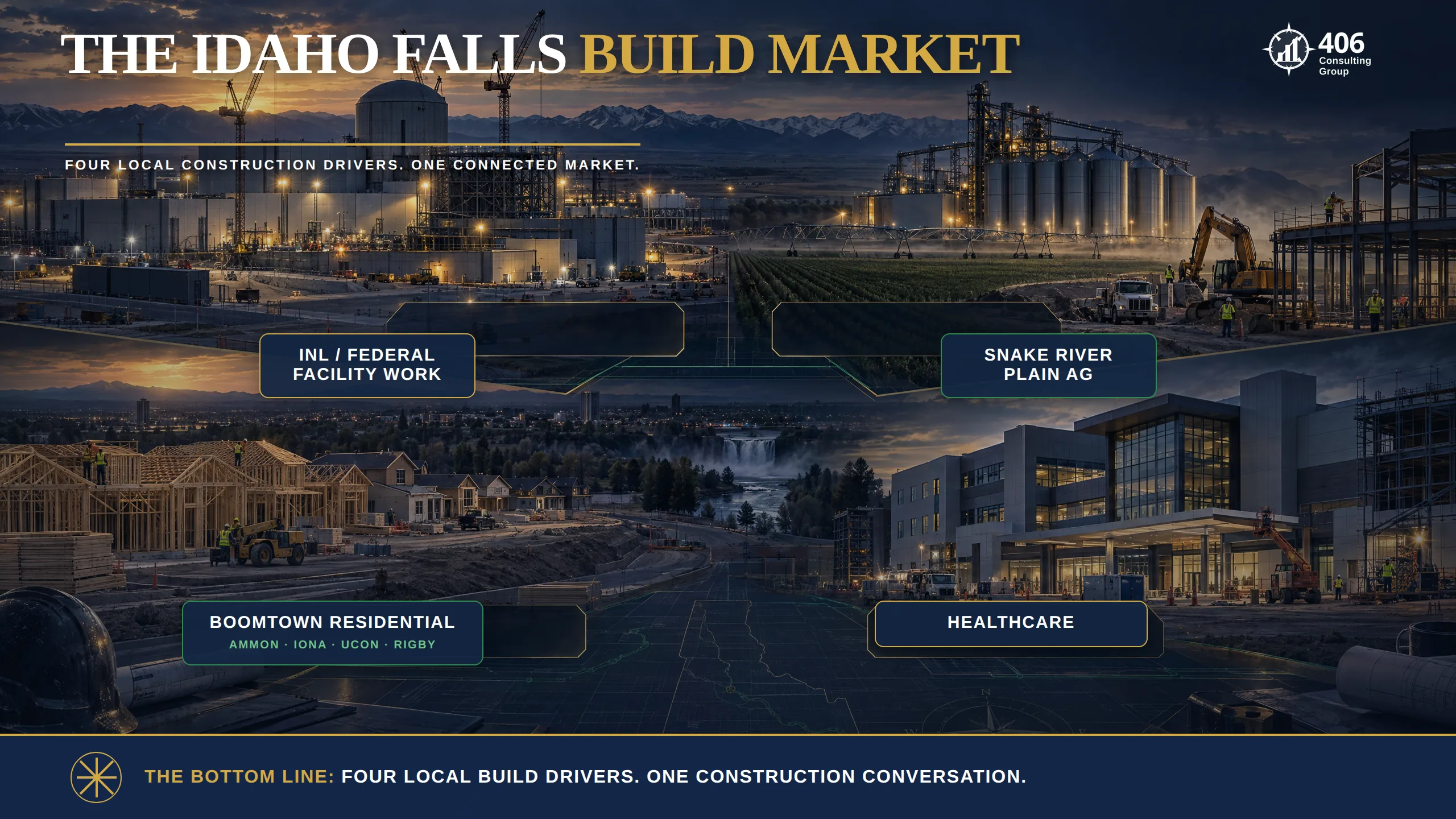
Idaho Falls construction has a character you should build your books around, because it's unlike Boise's or the Treasure Valley's. The gravitational center is the Idaho National Laboratory — nuclear and energy research, thousands of employees, and a documented ripple of roughly two spinoff jobs for every INL job. That creates a deep ecosystem of federal and government-adjacent contractors, R&D facilities, engineering firms, and specialty subcontractors— work that often demands job-costing rigor, indirect and overhead rate discipline, DCAA-style documentation, and multi-year project accounting that a simple ledger can't carry.
Around that sits the Snake River Plain ag economy — potatoes (the United Potato Growers of Idaho is headquartered here), barley for the region's malt operation, and dairy — feeding steady ag-processing, storage, and equipment-heavy construction with real seasonality. Add the healthcare hub around EIRMC, the large consumer-products presence of Melaleuca, a fast-growing residential base across Ammon, Iona, Ucon, Shelley, Rigby, and Rexburg, and the tourism pull as a gateway to Yellowstone and the Tetons. It is a mixed, bid-rich runway that rewards contractors who can price and cost very different job types accurately.
The counterintuitive lesson of a boomtown: fast growth is where contractors most often lose money, because volume hides thin or negative margins until the cash runs short. More work only builds a stronger company if you can see the margin on each job and fund the growth — which means job costing, a real WIP schedule, and a cash forecast, not just a fuller calendar.
Growth is only good growth if it's profitable — and that's a bookkeeping question before it's a sales one. Which brings us to the number that answers it.
Job Costing: Which Jobs Actually Made Money
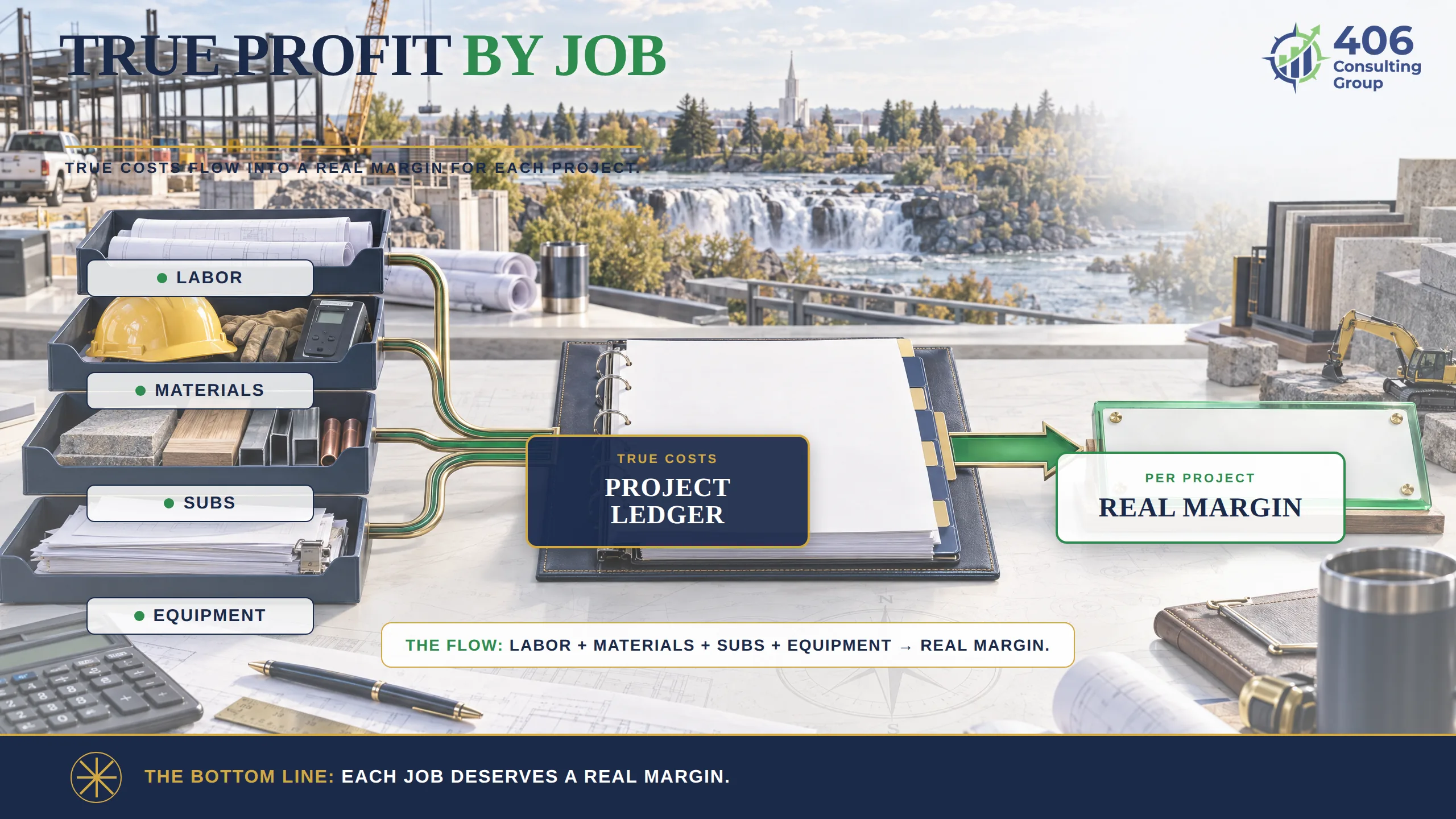
Ask ten contractors which of their jobs made money last year and most will point to the biggest one or the busiest one. Those are the wrong answers often enough to sink a company. Job costingis the discipline that gives you the right one. It assigns every labor hour, every material invoice (at its tax-included cost), every subcontractor bill, and every hour of equipment time to the specific project — so each job's true margin stands on its own instead of dissolving into a company-wide average.
The payoff is decisions you can't make without it. When you can see that an INL-adjacent facility retrofit ran thin on overtime and rework while your residential work in Ammon quietly carried the quarter, you bid, staff, and chase completely differently. You stop rewarding revenue and start rewarding margin. That is operational discipline — the unit economics of each job and each crew — and it is the single habit that most reliably separates contractors who grow richer from contractors who just grow busier.
| Cost bucket | What job costing pins down |
|---|---|
| Labor | Field hours burdened with comp, taxes, and benefits — tied to the job, not dumped in overhead |
| Materials | At tax-included cost (you're the consumer) — the price you actually paid, not the shelf price |
| Subcontractors | Each sub bill mapped to its job and phase, with retainage tracked separately |
| Equipment | Hours charged to the jobs that used the machine, so idle time shows as the cost it is |
Figuring out which jobs and crews genuinely carry the business is the whole point of our contractor unit economicswork — and job costing is what makes the answer visible. It's also the layer every other report stands on.
WIP, Percentage-of-Completion, Retainage & Change Orders
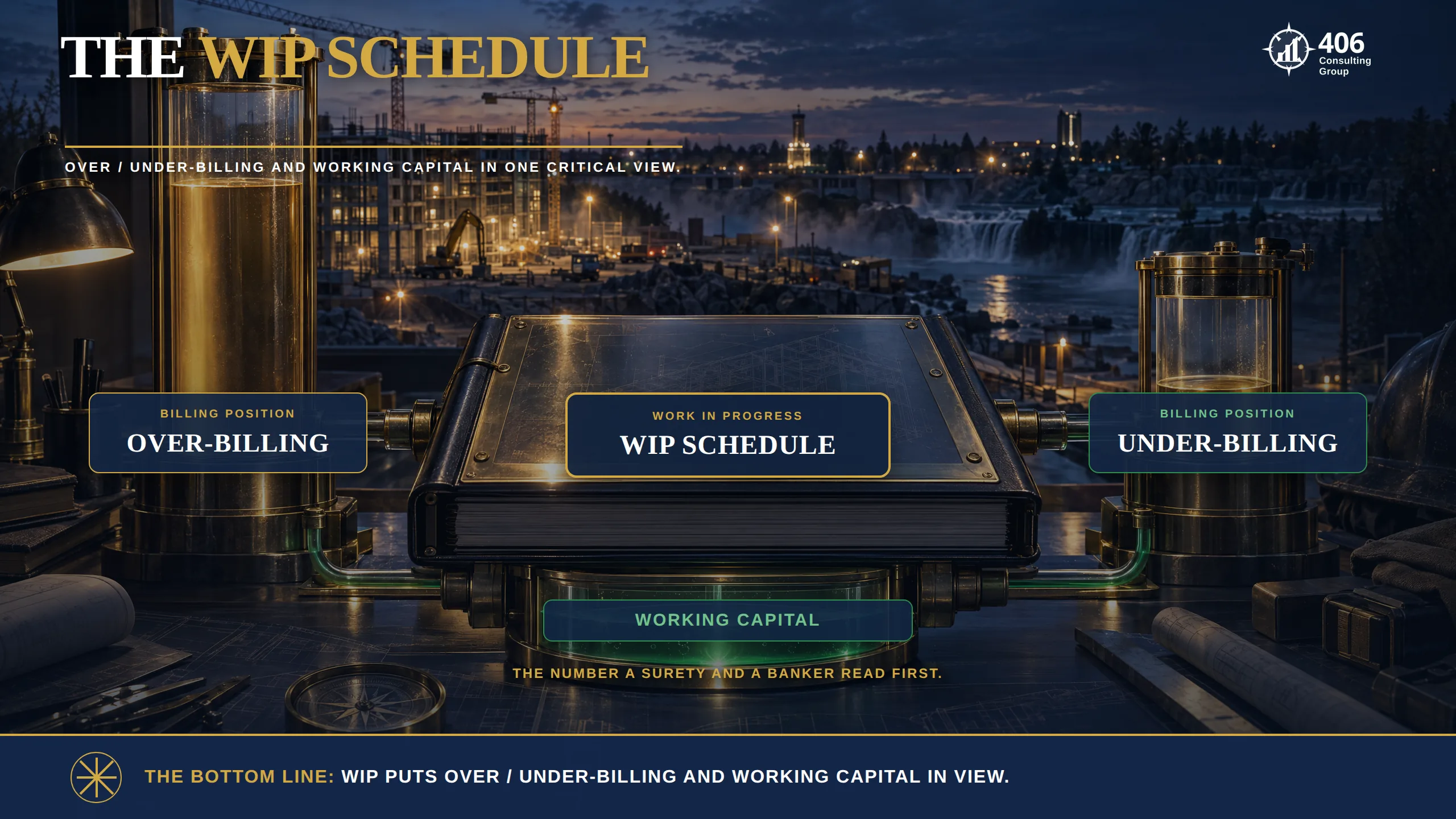
Jobs that span months need reporting a plain ledger can't give you. A work-in-progress (WIP) schedule holds each open job's costs, billings, and estimated cost-to-complete together, so the relationship among them reveals whether you're over- or under-billed. Bill ahead of the work and the surplus flatters your cash while the costs are still coming; bill behind it and you're quietly lending the owner your working capital. Percentage-of-completion ties revenue to how far the job has actually progressed, keeping the monthly picture honest instead of back-loaded.
Add retainage — the slice held to the end, which parks cash and belongs in its own receivable — and change orders, which move scope and margin and must be logged and priced beforethe work is absorbed into the job. On INL-corridor and public projects especially, unpriced change-order work is one of the fastest ways to build for free. And here is where this section meets section one: the WIP schedule is a primary input to the net worth and working capital on the financial statement that sets your PWCL class. A sloppy WIP doesn't just hide margin — it can cost you a license tier.
As you scale, this is where a controller or CFO functionearns its keep — the WIP is the report that tells you, and your banker and surety, where the business truly stands.
Bonding & Surety: Your Capacity Is Someone's Underwriting
Public and large private work in Idaho Falls usually means bonds — bid, performance, and payment bonds — and this is the part I can speak to from the inside. A surety bond is not insurance you buy off a shelf; it is credit extended on an underwriter's judgment that you can finish the job. And an underwriter decides your bonding capacity— the total and single-job work the surety will stand behind — by reading the same things a bank reads: working capital, net worth, your WIP schedule, and the quality of the financial statements presenting them.
I spent my career on the other side of that table, reviewing hundreds of loan and credit files, and I can tell you what a thin file costs you. A contractor with messy books, no credible WIP, and a bare-bones statement doesn't get a "no" — they get a small capacity, which is a quiet ceiling on how much work they're allowed to carry. A contractor with clean job costing, a real WIP, and a Reviewed or Audited statement walks in with a file that answers the underwriter's questions before they're asked, and the capacity reflects it. Same company, same crews — different books, different ceiling.
Bonding capacity and your PWCL class are the same muscle: both are underwriting, and both are decided by the financial statements your books produce. Build the books that pass review, and you raise both ceilings at once.
That underwriter's lens is exactly what we bring to a contractor's books — we build them to read the way a surety or a banker needs them to read, because we have been the ones reading them. It's the heart of our CFO and advisory work for contractors.
Payroll, No Prevailing Wage & Idaho Workers' Comp
Idaho construction payroll is comparatively clean, with a few pieces that belong inside your job costing. Because Idaho has a flat income tax, payroll carries Idaho withholding (a flat 5.3%, verify current) alongside federal. Workers' compensationis required once you have employees and is also the coverage that gates your DOPL registration — construction class-code rates are real money and belong in your burdened labor, not buried in overhead.
On prevailing wage, Idaho stands apart: there is no state prevailing-wage law. So on ordinary private and state-funded work there is no prevailing wage to pay and no certified payroll to file. That obligation appears only when you take a federally fundedjob — common in the INL orbit — where the federal Davis-Bacon Act sets wage rates and requires certified payroll for every worker. Those reports must be exact; a classification or rate slip can stall your draw.
No state prevailing wage
Certified payroll only on federal Davis-Bacon work — check each contract's funding source before you bid.
Workers' comp is the gate
Required with employees, and the coverage DOPL registration depends on — class-code rates go in burdened labor.
Flat withholding
Idaho withholding runs beside federal at a flat 5.3% (verify) — no bracket gymnastics.
Beyond that, construction payroll means tracking labor to jobs so it feeds job costing, and handling a heavy mix of subcontractors and 1099s with correct worker classification — an area that draws scrutiny in a fast-growing trades market. Set up cleanly, our payroll and bookkeeping turn each labor hour into clean job-cost data instead of a month-end fire drill.
Common Construction Bookkeeping Mistakes
A handful of avoidable errors cause most of the financial pain for Idaho Falls contractors — and in a boomtown with real public work on the table, each one bites harder.
Treating financial statements as year-end homework
If your statements are stale or thin when a public bid or bond comes up, your license class and bonding capacity drop — you get fenced out of the very jobs worth chasing.
Leaving materials tax out of the bid
You pay Idaho's 6% as the consumer, so it's a job cost — omit it, or miss use tax on out-of-state orders, and every estimate comes in short.
Letting DOPL registration, insurance, or comp lapse
Your $300K liability and workers' comp gate registration; let them slip and you're working unregistered, risking your right to get paid and inviting penalties.
Growing without job costing
In a boom, volume hides thin margins; without per-job costs you can scale straight into losing money and not see it until cash is tight.
Running a sloppy WIP schedule
Over- and under-billing mask where each job stands — and a weak WIP drags down the working capital that sets both your PWCL class and your bonding line.
None of these are hard problems — they're setup gaps. Build the books for Idaho construction, close them every month, and they simply stop happening.
Local vs. a Great Remote Partner
An Idaho Falls contractor's day runs between the job site and the truck, not an accountant's lobby — so a remote partner already matches how the business works. The question that actually matters isn't distance; it's whether your accountant can carry Idaho construction: the PWCL statement that sets your bid ceiling, the consumer-of-materials rule, DOPL registration, job costing across federal, ag, and residential work, a bonding-grade WIP, and the surety file behind it.
A specialist who lives in Idaho's details — and has read loan and bond files from the underwriter's chair — beats a nearby generalist who has never built a WIP or prepared a statement for a PWCL class, wherever either one sits.
Our workflow fits a builder's day: secure cloud accounting and job-costing software, receipts and field hours captured from the site, connected bank feeds, and a dependable monthly close — often a faster turnaround than a one-person local shop can manage, and specialists rather than a generalist down the street. You get Idaho-literate construction books and statements ready for a bid or a bond, with no trip across town. We serve contractors across Idaho Falls, Ammon, Rigby, Rexburg, Blackfoot, and the surrounding Bonneville and Bingham county communities the same way.
What matters is whether your accountant knows Idaho construction and can produce the statements that raise your ceiling — the office location is beside the point.
How to Get Started
Getting an Idaho Falls contractor's books ready to raise the ceiling is three steps.
Get the Idaho compliance pieces right
Keep DOPL registration, $300K+ liability, and workers' comp current; build the 6% materials tax into every bid as a job cost; confirm specialty trade licenses.
Build statement-grade, bonding-grade books
Stand up phase-level job costing, a clean WIP schedule, retainage and change-order tracking, and a tidy balance sheet — so a CPA can produce the Compiled, Reviewed, or Audited statement your license class needs.
Run it monthly and aim it at the bid
A dependable monthly close, a WIP review, and current financials kept under twelve months old — so when the career-making public job posts, you're already eligible to bid it.
Not sure where your books stand? Our Financial Maturity Assessmentmaps it out in a couple of minutes — and tells you whether your financials are ready to carry a bigger bid.
FAQ: Idaho Falls Construction Accounting
In Idaho, do my financial statements really decide how big a public job I can bid?
Yes. To bid public works projects above the state threshold, an Idaho contractor needs a Public Works Contractor License (PWCL), and the license comes in classes that each carry a maximum bid and aggregate limit. The class you qualify for is set by the net worth and working capital shown on CPA-prepared financial statements that are less than twelve months old. Higher classes require Reviewed or Audited statements; lower classes accept a Compiled statement. In practical terms, your books set your bid ceiling — clean, current, CPA-ready financials let you bid bigger work, and thin or stale ones fence you out of it. Confirm current classes and limits with Idaho DOPL.
What's the difference between a Compiled, Reviewed, and Audited financial statement, and which do I need?
They are three levels of CPA assurance. A Compiled statement puts your numbers into proper format with no testing or opinion — enough for the lower PWCL classes. A Reviewed statement adds analytical procedures and inquiry for limited assurance and is typically what you need to reach the higher classes and bigger bid limits. An Audited statement is the deepest level, with testing and a formal opinion, and supports the top class and the largest bonded public work. Which you need depends on the bid limit you're chasing — but all of them are only as strong as the monthly bookkeeping and WIP beneath them, which is why the accounting and the bid ceiling are really one conversation.
Do I need a contractor's license in Idaho to do private work?
Idaho doesn't require a general-contractor exam for private work, but it does require registration. Any construction with an aggregate contract price of roughly $2,000 or more requires Idaho Contractor Registration (RCE) through the DOPL Contractors Board, and to register you must show proof of at least $300,000 in general liability insurance and workers' comp coverage (or a signed exemption if you have no employees), plus a fee. So your insurance and comp compliance literally gate your ability to register and work. Electricians, plumbers, and HVAC contractors are separately licensed with their own exams. Public work additionally requires the PWCL. Confirm what applies to your trade with Idaho DOPL.
Do Idaho contractors charge customers sales tax on a construction job?
Generally not on real-property construction. Idaho treats a contractor who installs materials into real property as the final consumer of those materials, so you pay sales or use tax when you buy them and don't charge the property owner sales tax on the construction itself. That makes materials tax part of your job cost, which has to sit in your estimates at the tax-included price. Idaho Falls has no local-option sales tax, so you're pricing against a clean, flat 6% state rate. Use tax applies to purchases where no Idaho tax was charged — out-of-state orders or materials pulled from inventory — and if you also sell goods at retail without installing them, that side can be taxed like normal sales. Confirm the details for your work with the Idaho State Tax Commission.
Is there prevailing wage or certified payroll in Idaho?
No — Idaho has no state prevailing-wage law, so on ordinary private and state-funded work there's no prevailing wage to pay and no certified payroll to file. That obligation only appears when you take a federally funded job — common around the INL corridor — where the federal Davis-Bacon Act sets wage rates and requires certified payroll for every worker. Those reports must be exact, because a classification or rate slip can stall your draw, so if federal work is in your mix, set payroll up to generate them cleanly. Workers' comp is a separate, year-round requirement: every Idaho employer with employees needs coverage, and it's also what your DOPL registration depends on.
Does 406 Consulting Group provide trades & construction accounting in Idaho Falls, ID?
Yes. 406 Consulting Group provides remote bookkeeping, job costing, WIP, payroll, controller, CFO, and tax services to contractors and trades across Idaho Falls and the surrounding Bonneville and Bingham county communities — Ammon, Iona, Ucon, Shelley, Rigby, Rexburg, and Blackfoot. We build the statement-grade, bonding-grade books that set your PWCL bid ceiling and your surety capacity, handle Idaho's consumer-of-materials sales tax and DOPL compliance, and — with Carrie Anderson's commercial-banking and underwriting background — prepare the financials the way a banker or surety needs to read them. Everything runs on secure cloud tools with a dependable monthly close, so a busy Idaho Falls builder is served the same whether we're across town or across the Mountain West.
Keep Reading
Trades & Construction — Idaho Falls, ID
Build Books That Raise Your Bid Ceiling.
406 Consulting Group keeps Idaho Falls contractors clean and compliant — PWCL-ready statements, DOPL registration, the consumer sales-tax rule, job costing, WIP, and bonding-grade financials — delivered remotely, by a firm that has read these files from the underwriter's side.
Idaho Falls Construction Quick Reference
Idaho Falls, ID — Bonneville County
Chasing bigger public work?
PWCL-ready, bonding-grade books — handled.
About the Author
Carrie Anderson
Co-Founder, 406 Consulting Group
Commercial banking and underwriting background — 300+ loan and credit reviews. Carrie has read the financial statements that decide a bond line and a license class from the underwriter's side, and she builds Idaho Falls contractors' books to pass that test — PWCL-ready statements, clean WIP, real job costing, and the bonding capacity to carry bigger work.
Read the Full Story