
Bookkeeping Services in Idaho Falls, ID:
Books You Can Actually Trust
A cheap bookkeeper keeps tidy records that are quietly wrong — a loan booked as revenue, job costs smeared into overhead — and tells you it's right until a loan, a tax bill, or a bad decision proves it isn't. Here's why categorization integrity, not data entry, is the real product for an Idaho Falls business — built remotely across eastern Idaho.

Nobody discovers their books are wrong on a quiet Tuesday. They discover it in the worst possible room — across a desk from a lender who just pulled their file, in a meeting with a CPA who found a tax bill nobody saw coming, or in the middle of a decision that turned out to be built on numbers that were never true. That is the thing about a cheap bookkeeper in Idaho Falls: the records look tidy, the reports balance, and the person doing them tells you it is all correct. You never know any different — until something expensive makes you.
This guide is about the part of bookkeeping almost no one talks about: not data entry, but categorization integrity— whether every dollar landed in the right place. We walk through how a transactional bookkeeper quietly misclassifies revenue and job costs, why seasonal Idaho Falls businesses need accrual to see the truth, what a monthly close that actually closes looks like, and how all of it is delivered remotely across eastern Idaho.
By Carrie Anderson — Co-Founder, 406 Consulting Group. Commercial banker and underwriter who reviewed 300+ loan files before building books on the other side of the desk — for small businesses, ag operations, and INL-area contractors across Idaho Falls and eastern Idaho. Delivered remotely.
Quick Answer: Bookkeeping for an Idaho Falls Business
- →The real product of a bookkeeper is not data entry — it is categorization integrity: every dollar in the right place so the reports tell the truth.
- →A cheap, transactional bookkeeper misclassifies revenue and job costs and tells you it is right — you find out at a loan, a tax bill, or a bad decision.
- →Idaho Falls is seasonal — potato and barley harvest cycles, Yellowstone and Teton tourism swings — so accrual books show the truth cash books hide.
- →INL subcontractors running multiple entities and projects live or die on job costing and clean indirect-cost categorization.
- →A real monthly close is a system, not a scramble — and it is all remote, with roughly 80% of our own local clients never coming into an office.
Table of Contents
The Day the Cheap Books Cost You
Here is the scary part, and it is worth sitting with: you do not know what you do not know. Say a Rigby potato-shed operator has run the same cheap monthly bookkeeping for six years. The statements always balanced. Then a strong year arrives, the owner goes to the bank in Idaho Falls to finance a new storage building, and the loan officer reads the file for ten minutes and starts asking questions the owner cannot answer — why revenue spikes and vanishes with no matching cost, why an owner draw is sitting in wages, why a chunk of equipment financing is booked as income. The deal does not die because the business is bad. It dies because the books cannot be trusted, and now neither can the borrower.
A cheap bookkeeper does not fail loudly. The records stay tidy and the reports keep balancing — right up to the moment a loan, a tax bill, or a decision forces someone to actually read them.

The fee you saved every month was never the real cost. The real cost was the day the books finally got read. So why does nearly everyone miss this?
Everyone Knows They Need a Bookkeeper — That's the Trap
No one needs to be convinced they need bookkeeping. That is exactly the problem. Because the claim is so obvious, owners stop asking the only question that matters and jump straight to the one that does not: how cheap can I get it?They treat bookkeeping like a commodity — a data-entry chore where every provider does the same thing and price is the only variable. And in that framing, the lowest monthly fee wins every time.
But data entry is not the product. A bank statement imported into software is not bookkeeping — a trained monkey or a bank feed can move the numbers across. The product is categorization integrity: the judgment call, on every single transaction, about what that dollar actually is. Is that deposit revenue, a loan, an owner contribution, or a customer deposit you have not earned yet? Is that $40,000 a job cost, an overhead expense, or a fixed asset? Get the typing right and the categories wrong, and you have immaculate records that lie.
What owners buy
- •"Someone to do the books"
- •The cheapest monthly fee
- •Transactions typed in, reports that balance
- •Data entry — treated as a commodity
What actually protects them
- ✓Every dollar in the right place
- ✓Reports that survive a lender's read
- ✓Numbers you can bet a decision on
- ✓Categorization integrity — the real product
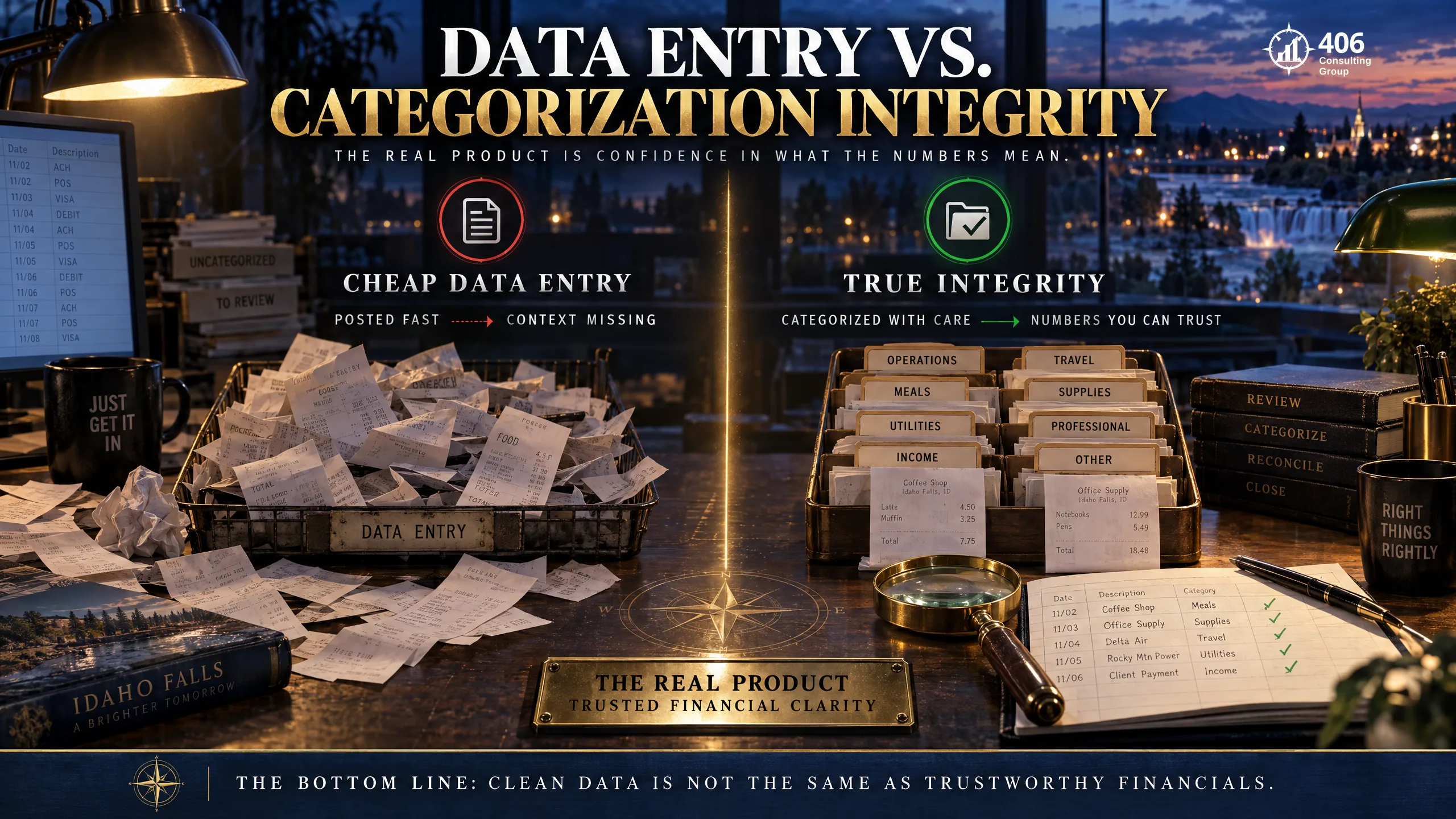
The kind of owner who refuses to fly blind does not shop for the cheapest typing. They buy the judgment. Now let us look at exactly how that judgment goes wrong when nobody is watching.
How Quiet Misclassification Happens
Misclassification is almost never dramatic. It is a transactional bookkeeper, working fast and cheap, making a defensible-looking guess on a transaction they do not fully understand — and then never flagging it, because to them it looked fine. Do that a few hundred times a year and the books drift away from reality one quiet entry at a time. Here are the ones we see most in eastern Idaho:
A loan booked as revenue
An equipment loan or line-of-credit draw hits the bank account and gets coded as income. Now the business looks far more profitable than it is — and owes tax on money it borrowed.
Owner draws hidden in payroll or expenses
An owner's distribution gets dropped into wages or a random expense account. The profit picture warps, and reasonable-salary and tax positions get built on a lie.
Job costs smeared into overhead
Materials and subcontractor costs for a specific project land in a general expense bucket instead of against the job. The P&L balances; you just can't tell which jobs made money.
Customer deposits counted as earned revenue
A deposit on next season's work shows up as revenue today. The month looks great, then collapses when the real work — and its costs — arrive later.
Personal and business run together
A fuel card or a truck payment that's half personal gets expensed in full. Tidy, consistent, and exactly the kind of thing that unravels in an audit.
Every one of these produces a report that balances. Balancing is not the same as being right — and a bookkeeper who only checks that the columns tie will never catch a single one.
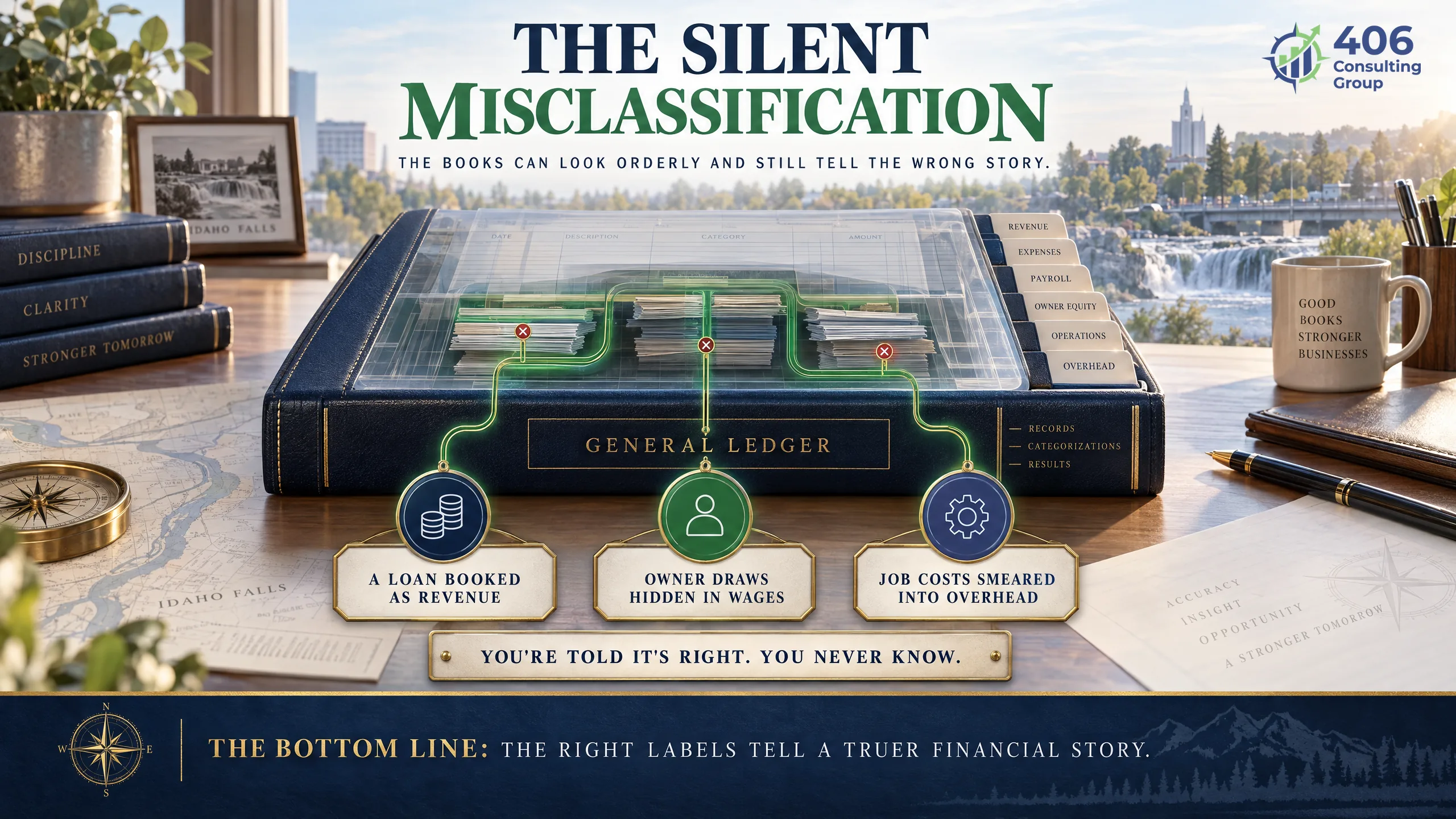
These errors do the most damage in a business whose income does not arrive evenly — which, in Idaho Falls, is most of them.
Cash vs. Accrual for a Seasonal Business
Idaho Falls runs on seasons. Potato and barley harvest cycles pack costs and revenue into lopsided windows. A Teton-gateway outfitter or a tourism operator banks much of the year between Memorial Day and the first snow. A construction crew riding the boomtown growth bills heavy in summer and thin in winter. On a pure cash basis— income when the money lands, expense when you pay — those businesses look wildly profitable some months and broke in others, and neither picture is true.
Accrualfixes that by matching revenue to the period it was earned and costs to the work they belong to. Say an Ucon seed-potato grower sells in October but incurred the planting, water, and labor costs across the whole prior season. Cash books show a catastrophic spring and a euphoric fall. Accrual books spread the truth across the year, so the owner can actually see the margin on the crop — and so can a lender. You can keep filing taxes on the cash method if you qualify while running the business on accrual management books; that is a legitimate, common setup, and it is often the right one here.
Cash basis
- •Simple — tracks the bank account
- •Wild swings for a seasonal business
- •Hides the real margin on a crop or a season
- •Fine for many tax returns, if you qualify
Accrual basis
- ✓Matches revenue and cost to the period earned
- ✓Smooths the seasonal picture into the truth
- ✓Shows true profitability per job or crop
- ✓What a lender or bonding company wants to see
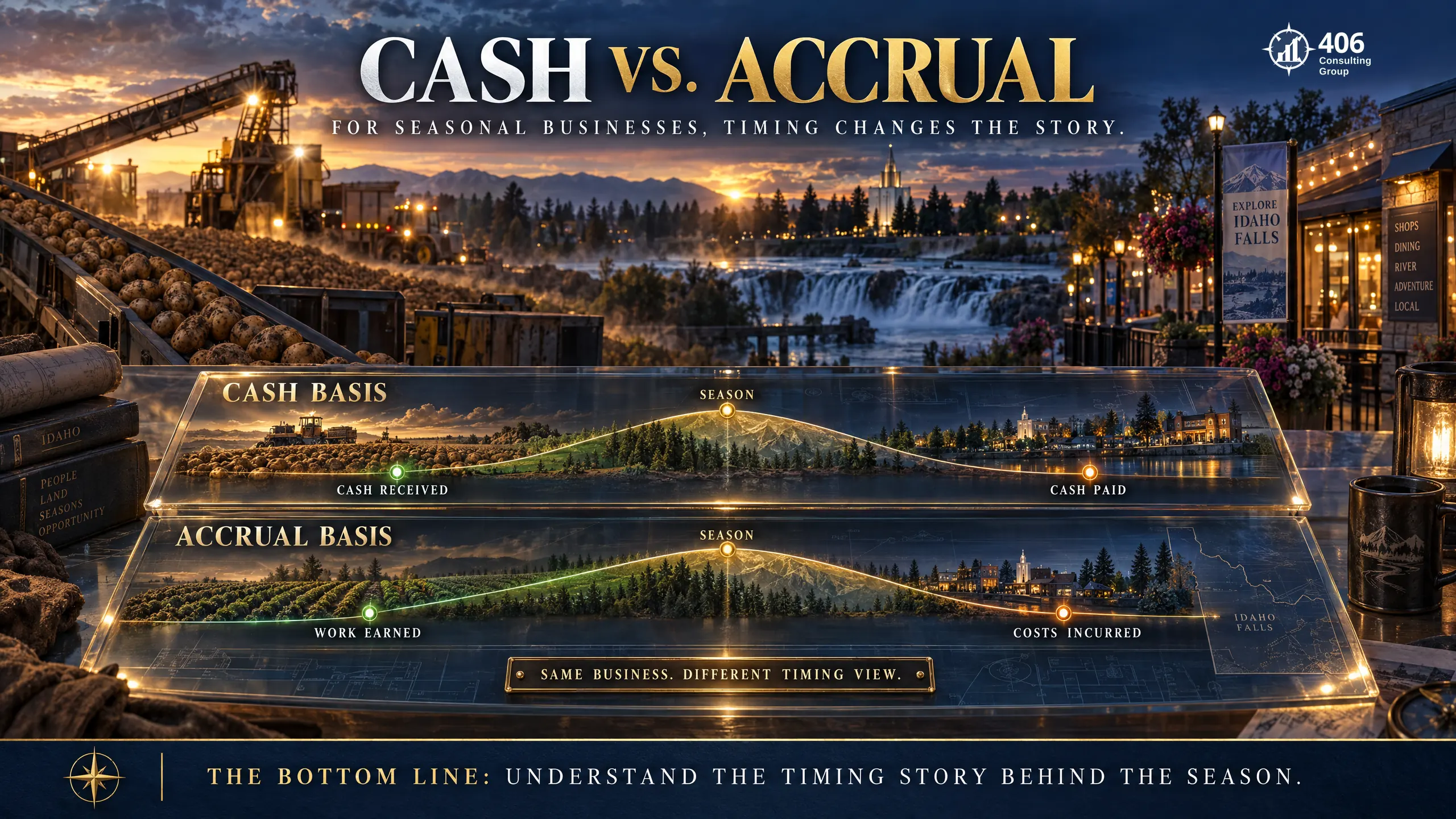
For a deeper walk-through, see our guide to cash vs. accrual accounting. Confirm your tax method with a professional and the IRS. The matching problem gets sharper still when one business is running several projects at once.
Job Costing for INL Subcontractors
Idaho National Laboratory anchors a deep ecosystem of federal and R&D contractors, engineering firms, and specialty subcontractors around Idaho Falls — roughly two spinoff jobs for every INL job. Many of those shops run multiple entities, multiple projects, and layered cost structures, often with the kind of indirect-cost and overhead-rate rigor that government-adjacent work demands. This is where sloppy categorization stops being a nuisance and becomes a threat to the whole business.
Say a Bonneville County engineering subcontractor runs four projects through one set of books. A cheap bookkeeper dumps every material invoice, every subcontractor payment, and every hour of labor into general accounts. The P&L still balances — but the owner cannot tell you which of the four jobs made money and which one quietly bled all year. When labor and materials are not tied to the job that consumed them, and when shared overhead is not allocated on a defensible rate, you are flying blind on the exact number that decides whether you bid the next contract and at what price.
What clean job costing makes visible
- 1.True gross margin on each project — not a blended company average that hides the losers
- 2.Direct labor and materials tied to the job that actually consumed them
- 3.Indirect costs and overhead allocated on a rate you can defend
- 4.Which entity, project, and contract type actually earns its keep
- 5.A clean cost history to price and win the next INL-area bid
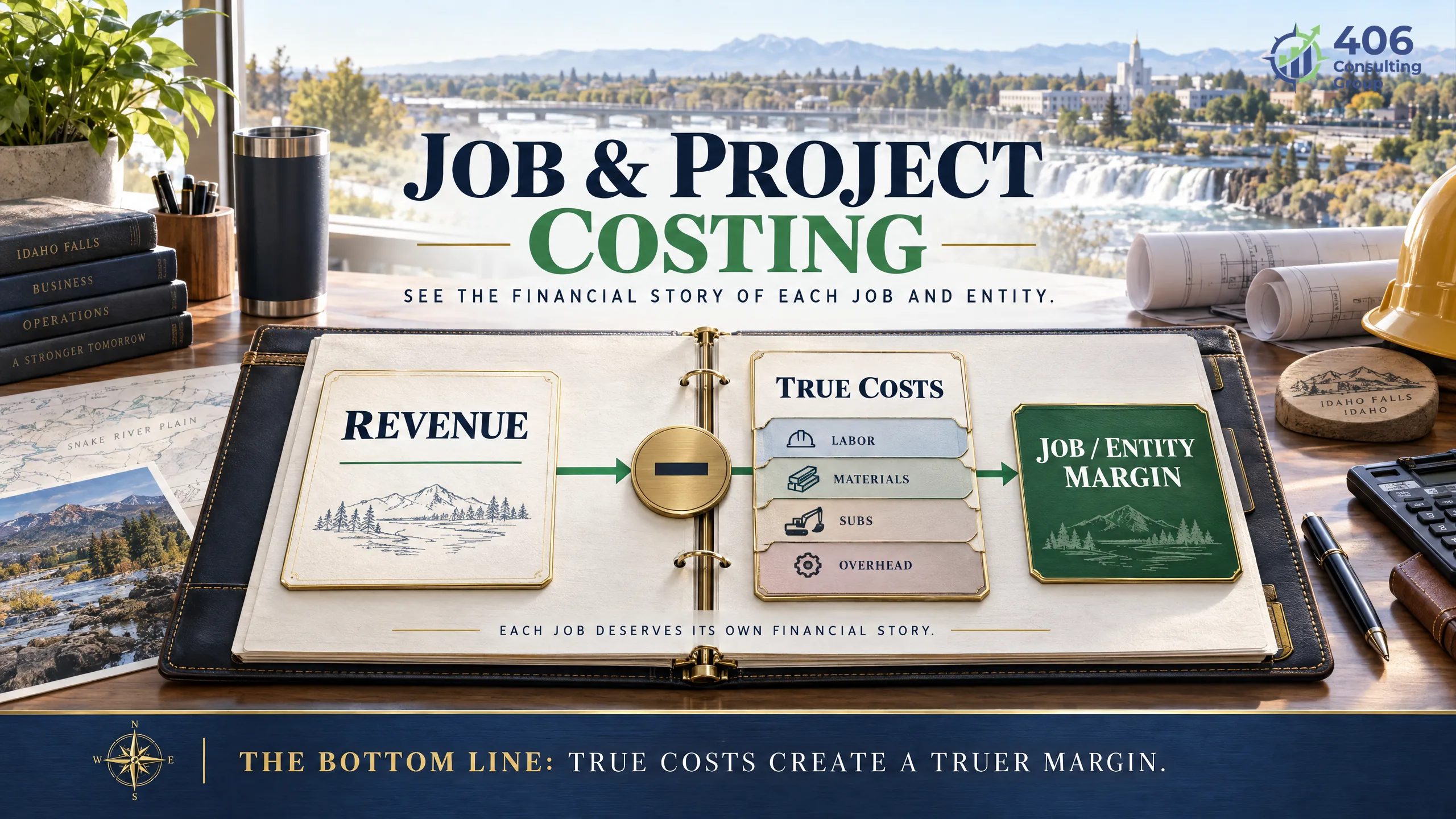
This is where our background shows: Jason spent years in big-firm accounting and job-costing systems, and we design the chart of accounts and cost structure from a whole-company view — not just an accounting lens — so the numbers answer the questions an owner actually has. See how we approach it for general contractors. None of it works, though, without the one discipline most cheap bookkeepers skip entirely.
The Monthly Close That Actually Closes
Ask a cheap bookkeeper when the month is "closed" and you will often get a blank look. For them, the books are never really done — transactions keep getting backdated, categories keep shifting, and last quarter's numbers quietly change under you. That is not a close. That is a permanent scramble. A real monthly close is a system: a repeatable process that runs the same way every month, finishes on a schedule, and locks the period so the numbers stop moving and you can trust them.
It is the same discipline that separates a shop that runs on process from one that runs on heroics. Every account reconciled to a real statement. Every anomaly investigated, not guessed at. A review step where a second set of eyes asks whether each number makes sense — the step where misclassification gets caught before it ever reaches a report. Then the period closes, on a date you can count on.
A close that is a system, not a scramble
The process
When the close is a system, the books are not a mystery you hope is right — they are an asset you can hand to anyone. Which brings us to the person most likely to read them hardest.
What a Lender Sees in Your Books
I spent years as a commercial banker and underwriter, and I read more than 300 loan files before I ever built a set of books. So I can tell you exactly what happens when unreliable books hit an underwriter's desk: confidence collapses. A lender is not grading how much money you make — they are grading whether they can believe the numbers in front of them. Revenue that appears without matching cost, an owner draw buried in wages, a loan booked as income, categories that shift from month to month: each one is a red flag, and together they tell the underwriter the story might be fiction.
And here is the quiet penalty — a cautious underwriter does not always decline. Sometimes they just price the uncertainty in: a lower limit, a higher rate, more collateral, a personal guarantee you did not want to sign. You never see the better terms you would have gotten with clean, accrual, reconciled books, because they were never on the table. The cheap bookkeeper cost you on the loan, and you will likely never know the number.
An underwriter is not asking "is this a good business?" first. They are asking "can I trust these numbers?" If the answer is no, the quality of the business never gets a fair hearing.

Building books that survive that read is the whole point — it is the difference between a loan file and a loan. See our lender-ready books checklist for the full standard. A handful of Idaho-specific facts also have to be exactly right.
The Idaho Facts Your Books Must Get Right
Bookkeeping is where tax strategy either works or quietly breaks, because the strategy is only as good as the records behind it. You do not have to be a tax expert to run a business — that is our job — but your books have to capture these Idaho realities cleanly so nothing is lost when the return is filed:
5.3% flat income tax
Idaho taxes individual and corporate income at a single flat 5.3% (2025 law carrying into 2026). Payroll withholding matches — so your wage and distribution coding has to be clean.
6% sales tax, no local add-on
Idaho Falls has no local-option sales tax (that's resort-city only), so it's a clean flat 6% — far simpler to track than a home-rule state, but still has to be collected and remitted correctly.
The ABE election
S-corps and partnerships can elect to pay Idaho tax at the entity level (an Affected Business Entity election), which can sidestep the federal SALT cap — but only if your books cleanly separate the entity-level payment.
Salary vs. distribution
An S-corp splits owner pay between payroll (taxed) and distribution (no self-employment tax). If draws are miscategorized, the whole reasonable-salary position is built on sand.
We go deep on all of this in our companion Idaho Falls tax guide, and you can run your own numbers with the S-corp calculator and the LLC vs. S-corp tool. Confirm current rates and the ABE rules with the Idaho State Tax Commission.

All of which raises the obvious question for an Idaho Falls owner: does the bookkeeper have to be down the street?
Remote Beats an Okay Local Shop
There is a comfortable instinct to hire the bookkeeper in the strip mall off Yellowstone Avenue because they are close. But proximity does not reconcile an account or catch a misclassified job cost — judgment does. A great remote team beats an okay local one in every way that affects your books, and the gap is not close. The work already lives in secure cloud accounting that you can see any time; you are not driving a shoebox of receipts across town.
Secure & always visible
Cloud books you can open from your phone in a potato shed or a job trailer — not a filing cabinet across town.
Faster response
A question answered same-day by the team that knows your file — not whenever the one local bookkeeper gets back from lunch.
Specialists, not a generalist
Job costing, payroll, tax coordination, and a reviewer — a whole team, not one person doing everything down the street.
About 80% of even our own local clients never set foot in an office, and the relationship feels closer than a down-the-street shop, not more distant — because the work is more visible and the response is faster. We have run and operated real businesses ourselves, in the oilfield and beyond; we are reading your books the way an owner does, not just typing them.

We serve Idaho Falls and the communities around it the same way — closely, and remotely.
Idaho Falls & the Communities We Serve
A bookkeeper for Idaho Falls should know it as more than a dot on a map — the ag operations out on the Snake River Plain, the INL-area contractors and engineering shops, the Melaleuca-and-EIRMC service economy, and the tourism businesses riding the gateway to Yellowstone and Grand Teton. We build clean, correctly categorized, lender-ready books for small businesses across Idaho Falls, Ammon, Iona, Ucon, Shelley, Rigby, Rexburg, Blackfoot, Bonneville County, and Bingham County— and, remotely, across the rest of Idaho and the Mountain West.
Stop hoping your books are right. Know they are.
We build clean, correctly categorized, accrual-ready books with a monthly close that actually closes — for Idaho Falls businesses, ag operations, and INL-area contractors, delivered remotely. Start with a conversation before the next loan, tax bill, or decision forces the issue.
FAQ: Idaho Falls Bookkeeping Questions
How much do bookkeeping services cost in Idaho Falls?
It depends on the volume and complexity of the work — transaction count, number of accounts and entities, whether you need job costing, and whether payroll and sales tax are in scope. But the more useful way to think about price is what you are actually buying. A rock-bottom monthly fee usually buys data entry: transactions typed in and reports that balance. What protects an Idaho Falls business is categorization integrity — the judgment that every dollar is in the right place — plus a real monthly close. The cheapest option is often the most expensive once you count the tax you overpaid, the loan terms you lost, or the decision you got wrong because the numbers were quietly off. We scope a fixed monthly fee to what your business actually needs.
What's the difference between a cheap bookkeeper and a good one?
Both can type transactions into accounting software and produce reports that balance. The difference is judgment. A transactional bookkeeper categorizes fast and cheap and never flags what they are unsure about, so misclassifications — a loan booked as revenue, an owner draw hidden in wages, job costs smeared into overhead — pile up silently and the books drift from reality. A good bookkeeper treats categorization as the real product, reconciles every account to a real statement, reviews whether each number makes sense, and closes the month on a schedule so the numbers stop moving and you can trust them. You usually cannot see the difference in the reports — both balance — until a loan, a tax bill, or a decision forces someone to read them closely.
Should my seasonal Idaho Falls business use cash or accrual bookkeeping?
For a seasonal business — a potato or barley operation on harvest cycles, a Yellowstone- or Teton-gateway tourism outfit, a construction crew that bills heavy in summer — accrual management books usually tell the truth that cash books hide. Cash basis records income when the money lands and expense when you pay, so a seasonal business looks euphoric some months and broke in others, and neither is real. Accrual matches revenue and cost to the period they were earned, so you can see the true margin on a crop, a season, or a job — and so can a lender. Many businesses legitimately run accrual management books while still filing taxes on the cash method if they qualify. Confirm your tax method with a professional and the IRS.
Why does job costing matter for INL-area contractors and subcontractors?
The INL ecosystem is full of contractors, engineering firms, and specialty subcontractors running multiple entities and projects at once, often with indirect-cost and overhead-rate expectations from government-adjacent work. If labor, materials, and subcontractor costs are not tied to the specific job that consumed them, and shared overhead is not allocated on a defensible rate, the P&L still balances — but the owner cannot tell which projects made money and which quietly lost it all year. That is the exact number that decides whether and at what price you bid the next contract. Clean job costing turns a blended company average into true per-project margin.
Can 406 Consulting Group do my bookkeeping remotely from outside Idaho Falls?
Yes — remote is how we work, and for your books it is an advantage, not a compromise. The work lives in secure cloud accounting you can open any time, questions get answered same-day by the team that knows your file, and you get specialists — job costing, payroll, tax coordination, and a reviewer — instead of one generalist down the street doing everything. About 80% of even our own local clients never come into an office, and the relationship feels closer, not more distant, because the books are more visible and the response is faster.
Does 406 Consulting Group provide bookkeeping services in Idaho Falls, ID?
Yes. We provide remote bookkeeping for small businesses, ag operations, and INL-area contractors across Idaho Falls, Ammon, Iona, Ucon, Shelley, Rigby, Rexburg, Blackfoot, Bonneville County, and Bingham County — and across the rest of Idaho. We build clean, correctly categorized, accrual-ready books with a monthly close that actually closes, designed from a whole-company view and delivered remotely. Founders Jason Anderson (big-firm accounting, job-costing and systems) and Carrie Anderson (commercial banking and underwriting) read your books the way an owner and a lender do, not just the way a data-entry service does.
What You Actually Get
Integrity, not just data entry
Books You Can Trust
Idaho Falls & all of Idaho.
About the Author
Carrie Anderson
Co-Founder, 406 Consulting Group
Commercial banker and underwriter who reviewed 300+ loan files before building books on the other side of the desk. Carrie knows exactly what unreliable books do to a loan — and builds the kind that survive the read. Delivered remotely.
Read the Full StoryMore for Idaho Falls