
Tax Planning in Idaho Falls, ID:
The Flat-Rate Levers Most Owners Miss
Idaho's flat 5.3% income tax means every deduction cuts a known bite — and the biggest lever most Idaho Falls S-corps and partnerships leave on the table is the ABE election. We plan the ABE election, the S-corp split, and equipment timing year-round, remotely across Idaho.

Here is the moment that costs Idaho Falls owners the most money, and almost none of them see it happen: the day their return gets filed with the Idaho tax paid the ordinary way — on the owner's personal return, stacked under a federal SALT cap where most of it is simply wasted. There is a legal switch that moves that tax to the business, makes it fully deductible on the federal return, and sidesteps the cap entirely. It is called the Affected Business Entity (ABE) election, and most local filers never even mention it.
That is the theme of this guide. Idaho runs a flat 5.3% income tax — the same rate for individuals and corporations — which means every planning move here has a clean, predictable payoff: a deduction cuts your federal bill and shaves a known 5.3% off the state bill too. No brackets to guess at, no local-option surprises. What separates owners who keep their money from owners who hand it back every April is not luck or a lower rate. It is whether someone is working the levers — the ABE election, the S-corp split, equipment timing — during the year, while the doors are still open.
We'll start with the big one — ABE, and a new Idaho law that makes it easier to claim starting July 1, 2026 — then walk the rest of the levers for an Idaho Falls business: S-corp reasonable-salary math, equipment depreciation for the ag processor and the contractor, and why Idaho's clean 6% sales tax is a quiet advantage. If your books aren't current yet, start with our Idaho Falls bookkeeping guide — planning runs on real numbers.
By Jason Anderson — Co-Founder, 406 Consulting Group. Big-firm tax background plus Six Sigma process work, advising S-corps, partnerships, ag processors, and federal subcontractors across Idaho on entity strategy, the ABE election, and equipment timing.
Quick Answer: Tax Planning for an Idaho Falls Business
- →The ABE election is the biggest miss: S-corps and partnerships can pay Idaho's tax at the entity level, deduct it federally, and skip the $40,000 SALT cap.
- →A flat 5.3% makes planning clean: every deduction cuts a known bite — federal plus a flat 5.3% state.
- →New law, July 1, 2026: you can make the ABE election on any original return, regardless of when you file.
- →S-corp & equipment stack on top: reasonable-salary splits cut self-employment tax; Section 179 cuts both bills at once.
- →Idaho Falls has no local-option sales tax — a clean flat 6%, not the home-rule maze of other states.
Table of Contents
The ABE Election Most Idaho Falls Owners Leave on the Table
Say an Ammon engineering firm — one of the many INL spinoffs doing specialty subcontract work — is an S-corp that nets $400,000 split between two owner-engineers. Idaho's flat 5.3% on that income is roughly $21,000 of state tax. Filed the ordinary way, that $21,000 lands on the owners' personal returns as a state-tax deduction — where it collides with the federal SALT cap. Even after the cap jumped to $40,000 post-OBBBA, add their property taxes and most of that $21,000 is crowded out and simply lost on the federal side. They paid the state. They got little or no federal credit for paying it.
The ABE election fixes this. Idaho lets S-corps and partnerships elect to pay the Idaho income tax at the entity level — the business writes the check at the same 5.3% rate. Because a state tax paid by the business is an ordinary business expense, it is fully deductible on the federal return, with no SALT cap in the way. The owners then get a credit on their Idaho returns for their share of what the entity paid, and any unused credit is refunded. Same Idaho tax, but now the federal deduction actually counts.
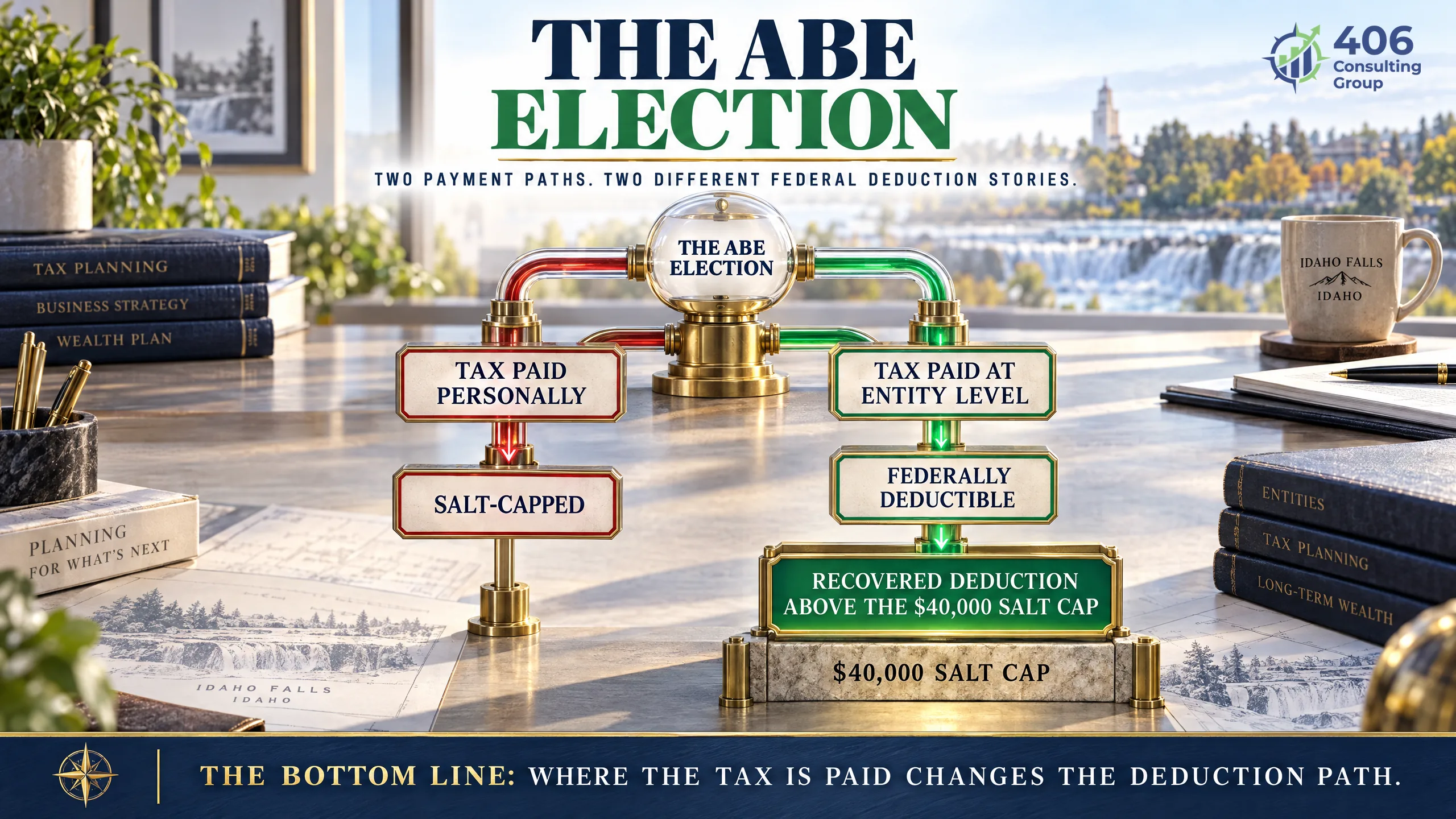
Without ABE
~$0
federal benefit from the ~$21,000 of Idaho tax — crowded out above the $40,000 SALT cap.
With ABE
~$6,700
federal tax saved — the full $21,000 deducted at a ~32% bracket. Same state tax, real federal benefit.
"The fee was never the cost. The cost is a $6,700 deduction you were legally entitled to, paid for by the tax you already sent Idaho, and never claimed — year after year, because nobody at the filing desk brought it up."
Why a Flat 5.3% Changes How You Plan
Idaho moved to a single flat income-tax rate in 2023, and 2025's HB 40 set it at 5.3% for 2025, carrying into 2026 — the same rate for individuals and corporations, with payroll withholding matched to it. For planning, a flat rate is a gift: there are no brackets to game and no guessing where the next dollar lands. Every dollar of deduction you create saves exactly 5.3% at the state level, every time.
That predictability is why planning matters morein Idaho than people assume. A deduction here works twice — it lowers your federal income tax, and because Idaho's tax starts from your federal taxable income, it shaves a clean 5.3% off the state bill too. In a no-income-tax state, the same move only touches the federal return. So the question for an Idaho Falls owner isn't "what's my rate" — it's known. The question is how many levers are actually being pulled before December 31.
| Tax | How it works in Idaho | Your lever |
|---|---|---|
| Federal income tax | IRS, on your profit (the big one) | ABE, S-corp, equipment, retirement |
| Idaho income tax | Flat 5.3% (2025 HB 40), individual & corporate | Every federal deduction cuts this too; ABE moves it to the entity |
| Sales & use tax | 6% state, no local-option in Idaho Falls | Clean compliance — track, remit, watch use tax |
| Self-employment / payroll | 15.3% federal SE tax; ID withholding at 5.3% | The S-corp salary/distribution split |
Not sure whether you're even structured to use these levers? Our business-entities guide lays out how LLCs, S-corps, and partnerships are taxed before you commit.
The July 1, 2026 Rule Change You Can Actually Use
Historically the catch with entity-level elections was timing — miss the window and you lost the benefit for the whole year, even if the math was obvious. Idaho just removed most of that risk. Under a new law effective July 1, 2026, an S-corp or partnership may make the ABE election on any original return, regardless of when you file it— and may amend before the original due date to change the choice. The election stops being a landmine you have to tiptoe around and becomes a decision you make with the full year's numbers in front of you.
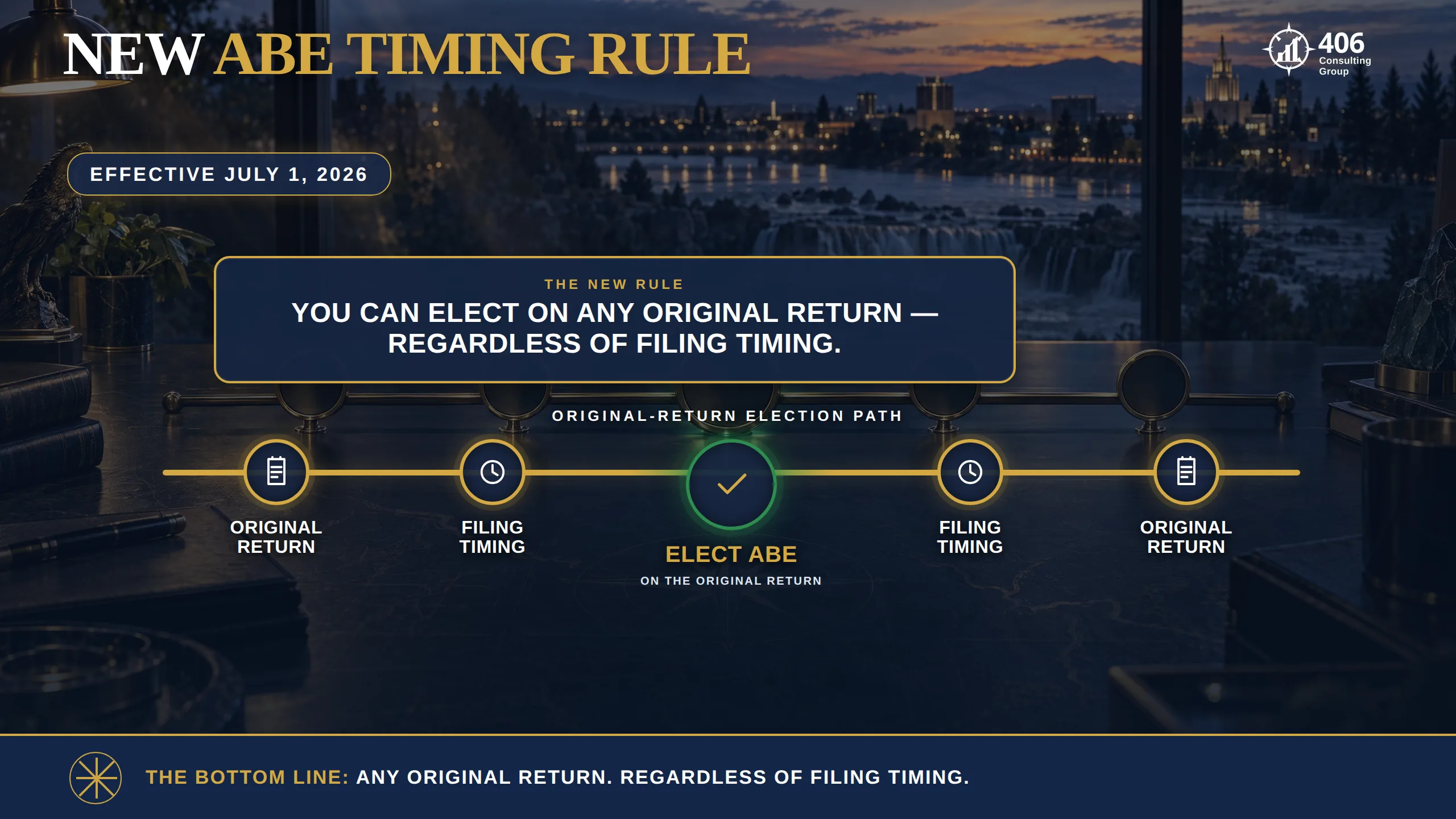
Why this matters now
This is exactly the kind of change that never reaches the owner who only talks to their preparer in April. The savings are real and the election is now flexible — but flexible only helps if someone is tracking Idaho law and running the entity-vs-personal comparison for you each year. That is the difference between a firm that files and a firm that plans. Confirm the mechanics for your entity and year with a planner before relying on them.
For the official rate, forms, and the pass-through election rules, the Idaho State Tax Commission is the authority. Our job is to decide whether and how to use them.
The S-Corp Reasonable-Salary Math
The S-corp election is the lever that pairs with ABE, and it attacks a different tax. As a sole proprietor or standard LLC, every dollar of profit gets hit with 15.3% self-employment tax up to the Social Security wage base (2.9% above it). Elect S-corp status and you split profit into a reasonable salary (which owes the 15.3%) and distributions(which don't).
Picture a Rexburg owner netting $150,000. Pay a reasonable $75,000 salary and take $75,000 as a distribution, and that distribution sidesteps the 15.3% — on the order of $11,000 saved a year in federal self-employment tax. Note this is a federal play: the full profit still owes income tax (federal and the flat 5.3% Idaho) either way, so the S-corp stacks with ABE and the deduction levers rather than replacing them.
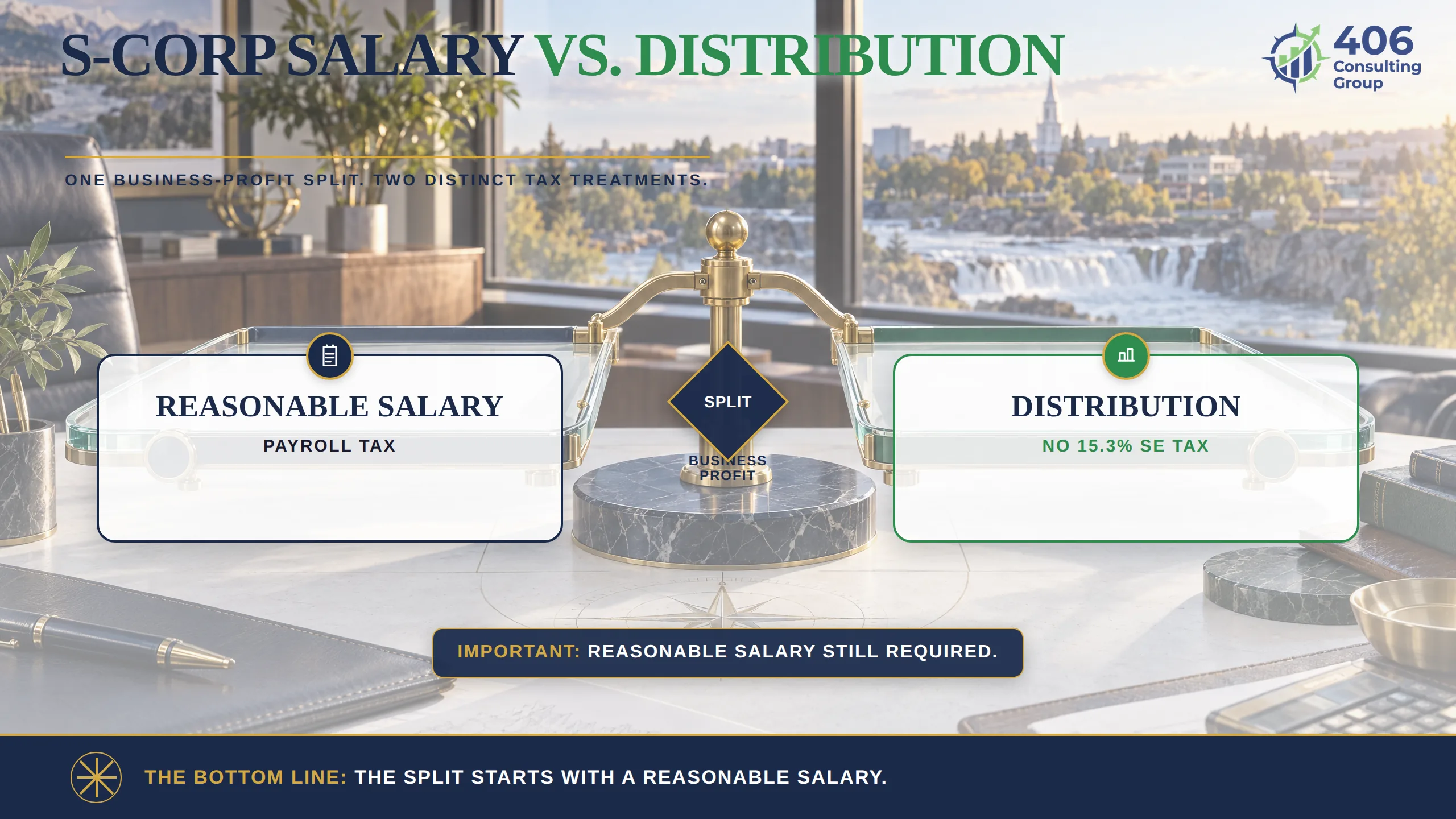
The catch most people miss
The S-corp only wins if the salary is genuinely "reasonable" — the IRS expects it to reflect what the work is worth, and lowballing it is exactly what they audit. It adds payroll and a separate return, so it typically pays off around consistent profit of $50,000–$80,000+ over a fair salary. Getting the salary right is where a planner earns the fee. Estimate your own on our S-Corp calculator, and compare staying an LLC with our LLC vs. S-Corp tool.
Equipment Timing: The Double-Dip Deduction
For the Snake River Plain economy — potato sheds, barley and dairy operations, the specialty contractors feeding the Idaho Falls construction boom — equipment is the single biggest tax lever there is. The code often lets you deduct most or all of a purchase in the year you place it in service instead of over many years. And because Idaho taxes income and generally conforms to the federal depreciation figures, that deduction cuts both bills at once: federal, plus a clean 5.3% off Idaho.
Section 179 lets you write off qualifying equipment — grading and sorting lines, trucks and trailers, tooling, certain software — up to a generous annual limit (well over $1 million). Bonus depreciation can cover much of the rest. Say a Shelley potato-shed operator places a $300,000 sorting line in service before year-end: that can be a very large deduction landing in one year, against both tax bills. The planning move is timing — pull a purchase you were going to make anyway into a high-income year and the deduction is worth the most.
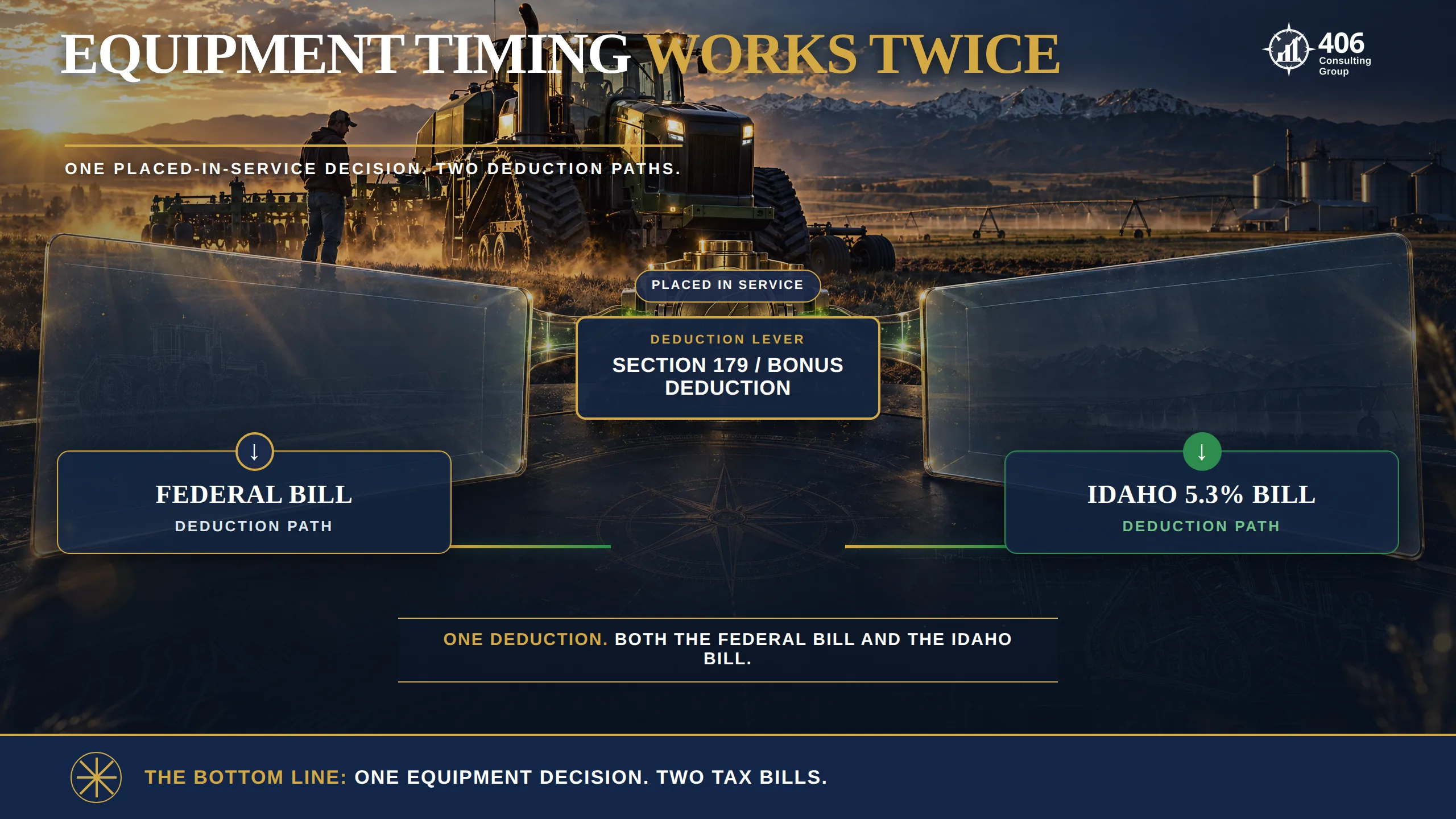
Two things owners get wrong
First, a deduction is not a discount — you still spent the cash, so buy equipment you actually need, then time it; don't buy to "save on taxes." Second, the equipment itself generally owes Idaho sales or use tax (6%), so factor that into the real cost — some production equipment and inputs may qualify for an exemption worth confirming. Federal limits and Idaho's conformity shift year to year, so verify the current figures before you buy. Contractors should pair this with our general-contractor industry guide.
A Clean 6% vs. Home-Rule Chaos Elsewhere
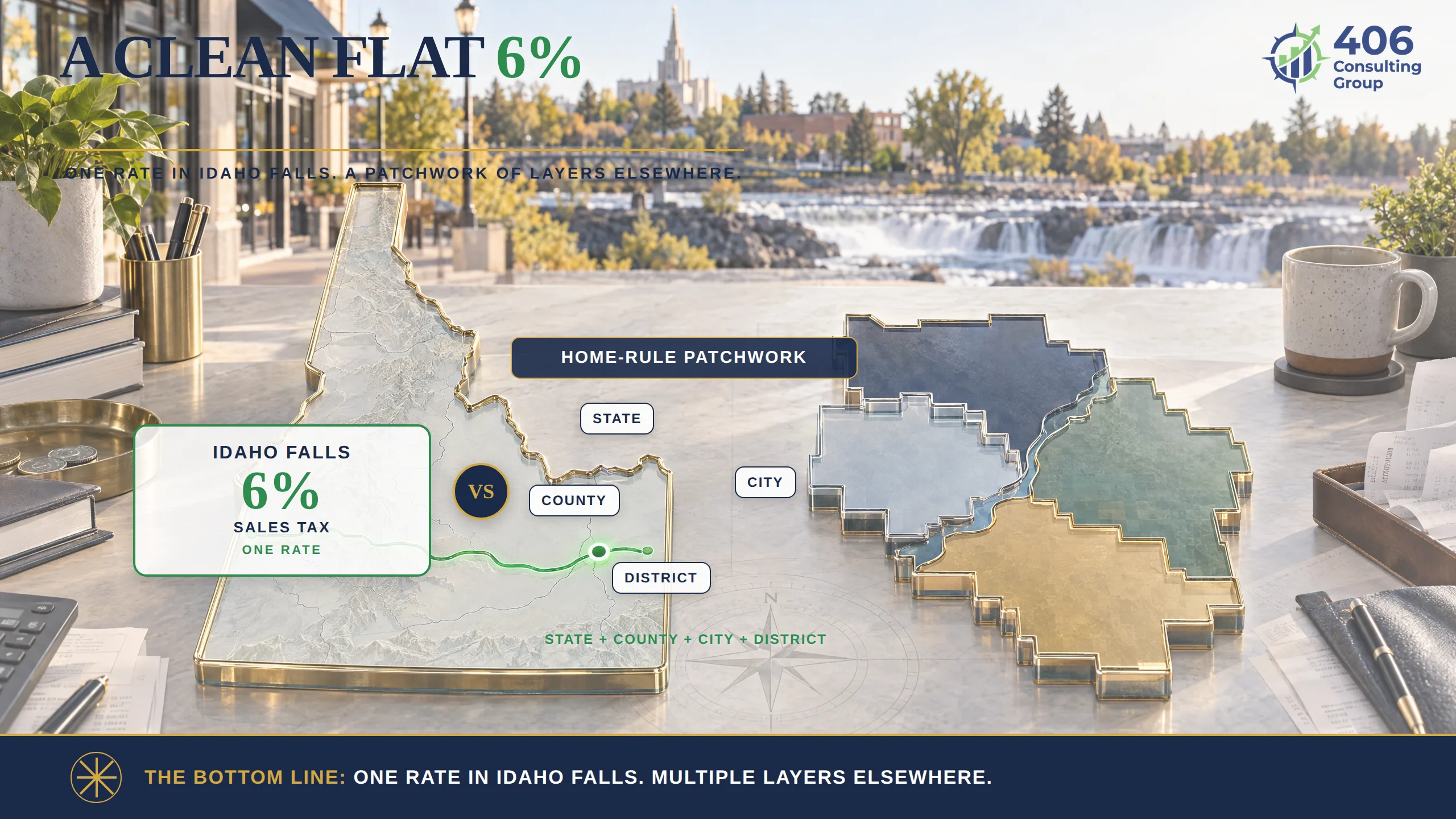
Here is an advantage Idaho Falls owners rarely appreciate until they see what the alternative looks like. Idaho's sales tax is a flat 6% statewide, and Idaho Falls has no local-option sales tax — local-option authority in Idaho is limited to certain resort cities like Sun Valley and McCall. So a Bonneville County business deals with one rate, one filing, one set of rules.
Contrast that with a home-rule state like Colorado, where a single sale can involve the state, the county, a city that administers its own tax, and a special district — dozens of overlapping jurisdictions, each with its own rate, base, and return. Businesses there burn real hours and real penalty exposure just figuring out what they owe and to whom. In Idaho Falls, that whole category of risk mostly disappears. Your sales-tax job is clean compliance: collect the 6% on taxable sales, hold it as a liability, and watch use tax on the out-of-state machine or tooling you just deducted — that liability is the one people miss.
We cover the Idaho seller's permit, use tax, and remittance in detail in the Idaho Falls bookkeeping guide. Contractors have a twist — in Idaho the contractor is the consumer of materials and pays tax at purchase rather than billing it — which we break down in the Idaho Falls trades & construction guide.
Year-Round Planning vs. Once-a-Year Filing
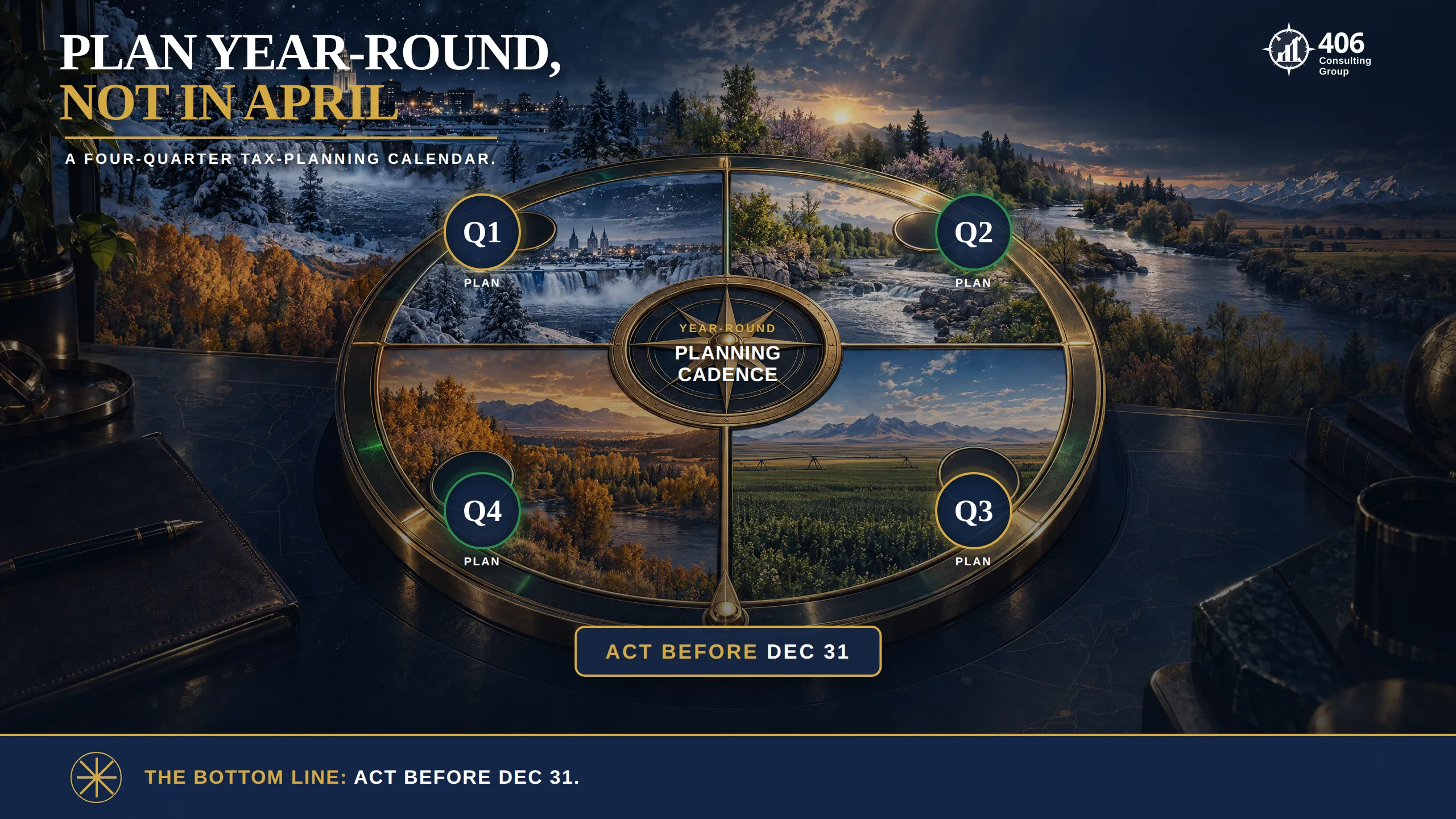
Step back and look at what every lever in this guide has in common: they are all decided before the year closes. Tax preparation records what already happened and files it. Tax planning changes what happens so there is less to owe. By April, the ABE window logic, the S-corp salary, the equipment in service, the retirement funding — every door is shut.
That is why paying only for a once-a-year filing is the quietly absurd choice. Think about the asymmetry: an Idaho Falls S-corp skips the ABE election and a mid-year projection to save maybe a few hundred dollars a month on a cheaper preparer — and in doing so leaves a $6,700 federal deduction and thousands in self-employment tax on the table. You spent a 7-figure career building the business; the planning that protects its profit should not be the line item you shop on price.
Reactive filing (April only)
- • Records what already happened
- • ABE never mentioned
- • Salary split missed or set wrong
- • Equipment timed by accident
- • You find out the bill in April
Proactive planning (year-round)
- • Mid-year projection of both bills
- • ABE election run and claimed
- • Reasonable salary set on purpose
- • Equipment placed in the right year
- • April is just paperwork
Estimates, Deadlines & Setting the Bill Aside
If you're self-employed or own a pass-through, you pay federal tax as you go through quarterly estimates — generally due April 15, June 15, September 15, and January 15. The safe-harbor rule protects you: pay in at least 100% of last year's tax (110% if higher-income) or 90% of this year's, and you avoid federal underpayment penalties. Idaho is lighter — it doesn't force a federal-style quarterly-estimate regime on most individuals and pass-through owners; instead, interest accrues on Idaho tax left unpaid after the April deadline. So the Idaho move is simpler: set the flat 5.3% aside as you earn so it's funded by filing.
One wrinkle the ABE election adds: when the entitypays the Idaho tax, the cash and the estimate planning shift to the business, not the owner's personal account — another reason the election and your cash plan get decided together, not in isolation. C-corporations and certain electing pass-throughs do have Idaho estimate requirements, and a planner will flag if that's you.
Keep the full federal and Idaho calendar in front of you with our tax-deadlines resource, and pair the set-asides with cash planning so a good year doesn't strand you at filing time.
A Remote, Idaho-Savvy Team Beats a Local Filer
What matters in a tax relationship is whether your accountant works your numbers all year and actually knows Idaho's mechanics — the ABE election, the flat-rate math, the conformity details on equipment — not whether their office is on a particular street in Idaho Falls. A proactive remote firm that brings a big-firm tax playbook beats an okay local preparer who only files in April and has never raised ABE with you.
And honestly, remote is how this work already happens — even for clients down the road. Roughly 70–80% of our own local clients never come into the office. The planning conversations — do we elect ABE this year, is the salary reasonable, do we place the sorting line in service now, are we covered on estimates — all happen over a secure cloud screen share with live numbers, often with a faster response than a walk-in shop can manage. Distance simply isn't the variable it used to be, so an Idaho Falls business gets the same proactive, Idaho-savvy planning our in-town clients do.
And because our background is in running whole businesses — not just booking them — we look at how a tax move lands on operations, equipment, payroll, and cash, not just the line on the return. That cross-departmental lens is the difference between a tax plan that saves money on paper and one that actually fits the company. See how we think about it in our tax planning and fractional CFO services.
How to Get Started
Getting off the once-a-year treadmill is three steps.
Get your books current
The ABE math, the salary split, and the equipment timing all run on real numbers. If your books are behind, that's step one.
Run a mid-year projection
Before year-end, estimate where you'll land federally and at Idaho's flat 5.3%, then decide on ABE, the salary, equipment, and retirement.
Act before December 31
Make the elections, place the equipment in service, fund the accounts, set the estimates — so April is just paperwork.
Not sure which layer you need first — cleaner books, or proactive tax planning? Our Financial Maturity Assessment maps it out in about two minutes.
FAQ: Idaho Falls Business Tax Questions
What is the ABE election, and why do most Idaho Falls owners miss it?
The Affected Business Entity (ABE) election lets an Idaho S-corp or partnership pay Idaho's income tax at the entity level (the flat 5.3% rate) instead of passing it to owners' personal returns. Because a state tax paid by the business is deductible on the federal return with no SALT cap in the way, it recovers a federal deduction that would otherwise be crowded out above the $40,000 cap. Owners get an Idaho credit for their share, and unused credit is refunded. Most owners miss it because a once-a-year preparer never raises it — which is the whole reason it belongs in a year-round planning conversation.
What changed about the ABE election on July 1, 2026?
Under a new Idaho law effective July 1, 2026, an S-corp or partnership can make the ABE election on any original return, regardless of when it files, and can amend before the original due date to change the choice. That removes most of the old timing risk, so the election can be decided with the full year's numbers in hand rather than locked in early. Confirm the current mechanics for your entity and tax year with a planner or the Idaho State Tax Commission before relying on them.
Does tax planning matter more in Idaho than in a no-income-tax state?
In one important way, yes. Because Idaho taxes income at a flat 5.3%, the deductions you create — equipment, retirement contributions, timing moves — reduce both your federal bill and your Idaho bill. In a no-income-tax state the same moves only touch the federal return, so a dollar of deduction is worth more in Idaho. A flat rate also makes the math clean: every deduction saves exactly 5.3% at the state level. The ABE election adds a second Idaho-specific reason to plan proactively here.
When should my Idaho Falls business elect S-corp status?
Generally once you're consistently profitable beyond a reasonable salary — often around $50,000 to $80,000+ of net profit over what you'd pay yourself in wages. Below that, the added payroll, separate return, and bookkeeping usually outweigh the self-employment-tax savings. The election only works if you pay a genuinely reasonable salary, which is what the IRS audits. The S-corp cuts federal self-employment tax; it doesn't change your Idaho income tax, so it stacks with the ABE and deduction levers. Run your own numbers with our S-Corp calculator, then confirm with a professional.
Does Idaho Falls have a local sales tax on top of the state 6%?
No. Idaho's sales tax is a flat 6% statewide, and Idaho Falls has no local-option sales tax — local-option authority in Idaho is limited to certain resort cities such as Sun Valley and McCall. That means a Bonneville County business deals with one rate and one set of rules, unlike home-rule states where a single sale can involve the state, a county, a self-administered city, and a special district. Your main watch item is use tax on out-of-state equipment and inputs, which still owes the 6%.
Does 406 Consulting Group provide tax services in Idaho Falls, ID?
Yes. 406 Consulting Group provides proactive federal and Idaho tax planning and preparation — including the ABE election, S-corp strategy, and equipment timing — plus bookkeeping, payroll, and fractional controller and CFO services to businesses in Idaho Falls, Ammon, Rigby, Rexburg, Blackfoot, and across Bonneville and Bingham counties. We plan year-round so a good year isn't handed back in April, and we work remotely through secure cloud accounting — roughly 70 to 80% of our own local clients never come into the office. Because our background is in running whole businesses, we look at how each tax move affects operations, equipment, and cash, not just the return.
Keep Reading
Tax Planning & Preparation — Idaho Falls, ID
Claim the ABE Election. Keep the 5.3%.
406 Consulting Group plans the moves that cut both your federal and your flat 5.3% Idaho bill — the ABE election, entity strategy, equipment timing, and estimates — so a good year isn't handed back at tax time. Proactive, year-round, delivered remotely across Idaho.
Idaho Falls Tax Quick Reference
Idaho Falls, ID — Bonneville County
The Idaho Falls Lever Stack
A flat 5.3% means every move has a known payoff
An S-Corp or Partnership?
The ABE election may be leaving money on the table.
About the Author
Jason Anderson
Co-Founder, 406 Consulting Group
Big-firm tax background plus Six Sigma process work. Jason helps Idaho Falls S-corps, partnerships, ag processors, and federal subcontractors use the levers a once-a-year filer skips — the ABE election, the S-corp salary split, and equipment timing — so a good year stays a good year after both federal and Idaho taxes.
→Read the Full Story