
Accounting for Livingston Tourism & Hospitality:
The Seasonal Business Playbook
Run a restaurant, lodge, guide service, or shop in Livingston and you make your year in a season. Here's the financial playbook every seasonal hospitality business shares — the cash swing, the off-season reserve, lodging tax, payroll, and pricing the peak — from a Montana firm that gets seasonal business.

Run a tourism or hospitality business in Livingston and you already know the truth that shapes everything: you make your year in a season. The Yellowstone gateway fills up, the river runs busy, Main Street hums, and for a few months the money pours in. Then it stops — and the same business has to live on what it banked until the next summer comes around. That single fact changes what your books, your taxes, and your financial decisions all have to do, and it's why a restaurant, a lodge, or a guide service can't be run on the same financial playbook as a year-round shop.
Whether you run a restaurant or bar, a lodge or a portfolio of short-term rentals, an outfitting or guide operation, or a Main Street shop that lives and dies by summer traffic, you share a set of money problems a generic accountant simply isn't built for. The peak-to-off-season cash swing, lodging tax, seasonal payroll and tips, pricing when demand is concentrated, and the reserve that has to carry the winter — get these right and a great season builds a durable business; get them wrong and even a record summer can leave you scrambling by February.
This is the Seasonal Business Playbook — the shared mechanics every Livingston hospitality business needs handled, a segment-by-segment look at what's specific to yours, and how the pieces (clean books, smart taxes, and real financial leadership) fit together. It's the hub of our Livingston work, so we'll point you to the deeper guides as we go.
By Carrie Anderson — Co-Founder, 406 Consulting Group. Commercial banking and underwriting background — 300+ loan reviews — plus advisory work with Montana small businesses. Carrie helps Livingston and Park County hospitality owners get the cash discipline, reporting, and financing readiness a seasonal business runs on.
Quick Answer: What Seasonal Hospitality Accounting Requires
- →You make your year in a season: the whole playbook flows from the peak-to-off-season swing.
- →The off-season reserve is the number that matters most — what the summer has to bank to carry the winter.
- →Lodging tax & seasonal payroll are the compliance traps that catch lodging, STR, and food-and-beverage businesses.
- →Pricing & capacity during peak demand is where a seasonal business wins or leaves money on the table.
- →Books, tax, and CFO work together — and a seasonal-savvy remote partner beats a local generalist.
Table of Contents
Why Seasonal Hospitality Is Financially Different
The short answer: most businesses earn steadily across the year, so a monthly statement tells them how they're doing. A seasonal hospitality business earns its whole year in a few months — so a single month means almost nothing on its own, and the real question is always what the season produced and how far it has to stretch.
That difference cascades into everything. Cash floods in during the peak and trickles the rest of the year, so managing timing matters as much as managing profit. Payroll swings from a big summer crew to a skeleton off-season. Lodging carries its own tax. Demand is concentrated, so pricing and capacity decisions during peak weeks have outsized effects. A generic bookkeeper who treats a Livingston lodge like a year-round retail store produces technically-correct books that are operationally useless — they can't answer the questions a seasonal owner actually loses sleep over.
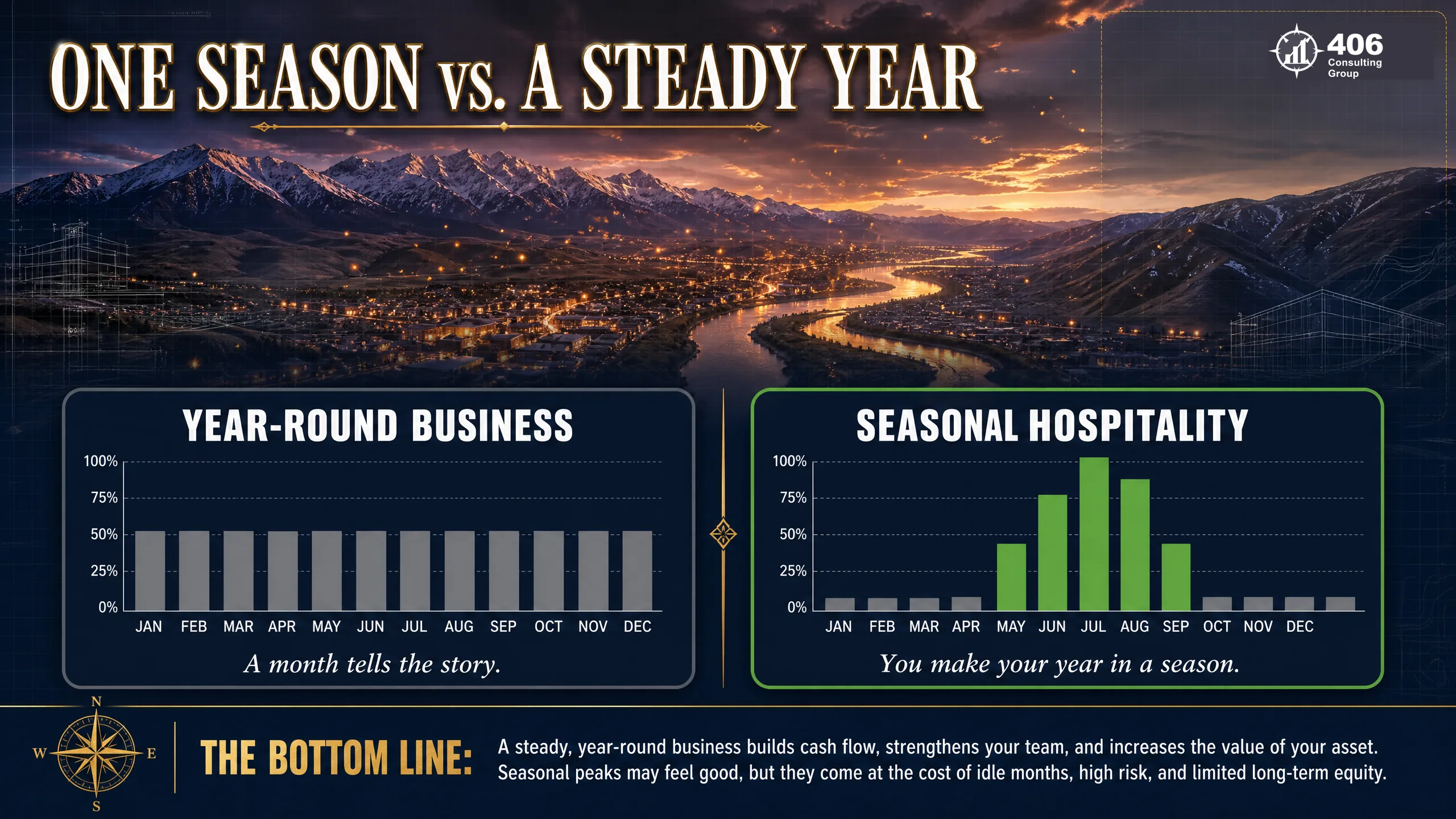
The rest of this playbook is the fix — the disciplines that turn "we had a good summer" into knowing exactly where you stand and what comes next. It builds on clean, season-aware books, so if yours are behind, start with our Livingston bookkeeping guide.
The Season Cycle: Peak to Trough
The short answer: the defining feature of your finances is the swing between peak and off-season, and almost every seasonal-business mistake comes from misreading it — spending the peak like it lasts all year, or getting caught flat in the trough. Understanding the cycle is the foundation everything else stands on.
A Livingston restaurant might do 60% of its annual sales between June and September; a guide operation might do even more. In the peak, revenue and costs both run hot — you're staffed up, buying inventory, running flat out. In the shoulder seasons, things taper. In the deep off-season, revenue can nearly vanish while fixed costs — rent, insurance, a core team, loan payments — keep right on going. The business is the same business in July and February; only the cash is wildly different, and planning for that gap is the whole game.
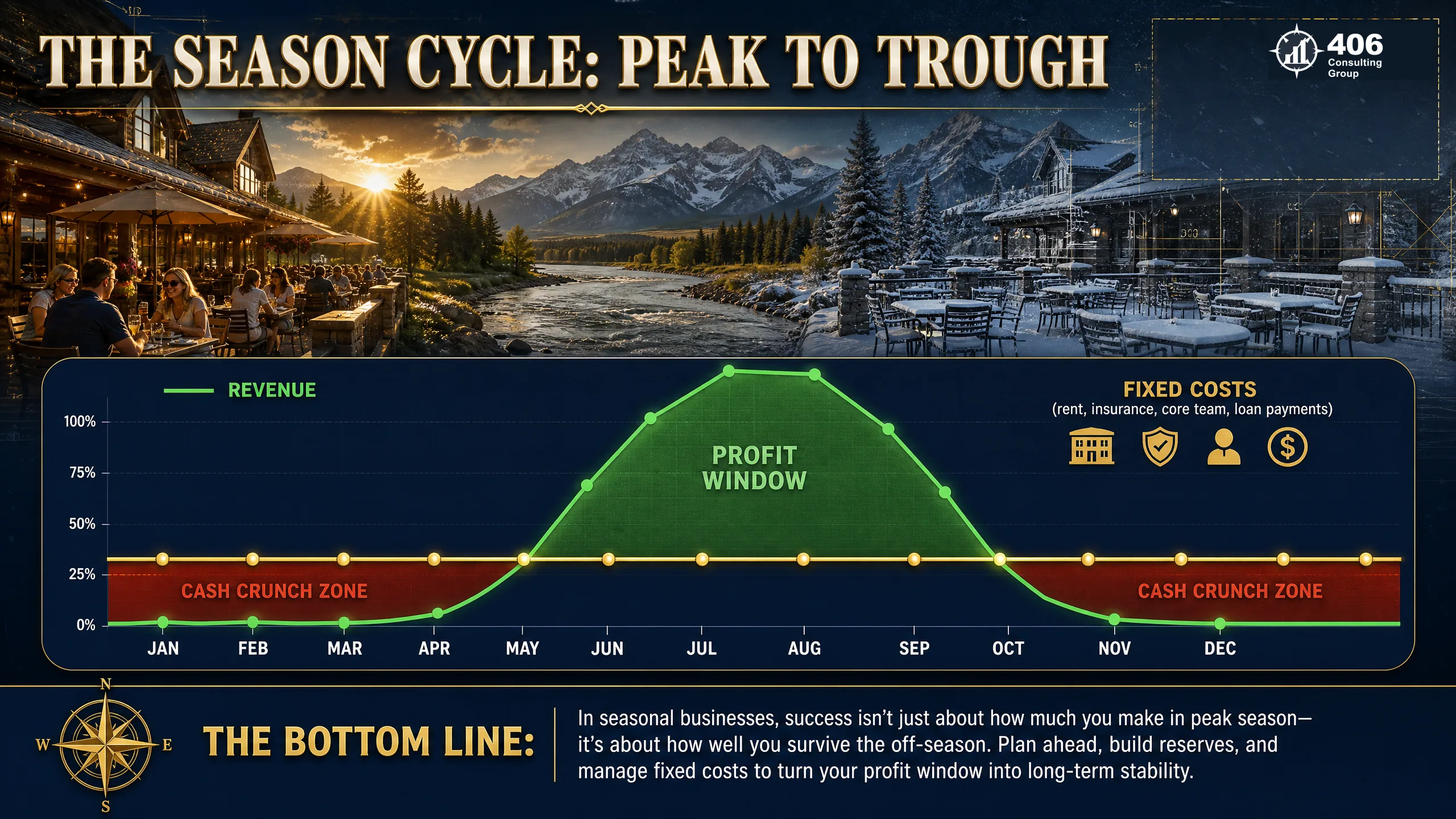
Once you can see the cycle clearly in your numbers, the moves that follow — reserving, pricing, financing, hiring — stop being guesses. The first and most important of those is the reserve.
The Off-Season Reserve
The short answer: the most important thing your finances can do is tell you, while the season's cash is flowing, how much of it can't be spent — because it belongs to the off-season, the tax bill, and next season's startup costs. Get this number right and February is calm; get it wrong and a record summer still ends in a scramble.
The trap is that a great season feels like profit. The account is full, so it's tempting to treat it all as yours — the big draw, the upgrade, the new hire. But a chunk is already spoken for: fixed costs through the slow months, the income tax due on the season's earnings, and the cash to reopen and restock before next season's revenue arrives. The reserve is simply that total, carved out and held back on purpose. It's not complicated math — it just has to actually get done, before the good feeling of a full account drives decisions you regret.
This is the seasonal form of the classic "profitable but broke" problem, and it's exactly what sinks otherwise-healthy hospitality businesses. We break down the general version in Profitable But No Cash, and the cash-forecasting side is where a CFO earns their keep — more on that below.
Lodging Tax & Short Stays
The short answer: Montana has no general sales tax, but it does tax short-term lodging — roughly 8% total (a 4% lodging facility use tax plus a 4% lodging sales tax) on stays under 30 days. If lodging is any part of your business — a motel, a lodge, cabins, or short-term rentals — this applies, and keeping it clean in your books is not optional.
The common trip-up is the platform question. Airbnb and VRBO generally collect and remit the state lodging taxes on the reservations they facilitate — but that doesn't erase it from your books, and it doesn't cover bookings you take directly. Track lodging revenue and lodging tax separately, note which platform collected and remitted what, reconcile it monthly, and confirm what applies to your property with the Montana Department of Revenue. The goal is simple: never owe lodging tax you've already spent.
We go deeper on the bookkeeping mechanics of this in the Livingston bookkeeping guide.
Seasonal Payroll & Tips
The short answer: a business that triples its headcount for the summer and cuts back for winter has a payroll challenge most year-round businesses never face — ramping a seasonal crew up and down, handling tips correctly, and keeping withholding and workers' comp right through the swing.
Ramping a summer crew means onboarding fast and getting everyone set up for withholding, often across a mix of full-time, part-time, and short-term help. For restaurants and bars, tips add a layer: tip reporting, tip credits where they apply, and records that hold up if anyone ever asks. Workers' comp has to cover the seasonal staff, and correct classifications keep a year-end premium audit from becoming a surprise bill. None of it is exotic — but packed into a short, busy season, it's exactly what slips.
Handled well, it's a clean process you run every spring and wind down every fall. That's what our payroll work gives a seasonal business — the ramp handled correctly so you can focus on the season.
Pricing & Capacity: Making the Peak Count
The short answer: when your demand is concentrated into a few months, how you price and how much capacity you can serve during those weeks has an outsized effect on the whole year. A seasonal business that underprices peak demand, or can't handle the volume when it's there, leaves money on the table it can't make back in the off-season.
Peak demand is when your pricing power is highest — a lodge at full occupancy, a guide service booked out, a restaurant with a wait every night. That's the moment to make sure prices reflect the value and the demand, not last year's rates set by habit. It's also when capacity constraints bite: the trips you couldn't staff, the covers you couldn't turn, the rooms you couldn't clean fast enough are pure lost margin. Knowing your real numbers — what each booking, cover, or trip actually contributes — is what lets you price and staff the peak deliberately instead of just surviving it.
These are financial-leadership decisions, and they're exactly where a controller's reporting and a CFO's analysis pay for themselves. We cover that in the Livingston CFO & controller guide.
The Segment-by-Segment View
The playbook is shared, but each corner of Livingston's hospitality economy has its own financial fingerprint. Here's what tends to matter most.
| Segment | What drives the numbers | Where money leaks |
|---|---|---|
| Restaurants & bars | Food/beverage cost, tips, seasonal labor, daily sales | Untracked food cost and over/under-staffed shifts |
| Lodging & short-term rentals | Occupancy, lodging tax, platform vs. direct, turnover cost | Lodging tax surprises and unpriced cleaning/turnover |
| Outfitters & guides | Prepaid trips and deposits, permits, gear, guide pay | Deposits spent early and unbilled or underpriced trips |
| Retail & Main Street | Inventory, seasonal cash swings, POS reconciliation | Overbought off-season inventory and cash tied up on shelves |

Different leaks, same backbone: know your real numbers, keep the season cycle honest, and stay ahead of lodging and payroll. Because our background is in running whole businesses, we build the financial system around how it affects the entire operation — pricing, staffing, and cash — not just tax-time tidiness.
How the Pieces Fit: Books, Tax & CFO
The short answer: seasonal hospitality accounting isn't one service, it's a stack — clean, season-aware books at the base, proactive tax planning on top, and financial leadership steering the whole thing. Each layer depends on the one beneath it, and the biggest wins come from having them work together instead of buying them piecemeal from three disconnected people.
Bookkeeping & payroll
Season-aware, current books and correctly handled seasonal payroll and tips — the foundation everything reads from.
Livingston bookkeeping guide →Tax planning
Entity strategy, income timing around a big season, estimates, and lodging tax — so a great summer isn't erased in April.
Livingston tax guide →Controller & CFO
Season reporting, peak-to-off-season cash forecasting, financing readiness, pricing and growth — reliable numbers turned into decisions.
Livingston CFO & controller guide →Here's our real differentiator: because our background is in running whole businesses — not just accounting — we design your financial systems around how they affect operations, staffing, pricing, and cash across the whole company, not just the ledger. A change to how you price the peak or handle tips ripples into payroll, taxes, and your reserve, and we build it to fit all of them at once. Not sure which layer you need first? Our Financial Maturity Assessment maps it in about eight minutes.
Remote & How to Get Started
The short answer: what a seasonal hospitality business needs is a partner who understands the season cycle — not one who happens to be in Livingston. Your sales run through a point-of-sale system and your bank feeds are digital, so a seasonal-savvy remote firm sees your numbers the same day you do and can plan around your season far better than a local generalist who treats you like a year-round shop.
And honestly, "remote" is how modern accounting already works — even for the clients right down the road. Roughly 70–80% of our own local clients never set foot in our office; the whole relationship runs through secure cloud accounting, shared screens, and a regular call rhythm, and it works beautifully. Distance simply isn't the variable it used to be. So whether you're in Livingston, elsewhere in Park County, or anywhere in Montana, you get the same responsive, season-aware partnership our in-town clients do.
Get the books season-aware & current
Everything reads from here. If your books aren't set up for the season cycle, that's step one.
Build the reserve & the forecast
Carve out the off-season reserve and a peak-to-trough cash forecast, and get lodging tax and payroll clean.
Steer the season on purpose
Use real numbers to price the peak, time financing and growth, and make winter planned instead of survived.
Wherever you are in that path, we can meet you there — and build the finance function around how your whole seasonal business actually runs.
FAQ: Livingston Hospitality Accounting
Why does a seasonal hospitality business need specialized accounting?
Because it earns its whole year in a few months, so month-to-month statements miss the real picture and a generic setup can't answer the questions that matter. Seasonal hospitality accounting has to handle the peak-to-off-season cash swing, the off-season reserve, lodging tax, seasonal payroll and tips, and pricing when demand is concentrated. A restaurant, lodge, or guide service run on the same books as a year-round retail store will look fine on paper while quietly heading for a cash crunch in the off-season.
How much of a good season should I set aside for the off-season?
The method is the same for every seasonal business: estimate your off-season burn (fixed costs like rent, insurance, a core team, and loan payments through the slow months), add the income tax due on the season's earnings, and add the cash to reopen and restock before next season's revenue arrives. That total is your reserve — carved out and held back while the season's cash is flowing, so a great summer doesn't get spent before winter's bills come due.
Does my Livingston lodging or short-term rental owe Montana lodging tax?
Yes. While Montana has no general sales tax, short-term stays (under 30 days) carry roughly an 8% lodging tax — a 4% lodging facility use tax plus a 4% lodging sales tax. Airbnb and VRBO generally collect and remit the state lodging taxes on reservations they facilitate, but you still must account for it correctly and it doesn't cover direct bookings. Track lodging revenue and tax separately and confirm what applies to your property with the Montana Department of Revenue, so you never owe tax you've already spent.
How do I handle payroll and tips for seasonal staff?
Seasonal payroll means ramping a summer crew up and winding it down — onboarding and withholding for a mix of full-time, part-time, and short-term help, plus workers' comp coverage and correct classifications so a year-end premium audit doesn't surprise you. For restaurants and bars, add tip reporting and tip credits where they apply, with records that hold up. Done right, it's a clean process you run each spring and wind down each fall rather than a scramble in your busiest months.
How should I price my peak season?
Deliberately, based on real numbers — because concentrated demand gives you your greatest pricing power, and underpricing the peak leaves money you can't recover in the off-season. Know what each booking, cover, or trip actually contributes, then set peak pricing to reflect the value and demand rather than last year's habitual rates. Capacity matters just as much: the trips, covers, or rooms you can't serve at the peak are pure lost margin, so staffing and capacity planning are part of the same decision.
Can 406 Consulting Group work with my Livingston hospitality business remotely?
Yes. We work with restaurants, lodging and short-term rentals, outfitters and guides, and retail across Livingston, Park County, and Montana through secure cloud accounting — bookkeeping and payroll, tax planning, and fractional controller and CFO services. What matters for a seasonal business is expertise in the season cycle, lodging tax, and hospitality payroll, not office proximity, and we review your live numbers on a rhythm timed to your season. Because our background is in running whole businesses, we design the financial system around how it affects the entire operation.
Keep Reading — The Livingston Series
Tourism & Hospitality Accounting — Livingston, MT
Build a Business the Off-Season Can't Break.
406 Consulting Group gives Livingston's restaurants, lodging, outfitters, and shops season-aware books, smart tax planning, and the CFO leadership to price the peak and carry the winter — from a Montana firm that understands seasonal business. Let's build the financial system your season needs.
Seasonal Hospitality Quick Reference
Livingston, MT — Park County
The Seasonal Business Playbook
Running a Season in Livingston?
Books to CFO strategy, built for the season.
About the Author
Carrie Anderson
Co-Founder, 406 Consulting Group
Commercial banking and underwriting background — 300+ loan reviews — plus advisory work with Montana small businesses. Carrie helps Livingston and Park County hospitality owners get the cash discipline, reporting, and financing readiness a seasonal business runs on.
Read the Full Story