
CFO & Controller Services for Livingston, MT:
Financial Leadership for a Seasonal Economy
A seasonal business lives two lives — flat-out in summer, living on reserves all winter. Here's how a controller and a fractional CFO manage the cash swing, arrange financing before you need it, and time growth on real numbers, from a Montana firm that understands seasonal business.

A seasonal business in Livingston lives two lives. For a few months it's a machine — packed, profitable, running flat out. Then the season turns, revenue falls off a cliff, and the same business has to live on what it banked. Plenty of owners can run a great summer on instinct. Far fewer can answer the questions that actually determine whether the business survives and grows: exactly how much of the peak has to carry the off-season, whether this year's numbers say it's time to expand or hold, and how to finance a slow stretch or a big move without gambling the whole operation.
Those aren't bookkeeping questions. They're financial-leadership questions — and they're exactly what a controller and a fractional CFO exist to answer. A controller makes your numbers reliable and gives you a real read on the season while it's happening. A fractional CFO uses those numbers to manage the peak-to-trough cash swing, secure financing before you need it, and decide when and how to grow. Together they're what turn a good-season-and-hope business into one that scales on purpose.
This guide covers what each role does for a seasonal tourism or hospitality business, when you need them, what they cost, and how a Montana firm delivers it remotely. It builds on the layers beneath it — our Livingston bookkeeping guide and Livingston tax guide — so if those aren't handled yet, start there.
By Jason Anderson — Co-Founder, 406 Consulting Group. Background in large-scale operational finance at BP before building financial infrastructure for Montana small businesses, where cash forecasting, financing decisions, and steering a business through uneven cycles are everyday work.
Quick Answer: Controller & CFO for a Seasonal Business
- →Controller: owns the monthly close and gives you a reliable read on the season while it's happening.
- →CFO: owns the peak-to-off-season cash swing, financing, pricing and capacity, and growth strategy.
- →The season cycle is the trigger: the swing between flush and lean is where seasonal businesses get caught.
- →Fractional gives you both roles for ~$4,000–$8,000/month — a fraction of full-time salaries.
- →Delivered remotely across Montana, by a firm that understands seasonal business.
Table of Contents
Controller vs. CFO: The 30-Second Difference
The short answer: a controller makes your numbers accurate and on time; a CFO uses those numbers to make better decisions about cash, pricing, financing, and growth. A bookkeeper records what happened, a controller makes it reliable, and a CFO decides what to do about it — and a growing seasonal business eventually needs all three.
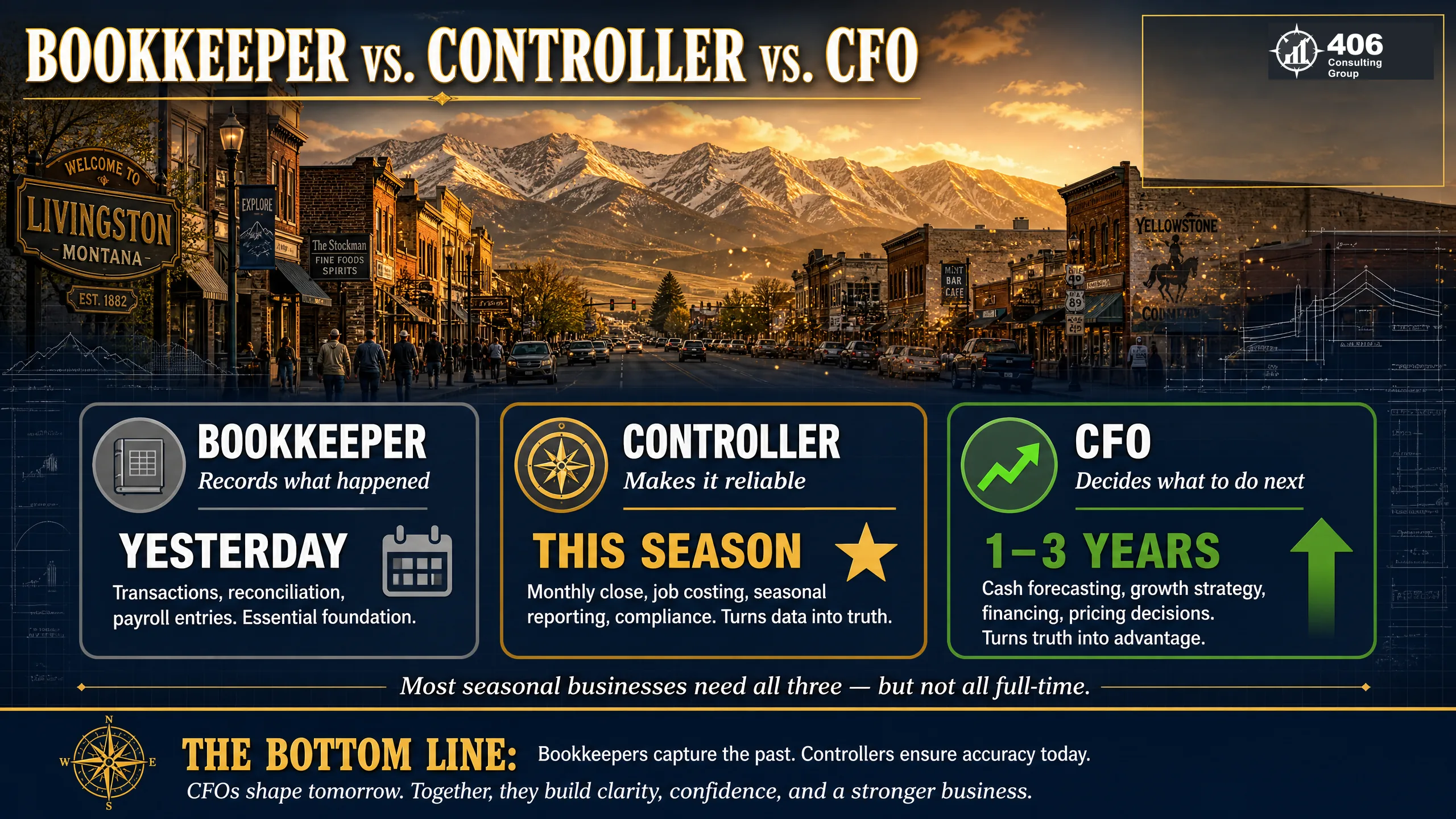
| Bookkeeper | Controller | CFO | |
|---|---|---|---|
| Owns | Transactions | The close & reporting | Financial strategy |
| Time horizon | Yesterday | This season | Next 1–3 years |
| Answers | What did we spend? | How is the season doing? | What should we do next? |
Want the full "which role, and when" breakdown with a revenue-and-complexity ladder? We go deep in our controller-vs-CFO guide. This article is about what these roles do specifically for a seasonal Livingston business.
Why Seasonal Businesses Hit a Financial Ceiling
The short answer: a seasonal business hits a wall when the swing between peak and off-season gets too big to run by feel — when one bad forecast, one mistimed expansion, or one slow summer can put the whole year at risk. Instinct carries you a long way, but past a certain size the decisions get too expensive to guess.
Think about the specific traps. A great summer feels like permission to expand — a second location, more staff, a big equipment purchase — but without a real forecast, that expansion can drain the reserve the off-season depended on. Pricing set by gut leaves margin on the table during peak demand. The slow months get financed by scrambling for a loan in February, on the worst possible terms, instead of a line of credit arranged in the flush of summer. None of these are failures of effort; they're failures of not having someone whose job is to see them coming.
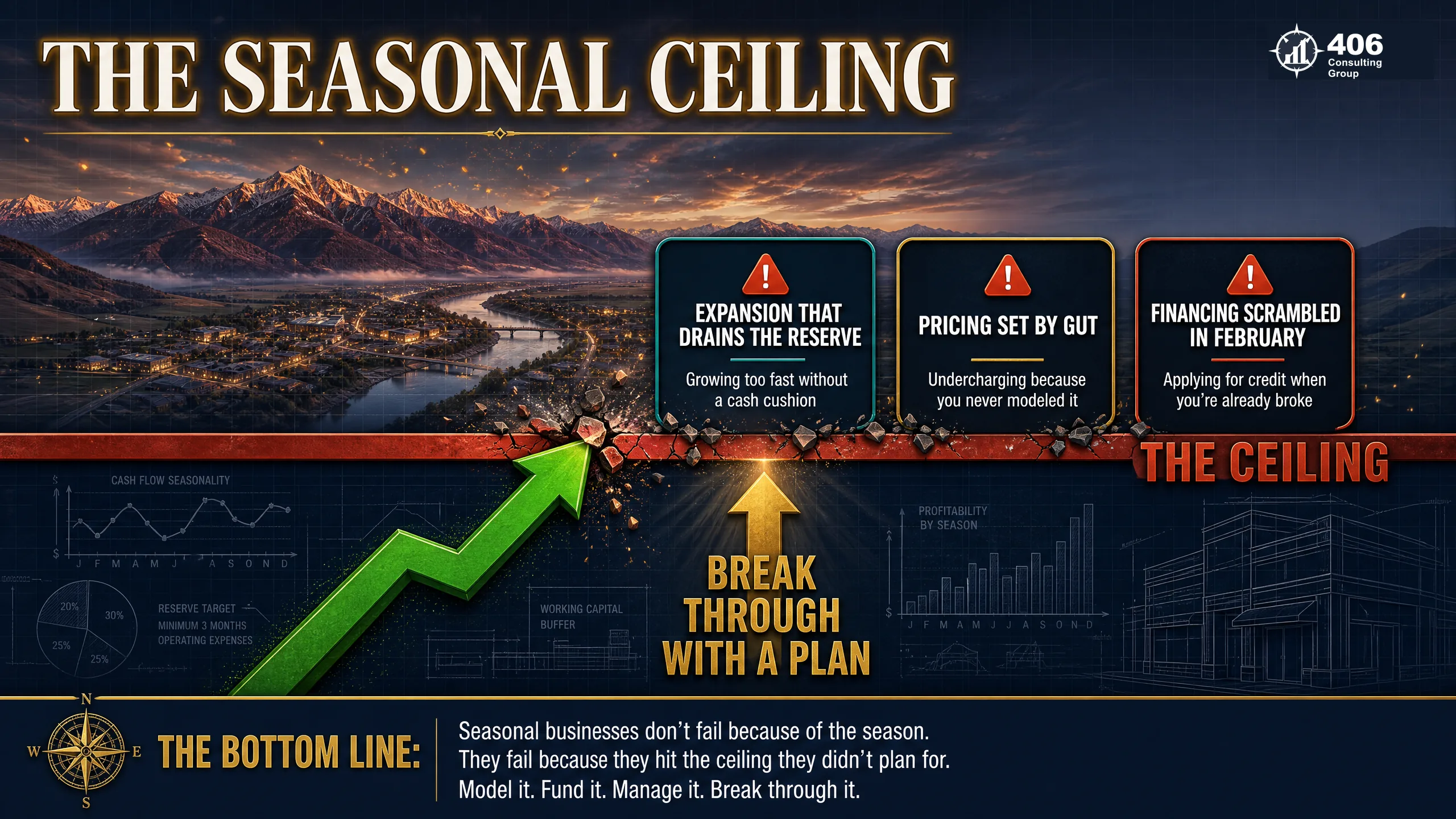
Pushing through that ceiling takes reliable reporting and real cash management — the controller and CFO functions. The framework below is how they fit together for a business whose year comes in waves.
The Season-Ready Finance Framework
Financial leadership for a seasonal business comes down to five layers, each building on the one before. Get them in order and the swing between peak and off-season stops being a threat and becomes something you plan around.
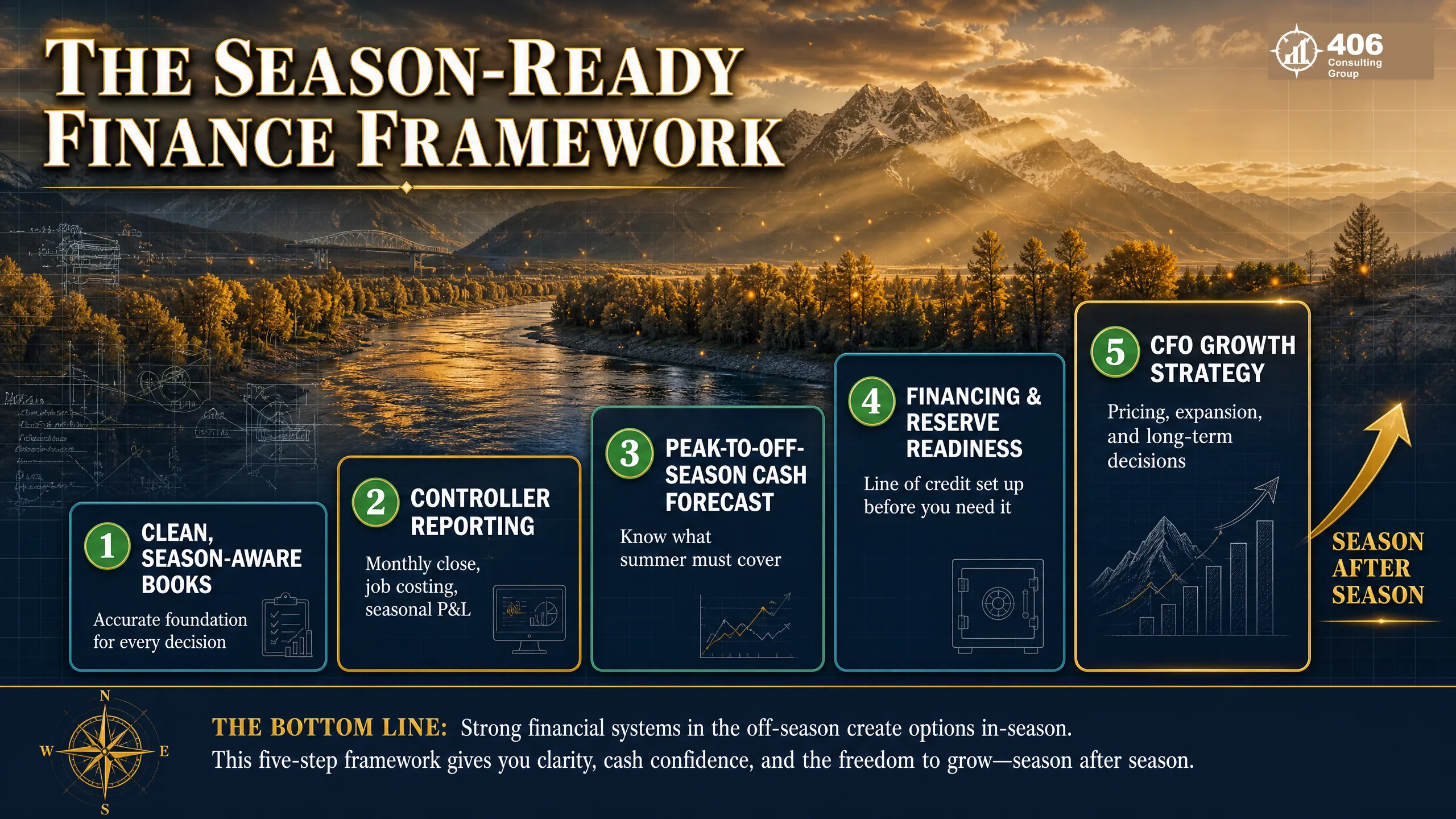
Clean, season-aware books
Accurate monthly close with revenue and costs tracked so you can read the season as it happens.
Controller reporting
A reliable read on where the season stands versus plan, and what the year is really shaping up to be.
Peak-to-off-season cash forecast
A rolling forecast of the swing, so you know what the summer has to bank to carry the winter.
Financing & reserve readiness
A line of credit and reserve set up during the peak — not scrambled for in the slow months.
CFO growth strategy
Pricing, capacity, and expansion decisions made on real numbers, timed to the season cycle.
The first two layers are controller work; the last three are where a CFO earns their keep. Here's what each role actually delivers.
What a Controller Delivers
The short answer: a controller makes your numbers trustworthy and timely, so you can steer the season on facts instead of the feeling that it's "going well." For a seasonal business, that means knowing in August how the season actually compares to plan — while there's still time to adjust staffing, hours, or spending.
Concretely, a controller owns a fast, accurate monthly close; sets up reporting that shows the season against budget and against last year; keeps the books clean enough to trust for financing and tax; and puts basic internal controls in place so cash is handled safely during the busy months when it's flying in fast. The payoff is simple: you stop flying blind through your most important months.
For many Livingston businesses, strong controller-level support is the first step up from bookkeeping — and often all they need for a while. Our controller services are built for exactly that.
What a Fractional CFO Delivers
The short answer: a CFO turns reliable numbers into decisions — managing the cash swing, securing financing, sharpening pricing, and deciding when and how to grow. This is the role that keeps a strong season from being wasted and a slow one from being fatal.
For a seasonal Livingston business, a fractional CFO builds the peak-to-off-season cash forecast so you know exactly what to bank; arranges a line of credit during the summer so the slow months are covered on good terms; pressure-tests pricing and capacity so peak demand actually converts to margin; and models the big decisions — a second location, a major hire, an equipment investment — before you commit, not after. They also get you financing-ready, because a bank lends far more easily to a seasonal business that can show a real forecast and clean numbers.
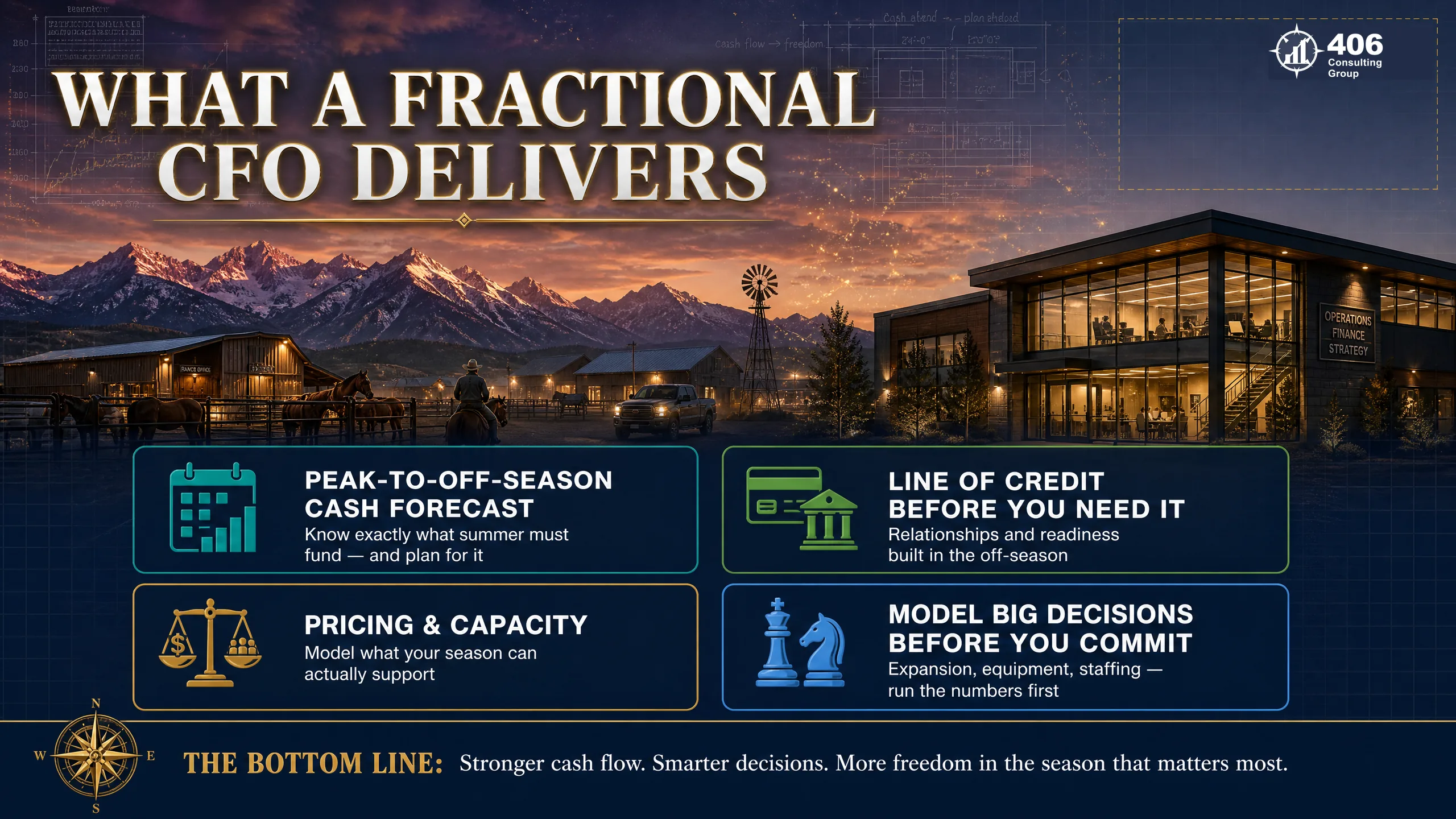
That's the difference between surviving the cycle and using it to grow. Our fractional CFO services bring that leadership without a full-time hire.
Signs It's Time
The short answer: you're ready for controller or CFO support when the decisions have gotten bigger than your reporting can safely inform. A few clear signals:
Your books close late or you don't trust them
You can't get a reliable read on the season until long after it matters. (Controller.)
You can't say what the summer has to bank
The off-season reserve is a guess, and February is a white-knuckle month. (CFO.)
You're financing the slow months reactively
Scrambling for a loan in the off-season instead of a line arranged during the peak. (CFO.)
A big decision is looming
A second location, a major hire, or an equipment purchase you're deciding on instinct. (CFO.)
You're the only one who understands the numbers
Every financial decision runs through you, and there's no real system behind it. (Both.)
Not sure which you need? Our Financial Maturity Assessment points you to the right layer in about eight minutes.
Fractional vs. Full-Time: The Cost Math
The short answer: a seasonal business rarely needs — or can justify — a full-time controller or CFO, which is exactly why fractional fits so well. You get senior financial leadership scaled to your business and your season, for a fraction of a full-time salary.

| Role | Fractional (monthly) | Full-time (all-in / year) |
|---|---|---|
| Controller | ~$2,500–$6,000 | $85K–$120K + ~25% benefits |
| Fractional CFO | ~$2,500–$5,000 | $150K–$300K+ + benefits |
| Both, coordinated | ~$4,000–$8,000 | $235K–$420K+ |
Fractional is dramatically more cost-effective until a business reaches the scale (generally $15M+) that keeps a full-time hire busy year-round — which, for a seasonal business with a concentrated season, is a level most never need to reach to get the leadership they want.
Serving Livingston & Park County
The short answer: what a seasonal business needs from a controller or CFO is expertise in the season cycle — cash swings, financing, pricing, growth timing — not someone physically in Livingston. A seasonal- and hospitality-savvy remote partner beats a local generalist, and the work is a natural fit for remote delivery.
It's worth being concrete about how normal remote already is: even 70 to 80 percent of our own local clients never come into the office. The reporting, forecasting, and season-timed strategy calls all run on secure cloud accounting and shared screens. So for a Livingston operator, proximity simply isn't a factor — a business right in Park County and one clear across Montana get the exact same season-aware controller and CFO leadership.
The high-value moments are conversations over live numbers: reviewing where the season stands, setting the off-season reserve, deciding on a line of credit, modeling an expansion. They happen over a screen share, timed to your season — a mid-summer check on how the peak is tracking, a post-season projection, a plan before December. Secure cloud accounting means we see your numbers the same day you do. For a Livingston or Park County business, the deciding question isn't proximity; it's whether your partner understands a business that makes its year in a season.
And because our background is in running whole businesses, we look at how a financial decision affects the entire operation — staffing, pricing, the off-season, cash — not just the ledger. That whole-company view is what makes the difference for a seasonal business, and it works just as well remotely.
How to Get Started
Building the finance function your season needs is three steps.
Get the books reliable
Clean, season-aware books are the foundation. If yours are behind, that's where we start — controller work builds on good books.
Build the cash forecast
Map the peak-to-off-season swing so you know what the summer must bank and when financing should be arranged.
Steer with the numbers
Use reliable reporting and the forecast to set pricing, time growth, and make the big decisions on facts, not instinct.
Wherever you are in that path, we can meet you there — and build the finance function around how your whole seasonal business actually runs.
FAQ: CFO & Controller Questions
What's the difference between a controller and a CFO for a seasonal business?
A controller owns the accounting function — a fast, accurate monthly close, reporting that shows the season against plan, and clean books you can trust for financing and tax. Their focus is making the numbers reliable and giving you a real read on the season as it happens. A CFO owns the finance function — using those numbers to forecast the peak-to-off-season cash swing, secure financing, sharpen pricing and capacity, and plan growth. A growing seasonal business needs both: the controller produces trustworthy numbers, and the CFO turns them into strategy.
Does my seasonal Livingston business need a controller or a CFO?
Start with a controller if your books close late, you can't trust them, or you can't get a timely read on how the season is tracking — you need reliable reporting first. Add a CFO when the numbers are solid but you need a real cash forecast across the season swing, financing arranged before the slow months, pricing and capacity decisions, or help modeling a big move like a second location. Many Livingston businesses are well served by controller-level support for a while, then add CFO strategy as the decisions get bigger.
How much do CFO and controller services cost in Livingston, MT?
Fractional pricing in Montana typically runs about $2,500–$6,000 per month for a controller and about $2,500–$5,000 per month for a fractional CFO, depending on complexity and scope. A coordinated engagement covering both often runs roughly $4,000–$8,000 per month. Compare that to full-time salaries — $85K–$120K for a controller and $150K–$300K+ for a CFO, plus roughly 25% in benefits — and fractional is dramatically more cost-effective until a business reaches the scale (generally $15M+) that keeps a full-time hire busy year-round, which most seasonal businesses never need to reach.
How does a CFO help with the off-season cash swing?
A CFO builds a rolling cash-flow forecast around your specific season — projecting what the peak will bank and what the off-season will burn — so you know exactly how much of the summer has to carry the winter. They arrange a line of credit during the flush months (when terms are best and approval is easy) rather than scrambling for a loan in February, keep a reserve sized to your actual off-season, and make sure a strong season isn't spent before the slow months arrive. It's the single best defense against the feast-or-famine trap.
When is the right time to make a big decision like expanding?
When you can model it on real numbers rather than the feeling of a good summer. A great season can tempt an owner into a second location, a major hire, or a big equipment purchase — but without a forecast, that move can drain the reserve the off-season depends on. A CFO pressure-tests the decision first: what it costs, how it affects the cash swing, what has to be true for it to work, and how to finance it safely. The goal is to grow on purpose, timed to the season cycle, not to gamble a good year.
Does 406 Consulting Group provide CFO and controller services in Livingston, MT?
Yes. 406 Consulting Group provides fractional CFO, controller, bookkeeping, payroll, and tax services to seasonal and year-round businesses in Livingston, Park County, and across Montana. We specialize in the financial leadership a seasonal business needs — season-aware reporting, peak-to-off-season cash forecasting, financing readiness, and growth timing — and we work remotely through secure cloud accounting, so you get senior financial leadership without anyone needing to be in your office. Because our background is in running whole businesses, we look at how each decision affects the entire operation. Contact us to talk through where your business is.
Keep Reading — The Livingston Series
CFO & Controller — Livingston, MT
Make the Season Cycle Work For You.
406 Consulting Group gives seasonal Livingston businesses the controller foundation and CFO strategy — season-aware reporting, peak-to-off-season cash forecasting, financing readiness, and growth timing — from a Montana firm that understands seasonal business. Let's build the finance function your season needs.
Seasonal Finance Quick Reference
Livingston, MT — Park County
The Season-Ready Finance Framework
Scaling a Seasonal Business?
Cash swing, financing & growth, handled.
About the Author
Jason Anderson
Co-Founder, 406 Consulting Group
Background in large-scale operational finance at BP before building financial infrastructure for Montana small businesses. Jason helps seasonal Livingston and Park County owners forecast the cash swing, get financing-ready, and time growth on real numbers instead of a good feeling.
Read the Full Story