
CFO & Controller Services for Butte, MT:
When You Need Which
A $4M Butte fab shop keeps its books, runs payroll, and files taxes on time — yet can't say which jobs make money or where cash will be in 90 days. That's a financial-leadership gap. Here's what controller and CFO services actually do, when you need each, and what they cost.

Picture a Butte metal-fabrication and industrial-services business — about $4 million in revenue, 25 employees, running a dozen jobs at a time across mining-services, structural steel, and repair work. The owner is good at the work and good with customers. The books get kept, payroll runs, taxes get filed. And yet, sitting across the table, he can't answer three questions: which type of job actually makes money, where cash will be in 90 days, and why the bank wants more documentation before extending his line of credit.
That is not a bookkeeping problem. That is a financial-leadership gap — and it's exactly what CFO and controller services in Butte, MT are built to close. A bookkeeper records what already happened. A controller makes the numbers reliable and turns them into reporting you can run the business on. A CFO uses those numbers to make forward-looking decisions about margin, cash, and growth. Most Butte businesses over $1 million need more of the second and third than they're getting.
The problem is that "CFO" and "controller" get thrown around loosely, the pricing is opaque, and a full-time hire at a Montana salary feels out of reach for a business this size. This guide clears all of that up: what each role actually does, when a Butte business needs which one, what it costs, and how the fractional model makes senior financial leadership affordable for a company that isn't ready for a six-figure hire.
By Jason Anderson — Co-Founder, 406 Consulting Group. Background in large-scale operational finance at BP, where financial reporting, margin analysis, and capital decisions ran at a scale that makes a $4M shop's numbers legible fast. Works with businesses across Butte and Montana.
Quick Answer: CFO vs. Controller for a Butte Business
- →Controller: Owns accurate, on-time books and reporting. Hire one when your financials are late, unreliable, or you can't trust the numbers.
- →CFO: Uses reliable numbers to forecast, finance, and grow. Hire one when your books are clean but you can't plan, model, or borrow.
- →Fractional: Both roles are available part-time on a monthly retainer — senior expertise without a full-time salary.
- →Cost in Montana: Fractional controller ~$2,500–$6,000/mo; fractional CFO ~$2,500–$5,000/mo — versus $85K–$300K+ in salary for full-time.
- →Most Butte businesses $1M–$5M need the controller foundation first, then add CFO strategy on top.
Table of Contents
CFO & Controller Services, Explained in 30 Seconds
The short answer: controller services make your financial numbers accurate, timely, and trustworthy; CFO services use those numbers to make better decisions about cash, margin, financing, and growth. Together they are the difference between knowing what happened last quarter and knowing what to do next quarter.
Here it is in plain terms for a Butte business owner. Right now your bookkeeper is the person who enters the transactions. A controller is the person who closes the month, catches the errors, builds the reporting package, and makes sure the books actually reflect reality — so when you look at a profit number, you can believe it. A CFO is the person who sits down with those reliable numbers and helps you answer the questions that keep you up at night: Can I afford this hire? Which work should I bid more of? Will the bank say yes? What happens to cash if the big job pays 45 days late?
Define it once
Controller = the head of accounting. Owns the historical record and the monthly close. CFO (Chief Financial Officer) = the head of finance. Owns the forward-looking strategy. Fractional = you get either role part-time, on a monthly retainer, instead of hiring a full-time employee. A $4M Butte fab shop rarely needs 40 hours a week of either — but it badly needs the expertise a few days a month.
Bookkeeper vs. Controller vs. CFO: Who Does What
The short answer: these are three different jobs, not three names for the same job. A growing business eventually needs all three — the bookkeeper feeds the data, the controller makes it reliable, and the CFO uses it to steer. Confusing them is why so many owners overpay one person to do work they were never trained for.
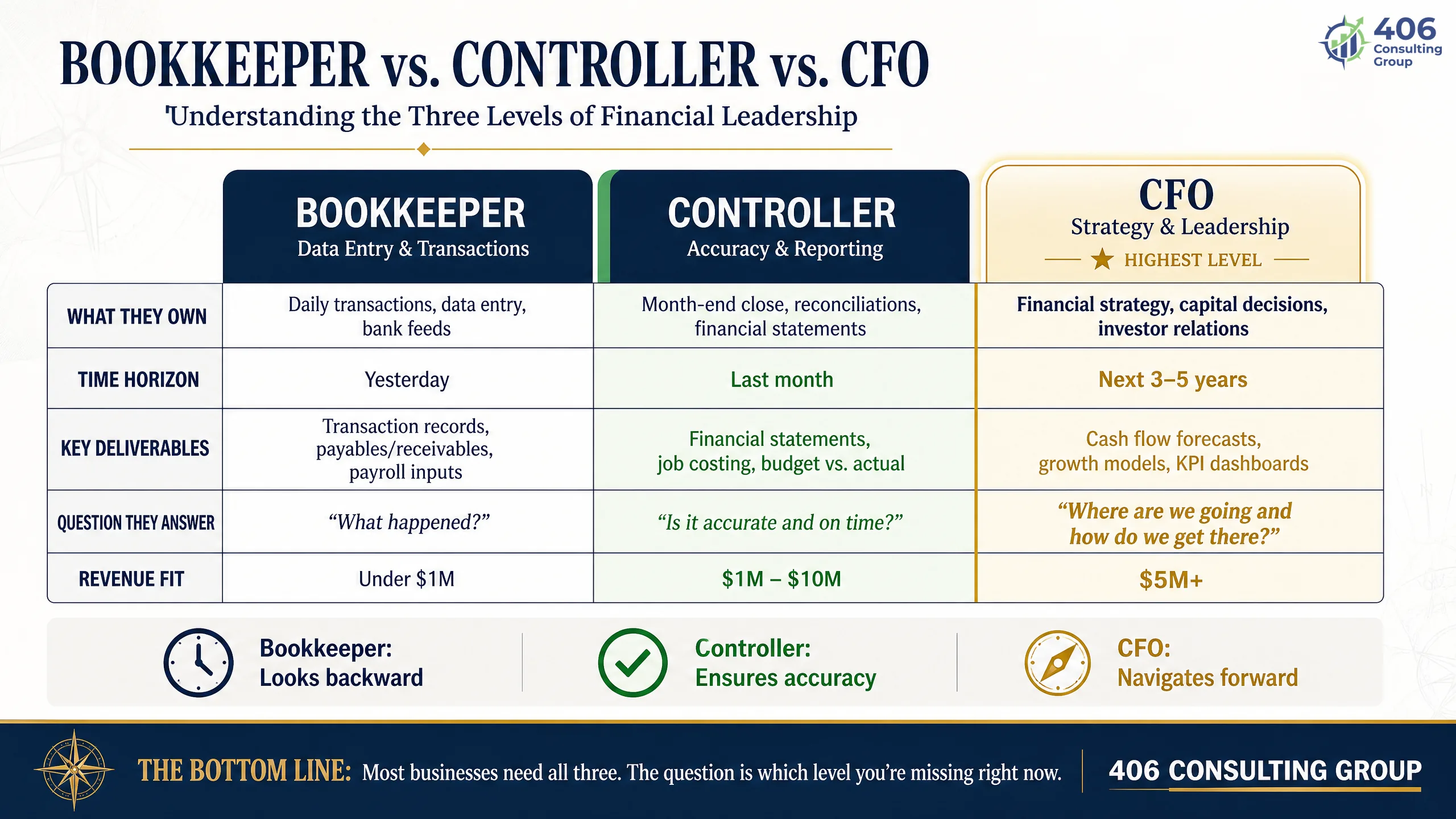
| Bookkeeper | Controller | CFO | |
|---|---|---|---|
| Owns | Data entry & reconciliations | The monthly close & reporting | Financial strategy & decisions |
| Time horizon | Yesterday | Last month | Next 12–36 months |
| Key output | Categorized transactions | Reliable monthly financials | Forecasts, models, lender packages |
| Question answered | What did we spend? | Are the numbers right? | What should we do next? |
| Typical trigger | You started a business | Books are late or unreliable | You can't forecast or borrow |
Notice the trap in the middle column. Most Butte businesses have a bookkeeper and a CPA who files the return — and nothing in between. That gap, the controller function, is where late closes, surprise tax bills, and untrustworthy margin numbers live. We wrote a deeper piece on exactly that transition: when to upgrade from bookkeeping to a controller.
The Financial Leadership Ladder
The short answer to "which one do I need?" is: it depends on which rung of the Financial Leadership Ladder you're standing on. Businesses climb this ladder as revenue and complexity grow. Skip a rung and you either overpay for capability you can't use yet, or you stall because you're missing a layer you need. Here's the ladder we use with Butte businesses.
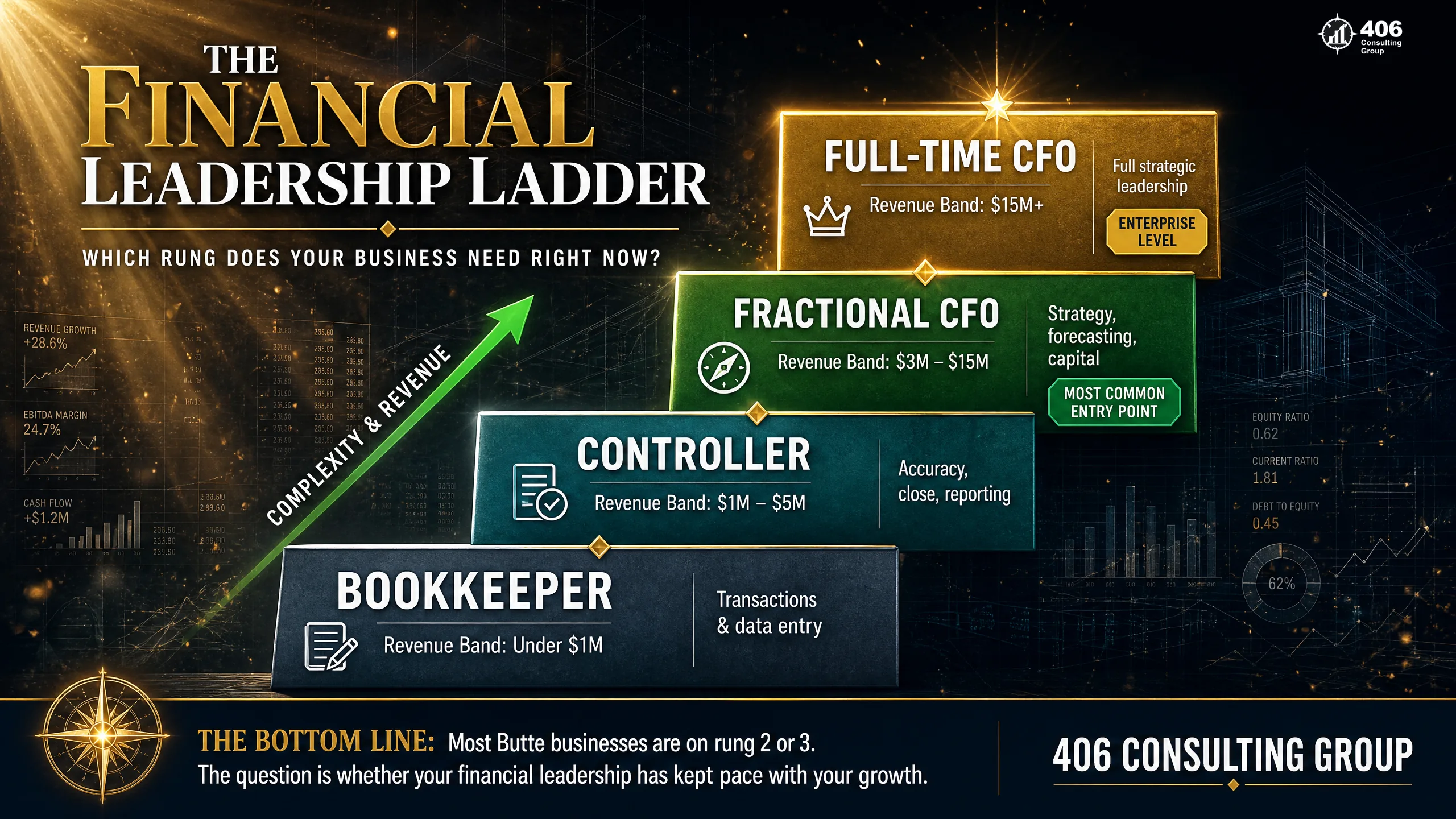
Bookkeeper
Startup – ~$750KClean transaction entry, reconciliations, payroll, and a CPA at tax time. At this stage, a solid bookkeeper is usually enough. The numbers are simple and the owner can hold the whole picture in their head.
Controller
~$1M – $5MOnce you have employees, multiple job types, and a line of credit, you need reliable monthly financials, job costing, and internal controls. This is where most Butte businesses are under-served — they're still running on rung 1 while operating at rung 2.
Fractional CFO
~$1.5M – $15MWhen the books are clean but you can't forecast cash, model a decision, or build a lender package, you add CFO strategy. Fractional means a few days a month — enough to change decisions without a full-time salary.
Full-Time CFO
~$15M+At real scale — multiple entities, complex financing, M&A, a finance team to manage — the volume finally justifies a full-time CFO. Very few Montana businesses reach this rung, and that's fine.
Where our $4M Butte fab shop sits
At $4M with 25 employees and a line of credit, this business is squarely on rungs 2 and 3 — it needs a controller running a real monthly close and a CFO helping with cash forecasting and the bank relationship. What it's actually running on is rung 1. That gap is the whole problem, and closing it is usually worth far more than it costs.
7 Signs Your Butte Business Has Outgrown Its Bookkeeper
None of these mean your bookkeeper is doing a bad job. They mean the business has grown past what bookkeeping alone can carry — and it's time to add the controller or CFO layer.
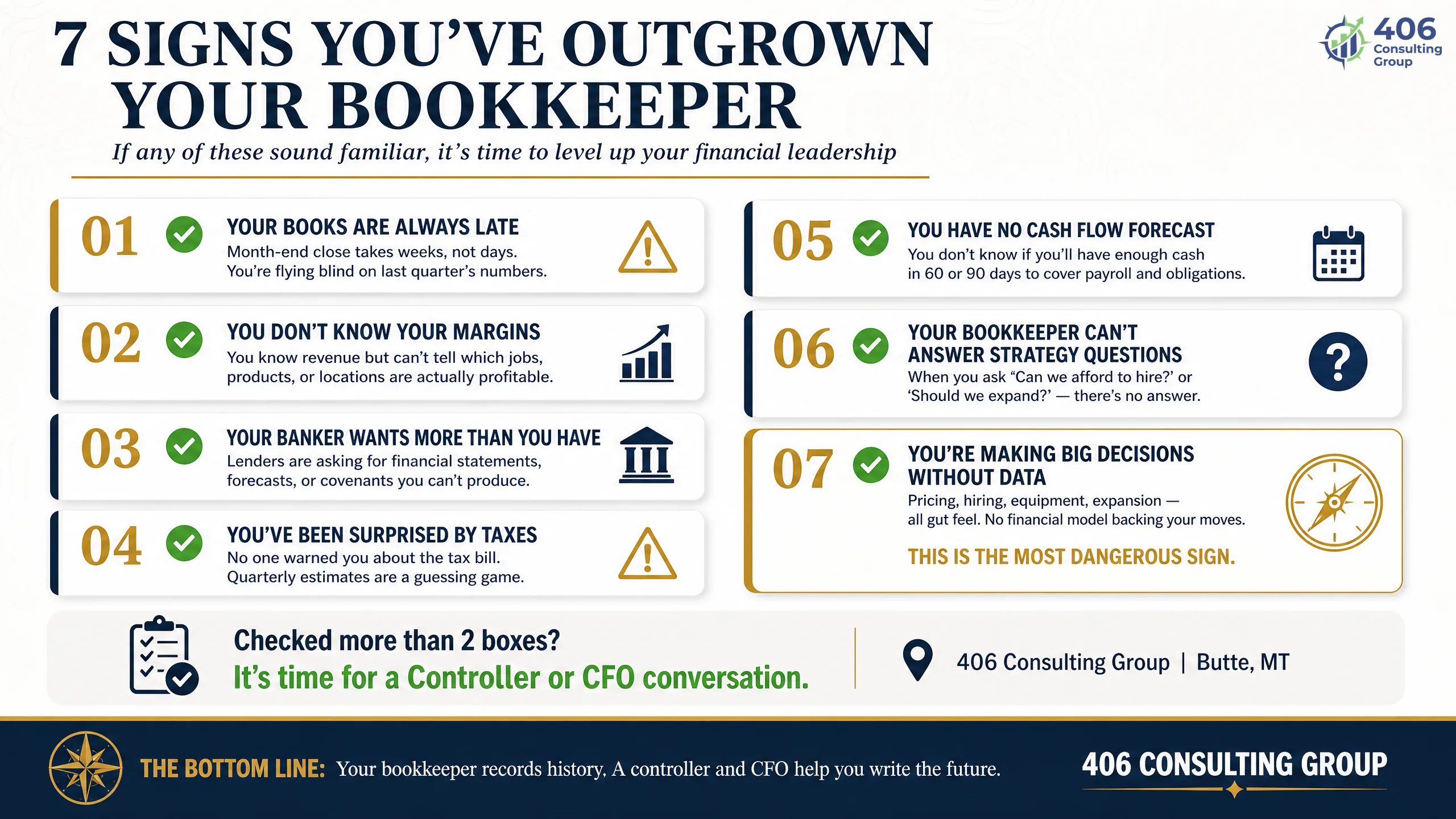
Your books close weeks late — or never really close
If you're looking at October's numbers in December, you can't make decisions with them. A controller closes the month within days, not weeks.
You can't tell which jobs or service lines make money
Total profit looks fine, but you have no idea whether structural work or repair work carries the business. Without job costing, you're bidding blind.
Your tax bill blindsides you every year
Surprise April tax bills mean nobody is looking forward. A controller and CFO turn tax into a planned number, not an ambush.
You've nearly missed payroll despite being profitable
Profitable on paper, tight on cash is the classic growth trap. It signals you need cash flow forecasting — a CFO function.
A lender asked for something you couldn't produce
A 13-week cash forecast, a DSCR calculation, clean year-over-year statements — if a bank request stumped you, that's the CFO layer talking.
You make big decisions on gut, not numbers
Buying equipment, adding a crew, taking on a huge job — if you can't model the impact first, you're exposed on every one of them.
You're the only financial control in the business
If you personally are the only thing standing between the company and a costly error or fraud, you have an internal-controls gap a controller closes.
Counting three or more? That's the signal. You can size the controller side with our controller estimator and pressure-test where your whole financial function stands with the free financial maturity assessment.
What a Controller Actually Delivers
The short answer: a controller delivers financial statements you can trust, on time, every month — plus the job costing and internal controls that make those statements mean something. It's the foundation everything else is built on. You cannot run CFO-level strategy on numbers you don't believe.
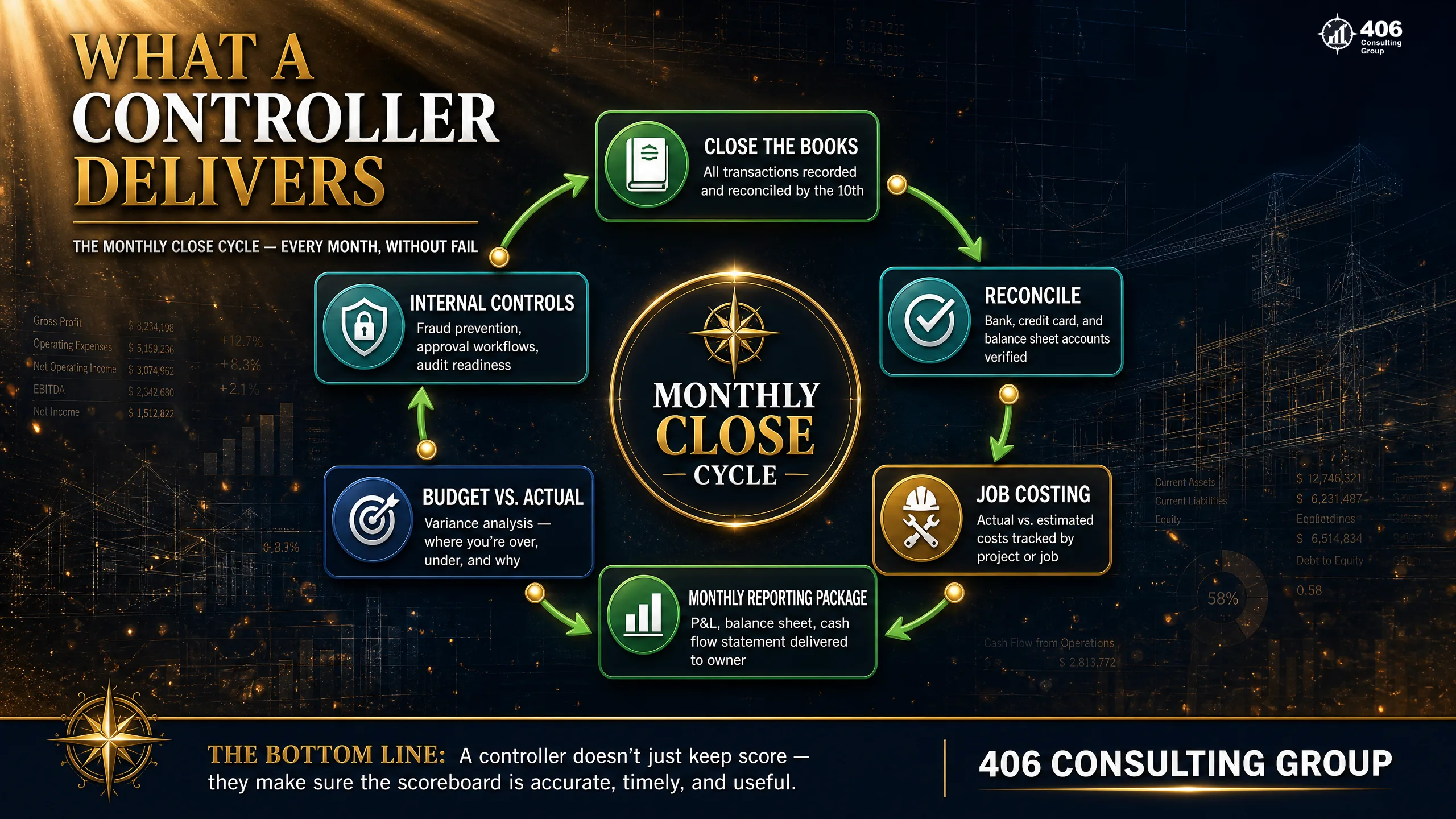
A fast, reliable monthly close
Books closed within days of month-end, reconciled and reviewed, so you're looking at current reality — not a two-month-old guess.
Job costing you can bid from
Cost captured by job and by type, so you finally know which work makes money. For a fab shop, this is the difference between bidding to win and bidding to profit.
A monthly reporting package
P&L, balance sheet, cash position, and budget-vs-actual — presented so an owner can read them, not just an accountant.
Internal controls
Separation of duties, approval workflows, and reconciliation discipline that protect the business from errors and fraud as headcount grows.
Clean, lender-ready statements
Financials that don't need to be explained away when a bank or bonding company asks for them.
A tax-ready year
Books maintained so tax time is a handoff, not a scramble — and so your CPA can actually plan instead of just report.
What it's worth
When our Butte fab shop got real job costing, it discovered its repair work was running a 9% margin while its structural work ran 26%. It had been chasing the wrong jobs for years. Shifting the bid mix toward structural work added an estimated $140,000 to annual gross profit — from information a controller produces as a matter of routine. Explore the full scope of controller services.
What a Fractional CFO Actually Delivers
The short answer: a fractional CFO turns reliable numbers into better decisions — cash flow forecasting, margin strategy, financing, and growth planning — for a few days a month instead of a full-time salary. Where the controller answers "are the numbers right?", the CFO answers "what should we do about them?"
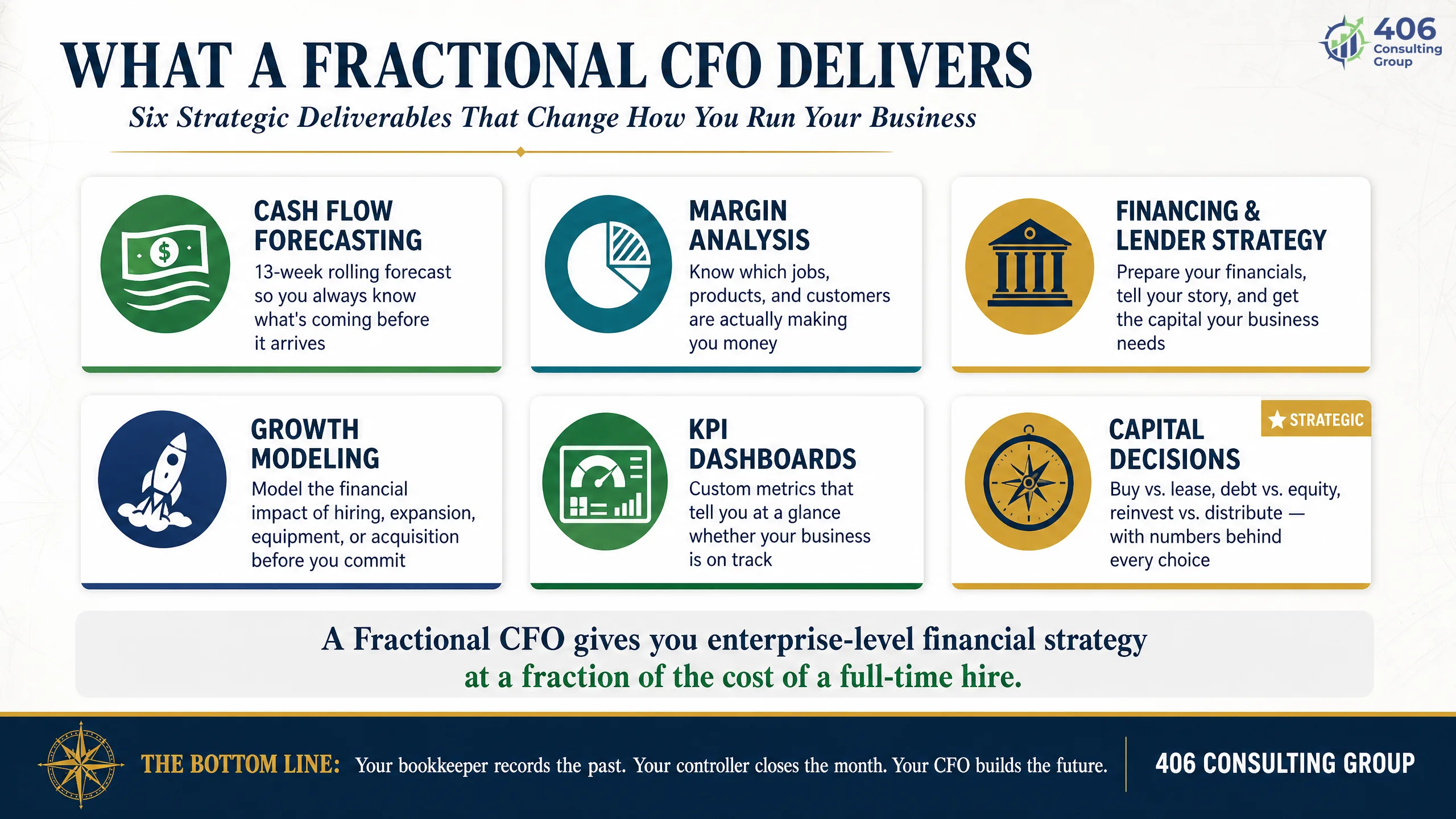
Cash flow forecasting
A rolling 13-week cash forecast so you see the crunch before it happens — and never come within a week of missing payroll again.
Margin and pricing strategy
Turning job-cost data into decisions: which work to chase, what to charge, and which customers or lines to fire.
Financing and lender strategy
Building the package that gets a yes — projections, DSCR, and the narrative an underwriter needs — and managing the banking relationship. This is where a background in commercial lending pays off directly.
Growth and scenario modeling
Before you buy the equipment, add the crew, or take the big job, you model it. What does cash do? What does profit do? What's the risk if it goes sideways?
KPIs and a real dashboard
The five or six numbers that actually run your business, tracked and reviewed monthly — not 40 metrics nobody looks at.
Capital and structure decisions
Equipment financing vs. cash, distributions vs. reinvestment, entity structure, and the tax coordination that ties it all together.
The clearest ROI case is financing. Most businesses denied a line of credit didn't have a business problem — they had a lender-package problem. A CFO fixes that. See the full scope of CFO services.
Fractional vs. Full-Time: The Cost Math for Butte
The short answer: for a Butte business under roughly $15M in revenue, fractional almost always wins the math. You get senior expertise for a monthly retainer that's a fraction of a full-time salary — because you're paying for the hours you actually need, not 40 a week.
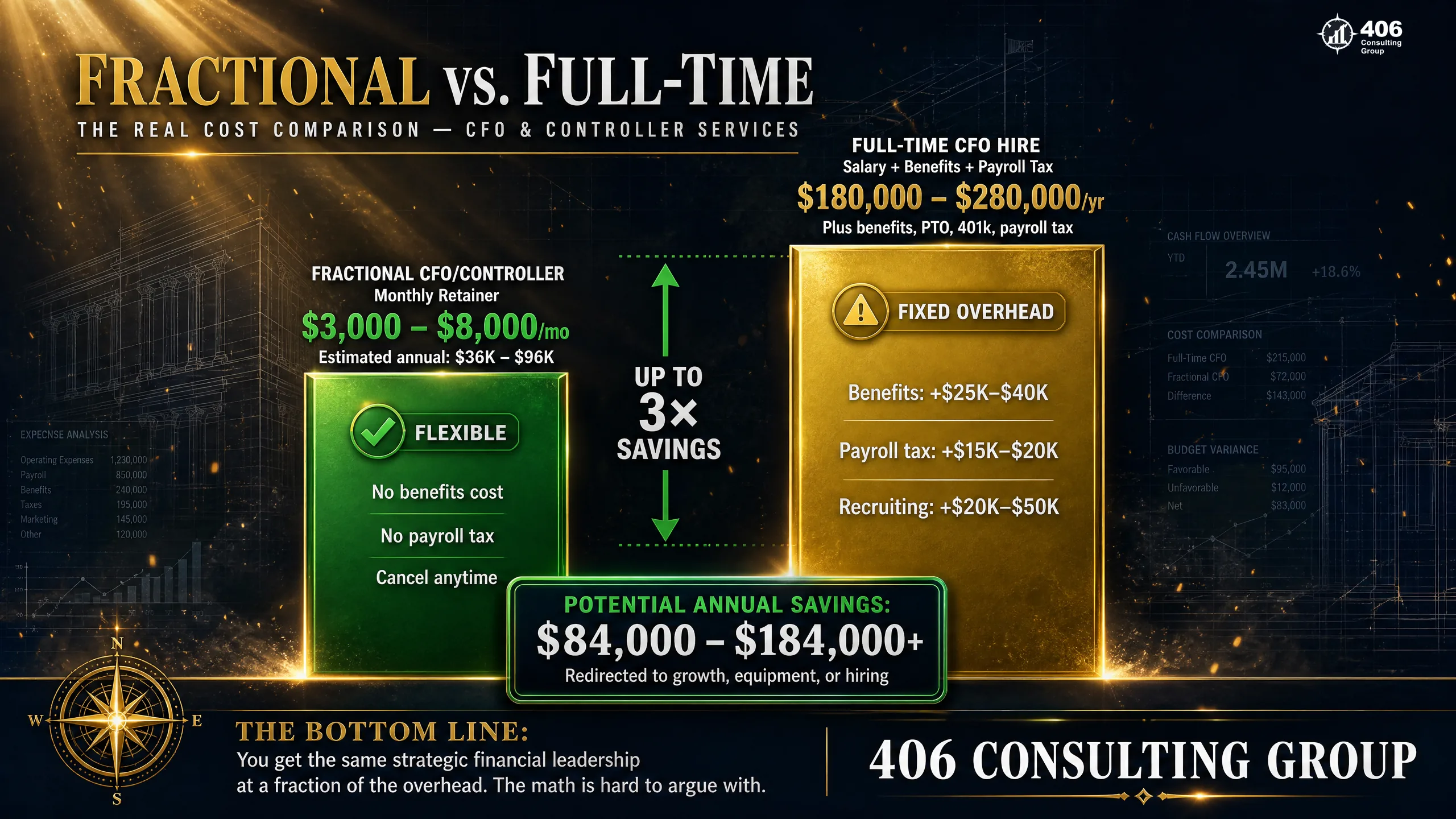
| Role | Full-time (salary + benefits) | Fractional (monthly retainer) |
|---|---|---|
| Controller | $85K–$120K salary + ~25% benefits | ~$2,500–$6,000 / month |
| CFO | $150K–$300K+ salary + ~25% benefits | ~$2,500–$5,000 / month |
| Both, coordinated | $235K–$420K+ all-in | ~$4,000–$8,000 / month |
The Butte fab shop's decision
A full-time controller in Montana would cost this business roughly $110,000 in salary plus another ~$28,000 in benefits and payroll taxes — call it $138,000 all-in — for capability it needs maybe two days a week. A fractional controller-plus-CFO engagement runs it about $5,500 a month, or $66,000 a year, for the specific expertise it actually uses.
That's roughly half the cost of one full-time hire — and it delivers both the controller foundation and the CFO strategy, not just one seat. The full-time hire only wins once volume grows enough to keep a senior person busy 40 hours a week, which for most Montana businesses is well past $15M.
Want to run your own numbers? The hire scenario calculator compares the true all-in cost of a full-time hire against a fractional engagement for your revenue and stage.
Butte-Specific Financial Realities
Financial leadership isn't generic. A few things about doing business in Butte-Silver Bow shape how CFO and controller work actually gets done here.
An industrial, project-based economy
Butte's business base skews toward mining services, fabrication, construction, and industrial trades — all project- and job-based. That makes job costing and work-in-progress tracking, a core controller function, disproportionately important here. Revenue-by-period reporting simply doesn't cut it for a job-based business.
Butte-Silver Bow's consolidated government
Butte operates a consolidated city-county government with its own business license and local filing rhythm — including the annual personal property reporting most owners forget until a penalty notice arrives. A controller keeps these local obligations on the calendar.
Montana's tax landscape
No state sales tax, but Montana taxes pass-through income at rates topping out near 5.9% (dropping to 5.65% in 2026). A CFO coordinates entity structure, owner compensation, and distributions so the tax number is planned, not discovered in April.
Local lending and bonding
Butte businesses borrow from community and regional banks and often need bonding for public and industrial work. Both underwrite on the strength of your financials and forecast — exactly the package a CFO builds. Clean, credible numbers change the terms you're offered.
Butte also has a real advantage: Montana Technological University produces strong technical and analytical talent, and the city's industrial base means serious, sophisticated operators. The businesses here don't need to be talked down to — they need a financial partner who can keep up. That's the standard we build to.
A Butte Business, Before and After
Here's what closing the financial-leadership gap looks like in practice, using our $4M Butte fabrication and industrial-services business as the example.
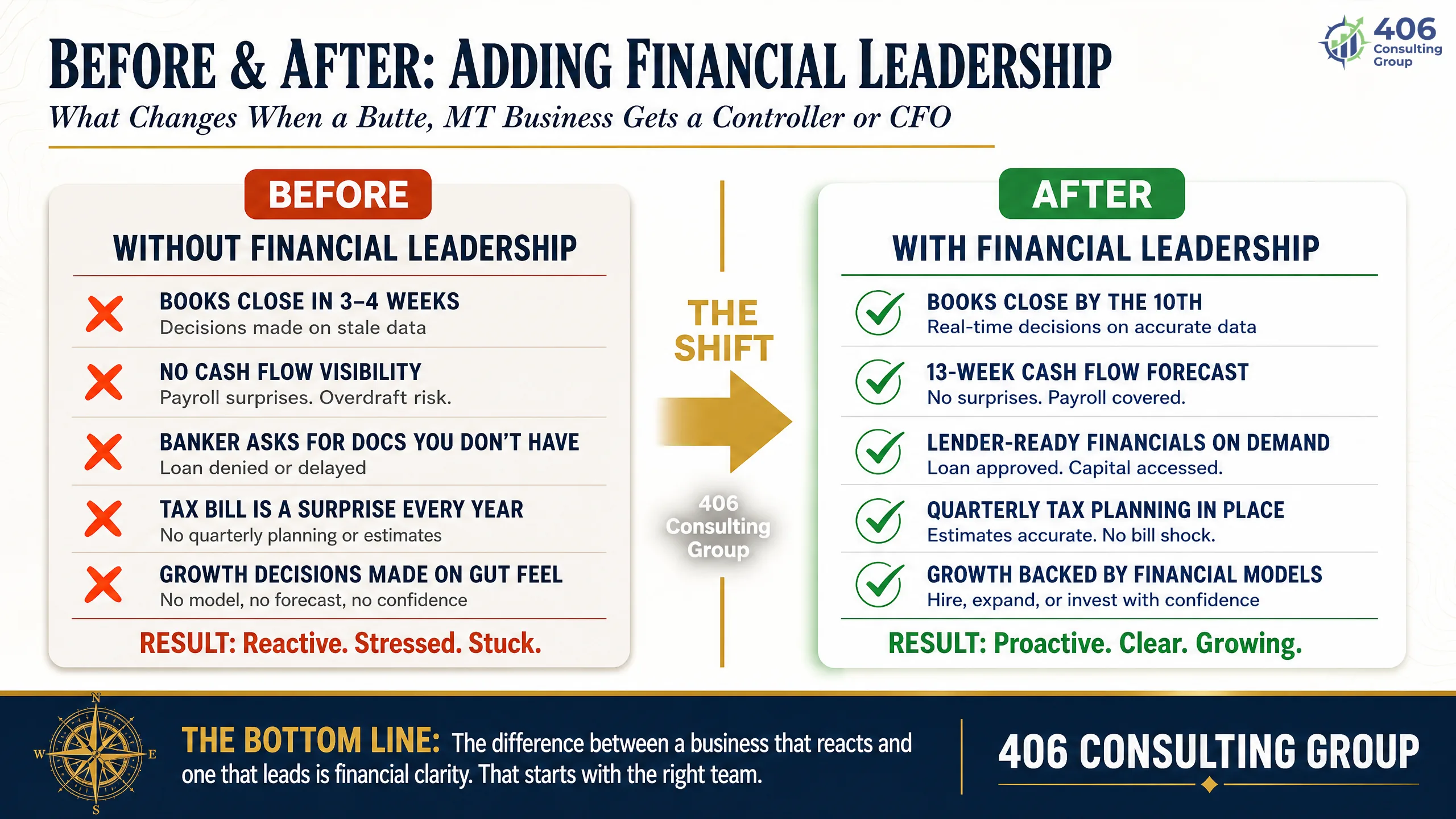
Before
- Books closed 6–8 weeks late; decisions made on stale numbers
- No job costing — repair work quietly running a 9% margin
- Cash surprises; came within days of missing payroll twice
- Line-of-credit increase denied for lack of documentation
- Surprise five-figure tax bill every April
After (controller + fractional CFO)
- Monthly close in 5 business days; current numbers, every month
- Job costing by type; bid mix shifted toward 26% structural work
- Rolling 13-week cash forecast; payroll never in question
- Line of credit approved with a clean, CFO-built package
- Tax planned in Q4 — no April surprises
How to Choose — and What to Look For
The short answer: start with a controller if your books are unreliable, start with a CFO if your books are clean but you can't plan or borrow, and in most cases you want a partner who can do both so the foundation and the strategy stay coordinated.

What to look for
Red flags
The Financial Leadership Ladder Playbook
Here's the sequence we run with a Butte business closing the gap. Order matters — you build the foundation before the strategy.
Assess where you are on the ladder
Honest diagnosis: what's your close time, do you have job costing, can you forecast cash, can you produce a lender package? This tells you which rung you're on and which you need.
Stabilize the foundation (controller)
Get the monthly close fast and reliable, stand up job costing, and put basic internal controls in place. Everything else depends on numbers you can trust.
Add forward-looking strategy (CFO)
Layer on cash forecasting, margin analysis, and — if financing is on the horizon — a lender-ready package. This is where the numbers start changing decisions.
Install the monthly rhythm
A recurring cadence: books closed, reporting package delivered, KPIs reviewed, and a monthly conversation about what the numbers mean and what to do next.
Revisit the rung annually
As revenue and complexity grow, your needs move up the ladder. Review the engagement each year so the level of support matches the business.
The whole point of the ladder is that you don't buy more than you need — and you don't stall for lack of a layer you do need. If you're not sure which rung you're on, the free financial maturity assessment is the fastest way to find out, and our CFO Services Scorecard shows exactly how we measure financial health.
Frequently Asked Questions: CFO & Controller Services in Butte, MT
What's the difference between a controller and a CFO?
A controller owns the accounting function — closing the books accurately and on time, job costing, monthly reporting, and internal controls. Their focus is the historical record: making sure the numbers are right. A CFO owns the finance function — using those reliable numbers to forecast cash, analyze margin, build lender packages, and guide growth decisions. Their focus is forward-looking: deciding what to do next. Most growing businesses need both, working together — the controller produces trustworthy numbers, and the CFO turns them into strategy.
Does my Butte business need a controller or a CFO?
Start with a controller if your books close late or you can't trust the numbers — you need the foundation fixed first. Start with a CFO if your books are already clean but you can't forecast cash, model decisions, or produce what a lender asks for. Many Butte businesses in the $1M–$5M range benefit from both, fractionally: the controller stabilizes the numbers and the CFO uses them. If your financials aren't reliable yet, a CFO can't add full value — so the controller usually comes first.
How much do CFO and controller services cost in Butte, MT?
Fractional pricing in Montana typically runs about $2,500–$6,000 per month for a controller and about $2,500–$5,000 per month for a fractional CFO, depending on complexity, transaction volume, and scope. A coordinated engagement covering both often runs roughly $4,000–$8,000 per month. Compare that to full-time salaries — $85K–$120K for a controller and $150K–$300K+ for a CFO, plus roughly 25% in benefits and payroll taxes — and fractional is dramatically more cost-effective until a business reaches the scale (generally $15M+) that keeps a full-time hire busy 40 hours a week.
What is a fractional CFO?
A fractional CFO is an experienced chief financial officer who works with your business part-time on a monthly retainer instead of as a full-time employee. You get senior-level financial strategy — cash flow forecasting, margin analysis, financing, and growth planning — for the hours you actually need, typically a few days a month. For a Montana business that needs CFO-level thinking but can't justify a six-figure salary, the fractional model delivers the expertise without the full-time cost.
Can I keep my bookkeeper if I hire a controller?
Yes — and usually you should. The bookkeeper and controller do different jobs and work together. The bookkeeper handles day-to-day transaction entry and reconciliations; the controller reviews that work, closes the books, adds job costing, and produces reliable reporting on top of it. Replacing a solid bookkeeper is rarely the goal. Adding the controller layer on top of what your bookkeeper already does is the right structure.
When should a Butte business hire a CFO?
The clearest trigger is when you can't answer forward-looking financial questions: Where will cash be in 90 days? Which jobs or service lines actually make money? Can we afford this hire or this equipment? Other triggers include a denied line-of-credit or bonding request, cash surprises despite being profitable, or a major opportunity you can't evaluate with numbers. Practically, most businesses are ready for CFO support once their books are clean and reliable — often in the $1.5M–$15M revenue range.
Does 406 Consulting Group provide CFO and controller services in Butte, MT?
Yes. 406 Consulting Group provides fractional CFO, controller, bookkeeping, payroll, and tax services for businesses in Butte and across Montana and the Intermountain West. We work virtually — a fast monthly close, a reporting package you can actually read, cash forecasting, and lender-ready financials — coordinated so the controller foundation and CFO strategy work together. Jason Anderson's operational-finance background at BP and Carrie Anderson's commercial-lending and tax experience are both directly relevant to job-based Butte businesses. Contact us to talk through which rung of the ladder your business is on.
Related Tools & Resources
A final note on how the work is delivered, because it matters less than owners fear: none of it depends on someone being in Butte. About 70 to 80 percent of our local clients never visit the office — the monthly close, reporting package, cash forecasting, and lender prep all run over secure cloud accounting and a regular call rhythm. Controller and CFO work is simply delivered remotely now, so being in Butte or anywhere else in Montana changes nothing about the financial leadership you receive.
CFO & Controller Services — Butte, MT
Know Which Jobs Make Money. Know Where Cash Is. Get the Yes From the Bank.
406 Consulting Group gives Butte businesses the controller foundation and the CFO strategy — a fast monthly close, job costing, cash forecasting, and lender-ready financials — coordinated and priced for a business your size. Let's figure out which rung of the ladder you're on.
CFO vs. Controller Quick Reference
The numbers that matter
The Financial Leadership Ladder
Which rung is your business on?
1 — Bookkeeper
Startup – ~$750K
2 — Controller
~$1M – $5M
3 — Fractional CFO
~$1.5M – $15M
4 — Full-Time CFO
~$15M+
Butte Business Over $1M?
Find your rung and close the gap.
About the Author
Jason Anderson
Co-Founder, 406 Consulting Group
Background in large-scale operational finance at BP — financial reporting, margin analysis, and capital decisions at scale. Applies that same discipline to Montana businesses: fast closes, real job costing, and the forecasting that turns numbers into decisions.
Read the Full Story