
Accounting for St. Charles Small Business:
One Financial System, Built for Illinois
The overview that ties it together — Illinois's three taxes, the PTET edge, and the books-to-tax-to-CFO stack for a St. Charles small business, delivered remotely.
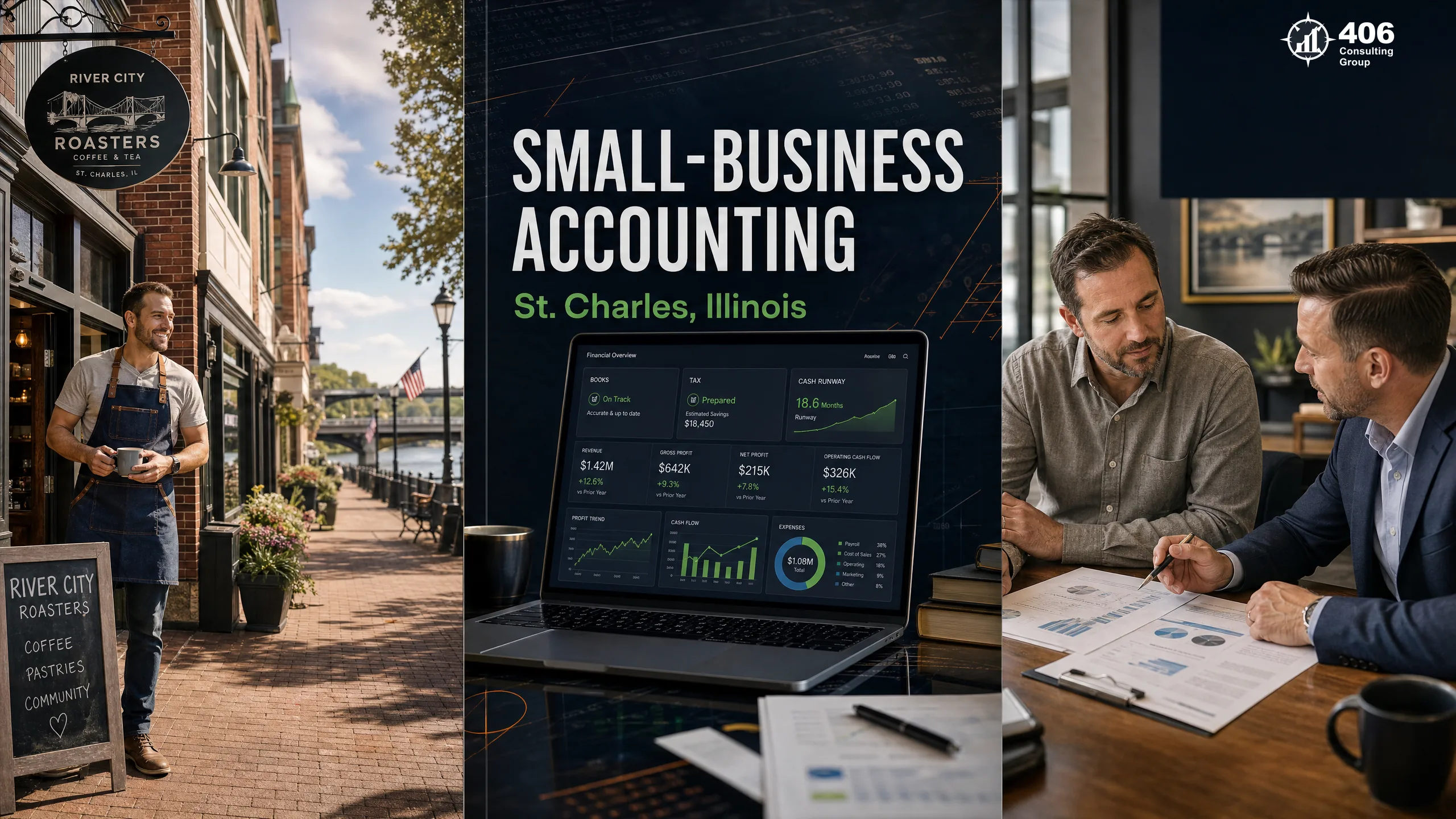
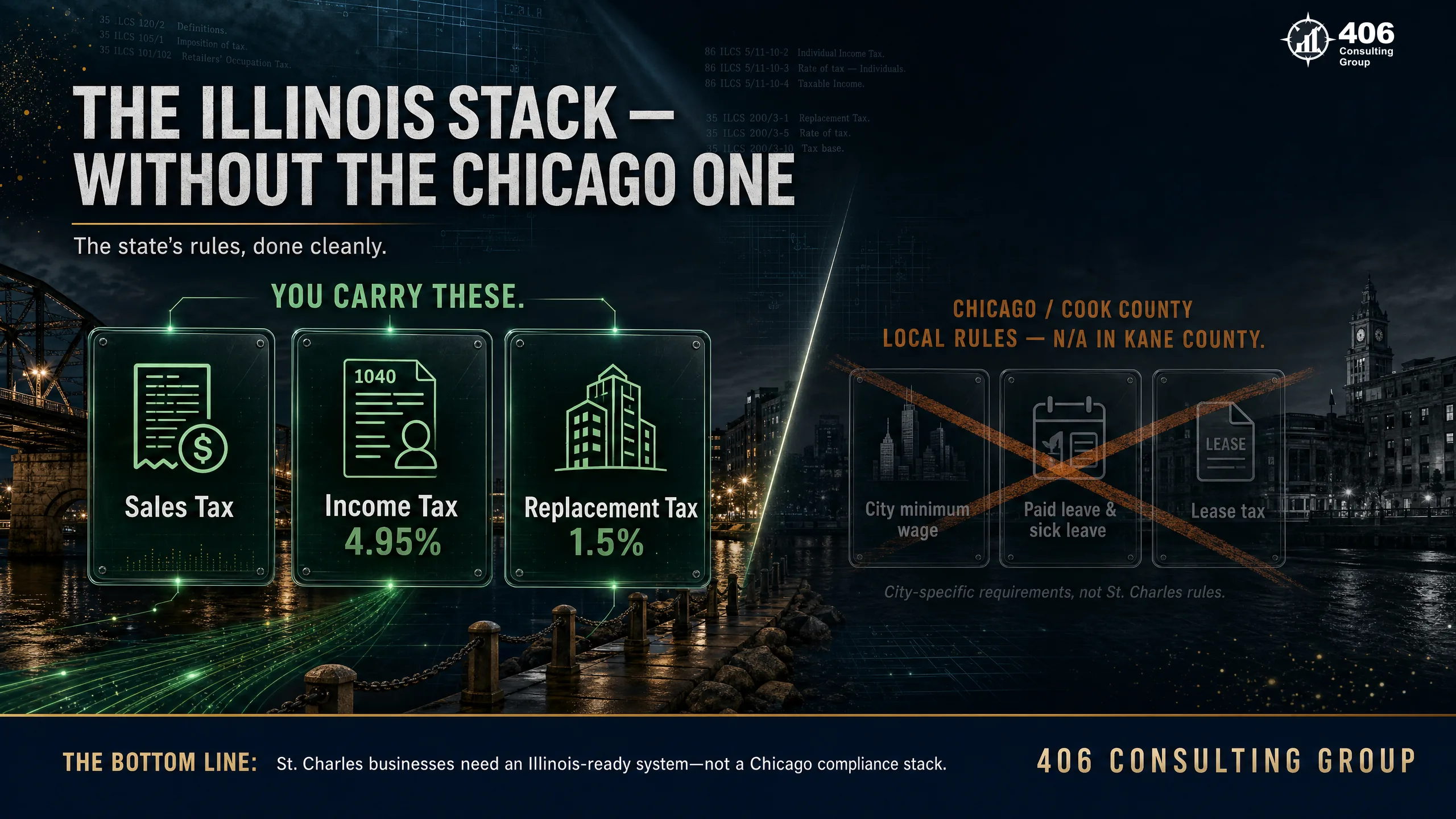
Run a small business in St. Charles and you're operating inside one of the fuller state tax setups in the country. Money leaves in four directions: a sales tax you collect and remit, a flat income tax on your profit, the Personal Property Replacement Tax charged to the entity, and the federal bill that still dwarfs the rest. Being in Kane County spares you Chicago's local machinery — no tiered city wage floors, no Cook County sick-leave ordinance, no municipal lease taxes reach you out here — but the statewide load is substantial on its own, and it demands attention you'd rather spend running the shop.
The good news: Illinois is manageable once your financial system is built for it — a single flat income rate, well-defined agencies, and a couple of genuine advantages (the PTET election chief among them) hiding inside the complexity. Whether you run a downtown shop or restaurant, a professional practice, a healthcare office, a contractor, or a Fox Valley manufacturer, the same playbook applies: track sales tax as the liability it is, set aside for the income and Replacement taxes as you earn, plan the deductions that cut both federal and state, and keep payroll clean. This guide is the overview that ties it all together — the hub of our St. Charles series.
Below: the Illinois tax picture explained simply, how to keep sales and income taxes clean, why planning works twice here (plus the PTET edge), how the books-tax-CFO stack fits together, and a segment-by-segment look at what matters for your kind of business.
By Carrie Anderson — Co-Founder, 406 Consulting Group. Commercial banking and underwriting background — 300+ loan reviews — plus advisory work with small businesses across the country. Carrie helps St. Charles and Illinois owners build financial systems that keep compliance clean and fund growth.
Quick Answer: The Illinois Small-Business Playbook
- →Three state taxes, not one: the ~8% sales tax you collect, the 4.95% income tax on profit, and the entity-level Replacement Tax — on top of federal.
- →Sales & use tax is compliance you keep clean; the income side is where planning saves money.
- →Deductions work twice (federal + 4.95% Illinois), and the PTET election can win back federal dollars on top.
- →Cash flow carries three set-asides — sales tax held, income tax, and the Replacement Tax.
- →Books → tax → CFO is a stack, delivered remotely — and our co-founder is a St. Charles native.
Table of Contents
Why an Illinois Small Business Is Different
Illinois taxes activity and income — and then adds a third layer most states don't have. Your financial system has to track the sales tax you collect, plan for the income tax you owe, and account for the Personal Property Replacement Tax on the entity. An owner who moved a business in from another state, or an accountant who learned in a simpler system, can easily miss that third piece entirely.
The St. Charles upside: Illinois's rules without Chicago's. A Kane County business tracks none of the city wage tiers, county sick-leave accruals, or municipal lease taxes — just the state framework, run properly.
It cuts both ways. Illinois is cleaner than its reputation in some respects — a single flat income rate rather than a bracket puzzle, and defined state agencies — but you can't ignore the income and Replacement taxes, and you can't get sloppy with the ~8% sales tax. The businesses that stay calm and compliant are the ones whose books were built for all of it from the start.
The rest of this playbook is the how. It builds on clean books, so if yours have fallen behind, the St. Charles bookkeeping guide is the place to start.
The Illinois Tax Picture
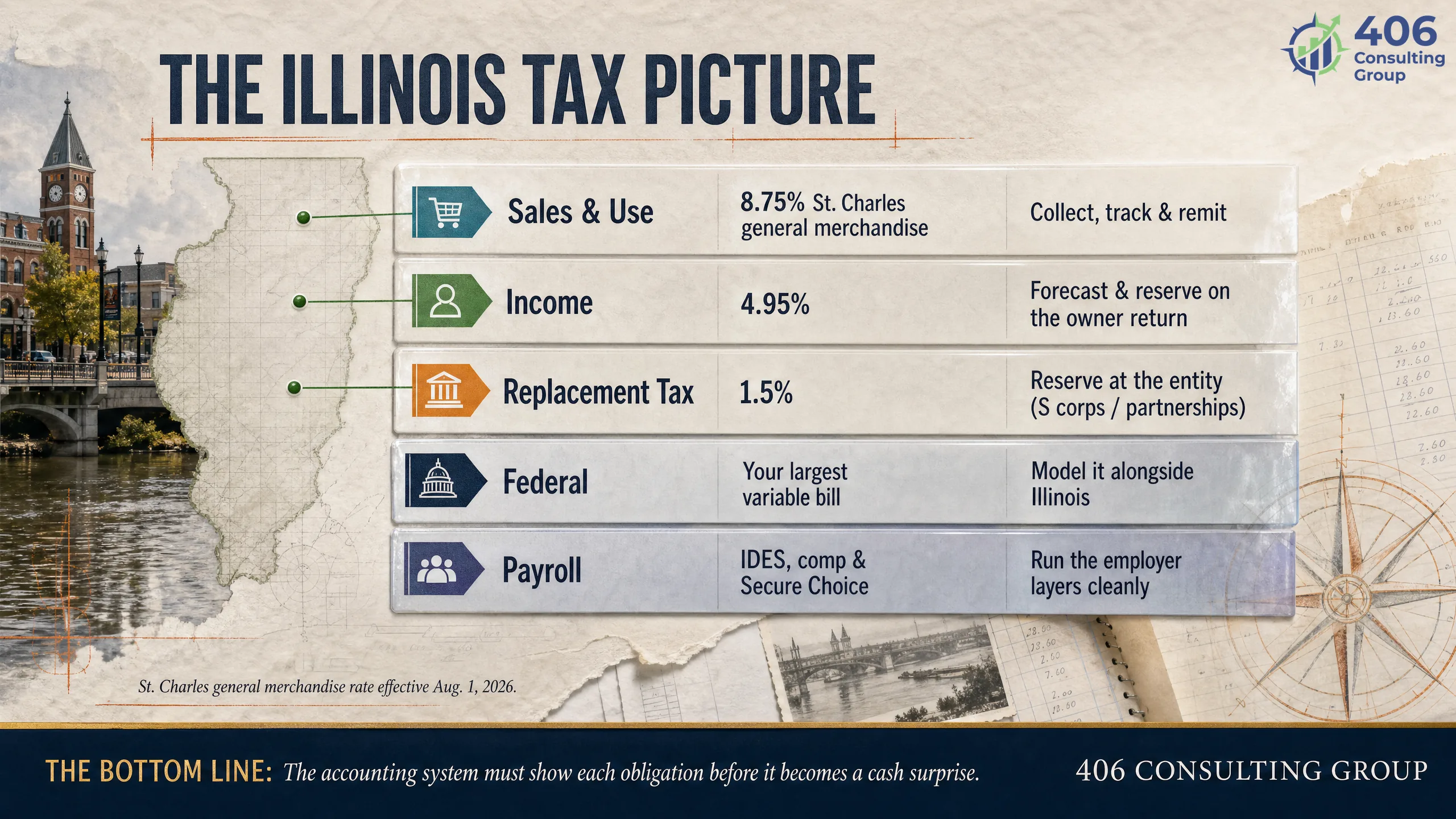
A St. Charles business deals with several tax realities, and the biggest mistake is treating them as one blur. Here's the whole picture in one place.
| Tax | What it is | Your job |
|---|---|---|
| Sales & use tax | ~8% in St. Charles — collected / on untaxed purchases | Collect, hold as a liability, remit — don't spend it |
| Illinois income tax | Flat 4.95%, usually on your personal return | Set aside as you earn; plan deductions to cut it |
| Replacement Tax (PPRT) | 1.5% pass-through / 2.5% C-corp, at the entity | Budget for it — sole proprietors are exempt |
| Federal income tax | IRS, on your profit — your largest bill | Plan proactively — the levers live here, plus PTET |
| Payroll taxes | Federal + IL withholding, IDES, comp, Secure Choice | Set up correctly, process cleanly |
The next sections take the sales side, the income side, and the planning that ties them together.
Sales & Use Tax
Illinois sales tax is money you collect on the state's behalf and hand back — you never owned it. You also owe use tax on business purchases that arrived without Illinois tax, typically out-of-state or online buys. In St. Charles the combined rate sits near 8% once local add-ons stack on the 6.25% state base, and because the exact rate shifts block to block across Kane and DuPage, pinning the correct one to each sale is a real, if small, discipline.
The rule that saves businesses: don't let collected sales tax masquerade as cash. It parks in your account but belongs to Springfield, and at ~8% the balance climbs quickly — spend it and you're short the day the return posts. Its overlooked twin is use tax: that "tax-free" online equipment order usually still owes Illinois. Books built right keep the sales-tax liability in plain view and surface use-tax situations before they surprise you.

We go deep on sales tax, use tax, and rate accuracy in the St. Charles bookkeeping guide.
Income Tax, PPRT & Set-Asides
Illinois's income tax is a flat 4.95% with no standard deduction, and for most small businesses that profit flows through to the owner's personal return, on top of federal tax. Layered on it is the Personal Property Replacement Tax — 1.5% of net income for partnerships and S-corps, paid at the entity level (sole proprietors are exempt). The practical job is to set aside for both as you earn rather than facing them at filing.
For most owners the income tax rides on the personal return, so its funding comes straight out of the cash that feels spendable. Illinois isn't lenient about it, either: it wants quarterly estimated payments once you'll owe more than $1,000, and it penalizes underpayment — meaning you carry a federal and an Illinois estimate track. Reserve a slice of profit as it lands and both of those, plus the Replacement Tax, become numbers you calculate instead of scramble for.

The income side is also where proactive planning saves real money — which is the next section. We go deeper in the St. Charles tax guide.
Payroll in Illinois
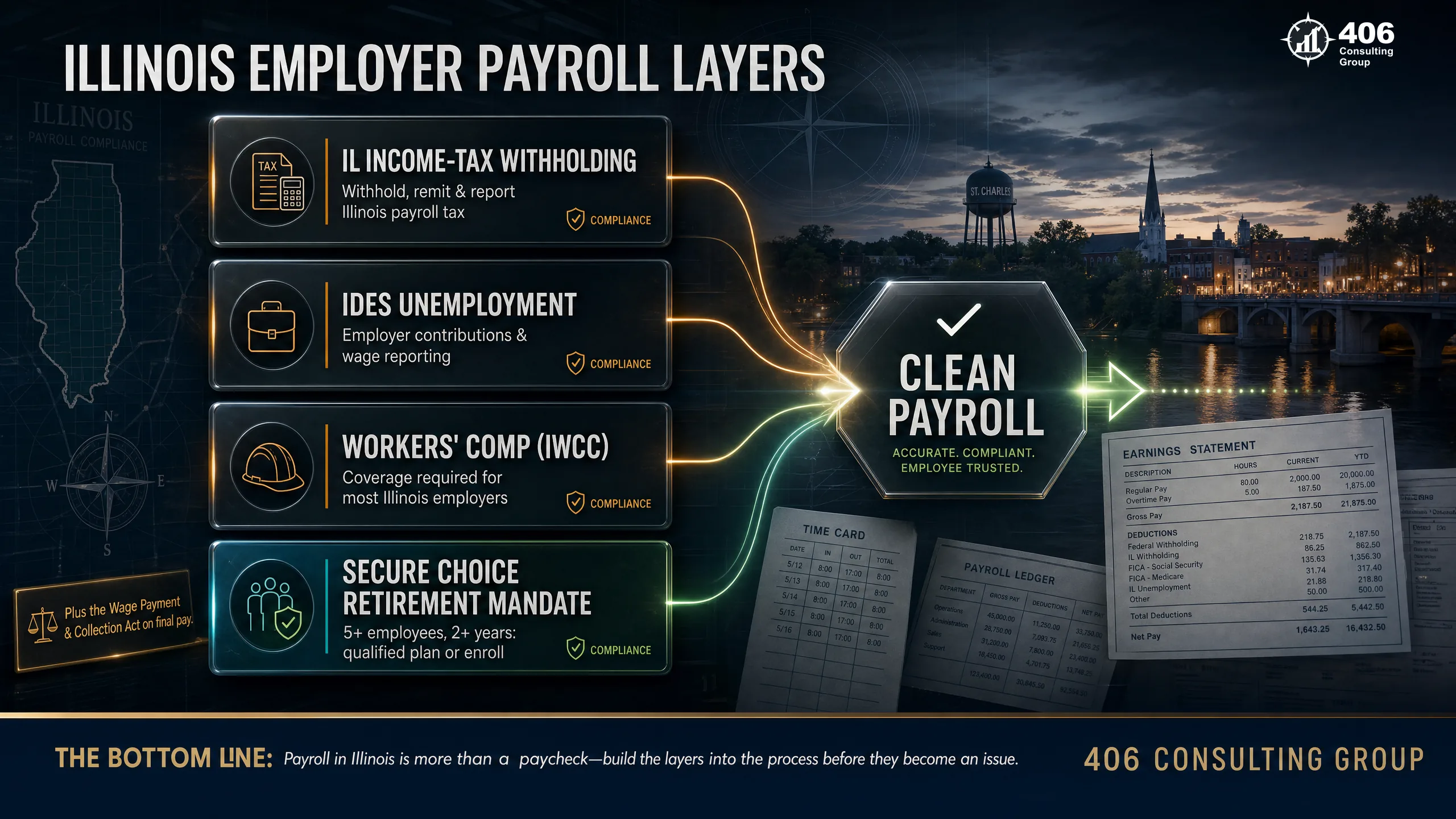
Hiring switches on Illinois's payroll stack: flat-rate state withholding, IDES unemployment, private-carrier workers' comp, and — if you sponsor no plan of your own — enrollment in Illinois Secure Choice. On top of that, the state's Wage Payment and Collection Act governs final checks and deductions tightly, so a payroll slip becomes a legal exposure, not just an accounting one.
Individually none of these are complicated, but Illinois punishes getting them wrong, and unwinding a payroll error after the fact is slow and costly. Nail it from the first check — withholding, IDES registration, comp in force, Secure Choice — and payroll runs as quiet background routine instead of a liability you stumble onto later. That's the work our payroll team carries for Illinois employers.
Planning That Works Twice (Plus PTET)
Every deduction you engineer lands twice in Illinois — once against the federal bill, once against the 4.95% state one — which is exactly why planning earns more in a high-tax state, not less. The workhorse levers: electing S-corp status to trim federal self-employment tax (balanced against the Replacement Tax it switches on), timing Section 179 equipment buys, shifting income and expenses between years, and funding a retirement plan.
Then there's the lever unique to Illinois: the PTET election, which lets a pass-through pay the state income tax at the entity level and deduct it federally, working around the $10,000 SALT cap — often thousands of federal dollars saved for a profitable business. One Illinois caveat on equipment: the state decouples from federal bonus depreciation, so that piece is spread over years for Illinois even when it's immediate federally. For a profitable St. Charles owner, the levers together can save five figures a year.
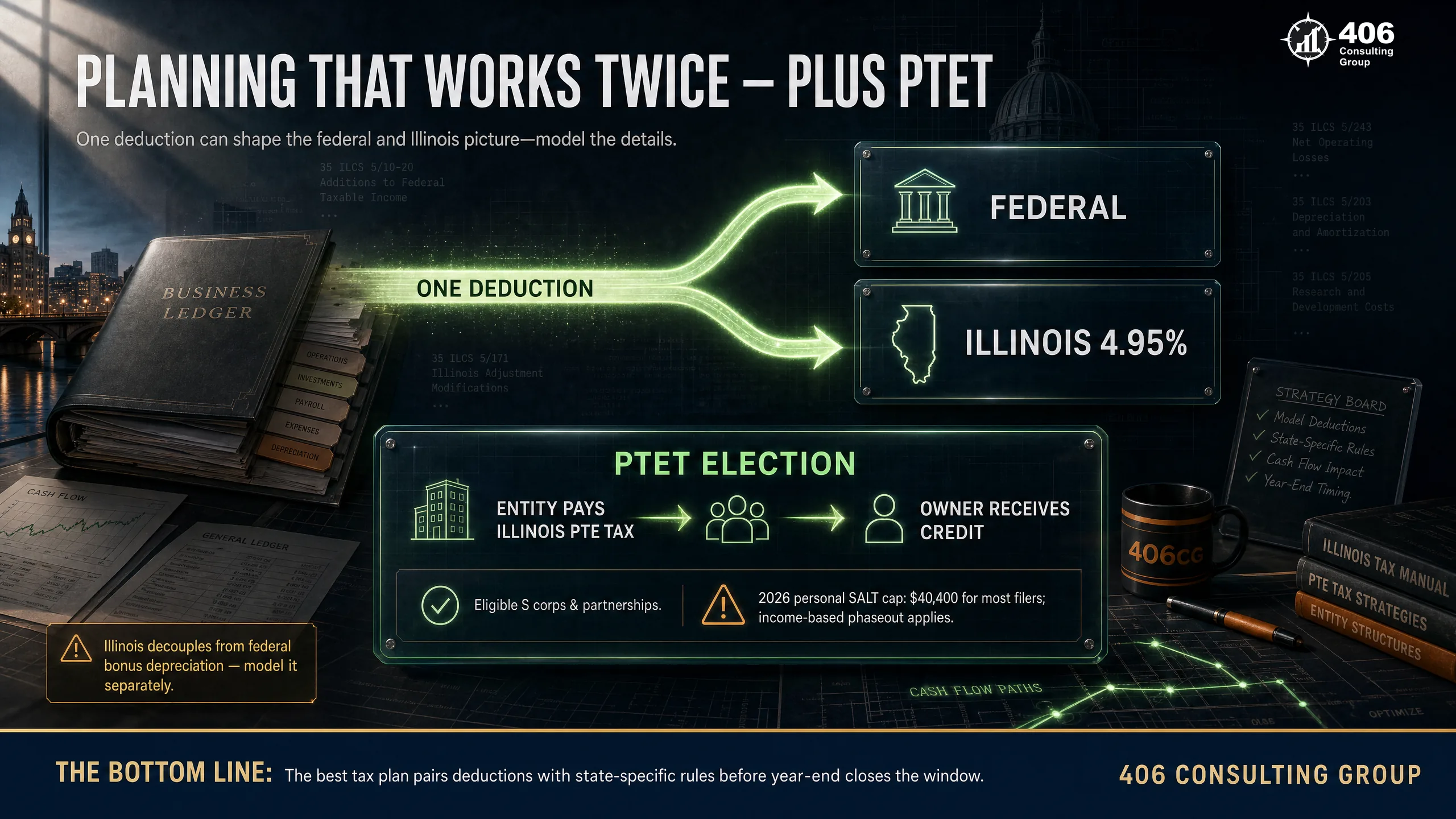
We walk through all the levers, with real numbers, in the St. Charles tax guide — and you can estimate S-corp savings on your own numbers with our S-Corp calculator.
Cash Flow: Three Set-Asides
Your bank balance flatters you, because three obligations are already buried inside it: sales tax you're holding for the state, income tax coming due on profit, and the entity's Replacement Tax. Run the business off that raw number and you're budgeting with money that was never yours to spend.
The fix is a simple discipline: treat collected sales tax as a liability the moment it lands, and set aside a share of profit for the income and Replacement taxes as you earn. This matters more as you grow — bigger revenue means bigger obligations siphoning off cash that feels available but isn't. Get it right and you avoid the "we were up all year and still ran tight" trap that catches so many otherwise-healthy businesses.
It's the classic "profitable but broke" problem with an Illinois twist — we break down the general version in Profitable But No Cash, and the forecasting side in the St. Charles CFO & controller guide.
The Books → Tax → CFO Stack
Small-business accounting isn't one service, it's a stack — clean books at the base, proactive tax planning on top, and financial leadership steering the whole thing. Each layer depends on the one beneath it, and the biggest wins come from having them work together instead of buying them piecemeal from three disconnected people. It's the same climb described in the Financial Maturity Ladder.
Bookkeeping & payroll
Illinois-ready, current books and correctly handled payroll — the foundation everything reads from.
St. Charles bookkeeping guide →Tax planning
The levers, the PTET election, and the three Illinois set-asides — so a good year isn't given back at tax time.
St. Charles tax guide →Controller & CFO
Reliable reporting, cash forecasting, margin analysis, and financing readiness — numbers turned into decisions.
St. Charles CFO & controller guide →Here's our real differentiator: because our background is in running whole businesses — not just accounting — we design your financial system around how it affects operations, pricing, hiring, and cash across the whole company, not just the ledger. Not sure which layer you need first? Our Financial Maturity Assessment maps it in about eight minutes.
The Segment-by-Segment View
The playbook is shared, but each corner of the St. Charles economy asks something a little different of the books.
| Segment | What to watch |
|---|---|
| Retail & restaurants | Charging the right ~8% rate, reconciling daily deposits, and pacing through downtown-event swings |
| Professional services | Converting billable time into collected receivables and reading true project margin |
| Healthcare & dental | Carrying slow insurance receivables against a payroll-heavy cost base |
| Construction & trades | Per-job costing and prevailing-wage certified payroll, with materials tax priced into every bid |
| Light manufacturing | COGS and inventory control, plus claiming the machinery sales-tax exemption |
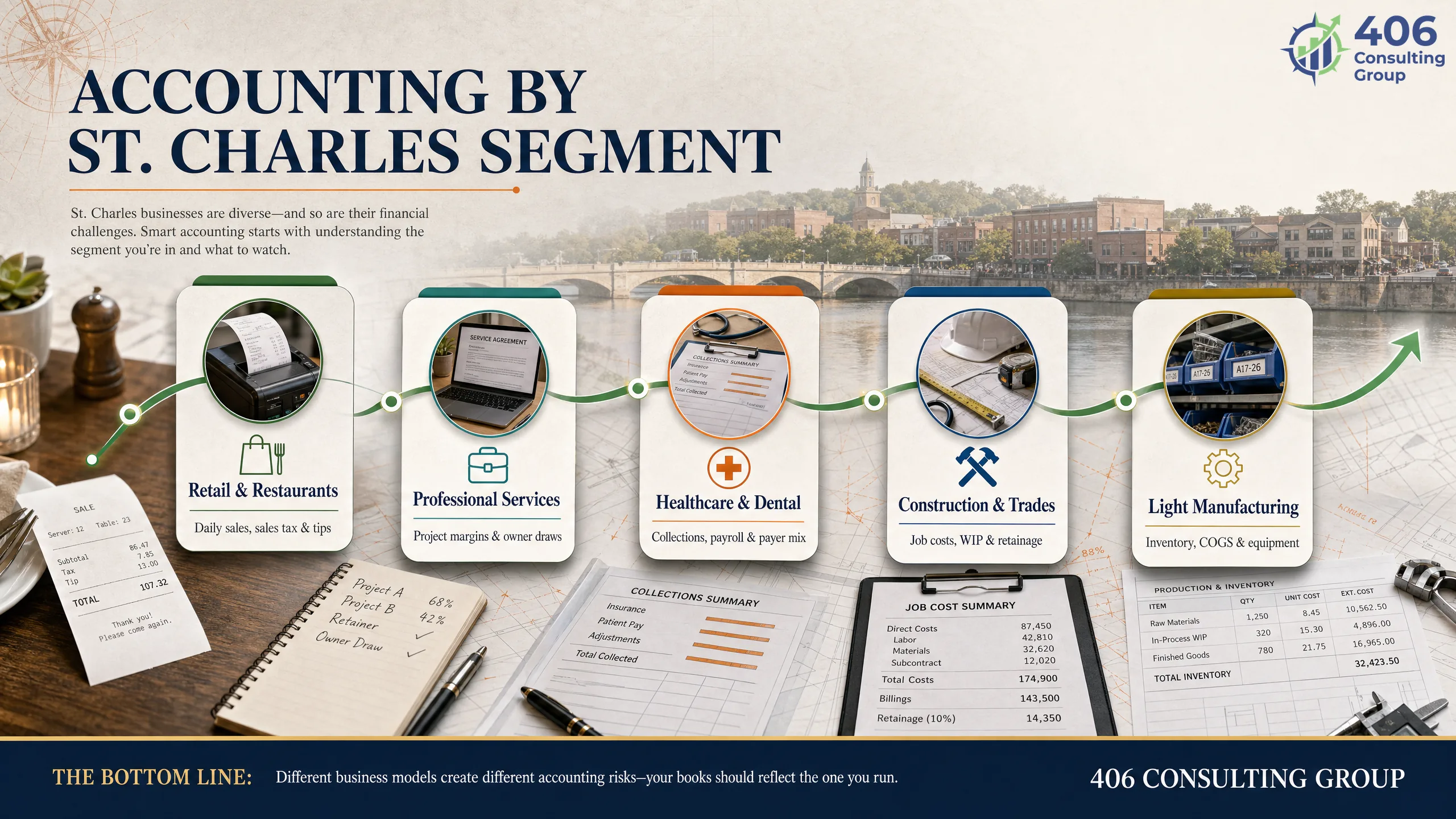
The particulars change by segment; the spine doesn't — sales tax stays a liability, profit stays legible for the income and Replacement-Tax reserves, and cash gets run off what's genuinely yours. We shape the system to your niche without losing the whole-company view.
Remote & How to Get Started
What a St. Charles business needs is a partner who knows Illinois — sales and use tax, the income and Replacement taxes, PTET, state payroll, and federal planning — not one who happens to be down the street. An Illinois-savvy remote firm beats a local generalist, and the work is a natural fit for remote delivery.
It's genuinely how modern accounting works — even for clients nearby: secure cloud accounting, connected bank feeds, shared screens, and a steady rhythm. Distance isn't the variable it used to be, so a St. Charles business gets responsive, Illinois-savvy service — with a hometown bonus, since our co-founder grew up in the Fox Valley and knows Illinois cold. Because our background is in running whole businesses, we build the financial system around your entire operation, not just the ledger.
Get the books Illinois-ready & current
Everything reads from here — sales tax as a liability, profit readable for set-asides, clean payroll.
Layer in tax & cash planning
The levers, PTET, correct set-asides, and a cash discipline that respects the three Illinois claims on your account.
Steer with the numbers
Use reliable reporting to manage margin, get financing-ready, and grow on facts instead of gut.
Wherever you are in that path, we can meet you there — and build the financial system around how your whole business actually runs.
FAQ: St. Charles Small-Business Accounting
What taxes does a St. Charles small business actually pay?
Four bills, really. Illinois sales tax — about 8% combined in St. Charles — that you collect and remit, plus use tax on anything bought untaxed. A flat 4.95% Illinois income tax most owners pay on their personal return. The Personal Property Replacement Tax charged to the entity (1.5% for pass-throughs, 2.5% for C-corps). And federal income tax, the biggest of the four. Add payroll obligations once you hire — state withholding, IDES, workers' comp, Secure Choice. What you skip, sitting in Kane County: the Chicago and Cook County taxes entirely.
What's the Replacement Tax and why haven't I heard of it?
The PPRT is Illinois's business income tax that stepped in when the state scrapped the old local personal-property tax — it's literally the replacement. Partnerships and S-corps owe 1.5% of net income, C-corps 2.5%, assessed on the entity, in addition to whatever owners pay personally on the same profit; sole proprietors owe none. Transplant owners miss it more than any other Illinois tax, because their prior state had no equivalent. A system built for Illinois simply reserves for it as profit accrues.
What's the most common Illinois small-business money mistake?
Treating collected sales tax as spendable cash — at ~8%, it builds up quickly and it belongs to the state. Close behind: forgetting the Replacement Tax, not setting aside for income tax as you earn, and leaving the PTET election on the table. All of these are prevented by books that track sales tax as a liability, keep profit readable for the income and Replacement-Tax set-asides, and a tax partner who models PTET each year.
Do I need a bookkeeper, an accountant, or a CFO?
Often all three over time, in that order — it's a stack. Clean, Illinois-ready bookkeeping is the foundation. Proactive tax planning (the levers, PTET, and the three set-asides) sits on top. Financial leadership — a controller for reliable reporting, a fractional CFO for cash forecasting, margin analysis, and financing — comes as the business grows and decisions get bigger. The layers work best together; our Financial Maturity Assessment can point you to which you need first.
Can 406 Consulting Group work with my St. Charles business remotely?
Yes. We work with retail, restaurants, professional services, healthcare, construction, and manufacturers across St. Charles, the Tri-Cities, Kane County, and Illinois through secure cloud accounting — bookkeeping and payroll, tax planning, and fractional controller and CFO services. What matters is Illinois expertise (sales and use tax, the income and Replacement taxes, PTET, state payroll, federal planning), not office proximity — and our co-founder is a St. Charles native. Because our background is in running whole businesses, we design the financial system around your entire operation.
Keep Reading — The St. Charles Series
Small-Business Accounting — St. Charles, IL
One Financial System, Built for Illinois.
406 Consulting Group gives St. Charles businesses Illinois-ready books, tax planning that cuts both your federal and state bill, and the controller and CFO leadership to grow — sales tax, income and Replacement taxes, and payroll handled, delivered remotely. Let's build the system your business needs.
Illinois Small-Business Quick Reference
St. Charles, IL — Kane County
The Illinois Playbook
Running a Business in St. Charles?
Books to CFO strategy, built for Illinois.
About the Author
Carrie Anderson
Co-Founder, 406 Consulting Group
Commercial banking and underwriting background — 300+ loan reviews — plus advisory work with small businesses across the country. Carrie helps St. Charles owners build financial systems that keep Illinois compliance clean and fund growth.
Read the Full Story