
Accounting for St. George Businesses:
The Washington County Playbook
Tourism, short-term rentals, real estate, and a construction boom on Utah's flat-tax base — St. George accounting has demands a generic approach can't meet. Here's the whole playbook: bookkeeping, tax, and financial leadership.

St. George is one of the fastest-growing corners of the country, and its economy has a distinct shape: tourism and short-term rentals anchored by Zion and the outdoors, a residential and second-home construction boom, and a large, affluent retiree population driving healthcare and services — all on Utah's low, flat-tax base. Real estate runs through nearly all of it, much of the economy is seasonal, and a lot of the ownership is out of state. That combination makes accounting here more specialized than a generic approach can handle, and quite different from the tech scene up north.
This is the whole playbook — the one-page map of how accounting works for a St. George business, and where to go deeper on each piece. Bookkeeping, tax, and financial leadership each get their own detailed guide; this ties them together for an owner who wants to see how the rentals, real estate, construction, and seasonality pieces fit into one clear picture.
By Carrie Anderson — Co-Founder, 406 Consulting Group. Commercial banking and underwriting background — 300+ loan reviews — advising real-estate, hospitality, and small-business owners across the Mountain West.
Quick Answer: Accounting for a St. George Business
- →Short-term rentals owe sales tax plus a transient room tax, and need per-property books.
- →Real estate leads the tax planning: depreciation, cost segregation, the STR rules, and 1031 exchanges.
- →Seasonality is real: tourism cash swings, so plan reserves and read numbers annually.
- →Utah taxes: a low flat income tax (~4.5%) plus ~6.75% sales tax in Washington County, no B&O.
- →All of it remote — and many St. George owners are out of state anyway.
Table of Contents
Why Washington County Accounting Is Different
Most accounting advice assumes a steady business selling one thing in one place. St. George rarely fits. A short-term rental owner handles lodging taxes and per-property books, and taps real-estate tax strategy. A seasonal hospitality business has to manage cash through big swings. A home builder needs job costing. And Utah's income tax means planning pays off on two returns, not one. Four different demands, and a generic setup meets none of them well.
The four pillars are the same as any business — bookkeeping, tax, financial leadership, and the system underneath — but in St. George each takes a rental-real-estate-and-seasonal shape. This guide maps all four and points to the deep dives, so you can see how the pieces fit before diving into any one.
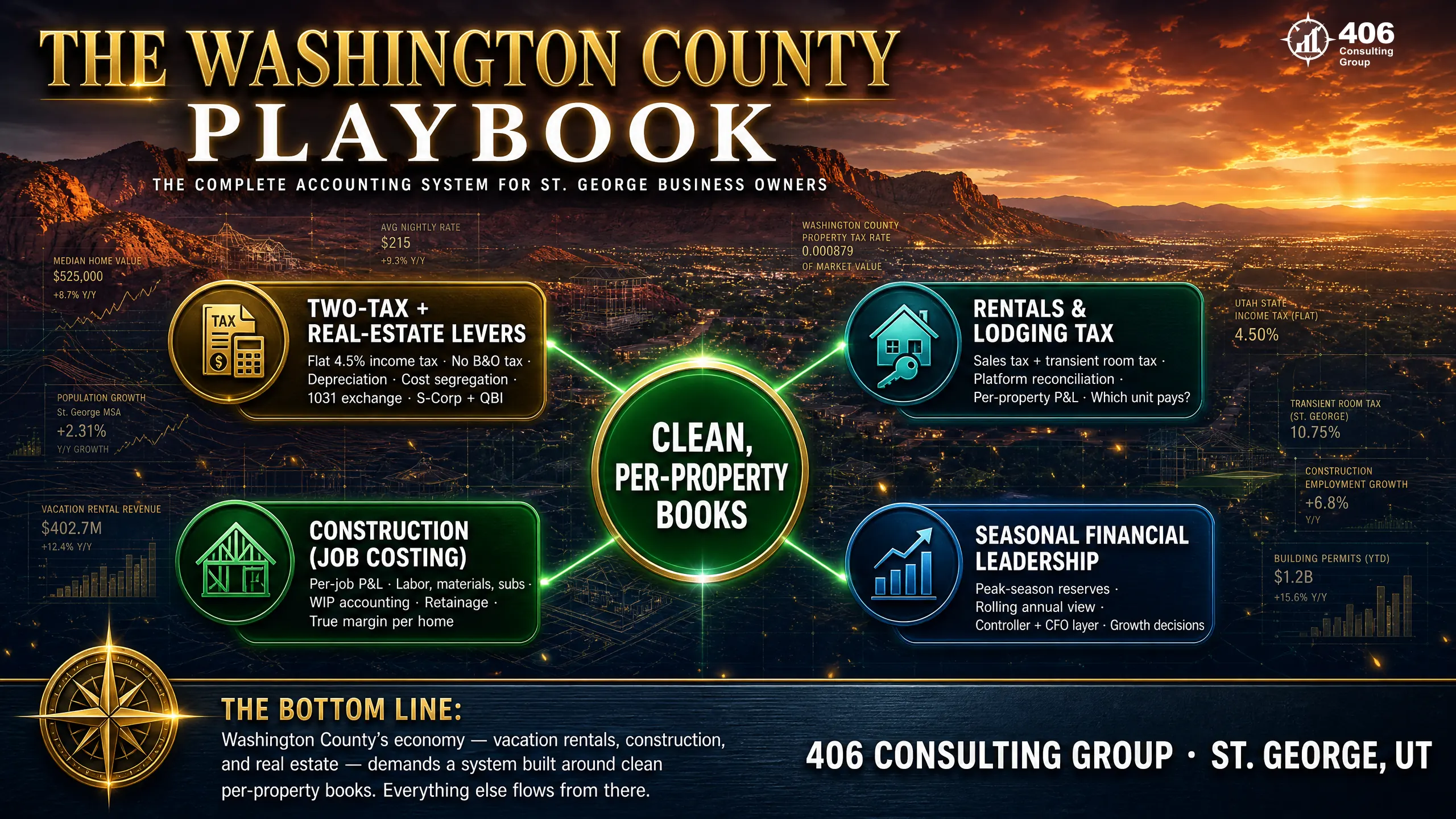
Start anywhere below — the big idea is that a rental, real-estate, and seasonal economy on a two-tax base rewards accounting built for exactly that.
The Utah Tax Picture
Here's the whole state tax picture for a typical St. George business, at a glance:
| Tax | Utah reality |
|---|---|
| State income tax | Low flat rate (~4.5%) — so planning cuts both the Utah and federal bill |
| Sales & use tax | ~6.75% combined in St. George (Washington County) — verify |
| Gross-receipts / B&O | None |
| Short-term lodging | Sales tax plus a transient room tax (and possible resort/tourism taxes) |
| County | Washington County |
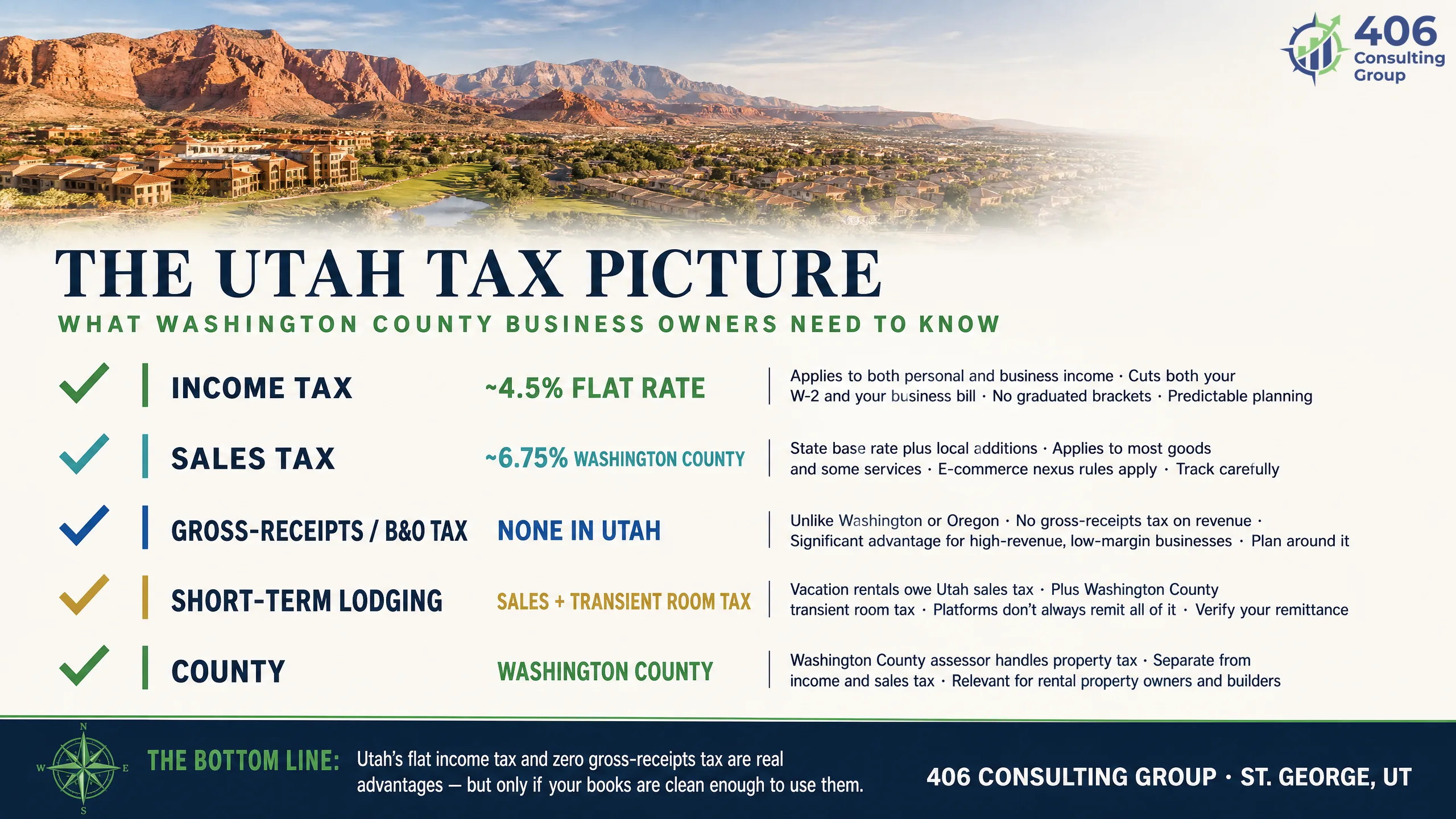
Because Utah has an income tax, proactive planning is worth more here than in a no-income-tax state. The full playbook is in the St. George tax guide.
Short-Term Rentals & Hospitality
Short-term rentals are central to the St. George economy, and they carry specific accounting needs. On compliance, a stay generally owes state and local sales tax plus a transient room tax, with possible resort or tourism taxes on top, and platforms don't always collect all of it — the owner is on the hook for the gap. On performance, an owner needs per-property books — income and expense by property — to know which rentals actually make money once cleaning, management, and maintenance are counted. The same discipline serves restaurants and tour operators, where seasonality and margins rule.
The combination — lodging-tax compliance you can't ignore and per-property numbers most owners never see — is exactly why a rental-heavy business needs books built for it.

Compliance mechanics are in the bookkeeping guide; the per-property economics are in the CFO & controller guide.
The Real-Estate Tax Playbook
In a real-estate-heavy market, the biggest tax dollars are in the property. Rental real estate can be depreciated, and a cost-segregation study can front-load a large amount of that deduction into the early years. For short-term rentals, if the average stay is short and you materially participate, the activity may be treated as non-passive — potentially letting those losses offset other income. And when an appreciated property sells, a 1031 exchange can defer the capital-gains tax and recapture by rolling into another property.
These are powerful and genuinely technical, and because Utah has an income tax, the savings hit both returns. The operating businesses that serve the area also get the usual profitable-owner levers — the S-corp, the QBI deduction, and the Utah pass-through election. Together they make proactive planning worth real money for a St. George owner.
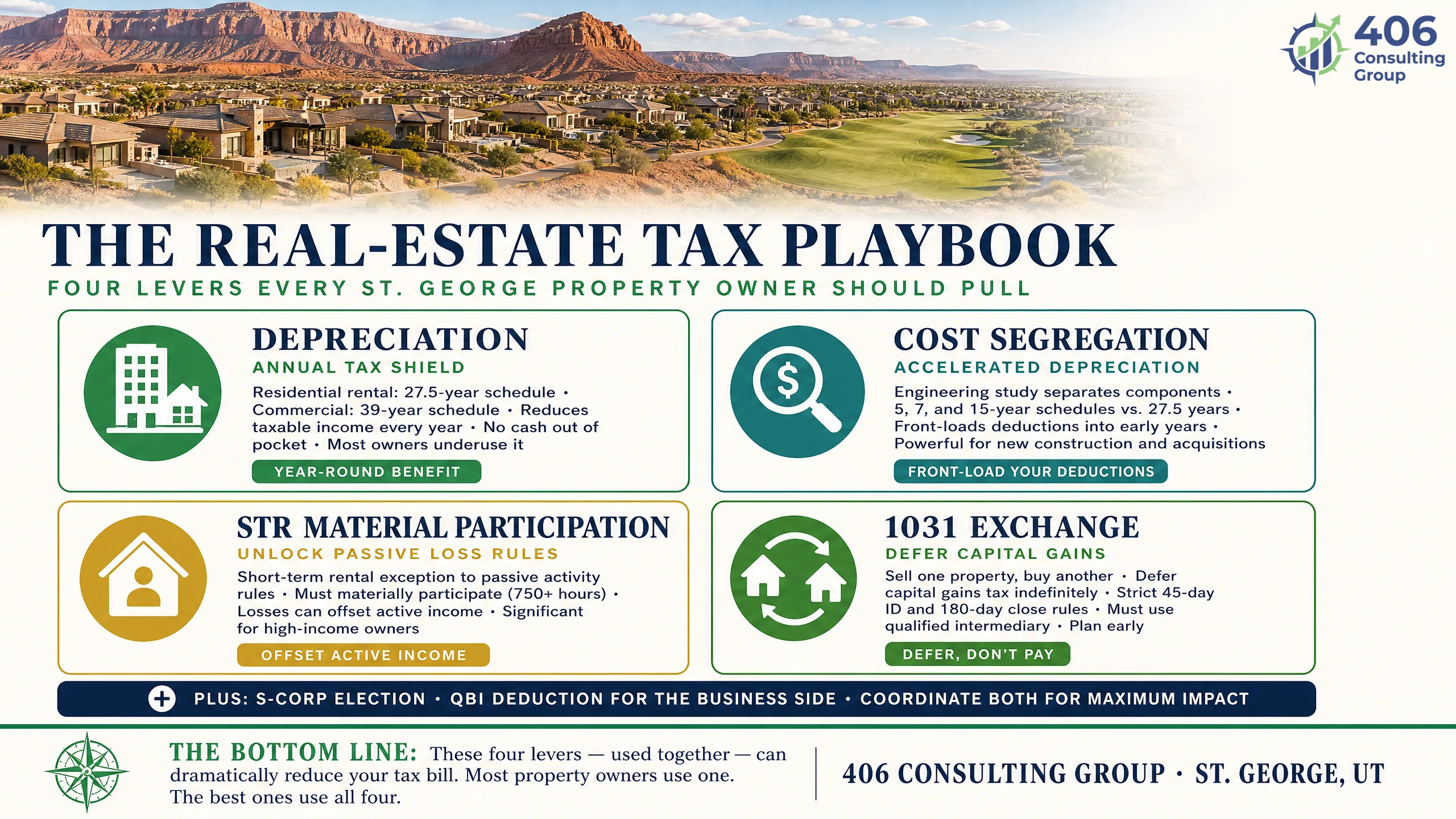
The full detail — hedged and worth real money — is in the St. George tax guide.
Construction & the Residential Boom
The residential and second-home building boom feeding St. George's growth needs construction-grade accounting: job costing that ties labor, materials, subs, and equipment to each home so you can see the real margin, work-in-progress tracking, and equipment-timing tax moves (Section 179 and bonus depreciation) that cut both bills. Without it, a builder can look profitable overall while individual homes quietly lose money — and can't quote the next one accurately.
It's a genuinely different discipline from generic bookkeeping, covered across the bookkeeping and CFO guides. For a deep look at which jobs actually make money, see our flagship on unit economics.
When You Need More Than a Bookkeeper
As a St. George business grows — another rental, a second location, a bigger build — clean books stop being enough. You need the numbers to tell you which properties or locations make money, how much cash to reserve for the slow season, and whether the next acquisition pencils. That's the step up to financial leadership: a controller who keeps the books reliable and broken out by property, location, or job, and a CFO who turns them into per-property economics, a seasonal cash plan, and financing analysis.
The classic St. George triggers are seasonality and financing: cash tight in the off-season, or a property purchase that needs underwriting before you commit. You don't need a six-figure hire — fractional leadership scales the controller-and-CFO thinking to your stage.

What each role delivers and what it costs is in the St. George CFO & controller guide.
Accounting by St. George Segment
St. George's economy is led by tourism and construction, with healthcare and services for a large retiree base around them — and each asks something different of the books.
| Segment | Accounting priorities |
|---|---|
| Short-term rentals & hospitality | Lodging + transient room tax, per-property P&L, seasonality, real-estate tax strategy |
| Residential & second-home construction | Job costing, WIP, subs/1099s, retainage, equipment timing |
| Restaurants & tour operators | Food/labor cost, tips, sales tax, equipment, seasonality |
| Healthcare & retiree services | Insurance receivables, payroll, utilization, clean reporting |
| Home services & professional | Job or client profitability, receivables, 1099s, scheduling |
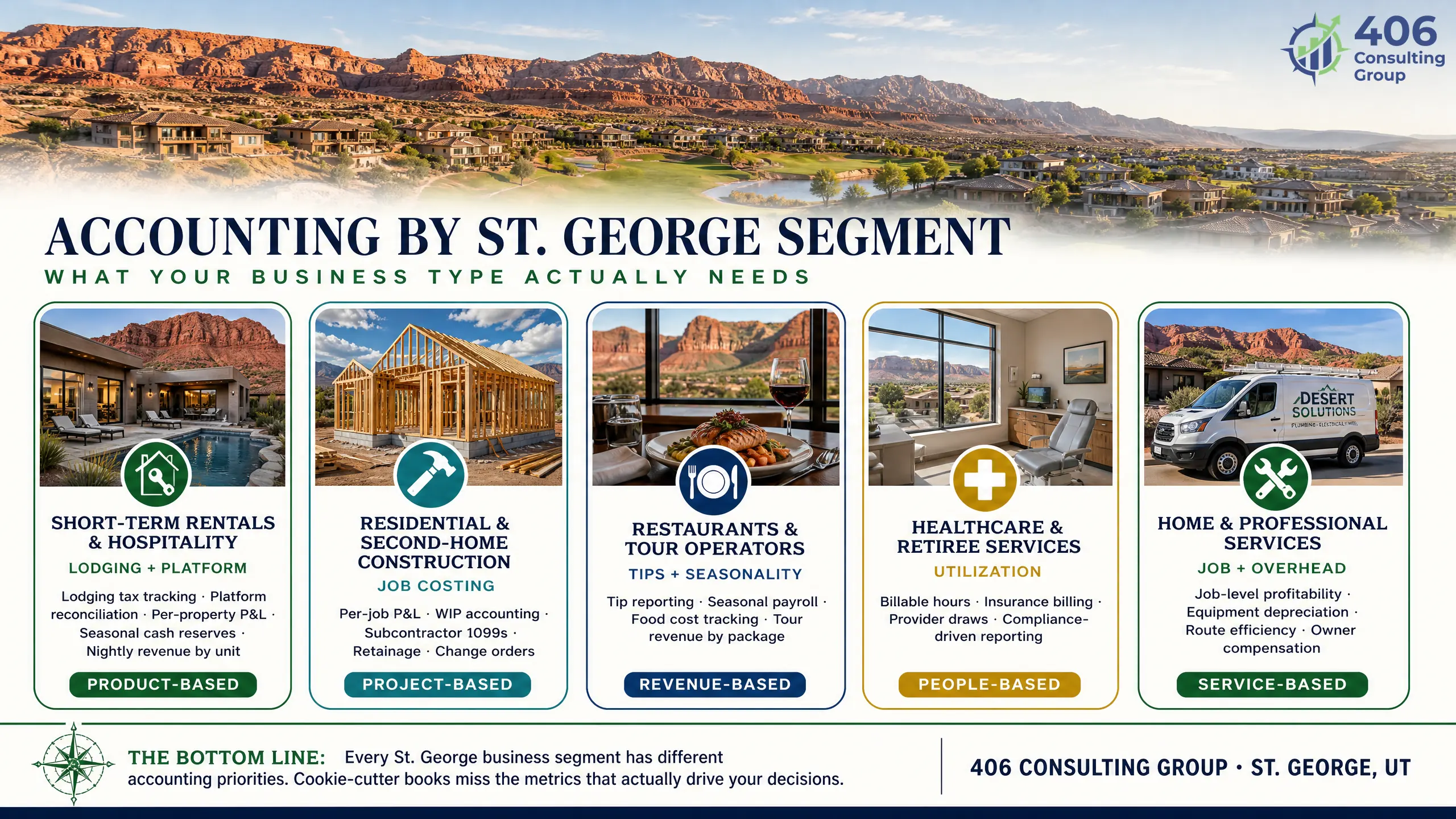
Different details, same backbone: per-property or job tracking clean, lodging and sales taxes handled, and profit readable for the Utah and federal returns.
Building the Right Accounting System
What separates accounting that just keeps you compliant from accounting that helps you run and grow is the system underneath it. A rental, real-estate, and seasonal market especially rewards a system designed around the whole operation — how each property performs, how lodging taxes are tracked and remitted, how cash moves through the season, how profit maps to both returns — because the numbers are only useful if they mirror how the business actually runs.
Built right, one system carries per-property economics, lodging-tax compliance, seasonal cash, and clean Utah and federal reporting — and every month is fast and clear, and every purchase or loan starts from clean books. Built as a generic template, it hides the very things a St. George business needs to see.

That whole-company perspective is our core differentiator — the difference between books that are merely compliant and books that are genuinely useful.
Local vs. a Great Remote Partner
Accounting for a St. George business is knowledge work — lodging taxes and per-property books, real-estate tax strategy, seasonal cash, financing. What matters is whether your partner knows rental, real-estate, and hospitality accounting, not whether they're on St. George Boulevard — and many owners here are out of state anyway. A great remote firm that understands this market beats a local generalist who doesn't, every time.
It's also how the work already happens. Roughly 70–80% of our own local clients never come into the office; everything runs on secure cloud accounting, connected bank and platform feeds, and regular calls. So whether you're in St. George, elsewhere in Washington County, or holding property here from out of state, you get the same full-service support — and our multi-state experience is a real advantage for an out-of-area owner.
Distance isn't the variable. Knowing your market is.
How to Get Started
Getting your St. George accounting right is three steps.
Build the books for your business
Per-property tracking and lodging taxes for rentals, job costing for construction, or clean seasonal books — structured for how you run.
Map the real-estate & owner tax plan
Cost segregation, the STR rules, and any 1031 for property, plus the S-corp, QBI, and Utah pass-through election for the business.
Add leadership as you grow
Controller and CFO for per-property economics, seasonal cash, and financing the next acquisition or build.
Not sure which layer you need? Our Financial Maturity Assessment maps it out in about eight minutes.
FAQ: St. George Accounting
What makes accounting for a St. George business different?
St. George runs on tourism, short-term rentals, real estate, and a construction boom, much of it seasonal and often out-of-state-owned, on Utah's flat-tax base. A rental owner needs lodging-tax compliance, per-property books, and real-estate tax strategy; a seasonal business needs cash planning; a builder needs job costing; and Utah's income tax means planning pays off on both returns. A generic, single-model approach handles none of it well, which is why St. George businesses benefit from accounting built for this rental-real-estate-and-seasonal market.
What taxes does a St. George, Utah business pay?
Utah has a low flat state income tax (about 4.5% in recent years — confirm the current rate), a combined sales tax around 6.75% in St. George/Washington County with a companion use tax, and no gross-receipts or B&O tax. Short-term lodging carries the sales tax plus a transient room tax, with possible resort or tourism taxes on top. You also handle federal income tax and payroll, Utah unemployment insurance, and workers' compensation through a competitive private market. Because Utah has an income tax, planning helps on both returns.
What are the biggest tax opportunities for a St. George property owner?
Real estate leads. Rental property can be depreciated, and a cost-segregation study can front-load a large amount of that deduction. For short-term rentals, if the average stay is short and you materially participate, the activity may be treated as non-passive, potentially letting losses offset other income. When an appreciated property sells, a 1031 exchange can defer the capital-gains tax and recapture by rolling into another property. These are powerful and genuinely technical, so they're work-with-a-pro strategies — and the operating businesses that serve the area also get the S-corp, QBI, and Utah pass-through levers. The St. George tax guide covers it all.
Do I need per-property or construction-specific accounting?
If you own rentals or build homes, yes. Rental accounting needs per-property books — income and expense by property — so you can see which rentals actually make money, plus lodging-tax tracking. Construction needs job costing (tying labor, materials, subs, and equipment to each build), work-in-progress, and retainage. In both cases, a company-wide bottom line hides which properties or jobs are winning and losing. It's a genuinely different discipline from generic small-business bookkeeping, and it's the foundation for every decision downstream.
Can 406 Consulting Group handle everything remotely for a St. George business?
Yes — bookkeeping, tax, and CFO/controller work all run well remotely through secure cloud accounting, connected platform feeds, and regular calls, and many St. George owners are out of state anyway. What matters is deep knowledge of rental, real-estate, and hospitality accounting, Utah's specifics, and multi-state work for out-of-area owners, not office proximity. Roughly 70–80% of our own local clients never come into the office either, so you get the same full-service support whether you're in St. George or holding property here from another state.
The St. George Series
Accounting — St. George, UT
The Whole Washington County Playbook, Handled.
406 Consulting Group gives St. George rental, hospitality, construction, and small businesses full-service accounting — lodging taxes, real-estate tax strategy, per-property economics, and seasonal cash — delivered remotely.
The St. George Series
Hub & the three deep-dive guides
St. George Business Accounting
The whole playbook, handled remotely.
About the Author
Carrie Anderson
Co-Founder, 406 Consulting Group
Commercial banking and underwriting background — 300+ loan reviews — advising real-estate, hospitality, and small-business owners across the Mountain West. Carrie helps St. George owners turn a rental, real-estate, and seasonal market on a two-tax base into a durable advantage.
Read the Full Story