
CFO & Controller Services in St. George, UT:
Know Which Property Pays, Buy the Next One Right
Rentals, hospitality, and building here grow property by property and swing with the season. Here's how fractional controller and CFO leadership — per-property economics, seasonal cash planning, and financing analysis — helps a St. George business grow on purpose.

Growth in St. George looks a little different than it does elsewhere. It might be a second and third short-term rental, a restaurant expanding to a second location, a tour company adding equipment, or a builder taking on bigger projects — and in each case, the decisions get bigger and the numbers get harder to run in your head. Which property actually makes money? Can we afford the next one? How do we get through the slow season? At that point, clean books aren't enough; you need someone turning them into decisions. That's financial leadership, and for most St. George businesses it doesn't require a full-time hire.
These businesses share a few hard problems: performance that varies property by property or location by location, cash that swings with the season, and growth that usually means financing — another property, more equipment, a bigger build. A controller keeps the numbers reliable and organized the way these businesses actually run; a CFO turns them into per-property economics, a seasonal cash plan, and a clear-eyed answer on whether to buy, build, or hold. Get it right and you grow on purpose instead of by feel.
This guide covers what controllers and CFOs do for a St. George business, what each costs, per-property and seasonal realities, financing decisions, and how to know which you need.
By Jason Anderson — Co-Founder, 406 Consulting Group. Big-firm-trained accountant advising real-estate, hospitality, and construction businesses across the Mountain West — where per-property economics, seasonal cash, and financing decisions are the daily work.
Quick Answer: CFO & Controller Help for a St. George Business
- →A controller makes the per-property and seasonal numbers reliable; a CFO turns them into decisions.
- →Per-property economics — occupancy, rate, and net operating income by property — tell you which ones make money.
- →Seasonality means the cash plan and reserves matter as much as the profit.
- →Financing the next property or build is where a lender's-eye view pays off.
- →Fractional delivers both roles for ~$4,000–$8,000/month — a fraction of full-time — remotely.
Table of Contents
Why a Growing St. George Business Needs It
Most businesses hit a financial ceiling when growth outpaces the owner's ability to run the numbers by feel. In St. George, that shows up as questions a single bottom line can't answer: which of my rentals actually earns its keep after all costs? Is this location pulling the average up or dragging it down? How much cash do I need to reserve to survive the off-season? Should I finance the next property or wait? These are portfolio and timing questions, and answering them well is what separates a business that scales cleanly from one that overextends.
Financial leadership is what turns clean books into those answers: per-property and per-location economics, a seasonal cash plan that holds up, and a disciplined view of whether the next acquisition or build actually pencils. It's the difference between growing a collection of properties or locations and growing a profitable one.
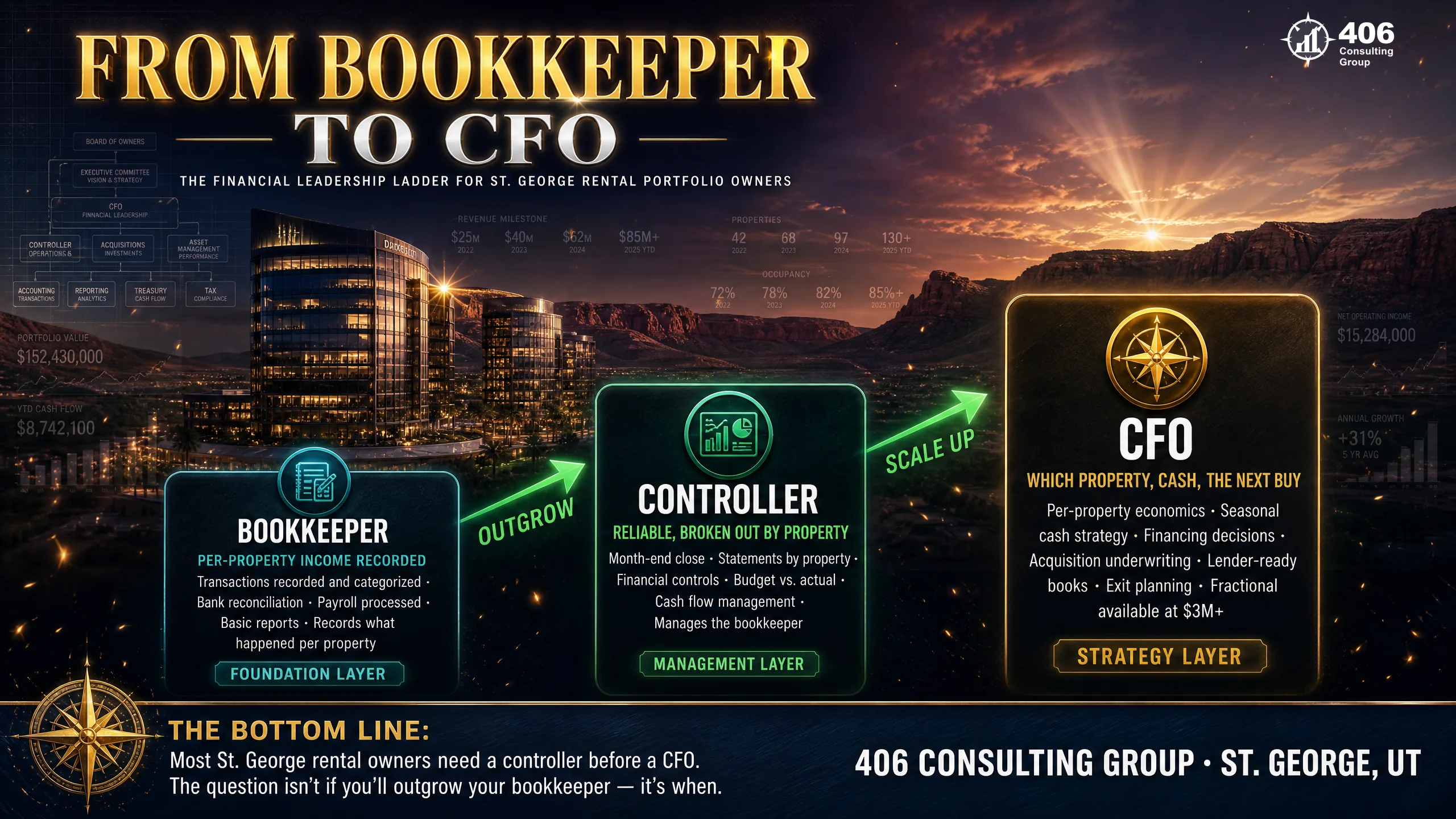
The question is which kind of help you need, and how to get it without overpaying. That starts with the roles.
Bookkeeper vs. Controller vs. CFO
These three roles get blurred constantly, but they're distinct — and hiring the wrong one for your problem is a common, expensive mistake.
| Role | Core question they answer |
|---|---|
| Bookkeeper | "Are the transactions and each property's income recorded and reconciled?" |
| Controller | "Are the financials right, on time, and organized by property and location?" |
| CFO | "What do the numbers tell us — which properties, how to fund growth, how to ride the season?" |
A quick rule: if your numbers are late or you can't see them by property, you need a controller. If they're clean but you can't tell which properties to keep or whether to buy the next one, you need a CFO. Many growing St. George businesses need some of both — which a coordinated fractional engagement delivers. We cover the first step up in upgrading from bookkeeping to a controller.
The Cost Math: Fractional vs. Full-Time
Full-time financial leadership is expensive, and at most growing St. George businesses it isn't a 40-hour-a-week job yet. Fractional gives you the expertise scaled to what you actually need.
| Role | Fractional (per month) | Full-time (annual) |
|---|---|---|
| Controller | ~$2,500–$6,000 | $85K–$120K + ~25% benefits |
| Fractional CFO | ~$2,500–$5,000 | $150K–$300K+ + benefits |
| Both, coordinated | ~$4,000–$8,000 | $235K–$420K+ |
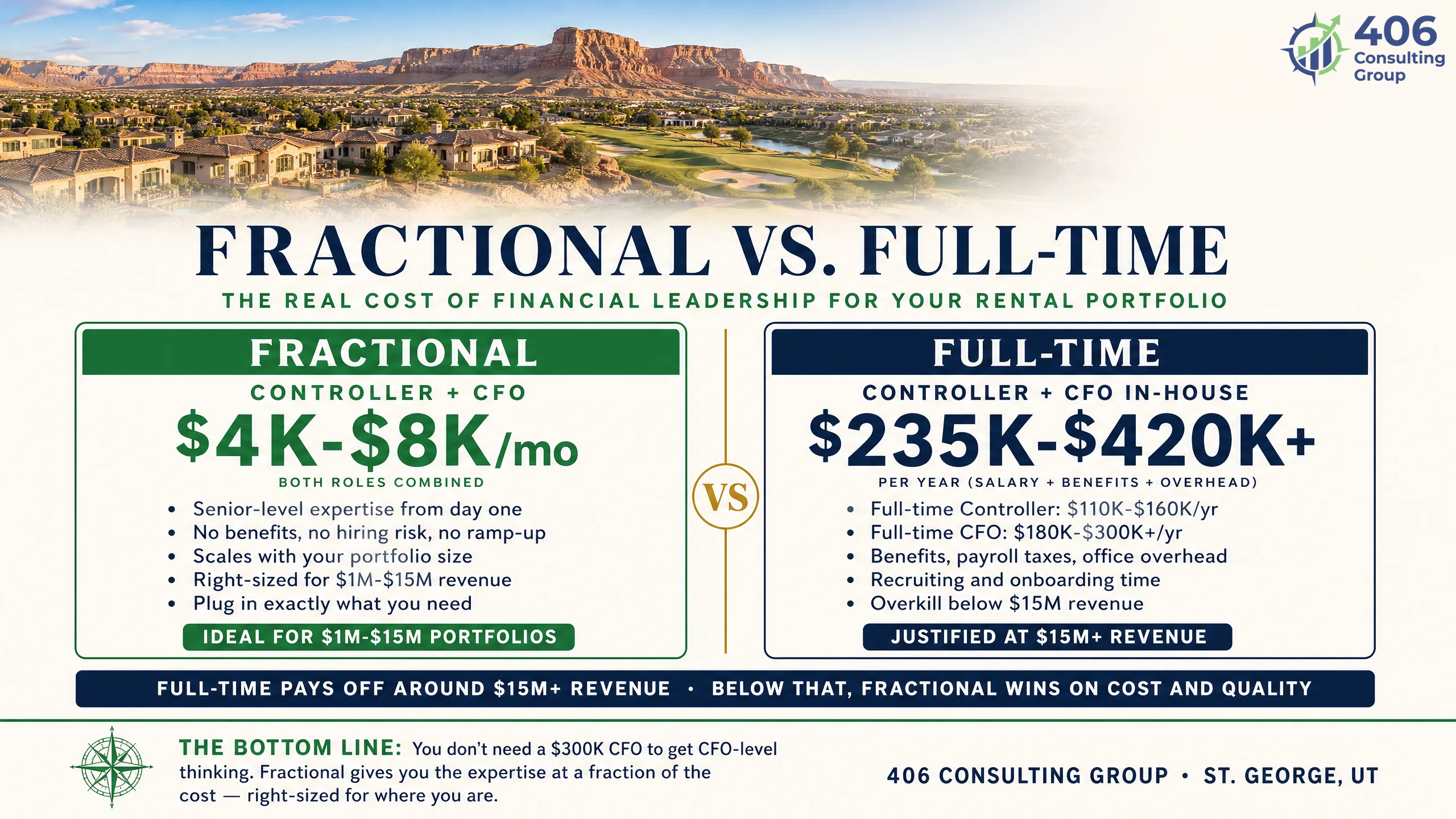
Fractional is dramatically more cost-effective until a business reaches the scale — generally $15M+ — that keeps a full-time hire busy year-round. Estimate the controller piece with our Controller Estimator.
What a Controller Delivers
A controller owns the integrity of your financials — and for a St. George business, that means organized the way you actually operate. A reliable monthly close, accurate statements you can trust, and — critically — the numbers broken out by property, by location, or by job, not just company-wide. For a rental owner that's per-property income and expense; for a restaurant group it's per-location; for a builder it's job costing. Add clean handling of lodging taxes, tips, and 1099s, and you have books that tell the truth at the level decisions get made.
Without that structure, a company-wide P&L blends your best property with your worst and hides the very thing you need to see. Because we build books around how these businesses run, the numbers stay useful for decisions, not just compliant for the return.
Once the numbers are reliable and broken out, most owners want to use them — which is the CFO's job.
What a CFO Delivers
A CFO turns reliable, broken-out numbers into forward strategy: per-property and per-location economics, seasonal cash-flow forecasting, the financing and buy-or-build decisions, and margin analysis for the hospitality and service side. For a St. George owner, the CFO is the person who can say which rentals or locations to keep and which to sell, how much cash to hold for the slow season, and whether the next property actually pencils at the price and the rate.
The highest-value CFO work here is usually seeing around two corners: the seasonal cash dip before it arrives, and the acquisition that looks good on the surface but doesn't cover its debt once you run the real numbers. Both are about deciding with data instead of optimism.
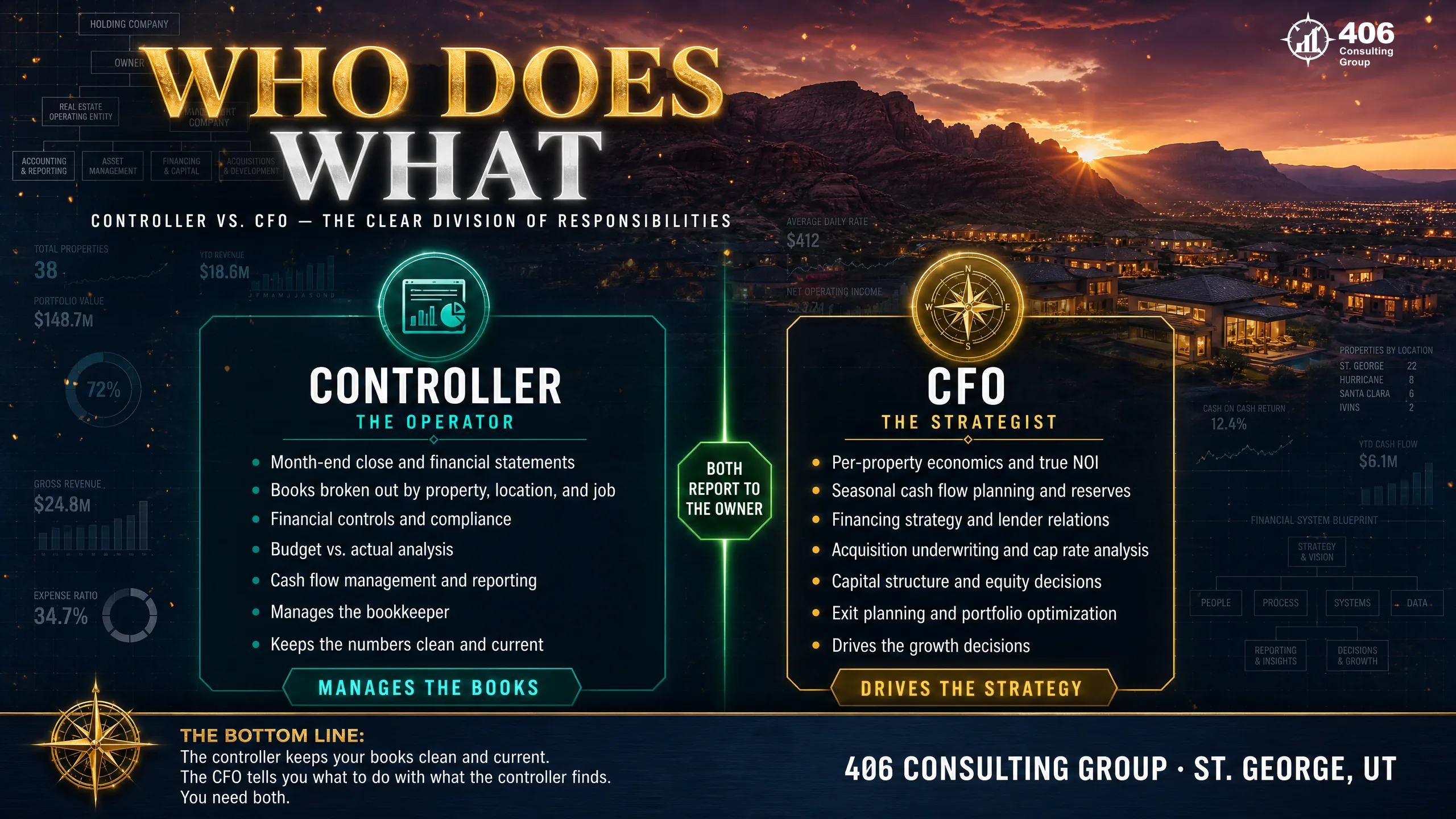
You rarely need both at full strength at once — which is why a coordinated fractional engagement, dialed to your stage, is usually the right answer.
Per-Property & Portfolio Economics
For a rental owner, the single most useful thing a CFO builds is a clear picture of each property on its own. That means the metrics the business actually turns on — occupancy, average nightly rate, and revenue per available night for a short-term rental — carried all the way down to net operating income by property after cleaning, management, maintenance, utilities, and taxes. Do that and you can finally see which properties are carrying the portfolio and which are quietly losing money behind a healthy-looking total.
The same idea applies to a multi-location restaurant or a service business with distinct lines: break performance out by unit and the decisions get obvious — where to invest, what to fix, what to exit. A blended average is exactly where an underperforming property or location hides.

It's the same idea as our flagship on unit economics — which unit actually makes money — applied to properties and locations.
Seasonal Cash & Reserves
In a tourism economy, cash arrives in waves, and a profitable business can still get caught short if it spends the peak like it's the norm. The CFO's job is to forecast the year's cash — not just the annual profit — so you can see the slow-season dip coming and reserve for it deliberately from the busy months. A rolling forecast that maps revenue, fixed costs, debt payments, and the tax set-aside against the calendar turns the off-season from a scramble into a plan.
This is also where growth and seasonality collide: taking on another property or a bigger build adds fixed costs that don't care what month it is, so the forecast has to prove you can carry them through the trough, not just the peak. It's simple discipline, and it's the difference between a seasonal business that's calm and one that white-knuckles every winter.
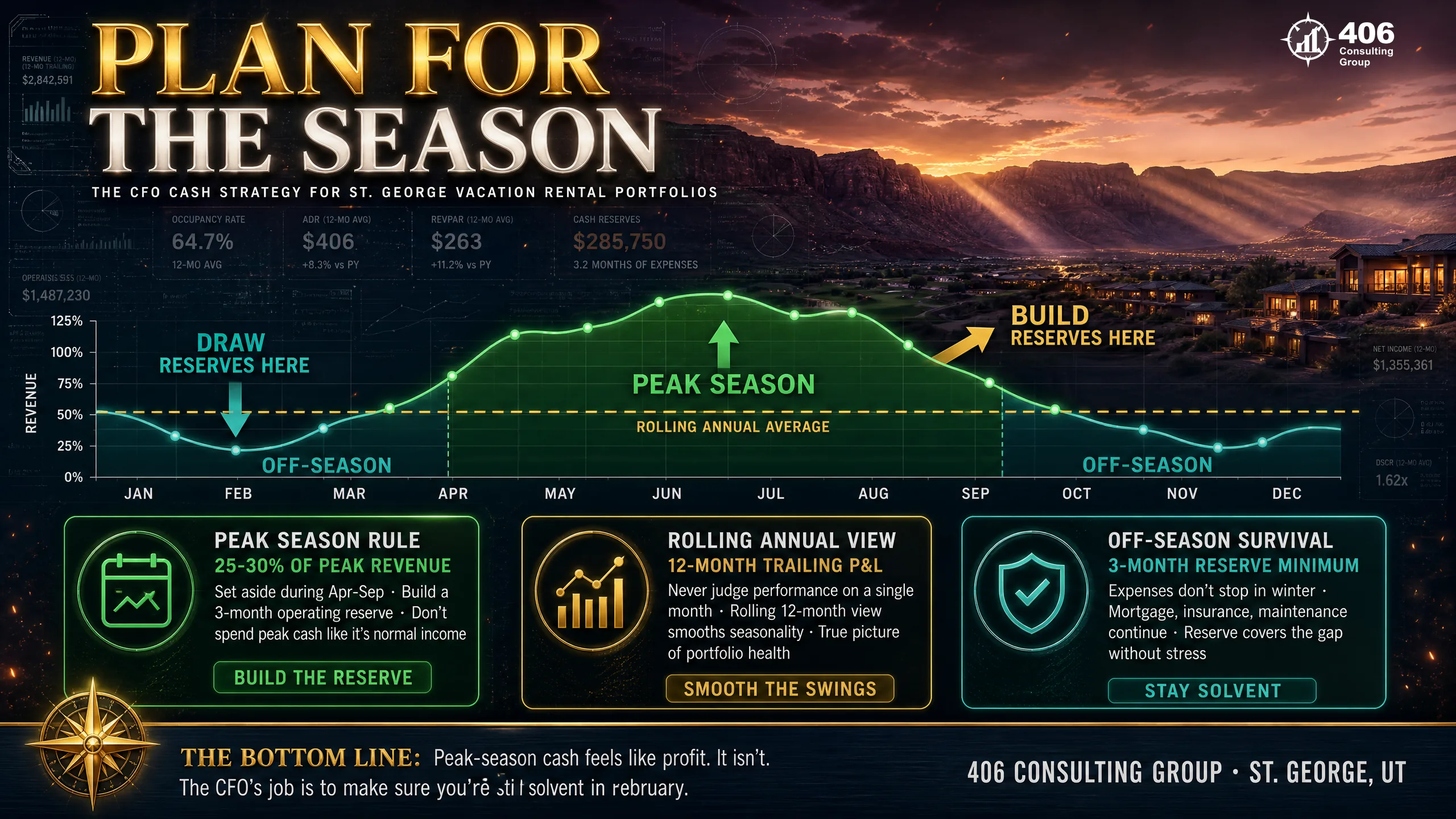
Want a quick read? Try our Cash Flow Runway tool, and see why profit and cash aren't the same.
Financing & the Acquisition Decision
Growth in St. George usually means borrowing — for the next rental, a bigger build, or new equipment — and the decision to buy is a financial one before it's an emotional one. A CFO runs the real numbers on a potential acquisition: what it yields relative to price, the return on the cash you actually put in, and — the one lenders care about most — whether the property's income comfortably covers the debt payment. A deal that looks great at peak-season rates can look very different once you underwrite it across the whole year.
This is also where getting ready for the lender pays off. Banks fund borrowers who show clean financials, per-property numbers, and a credible plan — and our commercial-banking background means we prepare a St. George business the way a lender actually evaluates one, so you get the money on better terms, or find out a deal doesn't work before it costs you.

See our loan & financing readiness work for how we get a business bank-ready.
When to Hire — and the Fractional Path
A few clear signals mean it's time for financial leadership:
You can't see performance by property or location
If it's all one blended number, an underperformer is hiding — and you can't fix what you can't see.
The off-season keeps catching you short
If cash gets tight every slow stretch, you need a seasonal forecast and a reserve plan now.
You're about to buy, build, or borrow
Run the real numbers and get lender-ready before you commit, not during underwriting.
The financials are late or you don't trust them
Decisions built on messy books are worse than none. Fix the close and the breakout with a controller first.

The fractional path lets you start with exactly what you need — often a controller to get per-property books and the close right, then CFO strategy for portfolio economics, seasonal cash, and financing — and scale up as you grow, without a premature six-figure hire.
Local vs. a Great Remote Partner
Financial leadership is analysis and judgment — building per-property economics, forecasting seasonal cash, underwriting an acquisition, preparing for a lender. None of it depends on being in the room; what matters is whether your partner understands rental, hospitality, and construction economics, not their zip code. A great remote CFO who knows this terrain beats a local generalist who doesn't, every time — and many St. George rental owners are out-of-state anyway.
It's also how we already work. Roughly 70–80% of our own local clients never come into the office; per-property dashboards, cash forecasts, and deal analyses run on shared screens with regular calls. So whether you're in St. George, elsewhere in Washington County, or holding property here from out of state, you get the same real-estate-and-hospitality-savvy financial leadership our in-town clients do — with a banker's eye on the numbers.
Distance isn't the variable. Knowing your business is.
How to Get Started
Getting financial leadership in place is three steps.
Diagnose what you actually need
No per-property breakout or a late close points to a controller; clean-but-unused numbers point to a CFO. We pinpoint the gap.
Get the foundation right
Reliable close and books broken out by property, location, or job — every decision depends on that structure.
Layer on portfolio & cash strategy
Per-property economics, seasonal cash planning, and acquisition/financing analysis, scaled to your stage.
Not sure which layer you need? Our Financial Maturity Assessment maps it out in about eight minutes.
FAQ: St. George CFO & Controller Questions
How much do CFO and controller services cost in St. George, UT?
Fractional pricing typically runs about $2,500–$6,000 per month for a controller and about $2,500–$5,000 per month for a fractional CFO, depending on complexity and scope. A coordinated engagement covering both often runs roughly $4,000–$8,000 per month. Compare that to full-time salaries — $85K–$120K for a controller and $150K–$300K+ for a CFO, plus roughly 25% in benefits — and fractional is dramatically more cost-effective until a business reaches the scale (generally $15M+) that keeps a full-time hire busy year-round.
What does a CFO actually do for a rental or hospitality business?
The core work is turning reliable, broken-out numbers into decisions: per-property and per-location economics (occupancy, rate, and net operating income by property), seasonal cash-flow forecasting, and the financing and buy-or-build analysis. A controller keeps the numbers reliable and organized by property, location, or job; the CFO uses them to say which rentals or locations to keep, how much cash to reserve for the slow season, and whether the next acquisition actually pencils once you underwrite it across the whole year. For a St. George owner, that forward view is what keeps growth profitable.
Why does per-property reporting matter so much?
Because a company-wide bottom line hides the truth. Two rentals can average out to a healthy number while one quietly loses money behind the other, and you'd never know from the total. Breaking performance out by property — occupancy, nightly rate, revenue per available night, and net operating income after cleaning, management, maintenance, utilities, and taxes — shows you which properties carry the portfolio, which to fix, and which to sell. The same logic applies to a multi-location restaurant or a service business with distinct lines.
How do I know if buying another property is a good idea?
Run the real numbers before you fall in love with it. A CFO underwrites a potential acquisition on what it yields relative to price, the return on the cash you actually put in, and — the one lenders weigh most — whether the property's income comfortably covers the debt payment across the whole year, not just at peak-season rates. A deal that looks great in July can fail once you underwrite the off-season. Getting lender-ready with clean, per-property financials also helps you secure financing on better terms — or discover a deal doesn't work before it costs you.
Can 406 Consulting Group provide CFO and controller services remotely?
Yes — it's how the work is done now, and many St. George rental owners are out of state anyway. Per-property dashboards, seasonal cash forecasts, and acquisition analyses all happen over shared screens, live dashboards, and regular calls; none of it requires being in the room. Roughly 70–80% of our own local clients never come into the office either. What matters is deep expertise in rental, hospitality, and construction economics — plus a commercial-banking background that means we prepare you the way lenders actually evaluate a borrower — not office proximity.
Keep Reading
CFO & Controller — St. George, UT
Know Which Property Pays. Buy the Next One Right.
406 Consulting Group gives St. George rental, hospitality, and construction businesses fractional controller and CFO leadership — per-property economics, seasonal cash, and financing analysis — delivered remotely, with a banker's eye.
Fractional vs. Full-Time
St. George, UT — typical ranges
Growing a Portfolio?
Per-property, cash & financing, handled.
About the Author
Jason Anderson
Co-Founder, 406 Consulting Group
Big-firm-trained accountant advising real-estate, hospitality, and construction businesses across the Mountain West. Jason helps St. George owners see per-property economics, plan seasonal cash, and underwrite the next acquisition before they buy.
Read the Full Story