
Bookkeeping Services in St. George, UT:
Tourism, Rentals & Building, Handled
St. George runs on tourism, short-term rentals, and a construction boom — where the books live on lodging taxes, seasonal cash flow, and job costing. Here's what a Washington County business really needs, on Utah's flat-tax base.

St. George is one of the fastest-growing places in the country, and its economy has a distinct shape: tourism and hospitality anchored by Zion, the lakes, and the golf, a wave of residential and second-home construction feeding the growth, and a large, affluent retiree and active-adult population driving healthcare, home services, and professional services. A lot of these businesses are seasonal, many involve short-term rentals, and all of them sit on Utah's low, flat-tax base — a very different world from the tech scene up north.
That shapes the books in specific ways. A short-term rental owner has to handle lodging taxes and reconcile platforms; a seasonal hospitality business has to manage cash through big swings; a home builder needs job costing; and a service business serving retirees needs clean, simple books that just work. Bookkeeping built for St. George handles the lodging taxes, the seasonality, and the construction — not just a generic monthly close — on top of Utah's straightforward tax setup.
This guide covers how tourism, rentals, seasonality, and construction shape your books — and how a remote firm delivers all of it.
By Jason Anderson — Co-Founder, 406 Consulting Group. Big-firm-trained accountant advising hospitality, construction, and small businesses across the Mountain West, where lodging taxes, seasonality, and job costing are everyday work.
Quick Answer: Bookkeeping for a St. George Business
- →Short-term rentals owe Utah sales tax plus a transient room tax — and platforms don't always collect it all.
- →Seasonality is real: tourism cash swings hard, so the books have to plan for the slow months.
- →Residential construction needs job costing and WIP to know which builds make money.
- →Utah taxes: a low flat income tax (~4.5%), ~6.75% sales tax in St. George, no gross-receipts/B&O tax.
- →Delivered remotely — even most of our local clients never come into the office.
Table of Contents
Why St. George Bookkeeping Is Different
Generic bookkeeping assumes a steady business selling one thing year-round. St. George rarely fits. A vacation-rental owner collects lodging taxes and reconciles Airbnb and VRBO payouts. A restaurant or tour operator makes most of its money in a few busy months and has to survive the slow ones. A home builder needs to know the margin on each custom build. A service business serving the retiree community just needs clean, reliable books. Different demands, and a one-size template handles none of them well.
St. George sits in Washington County, at the gateway to Zion and a magnet for visitors and retirees alike. That tourism-and-growth economy means seasonality, lodging taxes, and construction are everyday realities here in a way they aren't for a typical inland small business. Books built for St. George have to speak that language — not just record deposits and call it done.

The rest of this guide walks each piece — starting with the Utah tax backdrop everything sits on.
The Utah Tax Backdrop
Utah keeps it simple and business-friendly. Here's the picture for a St. George business:
| Tax | Utah reality |
|---|---|
| State income tax | Low flat rate (~4.5%) on business and personal income — verify current |
| Sales tax | ~6.75% combined in St. George (Washington County) — verify; use tax on untaxed purchases |
| Gross-receipts / B&O | None |
| Short-term lodging | Sales tax plus a transient room tax (and possible resort/tourism taxes) |
| County | Washington County |
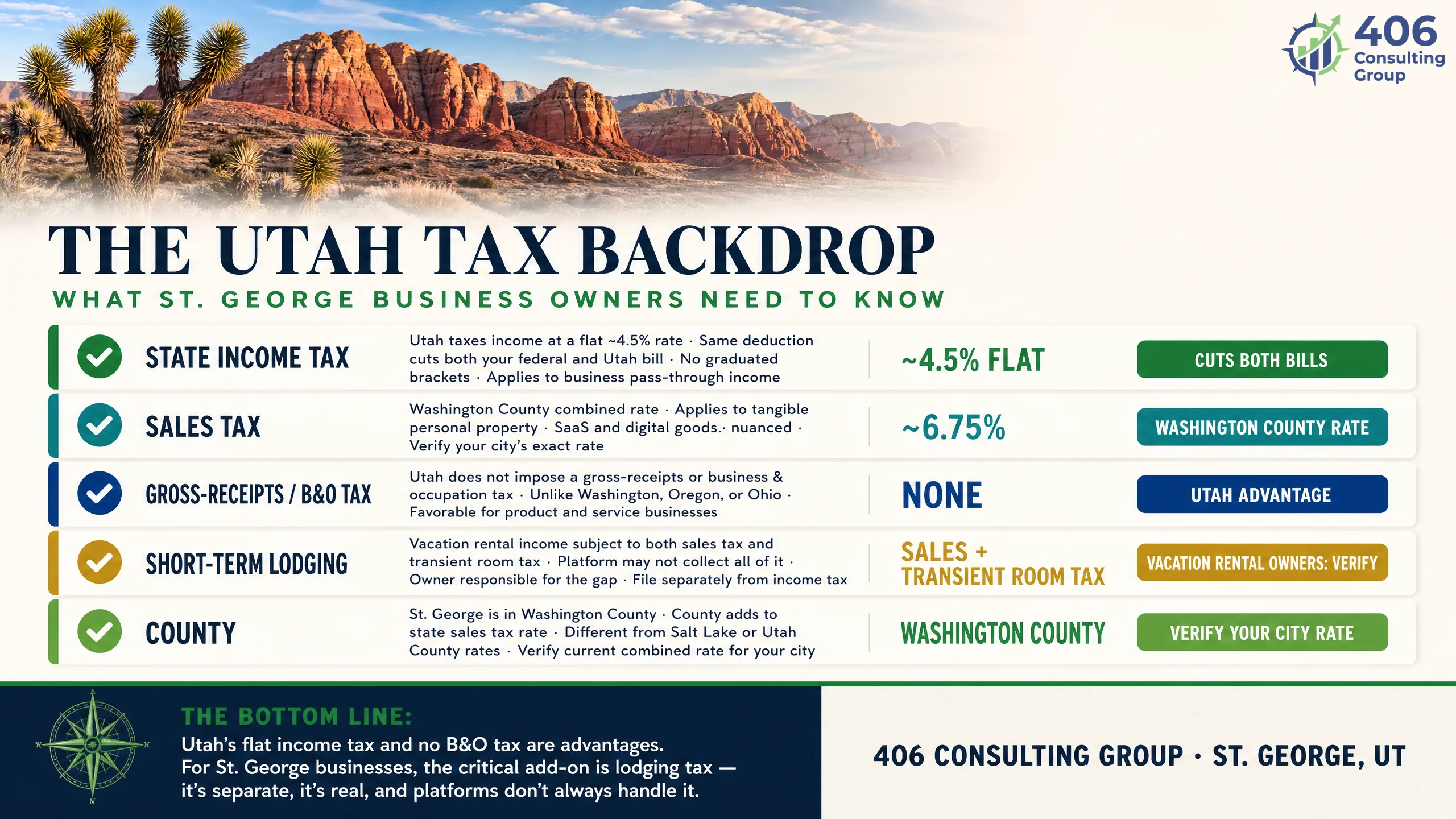
Because Utah has an income tax, your books also have to stay clean enough to support the state and federal return, and to set aside for the flat rate as you go. Confirm current rates — especially the local and lodging pieces — with the Utah State Tax Commission. We cover planning in the St. George tax guide.
Short-Term Rentals & Lodging Taxes
With Zion, Sand Hollow, and the golf drawing visitors, short-term rentals are a big part of the St. George economy — and they carry more than ordinary sales tax. A short-term stay in Utah generally owes state and local sales tax plus a transient room tax, and depending on the location there can be additional resort or tourism taxes layered on top. The rates and rules vary by jurisdiction, so what a St. George rental owes isn't a single number to guess at.
The trap is assuming the platform handles it. Airbnb and VRBO may collect some of these taxes, but not always all of them, and the owner is ultimately responsible for the gap. Clean books track lodging revenue by property, record each tax as a liability, and reconcile what the platform collected against what's actually owed — so nothing slips through. For an owner running several doors, that reconciliation is real, recurring work.

The lodging-tax trap
"Airbnb handles the taxes" is where St. George rental owners get burned — platforms don't always collect every tax that applies, and you're on the hook for the difference. Track lodging taxes yourself and reconcile. Confirm what applies with the Utah State Tax Commission and your local jurisdiction.
Seasonality & Cash Flow
A tourism economy runs in waves. Rentals, restaurants, tour operators, and the businesses that serve them see revenue spike in the busy stretches and drop off in the slow ones, and a business that spends in its peak like it's the new normal gets caught short when the season turns. The books' job here is to make that pattern visible — so you can see the real annual picture rather than a misleading month, and hold back from the good months to cover the lean ones.
Practically, that means tracking revenue and margin by month, reserving deliberately for the slow season and for taxes, and reading your numbers on a rolling annual basis instead of reacting to whatever last month happened to be. It's simple discipline, but it's the difference between a seasonal St. George business that's calm year-round and one that scrambles every off-season.

Clean monthly books are what make this possible — you can't plan around a season you can't see clearly.
Residential Construction Job Costing
The building side of St. George — custom homes, second homes, and master-planned residential — needs construction-grade books. Job costing ties labor, materials, subcontractors, and equipment to each build so you can see the real margin on that home, not a company-wide number that blends your best project with your worst. Add work-in-progress tracking, subcontractor 1099s, retainage, and change orders, and you have books that protect the margin the boom is supposed to be handing you.
Without it, a builder can look profitable overall while individual homes quietly lose money, and can't quote the next one accurately. In a fast market where subs are stretched and prices move, that discipline is exactly what keeps growth profitable.

Curious which of your crews or job types actually makes money? That's exactly what our flagship on contractor unit economics digs into — and clean job costing is what makes the answer visible.
Hospitality & Service-Business Books
Beyond rentals and building, St. George runs on hospitality and services — restaurants, tour and outfitter operators, and the home, health, and professional services that a large retiree population needs. Restaurants live on food and labor cost against thin margins and need sales tax and tips handled cleanly; tour operators juggle seasonality and equipment; home and professional service businesses need simple, reliable books and clean receivables. None of it is exotic, but each has its own quirks a generic setup glosses over.
The common thread is that these are often owner-operated businesses where the owner is busy running the operation, not the books — which is exactly when a clean, handled bookkeeping system pays for itself in time and clarity.
Utah Payroll & Seasonal Labor
Because Utah has a state income tax, payroll here includes state income-tax withholding at the flat rate, alongside federal payroll taxes, Utah unemployment insurance, and workers' compensation through a competitive private market. St. George's tourism and construction businesses add a wrinkle: seasonal and variable staffing — ramping up for the busy season, down for the slow one — plus tips in hospitality and 1099 subcontractors in construction, all of which have to be tracked and classified correctly.
Misclassifying workers or letting seasonal payroll and 1099s pile up untracked turns into a headache at filing time. Books that handle payroll, tips, and contractor payments cleanly all year keep it simple.
Handled properly, it's routine — which is what our payroll work keeps it.
Bookkeeping by St. George Segment
St. George's economy is led by tourism and construction, with healthcare and services for a large retiree base around them — and each asks something different of the books.
| Segment | What the books need to track |
|---|---|
| Short-term rentals & hospitality | Lodging + transient room tax, per-property P&L, seasonality, platform reconciliation |
| Residential & second-home construction | Job costing, WIP, subs/1099s, retainage, change orders |
| Restaurants & tour operators | Food/labor cost, tips, sales tax, equipment, seasonality |
| Healthcare & retiree services | Insurance receivables, payroll, utilization, clean reporting |
| Home services & professional | Job or client profitability, receivables, 1099s, scheduling |

Different details, same backbone: lodging or job tracking clean, sales and lodging taxes handled, payroll right, and profit readable for the Utah and federal returns.
Common St. George Bookkeeping Mistakes
A handful of avoidable mistakes cause most of the trouble for growing St. George businesses. Here's what we see most.
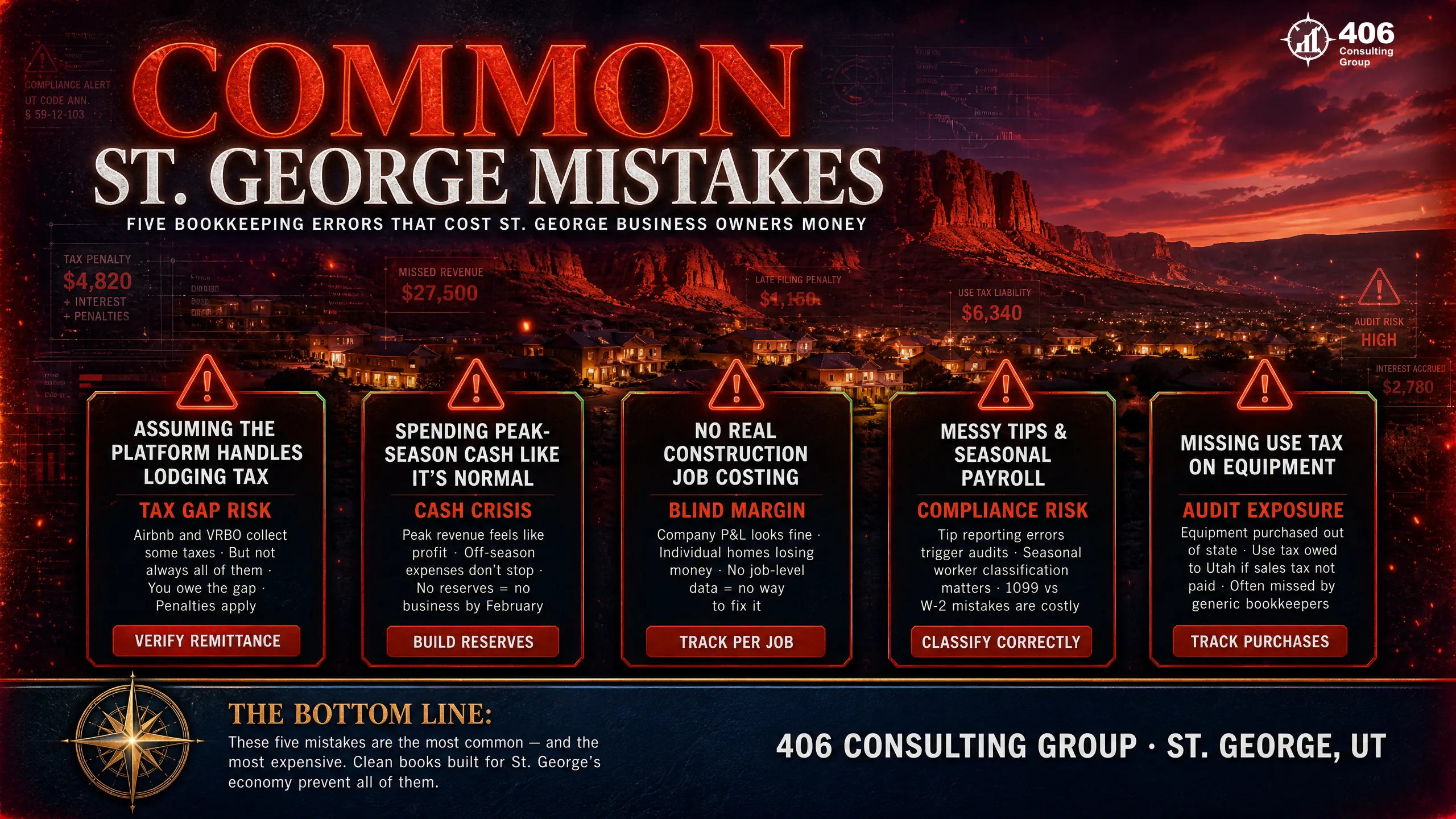
Assuming the platform handles lodging tax
Airbnb/VRBO don't always collect the transient room tax and every local tax that applies; the owner owes the gap.
Spending peak-season cash like it's normal
Not reserving for the slow months and for taxes, then scrambling every off-season.
No real construction job costing
Blending all builds into one P&L, so you can't tell which homes made money or quote the next accurately.
Messy tips and seasonal payroll
Untracked tips, seasonal staff, and 1099s pile into a filing-time headache and misclassification risk.
Missing use tax on equipment
Gear and supplies bought out of state without sales tax usually owe Utah use tax.
Every one is a setup-and-habit problem — and every one disappears once the books are built for a St. George business and maintained on a monthly rhythm.
Local vs. a Great Remote Partner
For a St. George business, what matters in a bookkeeper isn't whether their office is on St. George Boulevard — it's whether they understand lodging taxes and platform reconciliation, seasonal cash flow, and construction job costing. A great remote partner who knows those beats a local generalist who doesn't, every time — and much of this work (rentals, online bookings, cloud point-of-sale) already lives online.
Remote is simply how modern bookkeeping works. Roughly 70–80% of our own local clients never set foot in our office; everything runs on secure cloud accounting, connected bank and platform feeds, and a steady monthly rhythm. So whether you're in St. George, out in Washington County, or managing rentals from out of state, you get the same responsive, tourism-and-construction-savvy service.
Distance isn't the variable. Knowing your market is.
How to Get Started
Getting your St. George books in order is three steps.
Clean up and structure for your business
Set up per-property lodging tracking, job costing for construction, or clean service-business books — and structure sales and lodging taxes.
Get taxes and payroll right
Sales, use, and transient room taxes tracked; Utah payroll (flat-rate withholding), tips, and 1099s handled correctly.
Run it monthly
Monthly reconciliation and seasonal cash planning keep compliance routine and show you the real annual picture.
Not sure whether you need bookkeeping, tax help, or something more? Our Financial Maturity Assessment maps it out in about eight minutes.
FAQ: St. George Bookkeeping Questions
What taxes does a St. George short-term rental owe?
A short-term stay in Utah generally owes state and local sales tax plus a transient room tax, and depending on the location there can be additional resort or tourism taxes on top. The rates and rules vary by jurisdiction, so a St. George rental's total isn't a single number to guess at. Marketplace platforms like Airbnb and VRBO may collect some of these, but not always all of them, and the owner is ultimately responsible for the gap. Good books track lodging revenue by property, record each tax as a liability, and reconcile what the platform collected against what actually applies — and it's worth confirming the exact rates with the Utah State Tax Commission and your local jurisdiction.
What taxes does a St. George, Utah business deal with generally?
Utah has a low flat state income tax (around 4.5% — confirm the current rate), a combined sales tax around 6.75% in St. George/Washington County with a companion use tax, and no gross-receipts or B&O tax. Short-term lodging carries the sales tax plus a transient room tax. You also handle federal income tax and payroll, Utah unemployment insurance, and workers' compensation through a competitive private market. Because Utah has an income tax, planning helps on both the state and federal return.
How should a seasonal St. George business manage its books?
The key is making the seasonal pattern visible and planning around it. Track revenue and margin by month so you can see the real annual picture instead of reacting to whatever last month was, reserve deliberately from the busy months to cover the slow ones and your taxes, and read your numbers on a rolling annual basis. A tourism business that spends its peak season like it's the new normal gets caught short when the season turns; clean monthly books and a reserve habit are what keep it calm year-round.
Do I need construction-specific bookkeeping for my St. George building business?
If you build homes, yes. Construction bookkeeping centers on job costing — tying labor, materials, subcontractors, and equipment to each build so you can see the real margin — plus work-in-progress tracking, subcontractor 1099s, retainage, and change orders. Without it, a company-wide P&L can show a profit while individual homes lose money, and you can't quote the next build accurately. In a fast-moving residential market, that discipline is what keeps growth profitable rather than just busy.
Can 406 Consulting Group do my St. George bookkeeping remotely?
Yes. We work with St. George and Washington County businesses through secure cloud accounting — connected bank and platform feeds, shared screens, and a steady monthly rhythm. What matters for a tourism, rental, or construction business is expertise in lodging taxes and reconciliation, seasonal cash flow, and job costing, not office proximity — and much of this work already lives online. Roughly 70–80% of our own local clients never come into the office either, and we can serve rental owners managing properties from anywhere.
Keep Reading
Bookkeeping — St. George, UT
Tourism, Rentals & Building — Handled.
406 Consulting Group keeps St. George tourism, rental, construction, and small businesses clean and compliant — lodging taxes, seasonal cash flow, job costing, and reliable financials — delivered remotely.
St. George Bookkeeping Quick Reference
St. George, UT — Washington County
Behind on the Books in St. George?
Lodging tax, seasonality & job costing, handled.
About the Author
Jason Anderson
Co-Founder, 406 Consulting Group
Big-firm-trained accountant advising hospitality, construction, and small businesses across the Mountain West. Jason helps St. George owners handle lodging taxes, plan around seasonality, and keep clean job-costed books through a growth boom.
Read the Full Story