
Bookkeeping Services in Nampa, ID:
Built for Makers & Producers
Nampa is where the Treasure Valley makes things — and makers need books that track inventory, COGS, and equipment, plus Idaho's sales, use, and income taxes. Here's what a Nampa business needs from its bookkeeping, from a firm that knows Idaho and works remotely.

Nampa is where the Treasure Valley makes things. Food processing, manufacturing, agriculture, distribution, and the trades that keep them running are the backbone of Canyon County's economy — and businesses that make, move, and build have bookkeeping needs a coffee-shop setup was never designed for. On top of that sits Idaho's tax reality: the state taxes both sales and income, so your books have to collect and remit a sales tax and keep profit clean enough to plan the income-tax bill. Handle only one of those and you're half-covered.
The encouraging part is that Idaho is straightforward once your books are built for it — no gross-receipts tax like Washington's, a single flat income rate, and one main state agency. But a maker or producer has extra moving parts a service business doesn't: inventory, cost of goods sold, equipment, and the use tax that quietly rides along with out-of-state purchases. Get those tracked correctly and the numbers finally tell you what each product and job actually earns.
This guide covers how Idaho sales, use, income, and payroll taxes work for a Nampa business, what makers and producers specifically need from their books, the mistakes to avoid, and how a remote firm delivers all of it. If you're wondering whether you've outgrown DIY books, start here.
By Jason Anderson — Co-Founder, 406 Consulting Group. Background in large-scale operational finance at BP before building financial infrastructure for small businesses across the Northwest, where inventory, cost accounting, multi-state sales tax, and payroll compliance are everyday work.
Quick Answer: Bookkeeping for a Nampa Business
- →Idaho taxes both: a 6% sales tax you collect, and a flat state income tax (~5.3%) most owners pay on their personal return.
- →Use tax matters here: equipment and materials bought out-of-state without sales tax usually still owe 6% — easy to miss.
- →Makers need inventory & COGS tracked, so you know true product margins, not just a bank balance.
- →Payroll adds Idaho withholding, unemployment, and workers' comp through a private carrier or the State Fund.
- →Delivered remotely — even most of our local clients never come to the office.
Table of Contents
Why Idaho Bookkeeping Is Different
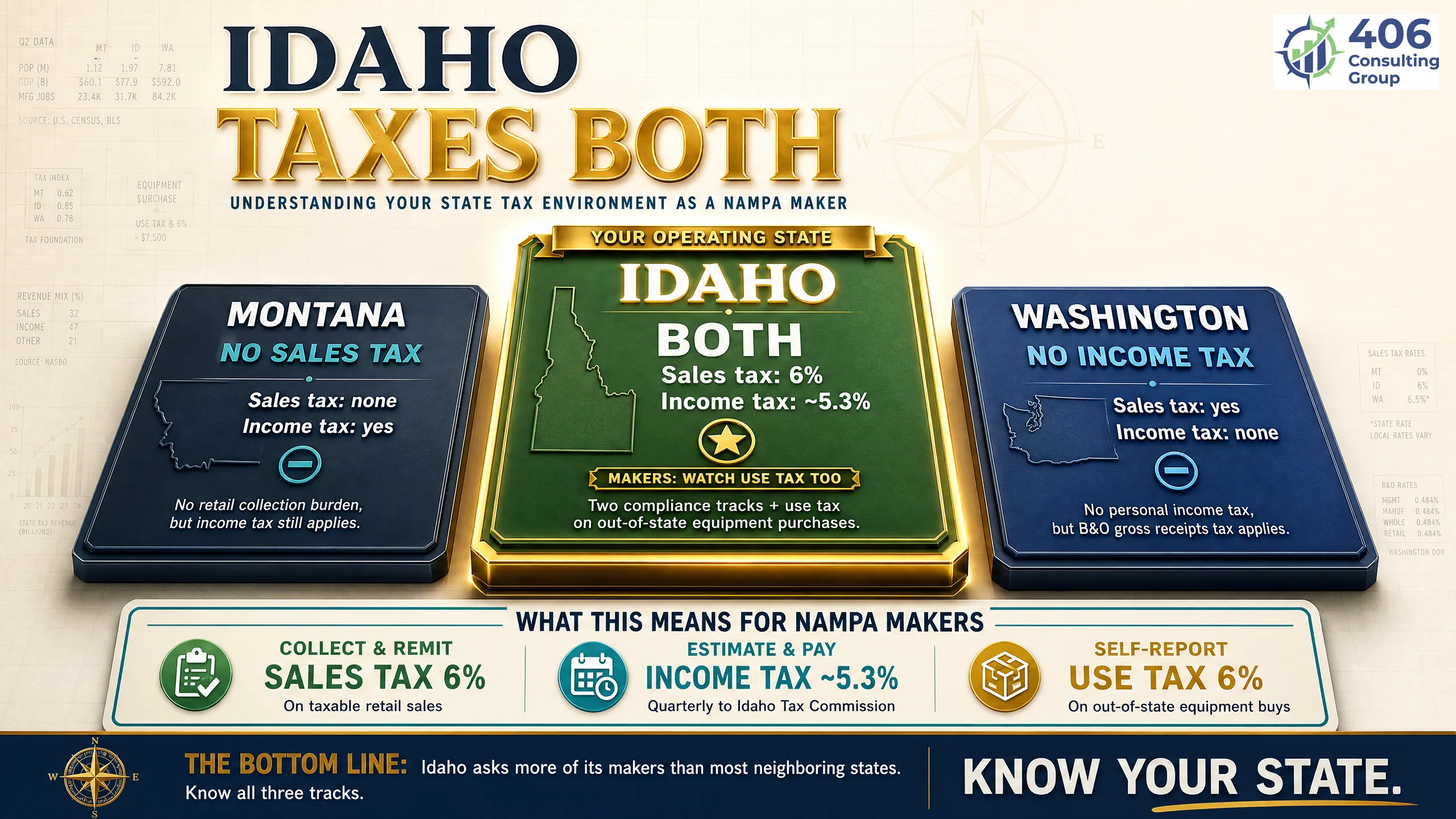
The short answer: Idaho taxes both income and sales, so your books have two jobs — track the sales tax you collect and keep profit clean enough to plan the income tax you owe. Montana has no sales tax; Washington has no income tax; Idaho has both, and a Nampa business can't ignore either side.
What Idaho spares you is complexity elsewhere: there's no business & occupation or gross-receipts tax like Washington's, the income tax is a single flat rate rather than a bracket puzzle, and most of it runs through one agency, the Idaho State Tax Commission. For a maker or producer, the real work isn't the tax rules — it's tracking inventory, cost of goods, and equipment cleanly enough that the tax numbers, and the margin numbers, are both trustworthy. Build the books for that and Idaho compliance becomes routine.
The rest of this guide walks through each piece. It builds on clean books, so if yours have fallen behind, this is the place to start — and the Boise and Meridian guides in this series cover the same Idaho fundamentals for their cities.
Sales & Use Tax (Watch the Use Tax)
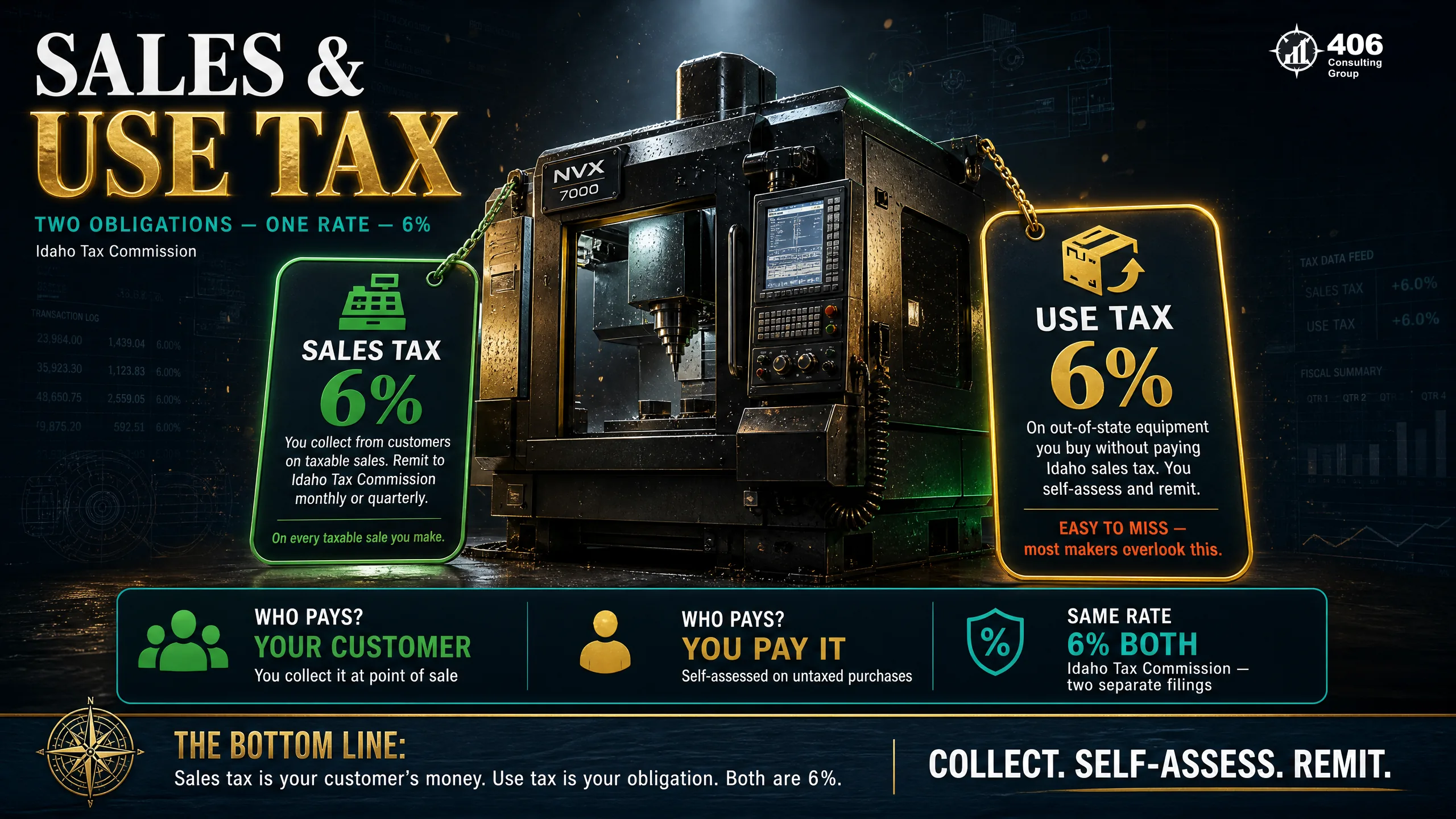
The short answer: Idaho has a 6% state sales tax; if you sell taxable goods you collect it and remit it, and you need a seller's permit from the Idaho State Tax Commission before you start. For Nampa's makers and producers, though, the piece that bites hardest is use tax — the companion tax on things you buy without paying sales tax.
Here's why it matters more for a maker: when you buy a machine, tooling, or raw materials from an out-of-state or online supplier that doesn't charge Idaho sales tax, you generally owe 6% use tax on it yourself. Equipment-heavy and materials-heavy businesses rack these up constantly, and because the purchase "felt" tax-free, the liability gets missed — until an audit finds it. Clean books record sales tax collected as a liability and flag every untaxed purchase so the use tax is captured as you go. Note that some manufacturing equipment and inputs may qualify for a production exemption, which is worth getting right rather than guessing.
The trap: spending sales tax you collected
Collected sales tax isn't revenue — it belongs to the state. Treating it as cash flow is one of the most common ways small businesses dig a hole. Clean books keep it visible as a liability, and flag use-tax situations, so you always know what's yours and what's owed. Confirm current rates, permits, and production exemptions with the Idaho State Tax Commission.
Income Tax & Set-Asides
The short answer: Idaho has a flat state income tax (around 5.3% as of 2025, after several recent cuts), and for most small businesses that profit flows through to the owner's personal return, on top of federal tax. The practical job is to set aside for it as you earn rather than facing it all at once.
For a pass-through business — a sole proprietorship, partnership, LLC, or S-corp — the business itself generally doesn't pay Idaho income tax; you do, on your personal return, on the profit that flows through. Idaho doesn't impose a federal-style mandatory quarterly-estimate regime with underpayment penalties on most individuals, but interest accrues on tax left unpaid after the April deadline — so the discipline is to reserve a share of profit as you go. That's only possible if your books show real profit through the year, which for a maker means inventory and cost of goods are tracked properly, not guessed at year-end.

Idaho income tax is also where proactive planning saves money — entity choice, equipment timing, and retirement all move the number, and because Idaho taxes income, those deductions cut both your federal and state bill. We cover that in the Nampa tax guide (part of this series); the bookkeeping job is to keep the numbers clean enough to plan from. Verify the current rate with the Idaho State Tax Commission.
Payroll in Idaho
The short answer: once you hire — and makers and producers hire in numbers — Idaho adds its own payroll layers on top of the federal ones: state income tax withholding, state unemployment insurance, and workers' compensation coverage. Idaho is conventional here: workers' comp comes from a private carrier or the Idaho State Insurance Fund, not a state-run monopoly.
| Item | What it is | Bookkeeping note |
|---|---|---|
| Idaho withholding | State income tax withheld from wages | Remitted to the Tax Commission; annual Form 967 reconciliation |
| State unemployment (SUI) | Employer-paid unemployment insurance | Experience-rated; quarterly filing with Idaho Dept. of Labor |
| Workers' comp | Required coverage via private carrier or State Fund | Premiums by class code; audited on payroll — key for shop-floor labor |
| Federal payroll | Social Security, Medicare, federal withholding, FUTA | Deposits and quarterly 941s as usual |
Workers' comp class codes matter especially for shop-floor and field labor, and getting them right keeps a year-end premium audit from becoming a surprise bill. Handled properly, payroll is a clean routine — which is what our payroll work gives a Nampa business.
Inventory & COGS for Makers
The short answer: if you make, grow, or move product, inventory and cost of goods sold (COGS) are the heart of your books — and the difference between knowing your real margins and flying blind. This is the piece a generic bookkeeper most often gets wrong for a Nampa maker or producer.
Done right, your books track what you hold in raw materials and finished goods, and capture the true cost of each product — materials, direct labor, and the overhead that belongs to production. That's what turns "we sold a lot" into "this product line earns 32% and that one barely breaks even." It also keeps your balance sheet honest for a lender and your taxable income accurate, since inventory sitting on the shelf isn't an expense until it's sold. For food processors and ag producers, add spoilage, seasonality, and lot tracking to the mix — all of which the books have to reflect.
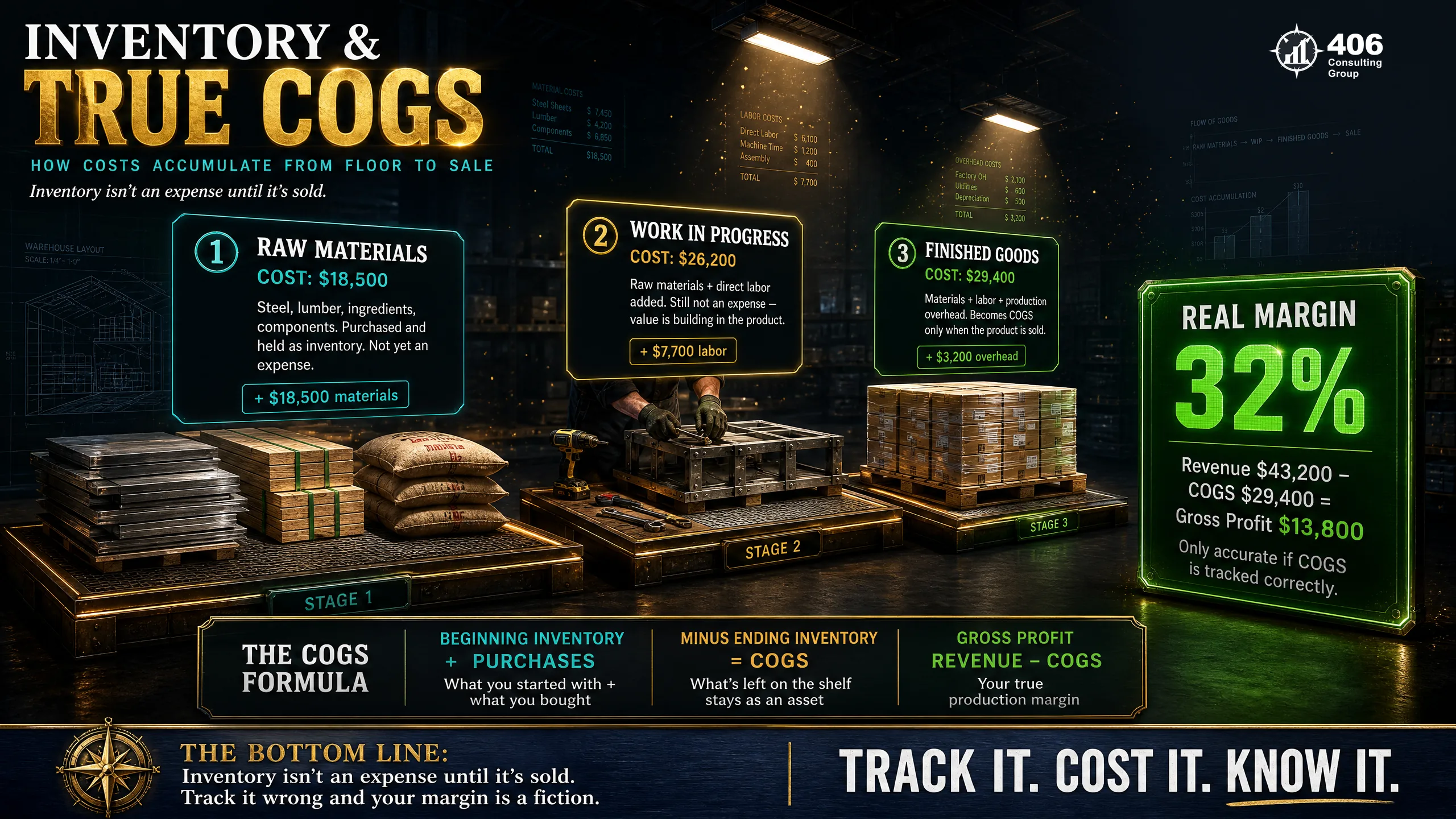
Inventory and COGS are exactly where clean bookkeeping starts paying for itself in decisions, not just compliance — and where the step up to controller-level reporting often begins.
A Chart of Accounts Built for Idaho
The short answer: your chart of accounts is the skeleton of your books, and for a Nampa business it has to keep the sales-tax liability, the income-tax set-aside, payroll liabilities, and — for makers — inventory and COGS cleanly separated, so each return and each margin report is something you run, not reconstruct.
An Idaho-ready chart of accounts keeps sales tax collected as a liability (never mixed into revenue), makes profit easy to read so income-tax estimates are accurate, breaks out payroll liabilities, and — critically for producers — separates inventory and cost of goods sold from operating expenses. Set up that way, your sales-tax return, your set-aside math, and your product-margin reports all come straight from numbers the books already track.
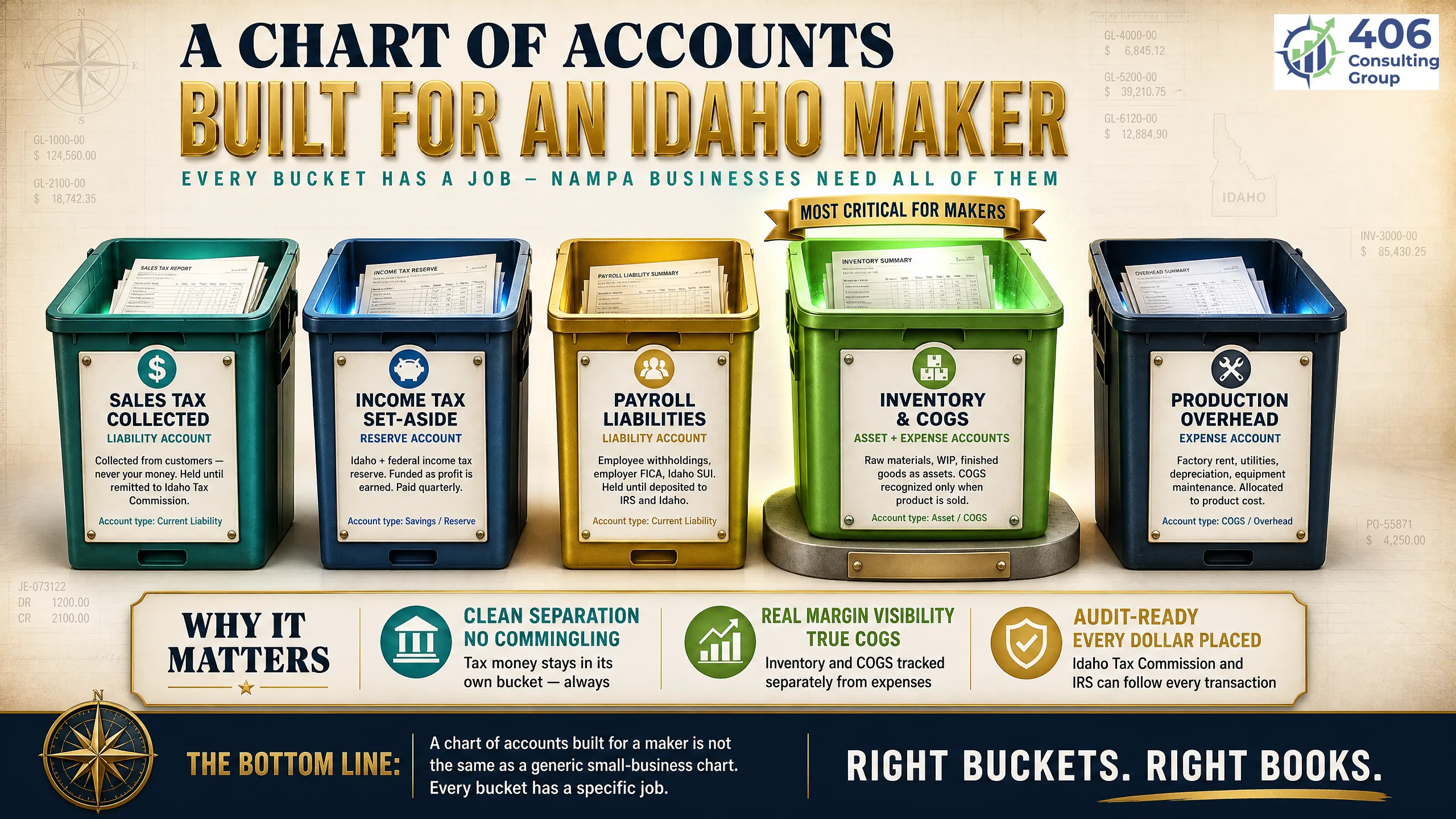
It's the kind of setup work that pays off every month — and the first thing we fix when we take on a Nampa business whose books grew up without it.
What a Growing Nampa Business Needs
The short answer: beyond compliance, a growing Nampa business needs books that inform decisions — accurate monthly financials, real product and job margins, and a cash-flow picture that accounts for the sales and income taxes coming due.
Nampa and Canyon County are growing fast, and makers scale on thin margins where a few points matter. Clean monthly books are the baseline; from there the value climbs — margin visibility so you know what to run more of, payroll handled correctly as the crew grows, inventory managed so cash isn't frozen on the shelf, and a cash-flow forecast so growth doesn't outrun the bank account. Good books give you the numbers to make pricing, hiring, and equipment decisions on facts instead of gut.
When reliable numbers become the basis for real decisions, many businesses step up from bookkeeping to controller-level support — a path we cover in upgrading from bookkeeping to a controller.
Bookkeeping by Nampa Industry
Nampa's economy leans toward making, growing, and moving product — and each corner asks something a little different of the books.
| Industry | What the books need to track |
|---|---|
| Food processing | Ingredient inventory, spoilage, lot tracking, production labor, use tax on equipment |
| Manufacturing | Raw materials & WIP, COGS, machine/equipment costs, multi-state sales tax |
| Agriculture | Seasonal income, input costs, equipment depreciation, ag-specific accounting |
| Distribution & warehousing | Inventory turns, freight, fuel and fleet, receivables |
| Construction & trades | Sales tax on materials, job costing, equipment, receivables |
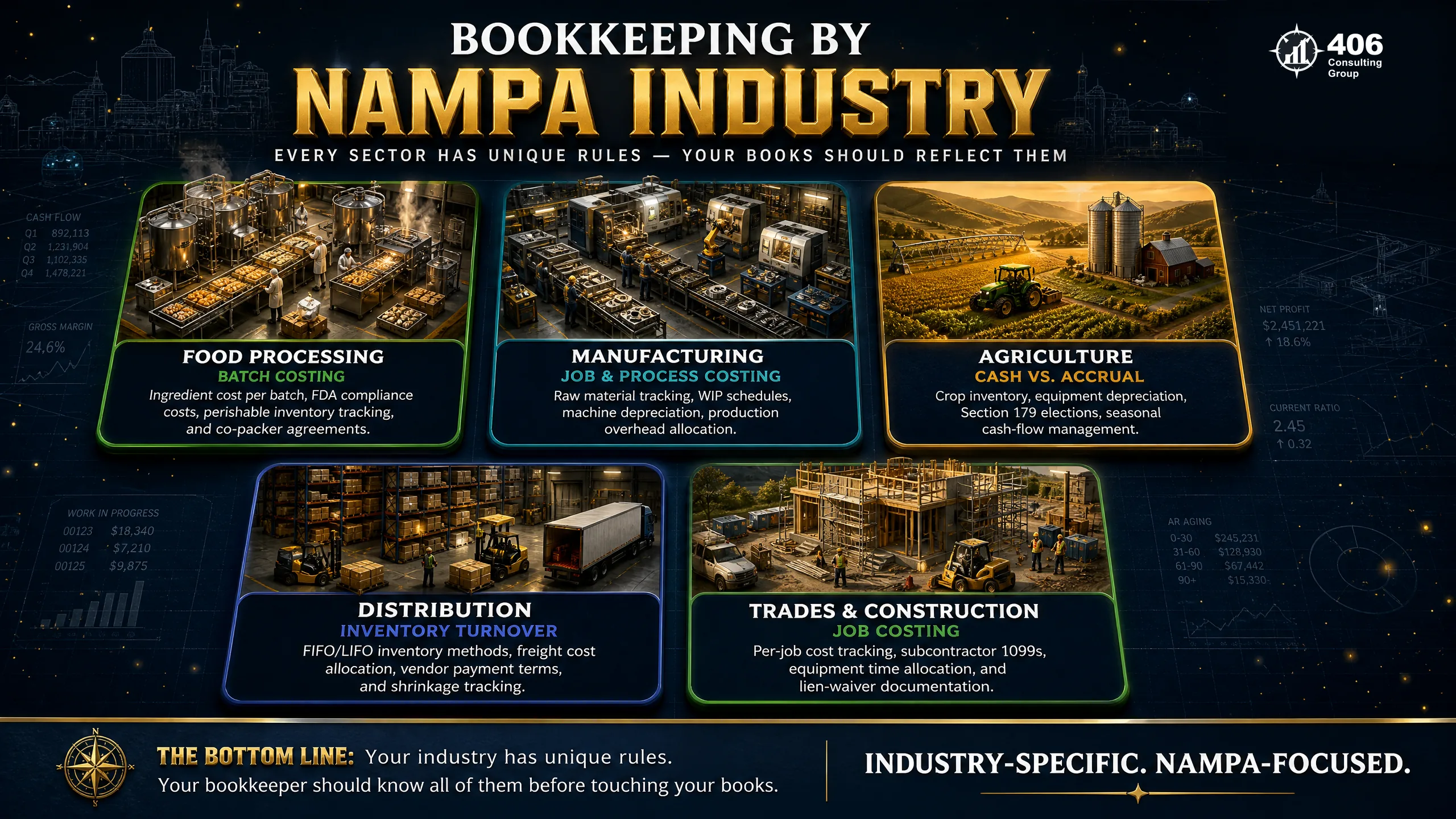
Different details, same backbone: track inventory and COGS so margins are real, keep sales and use tax clean, and stay ahead of payroll. Because our background is in running whole businesses, we set books up around how they affect the entire operation — pricing, purchasing, and cash — not just tax-time tidiness.
Common Idaho Bookkeeping Mistakes
Most Idaho bookkeeping trouble comes from the same avoidable mistakes — and for makers, a couple more. Here's what we see most.
Spending collected sales tax
It's the state's money in your account. Treat it as cash flow and you're short when the return is due.
Missing use tax on equipment
Out-of-state machines, tooling, and materials bought without sales tax usually owe 6% use tax — commonly overlooked.
Not tracking inventory & COGS
Without them you can't see real product margins, and taxable income and the balance sheet are both off.
Not setting aside for income tax
Idaho profit flows to your personal return; owe it all in April and a good year hurts.
Setting up Idaho payroll wrong
Withholding, SUI, and workers' comp class codes each have rules; retroactive fixes are costly.
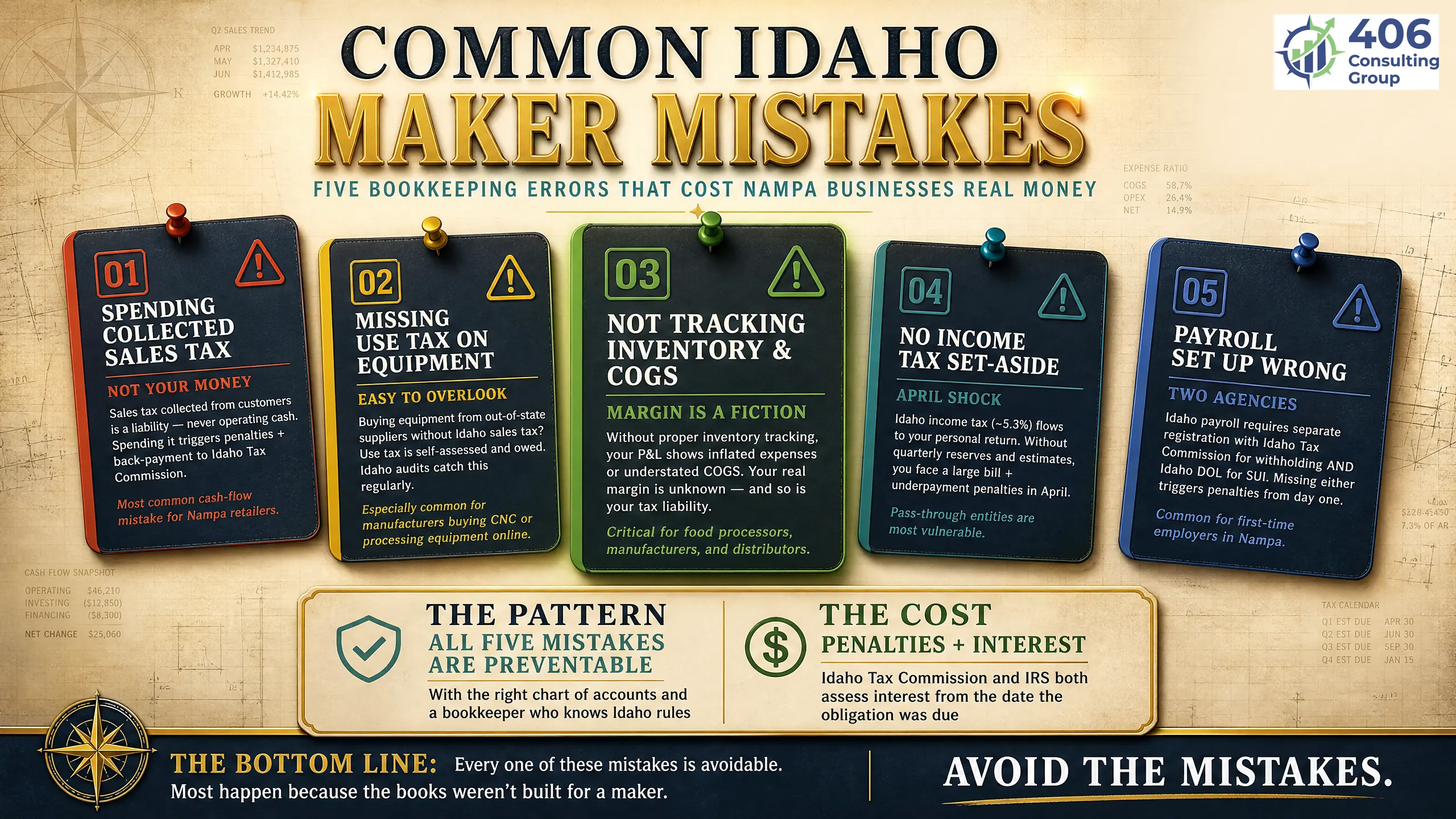
Every one is a setup-and-habit problem, not a character flaw — and every one disappears once the books are built for an Idaho maker and maintained on a monthly rhythm.
Local vs. a Great Remote Partner
The short answer: what matters in a bookkeeper is whether they know Idaho's tax setup and how to handle inventory, COGS, and equipment for a maker — not whether their office is in Nampa. A great remote partner who understands both beats an okay local generalist, and the work is a natural fit for remote delivery.
And honestly, remote is how modern bookkeeping already works — even for the clients right down the road. Roughly 70–80% of our own local clients never set foot in our office; the whole relationship runs on secure cloud accounting, connected bank feeds, shared screens, and a steady monthly rhythm. Distance simply isn't the variable it used to be. So whether you're in Nampa, elsewhere in Canyon County, or anywhere in Idaho, you get the same responsive, Idaho-savvy service our in-town clients do.
And if you sell or ship across the region — into Oregon, Washington, or beyond — that multi-state experience matters more than a local address, and it's exactly what a specialized remote firm brings.
How to Get Started
Getting your Idaho books in order is three steps.
Clean up and set the baseline
Reconcile the accounts and build a chart of accounts that separates sales tax, income-tax set-aside, payroll, and inventory/COGS.
Get the tax and cost rhythm right
Set up sales- and use-tax tracking, a profit-based income-tax set-aside, and inventory/COGS so margins are real.
Run it monthly
Monthly reconciliation and clean financials keep compliance routine and give you numbers you can run the business on.
Not sure whether you need bookkeeping, tax help, or something more? Our Financial Maturity Assessment maps it out in about eight minutes.
FAQ: Nampa Bookkeeping Questions
What taxes does a Nampa, Idaho business have to deal with?
Idaho taxes both sales and income. You collect Idaho sales tax (6% in Nampa) on taxable sales and remit it, and you owe use tax on business purchases bought without sales tax. You also pay Idaho income tax on your profit — for most small businesses that flows through to the owner's personal return, alongside federal income tax. There's no gross-receipts or B&O tax like Washington's. Employers also handle Idaho payroll: state withholding, unemployment insurance, and workers' compensation.
What is use tax and why does it matter for a maker?
Use tax is the companion to sales tax: if you buy taxable goods for your business without paying sales tax — commonly machines, tooling, or materials from out-of-state or online suppliers — you generally owe Idaho use tax at the same 6% rate. It matters more for Nampa's makers and producers because equipment- and materials-heavy businesses rack up untaxed purchases constantly, and the liability is easy to miss until an audit. Clean books flag these so use tax is captured as you go. Some production equipment and inputs may qualify for an exemption — worth confirming rather than guessing.
Do I really need to track inventory and COGS?
If you make, grow, or move product, yes — it's the heart of accurate books. Inventory and cost of goods sold (COGS) capture the true cost of each product (materials, direct labor, production overhead), which is the only way to know real margins rather than just watching the bank balance. It also keeps taxable income accurate, since inventory on the shelf isn't an expense until it's sold, and keeps your balance sheet credible for a lender. Food processors and ag producers add spoilage, seasonality, and lot tracking on top.
How much should I set aside for Idaho income tax?
It depends on your profit, but the method matters most: set aside a share of profit as you earn it rather than facing the bill in April. Because Idaho profit typically flows to your personal return, you'll usually plan federal and Idaho income tax together. Idaho doesn't impose a federal-style mandatory quarterly-estimate penalty on most individuals, but interest accrues on tax unpaid after the April deadline — so a steady set-aside keeps it painless. Clean, current books make that set-aside accurate instead of a guess.
Can 406 Consulting Group do my Nampa bookkeeping remotely?
Yes. We work with Nampa and Canyon County businesses through secure cloud accounting — connected bank feeds, shared screens, and a steady monthly rhythm. What matters for an Idaho maker is expertise in sales and use tax, inventory and COGS, income-tax set-asides, and state payroll, not office proximity. In fact, roughly 70–80% of our own local clients never come into the office either, so the relationship is effectively remote for them too. An Idaho-savvy remote partner serves you better than a local generalist, and multi-state experience is a real plus if you ship across the region.
Keep Reading
Bookkeeping — Nampa, ID
Books That Know What You Make.
406 Consulting Group keeps Nampa makers and small businesses clean and compliant — sales and use tax, inventory and COGS, income-tax set-asides, and Idaho payroll handled, with financials you can run the business on. Delivered remotely, by a firm that knows Idaho.
Nampa Bookkeeping Quick Reference
Nampa, ID — Canyon County
Behind on Idaho Compliance?
Sales/use tax, COGS & payroll, handled.
About the Author
Jason Anderson
Co-Founder, 406 Consulting Group
Background in large-scale operational finance at BP before building financial infrastructure for small businesses across the Northwest. Jason helps Nampa makers and producers get inventory, COGS, Idaho tax, and payroll right — with books they can actually run the business on.
Read the Full Story