
CAAS vs. Fractional CFO:
Which Does Your Business Actually Need?
CAAS is your finance engine; a fractional CFO is the navigator. Here's what each really does, which you need first, and why the businesses that pull ahead connect the two — delivered by one remote team.

If you've been told you need "CAAS" by one firm and a "fractional CFO" by another, you're not confused because you're missing something — you're confused because the industry uses two different words for two different jobs and rarely explains how they fit together. This guide settles the CAAS vs. fractional CFO question in plain English: what each one actually is, which your business needs right now, and why the businesses that pull ahead usually stop treating it as an either/or.
Here's the short version before we go deep. CAAS is the engine that runs your finances every month. A fractional CFO is the navigatorwho decides where to point the business. Buy the wrong one — or buy them from two disconnected vendors — and you either pay for horsepower with no direction, or direction with no reliable data underneath it.
By Jason Anderson — Co-Founder, 406 Consulting Group. Big-firm-trained accountant with a Six Sigma background who designs connected finance systems — clean books through CFO strategy — for growing companies, delivered remotely.
Quick Answer: CAAS vs. Fractional CFO
- →CAAS (Client Accounting & Advisory Services) is your outsourced finance engine — bookkeeping, payroll, controller-level reporting, and ongoing advice, run for you every month.
- →A fractional CFO is part-time senior finance leadership — forecasting, capital strategy, pricing, and the big decisions — without a full-time salary.
- →They do different jobs. Most growing businesses need the engine first, then add the navigator.
- →Bolting a CFO onto messy books means paying CFO rates for cleanup. Sequence matters.
- →406 delivers both, connected — one team, one set of numbers, fully remote.
Table of Contents
The Short Answer
CAAS keeps your numbers accurate, current, and understood. A fractional CFO uses those numbers to make the business more valuable. One is production; the other is strategy. You can buy them separately, but the real leverage shows up when they run off the same books, in the same rhythm, by people who talk to each other.
Before you decide which you need, a gut check. If any of these sound like your business, your current setup is already costing you money:
Your books are always a month or two behind, so every decision is made in the rearview mirror.
Tax time brings surprises — a bill you didn't see coming, or deductions you missed.
You can't quickly answer "can I afford to hire, buy that equipment, or take this job?"
A lender or investor asked for something and you couldn't produce it fast, or at all.
The short answer: it's rarely CAAS or a fractional CFO. It's which one you need first — and whether whoever provides it can connect the two.
What Is CAAS?
CAAS stands for Client Accounting & Advisory Services— a modern, all-in-one way to outsource the finance function of a small or mid-sized business. Instead of stitching together a data-entry bookkeeper, a once-a-year tax preparer, and a spreadsheet you maintain yourself, CAAS is one team running the whole engine for you, every month.
A real CAAS engagement typically includes:
Bookkeeping & reconciliations
A clean chart of accounts, monthly reconciliations, and a real close — not a shoebox sorted in April.
Payroll & compliance
Payroll run correctly, filings on time, sales/payroll tax handled, deadlines tracked.
Controller-level reporting
Monthly financial statements you can actually read, plus job costing or department detail where it matters.
Ongoing advisory
A person who reviews the numbers with you and tells you what they mean — the part most bookkeeping skips.
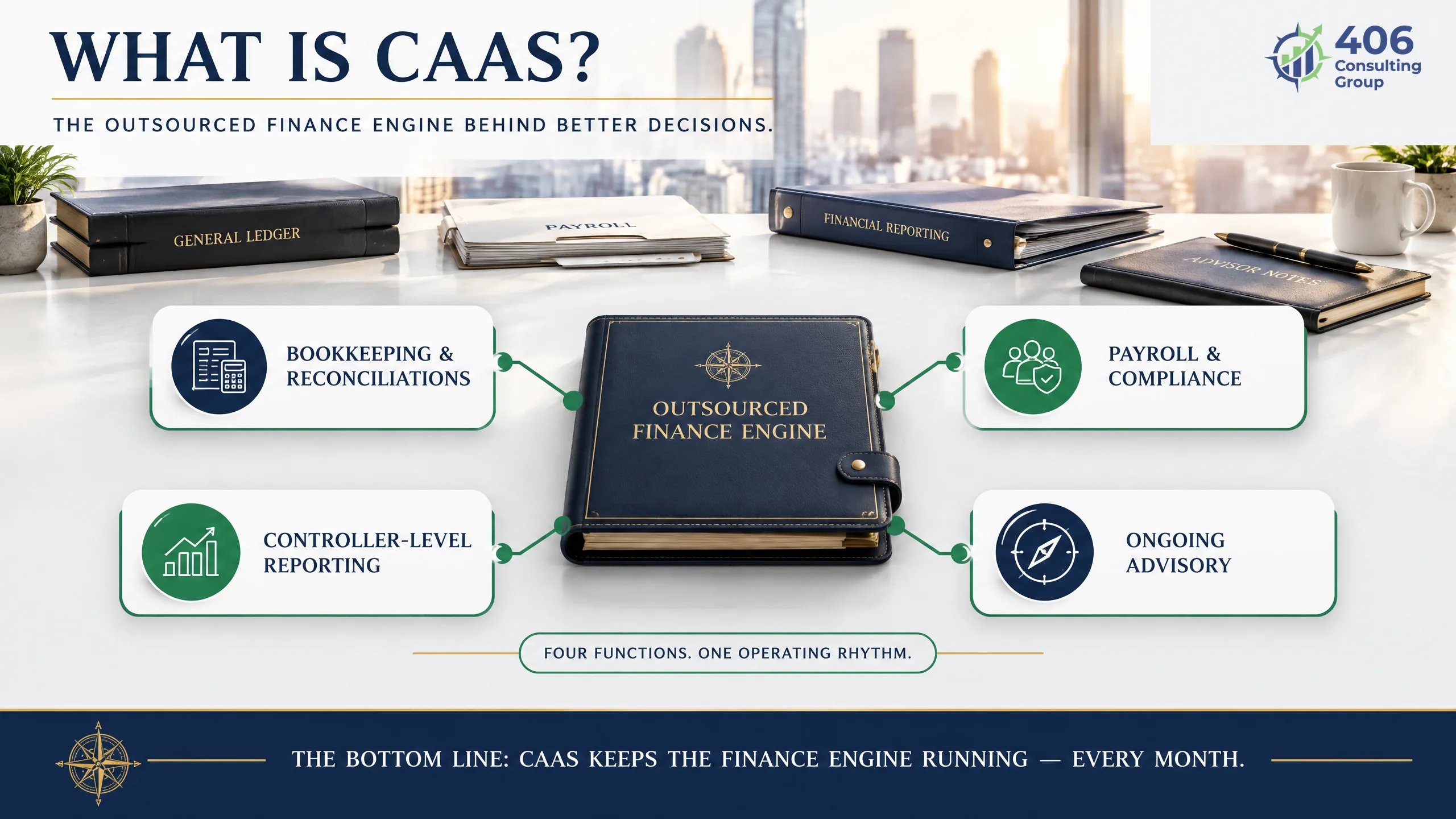
Think of CAAS as your outsourced finance department— the day-to-day and month-to-month machinery that keeps the numbers trustworthy. But there's a catch hiding in that last bullet, and it's where a lot of firms quietly fall short.
CAS vs. CAAS: The Extra “A” Is the Whole Point
You'll see two acronyms in the wild: CAS (Client Accounting Services) and CAAS (Client Accounting & Advisory Services). The extra “A” looks like a typo. It isn't. It's the difference between a firm that records your business and one that helps you runit. (The letters get used loosely — the AICPA even uses “CAS” for “Client Advisory Services,” folding the advisory in. Whatever the acronym, the question that matters is the same: does your firm just record, or does it actually advise?)
CAS — Compliance only
- •Records what already happened
- •Delivers statements — you interpret them
- •Answers "what did we spend?"
- •You still wonder what to do next
CAAS — Compliance + advisory
- →Records it — then tells you what it means
- →Flags the trend before it's a problem
- →Answers "what should we do about it?"
- →You walk away with a decision
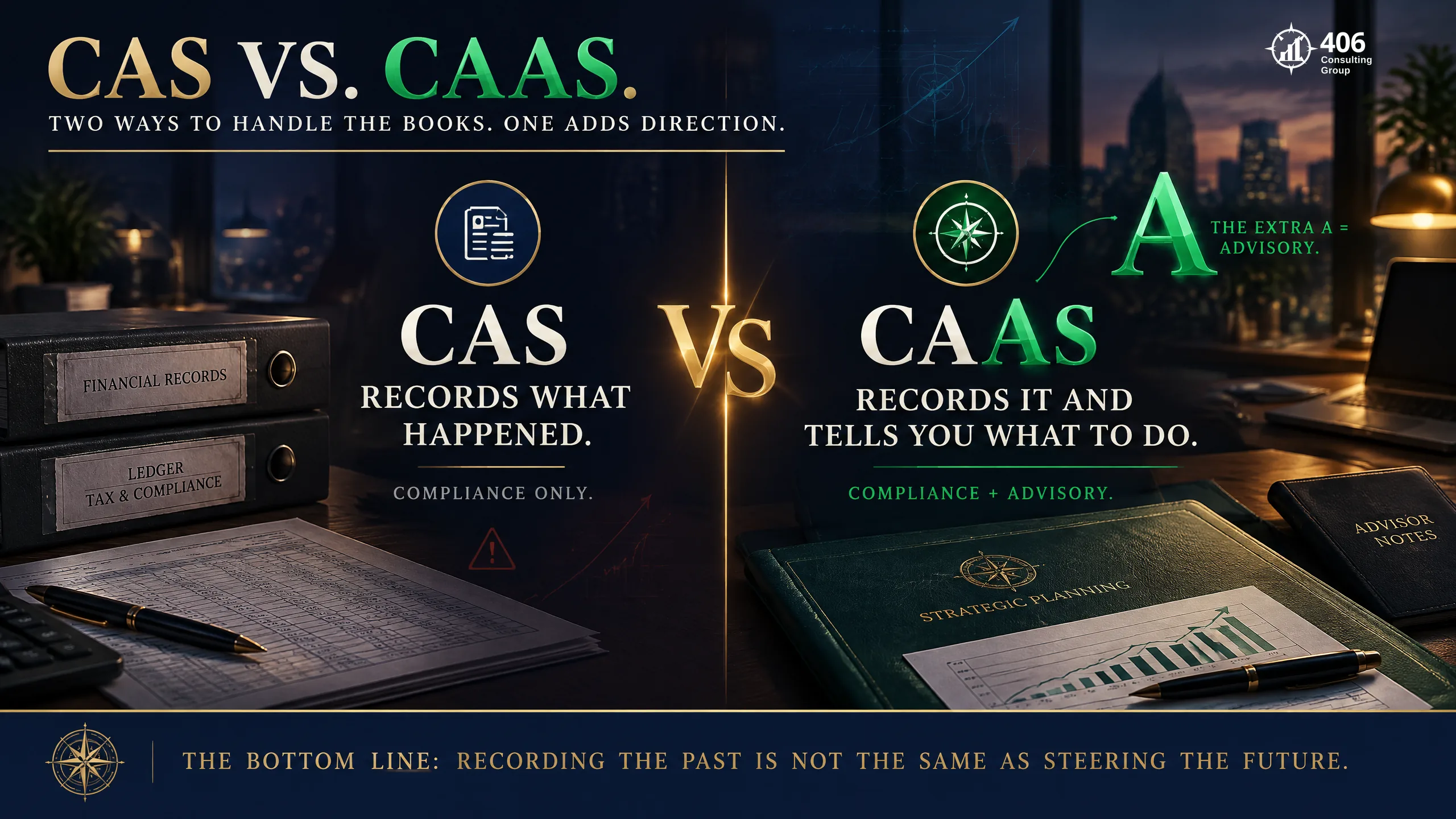
Here's the honest part: plenty of firms market “CAAS” and deliver CAS.You get tidy books and a monthly PDF, but nobody ever picks up the phone to say, “your margins slipped on the last three jobs — here's why, and here's the fix.” The advisory is the part that changes outcomes, and it's the first thing to disappear when a firm is really just doing data entry with a nicer name.
Automation now handles most of the data entry. So the value of modern accounting isn't recording the numbers — it's the human who reads them and tells you what to do. That's the “A” you're actually paying for.
What Is a Fractional CFO?
A fractional CFOis an experienced chief financial officer who works with your business part-time — a few days a month, or a set engagement — instead of drawing a full-time executive salary. You get senior-level financial leadership scaled to what a growing company actually needs, without the six-figure hire.
Where CAAS keeps the numbers right, the fractional CFO decides what to do with them:
Forecasting & cash
13-week cash flow, scenario planning, and knowing today what next quarter looks like.
Capital & lending
Getting financing-ready, structuring debt, and presenting the business the way a lender underwrites it.
Pricing & margin
Which jobs, products, and customers actually make money — and which quietly lose it.
Growth strategy
Whether to expand, hire, add a location, or hold — with numbers behind the call.
KPIs & dashboards
The handful of metrics that predict the business, reviewed on a real cadence.
Exit & value
Building a business that's worth more when you sell, borrow, or bring on a partner.
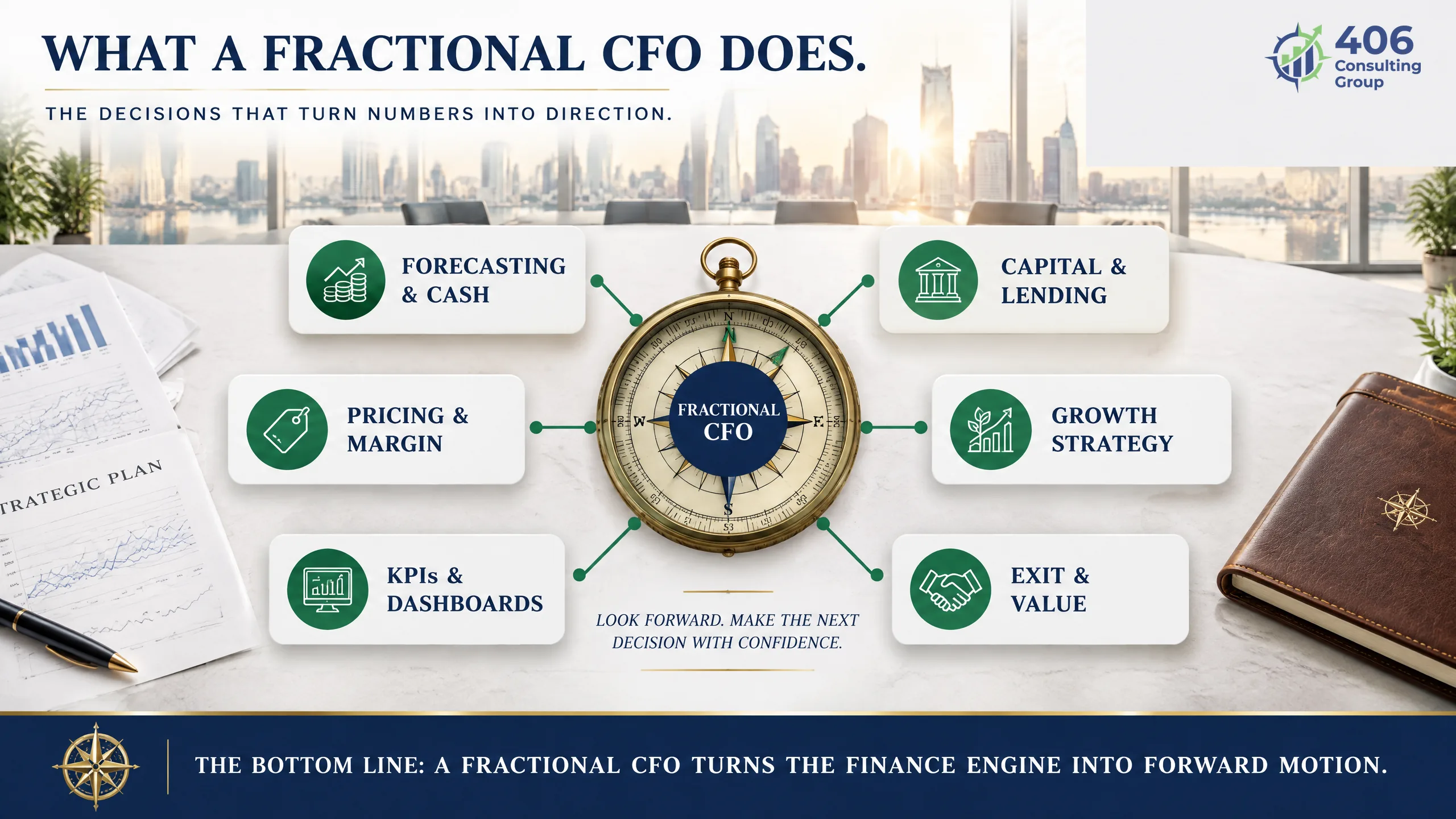
A fractional CFO is nota glorified bookkeeper, and shouldn't be doing your reconciliations. If yours is, you're overpaying for data entry — which is exactly the trap the next few sections are about.
The Core Difference, Side by Side
The clearest way to see it: same business, two different jobs, two different cadences.
| CAAS | Fractional CFO | |
|---|---|---|
| Core job | Keep the numbers right | Decide what to do with them |
| Focus | The past & present | The future |
| Cadence | Daily / monthly, ongoing | Strategic, milestone-driven |
| Deliverables | Clean books, payroll, statements | Forecasts, capital plans, strategy |
| Best for | Any business that needs reliable finances | Businesses facing growth, capital, or big decisions |
| Question it answers | “Where do we stand?” | “Where are we going, and how?” |
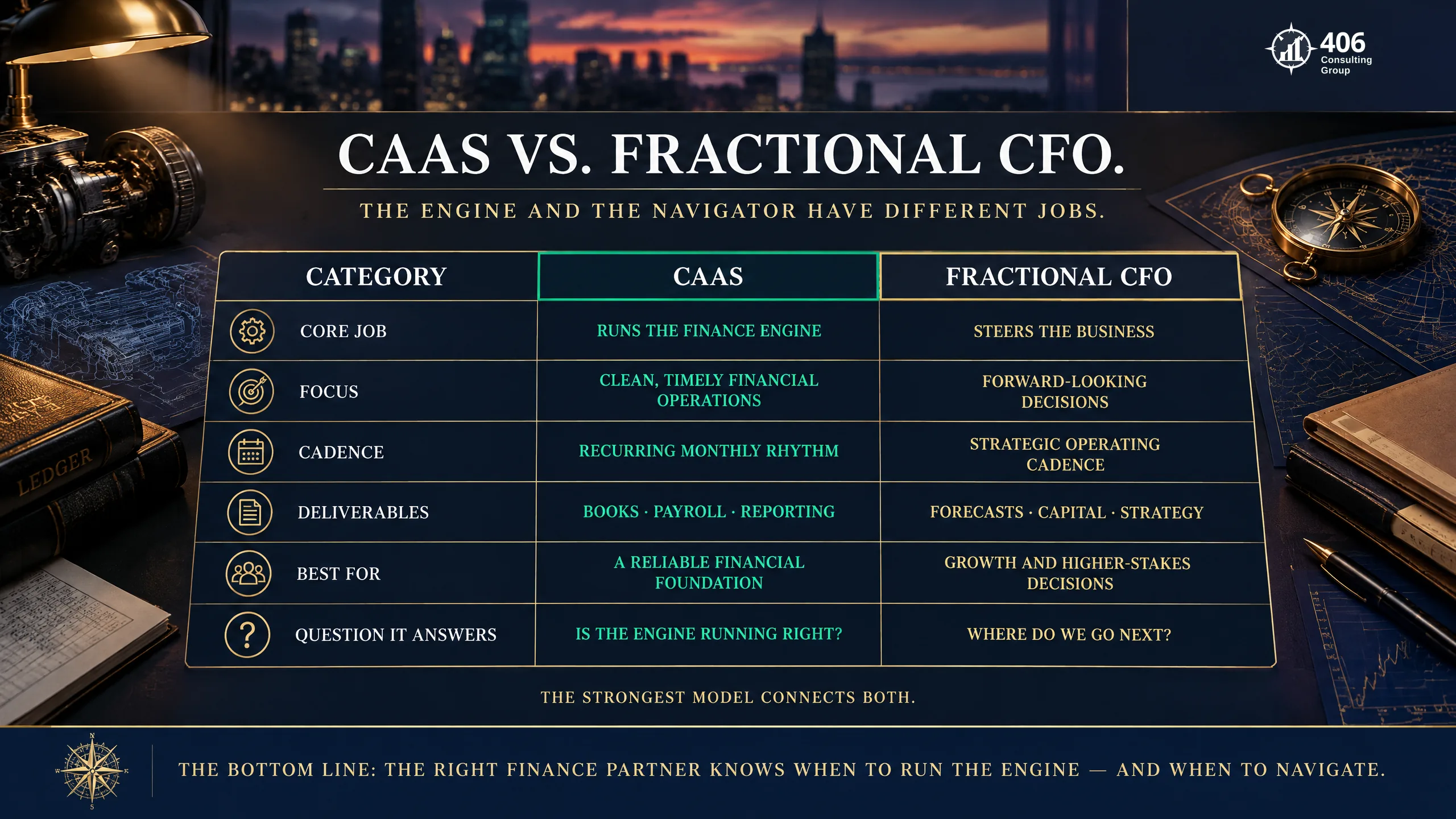
Notice they don't overlap — they stack. Which is exactly why keeping them in separate silos, at separate vendors, quietly costs you.
Where Most Firms Fail: The Silo Problem
The typical growing business ends up with three disconnected vendors: a bookkeeper who records transactions, a CPA who shows up at tax time, and — eventually — a CFO consultant who parachutes in for strategy. Each is competent. None of them owns the whole picture. And the gaps between them are exactly where money leaks out.
A strategist working off books they didn't build and can't fully trust spends the first half of every engagement cleaning data instead of driving decisions. The bookkeeper doesn't know what the CFO needs, so they don't track it. The CPA finds problems in March that a monthly advisor would have caught in June. Nobody is accountable for the outcome — only for their slice.
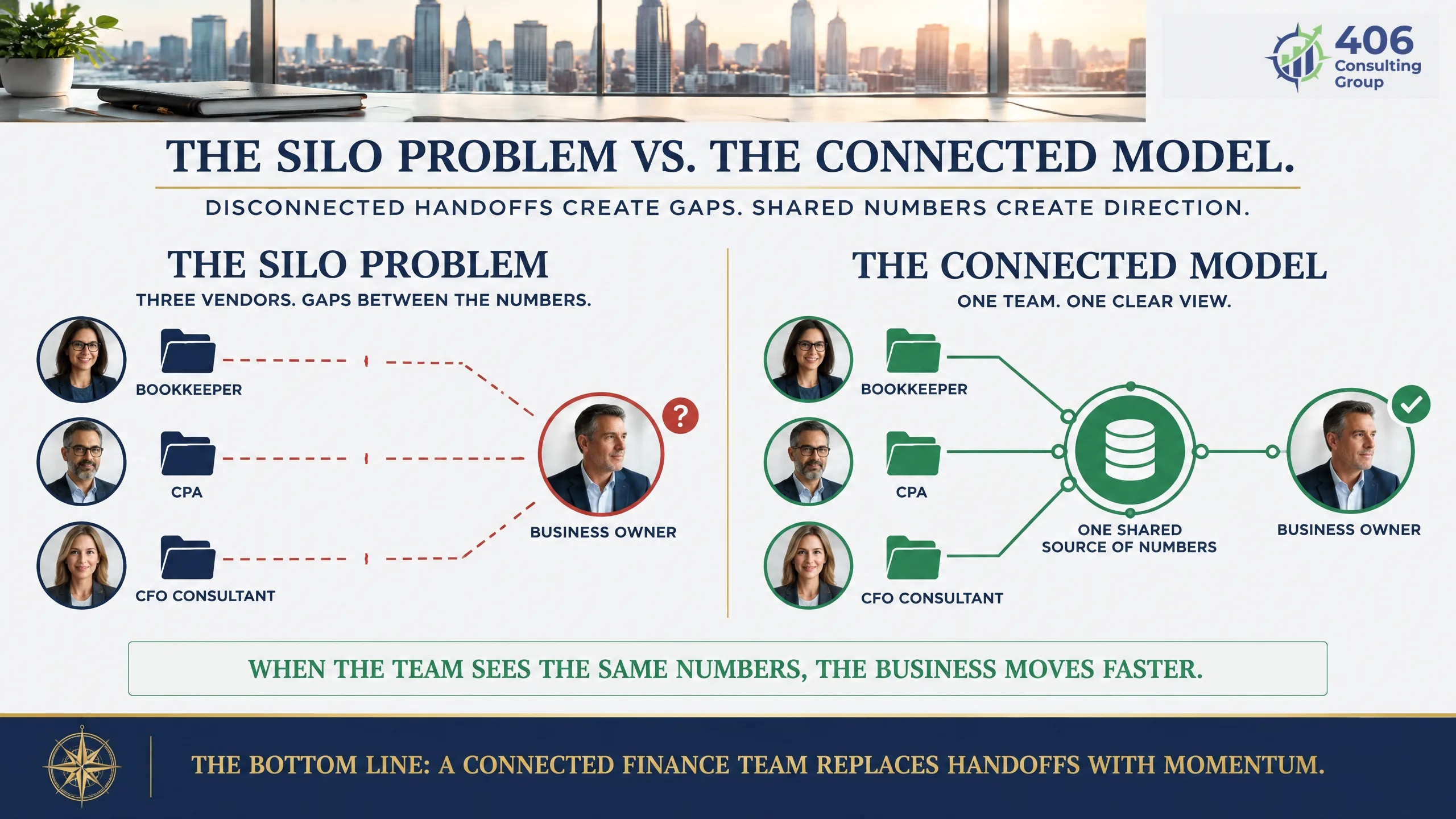
The most expensive words in small-business finance: “I assumed the other person was handling that.” Three vendors, three slices, one thing nobody owns — your actual result.
The Connected Finance Model
Here's the framework we build around. Stop thinking of CAAS and a fractional CFO as two purchases and start thinking of them as two parts of one system: the engine and the navigator, running off one set of numbers.
The Engine — CAAS
Clean books, payroll, and controller-level reporting produce a single, trusted source of truth — updated every month, not reconstructed once a year.
The Navigator — Fractional CFO
Because the CFO trusts the data instantly, every session is spent on decisions — forecasting, pricing, capital — not on cleaning up someone else's books first.
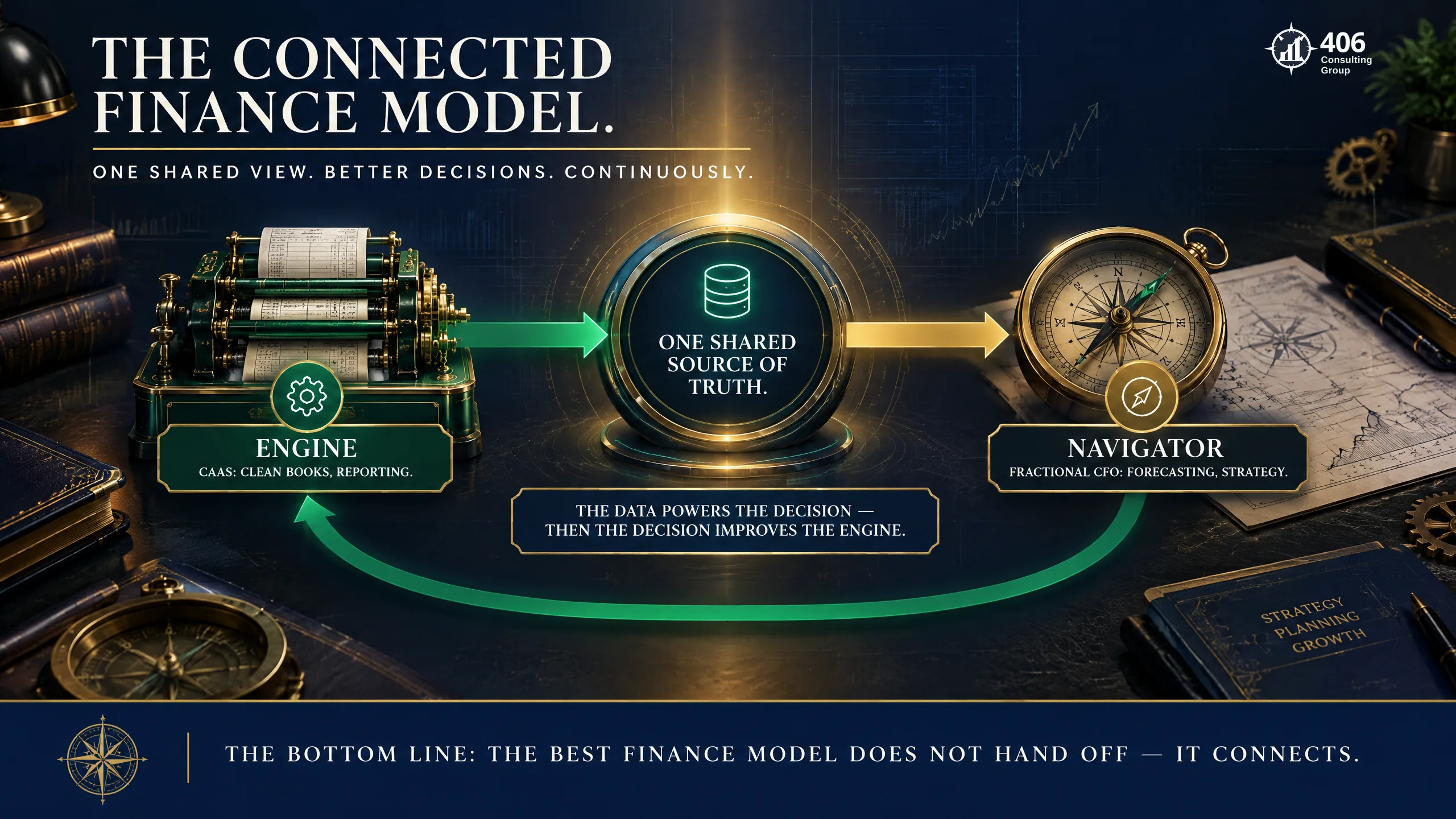
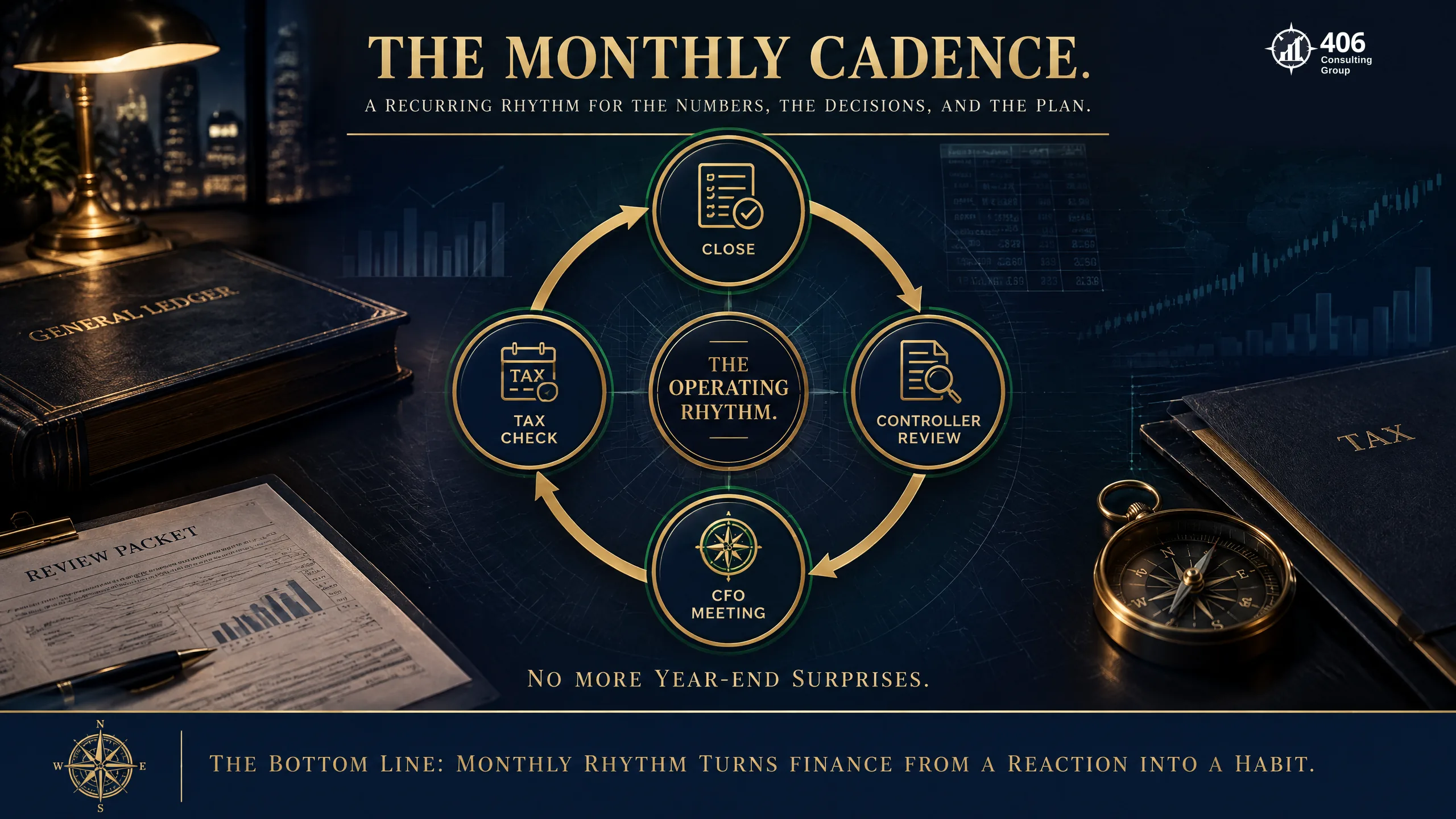
When the engine and the navigator are the same team, the loop closes: the CFO's strategy tells the controller what to track, the controller's numbers sharpen the CFO's next call, and you get one group accountable for the result. That's the whole idea behind the financial maturity ladder— moving from chaos to control to strategy without changing teams at every rung.
Which Do You Need? The 3 Signals
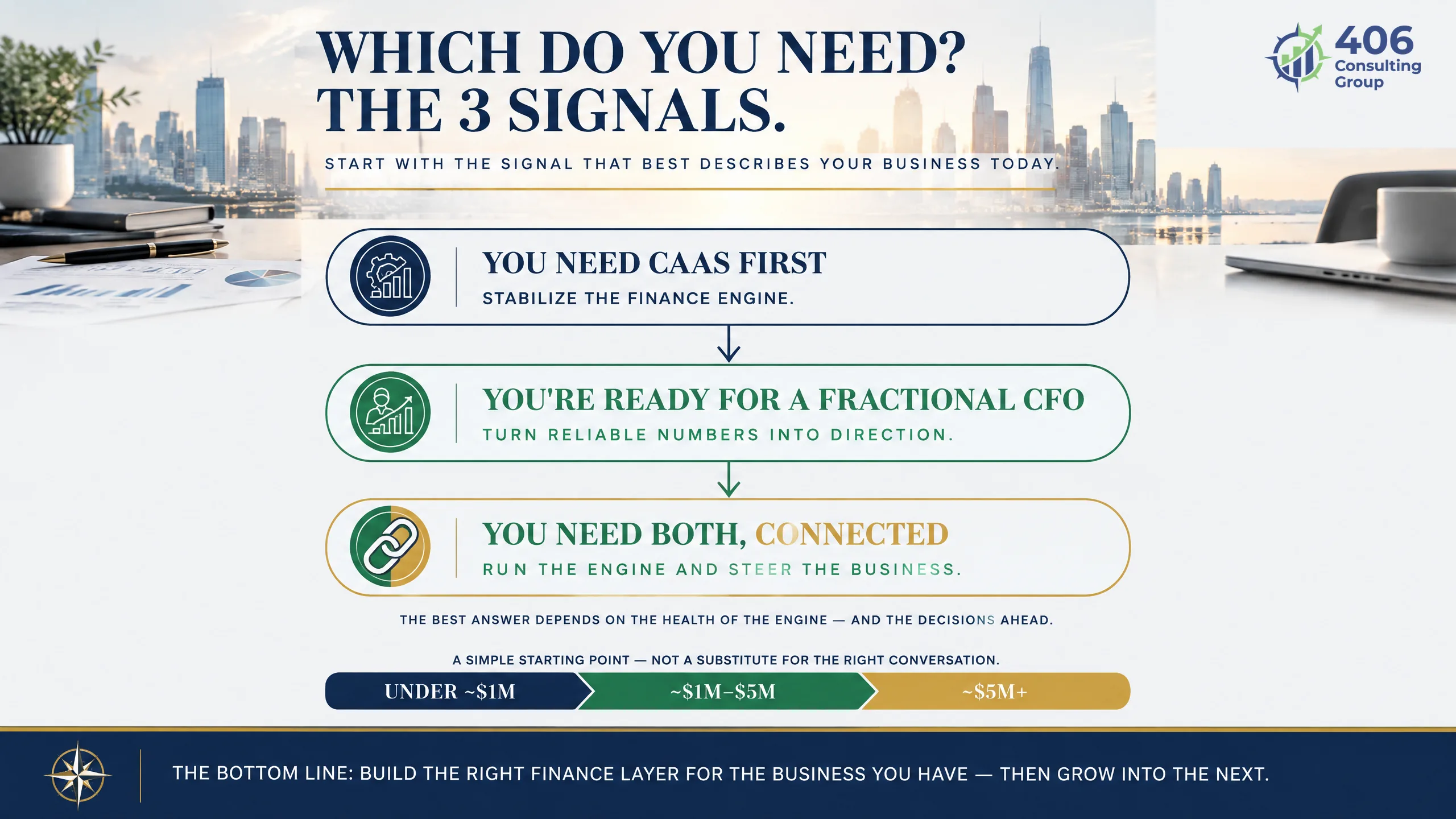
Most businesses need the engine before the navigator — you can't steer with numbers you don't trust. Use these three signals to place yourself.
You need CAAS first
Your books are late or unreliable, tax time is a scramble, and you can't get a clean, current P&L on demand. Fix the engine before anything else.
You're ready for a fractional CFO
Your books are clean, but you're facing a real decision — raising capital, a big hire, a new location, pricing, or an exit — and you want senior firepower behind the call.
You need both, connected
You're growing fast, the stakes are rising, and you want reliable numbers AND someone using them to steer — without managing two vendors who don't talk.
Revenue is a rough proxy, too — not a rule, but a pattern we see constantly:
Under ~$1M
Usually a CAAS/engine problem. Get clean, current books and real monthly advice in place first.
~$1M–$5M
The crossover. The engine has to be solid and the navigator starts paying for itself — often both, connected.
~$5M+
CFO-level strategy is no longer optional; the engine underneath it has to be airtight to support it.
Not sure where you land? Our financial maturity assessment gives you a read in a few minutes.
Why Bolting a CFO onto Messy Books Wastes Money
This is the single most common — and expensive — mistake we see: an owner feels the strategy gap, hires a fractional CFO, and points them at books that aren't reliable. Now you're paying the highest hourly rate in your finance stack to do the lowest-value work: cleanup.
Wrong sequence
Hire a CFO → CFO finds the books can't be trusted → CFO spends months on cleanup at CFO rates → strategy stalls → you question the ROI.
Right sequence
Get the CAAS engine clean and current → the CFO trusts the data on day one → every session goes to decisions → strategy compounds → ROI is obvious.
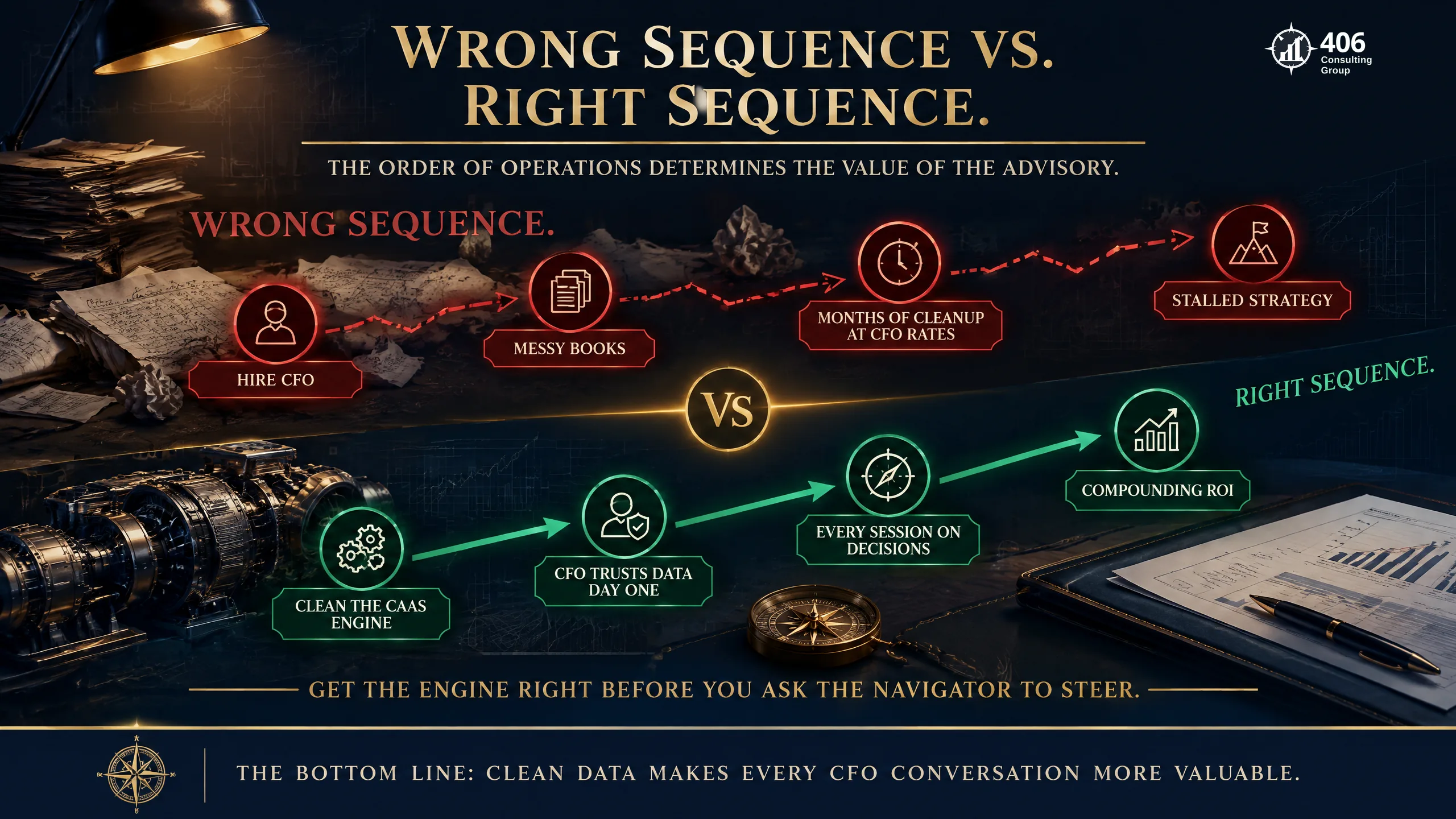

A fractional CFO is only as good as the numbers underneath. Fix the engine first, or you're buying a Ferrari and leaving it in the shop.
What 406 Actually Delivers
We built 406 to be the connected model, not another silo. You get the engine and the navigator from one team — and two things most firms can't offer together.
A whole-company systems view
A big-firm accounting background plus a Six Sigma process obsession means we design your finances as a connected system — how sales, operations, and cash actually move — not through a narrow accounting lens.
A lender's-eye read on your numbers
With a commercial-banking and underwriting background — 300+ business loans reviewed — we keep your books the way a lender reads them, so when you go to borrow, the numbers already make your case.
What the first 90 days usually look like:
Assess and stabilize the engine — clean up the chart of accounts, catch up and reconcile, and get to a real monthly close.
Stand up reporting — monthly statements you can read, the KPIs that matter for your business, and job or department detail where it counts.
Turn on the navigator — a forward look at cash, the first strategic review, and a plan for the decisions in front of you.
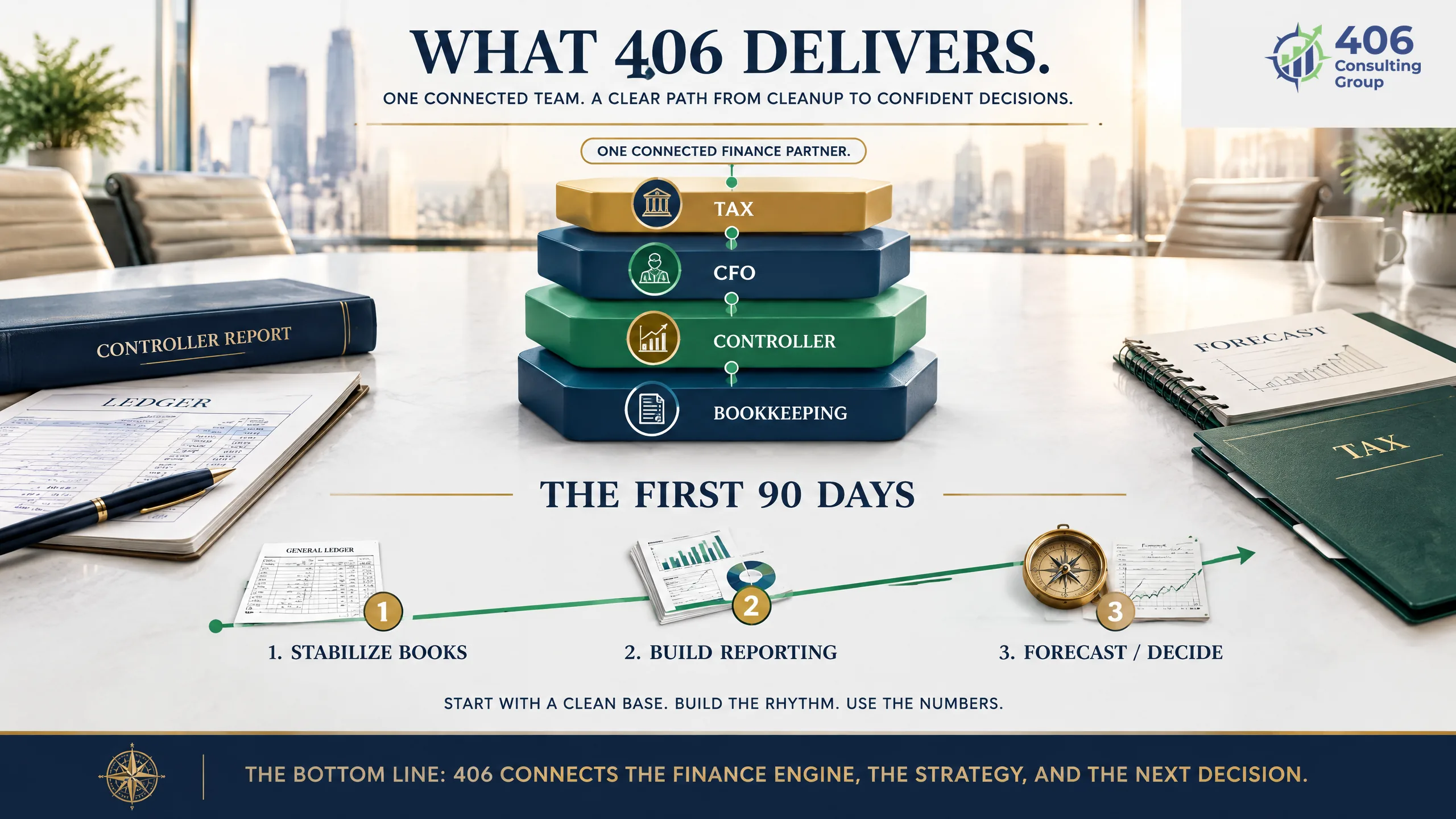
Take a growing contractor as the everyday example: CAAS keeps the job costing, work-in-progress, and retainage accurate every month; the fractional CFO uses that same data to build the bonding capacity and financing story that lets them take on bigger work. Same numbers, two jobs, one team — and it's all remote. Around 80% of our own local clients run the entire relationship that way and never come into an office; a great connected team that knows your industry beats an okay local one that only does part of the job.
Examples of the Value
The scenarios below are illustrative composites— representative of what a connected model surfaces, not specific client accounts — with the layer that drives each result called out.
The margin leak nobody was watching
Monthly job costing shows the last three projects came in 9 points under bid margin because materials were miscoded to overhead. Caught in June, not at tax time — and the bidding gets fixed before the next contract.
The cash crunch that never happened
A 13-week cash forecast flags a squeeze 60 days out from a payroll-and-tax collision. The fix — timing a purchase and a draw — is a five-minute decision instead of a panicked call to the bank.
Lender-ready in weeks, not never
Clean books plus a CFO-built package means an SBA or equipment request goes out fast and complete — the difference between a quick yes and a slow, document-chasing no.
The S-corp savings hiding in plain sight
Accurate owner-compensation data plus proactive planning surfaces a reasonable-salary structure that trims self-employment tax — money that was on the table every year nobody was planning.
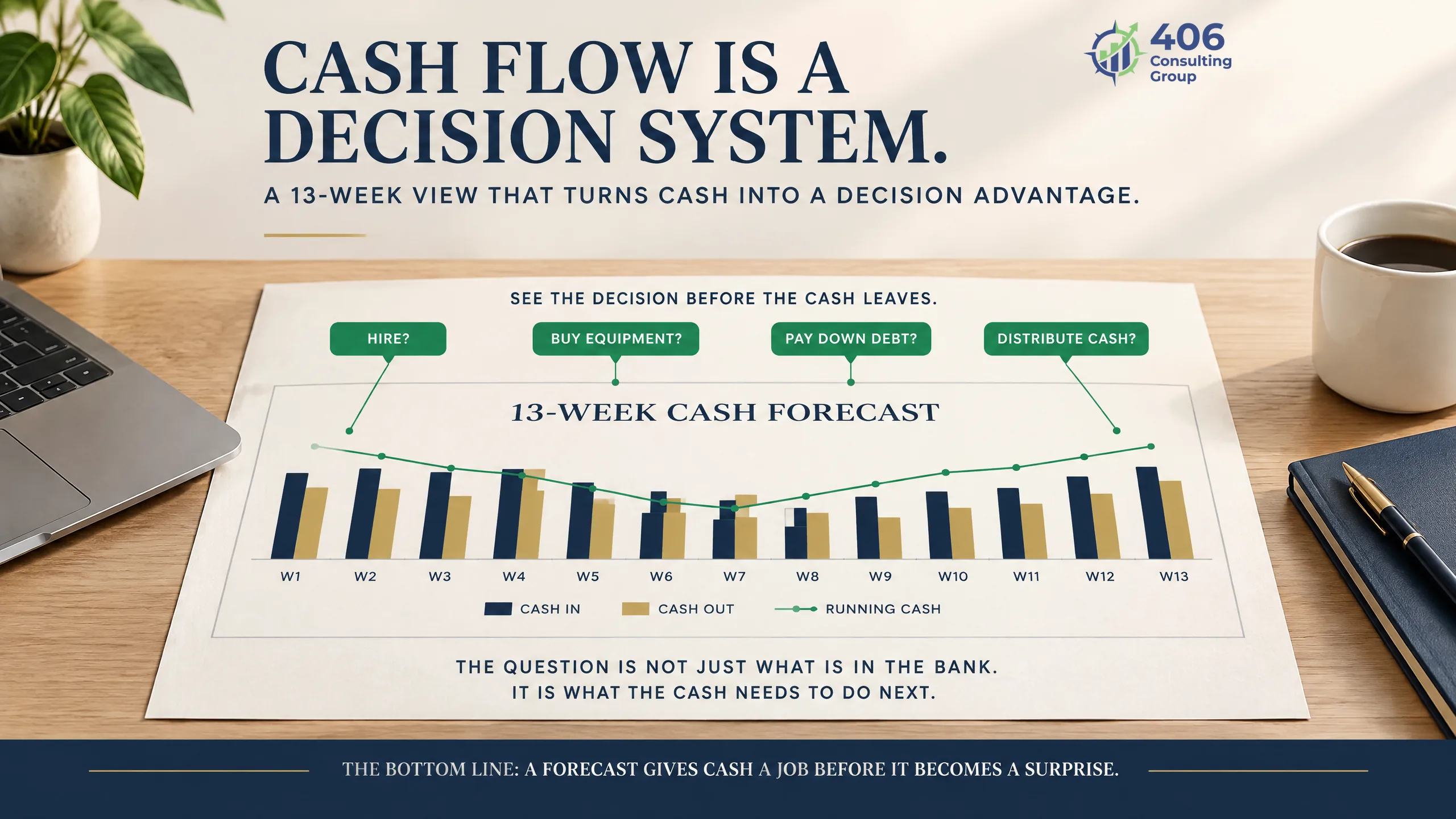
None of these needs a full-time hire — and some, like the S-corp move, you can sanity-check yourself with our S-Corp salary calculator. Which raises the question every owner actually asks: what does this cost?
Cost & ROI: A Fraction of a Full-Time Hire
The point of “fractional” is right there in the word: senior-level finance for a fraction of what building it in-house costs. A full-time controller and CFO, loaded with benefits, run well into the six figures each before either has driven a single decision.
Full-time CFO
A loaded salary that often lands in the mid-six figures — a serious fixed cost for a growing company.
Full-time controller
A six-figure hire on top of that, if you want the engine run in-house too.
Connected fractional model
Both functions, scaled to what you need, for a predictable monthly fee — a fraction of the in-house cost.
But price is the wrong lens. The real question is value per dollar: what's it worth to catch a margin leak before it runs for a year, to time cash so you never draw an emergency line, or to walk into a lender already fundable? Judge it on return, not rate. The most expensive finance setup is usually the cheapest one that misses the things that matter.
How to Choose a Provider: The Connection Test
Once you know whether you need the engine, the navigator, or both, the real screening question is whether a provider can connect them. Ask these — the answers expose a siloed shop fast:
Will the same team handle both my books and my strategy, or do you hand me off?
Who owns the outcome — one accountable person, or three vendors and me in the middle?
When my numbers change, does my advisor see it automatically, or do I forward reports around?
Do you actually advise, or just deliver statements? Give me an example of a call you'd make.
Can you keep the books the way a lender or bonding company reads them?
Is this built to work remotely, on a real monthly rhythm?
One team. One set of numbers. Engine and navigator, connected.
That's the whole difference — and it's how we work.
FAQ: CAAS vs. Fractional CFO
What does CAAS stand for?
CAAS stands for Client Accounting & Advisory Services — an all-in-one way to outsource your finance function to one team. It typically bundles bookkeeping and reconciliations, payroll and compliance, controller-level monthly reporting, and ongoing advisory (someone who reviews the numbers with you and tells you what they mean). Think of it as an outsourced finance department, run for you every month, rather than a data-entry bookkeeper you manage yourself. The extra 'A' — advisory — is what separates real CAAS from plain compliance work.
What's the difference between CAAS and a fractional CFO?
CAAS keeps your numbers accurate, current, and understood — it's the ongoing engine (books, payroll, reporting, advice). A fractional CFO is part-time senior finance leadership that uses those numbers to make decisions — forecasting, capital and lending strategy, pricing, growth, and exit planning — without a full-time executive salary. CAAS focuses on the past and present; the CFO focuses on the future. They don't overlap, they stack: the engine produces trustworthy data, the navigator decides where to point the business.
Do I need a bookkeeper, a controller, or a CFO?
It depends on where you are. If your books are late or unreliable, you need the engine first — bookkeeping and controller-level reporting (the CAAS layer). If your books are clean but you're facing a real decision like raising capital, a big hire, or an exit, you're ready for a fractional CFO. Fast-growing businesses with rising stakes usually need both, connected. As a rough pattern: under about $1M is usually an engine problem, $1M–$5M is the crossover where both start to pay off, and $5M+ makes CFO-level strategy essentially non-negotiable.
How much does a fractional CFO cost?
Far less than a full-time hire, which is the point. A full-time CFO loaded with benefits often runs into the mid-six figures, and a full-time controller adds a six-figure cost on top. A fractional or connected model delivers those functions scaled to what you actually need for a predictable monthly fee — a fraction of building it in-house. The better way to judge it is return, not rate: what it's worth to catch a margin leak early, time your cash, or walk into a lender already fundable. Exact cost depends on your size, complexity, and how much strategy you need.
Can one firm do both CAAS and fractional CFO?
Yes — and having one team do both is the whole advantage. When the same group runs your books and your strategy off one set of numbers, the CFO trusts the data instantly and spends every session on decisions instead of cleanup, and one person is accountable for the outcome instead of three vendors each owning a slice. That's the connected model we built 406 around. The screening question for any provider is simple: will the same team handle both, or do they hand you off?
When should I hire a fractional CFO?
When your books are already reliable and you're facing a decision big enough that you want senior financial firepower behind it — raising or restructuring debt, a major hire or new location, a pricing overhaul, preparing for a sale, or growth that's outrunning your visibility. The prerequisite matters: hire a CFO before your books are trustworthy and you'll pay CFO rates for cleanup instead of strategy. Fix the engine first, then add the navigator.
Can CAAS and a fractional CFO be delivered remotely?
Yes — this is how modern finance works, and it's how we work. Cloud accounting, live bank feeds, secure document sharing, and scheduled video reviews mean the work happens the same whether your team is down the street or across the country. Around 80% of our own local clients run the entire relationship remotely and never come into an office. What matters is expertise and how well the functions connect — a great connected remote team that knows your industry beats an okay local one that only handles part of the picture.
CAAS vs. CFO at a Glance
Two jobs, one system
One Connected Team
Books through strategy, remote.
About the Author
Jason Anderson
Co-Founder, 406 Consulting Group
Jason pairs a big-firm accounting background with a Six Sigma passion for process to design connected finance systems — clean books through CFO strategy — for growing companies, delivered remotely.
Read the Full Story