
Is Your Business Growing —
or Just Getting Bigger?
You can double your revenue and make less money, work more hours, and carry more risk. That's getting bigger, not growing. How to tell the difference — and build the scoreboard, margins, and systems that turn size into growth you actually keep.

Meet Marcus. He runs a commercial landscaping company, and by every number he brags about at the bar, he's crushing it. Three years ago he did $2 million in revenue. This year he'll clear $4 million. He doubled. More trucks, more crews, more contracts, more everyone-knows-his-company. So here's the question that keeps Marcus up at night, the one he won't say out loud: if he doubled the business, why is there less money in the bank than there used to be, and why is he more exhausted, more stressed, and more trapped than when he was half the size?
Because Marcus didn't grow. He got bigger. They're not the same thing, and confusing them is one of the most expensive mistakes an owner can make. This is how to tell the difference — and how to make sure the next few years are actual growth, not just a heavier version of the same treadmill.
By Jason Anderson — Co-Founder, 406 Consulting Group. Big-firm-trained accountant who helps owners see the real scoreboard behind the revenue — margin, cash, and freedom — and build the systems that turn getting bigger into actually growing. Illustrative figures below; your numbers are your own.
Quick Answer: Growing vs. Getting Bigger
- →Bigger = more inputs (revenue, headcount, busyness). Growing = more of what matters (profit, margin, cash, freedom, value).
- →Revenue is the number that lies. You can double revenue and make less money — and a surprising number of "growing" businesses do.
- →The tells: profit flat while revenue climbs, shrinking margins, tighter cash, more hours, no week off.
- →Margin, not revenue, is the real growth metric — a dollar of margin beats ten dollars of top line.
- →The fix: a scoreboard that tells the truth, pricing on real cost, and systems so scale doesn't multiply the chaos.
Table of Contents
The Trap of the Top Line
Revenue is the number every owner leads with, because it's the one that sounds impressive. "We did four million this year." It's also the number that tells you the least about whether your business is actually healthy. Revenue measures how much money passed throughyour business — not how much stayed. Marcus's $4 million is real; it just doesn't mean what he thinks it means. To see what happened, you have to follow the number that survives all the way to the bottom.
Marcus "doubled" — here's what actually happened
Double the revenue. Lessprofit. And an owner working himself into the ground. That gap between the top line and the bottom line is the whole story — and it has a name.
Bigger Isn't Growing
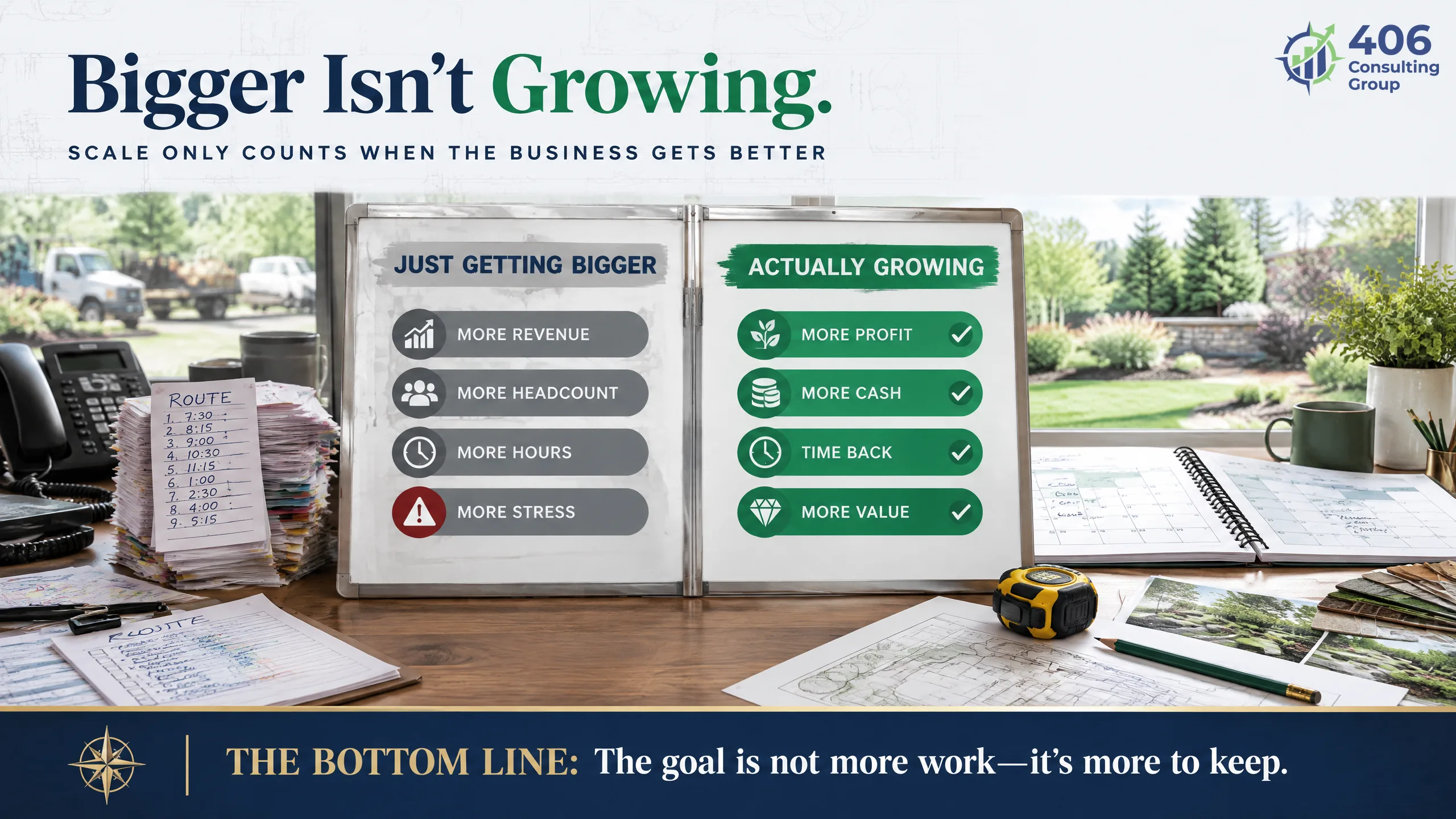
Here's the distinction that changes how you run a company. Getting bigger is about inputs — more revenue, more employees, more trucks, more activity. Growing is about outputs that matter — more profit, healthier margins, more cash in the bank, more of your time back, and a business worth more if you ever sold it. Bigger is easy: cut your price, chase every job, and you can add revenue all day. Growing is hard, because it means the business gets better, not just heavier. Marcus got very good at bigger and never noticed he'd stopped growing.
Just getting bigger
- •More revenue
- •More headcount & overhead
- •More hours from the owner
- •More stress, same (or less) money
Actually growing
- ✓More profit & stronger margins
- ✓More cash in the bank
- ✓More of the owner's time back
- ✓More enterprise value
So how do you know which one you're doing? The symptoms are surprisingly consistent.
Five Signs You're Just Getting Bigger
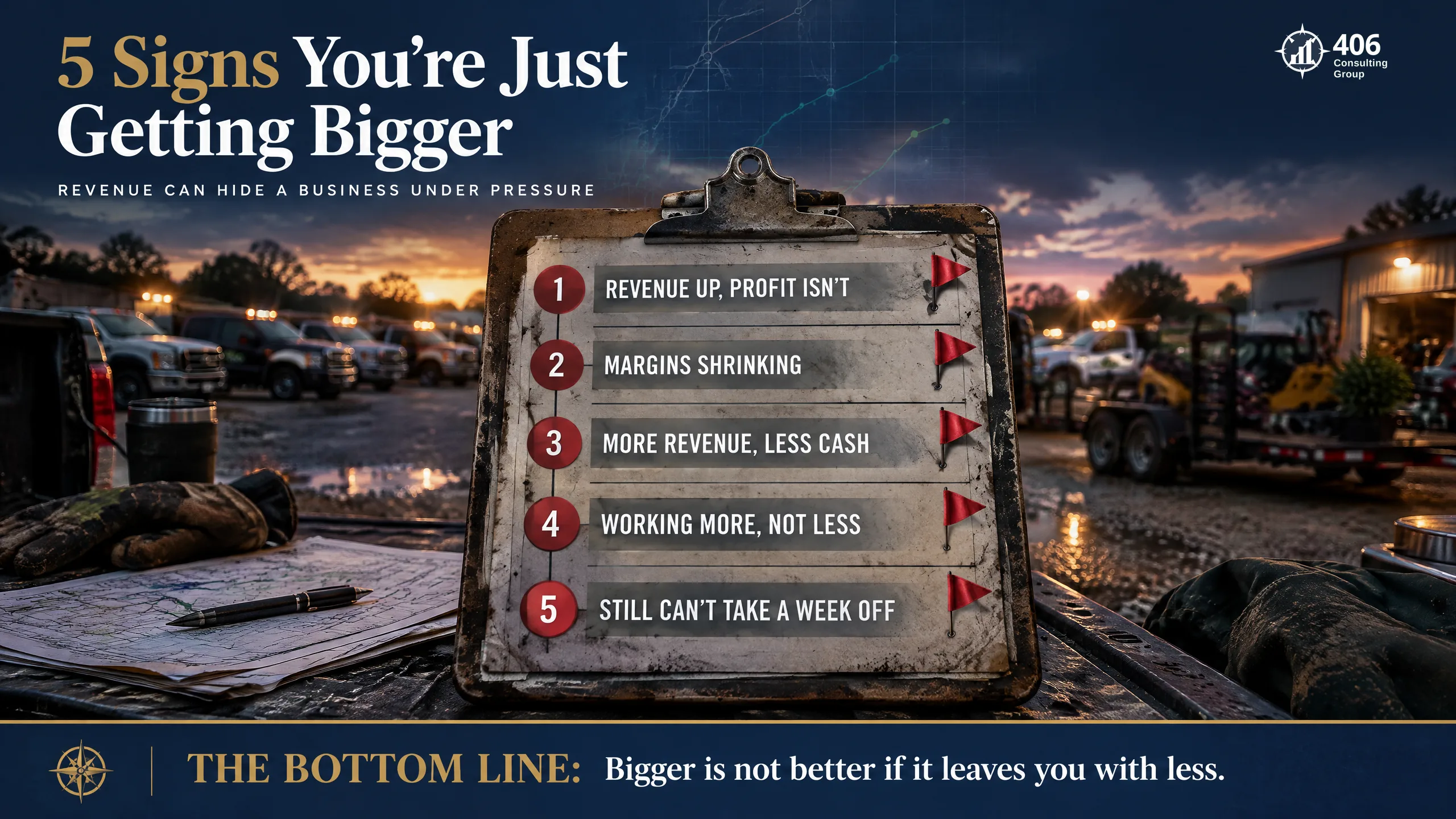
If two or three of these sound like you, you're probably adding size without adding growth:
Revenue is up but profit isn't
The top line climbs every year; the amount you actually keep is flat or falling. This is the master symptom.
Your margins are shrinking
To win more work you've quietly cut prices or absorbed rising costs, so each dollar of sales carries less profit than it used to.
There's more revenue but less cash
You're busier than ever, yet the bank balance is tighter — growth is eating cash faster than it's producing it.
You're working more, not less
Bigger was supposed to buy you freedom. Instead the business needs more of you than it did at half the size.
You still can't take a week off
A business that only works when you're in it hasn't grown into a company — it's grown into a bigger job.
Every one of those traces back to the same root cause — and it's the thing growth is best at hiding.
Why Growth Hides the Leaks
Growth is a magnifier. Whatever was slightly broken at $2 million — a pricing model that's a little too low, a job that's quietly unprofitable, an inefficient process, a leak in materials or labor — gets multiplied when you double the volume. At small scale, a thin margin and a bit of waste are survivable; you feel the slack in the system. Pour twice the revenue through the same leaky pipes and the losses double too, while the extra complexity, overhead, and management strain pile on top. That's how a business can work twice as hard, look twice as successful, and end up with less. The bigness doesn't fix the leaks — it feeds them.
Growth doesn't fix a broken model — it scales it. If you're losing a little on every job, the surest way to lose more is to book more jobs.

The only way to catch that is to stop watching the top line and start watching the numbers that tell the truth.
The Scoreboard That Tells the Truth
Real growth is measurable — just not with revenue. From the money seat, these are the numbers that actually tell you whether the business is getting better, and they belong on a scoreboard you look at every month:
Net profit margin (the trend)
Not just the dollars — the percentage, tracked over time. Rising margin is growth; falling margin is just bigger.
Gross margin by job or product
Which work actually makes money. You can't fix what you can't see at the job level.
Cash in the bank / cash conversion
How fast sales turn into money you can use — and whether the balance is climbing or shrinking.
Revenue per employee
Are you getting more productive as you scale, or just adding bodies to keep up?
Owner hours
The most honest freedom metric. Real growth gives you time back; bigness takes it.
Enterprise value
What the business would sell for. A company that runs without you typically sells for far more than one that depends on you.

Of all of them, one deserves the center of the scoreboard — because it's the one revenue is pretending to be.
Margin Is the Real Growth Metric
Revenue is vanity; margin is sanity. A dollar of margin — profit you actually keep — is worth more than ten dollars of top line that costs you nine-fifty to earn. Watch what happens when Marcus stops chasing size and starts protecting margin:
Bigger
$4.0M
× 5% margin
= $200K
exhausting to run
Growing
$2.5M
× 14% margin
= $350K
and far easier to run
Less revenue. $150,000 more profit. A fraction of the trucks, crews, headaches, and risk. If Marcus had spent the last three years lifting his margin instead of his revenue, he'd be richer, calmer, and running a more valuable company — on lessvolume. That's the whole difference between growing and getting bigger, in one comparison.

There's one more way bigness bites that the profit number alone won't show you.
The Growth That Quietly Eats Your Cash
Even profitable growth can drain your bank account. When you take on more work, you pay for the labor and materials beforethe customer pays you — so every new job ties up cash for weeks or months. Double the volume and you've doubled how much cash is trapped in work you've done but haven't been paid for. That's why Marcus can be "up" on paper and still sweat payroll: the profit is real, but it's tied up in receivables and materials, not sitting in the bank. Getting bigger without a plan for the cash growth consumes is how profitable companies end up borrowing to survive their own success.

We wrote a whole flagship on that trap — Profitable On Paper, Broke in the Bank. The good news: every one of these problems is fixable, and the fix is the same handful of moves.
Growth You Can Actually Keep
Turning "bigger" back into "growing" isn't complicated, but it's deliberate. Four moves do most of the work:
Know your margins — by job, not just overall
You can't protect what you can't see. Job-level costing tells you which work to chase and which to fire.
Price on real cost, not the market's race to the bottom
Most margin erosion is quiet under-pricing. Bidding on fully-loaded cost is the fastest way to lift the bottom line.
Build systems so scale doesn't multiply chaos
Processes and developed people mean more volume runs on the business, not on you — the opposite of Marcus's treadmill.
Fund growth on purpose
A cash-flow forecast tells you what growth you can actually afford, so success doesn't bankrupt you.
Two of those — systems and people — we cover in Good Businesses Run on Processes, Not Heroes and You Can't Scale a Business on People Who Stopped Growing. Together they turn size into strength instead of strain.

It starts with one honest look at whether the last few years were growth or just weight.
Are You Growing? Run the Check
Pull your last three years and put revenue next to net profit marginand cash in the bank. If revenue climbed while margin and cash didn't, you've been getting bigger — and now you know to fix it. That's not a failure; it's the most common pattern in business, and it's completely reversible once you're watching the right scoreboard.
Find out which one you've been doing.
Our Financial Maturity Assessment shows where your business really stands, and we'll help you build the scoreboard, protect your margins, and turn size into growth you actually keep — delivered remotely.
Bigger is easy and everywhere. Growing — more profit, more cash, more freedom, a company worth more than the sum of your hours — is the one worth chasing.
FAQ: Growing vs. Getting Bigger
What's the difference between a business growing and just getting bigger?
Getting bigger is about inputs — more revenue, more employees, more activity. Growing is about the outputs that actually matter — more profit, healthier margins, more cash in the bank, more of the owner's time back, and a business worth more if sold. The trap is that they look identical from the outside and only revenue is easy to see. You can double your revenue and make less money, work more hours, and carry more risk — that's getting bigger. Real growth means the business gets better, not just heavier: each dollar of sales keeps more, and the company depends on you less.
Why is my revenue up but my profit flat or down?
Usually because growth magnified problems that were survivable at a smaller size. To win more work you may have quietly cut prices or absorbed rising costs, so your margin thinned; then you poured more volume through the same slightly-broken pricing, processes, and unprofitable jobs, and the losses scaled right along with the sales. Add the extra overhead, management strain, and complexity that come with size, and you can end up with more revenue and less profit. The fix starts with job-level margin visibility — seeing exactly which work makes money and which just makes you busy.
What numbers should I track instead of revenue?
Build a monthly scoreboard around the metrics that reveal real growth: net profit margin as a percentage tracked over time (not just the dollars), gross margin by job or product line, cash in the bank and how fast sales convert to usable cash, revenue per employee (are you getting more productive or just adding bodies?), your own hours worked, and enterprise value — what the business would sell for. Revenue belongs on the board too, but as one line among several, not the headline. If margin, cash, and your free time are all moving the right way, you're growing.
Is it bad to grow revenue?
Not at all — revenue growth is great when it comes with margin, cash, and freedom. The danger is chasing revenue as the goal itself, because it's easy to 'buy' revenue by cutting prices or taking on bad work, which makes you bigger and poorer at the same time. The healthiest approach is to treat revenue as an output of doing the right things — protecting margins, pricing on real cost, running efficient systems — rather than a target you hit by any means necessary. Grow the top line on purpose, with the bottom line and the bank balance moving with it.
How can 406 Consulting Group help my business grow instead of just getting bigger?
We come at it from the money seat. We build the scoreboard that shows what's really happening — margin trends, gross margin by job, cash conversion, and the rest — so you stop flying on the top line. We find where growth is leaking profit and cash, help you price on real cost, and design the systems and financial function so more volume runs on the business instead of on you. And we plan the cash so growth doesn't bankrupt you. The goal is a company that's more profitable, more valuable, and less dependent on your hours — real growth you keep, delivered remotely.
Marcus's Numbers
Doubled revenue, less profit
Illustrative. Revenue is vanity; margin is sanity.
Growing or Bigger?
Find out where you stand.
About the Author
Jason Anderson
Co-Founder, 406 Consulting Group
Jason helps owners see the real scoreboard behind the revenue — margin, cash, and freedom — and build the systems that turn getting bigger into actually growing. Big-firm-trained, delivered remotely.
Read the Full Story