
Good Businesses Run on Processes,
Not Heroes
If your business runs on heroics instead of processes, it can't scale past you — and it can't survive without you. A lifelong process guy on the Six-Sigma mindset, minus the jargon, and how to start with one process.
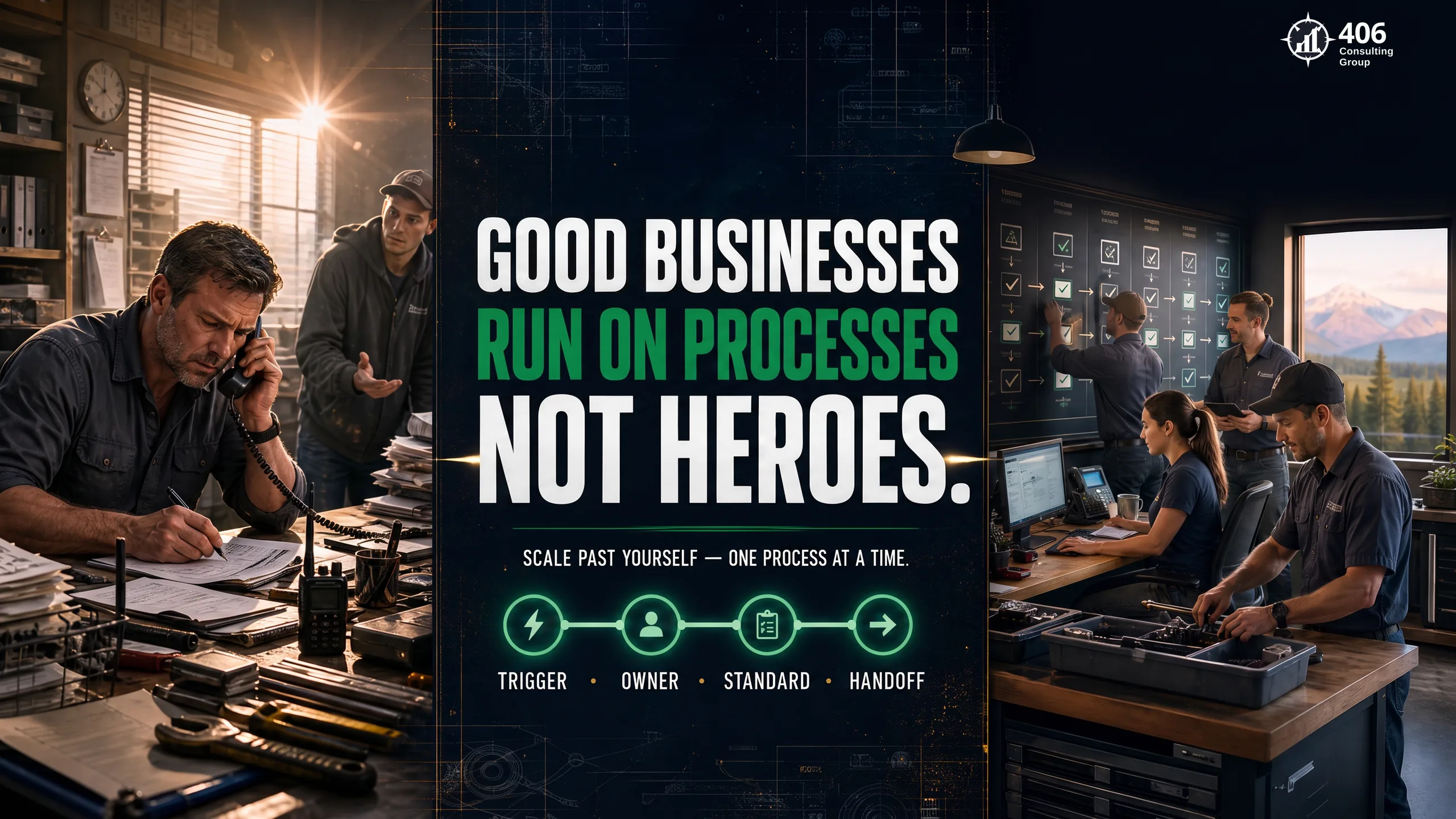
Here's a question that tells you more about your business than your P&L does: could you disappear for two weeks — phone off, truly gone — and would the business run without you? For most owners I meet, the honest answer is no, and it lands like a punch, because it means the thing they built to give them freedom has quietly become the thing they can never leave. If the business only works when youwork, you didn't build a company. You built a very demanding job that happens to own you.
The way out isn't working harder or hiring more bodies. It's process — repeatable ways of doing the recurring things, so quality doesn't depend on who's having a good day. I'll be honest up front: this is the thing I've cared about my entire career. And the good news I want you to hear is that you do nothave to boil the ocean to get there. It's a mentality, and you start with one process.
By Jason Anderson — Co-Founder, 406 Consulting Group. A lifelong process-and-efficiency guy who builds the systems and financial infrastructure that let a business run on repeatable processes instead of the owner's adrenaline.
Quick Answer: Processes, Not Heroes
- →A business that depends on heroes — you, or one irreplaceable person — has a hard ceiling and a real risk.
- →You scale past yourself with process: repeatable ways of doing recurring things, so quality doesn't depend on the day.
- →Six Sigma, minus the jargon, is two ideas: reduce variation (do it the same reliable way) and cut waste.
- →Don't boil the ocean. Pick the one process that hurts most, fix it, lock it in — then the next.
- →Your back office is full of processes too — and the ones living only in your head are key-person risk.
Table of Contents
The Vacation Test
Run the test honestly. If you left for two weeks, what breaks? For a lot of owners, the answer is everything— the quotes don't go out, the invoices don't get sent, the one person who knows how the schedule works gets overwhelmed, and you come back to a mess that takes another two weeks to dig out of. So you never actually leave. You take the laptop to the lake. You answer the phone at dinner. And you tell yourself that's just what owning a business is.
If the business can't survive two weeks without you, it isn't an asset yet — it's a job with a lot of overhead. The whole point of process is to change that answer from "everything breaks" to "it runs fine."
That gap — between a business that needs you and one that runs without you — comes down to a single choice most owners never realize they're making.
Heroes Don't Scale — Processes Do
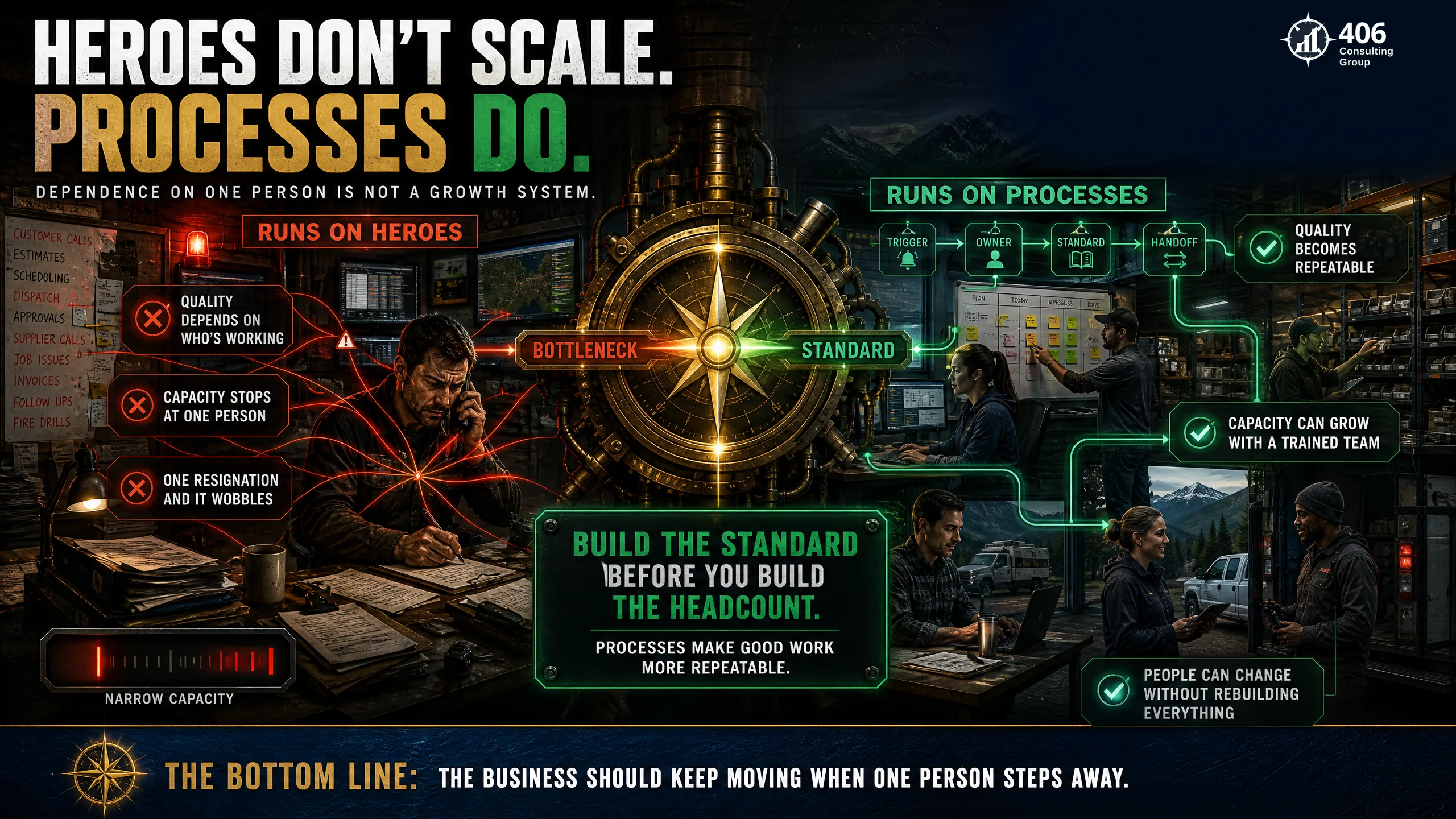
Most small businesses run on heroics. Something goes wrong, and a hero saves the day — usually the owner, sometimes a key employee who "just knows how everything works." It feels good, even noble. But heroics are a trap, because a hero is a single point of failure with a ceiling. The business can only grow as far as that one person's hours and memory stretch, and the day the hero burns out, gets sick, or quits, the whole thing wobbles. A company that depends on a hero isn't strong — it's fragile in a way that's hidden until the worst possible moment.
Runs on heroes
- Quality depends on who's working that day
- Growth capped at one person's hours
- One resignation and it wobbles
Runs on processes
- Quality is built into how the work is done
- Capacity grows with the team, not one person
- People can come and go without chaos
I'm not neutral on this one, and it's worth telling you why.
A Confession: This Has Been My Thing
Processes and efficiency have been close to my heart for my entire career. Long before 406, I was the person who couldn't leave a broken, wasteful way of doing something alone — who'd watch a task get done three different ways by three different people and feel a physical need to figure out the rightway and make it repeatable. Some people see a messy process and shrug; I see money leaking and stress being manufactured, and I can't un-see it. That instinct is a big part of what we bring to the businesses we work with, and it's why I want to hand you the mindset, not just the theory.
So let's make it concrete, because "process" is one of those words everyone nods at and no one defines.
What a "Process" Actually Is
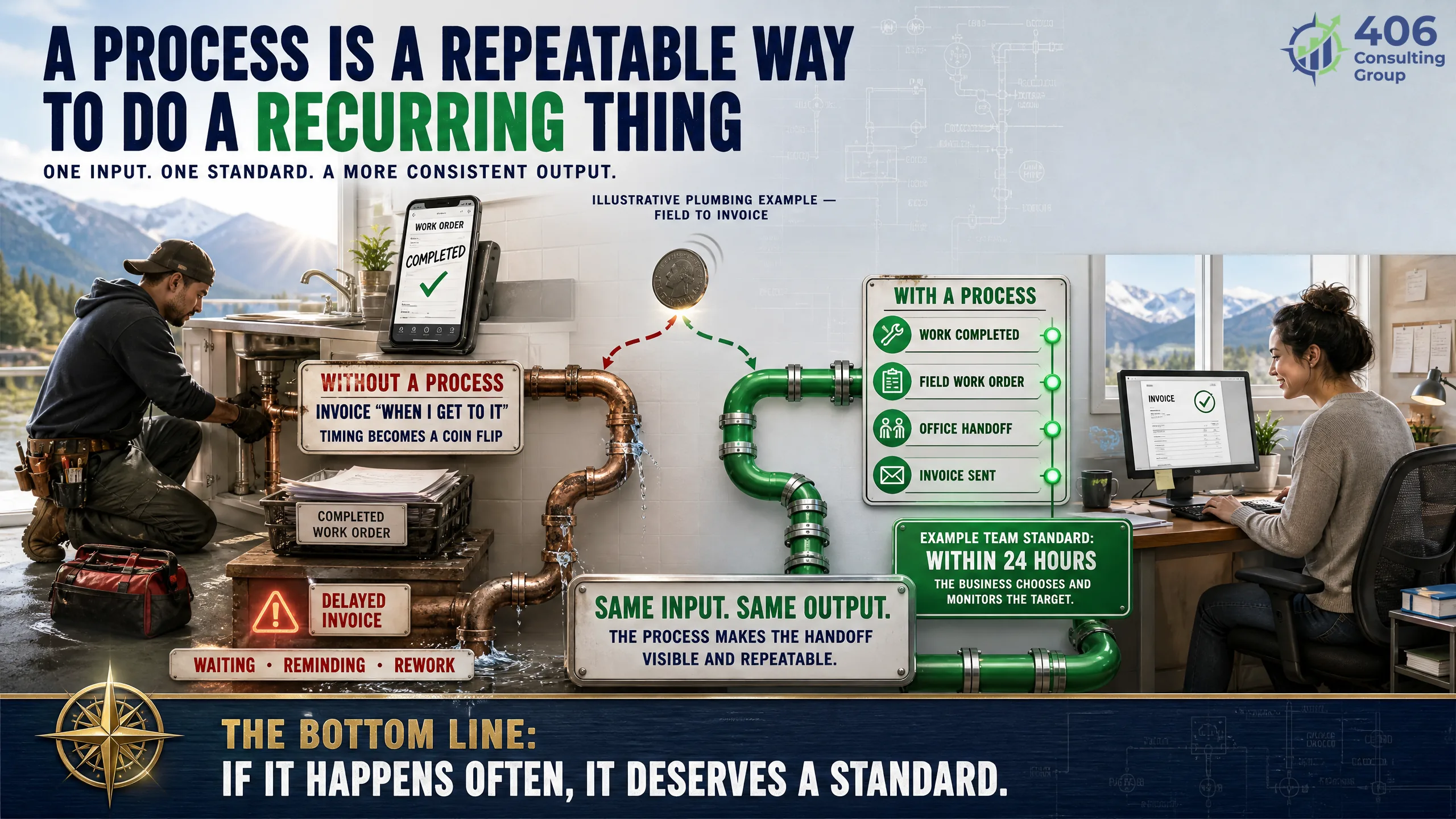
Strip the buzzword away and a process is simply a repeatable way of doing a recurring thing — the same reliable steps, every time, no matter who's doing it. That's it. Take Dave, who runs a plumbing company. Dave invoices "when he gets around to it" — sometimes the same day, sometimes three weeks later, sometimes not at all because the job slipped his mind in the chaos. That's not a process; that's a coin flip. A process would be: every tech submits the completed work order from the field the moment the job is done, and an invoice goes out within 24 hours, automatically. Same input, same output, every time.
That distinction — reliable versus a coin flip — is the whole idea behind a methodology that sounds scarier than it is.
Six Sigma Without the Black Belt
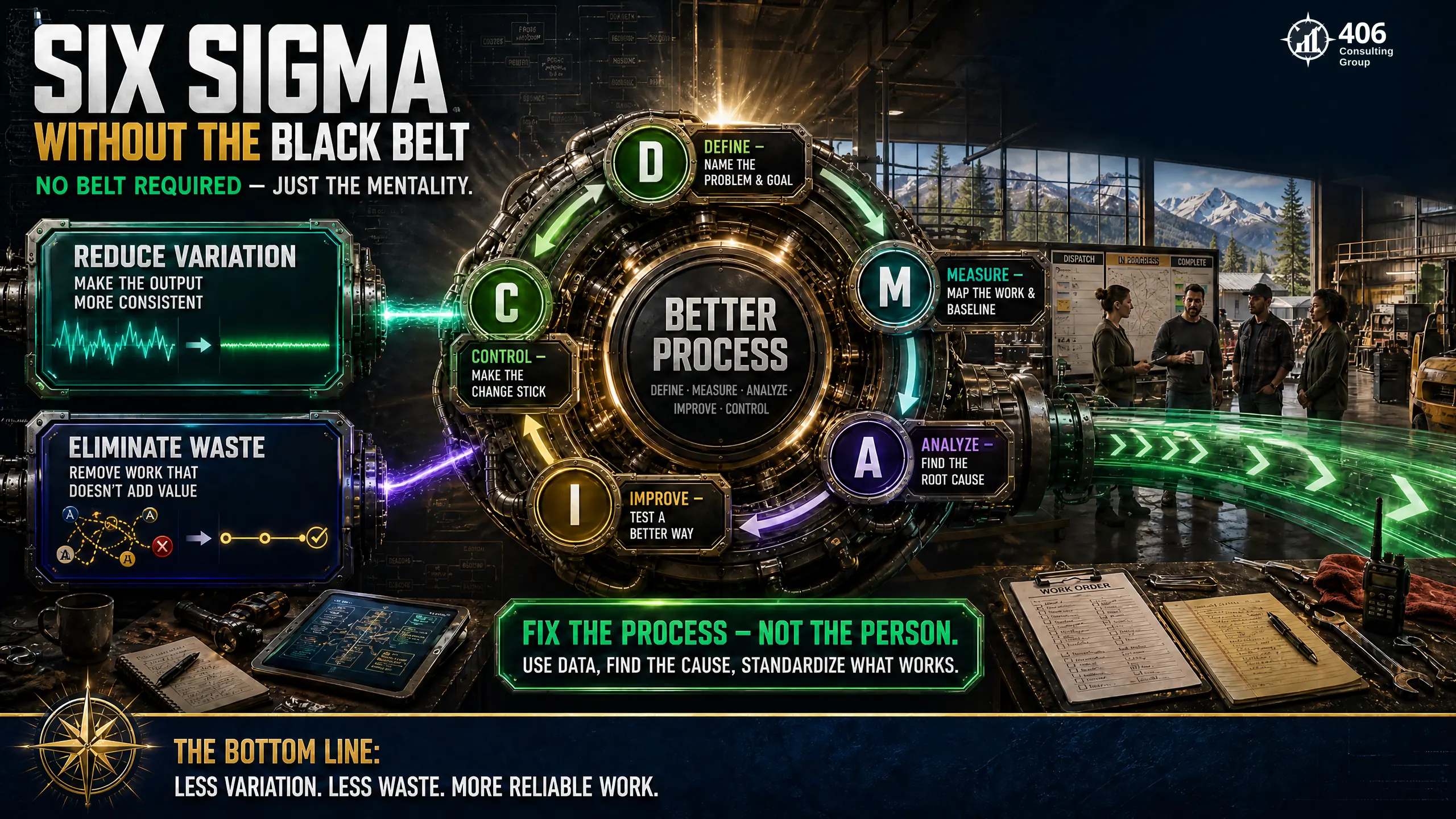
"Six Sigma" sounds like a factory thing — belts, statistics, a consultant with a clipboard. Strip it down and it's really two ideas at the heart of what's now usually called Lean Six Sigma: reduce variation — the Six Sigma side — do the job the same reliable way every time, so the result doesn't swing based on who did it; and cut waste— the Lean side — strip out the steps, waiting, and rework that don't add value. That's the heart of it. You don't need a black belt or a stats degree to put it to work — you need the mentality.
The method has a simple loop underneath it called DMAIC, and once you see it in plain clothes it's just common sense with a name:
DMAIC — in plain English
Abstract until you point it at real money — so let's point it at Dave's.
Where the Money Leaks: Waste & Variation
Every broken process leaks money somewhere — it's just usually invisible because no one line-items it. Walk through Dave's plumbing company and you can watch it drip:
Inconsistent invoicing
Invoices go out whenever Dave remembers — so cash arrives 45 days late instead of 10, and a few jobs a year (call it $8,000) never get billed at all.
No job-closeout checklist
Techs don't always log materials used or get sign-off, so callbacks, disputes, and unbilled parts eat margin on jobs that looked profitable.
Ad-hoc dispatch
Jobs get scheduled on gut, techs crisscross town, and the crew loses hours a week to drive time that could have been billable work.
Everyone trained differently
Each new tech learns Dave's way by osmosis over weeks — so quality swings by who trained them, and Dave is the bottleneck every time.
None of these show up as a line on the P&L called "waste." They hide inside slow cash, thin margins, callbacks, and Dave's 70-hour weeks. Add them up across a year and the "we're just busy" company is quietly leaving real money and real freedom on the table.
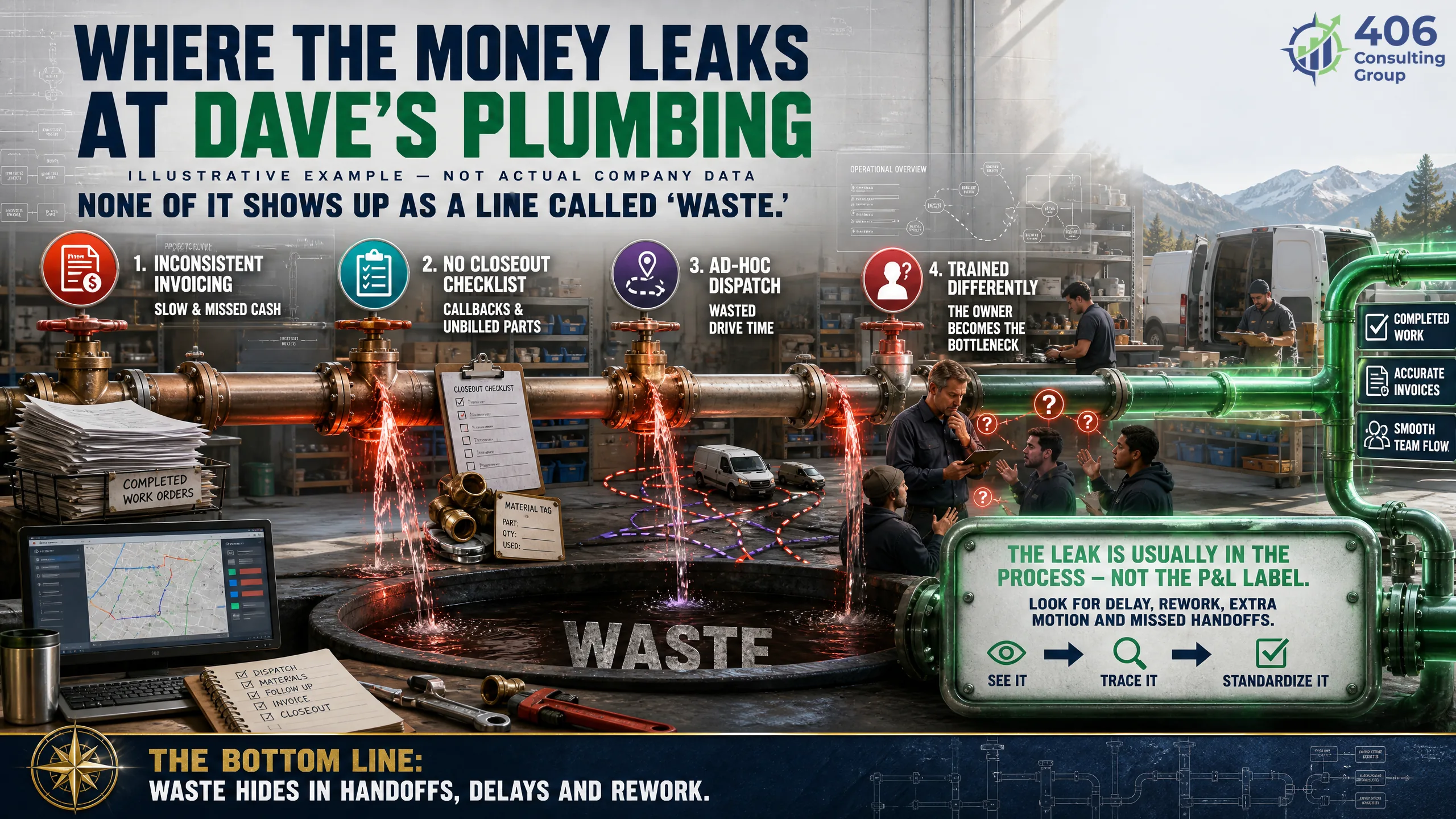
Seeing all that leakage at once is overwhelming — which is exactly the trap that stops most owners before they start.
Don't Boil the Ocean: Start With One Process
Here's where most people go wrong, and I want to save you from it: they look at everything that's broken, feel the weight of fixing all of it, and do nothing. Process improvement isn't a giant transformation project you clear a quarter for. It's a mentality, and you start with one process.Pick the single one that hurts the most or costs the most — for Dave, that's probably invoicing, because it's bleeding cash and unbilled work right now — and fix just that. One clean win builds the belief and the momentum to do the next.
You don't have to boil the ocean. Fix one process this month. Then one next month. In a year you'll have a business that runs on systems instead of adrenaline — built one small win at a time.
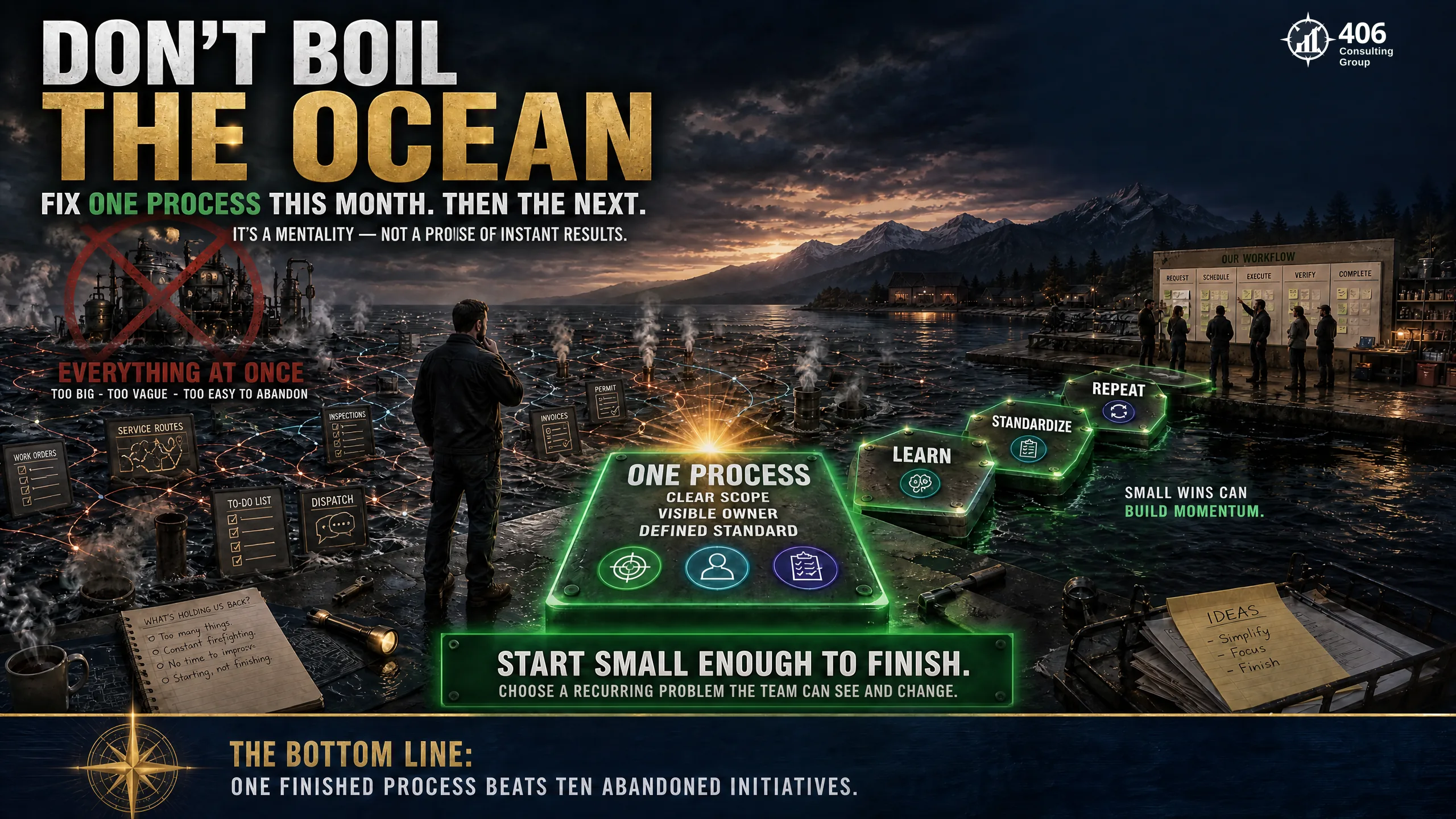
"Fix one process" is easy to say. Here's the simple loop for actually doing it.
A Simple Starting Plan
This is DMAIC in plain clothes — a loop any owner can run on one process, without a consultant or a certification:
Run this on one process this month
1.Pick one. The process that hurts most or costs most — not all of them.
2.Write down how it really happens now. The actual steps today, warts and all — not the tidy version in your head.
3.Find the biggest leak. The one error, delay, or wasted step costing the most.
4.Standardize it. A checklist, a template, a rule — make the right way the easy way.
5.Make it stick. Check it's being followed, adjust, then move to the next process.
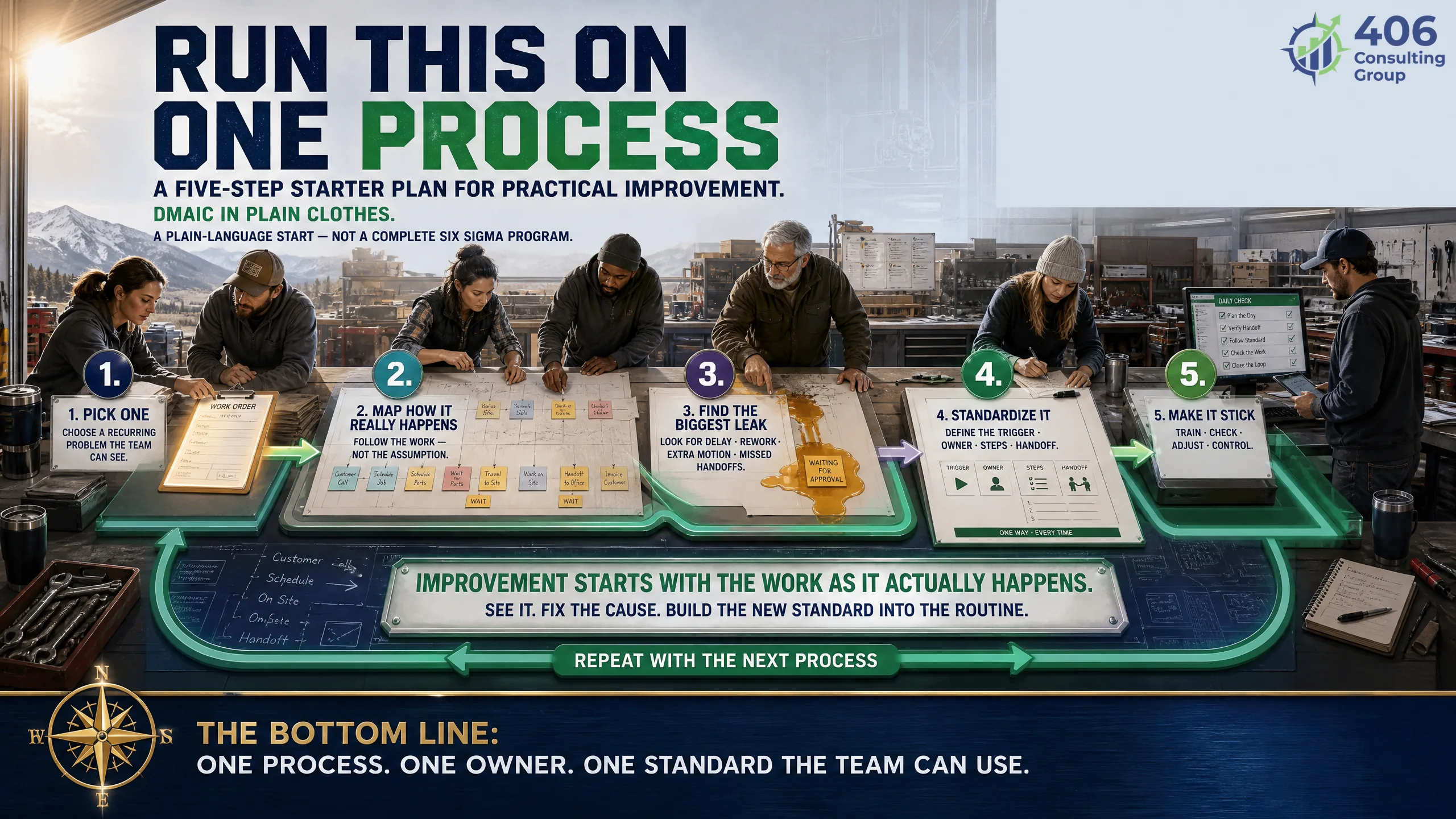
Do that on Dave's invoicing and the payoff isn't just faster cash — it's what it does for everyone around him.
Processes Free Your People — and You
Here's the part that surprises owners: good process isn't bureaucracy that boxes people in — it's what sets them free. When the right way to do a job is written down and repeatable, you can actually delegate it, because you're handing over a system, not a mystery only you understand. Your people stop guessing and start owning their work; new hires get productive in days instead of months; and the "hero" who used to be a single point of failure becomes one contributor on a capable team. And you? You get to climb out of the weeds and back into actually running — and, occasionally, leaving — the business.
You can't delegate a mystery. You can delegate a process. That one difference is what turns an owner who does everything into an owner who leads a team that does.
And nowhere is that "mystery only you understand" problem more expensive than in your back office.
Your Back Office Is Full of Processes Too
Here's where the words "back office" do you a disservice: say them and people picture accounting off in a corner — a bookkeeper, a stack of receipts, something walled off from how the real work gets done. But the processes that run your money don't sit in a corner. They thread straight through your operations. Take billing at a construction company. It looks like an accounting task, but a clean billing process runs through the project manager tracking work completed, the field crew logging materials and hours, the owner approving the draw, and only then the officethat invoices and collects. Break it anywhere along that chain — a PM who bills late, a missing change order, a draw nobody approved — and the "accounting problem" was an operations problem the whole time.
That's true of nearly every financial process. The monthly close, cash-flow forecasting, payroll, onboarding — each one reaches across departments and leans on people who'd never call themselves "accounting." And when the process lives only in one person's head, it's key-person risk sitting on top of your money and your operations at once. If the person who "knows how billing works" left tomorrow, what would actually happen?
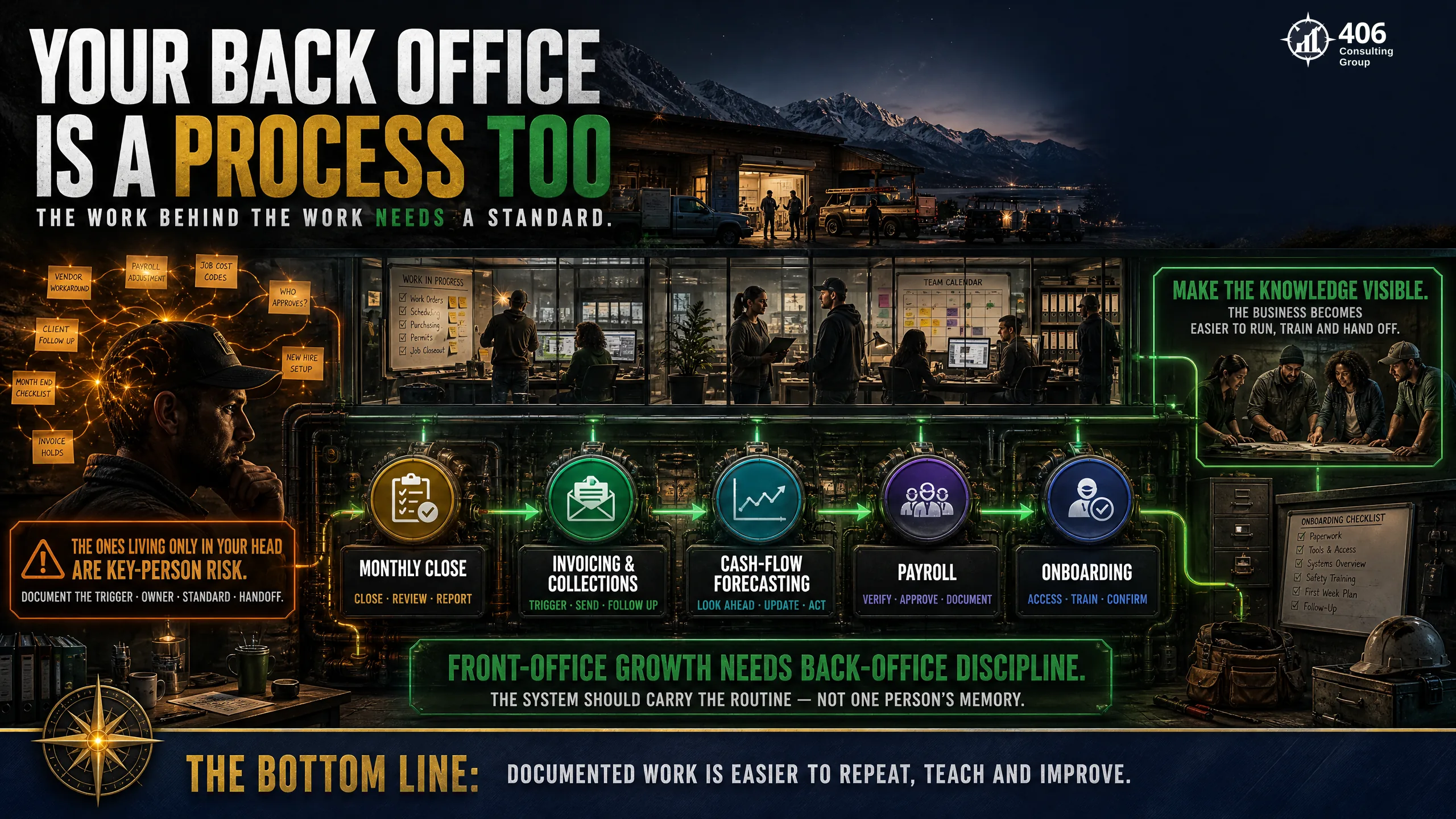
This is exactly why we don't design financial processes in an accounting silo. Because we build systems from a whole-company view — following each process across every department it actually touches, not just the ledger it lands in — your billing, close, and forecasting run as repeatable, documented processes independent of any one person, including you.
What to Do — and How 406 Helps
Start today, and start small. Pick the one process that's costing you the most sleep or the most money, run the five-step loop on it, and lock in the win. That's the whole mentality — not a transformation, just the next improvement, over and over. On the financial side, that's our work: we build repeatable, documented back-office processes — a reliable monthly close, clean collections, a cash forecast, onboarding — designed from a whole-company view so your finances run on systems instead of on you or one irreplaceable person.
Build a business that runs without you.
Let's put durable processes under your finances — the close, collections, forecasting — so quality doesn't depend on any one person — and you can finally work toward passing that two-week test. Start with where your business stands today.
This is the first in a series on process and efficiency — there's a lot more to say about developing your people, documenting how the work is done, and tightening the specific processes that run your money. For now: pick one, fix it, and feel what a single clean win does. That's how every business that runs on systems instead of heroes got started.
FAQ: Building Business Processes
Why can't my business run without me?
Usually because it runs on heroics instead of processes — the important work lives in your head and gets done by you (or one key person), a different way each time, rather than as a repeatable system anyone trained can follow. That feels productive, but it caps the business at one person's hours and memory and makes it fragile: the day the 'hero' is out, things wobble. The fix isn't working harder; it's turning the recurring work into documented, repeatable processes so quality is built into how the work is done, not who's doing it. Start with the one process that would break first if you left.
What is Six Sigma in simple terms for a small business?
Six Sigma sounds like a factory methodology with belts and statistics, but stripped down — as part of what's now called Lean Six Sigma — it comes to two ideas any small business can use: reduce variation (the Six Sigma side: do a job the same reliable way every time, so the result doesn't swing based on who did it) and cut waste (the Lean side: strip out the steps, delays, and rework that don't add value). Underneath is a simple loop called DMAIC — Define the problem, Measure what's really happening, Analyze where the waste or error comes from, Improve the process, and Control it so it sticks. You don't need a certification to use the mentality; you need to run that loop on one process at a time.
Where should I start with process improvement?
With one process — the single one that hurts the most or costs the most — not everything at once. Trying to fix it all is exactly what overwhelms owners into doing nothing. Pick the painful one (for many businesses it's invoicing and collections, because it's leaking cash right now), write down how it actually happens today, find the biggest leak or error, standardize it with a checklist or template or rule, and make it stick. One clean win builds the momentum and belief to tackle the next. Process improvement is a mentality you build one step at a time, not a quarter-long transformation project.
How do processes reduce key-person risk?
Key-person risk is what happens when critical knowledge or work depends on one person — if they leave, get sick, or burn out, the business is exposed. Documented, repeatable processes defuse that risk by moving the 'how' out of one person's head and into a system anyone trained can run. When your monthly close, collections, or field work follow a written process instead of one person's memory, that person becomes replaceable in the healthiest sense: the business keeps running smoothly through turnover, vacations, and growth. It's one of the highest-return reasons to build processes — and it applies to your back office as much as your field crew.
How does 406 Consulting Group help build business processes?
We focus on the processes that run your money — the monthly close, invoicing and collections, cash-flow forecasting, payroll, and onboarding into your financial systems. We build them to be repeatable, documented, and independent of any one person (including you), designed from a whole-company view rather than a narrow accounting lens, so they connect to how the business actually operates. The result is a back office that runs on systems instead of heroics, gives you numbers you can trust, and removes the key-person risk sitting on top of your finances. And we start where you are — one process at a time.
DMAIC, Plain
Run it on one process
Build Processes That Stick
Start where you stand.
About the Author
Jason Anderson
Co-Founder, 406 Consulting Group
A lifelong process-and-efficiency guy, Jason builds the systems and financial infrastructure that let a business run on repeatable processes instead of the owner's adrenaline — designed from a whole-company view and delivered remotely.
Read the Full Story