
You Can't Scale a Business on
People Who Stopped Growing
Most businesses that stall don't have a demand problem — they have a people-capacity problem. The owner-as-bottleneck trap, what key-person risk costs you, and how to build a company that runs on systems and developed people instead of heroes.
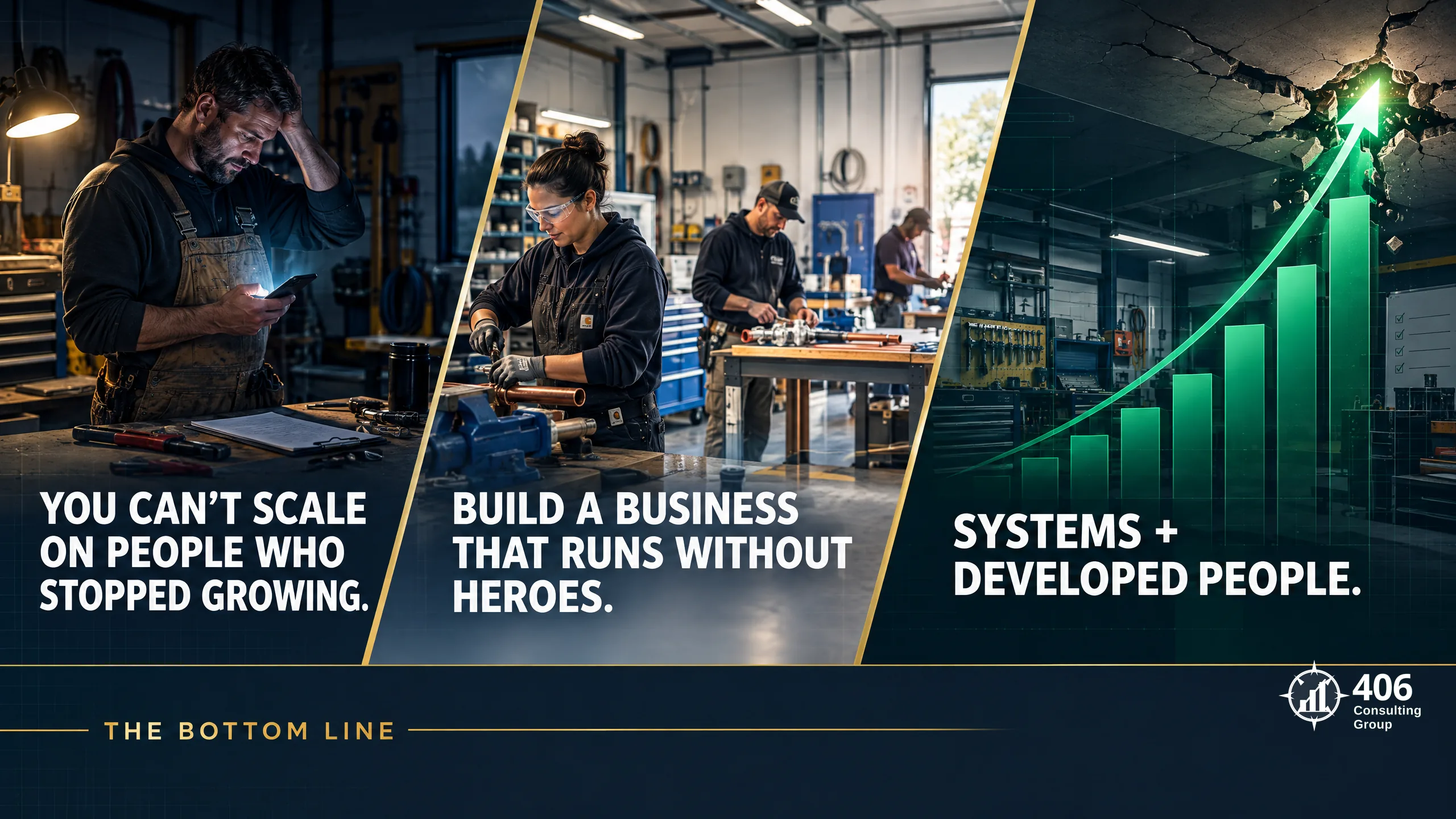
Meet Dave. Dave owns a plumbing company — twelve people, about $1.8 million in revenue — and for three years he's been stuck at exactly that size. The phone still rings. The work is still good. But every time he tries to grow, something breaks: a job goes sideways, a key guy quits, or Dave himself works another 55-hour week just to keep the plates spinning. Dave is sure it's a market problem. It isn't. Dave is the market problem — because every quote over $10,000, every tricky job, and every real decision still runs through him. His business didn't hit a ceiling of demand. It hit a ceiling of people who can carry weight.
I've watched a hundred versions of Dave. The story is always the same, and so is the fix: you cannot scale a business on people who stopped growing — and that starts with the owner. This is what the ceiling actually is, what it's quietly costing you, and how to build a company that runs on systems and developed people instead of heroes.
By Jason Anderson — Co-Founder, 406 Consulting Group. Big-firm-trained accountant with a lifelong focus on process and efficiency, who helps owners build businesses that run on systems and developed people — not on the owner's own back.
Quick Answer: Why Your Business Stopped Growing
- →Most stalls aren't a demand problem — they're a people-capacity problem. The business runs through a few heroes, and heroes don't scale.
- →The biggest bottleneck is usually the owner. If the business stalls when you take a week off, you are the constraint.
- →It's expensive in ways that hide in the P&L: turnover at 1.5–2× salary, capped capacity, and your own time.
- →A business that lives in one person's head tends to borrow harder and sell for less — buyers and lenders price the risk in.
- →The fix is developing people as a system (define → document → train → delegate → hold accountable) — start with one role, not the whole company.
Table of Contents
The Ceiling You Can't See
In plain terms: your business can only handle as much work as your people can carry — and if only a couple of people can carry the important stuff, that's your real ceiling, no matter how many calls come in. Dave's phone rings enough to do $3 million. He does $1.8M because that's all the work that can pass through Dave. When he pushes past it, quality slips or he burns himself out, so he unconsciously pulls back to the number he can personally hold. He calls it "a tough market." What it really is: he's the only one who can do the highest-value parts of the job, and there are only so many hours in his week.
If your revenue has been flat for a couple of years while the phone still rings, you don't have a demand problem. You have a capacity problem — and capacity is your people.

The first place that ceiling comes from is the thing that feels like your greatest strength: your best people.
Heroes Don't Scale
Every stuck business has heroes — the indispensable people who just know how everything works. At Dave's shop it's Dave and Linda, the office manager who has every customer, every price, and every vendor in her head. It feels like strength. It's actually your biggest fragility, because the whole company depends on a couple of people never leaving, never getting sick, and never having a bad week. Consultants call it the "bus factor": how many people would have to get hit by a bus before the business stops. When the answer is one, you don't own a scalable business — you own a very expensive job with a lot of exposure.
Heroes hit a hard limit: a hero can only do so much, and their knowledge lives in their head where no one else can use it or improve it. You can't clone Linda. But you canget what's in Linda's head into a system the next three hires can run.

And the most indispensable hero — the one hardest to see — is almost always the person reading this.
The Owner Is Usually the Bottleneck
Here's the uncomfortable part. In most stuck companies, the single biggest bottleneck is the owner. Dave insists on quoting every job over $10,000, approving every material order, and handling every unhappy customer "because that's the important stuff." So all of it waits in line behind him. When Dave is on a roof, twelve people and forty jobs are effectively paused on the decisions only he's allowed to make. He built a company that literally cannot move faster than one person — himself.
There's a simple test for this. The vacation test:take one real week off, phone in a drawer. If you come back to a pile of stalled work and a couple of small fires, the business runs on you, not on systems. Dave tried it — four days — and came back to three stalled bids and one angry customer who'd been waiting on "Dave's call." That's not a loyalty problem or a staff problem. That's a design problem, and the owner designed it.

Whether the bottleneck is you or your key people, it isn't free. From the money seat, you can see exactly what it costs.
What It's Actually Costing You
People-capacity problems don't show up as a line item called "we didn't develop our people." They hide inside other numbers. The clearest one is turnover. When a business runs on heroes and doesn't grow its people, the good ones leave — and replacing them costs far more than the paycheck. The rule of thumb from studies and from what I've watched firsthand: replacing an employee runs anywhere from about one to two times their salaryonce you count everything — and the more skilled the role, the higher it climbs.
Let's make that real. Dave loses a $52,000 field tech. Here's the actual bill:
The real cost of replacing one $52,000 tech
That's roughly the tech's entire salary again — gone — and for a field tech that's the conservativeend; replace a senior estimator or the office manager who runs everything, and it climbs toward twice their pay. It also barely counts the quiet costs: Dave's own hours pulled into firefighting, the customers who felt the drop, and the capacity he simply couldn't sell. Now multiply by the two or three good people a stuck shop loses every couple of years.

Turnover is the cost you can see. There's a bigger one hiding on your balance sheet that you only feel the day you try to borrow or sell.
Key-Person Risk Is a Number Buyers See
In plain terms: if your business can't run without one specific person, everyone who puts money behind it — a bank, a bonding company, a buyer — treats that as risk and charges you for it. Our firm has sat on the underwriting side of the table — my co-founder Carrie spent years in commercial banking and underwriting — and this is exactly what gets priced in. It has a name: key-person risk. And it's not abstract — it comes straight out of your wallet the day it matters.
Say Dave decides to sell one day. His shop earns about $250,000 a year to the owner. A healthy business like his might sell for around 3.5× that — roughly $875,000. But a buyer looks closely and sees the truth: the business is Dave. The relationships, the pricing, the big-job know-how all leave when Dave leaves. So the offer comes in at 2.5× instead — about $625,000. That gap is the price of being the hero:
Runs on systems
$875K
3.5× earnings
Runs on Dave
$625K
2.5× earnings
The "hero discount"
−$250K
for being irreplaceable
A quarter of a million dollars — the cost of a business that can't run without him. Lenders do a quieter version of the same math: a company that hinges on one person often gets a smaller line, a higher rate, or a personal guarantee, because the bank is underwriting a single point of failure. Being indispensable feels like job security. On the balance sheet, it's a discount you pay.

So why does a smart owner like Dave let it get this way? Usually for reasons that felt responsible at the time.
Why People Stop Growing
People rarely stop growing because they're lazy. They stop because the business gives them no room, no path, and no way to learn the job right. The usual culprits:
"It's faster if I just do it"
The owner keeps the hard, valuable work, so no one else ever learns it. True today, fatal over three years.
Hire cheap, skip the training
You bring in the low bid, hand them nothing to follow, and wonder why they never level up.
No documented way to do it right
Every job depends on memory, so quality swings and no one can be trusted with more.
No path and no ownership
Good people can't see a future or make a real decision, so the ambitious ones leave and the rest coast.
Notice the theme: every one of those is something the ownercontrols, not a flaw in the people. Which is good news — it means it's fixable. Dave's techs weren't incapable of quoting jobs; they'd just never been shown how, given a way to do it, and trusted to try.
"It's faster if I just do it" is true today and ruinous over three years. Every time you do the job instead of teaching it, you buy an hour and sell your ceiling.
The fix isn't a motivational speech or a ping-pong table. It's treating people development the same way you'd treat any other part of the business you want to be reliable: as a system.
Developing People Is a System, Not a Perk
"Developing your people" sounds soft and HR-ish. It isn't. It's the same continuous-improvement discipline behind any good process — you just point it at getting knowledge out of your heroes' heads and into people who can run with it. Five plain steps:
Define the role
Write down what "good" looks like — the outcomes and the decisions this person owns. If it lives only in your head, no one can hit it.
Document how it's done
Turn what your hero knows into a simple checklist or one-pager. This is how you clone Linda without cloning Linda.
Train to the document
Teach the standard, not your vibe. Now a new hire learns the right way in weeks instead of guessing for a year.
Delegate with guardrails
Hand over real decisions with clear limits — e.g., "you can approve quotes up to $10K." Authority, not just tasks.
Hold accountable to a number
Give the role a metric they own and review it. People grow when the target is clear and the results are theirs.
That's it — the same loop you'd use to fix any process, aimed at people. It's the sharp end of what we mean by systems: a financial or operational process almost always runs across several people, so getting a job out of one hero's head is really process design. (We go deep on that in Good Businesses Run on Processes, Not Heroes.)

When an owner actually does this, something specific happens to their calendar — and I've watched it happen.
Delegation Is How You Buy Back Your Time
Here's a real one — a client we'll keep anonymous. When we started, the owner was working 50-plus hours a week and was the answer to every question in the building. They did the un-flashy work: they hired good people who'd gone the cheap-and-untrained route before, we built the processes with them, and — the part most owners skip — they actually adopted them. Within a stretch of months, the owner's week dropped to about 10 hours, and the business ran on something close to autopilot. Not because the owner checked out — because the business no longer needed a hero to function.
Before
50+ hrs
owner is the answer to everything
After
~10 hrs
business runs on people + systems
Read the ingredients again, because they're the whole recipe: good people + documented processes + actual adoption.Miss any one and it doesn't work — good people with no system stay stuck, and a beautiful system nobody adopts is a binder on a shelf.

That freedom isn't just lifestyle. It's what turns a stuck job back into a business you own.
Build a Business That Doesn't Need Heroes
Put it together and the payoff compounds. Develop your people and the ceiling lifts — Dave can finally chase that $3M of demand because the work no longer has to pass through Dave. The turnover bleed slows, because good people who are growing and trusted tend to stay. And remember that $250,000 "hero discount"? It runs in reverse: a business that runs on systems and a developed team is the 3.5× business, not the 2.5× one. Developing your people literally rebuilds the enterprise value that being the hero was quietly destroying.
One piece owners miss: the numbers can't live in one head either. If only you understand the financials, you're still the bottleneck — just on the money side. That's where a controller or fractional CFOcomes in: reliable numbers and a clear financial picture the whole leadership team can act on, so decisions don't wait on you. Systems for the people, systems for the money — that's a company that runs without heroes.
A business that needs a hero to survive isn't an asset — it's a job you can never quit. A business that runs on developed people and systems is something you actually own, and can one day sell.
If that sounds like a mountain, don't worry — you don't climb it all at once.
Where to Start (Don't Boil the Ocean)
The mistake is trying to fix everything at once, getting overwhelmed, and doing nothing. You don't need to boil the ocean — it's a mentality, and you just need to start somewhere. Pick the one role that breaks the most when that person is out, and give it this month:
Name the biggest single point of failure
Which one person, if they left tomorrow, would hurt the most? Start there — that's your highest-risk hero.
Document one thing from their head
Sit with them and turn their most important task into a one-page checklist. Just one.
Hand one real decision to someone else
Delegate a single decision with a clear limit this week. Watch what happens when you don't take it back.

Ready to build a business that doesn't run through you?
We help owners get the knowledge out of their heroes' heads, build the systems, and put the financial picture in front of the whole team — so the business runs on people and process, not on you. Start by seeing where you stand.
Do that once, and you'll feel the ceiling move. Do it again next month with the next role. That's how a business stops depending on heroes — one documented, delegated, developed step at a time.
FAQ: Scaling Through Your People
How do I know if my people are the reason my business stopped growing?
Run the vacation test: take one real week off with your phone in a drawer. If you come back to stalled work and small fires, the business runs on you, not on systems — and that's a people-capacity ceiling, not a demand problem. Two other tells: the phone still rings but revenue has been flat for a couple of years, and the important work (quotes, key customers, tricky jobs) all routes through one or two people. When the 'bus factor' — how many people would have to disappear before the business stops — is one, your growth is capped by that person's hours, no matter how much demand exists.
What does employee turnover actually cost a small business?
Far more than the paycheck. Studies and hands-on experience put the fully-loaded cost of replacing an employee at roughly one to two times their salary — higher for skilled or senior roles — once you count recruiting, onboarding, the months to full productivity, overtime and coverage during the gap, rework and callbacks while the new hire ramps, and the jobs you simply couldn't staff. For a $52,000 field tech that's around $53,000 — essentially their whole salary again, and a conservative figure at that — and it doesn't count the owner's hours pulled into firefighting. Businesses that run on heroes and don't develop their people lose good ones the most, so they pay this bill over and over.
What is key-person risk and why does it lower my business's value?
Key-person risk is the danger that a business can't function if one specific person leaves — often the owner. Anyone putting money behind the business prices it in. A buyer who sees that the company 'is' the owner drops their offer: a business that might sell for 3.5 times owner earnings when it runs on systems can fall to 2.5 times when it runs on one person. On $250,000 of earnings that's roughly $875,000 versus $625,000 — a $250,000 'hero discount.' Lenders do the same quietly, offering a smaller line, a higher rate, or requiring a personal guarantee, because they're underwriting a single point of failure. Developing your people and documenting the work is what removes the discount.
How do I develop and delegate to my team without quality dropping?
Treat it as a system, not a leap of faith. Five steps: (1) define the role — write down the outcomes and decisions it owns; (2) document how the work is done as a simple checklist so it doesn't depend on memory; (3) train to that document so people learn the standard, not your vibe; (4) delegate real decisions with clear guardrails — for example, 'you can approve quotes up to $10,000'; and (5) hold the role accountable to a number they own. Quality drops when you hand off tasks with no standard and no follow-up; it holds when you hand off decisions inside a documented system with a metric. Start with one role and one checklist rather than trying to fix everything at once.
How can 406 Consulting Group help me build a business that doesn't depend on me?
We come at it from the money seat and the systems seat together. We help you find the biggest single points of failure, get the knowledge out of your heroes' heads into documented processes, and design those processes across the departments they actually touch — because most 'accounting problems' are really operations problems. Just as important, we make sure the numbers don't live in one head either: a fractional controller or CFO gives your whole leadership team a reliable financial picture to act on, so decisions stop waiting on you. The goal is a business that runs on developed people and systems — worth more, easier to borrow against, and one you could actually step away from. We do it remotely for clients across the country.
The Vacation Test
Do you own a business or a job?
Take one real week off, phone in a drawer. Come back to stalled work and fires? The business runs on you, not on systems — and you're the bottleneck.
Stop Being the Bottleneck
Systems + developed people.
The Hero Discount
On ~$250K owner earnings. A business that needs you is worth less.
About the Author
Jason Anderson
Co-Founder, 406 Consulting Group
Jason has spent his career on process and efficiency — getting the knowledge out of owners' heads and into systems and developed people, so a business runs without heroes. Big-firm-trained, and passionate about making it plain enough that any owner can start this month.
Read the Full Story