
The Invoicing Scramble:
Why Busy Contractors Still Run Out of Cash
You're profitable on paper and slammed with work — so why is every payroll a white-knuckle moment? For a lot of contractors, the answer isn't sales. It's billing. Here's the fix.

It's the 28th of the month. The crews are busy, the backlog is full, the P&L says you're profitable — and you're still doing mental math about whether Friday's payroll clears. If that's you, the problem usually isn't sales, and it isn't your margins. It's that billing is a monthly scramble instead of a process, so the cash you've already earned shows up weeks after you needed it. This is the single most common — and most fixable — reason a busy contractor feels broke.

By Jason Anderson
Co-Founder, 406 Consulting Group
Degreed accountant with 10+ years in tax and a decade of enterprise operations and accounting at BP — with a Six Sigma discipline for systems and job costing.
The example company and figures below are illustrative, to show how the fix works — not a real client or a guarantee. Your numbers depend on your jobs, contracts, and process.
Quick answer
Why is my construction company always short on cash even when we're profitable?
Because profit and cash aren't the same thing — and in construction, the gap between them is almost always billing. When invoicing is a once-a-month scramble with no set cadence and no one clearly in charge of it, you finish the work long before you bill for it, and get paid long after that. Change orders go uninvoiced, retainage piles up, and the money you've genuinely earned sits on your books as “unbilled” while payroll comes due every two weeks like clockwork.
The fix isn't more sales. It's a billing system: a fixed invoicing cadence, one owner of the process, progress billing tied to a real WIP schedule, and a weekly cash rhythm. That's the difference between “busy and broke” and “busy and banking it.” See where your whole financial function stands with our free financial maturity assessment.
The scramble: profitable on paper, panicked on payroll
Picture Summit Builders, a $20 million commercial GC. Great reputation, full backlog, solid crews. But every month-end looks the same: the owner and the office manager block off two days to dig through job folders, chase down what was completed, guess at percentages, and fire off a batch of invoices. Some draws miss the cutoff and wait another month. A fistful of change orders never get billed at all because nobody wrote them up. By the time the money lands, payroll has run twice.
Nobody at Summit is lazy. They're busy — which is exactly the problem. Billing is treated as an afterthought you get to once the “real work” is done. And an afterthought doesn't generate cash on a schedule. It generates a scramble.
Being busy is not a billing process
Here's the uncomfortable truth: in a lot of construction companies, “how we bill” lives entirely in one person's head. There's no set day, no checklist, no single owner, and no tie-out between the work that got done and the invoice that goes out. So three leaks open up at once:
No cadence
Billing happens “when we get to it,” so cash arrives whenever — usually late.
No owner
Everyone assumes someone else is tracking the draw. Draws slip; nobody’s accountable.
No tie-out
Completed work and change orders never make it onto an invoice. You eat the difference.
Any one of these would strain cash flow. Together, they guarantee it. And none of them is a sales problem or a profit problem — they're a process problem, which is good news, because process is fixable without landing a single new job.
What the scramble actually costs
“We always catch up eventually” hides the real bill. Slow, sloppy billing costs you in three ways, every month:
Illustrative cost of the scramble — a $20M GC
$80K–$200K / yr
in interest on a line of credit you only need because your own cash is late, change orders that never got billed, and time two people burn every month patching it together.
Borrowing your own money
You draw on the line of credit to cover payroll — and pay interest — while customers sit on cash you already earned.
Revenue you never bill
Unwritten change orders and missed draws are pure margin that walks out the door, invisible on the P&L.
Owner hours
Two days a month of the owner’s and office manager’s time on a task a system should handle in an hour.
That reframes the whole thing. The question isn't “is it worth fixing our billing?” It's “how much longer can we afford to pay for not fixing it?”
Fix #1: A billing cadence, and one person who owns it
You don't boil the ocean. You start with the two cheapest changes that stop the bleeding immediately: a set billing rhythm and a single owner of the process. Here's the before-and-after:
The scramble
- • Bill “at month-end,” whenever that lands
- • Owner + office manager reconstruct it from memory
- • Change orders billed if someone remembers
- • No one accountable when a draw slips
The system
- • A fixed billing day every cycle (e.g. the 25th)
- • One owner runs a standard billing checklist
- • Change orders logged and billed as they're signed
- • A weekly review so nothing slips a cycle
This is Six Sigma for the back office, minus the jargon: take a chaotic, person-dependent task and make it a documented, repeatable process that doesn't care who's on vacation. The same discipline you already apply on the jobsite — a sequence, a checklist, a foreman — applied to getting paid.
Fix #2: Bill as you earn — progress billing on a real WIP schedule
The scramble gets worse when you wait until a job is “done enough” to bill. On anything longer than a few weeks, you should be progress billing — invoicing for the percentage of work actually completed as you go — not fronting labor and materials for months and hoping it comes back. The engine that makes progress billing honest is a WIP (work-in-progress) schedule.
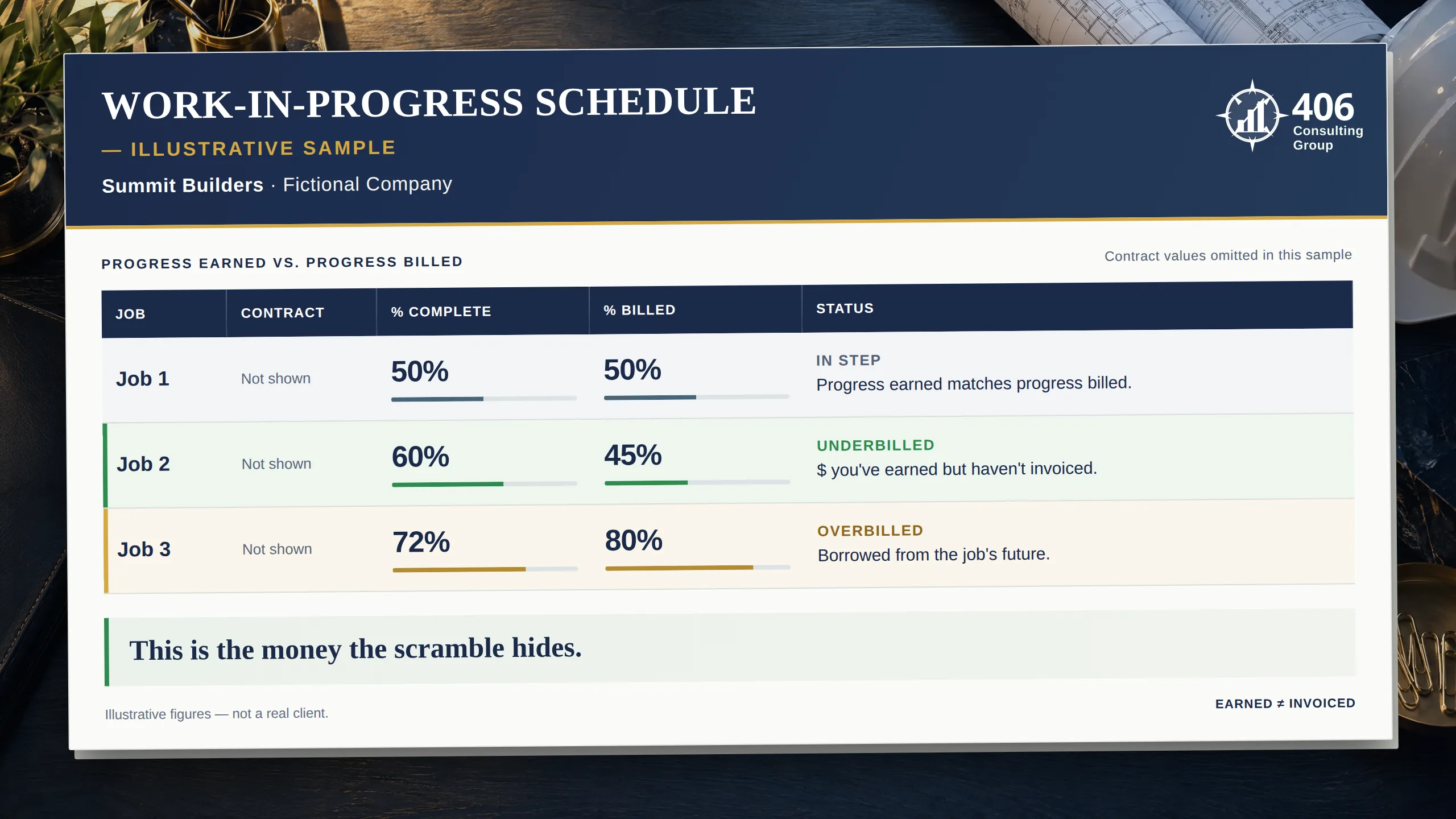
What a WIP schedule catches (illustrative)
Underbilling
You've done 60% of the work but only billed 45%. That 15% is cash you earned and haven't asked for — the scramble, quantified.
Overbilling
You've billed ahead of the work. Good for cash now, but it's borrowed from the job's future — you need to know so a profitable job doesn't turn into a cash cliff later.
A WIP schedule turns billing from guesswork into math, and it does double duty: it's also what a bonding agent and a bank want to see. Pair it with a job-costing calculator and a clear overhead rate, and you finally know which jobs make money while you can still do something about it — not six months after they close.
Fix #3: A weekly cash rhythm, so you see it coming
Once billing is on a cadence and tied to real completion, the last piece is a simple, forward-looking cash rhythm: a short weekly look at what's billed, what's collected, what's coming due, and what the next few weeks look like. It takes fifteen minutes and it ends the 28th-of-the-month panic for good, because you stop being surprised. A cash-flow runway model is a good place to start.
Notice the sequence: cadence first, then accurate billing, then forecasting. You can't forecast cash you're not reliably billing for. Fix the leak before you install the gauge.
Why this is really a maturity move
Fixing invoicing isn't just an accounting chore — it's how a contractor climbs the financial maturity ladder. A business whose billing lives in the owner's head and runs on a monthly panic is on the bottom rung: Chaos. Repairing the AR process — cadence, ownership, WIP, a cash rhythm — is exactly the work that moves you to the next rung, where the numbers are reliable and the business stops depending on one person's memory to get paid.
It's also a textbook case of a bigger principle: fix your weakest link first. For a lot of GCs, billing is the weakest link — the one broken process dragging down an otherwise strong company. Pour energy into a growth plan while draws go out late, and you're tuning the engine on a truck with a flat tire. Fix the billing, and everything above it moves up with it. Not sure where your weakest link is? The 8-question assessment will point at it in about two minutes.
Why the fix sticks (or doesn't)
Here's the part most “just use this template” advice skips. A billing checklist in a drawer changes nothing. Under deadline, the jobsite always wins over the back office — so the new cadence quietly dies by month three unless someone owns it and someone holds the line. That's where real help comes in: a bookkeeper keeps the billing accurate and on schedule, and a controller builds the process, watches the WIP, and keeps the whole rhythm running so it doesn't fall back on you.
That's the difference between knowing what to do and actually doing it — a plan plus a partner who makes sure it happens. We go deeper on that whole idea in why the score is the easy part, and on the construction specifics in our work with general contractors and specialty trades.
Where to start
You don't need a software overhaul or a new ERP to stop the scramble. You need a billing day, one owner, a WIP schedule, and a weekly cash look — in that order. Start with the first two this month; they cost nothing and they stop the bleeding fastest.
Stop billing late for work you've already done.
Take the free Financial Maturity Assessment to find where billing — and everything around it — really stands. Then talk to a founder about building a billing cadence and WIP process that actually sticks.
Who You’re Actually Working With
Two founders who’ve sat on both sides of your financials
We've run the back office for construction companies, not just booked it — billing cadence, WIP, and the cash rhythm that keeps a busy contractor from running broke. You aren’t handed off to a junior bookkeeper. You work directly with the people whose names are on the door — and their backgrounds are exactly the ones a growing business needs in its corner.

Carrie Anderson
Co-Founder · The Lender’s Eye
A former corporate controller and the contracted commercial loan analysta Montana community bank relies on — she has spread, packaged, and recommended 300+ commercial loans. She knows exactly how a bank reads your financials to decide what you can borrow — because she’s the one doing that analysis. That’s why our clients’ books come out lender-ready, not just tax-ready.

Jason Anderson
Co-Founder · The Operator’s Eye
A degreed accountant with 10+ years in tax and a decade of enterprise operations and accounting at BP, with a lifelong discipline for process, efficiency, and Six Sigma— made practical, not academic. He builds the job costing, tax strategy, and systems that let a company actually see where its money goes and scale without the wheels coming off.
Both spent years in the oil & gas industry, and both design financial systems from a whole-company view— not just an accounting lens. You get a firm that reads your numbers like a lender and builds systems like an operator.
Meet the teamFAQ
Why is my construction company always short on cash even when we're profitable?
Profit and cash aren't the same, and in construction the gap is usually billing. When invoicing is a monthly scramble with no cadence and no clear owner, you complete work long before you bill it and get paid long after that. Change orders go uninvoiced and retainage builds up, so money you've earned sits as 'unbilled' while payroll comes due every two weeks. Fixing the billing process — not landing more work — is what closes the gap.
What is progress billing, and how is it different from billing at the end of a job?
Progress billing means invoicing for the percentage of a job actually completed as you go, rather than waiting until the job is finished. On any project longer than a few weeks, end-of-job billing forces you to front labor and materials for months. Progress billing keeps cash coming in while the work happens, which is the whole point — you stop financing your customers' projects out of your own pocket.
What is a WIP schedule and why does my contractor business need one?
A WIP (work-in-progress) schedule compares how much of each job is actually complete against how much you've billed, so it surfaces underbilling (work done but not yet invoiced — cash you're owed) and overbilling (billed ahead of the work — a future cash cliff). It turns billing from guesswork into math, keeps progress billing honest, and it's also exactly what banks and bonding agents want to see.
Who should own invoicing in a construction company?
One person — not 'whoever gets to it.' The most common fix is to give a bookkeeper or office manager a standard billing checklist and a fixed billing day each cycle, with a controller building the process and reviewing the WIP. The key is single, clear accountability: when one person owns the cadence, draws stop slipping and change orders stop going unbilled.
How does fixing invoicing move my business up the financial maturity ladder?
A company whose billing lives in the owner's head and runs on a monthly panic is at the bottom rung — Chaos. Repairing the accounts-receivable process (a cadence, an owner, a WIP schedule, and a weekly cash rhythm) is exactly the work that moves you up to the next rung, where numbers are reliable and the business no longer depends on one person's memory to get paid. For many contractors, billing is the weakest link, so fixing it first lifts everything above it.
This article is general financial and operational education, not accounting, tax, legal, or investment advice for your specific situation. The example business and all figures are illustrative. Your results depend on your contracts, your jobs, and the process you put in place.
In one line
Busy and still short on cash? It's usually billing, not sales. A fixed cadence, one owner, a WIP schedule, and a weekly cash rhythm end the scramble.
Start here