
IRS Scam Alert:
Fake Letters Targeting Crypto Holders & Other 2026 Threats
A new physical-letter scam is targeting cryptocurrency holders with fake IRS notices and QR codes — plus AI phone impersonation, phishing, ghost preparers, and bogus credits. Here's how to spot every one.
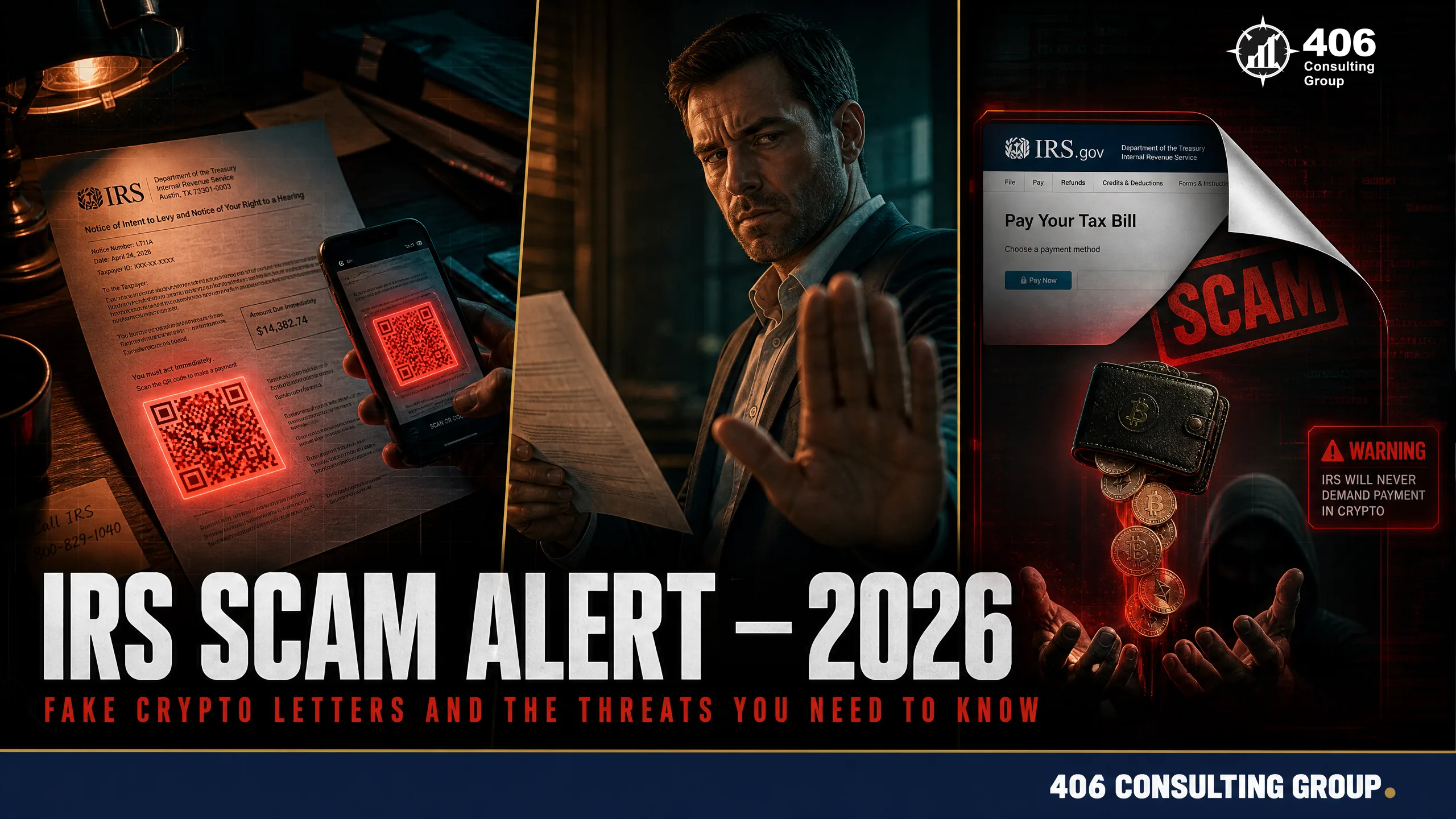
As a business owner or individual taxpayer, you're a prime target for scammers trying to steal your money, your identity, and now your digital assets. And the threats are getting more sophisticated — this isn't the era of the obvious typo-ridden email anymore. We're seeing a surge in highly convincing, fraudulent IRS communications, including a new physical-letter scam aimed squarely at cryptocurrency holders, plus AI-powered phone calls that sound genuinely real.
Here's the plain-English rundown of what's circulating in 2026, how each scam actually works, and — most importantly — the simple rules that keep you and your business safe. Spotting fraud used to be part of my job on the banking side of the table, and the good news is that almost every one of these scams collapses the moment you know one or two facts about how the IRS really operates.
By Carrie Anderson — Co-Founder, 406 Consulting Group. Commercial banking and underwriting background — 300+ loan reviews, and years spent spotting fraud and identity theft — now protecting business owners and taxpayers across the Mountain West and Southwest.
Quick Answer: The 2026 IRS Scams to Know
- →Fake IRS crypto letters: physical notices with a QR code pushing a bogus "Digital Asset Compliance Portal." Don't scan it.
- →AI phone impersonation: spoofed caller ID and cloned voices demanding immediate payment or threatening arrest.
- →Phishing & smishing: emails and texts with alarming language or a too-good refund, urging you to click a link.
- →Ghost preparers & viral 'tax hacks': unsigned returns and made-up credits that leave you holding the liability.
- →The one rule: the IRS contacts you by mail first, never demands crypto/gift-card/wire payment, and never threatens arrest.
Table of Contents
Why You're a Prime Target
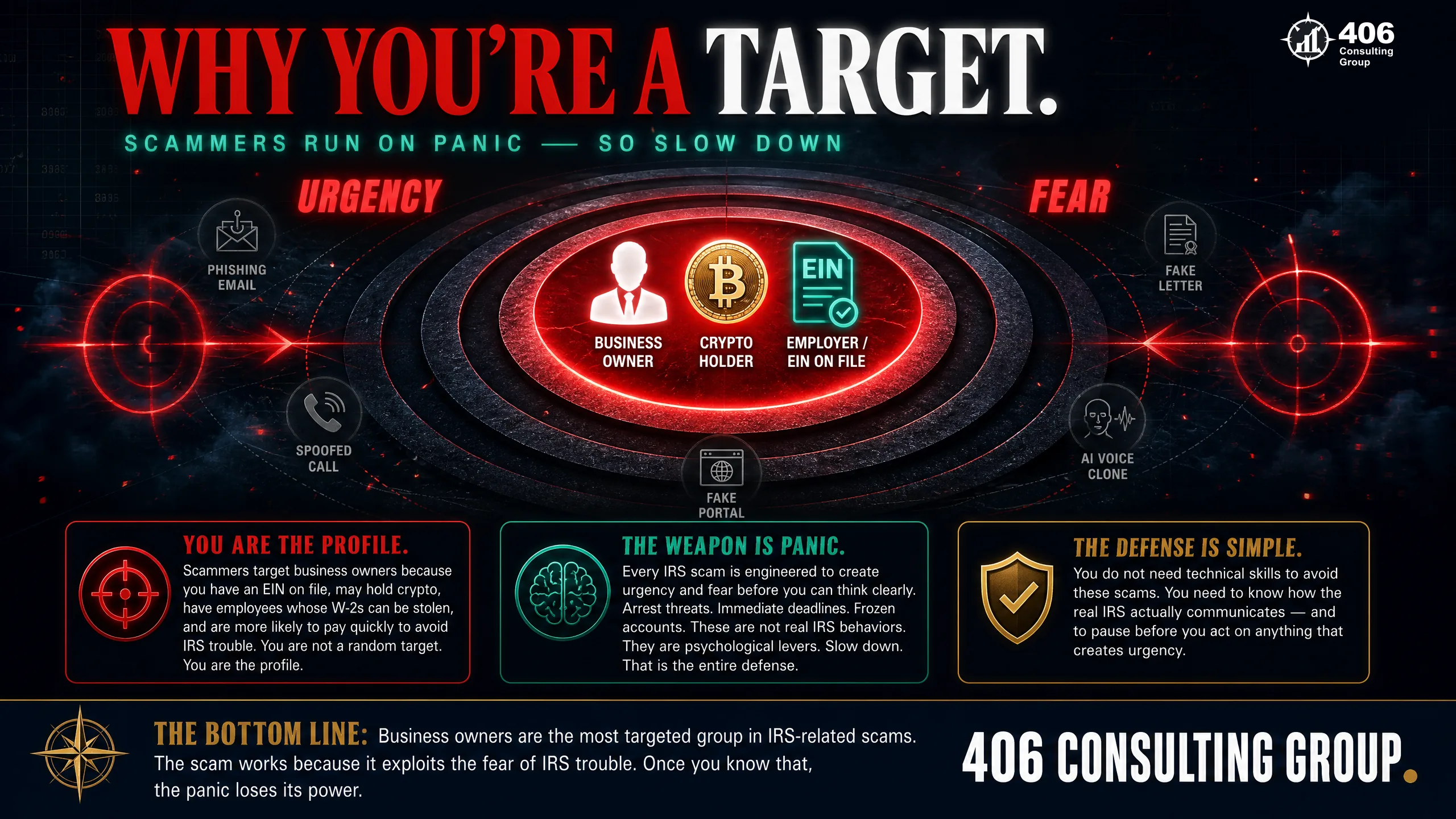
Scammers follow the money, and business owners sit right in the sweet spot: you move larger dollar amounts, you file more kinds of returns, you have an EIN and payroll and vendors, and you're busy enough that a well-timed "urgent" notice can slip past your guard. Add a crypto wallet or two and you become even more attractive, because digital assets can be drained in minutes and are far harder to claw back than a reversed bank transfer.
The scammers' entire playbook runs on two emotions: urgency and fear. A deadline that's about to pass. A threat of arrest. A refund you'll lose if you don't act now. The moment you feel that jolt of panic, that's the signal to slow down — because the real IRS almost never operates that way. Everything below is really just teaching you to recognize the difference between manufactured urgency and how a tax agency actually behaves.
Let's start with the newest and most alarming one — because it arrives in your physical mailbox, where most people don't expect a scam at all.
The Fake IRS Crypto Portal Scam
Federal fraud investigators and the tax community have been warning about a sophisticated scam targeting digital-asset holders — and what makes it dangerous is that it comes as a realistic, physical letter that looks like an official IRS notice. People have learned to distrust surprise emails and texts, but a printed letter in the mailbox still carries an air of authority, and the scammers are counting on exactly that.
The letter claims you must immediately enroll in a "Digital Asset Compliance Portal" before a strict deadline, and it includes a QR code. Scan that code and you land on a website built to look exactly like IRS.gov. The fake site then asks for your personal information, your cryptocurrency wallet details, and your exchange account credentials. Hand those over and the scammers drain your wallets and steal your identity — often within minutes, and usually with no way to reverse it.
Three facts that expose this scam instantly
- The IRS does not operate a "Digital Asset Compliance Portal."
- The IRS does not put QR codes in letters to send you to a compliance portal.
- A real IRS notice references specific tax years and amounts and points you to IRS.gov — not a code you scan.
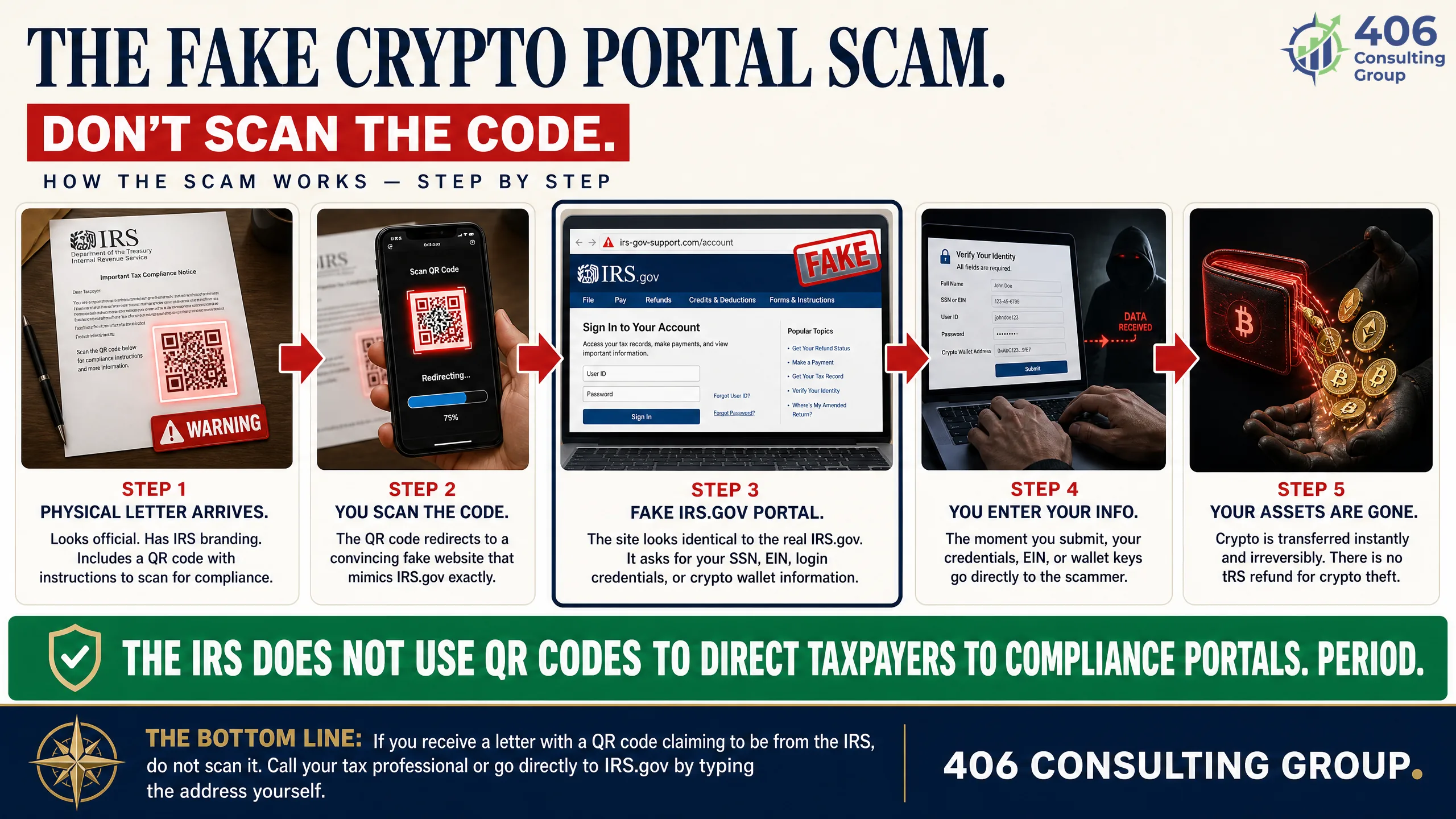
If a letter with a QR code demands crypto "compliance," do not scan it. Stop, don't respond, and call your tax professional — you can independently verify any real notice by logging into your own IRS.gov account or calling the IRS directly using the number on IRS.gov, never a number or link the letter gives you.
AI-Enabled Phone Impersonation
This is the one that catches even careful people in 2026. Scammers now use artificial intelligence for voice mimicry and spoofed caller ID, so your phone can genuinely display "IRS" and the voice on the line can sound calm, official, and human. They leave urgent, threatening voicemails demanding immediate payment or warning that arrest is imminent if you don't call back.
The reality
The IRS generally contacts taxpayers by mail first. It will never call to demand immediate payment by a specific method like a prepaid debit card, gift card, wire transfer, or cryptocurrency, and it will never threaten to send local police to arrest you. Caller ID can be faked; the demand for instant payment cannot be un-faked — it's always a scam.
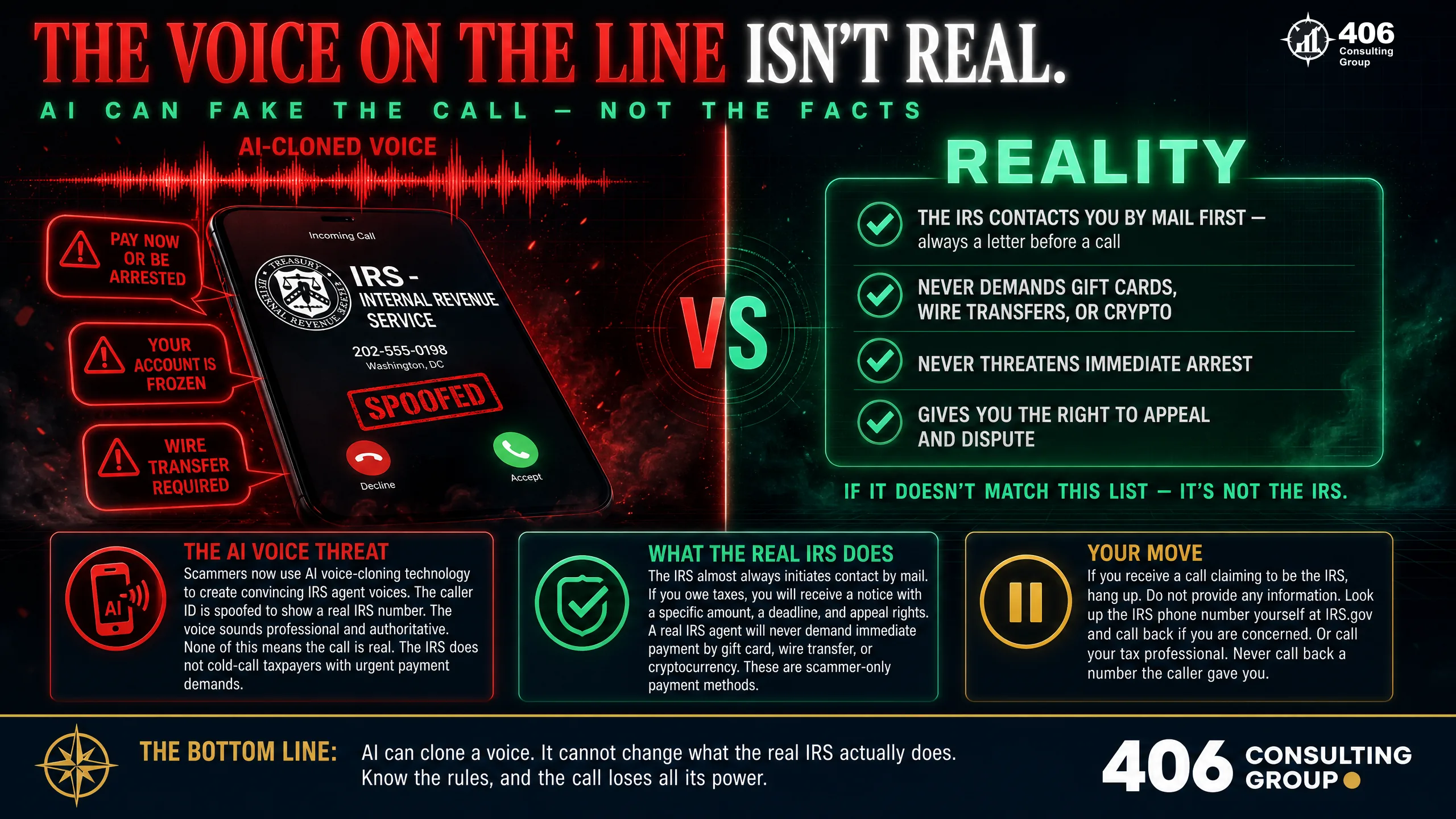
If you get one of these calls, hang up. Don't press a button, don't call the number back, and don't "just confirm" anything — engaging at all tells the scammers your line is live.
Phishing & Smishing
Phishing (fake emails) and smishing(fake text messages) are the volume plays — cheap to send by the million and effective on a small percentage. The messages appear to come from the IRS and lean on the same two levers: alarming language ("your account is on hold," "final notice") or an irresistible carrot ("you have an unclaimed refund"), always with a link to "verify" your account.
The reality
The IRS does not initiate contact with taxpayers by email, text message, or social media to request personal or financial information. Clicking those links can install malware on your device or drop you on a look-alike site built to harvest your data. When in doubt, don't click — open a browser and type IRS.gov yourself.
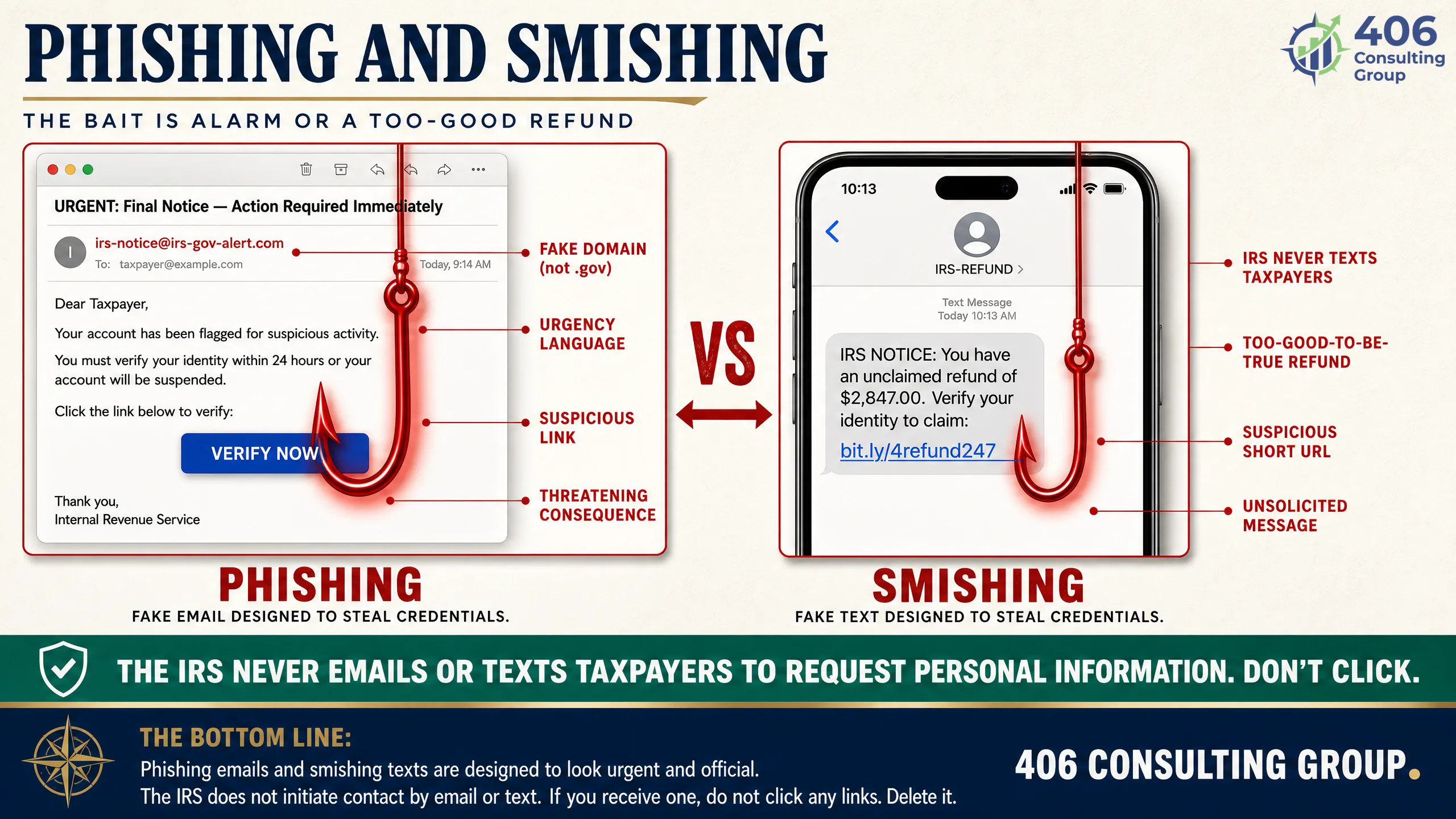
Forward suspicious IRS-themed emails to phishing@irs.gov and then delete them — we'll cover the full reporting steps below.
Ghost Tax Preparers
Not every scam comes from a stranger — some sit across the desk from you at tax time. A "ghost" preparer prepares your return but refuses to sign it or provide a valid Preparer Tax Identification Number (PTIN). They often dangle inflated refunds and charge a fee based on a percentage of that refund — a giant red flag on its own.
The reality
Anyone who prepares a federal return for compensation must have a valid PTIN and must sign the return. If your preparer won't sign, walk away — because when the return is filed, you are legally responsible for whatever they put on it, inflated numbers and all. A ghost preparer keeps the upside and leaves you the liability.
This is the whole reason working with a real, accountable firm matters: we sign every return we prepare, we stand behind the numbers, and our name is on it right next to yours.
The Bogus "Self-Employment Credit"
Social media is awash in confident-sounding advice promoting a broad "self-employment tax credit" that supposedly generates a massive refund — just file for it. It's a close cousin of the earlier wave of bad Employee Retention Credit advice: a real, narrow provision gets stretched into a viral "everyone qualifies" hack by people who make money whether or not your claim holds up.
The reality
Legitimate credits exist, but their rules are strict and specific. Filing for a credit you don't qualify for can trigger delayed refunds, audits, repayment, and significant penalties — and "I saw it on social media" is not a defense. If a tax hack sounds too good to be true, it's a trap dressed up as a tip.
There genuinely are credits and strategies that can cut your bill — but they come from a real analysis of your situation, which is exactly what our tax-planning work is built to do.
How the IRS Actually Contacts You
Almost every scam above dies the moment you hold it up against how the IRS really behaves. Memorize this short list and you've inoculated yourself against most tax fraud:
| The real IRS... | A scammer... |
|---|---|
| Contacts you by mail first, on official letterhead | Leads with a call, text, email, or QR code |
| References specific tax years and amounts | Uses vague, urgent, one-size threats |
| Lets you pay via official channels over time | Demands immediate payment by gift card, wire, or crypto |
| Gives you appeal and response rights | Threatens instant arrest or license loss |
| Points you to IRS.gov | Sends you to a link or portal they control |
| Never asks for wallet keys or passwords | Asks for credentials, keys, or full SSN by message |
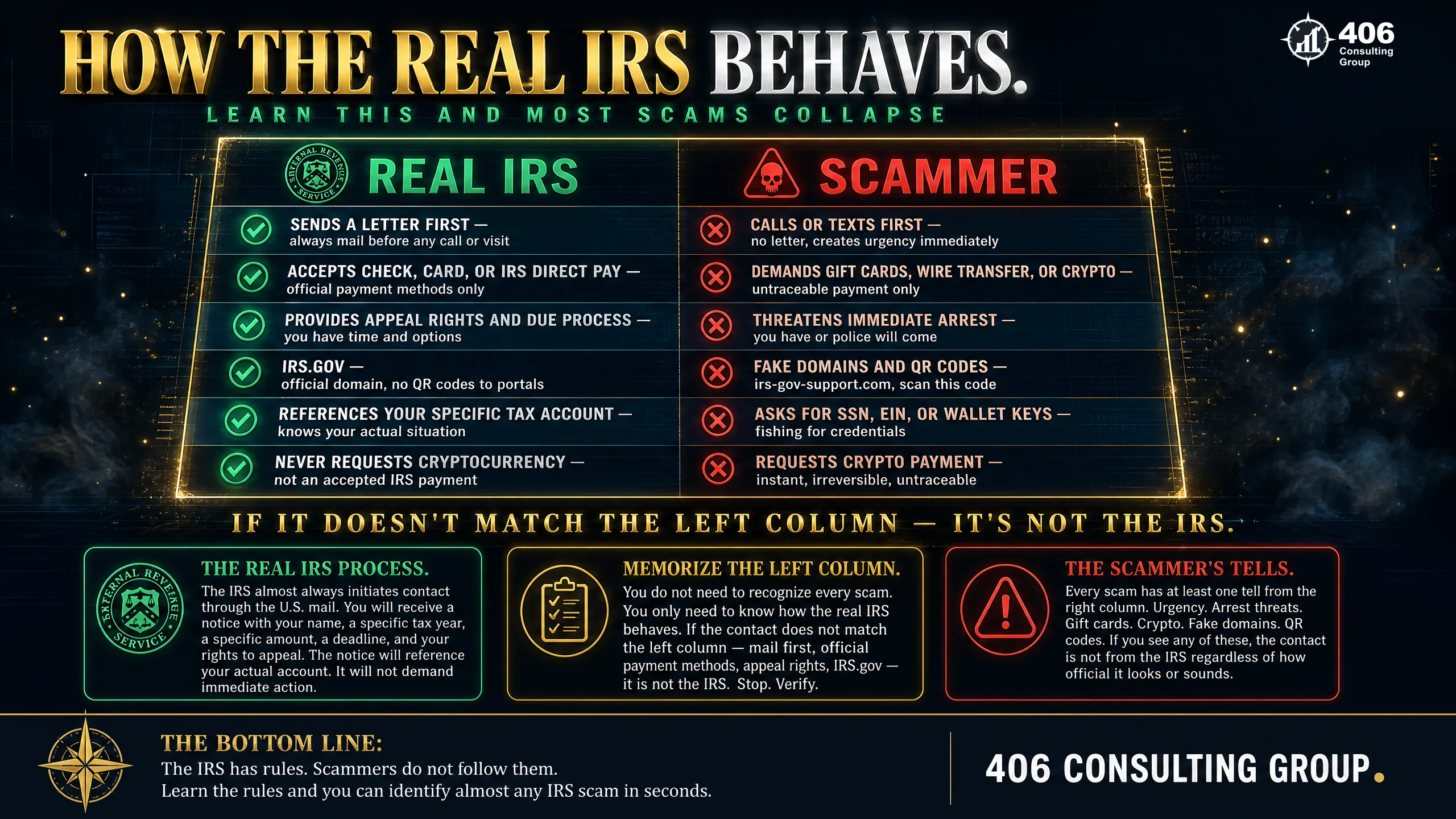
If a communication lands on the wrong side of that table, treat it as a scam until you've independently confirmed otherwise through IRS.gov or your tax professional.
The Business-Owner Blind Spot
Business owners face a whole category of scams that individuals don't, and they're often aimed not at you but at your team. The classic is the W-2 / payroll phishing attack: a scammer emails someone in HR or payroll, posing as you or another executive, and urgently requests copies of employee W-2s or a change to direct-deposit details. One rushed reply can expose your entire staff's Social Security numbers or reroute a payroll run to a criminal's account.
Business identity theft is the other big one — criminals use a stolen EIN to file fraudulent returns, open lines of credit, or claim bogus refunds in your company's name. Because businesses move bigger numbers and file more forms, the payoff is larger and the damage can take months to unwind. The defenses are practical: verify any internal request for W-2s or banking changes by phone before acting, lock down who can authorize payment or payroll changes, guard your EIN like a password, and reconcile your accounts and IRS notices promptly so a fraudulent filing surfaces fast.
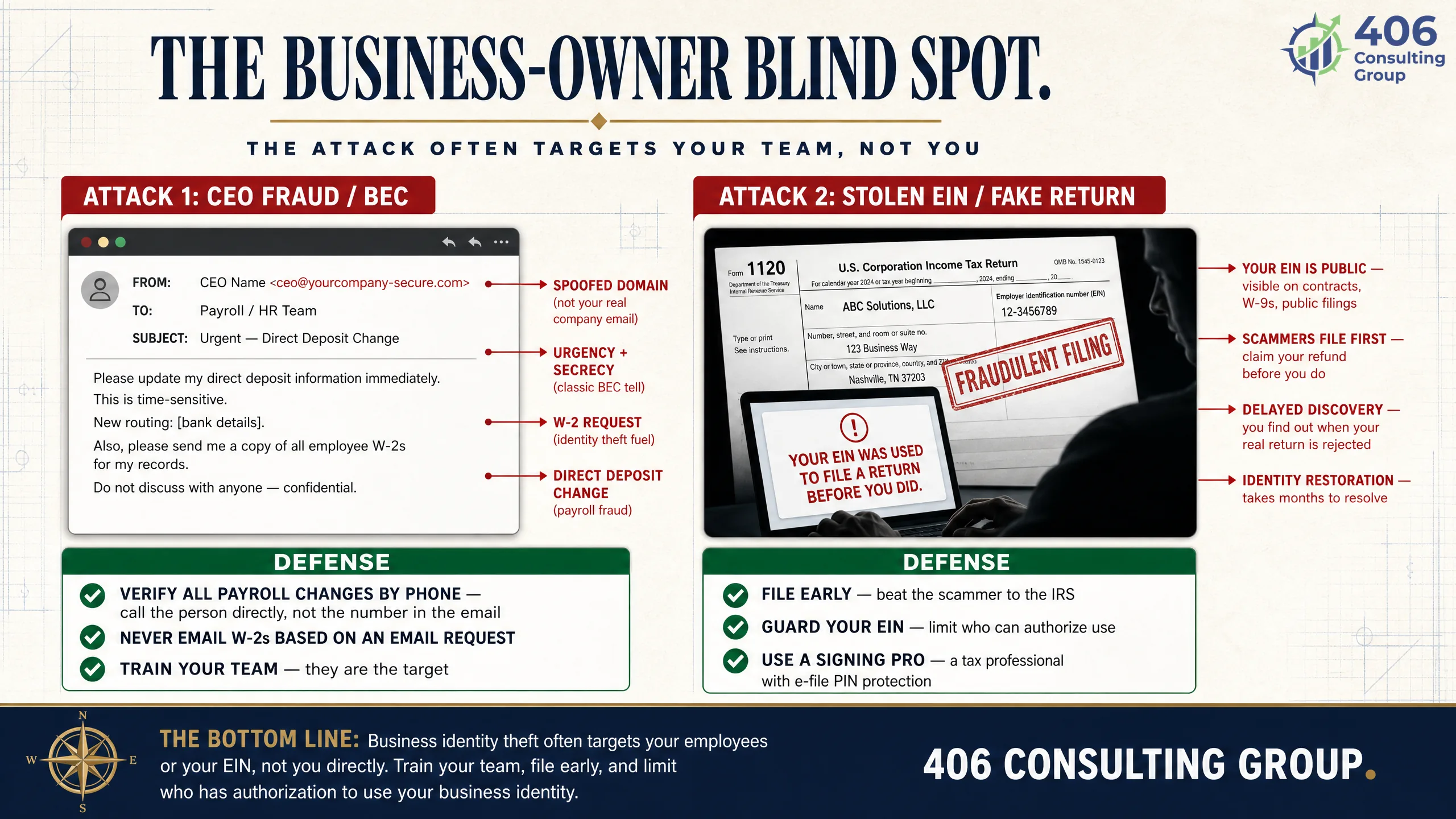
Clean books and a tight monthly close aren't just good accounting — they're fraud detection, because they make an unexpected transaction or filing impossible to miss.
How to Protect Yourself
Vigilance beats any single tool. Five rules cover the vast majority of tax fraud:
Verify the source
Never click links in unexpected emails or texts claiming to be the IRS. Open a browser and go to IRS.gov yourself, or log into your own IRS account.
Ignore the threats
Hang up on aggressive calls demanding immediate payment. Real tax matters are never resolved by gift card, wire, or crypto under threat of arrest.
Do not scan
Never scan a QR code on an unsolicited letter claiming to be a tax notice — that's not how the IRS directs you anywhere.
Protect the business too
Verify W-2 and direct-deposit requests by phone, guard your EIN, and limit who can authorize payroll or payment changes.
Use accountable professional help
Work only with reputable preparers who sign your returns and carry a valid PTIN — never a ghost preparer promising an inflated refund.
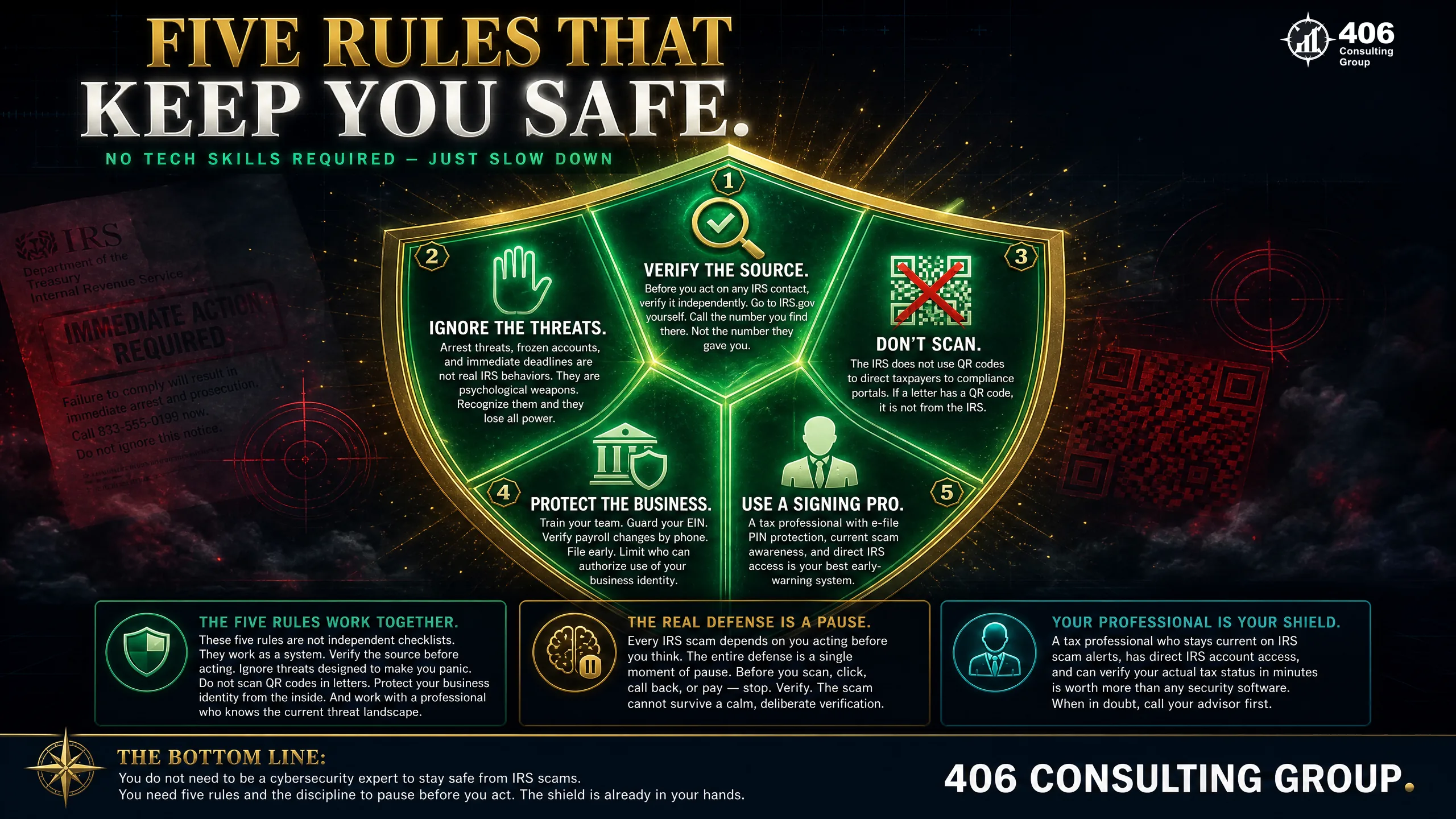
None of these require technical skill — just the habit of slowing down when something feels urgent.
What to Do If You're Targeted
If you receive a suspicious letter, email, call, or text claiming to be from the IRS — especially one involving cryptocurrency or demanding immediate payment — do not engage. Don't scan, don't click, don't call back, don't reply. Then take these steps:
Preserve it, don't interact
Keep the letter, screenshot the text, or note the caller ID and time — but don't scan codes, click links, or return calls.
Report it
Forward phishing emails and suspicious texts to phishing@irs.gov. Report IRS impersonation to the Treasury Inspector General for Tax Administration (TIGTA) and the FTC, and report crypto or online theft to the FBI's IC3 (ic3.gov).
Verify independently
Check for any real notice by logging into your account at IRS.gov or calling the IRS using the number published there — never a number the message provides.
Call your tax professional
Loop us in right away. We can confirm whether a notice is real, respond correctly if it is, and help you lock things down if you've already shared information.
If you think you've already given up information — wallet keys, credentials, or your SSN or EIN — act fast: move assets from a compromised wallet, change credentials, alert your bank and exchanges, and consider an IRS Identity Protection PIN. Speed matters, and it's exactly the moment to call a professional rather than face it alone.
FAQ: IRS Scams in 2026
Does the IRS have a 'Digital Asset Compliance Portal' for crypto?
No. There is no IRS 'Digital Asset Compliance Portal,' and the IRS does not mail letters with QR codes directing you to enroll in one. That letter is a scam designed to send you to a fake site that looks like IRS.gov and to harvest your personal information, wallet details, and exchange credentials. If you receive one, don't scan the code, don't respond, and verify independently at IRS.gov or with your tax professional. Real digital-asset reporting happens on your tax return, not through a surprise QR-code 'portal.'
How do I know if an IRS letter is real?
A genuine IRS notice generally arrives by mail, is printed on official letterhead, references specific tax years and dollar amounts, explains your rights to respond or appeal, and directs you to IRS.gov. It will not demand immediate payment by gift card, wire, or cryptocurrency, threaten arrest, or ask you to scan a QR code to a 'portal.' The safest way to confirm any notice is to independently log into your account at IRS.gov or call the IRS using the number published there — never a number or link printed on a letter you're unsure about — or simply hand it to your tax professional to verify.
Will the IRS ever call or text me?
The IRS generally makes first contact by mail. In limited situations the IRS may call or visit later, but it will never call to demand immediate payment by a specific method, require a prepaid card or wire or crypto, ask for credentials or wallet keys, or threaten to have local police arrest you. It does not initiate contact by email, text message, or social media to request personal or financial information. Any message doing those things is a scam — caller ID and cloned voices can be faked, but the demand for instant payment gives it away.
A tax preparer promised me a huge refund but won't sign the return. Is that a problem?
Yes — that's a 'ghost preparer,' and it's a serious red flag. Anyone who prepares a federal return for compensation must have a valid PTIN and must sign the return. A preparer who refuses to sign, or who bases their fee on a percentage of an inflated refund, is a classic warning sign of fraud. Remember that you are legally responsible for everything on a filed return, so a ghost preparer keeps the fee and leaves you holding the liability. Work only with preparers who sign what they prepare.
I think I already gave a scammer my information. What now?
Act quickly. If you shared cryptocurrency wallet keys or exchange credentials, move your assets to a secure wallet and change your credentials immediately, and alert your exchange and bank. If you shared your SSN or EIN, consider requesting an IRS Identity Protection PIN, watch your accounts and IRS notices closely, and report the incident. Report phishing to phishing@irs.gov, IRS impersonation to TIGTA and the FTC, and crypto or online theft to the FBI's IC3 at ic3.gov. Then call your tax professional — we can help you confirm what happened, respond to the IRS correctly, and lock things down.
Keep Reading
Tax Security — 2026
Got a Letter That Doesn't Feel Right?
Before you scan, click, or pay anything, send it to us. 406 Consulting Group will confirm whether an IRS notice is real, respond correctly if it is, and help you protect your business and your assets if it isn't — all delivered remotely.
2026 IRS Scam Quick Reference
Know the red flags
Not Sure If It's Real?
Send it to us before you act.
About the Author
Carrie Anderson
Co-Founder, 406 Consulting Group
Commercial banking and underwriting background — 300+ loan reviews, and years spent spotting fraud and identity theft. Carrie helps business owners and taxpayers recognize scams before they cause damage and respond correctly to anything that looks like the IRS.
Read the Full Story