
The Handshake That Ends Friendships:
Why Partnerships Die Without an Operating Agreement
Nobody signs a partnership expecting it to end — and the ones that end in wreckage almost always skipped the same document. Roles, money, and a buy-sell: the conversation nobody wants to have, and exactly why you have to.
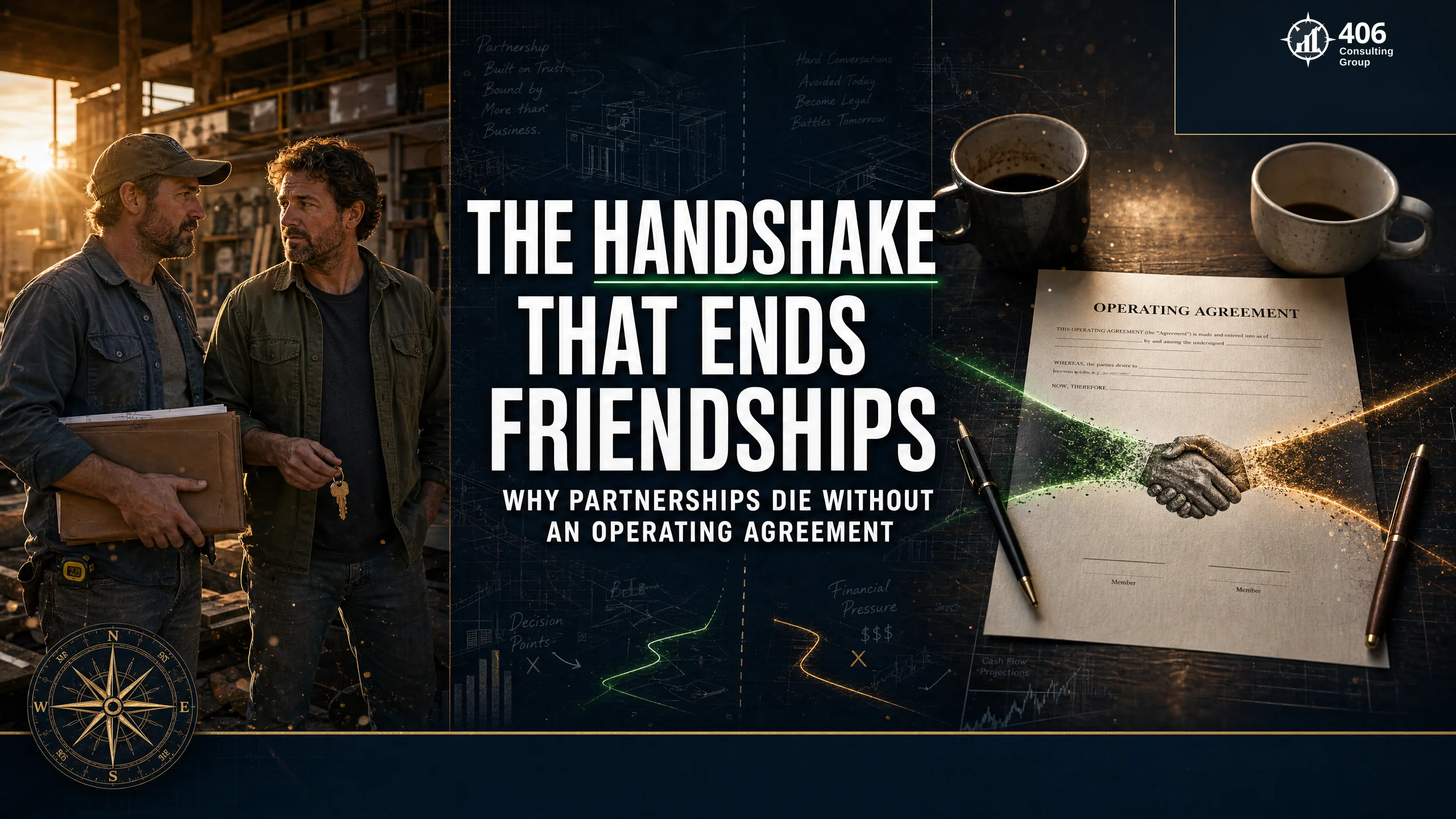
Nate and Kyle framed houses together for another company before they finally did the obvious thing and started their own. They were best friends. They trusted each other completely — so completely that when they shook hands in a Kalispell parking lot and said "fifty-fifty, partners," it never occurred to either of them to write anything down. Three good years later, Kyle's wife got a job in Denver, Kyle wanted out, and there was no agreement on earth that said what "out" meant. What was his half worth? Who decided? Who kept the trucks, the crew, the name? Within four months the company was frozen, the lawyers were involved, and two men who'd been in each other's weddings weren't speaking. The business survived on paper. The friendship didn't survive at all.
I've watched a version of this story more times than I can count, and it almost always starts the same way: two people who trust each other so much they skip the one conversation that would have protected them both. Here is the hard truth, and the hopeful one, in the same breath — nobody signs a partnership expecting it to end, and the partnerships that end in wreckage almost always skipped the same document.An operating agreement isn't cold legal paperwork that says you don't trust your partner. It's the opposite. It's the thing that lets you stay friends when life does what life always does. This is the conversation nobody wants to have — and exactly why you have to.
By Carrie Anderson — Co-Founder, 406 Consulting Group. Years in commercial banking and advisory across the country — enough time watching businesses succeed and implode to know that the ones that come apart worst are almost always the ones that never wrote down the rules.
Quick Answer: Why You Need an Operating Agreement
- →An operating agreement is the rulebook and prenup for your business — it protects the company and the friendship.
- →It defines the two things partners fight over most: who decides what, and how the money works.
- →Its most important piece is the buy-sell — what happens when a partner exits, dies, divorces, or wants out.
- →Without one, a partner dispute can freeze or destroy a healthy business — and the legal bill dwarfs the cost of the document.
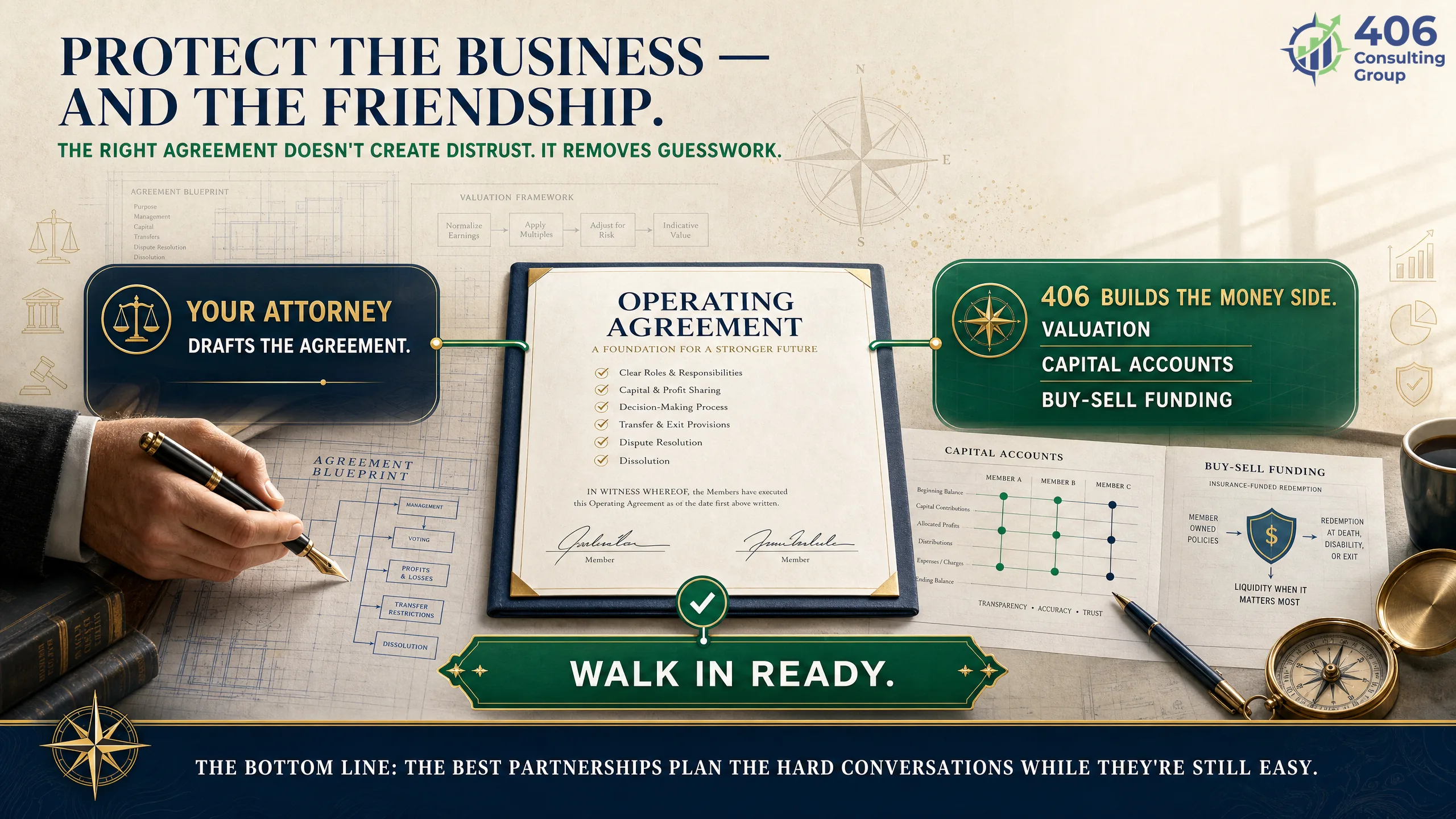
- →Your attorney drafts it; 406 builds the money side — valuation, capital accounts, and the financials a buy-sell runs on.
Table of Contents
The Handshake
The handshake feels like the honest way to start. You're excited, you trust each other, and pulling out a contract in that moment feels like you're accusing your friend of something. So you don't. You split everything down the middle, you get to work, and for a while it's the best decision you ever made. The trouble is that a handshake only captures the one moment when you both agree on everything. It says nothing about the hundred moments to come when you won't — and those moments are coming whether you plan for them or not.
A handshake records the day you agreed on everything. An operating agreement records what happens on all the days you won't — which is the only kind of day that ever ends a partnership.
To protect the friendship, you have to be willing to imagine it under strain. So let's start with why partnerships actually fall apart — because it's rarely what people expect.
Nobody Plans to Fail: Why Partnerships Actually End
Partnerships rarely end because of one dramatic betrayal. They end from slow, ordinary pressure that no one wrote a rule for. One partner starts working nights and weekends while the other coasts, and the resentment builds. The money gets complicated — one wants to reinvest, the other wants to take draws. Life simply moves: a spouse's job, a health scare, a new baby, a partner who falls out of love with the work. None of these are anyone's fault. They're just life happening to a business that never agreed on what to do when it did.
Mismatched effort
One partner grinds while the other eases off — and 'fifty-fifty' starts to feel like a lie.
Money creep
Reinvest or take draws? Salaries, distributions, whose money funded what — it all gets tangled.
Life changes
A move, a marriage, a diagnosis, a burnout. The person who signed up isn't the person a year later.
No way out
Someone wants to leave and there's no agreed price, process, or exit — so nobody can move.
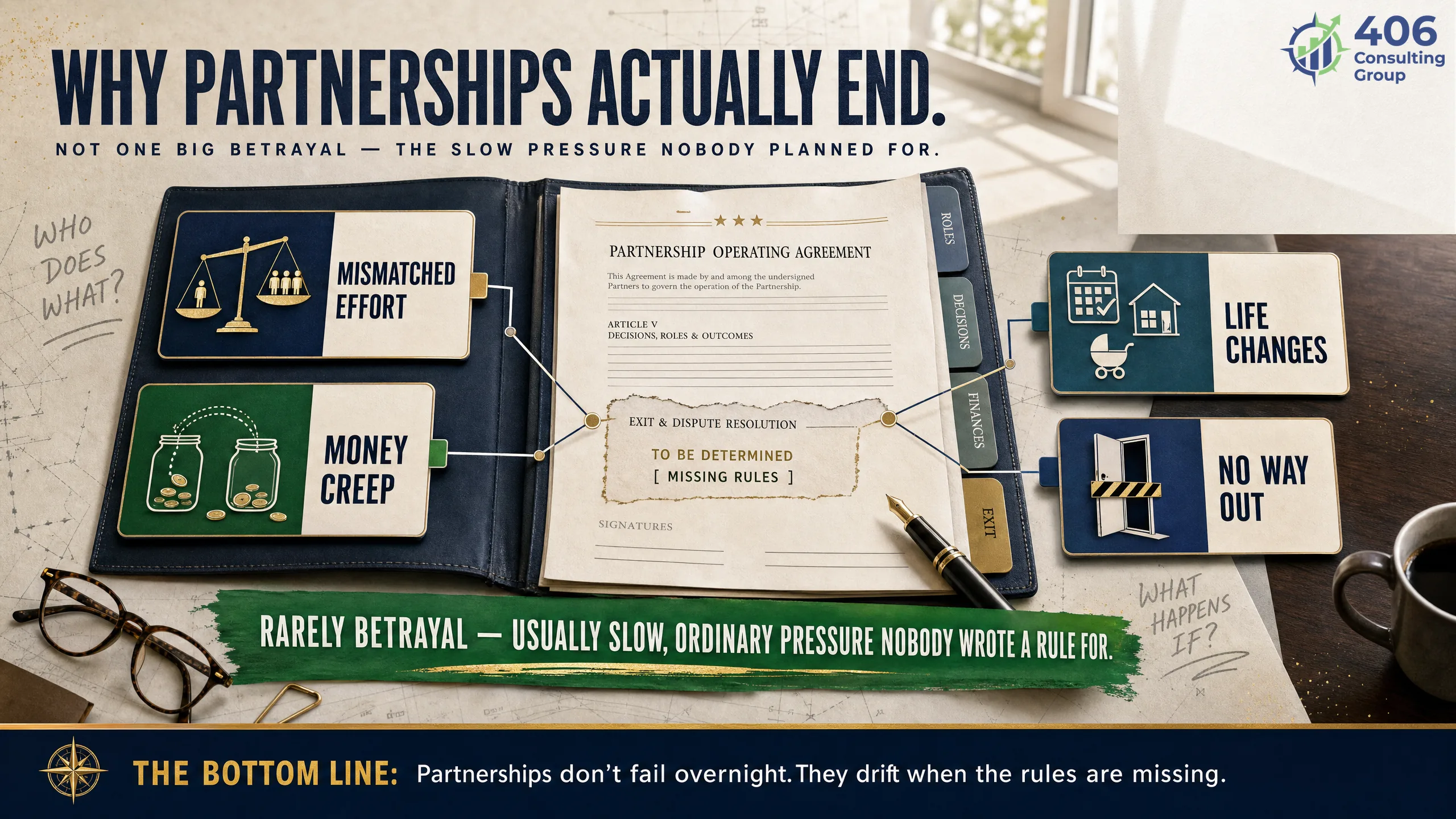
Every one of those is survivable — ifyou decided how to handle it back when you still liked each other. That's what the document is for.
What an Operating Agreement Really Is
Forget the legal-sounding name for a second. An operating agreement (a partnership agreementif you're a partnership, shareholder agreement if you're a corporation) is simply the written rulebook for how your business runs and what happens when things change. It's the prenup nobody wants to sign and everybody's glad they did. Its whole job is to answer the questions you're certain you'll never need to ask — while you're still calm, still friends, and still able to be fair to each other. The single best time to write it is right now, when neither of you can imagine needing it.
What a good agreement actually decides
Roles & authority
Who runs what, and who has final say on which decisions.
Money
Ownership split, profit distribution, draws, and how new capital gets in.
Decisions
What needs both partners, and how you break a tie.
Exit (the buy-sell)
What happens when someone leaves, dies, divorces, or wants out — and the price.

A quick, honest boundary: I'm writing from the finance and advisory seat, not as an attorney — the document itself should be drafted by a business lawyer. My job is to make sure you walk into that lawyer's office knowing exactly what you need it to say. Let's take the two pieces partners fight over most.
Defined Roles: Who Does What, Who Decides What
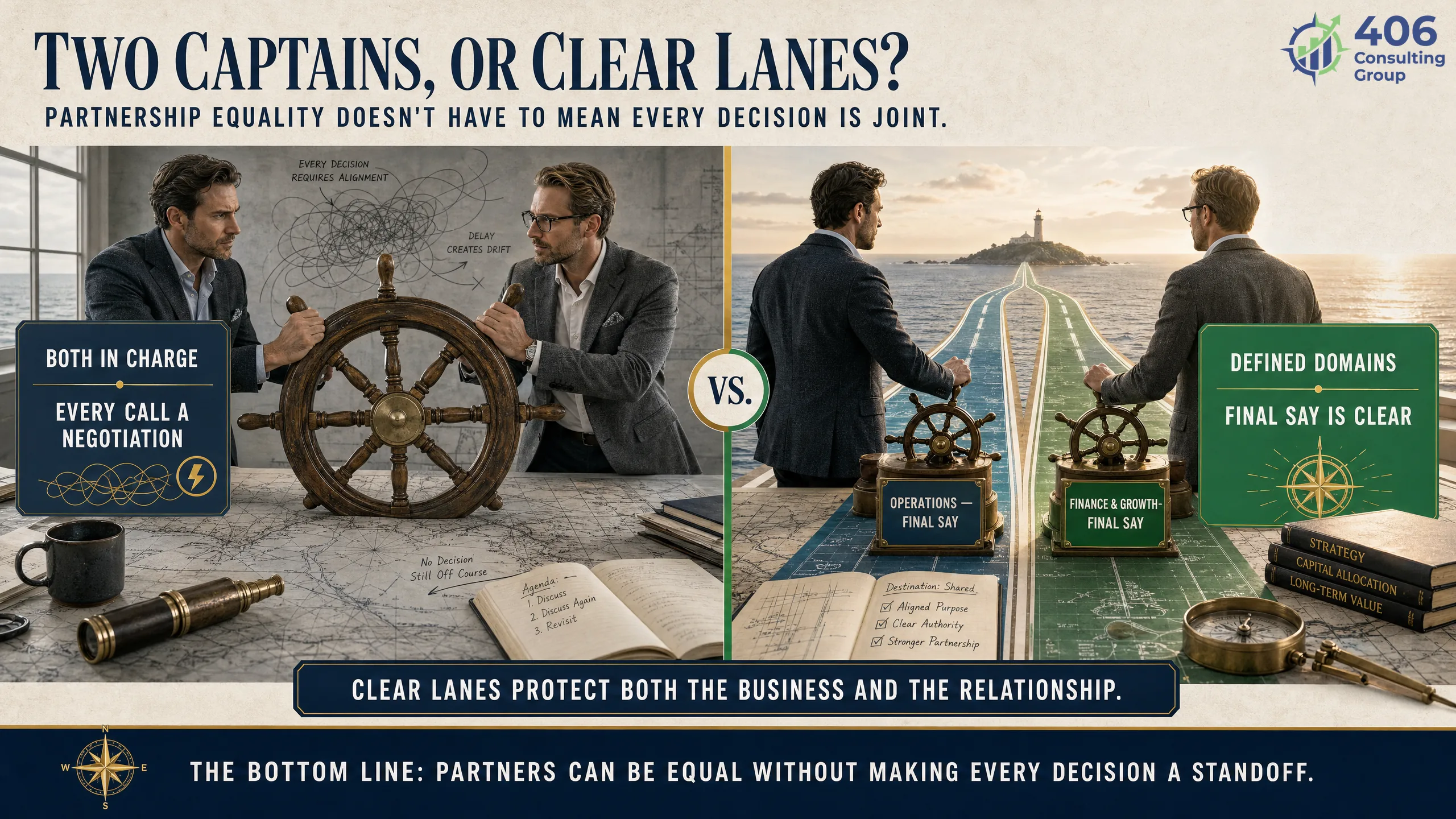
The quietest partnership killer isn't money — it's ambiguity about authority. When two equal partners both think they're in charge of everything, you get a business with two captains and no clear helm. Every decision becomes a negotiation, small disagreements harden into standoffs, and the team never knows whose answer is the real one. Defining roles isn't about ranking each other; it's about giving each person a clear lane to own so the company can actually move. One of you owns operations and the field; the other owns sales and the books. You still talk — but somebody has the final call in each lane.
Two captains, no helm
- Both partners "in charge" of everything
- Every call is a negotiation
- The team doesn't know whose answer counts
Clear lanes
- Each partner owns a defined domain
- Final say is clear in each lane
- The company can actually move
Once you know who decides, the next fight to head off is about the thing every partnership is ultimately about: the money.
The Money Rules: Draws, Capital & Profit Splits
"Fifty-fifty" sounds simple until real money moves through it. Does an equal split of ownership mean an equal split of profit — even if one of you put in $80,000 to start and the other put in sweat? How much can each of you pull out in draws, and who decides when the business needs to keep the cash instead? What happens when the company needs more money and only one of you can write the check? These aren't trust questions; they're plumbing questions, and the agreement is where you settle the plumbing before it leaks.
Ownership vs. profit
Equal ownership doesn't have to mean equal profit — spell out how splits actually work.
Draws & distributions
How much each partner can take, and who decides when cash stays in the business.
Capital contributions
Who put in what, who funds the next round, and what that does to ownership.
This is squarely where clean books and clear capital accountsmatter — the record of who contributed what and who's taken what out. Get that plumbing right and the money stops being a source of suspicion. Which leaves the scariest scenario of all: what happens when the two of you simply can't agree.
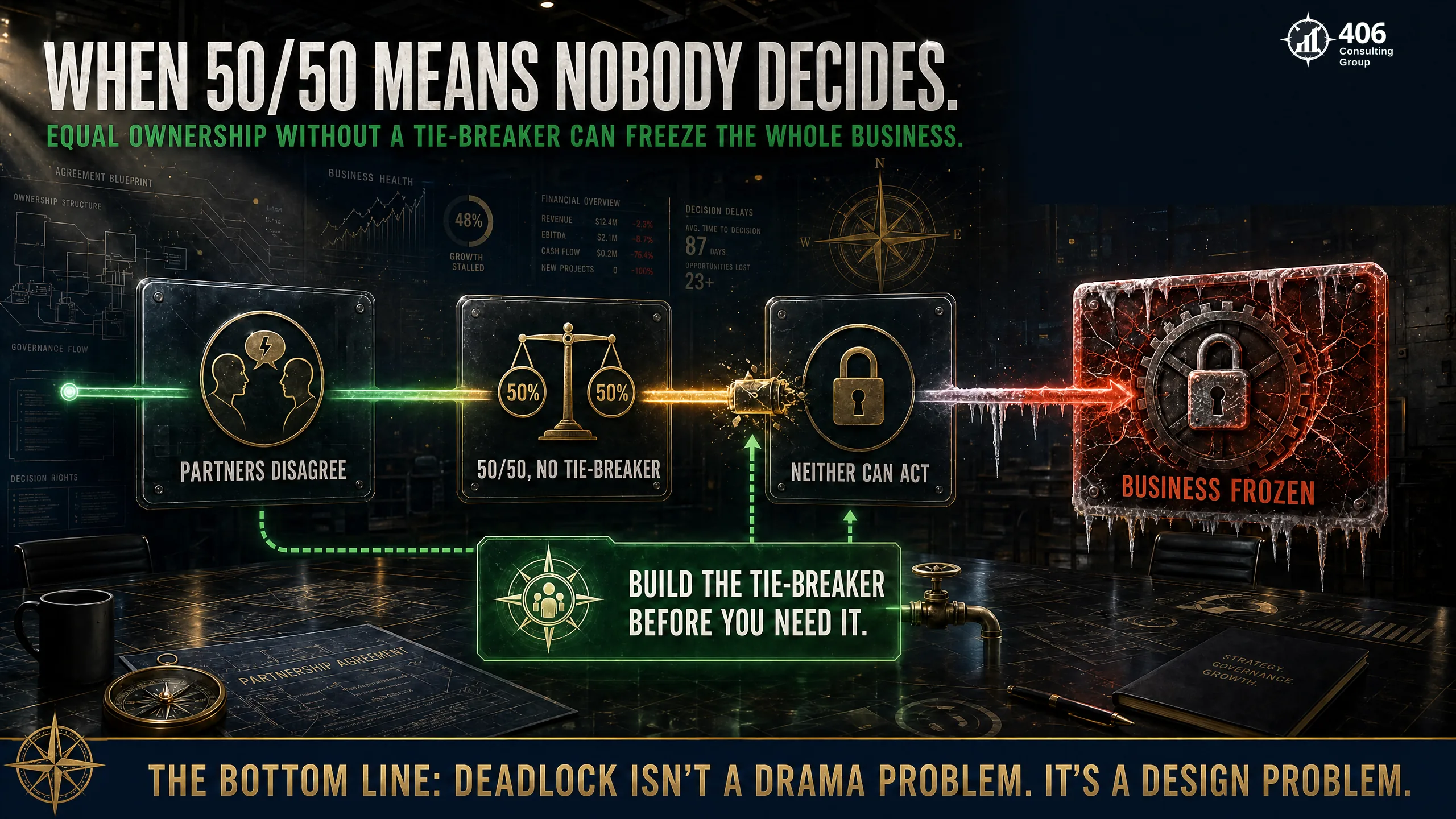
The Deadlock Problem: When 50/50 Means Nobody Decides
A perfect 50/50 split feels fair and egalitarian — until the day you truly disagree on something that matters, and discover that fifty-fifty means nobody has the deciding vote. The business simply freezes. Neither partner can act, neither can force the issue, and a company that was healthy on Monday is paralyzed by Friday over a decision that can't be made. A good agreement builds in a tie-breakerbefore you ever need one — a neutral third vote, a mediation step, defined domains where each partner decides alone, or a clear buy-out path if the deadlock can't be broken.
A tie-breaker clause is the off-ramp you build before the road ends.
Deadlock is bad, but it's recoverable. The scenario that actually destroys businesses is the one nobody wants to picture at all — a partner leaving.
The Buy-Sell: The Most Important Clause You Don't Have
If you take one thing from this article, make it this: your agreement needs a buy-sell. It's the clause that answers what happens to a partner's share when they leave, die, become disabled, divorce, or simply want out. It sets how the share gets valued, who has the right to buy it, on what terms, and how the purchase gets funded. Without it, the day a partner exits, you're negotiating the single biggest transaction of your business life with no rules, often against a grieving spouse or a lawyer — and no agreed idea of what the share is even worth.
Without a buy-sell
- No agreed value — you fight over the number
- No funding — you can't afford to buy them out
- A stranger (or an ex) can end up your partner
With a buy-sell
- A valuation method agreed in advance
- A funding plan (often life/disability insurance)
- A clean, fair, pre-agreed exit

The buy-sell matters because the triggers that set it off are not rare events. They're the ordinary shape of a human life.
The Four D's: Death, Divorce, Disability, Disagreement
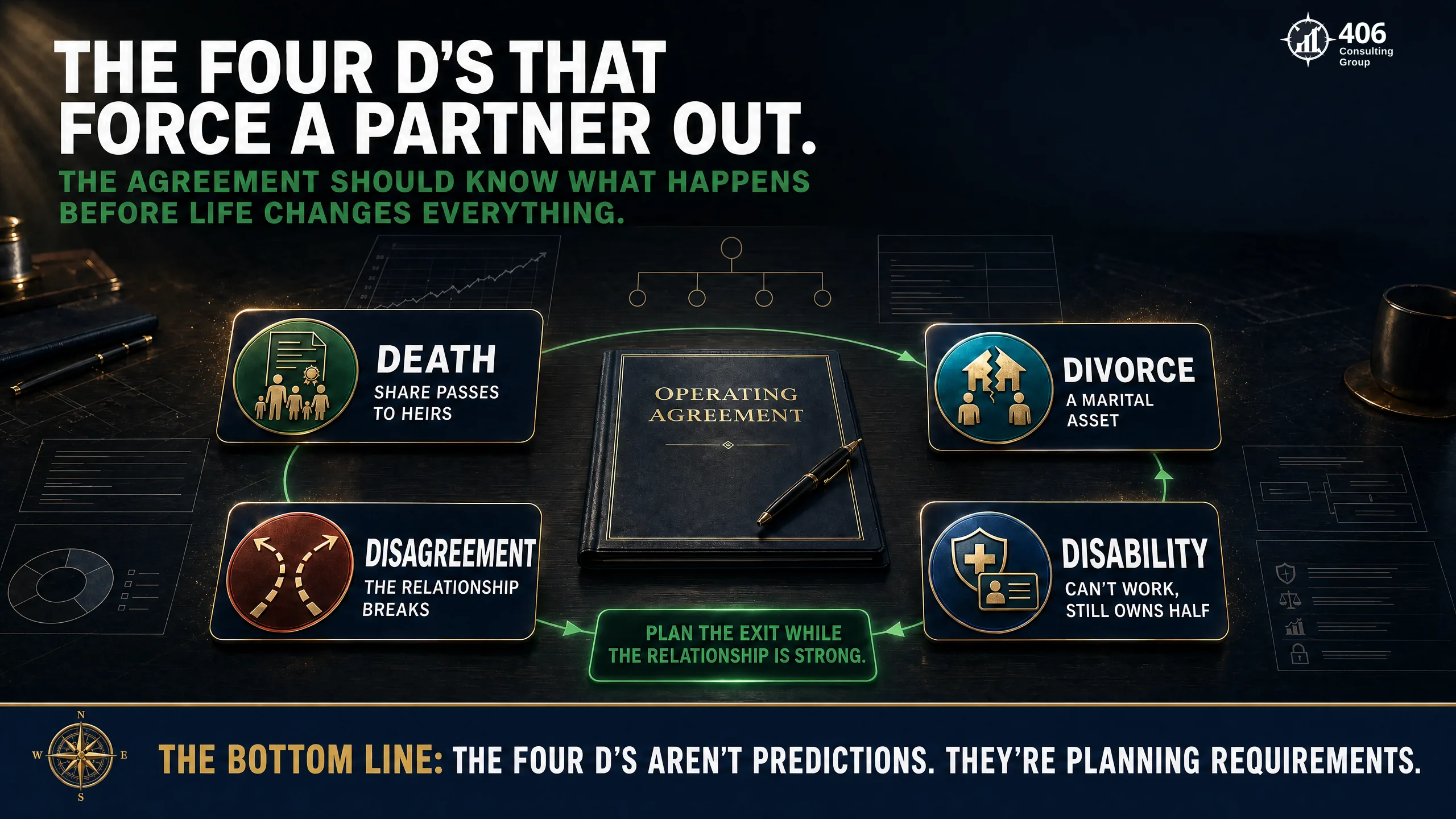
Advisors talk about the "Four D's" because they're the events that most often force a partner out — and every one of them will happen to somebody, eventually. The unsettling part is what each one can do to youif there's no agreement. If your partner dies, their share may pass to their spouse or kids — and now you're in business with them. If your partner divorces, their ownership can become an asset fought over in the settlement. Disability can leave a partner unable to work but still owning half. And plain disagreement can end the whole thing. A buy-sell turns each of these from a catastrophe into a procedure.
Death
A partner's share can pass to a spouse or heirs — suddenly you have a new partner you never chose.
Divorce
Ownership can become a marital asset on the table in someone else's divorce.
Disability
A partner who can no longer work may still own half the company.
Disagreement
The relationship simply breaks — and without a path out, so does the business.
Skip the agreement and any one of the Four D's doesn't just cost you a partner — it can cost you the whole business. Here's what that actually looks like.
The Financial Wreckage of Not Having One
From where I've sat, the saddest cases aren't failing businesses — they're healthyones torn apart by a partner split with no rules. When there's no agreement, the fight goes to lawyers, and legal fees for a partnership dispute routinely run into the tens of thousands, sometimes far more. The business often gets frozen while it's litigated — no big decisions, no financing, customers and crew drifting away. And because there was never an agreed value, the two sides can be a hundred thousand dollars apart on what the thing is even worth, each paying an expert to argue their number. A company that was worth real money on Monday can be worth a fraction of it by the time the dust settles.
The document (illustrative)
A few $1,000s
A lawyer-drafted agreement, once, while you're still friends.
No agreement (illustrative)
$50K+ & the business
Legal fees, a frozen company, a fire-sale value — and the friendship.
Put next to each other, it's not really a decision. Which raises the obvious question if you're reading this already in a partnership with nothing in writing.
Already in a Partnership Without One?
If you're three years in on a handshake and just felt your stomach drop — take a breath, because this is the good news. It is not too late, and today is the easiest day it will ever be.The best possible time to put an agreement in place is right now, while everyone's still getting along and no one has a reason to game the terms. When you write it during good times, both partners negotiate fairly, because neither knows which side of any clause they'll land on someday. Try to write it in the middle of a dispute and every sentence becomes a battle. Bringing it up isn't an act of distrust — framed honestly, it's one partner saying, "I care about protecting both of us and this thing we built."
Putting one in place — the honest version
Agree together that you both want the protection — frame it as caring, not doubting.
Get the numbers straight first: valuation, capital accounts, who's put in and taken out what.
Decide the hard parts — roles, tie-breaker, buy-sell — while it's all hypothetical.
Have a business attorney draft and finalize the document.
The lawyer writes the words. But the hardest parts — the number, the money, the fair terms — are exactly where we come in.
What to Do — and How 406 Helps
An operating agreement is a legal document, and a good business attorney should draft it — that part isn't ours, and we'll happily work alongside yours. But most of what makes an agreement actually work is financial, and that part is exactly what we do. What is the business really worth, and what valuation method should the buy-sell use? Are the capital accounts clean, so everyone knows who put in and took out what? How do the profit splits and draws actually function? How would you funda buy-out if a partner exited tomorrow? We build the numbers and the structure so you walk into the lawyer's office knowing exactly what you need — and we'll sit in the hard money conversations with you.
It's the same whole-company view behind our work on the advisors around you and the cash beneath your profit: the money is where the real decisions live. Protecting a partnership is one of the highest-return things a business owner can do, and it starts with numbers you can trust and a conversation you can finally have.
Protect the business and the friendship.
Let's get the valuation, the capital accounts, and the money terms right — so you walk into your attorney's office ready, and are far less likely to become one of the sad stories. Start with where your business stands today.
Nate and Kyle didn't need to lose their friendship — they needed one conversation and one document. You still have time to have yours.
FAQ: Partnerships & Operating Agreements
Do I really need an operating agreement if my partner is a friend or family member?
Especially then. The partnerships that end most painfully are usually the ones built on trust so complete that nobody wrote anything down — friends and family. An operating agreement isn't a sign you distrust your partner; it's how you protect the relationship when life changes, which it always does. Writing it while you're on good terms means you both negotiate fairly, because neither of you knows which side of any clause you'll land on someday. Think of it as a prenup for the business: you hope you never need it, and you'll be enormously grateful it exists if you do.
What should an operating agreement include?
At minimum: ownership percentages; how profits and losses are split; each partner's roles and decision-making authority; how everyday and major decisions get made (and how ties get broken); rules for draws, distributions, and future capital contributions; and — most important — a buy-sell provision covering what happens when a partner leaves, dies, becomes disabled, divorces, or wants out, including how the departing share is valued and funded. A business attorney should draft the document, but you want the financial pieces — valuation method, capital accounts, funding — worked out before you get there.
What is a buy-sell agreement and why does it matter?
A buy-sell is the part of the agreement that governs what happens to a partner's ownership when they exit — through death, disability, divorce, disagreement, or a voluntary sale. It sets how the share is valued, who has the right (or obligation) to buy it, on what terms, and how the purchase is funded (often with life or disability insurance). It matters because a partner leaving is the single largest transaction in most business lives, and without a buy-sell you negotiate it with no rules — frequently against a grieving spouse or a lawyer — with no agreed idea of what the share is even worth. It turns a potential catastrophe into a clear procedure.
What happens if partners deadlock and can't agree?
In a 50/50 partnership with no tie-breaker, a genuine disagreement can freeze the entire business — neither partner can act, and neither can force the decision. A healthy company can be paralyzed within days over a single deadlocked call. A good agreement prevents this by building in a mechanism ahead of time: a neutral third vote, a required mediation step, clearly defined domains where each partner decides alone, or a buy-out path if the deadlock truly can't be broken. The tie-breaker is an off-ramp you build before the road ever ends.
Can 406 Consulting Group help even though you're not attorneys?
Yes — and the two roles fit together. The operating agreement is a legal document that a business attorney should draft; we work alongside your lawyer, not in place of them. What we handle is the financial engine that makes the agreement actually work: what the business is worth and which valuation method the buy-sell should use, clean capital accounts showing who contributed and withdrew what, how profit splits and draws function, and how a buy-out would be funded. We get your numbers and structure right so you walk into the attorney's office knowing exactly what you need — and we'll sit with you through the hard money conversations.
The Four D's
What forces a partner out
Protect Your Partnership
Start with where you stand.
About the Author
Carrie Anderson
Co-Founder, 406 Consulting Group
With a commercial banking and advisory background, Carrie has watched businesses succeed and come apart — and knows the ones that come apart worst are usually the ones that never wrote down the rules. She helps partners get the valuation, capital accounts, and money terms right before they ever need them.
Read the Full Story