
SBA vs. USDA Business Loans:
Which Fits — and Why It Matters
SBA 7(a) works almost anywhere up to ~$5M and moves faster; USDA B&I is for rural businesses — much of Montana qualifies — and goes far larger. How to choose, and why getting the file right matters most.
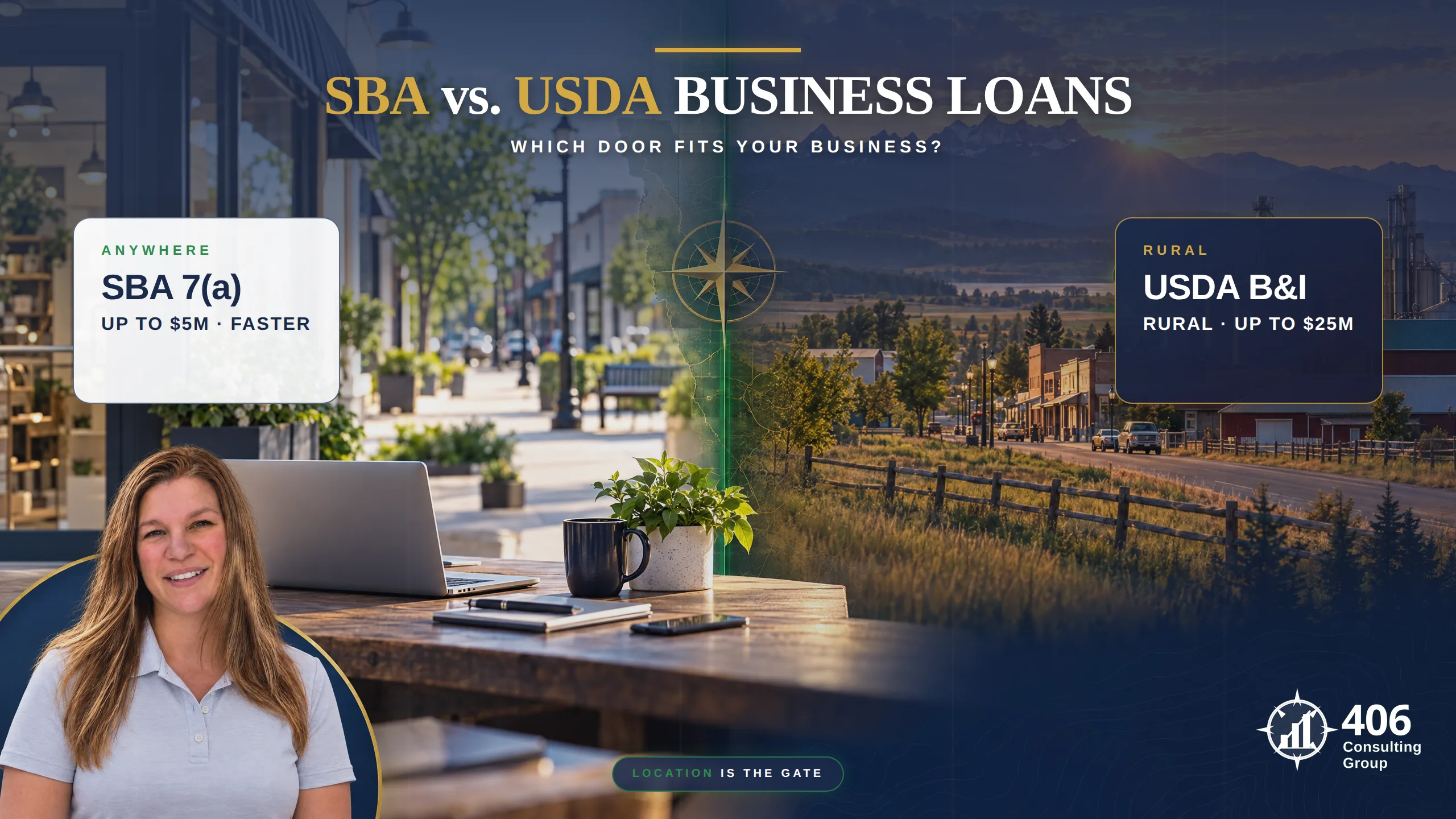
The main difference comes down to two things: where your business is, and how big the loan needs to be. An SBA 7(a) loan works for almost any small business, almost anywhere, up to about $5 million — and it moves faster. A USDA Business & Industry (B&I) loan is for businesses in ruralareas — and much of Montana qualifies — goes far larger (up to roughly $25 million), but is slower and more involved. If you're rural, USDA can open a door the SBA can't. If you need speed or you're in a metro, 7(a) is usually the path.

By Carrie Anderson
Co-Founder, 406 Consulting Group
Commercial banker and underwriter — 300+ loan files reviewed firsthand.
Program rules, caps, and guarantee levels are set by the SBA and USDA Rural Development and change over time; the figures below are typical, not a guarantee. Confirm current specifics with a lender and the agencies before you decide.
What's the real difference?
Both are government-guaranteed loans — a bank makes the loan, and a federal agency backs part of it so the bank can say yes to deals it might otherwise decline. The difference is the mission behind each program, and that changes who qualifies and how the loan behaves.
Where it works
SBA 7(a): Almost anywhere — urban or rural
USDA B&I: Rural areas only (generally towns under ~50,000)
Typical max
SBA 7(a): Up to ~$5 million
USDA B&I: Much larger — up to ~$25 million
Speed
SBA 7(a): Faster; experienced lenders can approve in-house
USDA B&I: Slower; adds state-level USDA review (often months)
Repayment
SBA 7(a): Flexible terms (real estate up to ~25 years)
USDA B&I: Fully amortized — no balloon payments
Best for
SBA 7(a): Most small businesses needing speed or general funding
USDA B&I: Larger rural projects — real estate, expansion, jobs
The question that decides it: are you rural?
This is the gate. USDA B&I exists to build rural economies, so the business — or the facility, equipment, or project the loan pays for — has to sit in an eligible rural area. The good news for a Montana business: a lot of the state qualifies. Outside Billings, Missoula, Great Falls, and the Flathead core, much of Montana — and big stretches of Wyoming, Idaho, and the Dakotas — falls inside USDA's rural map. A business that would be just another file to a big-city SBA lender can be exactly who the USDA program was built to fund.
Eligibility is tied to a specific address, and USDA publishes a map you can check. Being “rural” isn't a disadvantage here — it's a qualification. If you're a producer, processor, contractor, or operator in small-town Montana, the USDA door is one worth checking before you default to the SBA.
When SBA 7(a) is the better fit
When you want speed and flexibility and the deal is under roughly $5 million. The 7(a) is the workhorse of small-business lending: it funds working capital, equipment, real estate, even a business acquisition, and experienced SBA lenders can move quickly because they can approve much of it in-house. If you're in a metro area, or you simply need the money sooner, 7(a) is usually the cleaner road. (For a real-estate or big-equipment purchase specifically, there's also the SBA 504, which pairs a bank loan with a long, fixed-rate second — worth asking a lender about.)
When USDA B&I is the better fit
When you're rural and the project is larger — real estate, a major expansion, acquiring or building capacity that adds jobs. The B&I program reaches well past the SBA's ceiling, and because its mission is rural development, a rural business with a solid plan can be a genuinely strong candidate. The trade-off is time and process: USDA adds its own state-level review, so these loans take longer and the file has to be right. That's the price of the bigger door — and it's exactly why preparation matters.
Why these are the loans where a guide earns their keep
Both programs are paperwork-heavy and rule-bound, and USDA B&I is the more demanding of the two — extra agency review, no shortcut approval, a longer runway. On a loan this size, with a process this involved, you often get one real shot: a weak or incomplete package stalls or gets declined, and restarting costs you months you may not have.
This is where having someone who has sat on the lender's side changes the odds. We know what these programs weigh, how the file should be built, and how to frame your cash flow and DSCR the way an underwriter reads them — so the strongest version of your case lands the first time. On a make-or-break loan, that difference can be approval instead of a “no,” or months instead of a year.
Weighing an SBA or USDA loan?
We'll help you figure out which program fits, check whether your location qualifies for USDA, and build your file to land the first time — from someone who used to underwrite these on the bank's side.
FAQ
What's the difference between an SBA loan and a USDA business loan?
Both are government-guaranteed loans made by a bank and backed by a federal agency, but they serve different missions. SBA 7(a) loans work for most small businesses almost anywhere, up to about $5 million, and move relatively quickly. USDA Business & Industry (B&I) loans are for businesses in rural areas, go much larger (up to roughly $25 million), and support rural economic development — but they add a state-level USDA review, so they take longer. Location and loan size usually decide which one fits.
Does my Montana business qualify for a USDA business loan?
It depends on your location. USDA B&I eligibility is tied to a specific address being in a rural area — generally towns under about 50,000 people — and a large share of Montana qualifies, along with much of Wyoming, Idaho, and the Dakotas. The business, or the facility or project the loan funds, has to sit in an eligible area. USDA publishes an eligibility map you can check by address, which is the fastest way to confirm before you build an application.
Which is harder to get, an SBA or USDA loan?
Both are document-heavy, but USDA B&I is generally the more involved of the two because it adds a state-level USDA review on top of the lender's underwriting and has no shortcut approval, so it takes longer. That makes preparation matter even more: on a large, slow-moving loan you often get one real shot, and a weak or incomplete package can cost you months. Building the file correctly the first time — with cash flow and DSCR framed the way an underwriter reads them — is the single biggest thing in your control.
This article is general financial education, not lending, legal, or financial advice for your specific situation. SBA and USDA program terms, caps, and eligibility are set by those agencies and change over time; confirm current details with a lender.
In one line
SBA 7(a): almost anywhere, up to ~$5M, faster. USDA B&I: rural only (much of Montana qualifies), far larger, slower. Location and size decide.
Keep Reading
External Resources