
Tax Planning in Austin, TX:
The Big Moves Happen Early
No state income tax makes Austin look simple — but a startup's real tax levers are federal and time-sensitive: R&D credits, QSBS, entity choice, and stock comp. Here's what to get right, and when.

Founders move to Austin partly for the tax climate — no state income tax, a business-friendly reputation, and a dense startup ecosystem. But "low-tax state" lulls a lot of tech founders into thinking there's nothing to plan, and that's a costly misread. For a startup, the biggest tax levers aren't on any state return at all: they're the R&D credit, the QSBS exclusion that can wipe out tax on a future exit, the entity choice that determines whether QSBS is even available, and the way you handle stock compensation. Get those right early and you can save founders and employees enormous sums down the road; get them wrong and the money is often gone for good.
This is the planning companion to our Austin bookkeeping guide. Where that one covers recording SaaS revenue and the Texas sales tax, this one is about the decisions that actually move the number for a technology company — most of them federal, most of them time-sensitive, and most of them invisible to a generic preparer. All delivered remotely.
By Carrie Anderson — Co-Founder, 406 Consulting Group. Advising SaaS, startup, and technology businesses across the Mountain West and Southwest on tax strategy that actually moves the number — and on presenting clean financials to banks and investors.
Quick Answer: Tax Planning for an Austin Tech Business
- →No state income tax — so no PTE/SALT game; the real leverage is federal and startup-specific.
- →R&D credit: a federal credit plus a Texas franchise-tax R&D option — one of the biggest levers for a tech company.
- →QSBS (§1202): the right C-corp structure can exclude a large share of gain on a future exit — but only if set up early.
- →Entity & stock comp: C-corp vs. S-corp/LLC, ISOs vs. NSOs, and the 83(b) election all have big, time-sensitive consequences.
- →Delivered remotely — startup-and-Texas expertise matters far more than a local office.
Table of Contents
Why Austin Tax Planning Is Different
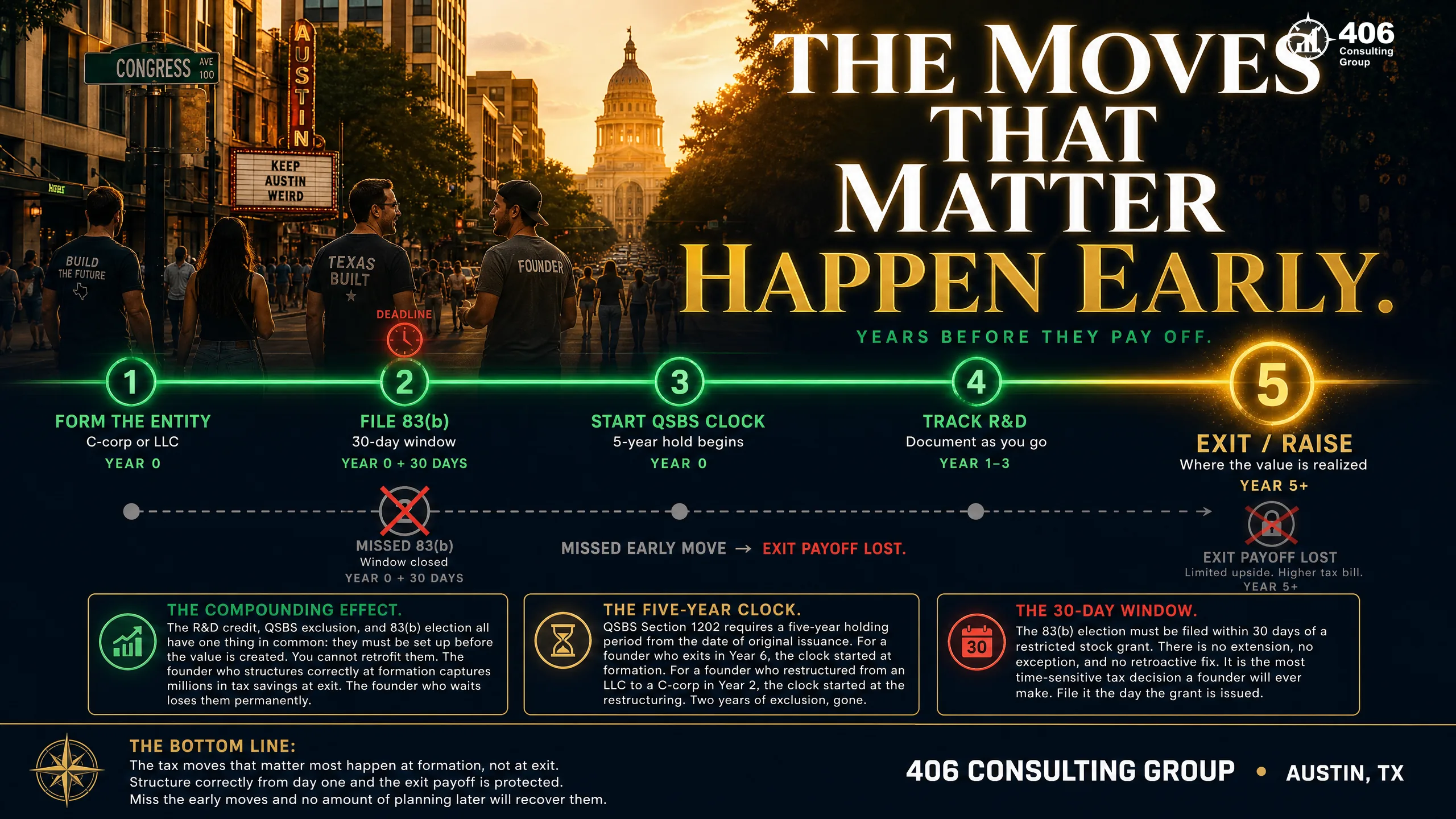
For a technology company, tax planning barely resembles what a typical small business does. There's no inventory to time, no equipment-heavy depreciation strategy, often no profit yet at all — and yet the tax stakes are enormous, because a startup's value is concentrated in equity and a future exit. The decisions that matter are made yearsbefore they pay off: how you structure the company, when you elect QSBS treatment, how you document R&D, how founders and employees hold their stock. Miss the window and the tax benefit simply doesn't exist later.
Texas's no-income-tax status is a genuine perk, but it's also a distraction: it removes the one thing founders think of as "tax planning" and leaves them assuming the job is done. Meanwhile the real levers — federal R&D credits, the QSBS exclusion, entity structure, stock-comp elections — sit untouched because a generic preparer doesn't raise them and the founder doesn't know to ask. In Austin, great tax planning is mostly about the moves nobody made because the state return looked so simple.
Let's start by being precise about what "no income tax" actually buys you — and what it doesn't.
No Income Tax — What It Does and Doesn't Do
The absence of a Texas income tax is real money for founders and employees, and it removes an entire category of planning: there's no state pass-through-entity election to chase, no state bracket management, no state credits to juggle. Compared with California or New York, that's a meaningful simplification, and it's part of why so many companies relocate here.
But it doesn't touch your federal tax, which is where essentially all of a startup's tax stakes live — the R&D credit, QSBS, stock-comp treatment, and the corporate or pass-through tax on any profits. And it doesn't erase other states'taxes: as you hire remote employees and sell nationwide, you can pick up income-tax and sales-tax obligations elsewhere. "No income tax" is a great starting point, not a finish line — it just means the planning that matters is federal and multi-state rather than Texan.
So let's spend the rest of this on the levers that actually move a tech company's tax bill — starting with the biggest one for a company that builds things.
The R&D Credit: Federal + Texas
The research & development credit is one of the most valuable — and most underclaimed — incentives available to an Austin tech company. Federally, the R&D tax credit rewards spending on qualified research (a big share of a software company's engineering payroll can qualify), and early-stage companies without income-tax liability may be able to apply a portion against payroll taxes instead — real cash back while you're still pre-profit. On top of the federal credit, Texas offers its own R&D incentive tied to the franchise tax: broadly, a company can choose a franchise-tax credit for research or a sales-tax exemption on qualifying research equipment.
The catch is documentation. These credits require you to identify and support qualified research expenses — the right wages, contractor costs, and supplies — which is exactly why the clean R&D tracking we set up in the books matters so much. There's also a federal wrinkle worth knowing: the treatment of research costs under §174 has been in flux in recent years — at points requiring them to be capitalized and amortized rather than expensed immediately, with subsequent law changes affecting that treatment (especially for domestic research). Because it directly affects taxable income and estimates and the rules have moved more than once, it's an area to plan deliberately and confirm the current treatment with a pro.
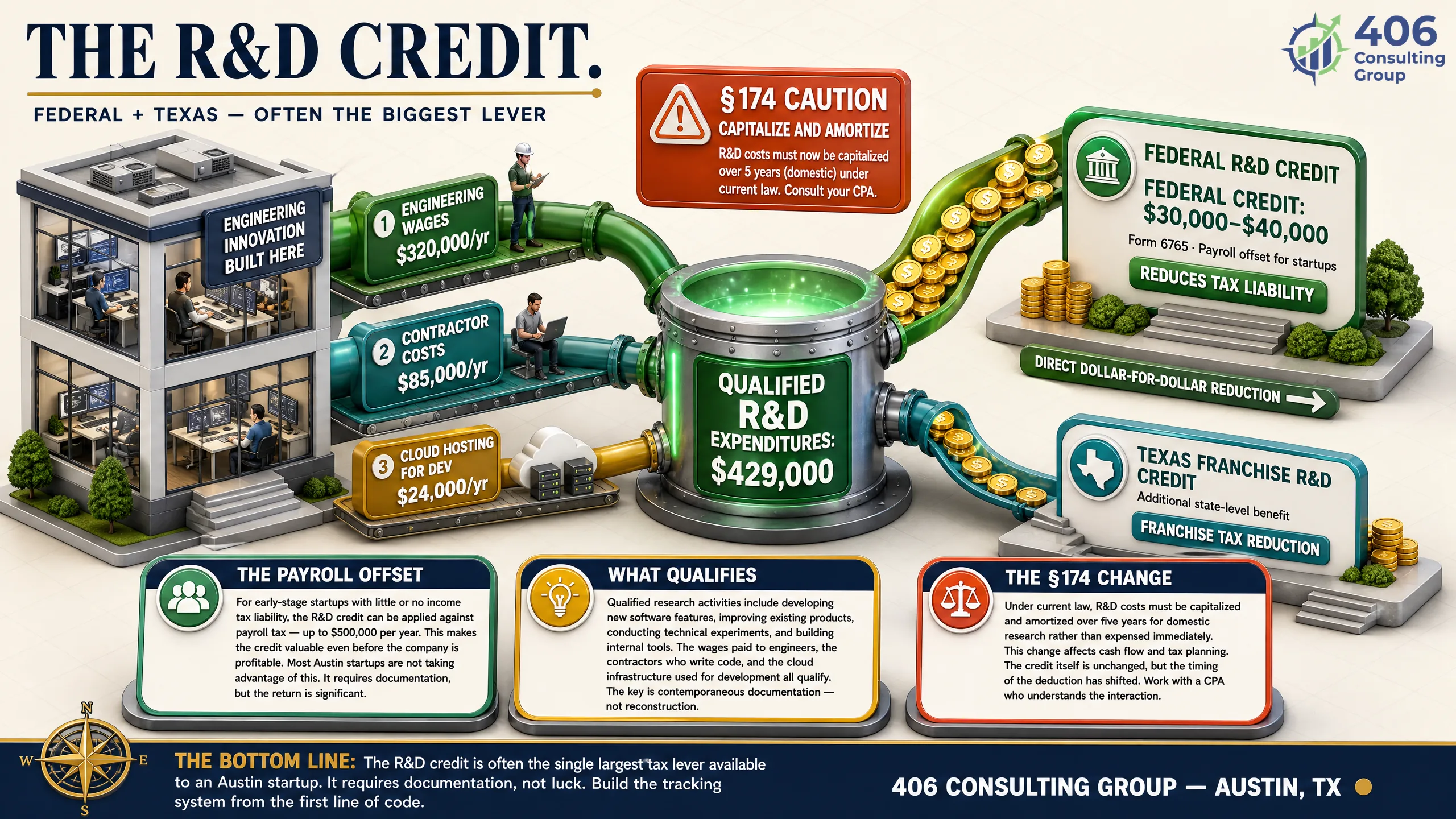
For a company whose main activity is building software, this is often the single biggest tax lever available — and it starts with tracking, not a year-end scramble.
QSBS: The Founder's Best-Kept Secret
If there's one provision every Austin founder should understand, it's Qualified Small Business Stock (QSBS) under Section 1202. In broad terms, if you hold qualifying stock in a C-corporation that meets the requirements for the required holding period, you may be able to exclude a very large portion — potentially all, up to generous limits — of the federal capital gain when you sell. On a successful exit, that can mean the difference between a large tax bill and little or none. It is, for many founders and early employees, the most valuable tax benefit they'll ever touch.
The catch — and the reason it belongs in a planning article — is that QSBS depends on decisions made at the very beginning: the company generally must be a C-corporation, the stock must be acquired in a qualifying way, and specific requirements and holding periods apply. Choose the wrong entity or miss a requirement early and the exclusion may simply never be available. The rules are detailed and have specific thresholds, so this is squarely a work-with-a-professional area — but the awareness has to come early, because you can't retrofit QSBS the year before you sell.
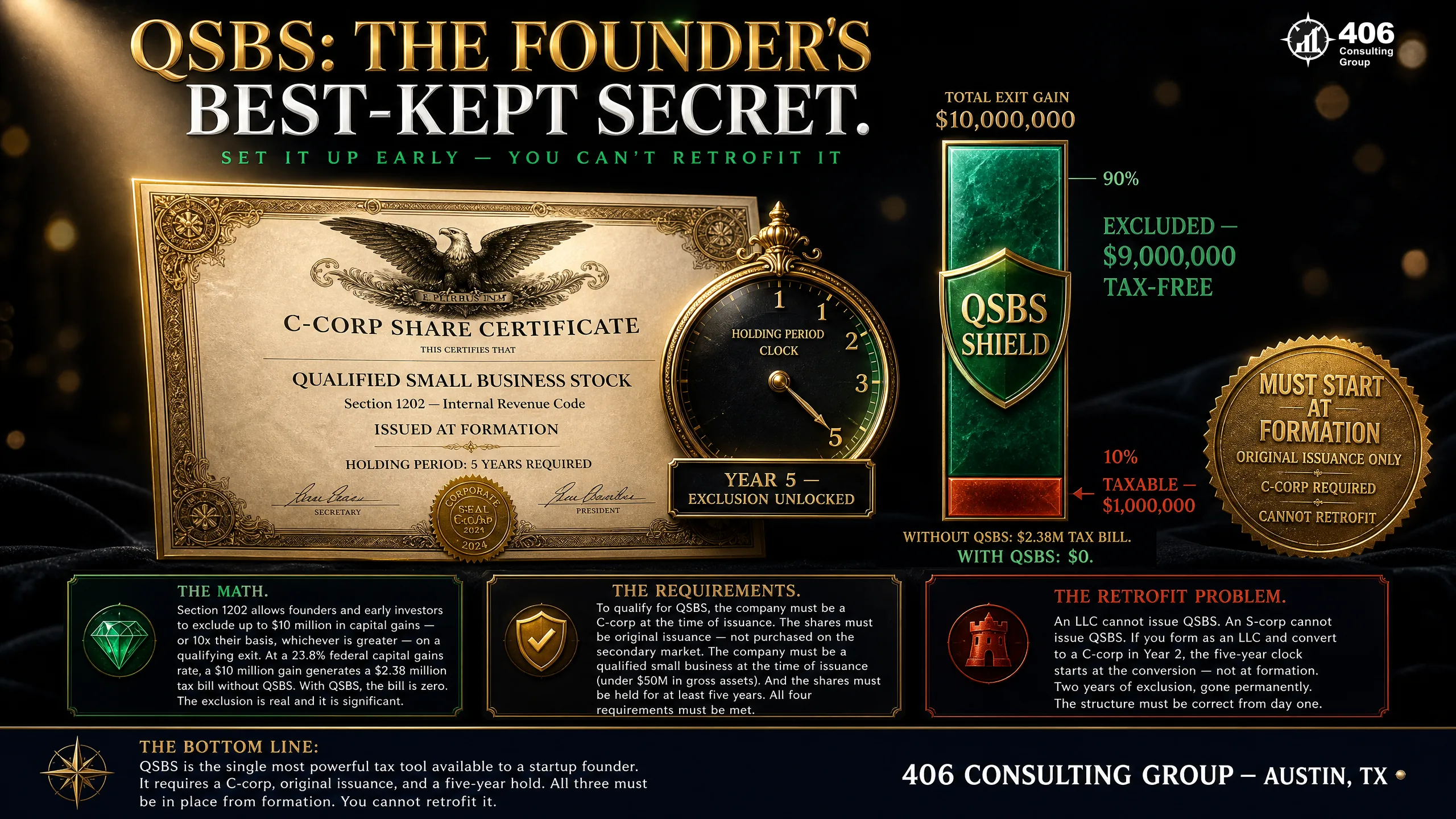
Why this is a day-one decision
QSBS eligibility is largely set by how you structure and capitalize the company at formation. By the time an exit is on the table, the window to qualify has usually long closed. If a big outcome is even possible, it's worth getting the structure reviewed early — confirm specifics with a qualified tax professional.
Entity Choice: C-Corp, S-Corp or LLC?
Entity choice is more consequential for a tech company than almost any other business, because it interacts with fundraising and QSBS. A company planning to raise venture capital almost always ends up as a Delaware C-corporation — that's what institutional investors expect and what QSBS requires. A bootstrapped, profitable software or services business, by contrast, may be far better off as an S-corp or LLC, where profits pass through and a reasonable-salary strategy can reduce self-employment tax without a layer of corporate tax.
The tension is real: the C-corp that unlocks venture money and QSBS also brings corporate-level tax and more formality, while the pass-through that's efficient for a profitable bootstrapper forecloses QSBS. The right answer depends entirely on your path — funding or bootstrapping, build-to-hold or build-to-sell — and it's expensive to change late. Our S-Corp Calculator helps a profitable pass-through weigh the salary/distribution math, and we pressure-test the full entity decision against where you're actually headed.
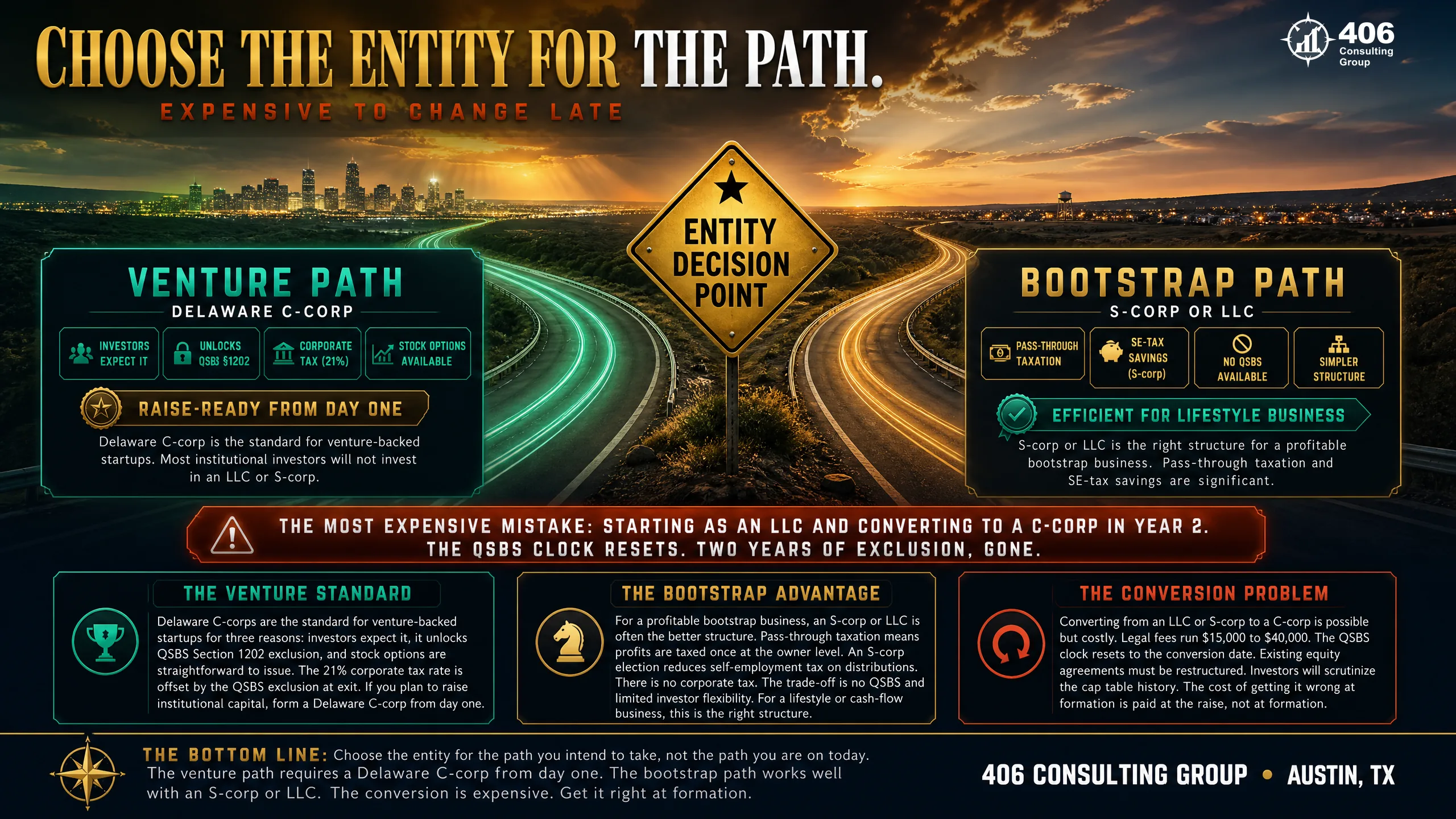
Choose the entity for the company you're building, not the one you have this quarter — the two paths diverge fast.
Stock Comp, ISOs & the 83(b) Election
Equity is how startups attract talent, and it comes with tax consequences that are easy to get catastrophically wrong. Different instruments are taxed differently — incentive stock options (ISOs), non-qualified options (NSOs), and restricted stock units (RSUs) each have their own rules, and ISOs can trigger alternative minimum tax on exercise even when you haven't sold anything. Timing an exercise without understanding the AMT hit is a classic, expensive founder mistake.
For founders and early employees who receive restricted stock, the 83(b) election is the one to know: filing it within the tight 30-day window after the grant lets you be taxed on the (usually tiny) value at grant rather than as the stock vests and appreciates — potentially saving enormous tax later and starting the QSBS clock. Miss the 30 days and the election is simply gone. These are high-stakes, deadline-driven decisions that reward getting advice before you sign or exercise, not after.
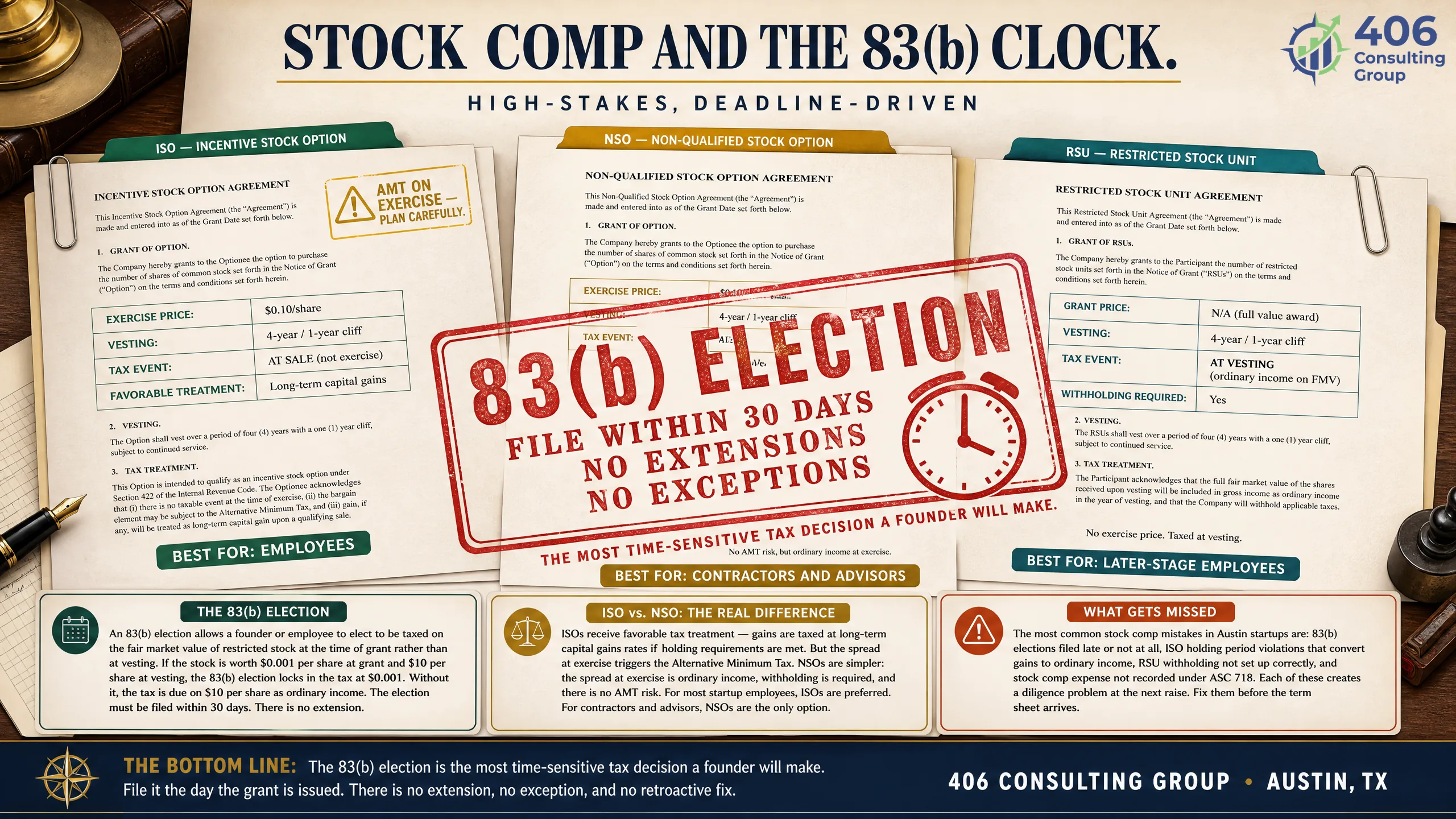
If equity is part of your comp — giving it or getting it — the tax treatment deserves a conversation well ahead of any deadline.
SaaS Sales Tax as a Planning Problem
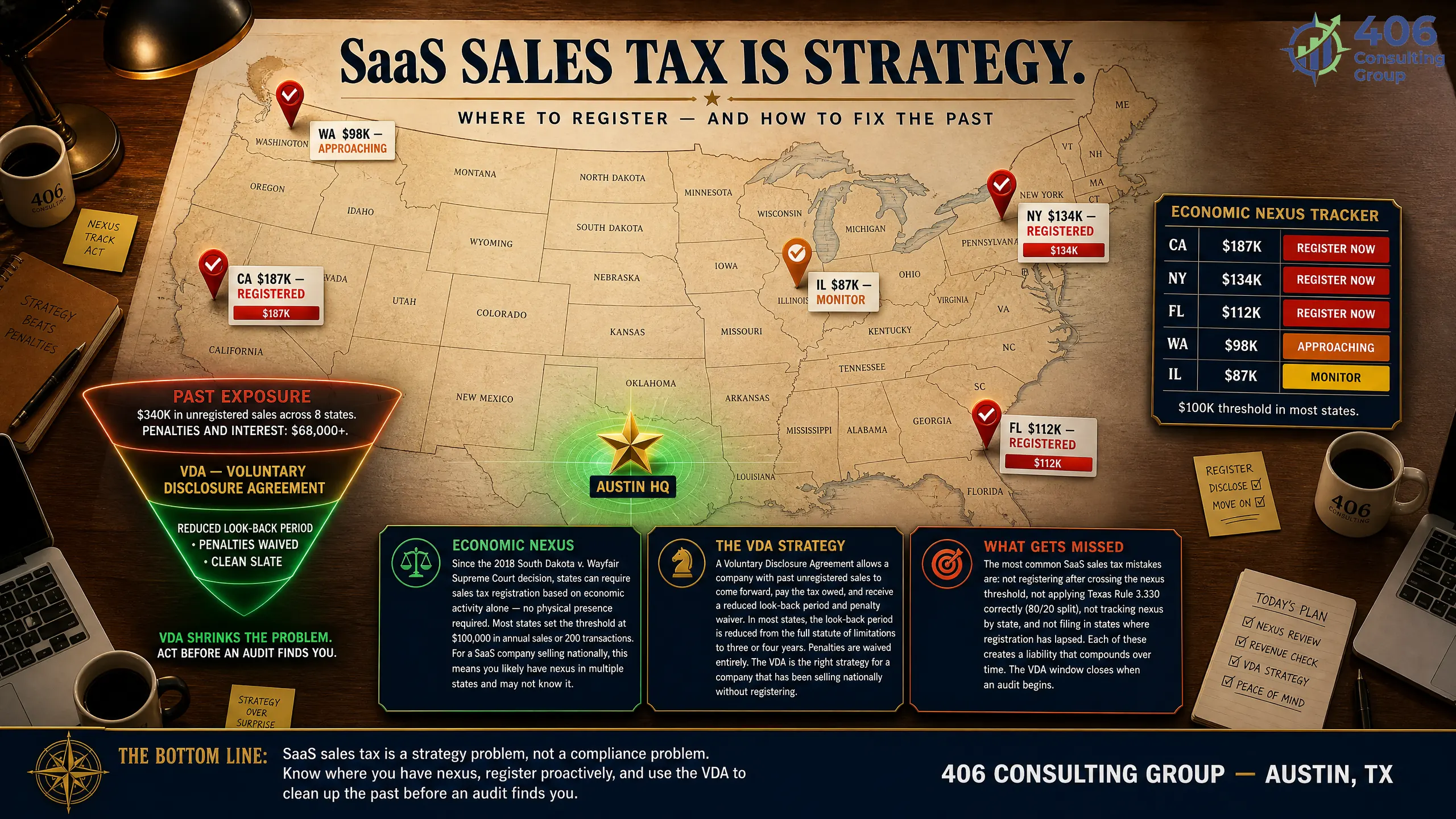
Sales tax is usually thought of as compliance, but for a SaaS company it's genuinely a planning issue with strategic choices attached. In Texas, remember, SaaS is generally taxed as a data-processing service (roughly 80% of the charge), and every state you sell into treats software differently and has its own economic-nexus thresholds. The planning questions: where have you already crossed nexus, what's your past exposure in states where you should have been collecting, and how do you fix it cleanly?
That last piece matters because uncollected sales tax is a real liability that surfaces in fundraising and acquisition diligence — and there are structured ways to address historical exposure, such as voluntary disclosure agreements (VDAs), that can limit look-back periods and penalties when handled proactively. Deciding where to register, when, and how to clean up the past is strategy, not data entry, and doing it before a diligence process rather than during one is worth real money and deal-timing sanity.
The recording mechanics live in the bookkeeping guide; the where-to-register-and-how-to-fix-it decisions live here.
The Margin Tax & Federal Levers
Texas's franchise (margin) tax is a smaller line item for most tech companies, but it still rewards planning: people-heavy software firms generally do better taking the compensation deduction over cost of goods sold, and many early-stage companies fall under the no-tax-due revenue threshold entirely. It's rarely the main event, but it's worth computing in your favor.
On the federal side, beyond R&D and QSBS, profitable pass-through owners should mind the QBI deduction (up to 20% of qualified income, subject to limits and phase-outs that can affect a services business), and everyone with real income owes quarterly estimated taxes — which for a fast-scaling company need to track actual results, not a stale prior-year figure. With no state income tax, the federal return carries the whole load, so these federal moves deserve more attention, not less.
None of it is glamorous, but planned together — R&D, QSBS, entity, equity, QBI, estimates — it adds up to a materially lower lifetime tax bill.
The Austin Tax Calendar
A tech company's calendar mixes Texas dates, federal dates, and a few deadlines that are uniquely startup — the 83(b) window being the one that ruins the most days when missed.
| Obligation | Rough timing |
|---|---|
| 83(b) election | Within 30 days of a restricted-stock grant — no extensions, ever |
| Franchise (margin) report | Annually, generally due May 15 (verify current) |
| Federal estimated tax | Quarterly — mid-Apr, mid-Jun, mid-Sep, mid-Jan |
| R&D credit / payroll offset | Claimed with the return; payroll-offset election is time-sensitive |
| Multi-state sales tax | Per each state's assigned frequency once you're registered |
Confirm dates with the Texas Comptroller, the IRS, and each state you're registered in — but put the 83(b) 30-day window somewhere you can't miss it.

Common Austin Tax Mistakes
The expensive mistakes here almost all share a theme: a decision made (or missed) early that can't be undone later.
Assuming 'no income tax' means no planning
It removes state planning, not the federal levers — R&D, QSBS, entity, equity — where a startup's real tax stakes live.
Picking the wrong entity for the path
A pass-through can foreclose QSBS; a C-corp adds tax a bootstrapper didn't need. The choice is expensive to reverse late.
Missing the 83(b) 30-day window
There are no extensions. Miss it and you can face far higher tax as the stock vests and appreciates.
Leaving the R&D credit unclaimed
Without contemporaneous tracking, a software company forfeits one of its biggest credits — sometimes even cash back against payroll.
Ignoring multi-state sales-tax exposure
Uncollected SaaS tax across states compounds into a diligence-killing liability that a VDA could have contained.
Every one is avoidable with a conversation early — which is the entire argument for planning before year-end and before you sign.
Local vs. a Great Remote Partner
Startup tax planning is a specialty, not a geography. What lowers a tech company's lifetime tax bill is someone who lives in R&D credits, QSBS, entity structure, and stock-comp elections — not someone whose office happens to be near yours. Most Austin founders would happily trade a local generalist for a remote specialist who has actually shepherded companies through formation, fundraising, and an exit, because those are the moments where the expensive mistakes get made or avoided.
And planning is a year-round, screen-share conversation anyway: a structure review at formation, a call before an option exercise or a financing, a mid-year check on estimates and R&D. We work this way with technology companies across Austin and beyond — proactive, deadline-aware, and fluent in both the Texas specifics and the federal startup playbook, wherever your team happens to sit.
For decisions this consequential, you want the right expertise on the call — the call doesn't care where either of you is sitting.
How to Get Started
Getting ahead of your Austin tech taxes is three steps.
Get the structure right early
Confirm your entity for the path you're on, review QSBS eligibility, and handle 83(b) and equity decisions inside their deadlines.
Capture the credits
Track qualified R&D as you go so the federal credit (and any payroll offset) and the Texas R&D option are defensible — not a year-end guess.
Plan the multi-state and federal picture
Manage sales-tax nexus and any past exposure, and plan QBI, estimates, and the margin tax so nothing surprises you at filing or in diligence.
Weighing an S-corp election for a profitable, bootstrapped company? Start with our S-Corp Calculator, then let's map the full picture together.
FAQ: Austin Tax Questions
If Texas has no income tax, does a startup still need tax planning?
Absolutely — arguably more than most businesses. No state income tax removes state-level planning, but it doesn't touch the federal levers where a startup's real tax stakes live: the R&D credit, the QSBS gain exclusion, entity structure, and stock-compensation elections. Those are largely federal and often time-sensitive, set years before they pay off. It also doesn't erase other states' taxes as you hire remotely and sell nationwide. 'No income tax' is a great starting point, but the planning that moves the number for a tech company is federal and multi-state, not Texan.
What is QSBS and why does it matter so much for founders?
Qualified Small Business Stock (Section 1202) can let you exclude a very large portion — potentially all, up to generous limits — of the federal capital gain when you sell qualifying stock in a C-corporation, provided the requirements and holding period are met. On a successful exit, that can be the most valuable tax benefit a founder or early employee ever receives. The critical point is that eligibility is largely determined at formation: the company generally must be a C-corp and the stock must be acquired in a qualifying way, so you can't retrofit QSBS right before a sale. If a meaningful outcome is even possible, have the structure reviewed early with a qualified professional.
How does the R&D tax credit work for a software company?
The federal R&D credit rewards spending on qualified research, and a large share of a software company's engineering payroll can qualify. Pre-profit startups may be able to apply a portion against payroll taxes rather than income tax — actual cash back while you're still losing money. Texas also offers its own R&D incentive tied to the franchise tax (broadly, a franchise-tax credit or a sales-tax exemption on qualifying research equipment). All of it depends on documenting qualified expenses as you go. Note too that the federal §174 treatment of research costs has been in flux in recent years — at points requiring capitalization and amortization rather than immediate expensing, with later law changes affecting that (especially for domestic research) — so it's an area to confirm the current treatment with a pro.
Should my Austin startup be a C-corp, S-corp, or LLC?
It depends on your path. A company planning to raise venture capital almost always becomes a Delaware C-corporation — that's what institutional investors expect and what QSBS requires. A bootstrapped, profitable software or services business is often better as an S-corp or LLC, where profits pass through and a reasonable-salary strategy can cut self-employment tax without corporate-level tax. The tension is that the C-corp unlocks venture money and QSBS but adds corporate tax and formality, while the pass-through is efficient but forecloses QSBS. It's expensive to change late, so choose for the company you're building. Our S-Corp Calculator is a good first step for the bootstrapped case.
Can 406 Consulting Group handle my Austin tax planning remotely?
Yes. Startup tax planning is a specialty rather than a geography — what lowers your lifetime bill is fluency in R&D credits, QSBS, entity structure, stock comp, and multi-state exposure, not office proximity. It's naturally a year-round, screen-share relationship: a structure review at formation, a call before an option exercise or a raise, a mid-year check on estimates and R&D. We work this way with technology companies across Austin and beyond, and most startup teams are distributed anyway, so you get the same responsive, specialized service wherever you and your team sit.
Keep Reading
Tax Planning — Austin, TX
The Big Tax Moves Happen Early.
406 Consulting Group plans Austin tech taxes around what actually moves the number — R&D credits, QSBS, entity structure, stock comp, and multi-state exposure — delivered remotely, before the windows close.
Austin Tax Quick Reference
Austin, TX — Travis County
Leaving Startup Tax on the Table?
R&D, QSBS, entity & equity — planned early.
About the Author
Carrie Anderson
Co-Founder, 406 Consulting Group
Advising SaaS, startup, and technology businesses across the Mountain West and Southwest. Carrie helps Austin founders capture R&D credits, structure for QSBS, handle equity and 83(b) decisions inside their deadlines, and keep clean financials that hold up with investors and lenders.
Read the Full Story