
Bookkeeping Services in Austin, TX:
SaaS, Startups & the Texas Software Tax
Most founders don't know Texas taxes their SaaS revenue. Add deferred revenue, R&D, equity comp, and multi-state nexus, and Austin tech bookkeeping is its own discipline. Here's what it takes.

Austin runs on software. SaaS companies, venture-backed startups, semiconductor and hardware firms, and the creative and real-estate businesses growing around them make up an economy that looks nothing like the rest of Texas — and needs bookkeeping to match. The tricky part is that Austin sits inside the same Texas tax system as everyone else (no income tax, but a franchise "margin" tax, sales and use tax, and a property tax on business assets), and that system was clearly not written with subscription software in mind. The result is a set of quirks that catch tech founders completely off guard.
The biggest surprise: Texas taxes most SaaS as a "data processing service," so a big chunk of your subscription revenue is subject to sales tax — something almost no first-time founder expects. Layer on deferred-revenue accounting, R&D and equity comp, and multi-state nexus from selling to customers nationwide, and clean books in Austin are their own discipline. This guide walks all of it, delivered remotely.
By Jason Anderson — Co-Founder, 406 Consulting Group. Big-firm-trained accountant advising SaaS, startup, and technology businesses across the Mountain West and Southwest on books built for how software companies actually run.
Quick Answer: Bookkeeping for an Austin Tech Business
- →SaaS is taxable in Texas — generally as a "data processing service," with a longstanding 20% exemption (so ~80% is taxed).
- →Deferred revenue is the heart of SaaS books — you collect up front and earn it over the subscription.
- →The margin tax usually favors the compensation deduction for people-heavy tech; heavy equipment/BPP is light here.
- →Selling nationwide creates multi-state sales-tax nexus you have to track and register for.
- →Delivered remotely — the norm for a cloud-native business anyway.
Table of Contents
Why Austin Bookkeeping Is Different
A software company's books look nothing like a contractor's or a retailer's. Revenue arrives as subscriptions you collect up front and earn over months; your biggest cost is people, not materials or equipment; you spend heavily on R&D long before you're profitable; you pay employees partly in equity; and you sell to customers in dozens of states from day one. None of that fits a generic bookkeeping template — and in Texas, it collides with a tax system built around goods and services that predate the cloud.
That collision is where Austin founders get surprised: SaaS revenue is largely taxable for Texas sales tax, deferred revenue has to be tracked correctly or your financials mislead you and your investors, and selling nationwide quietly builds sales-tax obligations in other states. Get the books right and you have clean numbers for fundraising and a tax position you understand; get them wrong and you carry hidden liabilities into your next diligence process. Books built for an Austin tech business have to speak SaaS and Texas tax at once.
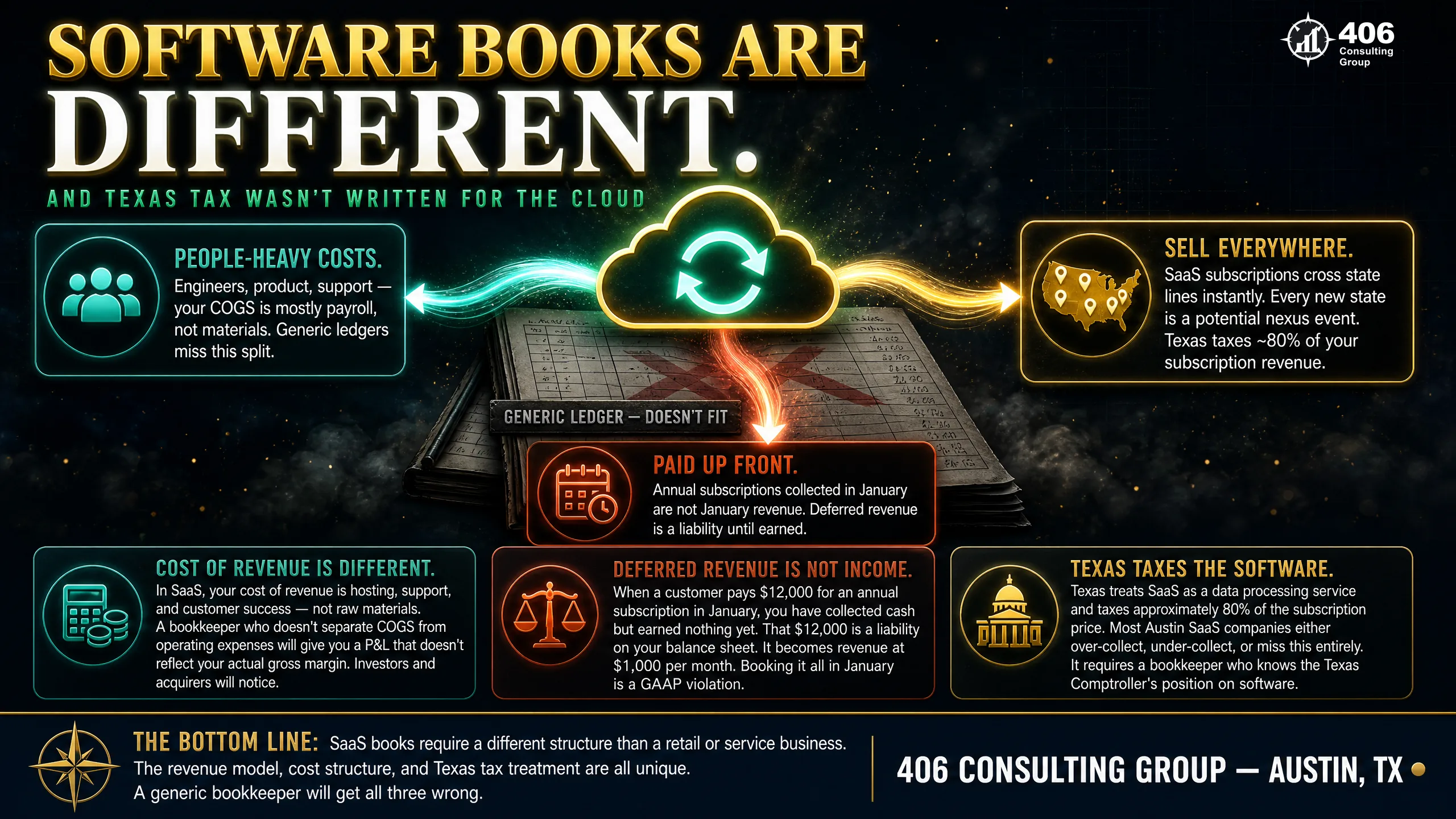
Let's set the Texas tax backdrop quickly, then get to the parts that actually surprise software founders.
The Texas Tax Backdrop, Briefly
Texas is famously income-tax-free, but it collects in other ways. Here's the short version for an Austin business — the mechanics are the same statewide, so we keep this tight and spend our time on the tech-specific parts below:
| Tax | What it means for a tech company |
|---|---|
| State income tax | None — a real draw for founders and employees alike |
| Franchise (margin) tax | On margin; people-heavy tech usually favors the compensation deduction (below) |
| Sales & use tax | ~8.25% in Austin — and yes, it often applies to your SaaS revenue |
| Business personal property | Annual rendition on assets — lighter for asset-light software, but not zero |
| Payroll | No state income-tax withholding; equity comp adds its own complexity |
Confirm current rates and rules with the Texas Comptroller. Now the part that surprises almost every software founder.
The SaaS Sales-Tax Surprise
Most founders assume software subscriptions aren't subject to sales tax. In Texas, that assumption is wrong — and the surprise can be expensive. Texas generally treats SaaS as a taxable "data processing service." There's a longstanding 20% exemption on such services, so in practice roughly 80% of the charge is taxable — meaning you're generally expected to collect and remit Texas sales tax on the taxable portion of subscriptions sold to Texas customers.
For the books, that means treating a slice of your SaaS revenue as taxable, tracking sales tax collected as a liability (never revenue), and — crucially — not discovering this in year three, when uncollected tax on years of Texas sales becomes a real balance-sheet problem that surfaces in due diligence. The rules around what counts as data processing versus a non-taxable service can be genuinely nuanced, and they can change, so it's an area to set up deliberately and confirm with the Comptroller or a pro.
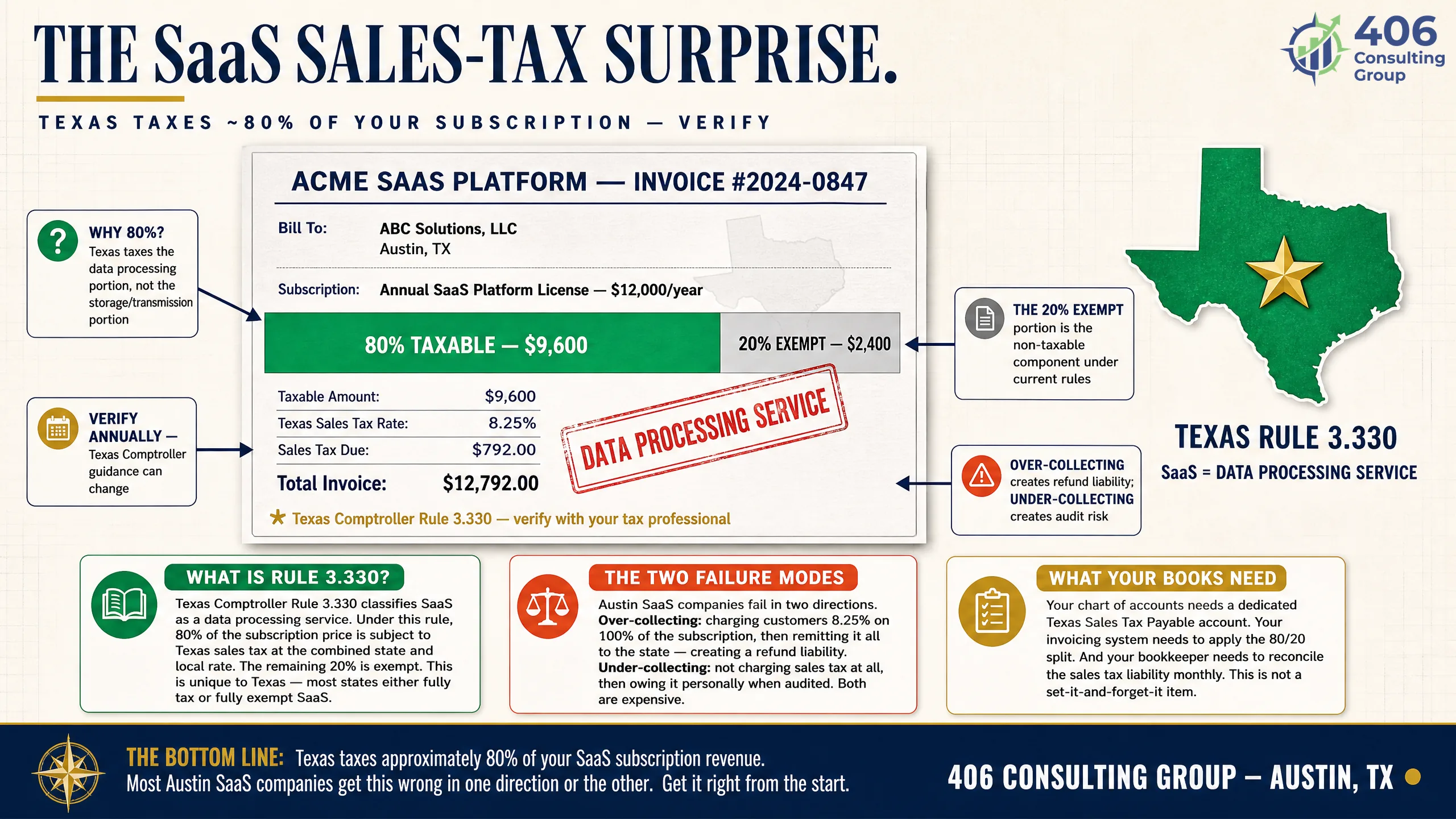
The "software isn't taxed" trap
Assuming SaaS is tax-free is one of the most common — and costliest — mistakes Austin founders make. Uncollected Texas sales tax doesn't disappear; it compounds into a liability that a future acquirer's diligence team will find. Confirm your SaaS taxability with the Texas Comptroller and set collection up correctly from the start.
SaaS Revenue: Deferred Revenue, MRR & ARR
The single most important accounting concept for a subscription business is deferred revenue. When a customer pays a year up front, you haven't earned that cash yet — you earn it month by month as you deliver the service. Recording the full payment as revenue on day one overstates your performance and misleads everyone reading the financials; recognizing it ratably over the subscription is what makes your numbers true. That collected-but-unearned amount sits on the balance sheet as a liability until it's earned.
On top of that sit the metrics investors actually judge you on: MRR and ARR (monthly and annual recurring revenue), churn, and the difference between bookings, billings, and revenue — three numbers founders routinely conflate. Books that track these cleanly let you report to a board with confidence and walk into a fundraise or acquisition without scrambling; books that don't turn every diligence request into a fire drill.
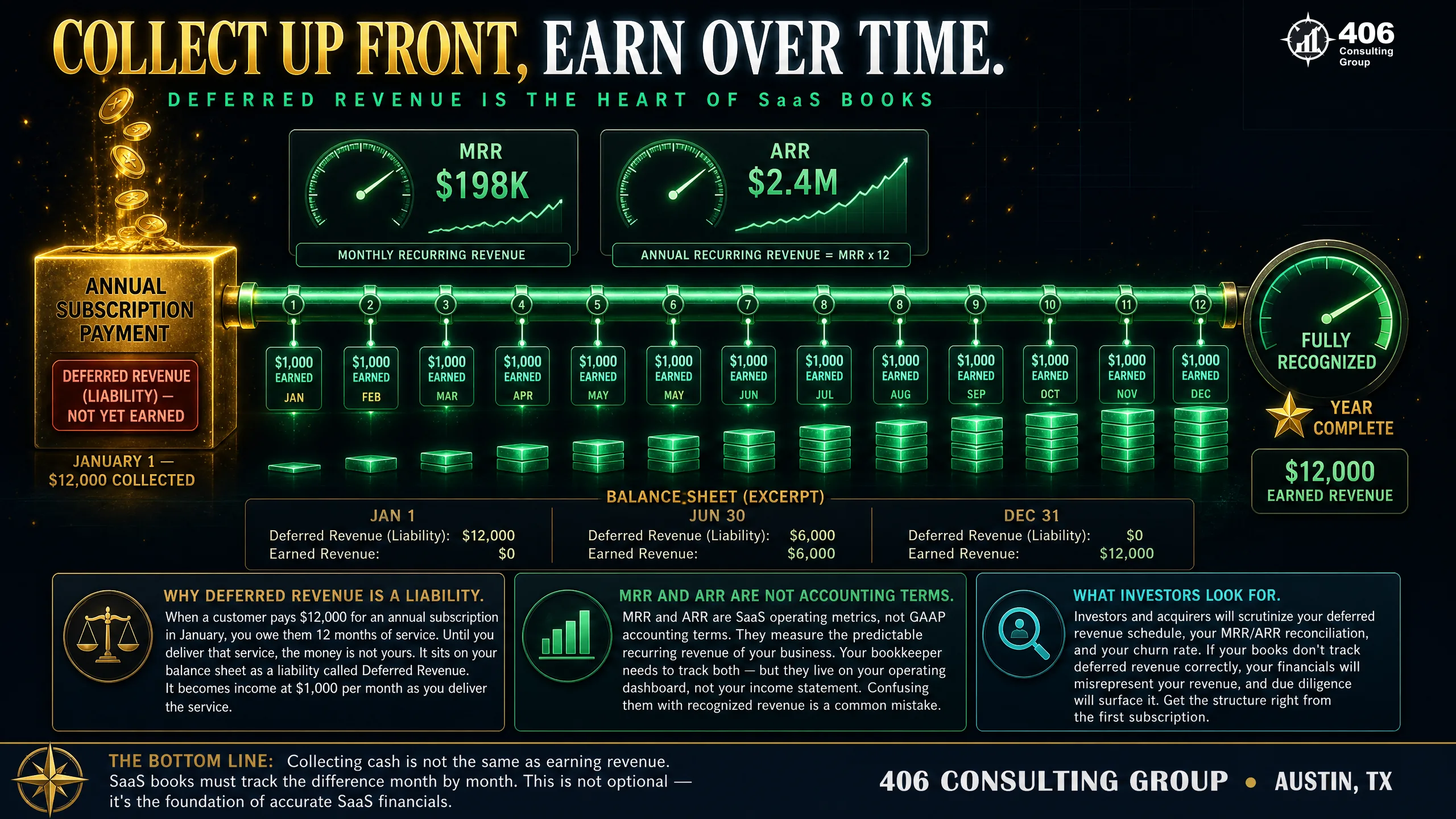
This is the difference between books that merely track cash and books that tell the true story of a subscription business.
The Margin Tax for a People-Heavy Company
Texas's franchise tax is calculated on your margin — broadly, revenue minus the greater of a few deductions, most importantly either cost of goods sold or compensation (capped at 70% of revenue). Here's where a software company differs from the rest of Texas: a SaaS or services business has very little traditional COGS but a large payroll, so it usually comes out ahead taking the compensation deduction. Clean, well-classified payroll and benefits data is therefore what drives your margin-tax outcome.
The flip side of being asset-light is a small business personal property footprint — laptops, servers, and office furniture rather than rigs and machinery — so the annual BPP rendition is a minor chore here rather than a major bill. And many early-stage companies fall under the franchise tax's no-tax-due revenue threshold entirely; the point isn't that the margin tax is large, but that the way you keep your books determines whether it's calculated in your favor.
The planning side of this — optimizing the deduction and the entity — lives in our Austin tax guide.
Tracking R&D and Equity Comp
Two things nearly every Austin startup has — and nearly every generic bookkeeper mishandles — are research spending and equity compensation. To claim R&D tax credits (both the federal credit and Texas's own franchise-tax R&D option), you need to be tracking qualified research expenses cleanly as you go, not reconstructing them at year-end from memory. Well-structured books capture the wages, contractor costs, and supplies tied to development so the credit is defensible.
Equity compensation — stock options, RSUs, and the cap table behind them — adds its own bookkeeping and reporting demands, from recording stock-based compensation expense to keeping the cap table reconciled with what the books say. These aren't optional niceties for a venture-backed company; they're exactly what an investor or acquirer scrutinizes. Getting them right from the seed stage saves a painful cleanup later.
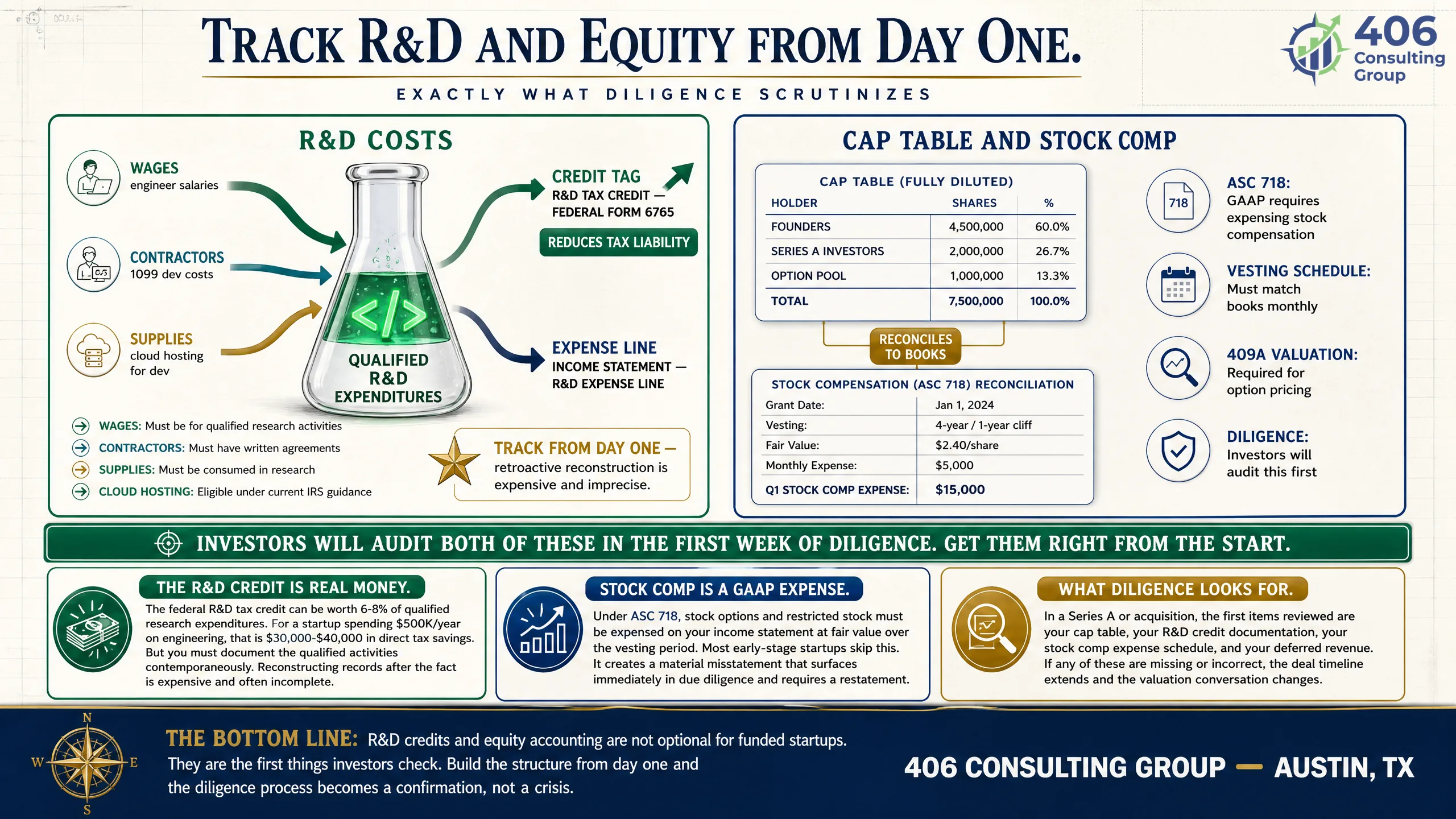
The tax-credit strategy is in the tax guide; the clean tracking that makes it possible starts in the books.
Multi-State Nexus: Selling SaaS Everywhere
A Texas software company rarely sells only to Texas — you sell to customers across the country from day one. That creates economic nexus: once your sales into another state cross that state's threshold (commonly framed around $100,000 in sales or a set number of transactions, though it varies), you can be required to register, collect, and remit that state's sales tax — and states treat SaaS taxability very differently from one another. It's entirely possible to owe sales tax in a dozen states without ever setting foot in them.
For the books, that means monitoring where your revenue is coming from, flagging when you approach a state's threshold, and registering before the obligation piles up. This is one of the most under-appreciated liabilities in SaaS — and, like the Texas data-processing issue, one that surfaces painfully in diligence if it's been ignored. Tracking sales by state from the start turns a future crisis into a routine compliance task.
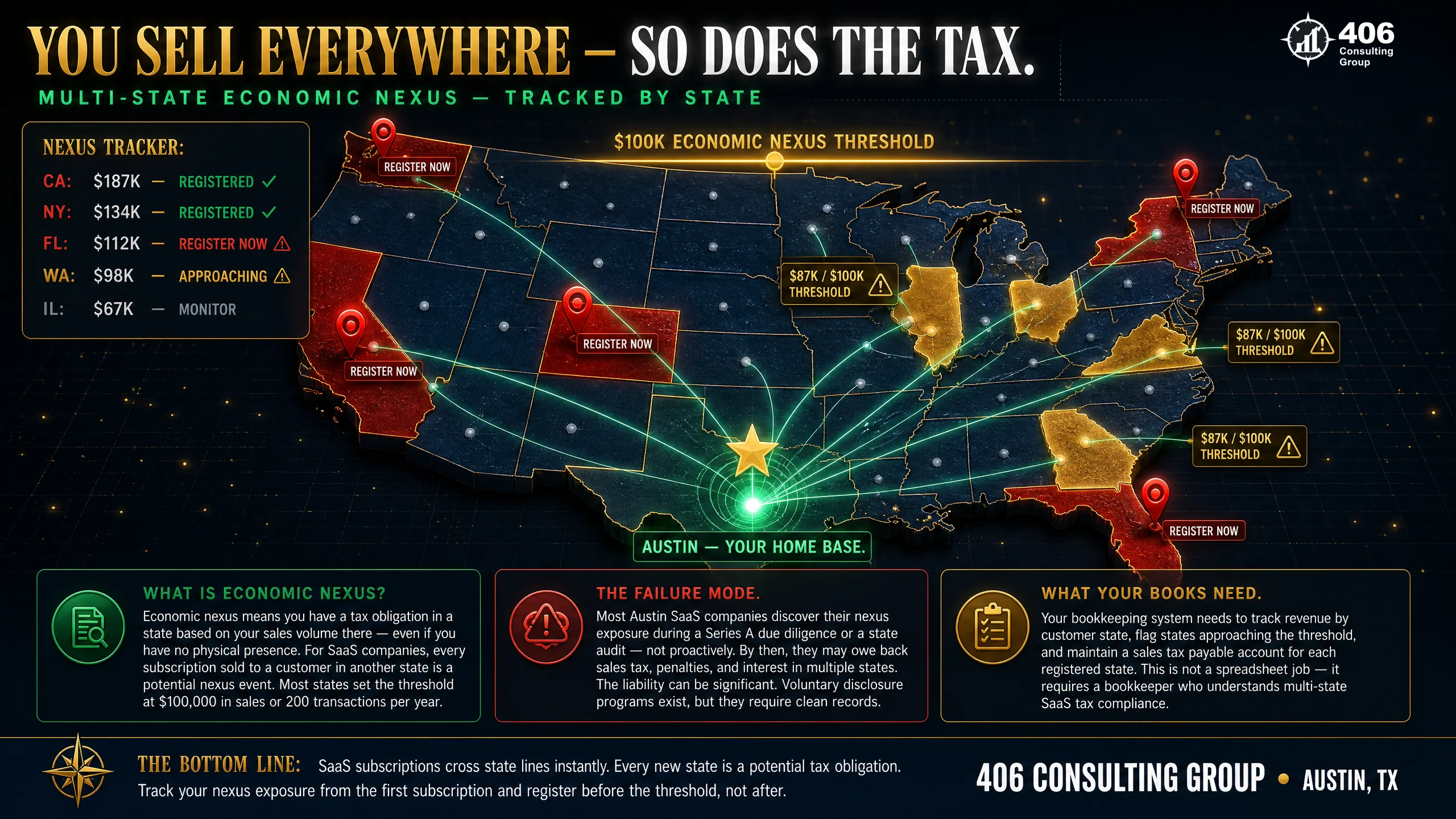
Nexus is complex and state-specific — worth monitoring in the books and confirming with a pro as you scale.
A Chart of Accounts Built for SaaS
A SaaS chart of accounts looks different from a generic one. It needs a real deferred-revenue structure, revenue and cost categories that let you compute gross margin the way software investors expect (separating cost of revenue — hosting, support, payment processing — from operating expenses), a clean R&D grouping for the credit, sales-tax-collected liabilities broken out by state for nexus, and the payroll and compensation detail the margin tax rewards.
Built right, that structure produces SaaS-standard financials on demand, makes tax and nexus compliance mechanical, and lets you answer an investor's questions in minutes. Built as a generic template, it blends the very things a software company needs separated — and every reporting cycle becomes a manual reconstruction.
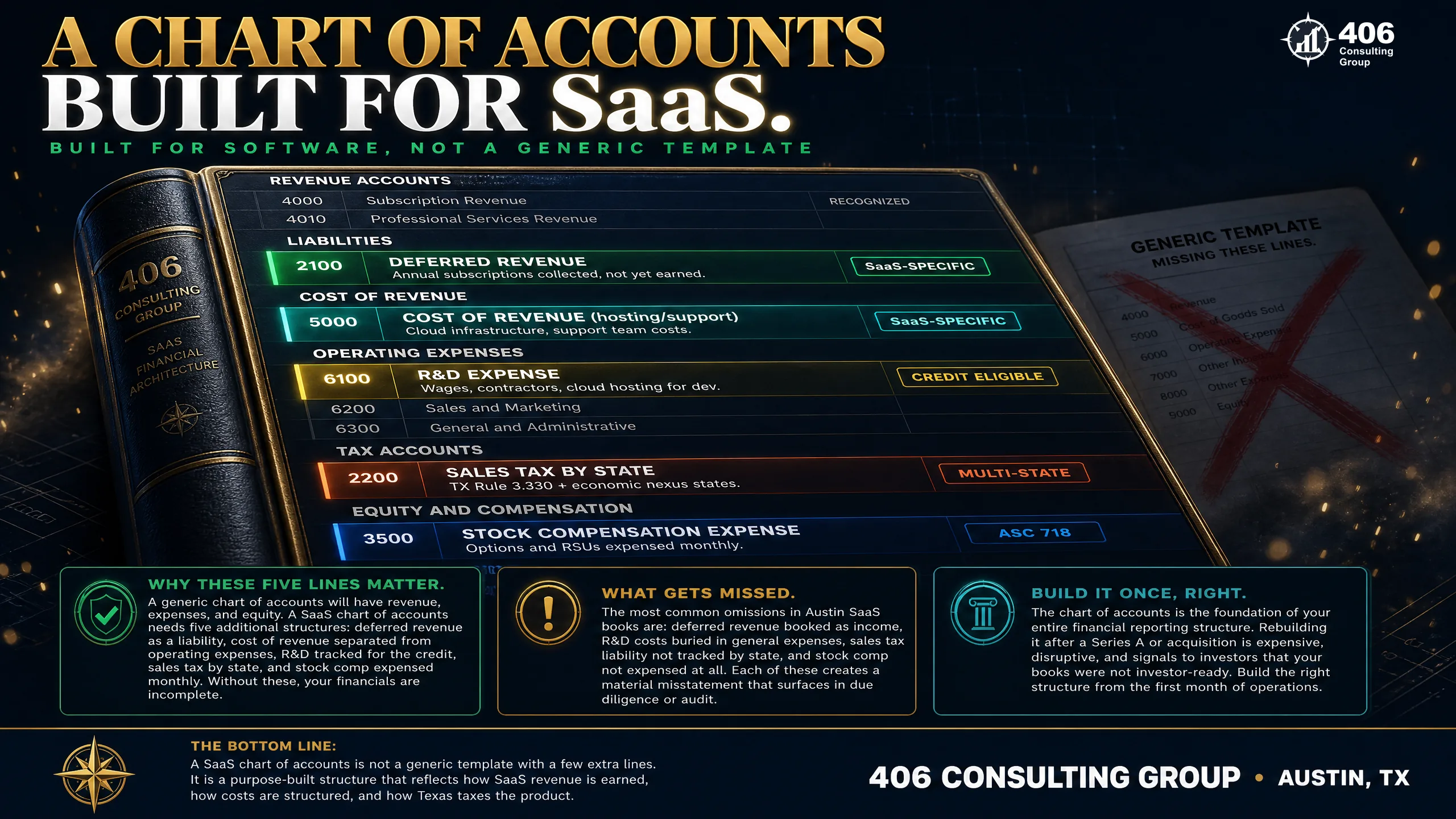
Getting the structure right once is what lets an Austin startup scale its books instead of constantly rebuilding them.
Bookkeeping by Austin Segment
Austin's economy is tech-led but broader than SaaS alone, and each corner asks something different of the books.
| Segment | What the books need to track |
|---|---|
| SaaS & subscription software | Deferred revenue, MRR/ARR, SaaS sales tax, multi-state nexus, R&D |
| Venture-backed startups | Burn & runway, equity comp/cap table, board reporting, investor-ready books |
| Semiconductor & hardware | Inventory & COGS, fixed assets/BPP, R&D, manufacturing sales-tax rules |
| Creative, media & music | Project/gig income, 1099s, royalties, event and seasonal cash flow |
| Real estate & construction | Job costing, entities by property, draws & retainage, BPP on equipment |
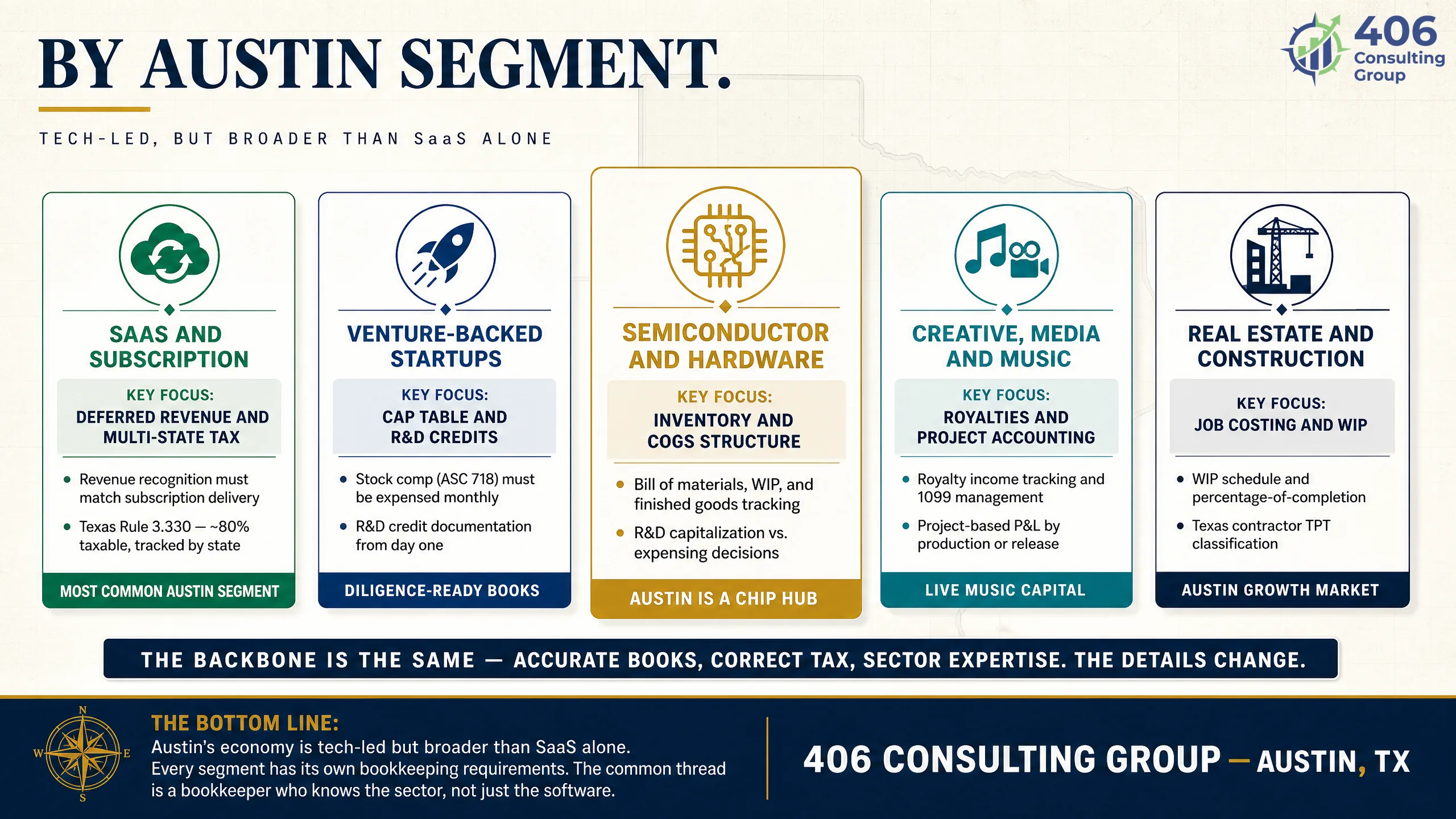
Different details, same backbone: revenue recognized correctly, sales tax handled across states, compensation clean for the margin tax, and financials an investor trusts.
Common Austin Bookkeeping Mistakes
A handful of avoidable mistakes cause most of the pain for Austin tech businesses — and several only surface at the worst possible time, in diligence.
Assuming SaaS isn't taxable in Texas
It generally is (as a data processing service). Uncollected sales tax compounds into a liability an acquirer will find.
Booking prepaid subscriptions as revenue
Recognizing a year's payment on day one overstates performance and misleads your board and investors.
Ignoring multi-state nexus
Selling nationwide creates sales-tax obligations in other states that pile up quietly until they're a crisis.
Reconstructing R&D at year-end
Without clean tracking as you go, the R&D credit is weak or undefendable — you leave money and support on the table.
Messy equity and cap-table records
Stock-comp and cap-table gaps turn a fundraise or acquisition into an expensive scramble.
Every one is a setup-and-habit problem — and every one is far cheaper to prevent now than to clean up under a diligence deadline.
Local vs. a Great Remote Partner
Here's the irony for a cloud-native business: worrying about whether your accountant is physically in Austin makes no sense when your entire company runs in the cloud, your customers are everywhere, and half your team may be remote. What actually matters is whether your bookkeeper understands SaaS — deferred revenue, the Texas data-processing tax, multi-state nexus, R&D, and investor-grade financials. A generalist down the street who's never closed a subscription company's books is far riskier than a specialist who does it every day.
We work the way software companies already work: shared cloud accounting, connected billing and banking, and a steady close on a rhythm — with the SaaS and Texas-tax fluency that keeps you investor-ready. Whether you're downtown, out in the suburbs, or distributed across time zones, you get the same responsive service and the same specialized expertise.
For a company born in the cloud, insisting on a local bookkeeper is the one part of the business you wouldn't run that way.
How to Get Started
Getting your Austin tech books in order is three steps.
Set up for SaaS and Texas
Build a chart of accounts with real deferred-revenue structure, SaaS sales-tax collection, by-state nexus tracking, clean R&D, and compensation detail for the margin tax.
Get revenue and equity right
Recognize subscription revenue ratably, track MRR/ARR and churn, and keep stock-comp and the cap table reconciled from the seed stage.
Run it on a rhythm
Monthly close, sales-tax filing across states, and investor-ready reporting so a board update or a fundraise is never a scramble.
Not sure whether you need bookkeeping, tax help, or a CFO-level view? Our Financial Maturity Assessment maps it out in about eight minutes.
FAQ: Austin Bookkeeping Questions
Is SaaS taxable in Texas?
Generally, yes. Texas treats most SaaS as a taxable 'data processing service.' There's a longstanding 20% exemption on such services, so in practice roughly 80% of the charge is taxable, and you're generally expected to collect and remit Texas sales tax on the taxable portion of subscriptions sold to Texas customers. Many founders assume software is tax-free and get caught, because uncollected tax compounds into a liability that surfaces in due diligence. The rules on what counts as data processing can be nuanced and can change, so confirm your specific situation with the Texas Comptroller or a professional.
How does deferred revenue work for a SaaS business?
When a customer pays up front for a subscription — say a full year — you haven't earned that money yet; you earn it over the life of the subscription as you deliver the service. So the payment is recorded as deferred revenue (a liability) and recognized as revenue ratably over the term. Recording the whole payment as revenue on day one overstates performance and misleads anyone reading your financials, including your board and investors. Clean deferred-revenue accounting, along with MRR/ARR and the distinction between bookings, billings, and revenue, is the core of SaaS bookkeeping.
Do I owe sales tax in other states if I sell SaaS from Austin?
Possibly. Selling to customers nationwide can create 'economic nexus' — once your sales into a state cross its threshold (often framed around $100,000 or a set number of transactions, though it varies by state), you may be required to register, collect, and remit that state's sales tax, and states treat SaaS taxability very differently. It's common for a growing SaaS company to owe sales tax in many states. The key is tracking sales by state from the start and registering before the obligation compounds — it's another liability that surfaces painfully in diligence if ignored.
How does the Texas margin tax affect a software company?
The franchise (margin) tax is calculated on your margin — broadly revenue minus the greater of cost of goods sold or compensation, capped at 70% of revenue. Because a SaaS or services company has little traditional COGS but a large payroll, it usually comes out ahead taking the compensation deduction, so clean payroll and benefits data drives the outcome. Being asset-light also means a small business-personal-property footprint (laptops and servers rather than machinery), and many early-stage companies fall under the no-tax-due revenue threshold entirely. Confirm current thresholds and rules with the Texas Comptroller.
Can 406 Consulting Group do my Austin bookkeeping remotely?
Yes — and for a cloud-native business it's the natural fit. We run on shared cloud accounting, connected billing and banking, and a steady monthly close, with genuine SaaS and Texas-tax fluency: deferred revenue, the data-processing sales tax, multi-state nexus, R&D tracking, equity comp, and investor-ready financials. What matters for a software company is that expertise, not whether we share a zip code — and most Austin tech teams are distributed anyway. You get the same responsive service and specialized knowledge whether you're downtown or fully remote.
Keep Reading
Bookkeeping — Austin, TX
SaaS Books, Done Right From the Seed Stage.
406 Consulting Group keeps Austin tech and startups clean and investor-ready — deferred revenue, the Texas SaaS sales tax, multi-state nexus, R&D, and financials that hold up in diligence — delivered remotely.
Austin Bookkeeping Quick Reference
Austin, TX — Travis County
SaaS Sales Tax Catch You Off Guard?
Deferred revenue, nexus & R&D, handled.
About the Author
Jason Anderson
Co-Founder, 406 Consulting Group
Big-firm-trained accountant advising SaaS, startup, and technology businesses across the Mountain West and Southwest. Jason helps Austin founders handle the Texas SaaS sales tax, keep clean deferred-revenue books, track R&D and equity, and stay investor-ready through every raise.
Read the Full Story