
CFO & Controller Services in Austin, TX:
Know Your Runway, Raise With Confidence
A startup lives or dies by burn and runway — and the SaaS metrics investors judge you on. Here's what a controller and a CFO each do, what they cost fractionally vs. full-time, and the startup-fluent finance an Austin company needs.

A startup lives and dies by two numbers most founders can't confidently state: how fast they're burning cash, and how many months of runway that leaves. Add the metrics investors actually judge — MRR growth, gross margin, CAC payback, net revenue retention — and the reality is that an Austin tech company needs a CFO-level view of its finances long before it can justify a full-time CFO's salary. The gap between "we have a bookkeeper" and "we can walk into a board meeting or a fundraise with numbers we trust" is exactly where a fractional controller or CFO earns its keep.
This guide walks the difference between a controller and a CFO, what each costs full-time versus fractional, when a startup actually needs one, and the tech-specific finance work — burn and runway, SaaS unit economics, board reporting, and fundraising support — that turns a promising company into a fundable one. All delivered remotely, the way software companies already operate.
By Jason Anderson — Co-Founder, 406 Consulting Group. Big-firm-trained accountant helping SaaS, startup, and technology companies build the financial function that carries them from seed to scale — and into every board meeting and raise.
Quick Answer: CFO & Controller Help for an Austin Startup
- →Controller owns accurate, investor-ready books; a CFO owns burn, runway, forecasting, fundraising, and strategy.
- →Fractional gets you the expertise for roughly $2,500–$8,000/mo versus a full-time all-in cost of $235K–$420K+.
- →Most companies don't need full-time until roughly $15M+ in revenue — but the need shows up at your first raise.
- →Startups here need burn/runway discipline, SaaS unit economics, and board- and investor-ready reporting.
- →Delivered remotely — the default for a cloud-native, often-distributed team.
Table of Contents
Why an Austin Startup Needs This
Most startups don't fail because the product was bad — they fail because they ran out of money before they figured it out. That makes cash the central discipline of a tech company, and cash is exactly what founders tend to manage by gut and bank balance until a board member or a lead investor asks a question they can't answer. What's your net burn? How many months of runway at current spend? What's your CAC payback, and is net revenue retention above 100%? A company that can't answer those quickly isn't just under-managed — it's harder to fund.
That's the gap a controller-and-CFO function closes: accurate books that close on time, a burn-and-runway model you can trust, SaaS metrics computed consistently, and financials that hold up in a board meeting or a data room. In Austin's dense startup ecosystem, the companies that raise well and scale cleanly are almost always the ones that treated finance as a strategic function early — not the ones that waited until a fundraise forced a scramble.

The first step is knowing which role you actually need — and they're not the same job.
Controller vs. CFO: Two Different Jobs
The titles get used loosely, but they solve different problems. A controller looks backward and makes it accurate: the books, the monthly close, revenue recognition, reporting, and controls — making sure the numbers are right and on time. A CFO looks forward and makes it strategic: burn and runway, forecasting, unit economics, fundraising, and the capital and pricing decisions that determine where the company goes.
| Controller (accuracy, backward) | CFO (strategy, forward) |
|---|---|
| Monthly close & accurate books | Burn, runway & forecasting |
| SaaS revenue recognition & deferred revenue | Unit economics (CAC, LTV, payback) |
| Reporting, controls & audit-readiness | Fundraising & board strategy |
| Payroll, equity records & compliance | Banking, venture debt & capital |
| Clean books for the CFO to use | The decisions those books inform |

Early on, many startups need the controller function first — clean, investor-ready books — and the CFO function as fundraising and scale arrive. Plenty need a blend. The wrong move is paying full-time-executive money for either before you need it.
The Cost Math: Fractional vs. Full-Time
For a company watching its runway, this math matters more than anywhere. A full-time senior finance hire is expensive — and the salary is only part of it.
| Option | Rough cost |
|---|---|
| Fractional controller | ~$2,500–$6,000/mo |
| Fractional CFO | ~$2,500–$5,000/mo |
| Both, fractional | ~$4,000–$8,000/mo |
| Full-time controller | $85K–$120K salary + ~25% benefits |
| Full-time CFO | $150K–$300K+ salary |
| Both, full-time (all-in) | $235K–$420K+ per year |

Fractional gets you senior expertise for a fraction of a full-time salary — and for a startup, every dollar not spent on overhead is runway. It also scales with you: more support around a raise or a scaling push, less between them.
When to Hire — and at What Size
The honest rule of thumb: most companies don't need a full-time CFO until somewhere around $15 million+ in revenue — below that, a full-time executive usually isn't kept busy enough to justify the cost, which is exactly why fractional exists. But for a startup, the need for the function is rarely about revenue size; it's about events.
You're raising a round
Investors will scrutinize your model, metrics, and books — a scramble here can cost you the round or the valuation.
The close keeps slipping
Books that aren't done until weeks after month-end mean board updates and burn figures run on stale numbers.
You can't state burn and runway
If you're not sure how many months you have, that alone is the signal — it's the number that decides everything.
Unit economics are a mystery
Not knowing CAC payback or whether NRR is above 100% means you're scaling blind — a CFO makes it visible.
You're hiring and spending fast
Post-raise scaling burns cash quickly; a forecast keeps growth deliberate instead of a guess.
Hit two or three and it's time — and fractional lets you add exactly the level you need without spending runway on an executive salary. Our Financial Maturity Assessment helps you place yourself.
The Startup CFO: Burn, Runway & Unit Economics
The core of startup finance is deceptively simple: know your net burn (how much cash you're consuming each month), know your runway (how many months that leaves before you need to raise or reach profitability), and manage both toward a milestone. A real CFO function builds a driver-based model that ties hiring, spend, and revenue assumptions to the cash balance, so you can see the effect of a decision — another five engineers, a slower sales ramp — before you make it, not after.
Underneath that sits unit economics: what it costs to acquire a customer (CAC), how long until that customer pays you back, and how much they're worth over their life (LTV). If you're spending more to acquire customers than they return, growth just accelerates the burn — and only clean unit economics reveal it. This is the difference between raising money to fund a working engine and raising money to paper over one that isn't.
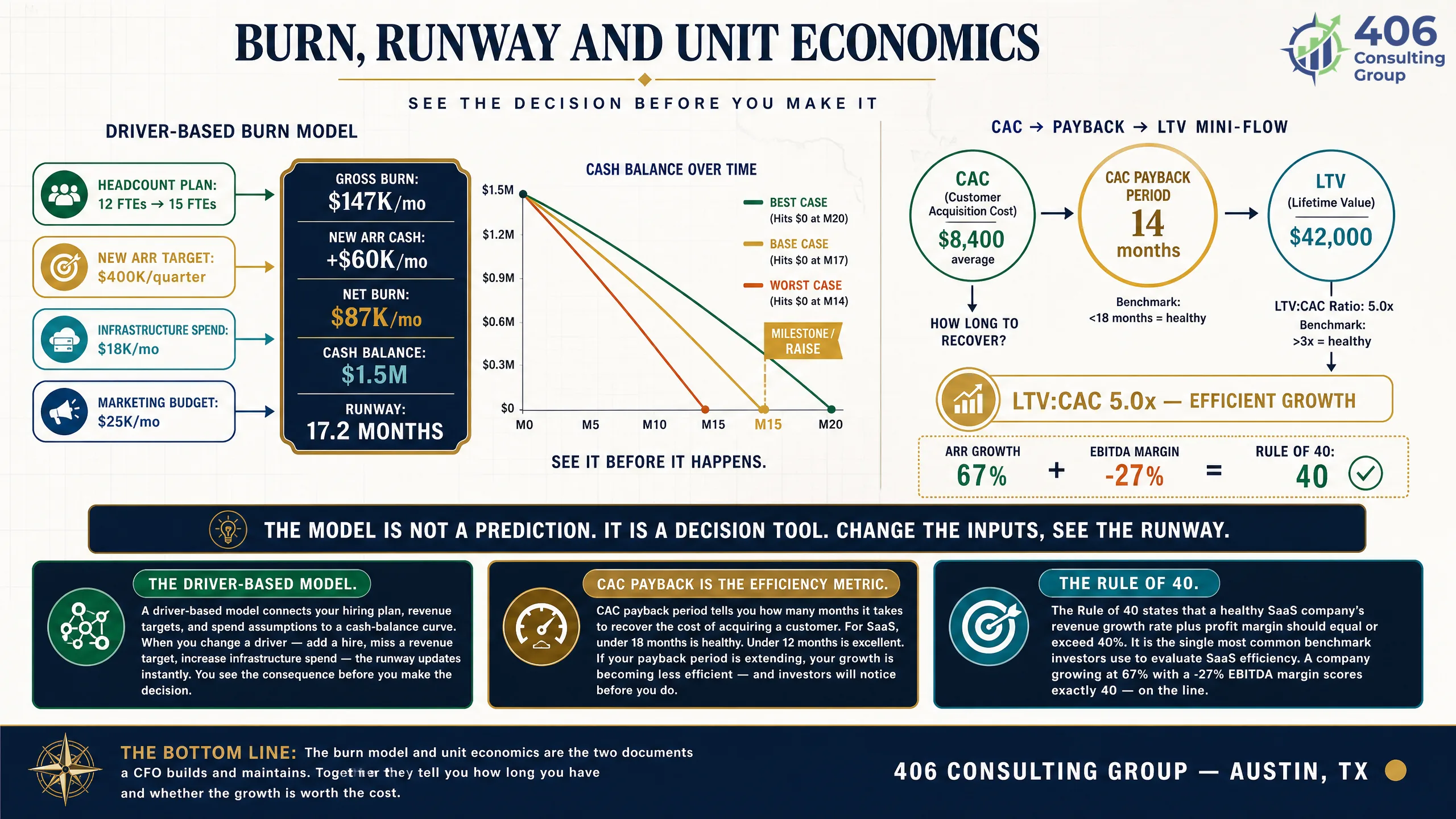
This is exactly the terrain our unit-economics work lives in — the principle is universal, and for SaaS it's the whole game.
The SaaS Metrics Investors Judge You On
Software investors evaluate companies through a specific set of metrics, and a startup that can produce them cleanly — and defend how they're calculated — signals a company that's in control of itself. The essentials: MRR/ARR and growth rate, gross margin (SaaS-standard, separating cost of revenue from opex), net revenue retention (are existing customers expanding or churning?), CAC payback, and increasingly the Rule of 40 (growth rate plus profit margin). Consistency matters as much as the numbers: investors trust a company whose metrics are computed the same way every month and tie back to the financials.
| Metric | What it signals |
|---|---|
| MRR / ARR & growth | Scale and momentum of recurring revenue |
| Net revenue retention | Whether the base expands or leaks — above 100% is the goal |
| Gross margin | How much each revenue dollar actually contributes |
| CAC payback | How fast acquisition spend comes back — sales efficiency |
| Rule of 40 | Growth + margin balance investors use as a health check |

A CFO function makes these boardroom-ready and consistent — so a metric never gets challenged and quietly undermines your credibility mid-raise.
Fundraising & the Board
A raise is where a startup's finances go on trial. Investors run diligence on your model, your metrics, your cap table, and your books, and gaps — unrecognized deferred revenue, uncollected sales tax, metrics that don't reconcile — can cut your valuation or kill the deal outright. A CFO function prepares you: a defensible financial model and forecast, a clean data room, metrics that tie to the financials, and answers ready for the questions investors always ask. Going in prepared is often worth more, in valuation and terms, than the raise costs to support.
Between raises, the same function runs your board reporting — the monthly or quarterly package of financials, metrics, and burn/runway that keeps a board informed and confident. Boards don't just want good numbers; they want to trust that management knows its numbers cold. Consistent, credible reporting is how you build that trust, and it pays off at the next raise when your investors already believe you run a tight ship.
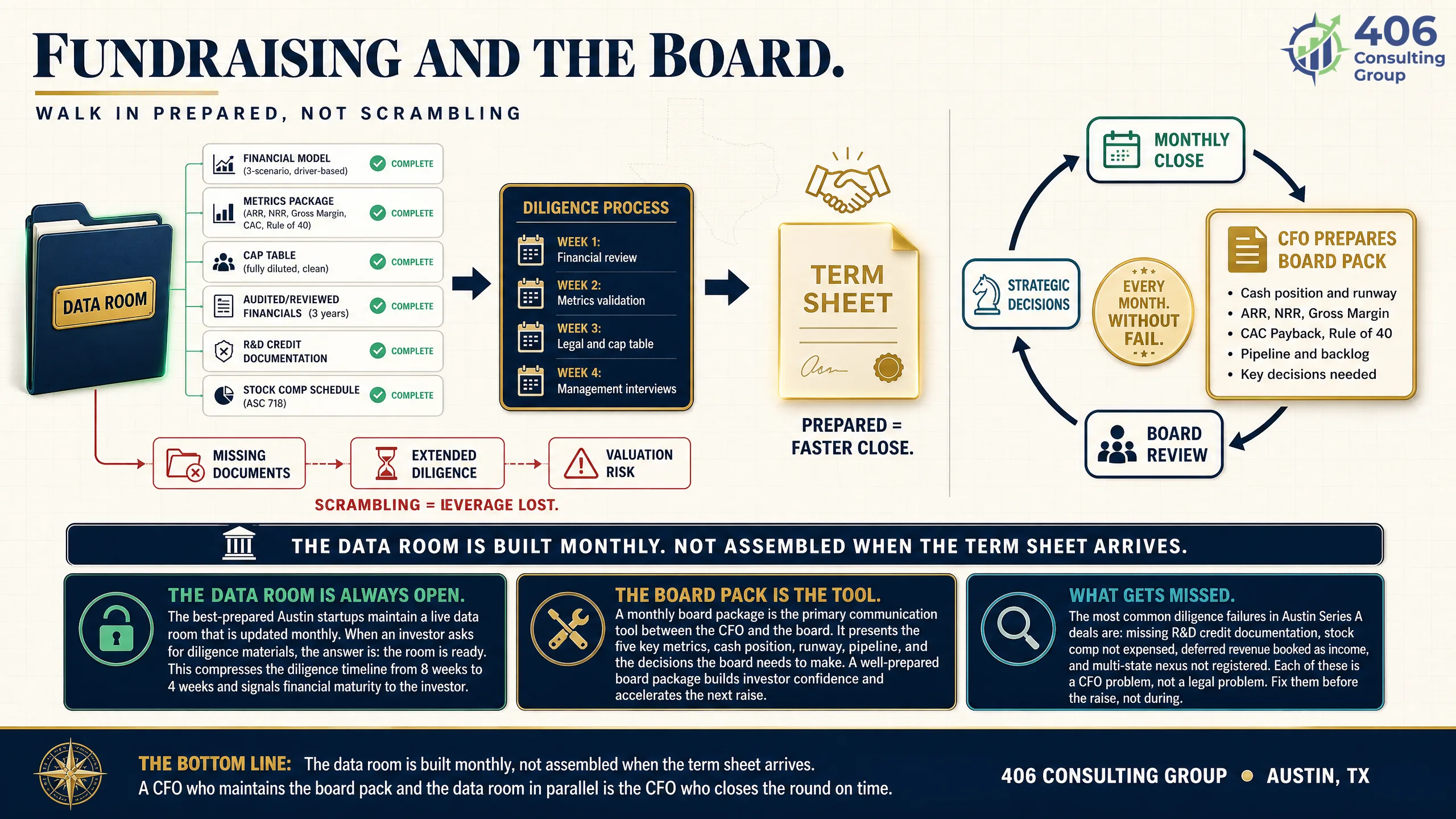
The best time to build fundraising-grade finance is well before you need to raise — scrambling during a process is how founders lose leverage.
Banking, Venture Debt & Capital
Equity isn't the only capital a startup uses. Venture debt and lines of credit can extend runway or fund growth without additional dilution — but they come with covenants, terms, and a lender's scrutiny of your financials, and taking on debt a fragile company can't service is its own risk. Knowing when non-dilutive capital makes sense, how much you can safely carry, and how to present the company to a lender is core CFO work.
This is where our commercial-banking background pays off: we understand how lenders read a company and what strengthens a file, so we help you approach venture debt or a credit facility prepared and negotiate from a position of understanding rather than hope. Our loan-readiness work is built for exactly these conversations.
Used well, non-dilutive capital is a runway extender that saves founder equity; used carelessly, it's a covenant trap — the difference is planning.
Systems Across the Whole Company
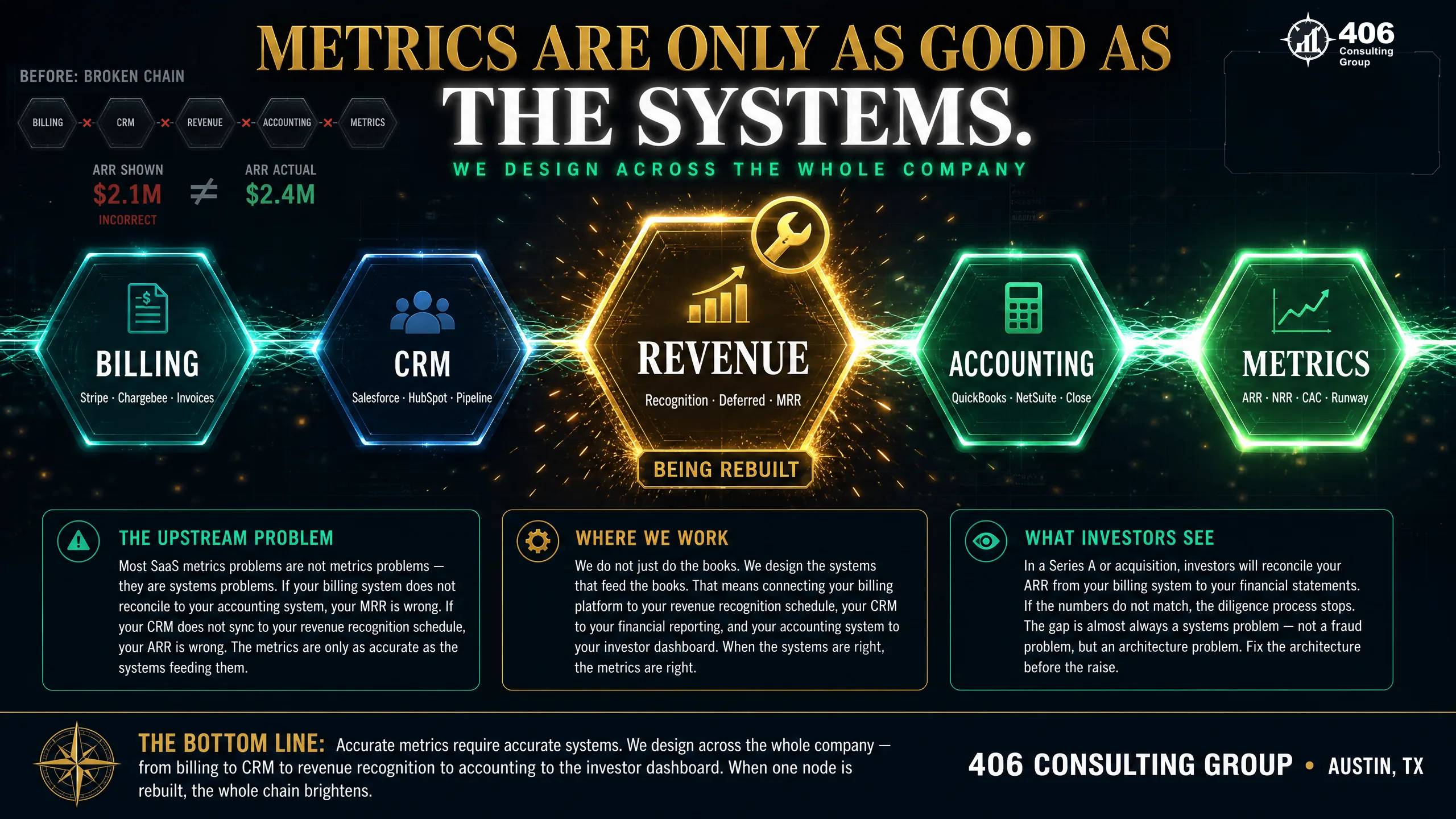
What sets our CFO work apart is that we don't treat finance as a silo. In a SaaS company the numbers are downstream of everything else — how your billing system records subscriptions, how sales-ops data flows into revenue, how product usage ties to expansion and churn, how the CRM and the accounting system agree (or don't). Metrics are only as trustworthy as the systems that produce them, so building a reliable financial function usually means fixing the whole-company data flow behind it.
That cross-functional lens is how a startup scales without its reporting breaking: billing, CRM, and accounting reconciled, metrics defined once and computed consistently, and decisions made on numbers that are right because the pipeline behind them is right. It's the difference between an accountant who reports the past and a partner who helps you build a company that runs.
We go deeper on this in the hidden cost of no systems — the quiet price of operational chaos disguised as hustle.
Local vs. a Great Remote Partner
For a cloud-native, often-distributed startup, insisting on a local CFO is the one decision you'd never apply to the rest of the business. What matters is judgment and startup fluency — someone who has built burn models, sat through diligence, computed SaaS metrics the way investors expect, and guided companies from seed to scale. A specialist who does that remotely runs circles around a nearby generalist who's never closed a subscription company's books.
And the work is naturally remote: a shared dashboard, a standing strategy call, a screen-share to review the model before a board meeting or a raise. We work this way with technology companies across Austin and beyond — proactive, metrics-fluent, and fundraising-aware — wherever your founders and team happen to sit.
For a role this strategic, expertise is the whole game — and expertise travels as well as your product does.
How to Get Started
Adding a CFO or controller function to your Austin startup is three steps.
Figure out which function you need
Controller (accurate, investor-ready books), CFO (burn, runway, metrics, fundraising), or a blend — and at what level for your stage.
Start fractional
Bring in senior expertise for a few thousand a month instead of spending runway on a full executive salary, scaled to where you are.
Build the forward view
A driver-based burn/runway model, clean SaaS metrics, and board- and investor-ready reporting — so a raise is a process, not a scramble.
Not sure where you stand? Our Financial Maturity Assessment maps your financial function in about eight minutes and shows what to build next.
FAQ: Austin CFO & Controller Questions
What's the difference between a controller and a CFO?
A controller looks backward and makes it accurate — the books, the monthly close, SaaS revenue recognition and deferred revenue, reporting, and controls. A CFO looks forward and makes it strategic — burn and runway, forecasting, unit economics, fundraising, board reporting, and capital decisions. In short, the controller makes sure the numbers are right and on time; the CFO uses those numbers to steer the company and raise money. Early-stage startups often need the controller function first (clean, investor-ready books) and add the CFO function as fundraising and scale arrive; many need a blend of both.
How much does a fractional CFO or controller cost in Austin?
Fractionally, a controller typically runs about $2,500–$6,000 per month and a fractional CFO about $2,500–$5,000 per month, with both together often around $4,000–$8,000 per month depending on scope. Compare that to full-time: a controller is roughly $85,000–$120,000 in salary plus about 25% in benefits, and a full-time CFO is $150,000–$300,000+, so both full-time run an all-in $235,000–$420,000+ per year. For a startup watching runway, fractional delivers the senior expertise for a fraction of the cost and scales up around a raise or a scaling push — which is why it fits most companies until they're much larger.
When does my startup actually need a CFO?
Most companies don't need a full-time CFO until roughly $15 million or more in revenue — below that, a full-time executive usually isn't kept busy enough to justify the cost, which is exactly what fractional solves. But for a startup the need is event-driven, not size-driven: you're raising a round, your close keeps slipping, you can't confidently state your burn and runway, your unit economics are a mystery, or you're hiring and spending fast post-raise. Hit two or three of those and it's time — and you can get the function fractionally without spending runway on an executive salary.
Do you understand SaaS metrics and fundraising?
Yes — it's central to the work. We build driver-based burn and runway models, compute SaaS unit economics (CAC, LTV, CAC payback) and the metrics investors judge you on (MRR/ARR growth, net revenue retention, gross margin, Rule of 40), and prepare companies for diligence with a defensible model, a clean data room, and metrics that tie back to the financials. Between raises we run board reporting that keeps investors confident. The goal is simple: walk into a board meeting or a fundraise with numbers you can defend cold.
Can 406 Consulting Group be our CFO remotely?
Yes — and for a cloud-native, often-distributed startup it's the natural fit. CFO and controller work is about judgment and startup fluency, not proximity: a shared dashboard, a standing strategy call, and a screen-share to review the model before a board meeting or a raise. We serve Austin and Central Texas technology companies the same way software companies already operate, and our commercial-banking background means we also prepare you for venture debt and lender conversations. For a role this strategic, expertise matters far more than a local office.
Keep Reading
CFO & Controller — Austin, TX
Know Your Runway. Raise With Confidence.
406 Consulting Group gives Austin startups a CFO and controller function — burn and runway models, SaaS unit economics, board-ready reporting, and fundraising support — fractionally and remotely, so you scale on data instead of hope.
Austin CFO Quick Reference
Austin, TX — Travis County
Can't State Your Runway?
Fractional CFO & controller — startup-fluent.
About the Author
Jason Anderson
Co-Founder, 406 Consulting Group
Big-firm-trained accountant helping SaaS, startup, and technology companies build the financial function that carries them from seed to scale. Jason helps Austin founders model burn and runway, get their SaaS metrics boardroom-ready, and walk into a raise with numbers they can defend.
Read the Full Story