
Tax Planning in Casper, WY:
Make the Energy Cycle Work for Your Tax Bill
Wyoming takes nothing out of your profit — so a Casper energy business plans entirely at the federal level, where equipment timing, the S-corp, and depletion are the big levers. Here's how to use the boom-and-bust cycle to your advantage.

For a Casper energy business, tax planning has an unusual shape. Wyoming takes nothing out of your profit — no state income tax, no gross-receipts or B&O tax — so there's nothing to minimize on the state side. That means every dollar of planning happens at the federal level. And in an equipment-heavy, cyclical industry, the federal levers are especially powerful: the timing of a rig or truck purchase against a strong year can move your tax bill dramatically.
That's the opportunity most energy owners underuse. When the good years come, they're busy running crews, not planning; when the down years hit, the chance to have smoothed the tax bill is gone. Good planning turns the industry's boom-and-bust rhythm into an advantage — accelerating deductions into the high years, using the right entity, and not leaving depletion or equipment strategy on the table. This is the industry we come from: both of our founders spent years in the oil field, so we plan taxes for energy companies with the cycles in mind, not against them.
This guide covers the federal levers for an energy business, equipment timing, the S-corp question, depletion for mineral and royalty interests, the Wyoming entity edge, and multi-state crews — all delivered remotely.
By Jason Anderson — Co-Founder, 406 Consulting Group. Big-firm-trained accountant with extensive oil-field experience, advising energy and small businesses across the Rocky Mountain West, where entity choice and equipment timing are where the money is made.
Quick Answer: Tax Planning for a Casper Energy Business
- →All federal: Wyoming has no income tax and no B&O, so there's nothing to minimize state-side.
- →Equipment timing is the big lever — §179/bonus depreciation on rigs and trucks, timed to strong years.
- →Depletion may apply if you hold working or royalty interests — an energy-specific deduction.
- →Multi-state crews can create tax and payroll obligations across state lines.
- →Planned by oil-field veterans, delivered remotely — most of our local clients never come in.
Table of Contents
Why Energy Tax Planning Here Is Different
Two things make tax planning for a Casper energy business distinct. First, the state: Wyoming has no income tax and no gross-receipts tax, so — unlike a business in Colorado, Montana, or almost anywhere — there's no state income bill to reduce. All of your income-tax planning points at the federal return. Second, the industry: energy-services businesses are capital-heavy and cyclical, which makes the federal timing levers unusually potent.
Put those together and the game is clear: use the federal levers hard, and use the cycle. A big equipment purchase deducted in a boom year is worth far more than the same purchase in a lean one; the right entity saves federal payroll tax every year; and energy-specific items like depletion can add up. The trap is treating a low-tax state as a reason not to plan — the federal bill is exactly the same in Casper as anywhere, and for an equipment-heavy business, the planning stakes are higher, not lower.

The rest of this guide walks the levers, in roughly the order they matter for an energy business.
The Federal Levers for an Energy Business
With the state out of the picture, these federal levers do the work — and their weighting is different for an energy-services company than for a typical small business.
| Lever | Why it matters in energy |
|---|---|
| Equipment & timing | The biggest lever — §179/bonus depreciation on heavy equipment, timed to strong years |
| Entity choice (S-corp) | Cuts federal self-employment/payroll tax once profit is high enough |
| Depletion | For working/royalty interests, an energy-specific deduction against production income |
| Retirement plans | Shelter big income in boom years — SEP, Solo 401(k), or defined-benefit |
| Clean, complete deductions | Fuel, per-diems, equipment costs — captured only if the books are clean |
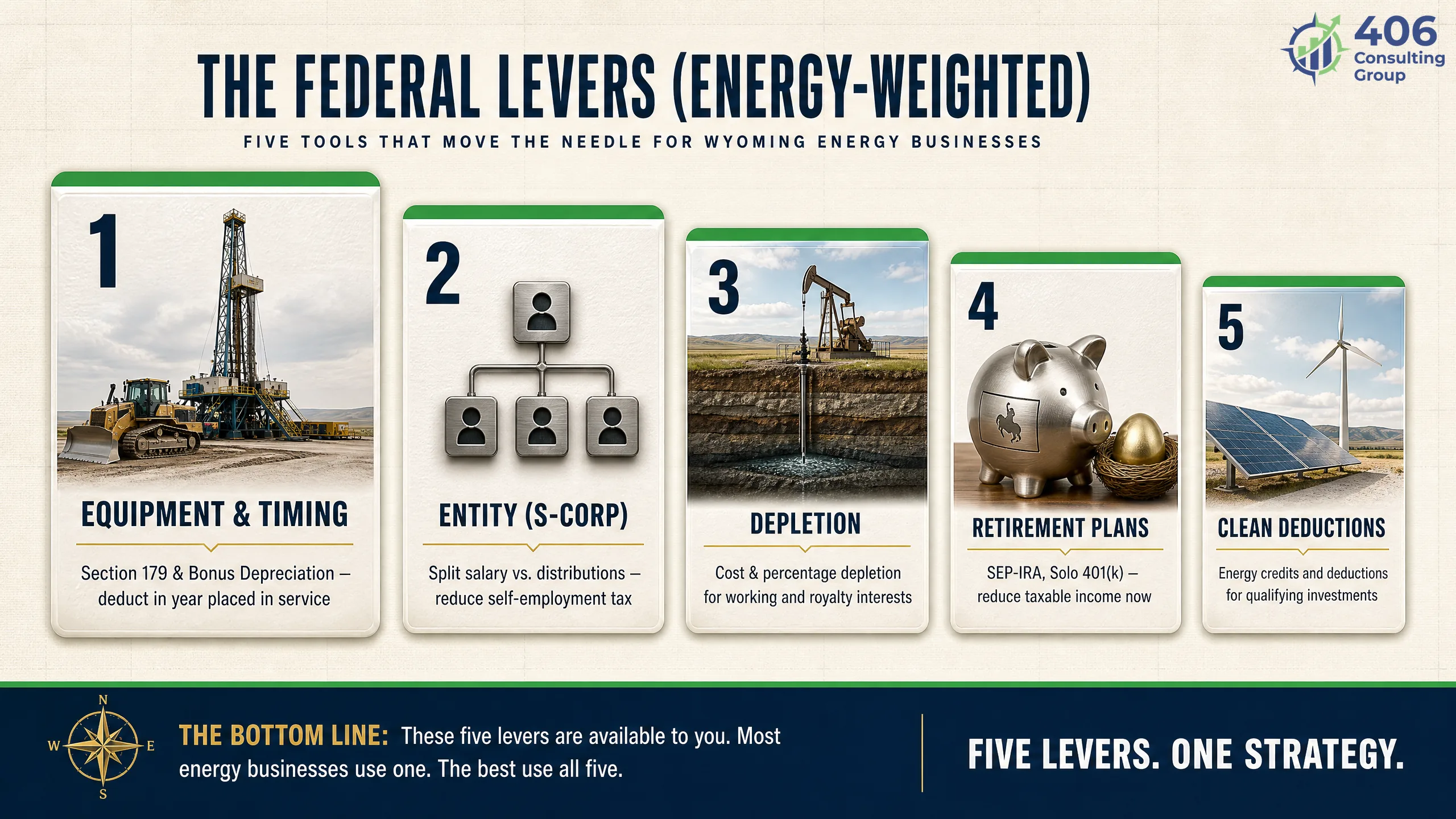
Every lever is federal — and every one is worth more when it's planned before year-end, not discovered at filing.
Equipment Timing: The Biggest Energy Lever
For an equipment-heavy energy business, when you buy is a tax decision as much as an operational one. Section 179 and bonus depreciation let you deduct much or all of a qualifying rig, truck, or piece of equipment in the year it's placed in service, rather than over years. In a strong year, that can wipe out a large chunk of a high federal bill; timed poorly, the same purchase saves far less.
The discipline is buying for the business first and letting tax refine the timing — accelerate a purchase you were going to make anyway into a boom year, or defer into a leaner one, based on where profit lands. That requires knowing your numbers before December, which is exactly why energy businesses benefit from a mid-year check-in rather than a March scramble. Bonus depreciation percentages shift over time, so confirm the current-year rules before counting on them.

Handled right, the cycle becomes your friend: the industry's volatility is exactly what makes deliberate equipment timing so valuable.
Entity Choice & the S-Corp Question
For a profitable energy-services owner, entity choice is a major federal lever. As a sole proprietor or partnership, every dollar of profit is hit with self-employment tax (roughly 15.3% up to the Social Security wage base). Elect S-corp treatment and you split income into a reasonable salary (payroll-taxed) plus distributions (not subject to self-employment tax) — often saving thousands a year once profit is high enough.
The catch is "reasonable" — the IRS requires a defensible market salary, and in energy that means paying yourself in line with what the work commands. There's also cost and paperwork (payroll, a separate return), so it's a math question, not a default — and one made cleaner in Wyoming, where there's no state income tax layered on either side.
Run your own numbers
Our S-Corp Calculator estimates the payroll-tax savings at your profit level, and LLC vs. S-Corp compares the structures. For a cyclical business, we model it across good and lean years before electing.
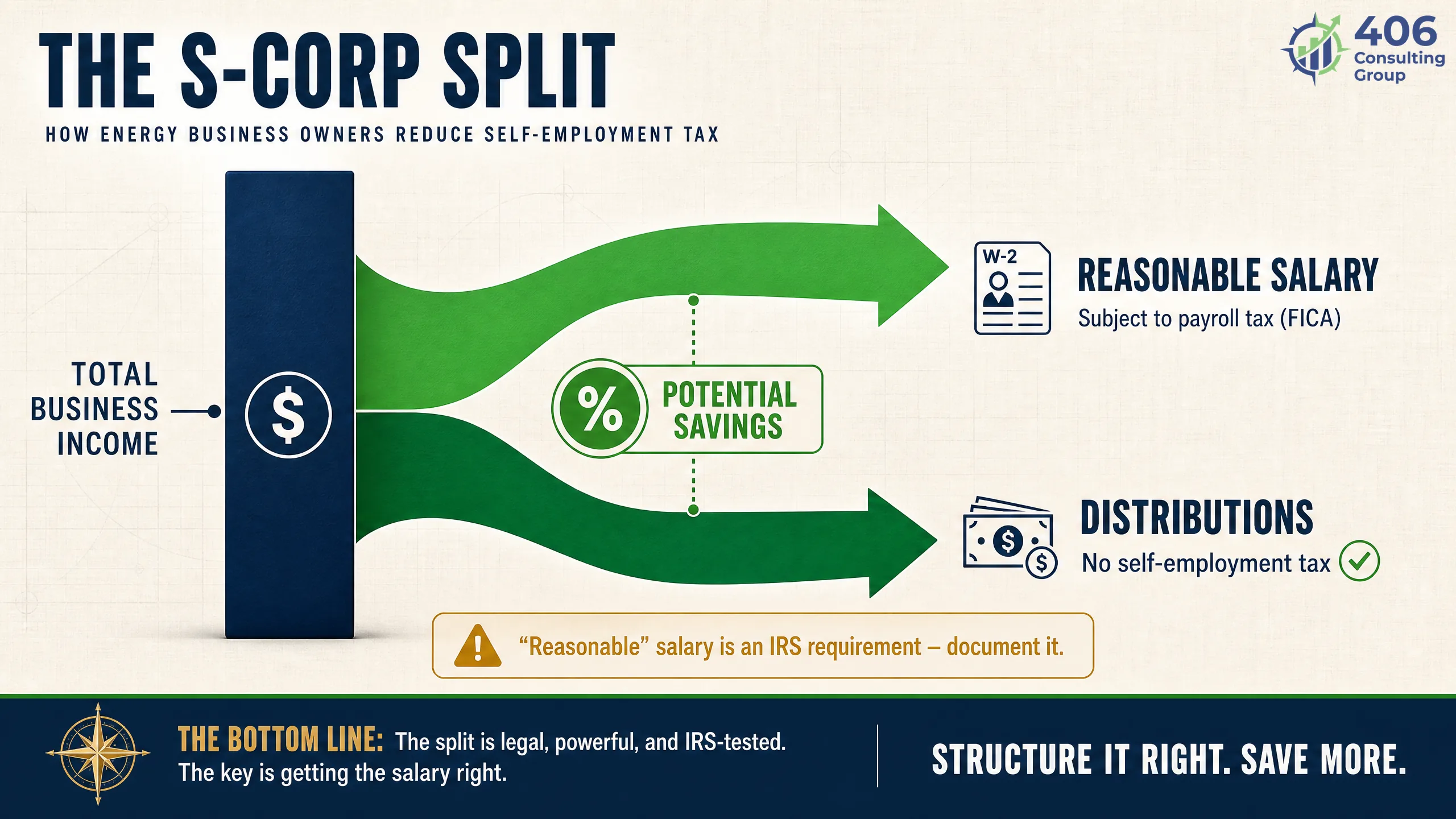
See the S-corp election deadline for the timing rules, and when to change your entity.
Depletion & Mineral/Royalty Interests
This is a lever unique to energy — and one plenty of Casper owners overlook. If you hold a working interest or a royalty interest in oil and gas production, you may be entitled to a depletion deduction — the tax system's way of recognizing that a well's reserves are being used up. There are two methods (cost depletion and percentage depletion), and for many independent producers and royalty owners, percentage depletion can be a meaningful annual deduction against production income.
The rules come with real limitations — percentage depletion is generally reserved for independent producers and royalty owners (not integrated majors) and is subject to income-based caps — so this is squarely an area to handle with a professional who understands oil and gas. But if you have mineral or royalty income and no one's talked to you about depletion, you may be leaving a legitimate deduction on the table.

It's exactly the kind of industry-specific item a generalist misses and an energy-savvy firm catches.
The Wyoming Entity Advantage
Operating in Wyoming comes with a built-in structural advantage: no state income tax on the entity, strong owner privacy, solid asset-protection statutes, and low ongoing cost — an annual report with a small license fee rather than an income-based franchise tax. For an energy business exposed to real operational risk, the liability and asset-protection side is worth as much as the tax side.
The key is using it deliberately. A Wyoming entity is a strong base, but it doesn't erase federal tax, and it doesn't erase obligations in other states where your crews or equipment actually work (more on that next). Paired with clean books and the right federal election, it's one of the most favorable setups an energy owner can operate from.
More on structure and the federal picture runs through this whole guide; the entity is the foundation the rest sits on.
Crews & Equipment Across State Lines
Energy work doesn't respect state borders. A Casper company may run crews and equipment into Montana, North Dakota, Colorado, or Utah — and the moment you do, those states' tax and payroll rules can reach you. Income earned there may be taxable there; employees working there can trigger that state's withholding and payroll obligations; and equipment moving across lines raises its own questions.
None of this is a reason to turn down out-of-state work — it's a reason to map where you actually have people, property, and revenue, and to file accordingly. Wyoming's own no-income-tax advantage doesn't extend to a neighboring state that does tax the work done there. This is where an energy-savvy, multi-state-experienced firm earns its keep: keeping the Wyoming base clean while staying compliant everywhere your crews run.
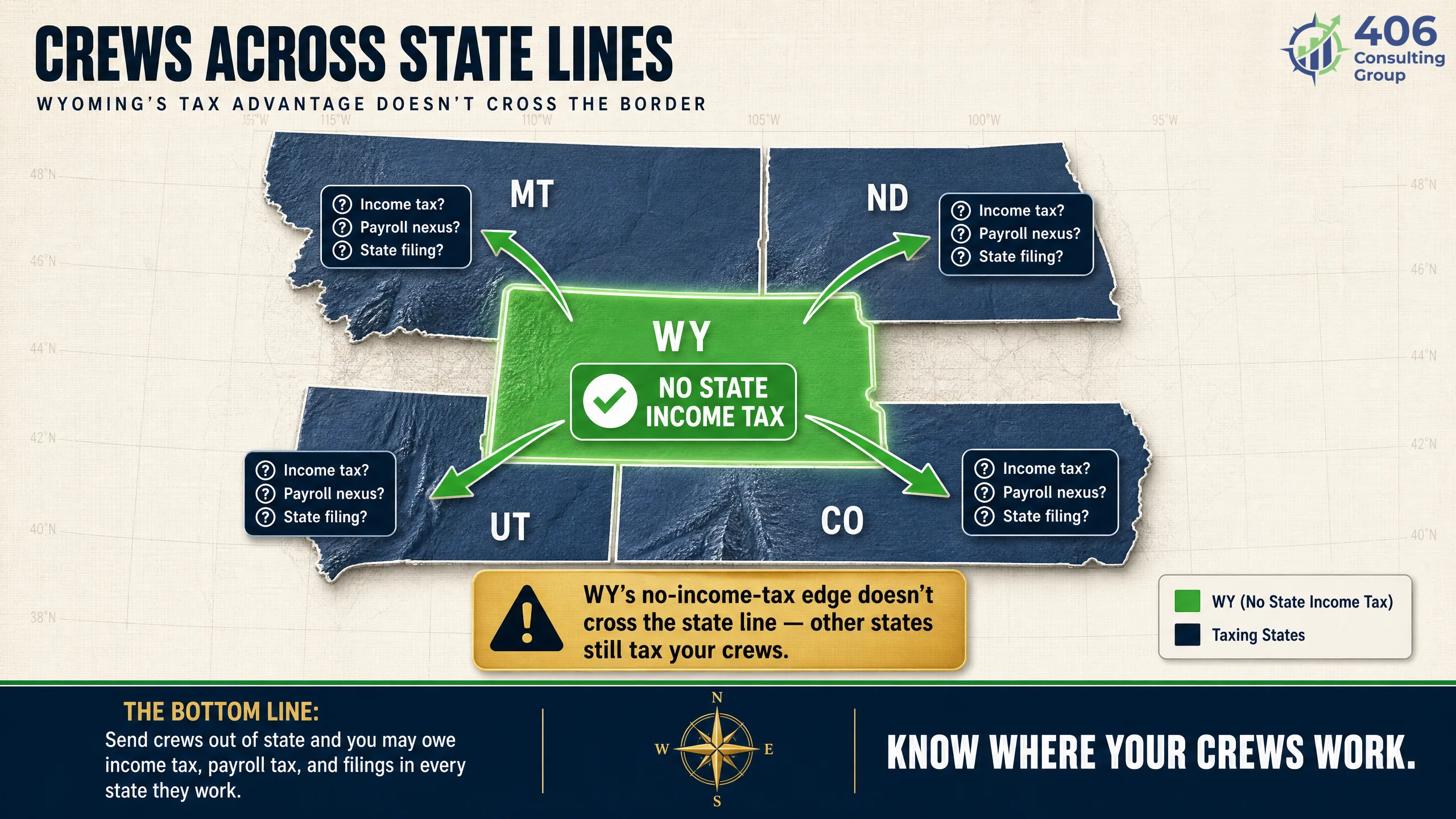
Map it early — retroactive multi-state cleanups are far more expensive than doing it right as you expand.
Retirement & Owner Benefits
Boom years are exactly when retirement plans earn their keep. A SEP-IRA or Solo 401(k) can shelter tens of thousands from federal tax in a strong year, and a defined-benefit or cash-balance plan can shelter far more for an older, high-income owner — turning a spike in profit into the owner's own wealth instead of a spike in the tax bill.
For a cyclical business, the strategy is to fund aggressively in the good years and dial back in the lean ones — flexibility that pairs naturally with energy's rhythm. Coordinated with an S-corp salary and clean fringe benefits, a profitable Casper owner can move a large slice of a boom year out of the federal tax base, legitimately.
A Year-Round Energy Tax Rhythm
Because the levers are federal and timing-driven, energy tax planning is a year-round rhythm tied to your cycle — not an April event.
| When | Focus |
|---|---|
| Q1 | File; confirm S-corp election (deadline mid-March); reconcile depletion and equipment from last year |
| Q2 | Read the year's trajectory; set equipment and retirement plans against expected profit |
| Q3 | Mid-year check: is this a strong year? Adjust equipment timing and salary accordingly |
| Q4 | The big one — finalize equipment purchases and retirement funding before Dec 31 |

There are no Wyoming state estimated-income-tax payments to juggle — the state has none — so the calendar is simpler than a neighboring state's. But the federal moves still have to happen before year-end to count.
Local vs. a Great Remote Partner
Energy tax planning is expertise, not proximity — modeling equipment timing across a cycle, structuring an S-corp, catching depletion, and mapping multi-state exposure. What matters is whether your advisor knows both oil and gas and Wyoming's setup, not whether they're across the street. A great remote partner who understands the industry beats a local generalist who's never dealt with a working interest, every time.
And it's how the work already runs. Around 70–80% of our own local clients never come into the office — planning sessions happen over shared screens and secure document exchange, and the numbers live in the cloud. So whether you're in Casper, elsewhere in Natrona County, or running crews across the basin and beyond, you get proactive, energy-specific planning from a team that's worked the field itself.
The goal is the same wherever you sit: pay the IRS what you owe and not a dollar more — through every part of the cycle.
How to Get Started
An energy tax plan comes together in three steps.
Get the entity and structure right
Model sole prop vs. S-corp across good and lean years, and confirm your Wyoming entity is set up and used correctly.
Build the federal plan around the cycle
Equipment timing, depletion, and retirement funding mapped to your expected profit — before year-end.
Stay clean on use tax & multi-state
Use tax handled and any out-of-state crew/equipment nexus mapped so the Wyoming advantage stays real.
Start with the S-Corp Calculator or our Financial Maturity Assessment, then let's talk.
FAQ: Casper Energy Tax Questions
Does a Casper energy business owe Wyoming state income tax?
No. Wyoming has no state individual income tax and no state corporate income tax, and no gross-receipts or B&O tax either. Your business income isn't taxed at the state level at all. You still owe federal income tax and handle federal payroll, plus Wyoming sales/use tax and state-administered workers' compensation. Because there's no state income tax, all of your income-tax planning happens at the federal level — which, for an equipment-heavy energy business, is where the biggest levers already are.
What's the most powerful tax lever for an energy-services business?
Usually equipment timing. Section 179 and bonus depreciation let you deduct much or all of a qualifying rig, truck, or piece of equipment in the year it's placed in service. In a strong year that can offset a large federal bill; timed into a lean year it saves far less. Because energy is cyclical, deliberately timing big purchases against strong years — a purchase you were going to make anyway — is often the single highest-value move. It requires knowing your numbers before December, not at filing.
Can I claim depletion on oil and gas income?
Possibly. If you hold a working interest or royalty interest in oil and gas production, you may be entitled to a depletion deduction — recognizing that the reserves are being used up. There are two methods (cost and percentage depletion), and percentage depletion is generally available to independent producers and royalty owners (not integrated majors), subject to income-based limits. It's an area to handle with a professional who knows oil and gas, but if you have mineral or royalty income and haven't discussed depletion, you may be missing a legitimate deduction.
My crews work in other states — does that affect my taxes?
It can. When your people, property, or revenue cross into Montana, North Dakota, Colorado, or elsewhere, those states' income-tax and payroll rules can apply to the work done there — regardless of Wyoming's no-income-tax status. Employees working in another state can trigger that state's withholding, and revenue earned there may be taxable there. It's manageable with planning: map where you actually have nexus and file accordingly. Retroactive multi-state cleanups are far more expensive than getting it right as you expand.
Can 406 Consulting Group handle my Casper energy taxes remotely?
Yes. Tax planning and preparation are knowledge work that runs well remotely — planning over shared screens, secure document exchange, and numbers in the cloud. What matters is deep energy and federal expertise plus multi-state know-how, not office proximity — and both of our founders spent years in the oil field, so we understand the work and the cycles. Around 70–80% of our own local clients never come into the office either, so you get proactive, year-round planning wherever your crews run.
Keep Reading
Tax Planning — Casper, WY
Make the Cycle Work for Your Tax Bill.
406 Consulting Group builds year-round tax plans for Casper energy businesses — equipment timing, entity strategy, depletion, and multi-state clarity — delivered remotely, by a firm with real oil-field experience.
Casper Energy Tax Quick Reference
Casper, WY — Natrona County
Overpaying the IRS in Casper?
Time the cycle. Catch depletion.
About the Author
Jason Anderson
Co-Founder, 406 Consulting Group
Big-firm-trained accountant with extensive oil-field experience. Jason helps Casper energy owners turn a low-tax state and a cyclical industry into real savings — equipment timing, the right entity, depletion, and multi-state clarity.
Read the Full Story