
Bookkeeping Services in Casper, WY:
Energy Books, Built by People Who've Been in the Field
Casper runs on energy — and energy-services books run on job costing, field tickets, heavy equipment, and use tax. Here's what an oil & gas business really needs from its bookkeeping, on top of Wyoming's no-income-tax backdrop.

Casper isn't called "Oil City" by accident. Central Wyoming's economy runs on energy — drilling and well services, midstream and pipeline, hauling and equipment rental across the Powder River Basin and the historic Salt Creek field — and the businesses behind that work have bookkeeping needs a generic accountant simply doesn't see. Field tickets, per-well job costing, equipment-heavy balance sheets, a mobile workforce, and cash flow that swings with the price of a barrel all have to be handled right.
The good news is the tax backdrop is about as friendly as it gets: Wyoming has no state income tax and no gross-receipts tax, so a Casper energy business isn't feeding a state income bill. That shifts the bookkeeping job toward what actually matters in this industry — clean job costing, correct sales and use tax on a lot of equipment, energy payroll and workers' comp done right, and cash discipline through the cycles. This is the industry we come from: both of our founders spent years in the oil field, so we build books for energy companies from the inside, not from a textbook.
This guide covers what energy-business books really need in Casper — the field-ticket and job-costing side, the equipment and use-tax side, energy payroll, and boom-and-bust cash — all delivered remotely.
By Carrie Anderson — Co-Founder, 406 Consulting Group. Commercial banking and underwriting background — 300+ loan reviews — plus extensive oil-field experience and advisory work with energy and small businesses across the Rocky Mountain West.
Quick Answer: Bookkeeping for a Casper Energy Business
- →Job costing is king — field tickets and per-well/per-job costs are the heart of energy books.
- →Use tax on equipment is a real exposure — a lot of field gear is bought without sales tax.
- →No state income tax, no B&O — Wyoming's low-tax backdrop; sales/use tax is the main state tax (~5% in Casper).
- →Energy payroll & workers' comp — a mobile crew and hazardous class codes need careful handling.
- →Built by oil-field veterans, delivered remotely — most of our local clients never come into the office.
Table of Contents
Why Casper Energy Bookkeeping Is Different
Energy-services books don't look like a retail shop's or a law firm's. Revenue often comes in as field tickets tied to specific wells or jobs; costs are dominated by equipment, fuel, and a mobile crew; and a big share of the balance sheet is heavy assets depreciating in the field. Layer on subcontractors, consumables, and multi-location work, and the bookkeeping is genuinely specialized — get the structure wrong and you can't tell which jobs actually made money.
Casper sits at the center of it — Natrona County, the Powder River Basin, and decades of oil and gas history. Whether you run a well-services company, a hauling outfit, an equipment-rental business, or a midstream contractor, your books need to speak the language of the field: jobs, tickets, equipment, and cycles. That's the difference between accounting that just files a return and accounting that tells you how the business is really doing.
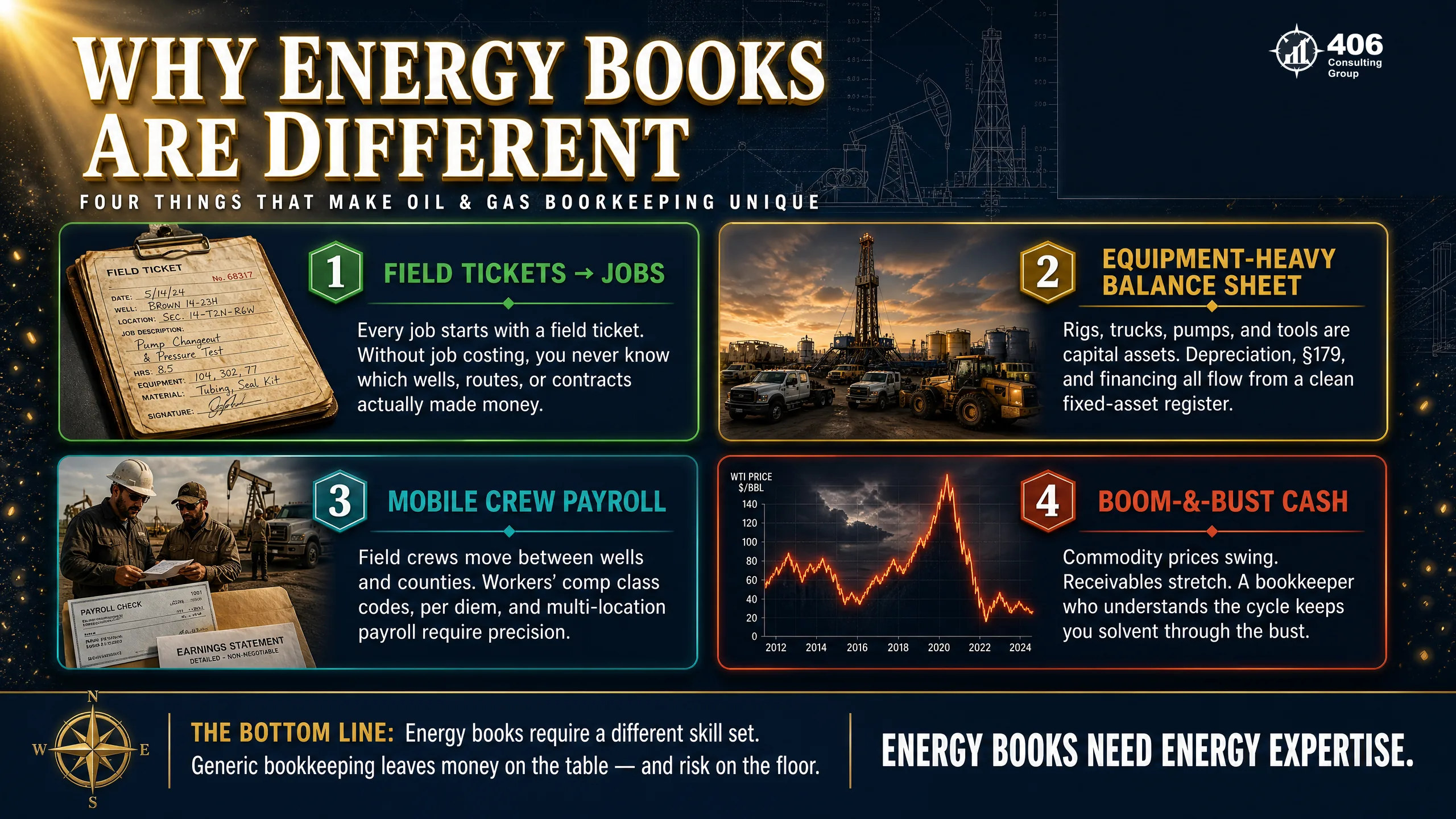
The rest of this guide walks each piece, on top of Wyoming's low-tax backdrop — which makes the whole thing simpler than it would be almost anywhere else.
The Wyoming Low-Tax Backdrop
Before the industry specifics, the backdrop: Wyoming is one of the lowest-tax states in the country. No state income tax — personal or corporate — and no gross-receipts or business & occupation tax. For a Casper energy business, that means no state income bill to compute or reserve for; the state's main tax is sales and use tax (around 5% combined in Casper — a state rate plus a Natrona County portion; confirm the current rate locally).
The practical effect on your books is that the energy of good bookkeeping goes to operations and federal planning rather than to a state income return. Clean job costing tells you what's profitable; clean records make the federal return and any financing straightforward. Wyoming stays out of the way — which is exactly why the industry-specific pieces below are where your attention belongs.
We cover the planning side in the Casper tax guide. Here, the focus is the books themselves.
Sales & Use Tax on Field Equipment
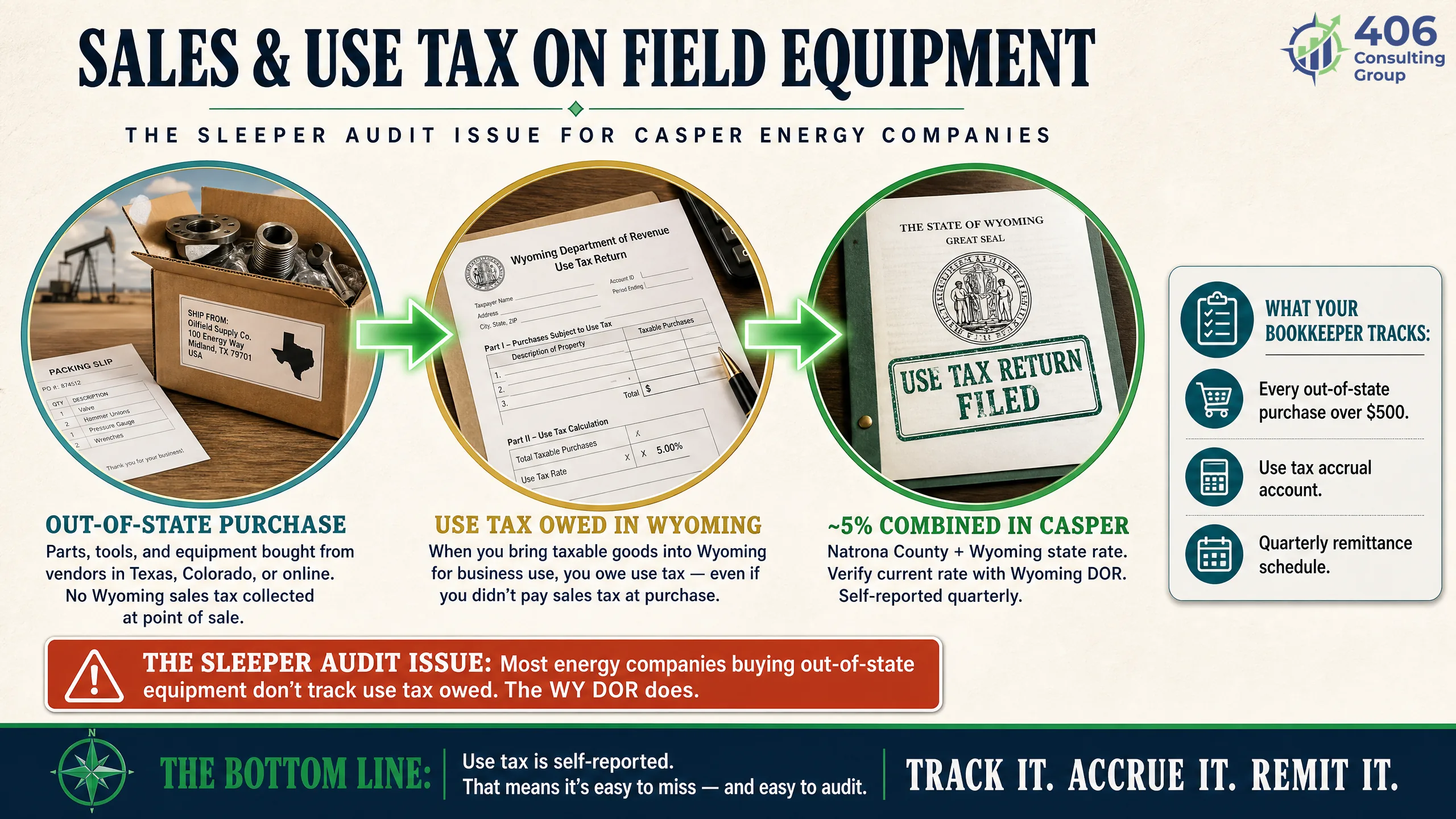
For an equipment-heavy energy business, use tax is the sleeper issue. Sales tax you collect on taxable sales is straightforward; the trap is use tax — Wyoming's companion tax owed on equipment and supplies you buy without paying sales tax, which for an energy-services company can be a lot: tools, parts, consumables, and gear sourced out of state or online. Miss it and it surfaces in an audit, with interest.
There's nuance in this industry, too: some equipment, resale, and certain services can qualify for Wyoming sales/use-tax treatment that differs from a straight retail purchase, so it's worth mapping your purchases with someone who knows both the rules and the field. Clean books record sales tax collected as a liability (never revenue) and flag untaxed purchases so use tax is captured as you go — not discovered later.
Where energy companies get bitten
Buying field equipment and parts out of state without accounting for Wyoming use tax is one of the most common — and most expensive — surprises for energy-services businesses. Track it as you go, and confirm rates, exemptions, and rules with the Wyoming Department of Revenue.
Field Tickets & Job Costing
This is the heart of energy-services bookkeeping. Revenue starts as field tickets — the record of work done on a specific well or job — and the whole point of good books is to tie those tickets, and the labor, equipment, fuel, and consumables behind them, back to the job. Do that and you can see the real margin on every well, route, and contract. Skip it and you're flying blind on the one number that matters: which work actually pays.
A proper job-costing setup captures cost by job and by cost type, reconciles field tickets to invoices so nothing goes unbilled, and tracks work-in-progress so revenue and cost land in the same period. For a Casper company juggling multiple crews and wells, that structure is the difference between a real P&L and a guess.

Having lived the field side, we set this up the way the work actually runs — so the numbers match reality, not just the tax return.
Equipment, Fixed Assets & Depreciation
Energy-services businesses are capital-heavy — rigs, trucks, trailers, pumps, tools — and that equipment dominates the balance sheet. Your books need a clean fixed-asset register: what you own, what it cost, when it went into service, and how it's depreciating. That register feeds the tax return (Section 179 and bonus depreciation can be powerful here), financing conversations, and any equipment buy-sell decision.
Sloppy asset tracking is common and costly: equipment expensed when it should be capitalized, assets still on the books that were sold or scrapped, or depreciation that doesn't match reality. For an energy company, getting this right isn't just compliance — it's knowing the true cost of the iron doing the work.
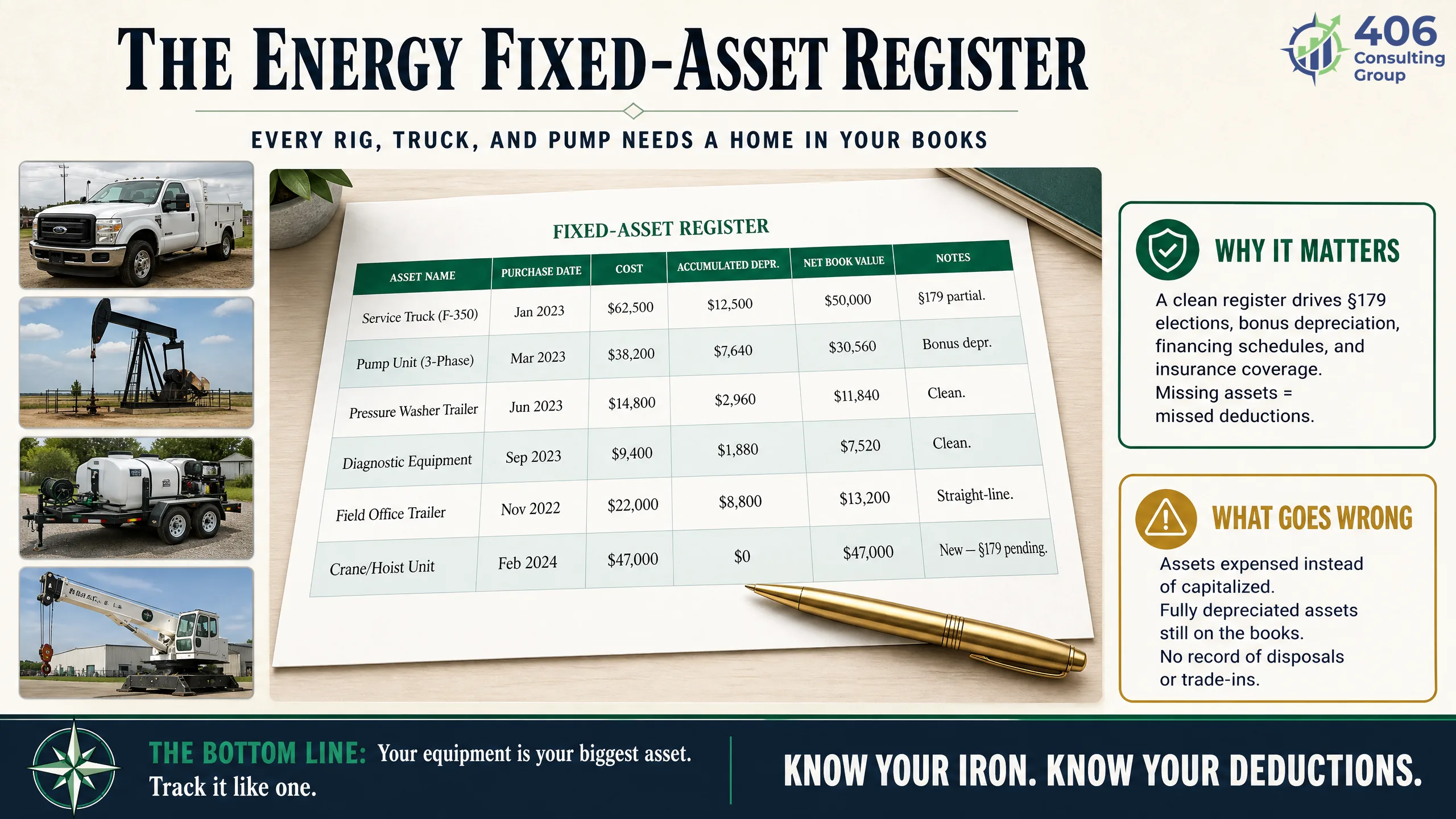
We handle the depreciation strategy in the Casper tax guide; the bookkeeping job is keeping the asset register clean and current.
Energy Payroll & Workers' Comp
Payroll in the field has its own wrinkles. Wyoming makes one part easy — with no state income tax, there's no state withholding to compute. But energy work brings real complexity: a mobile crew that may cross county or state lines, per-diems and travel, overtime, and — critically — workers' compensation on genuinely hazardous work.
| Item | Energy-business note |
|---|---|
| State income withholding | None — Wyoming has no state income tax |
| Workers' comp | State-administered; hazardous class codes make rates and accuracy critical |
| Mobile / multi-state crew | Work across lines can raise other-state payroll questions |
| Per-diem & travel | Field per-diems and reimbursements need clean, compliant tracking |
| Federal payroll | Social Security, Medicare, withholding, FUTA as usual |
Wyoming administers workers' comp through a state fund, and in energy the class codes and accurate payroll reporting matter more than in almost any other industry — get them wrong and it's expensive. Verify current rules with the Wyoming Department of Workforce Services, and let our payroll work keep it clean.
Bookkeeping for Boom-and-Bust Cash
Energy revenue swings with commodity prices, and the businesses that survive the down cycles are the ones whose books gave them early warning. Bookkeeping's role here is to keep cash visible: clean receivables aging (field-service payments can be slow), a clear read on committed costs, and reserves tracked deliberately so a strong quarter isn't mistaken for a permanent one.
This is where lived experience matters. Both of our founders spent years in the oil field and have seen the cycles first-hand, so we build books that flag the turn early — receivables stretching, margins compressing — rather than confirming it after the cash is gone.
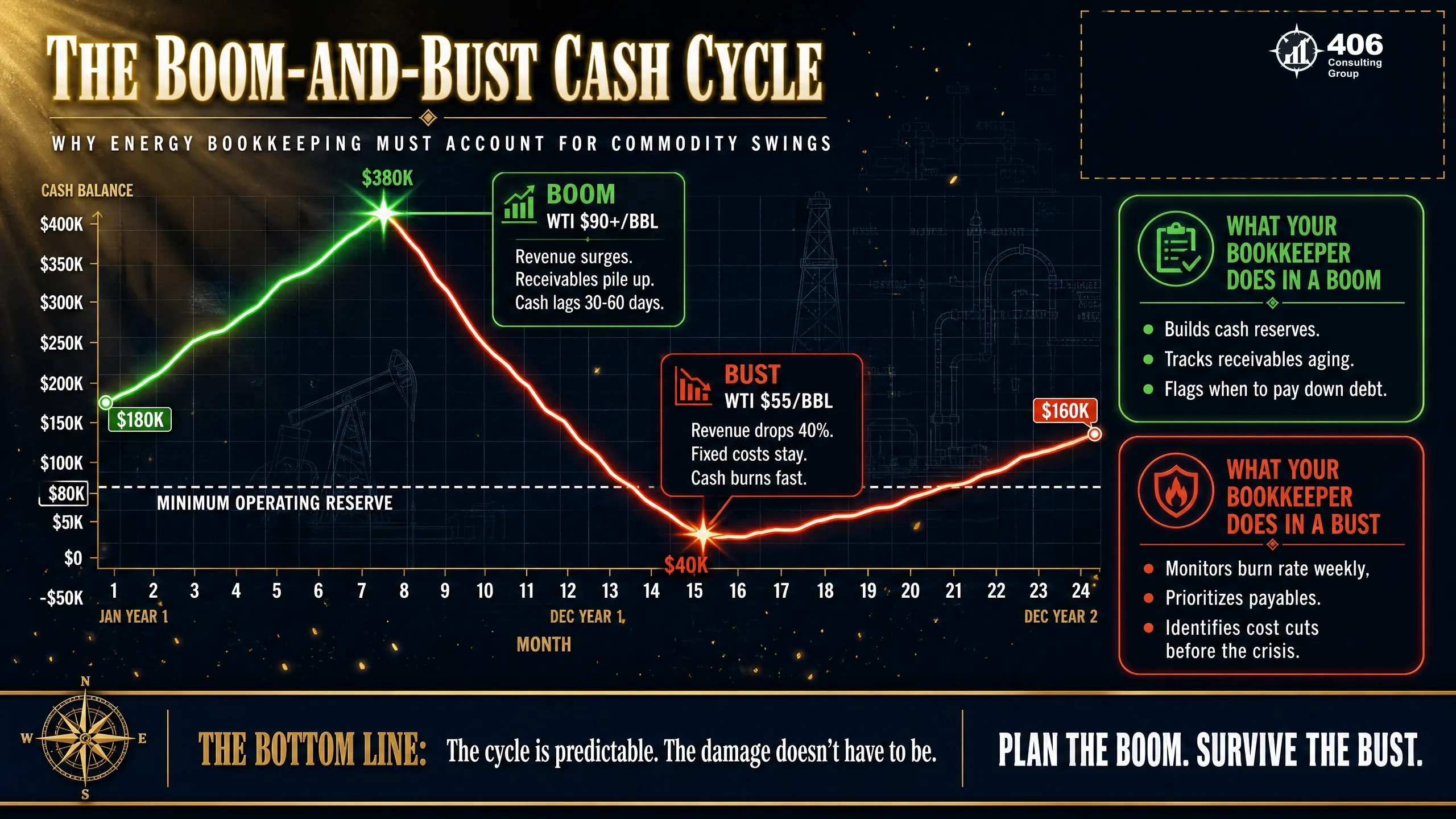
The forecasting and strategy side lives in the Casper CFO & controller guide; clean books are what make it possible.
Bookkeeping by Casper Segment
Casper's economy is energy-led but not energy-only — and each segment asks something different of the books.
| Segment | What the books need to track |
|---|---|
| Drilling & well services | Field tickets, per-well job costing, crew payroll, equipment, consumables |
| Hauling & trucking | Per-mile/per-load costs, fuel, DOT/driver payroll, equipment |
| Equipment rental | Asset utilization, depreciation, maintenance, rental billing |
| Midstream & pipeline contractors | Project/job costing, progress billing, retainage, multi-site work |
| Healthcare, retail & services | Sales tax (retail), receivables, payroll, utilization or inventory |

Different details, same backbone: clean job costing, use tax handled, payroll and workers' comp right, and profit readable for the federal return. Because we come from the field and build books around the whole operation, the numbers reflect how the work actually runs.
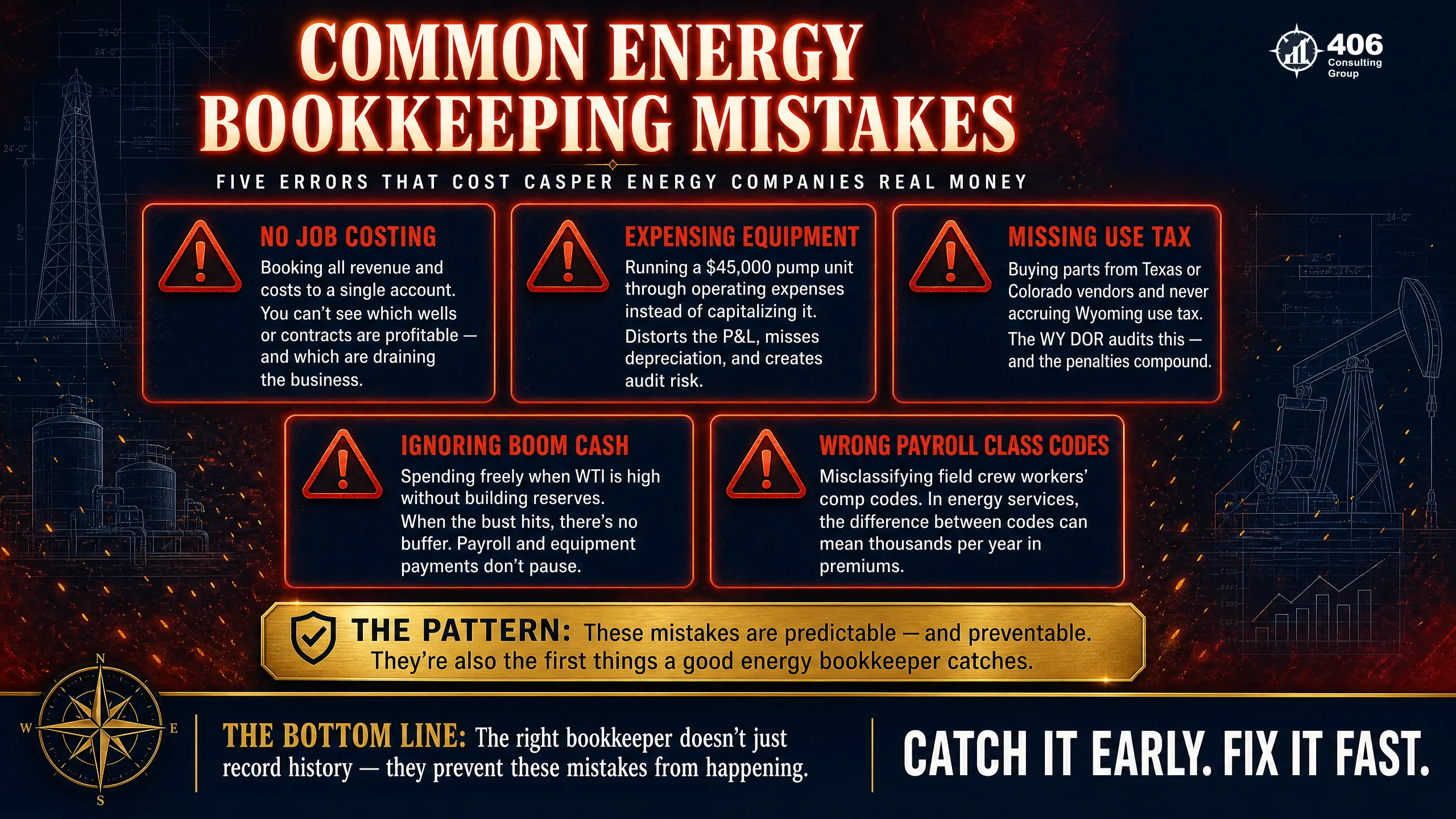
Common Energy Bookkeeping Mistakes
A handful of avoidable mistakes cause most of the trouble for Casper energy businesses. Here's what we see most.
No real job costing
Without field tickets tied to jobs, you can't tell which wells or contracts actually made money — the single most important number in the business.
Missing use tax on equipment
Field gear and parts bought out of state without sales tax usually owe Wyoming use tax — commonly overlooked and expensive in an audit.
Sloppy fixed-asset tracking
Equipment mis-capitalized, or assets still on the books after they're sold or scrapped, distorts both the balance sheet and taxes.
Wrong workers' comp class codes
In hazardous energy work, miscoded payroll or class codes create costly comp problems.
Spending collected sales tax
It's the state's money — treating it as cash flow creates a shortfall at remittance.
Every one is a setup-and-habit problem — and every one disappears once the books are built for an energy business and maintained on a monthly rhythm.
Local vs. a Great Remote Partner
For an energy business, what matters in a bookkeeper isn't proximity — it's whether they understand field tickets and job costing, equipment and use tax, and energy payroll and workers' comp. A partner who knows the industry and Wyoming's setup beats a local generalist who's never seen a field ticket, every time.
And remote is simply how field-based accounting works best now. Even most of our in-town clients never come into the office — roughly 70–80% of them — because the books live in cloud accounting, field tickets and receipts flow in digitally from the job site, and reviews happen over shared screens on a steady monthly rhythm. So whether you're in Casper, out in Natrona County, or running crews across the basin, you get the same responsive, energy-savvy service — from a team that's been in the field itself.
Distance isn't the variable. Knowing the industry is.
How to Get Started
Getting your Casper energy books in order is three steps.
Clean up and structure for the field
Reconcile the accounts and build books around jobs — field tickets, job costing, a clean fixed-asset register, and sales/use-tax tracking.
Get payroll and comp right
Energy payroll (no state withholding), accurate workers' comp class codes, and clean per-diem/travel handling.
Run it monthly
Monthly reconciliation and job-cost reporting keep compliance routine and show you which work actually pays.
Not sure whether you need bookkeeping, tax help, or something more? Our Financial Maturity Assessment maps it out in about eight minutes.
FAQ: Casper Bookkeeping Questions
What makes bookkeeping for a Casper energy business different?
Energy-services books are built around jobs, not just months. Revenue comes in as field tickets tied to specific wells or jobs, costs are dominated by equipment, fuel, and a mobile crew, and the balance sheet is heavy with rigs and trucks. Good bookkeeping ties tickets and costs back to each job so you can see real margins, keeps a clean fixed-asset register, handles use tax on a lot of equipment, and gets energy payroll and workers' comp right. It's specialized work — and it's the industry we come from.
What taxes does a Casper, Wyoming business deal with?
Wyoming is one of the lowest-tax states — no state income tax (personal or corporate) and no gross-receipts or B&O tax. The main state tax is sales and use tax, around 5% combined in Casper (a state rate plus a Natrona County portion; confirm the current rate locally). Use tax on equipment bought without sales tax is a big one for energy businesses. You still owe federal income tax and handle federal payroll, plus Wyoming unemployment insurance and state-administered workers' compensation. There's no state income-tax withholding on payroll.
How should an energy-services company handle job costing?
Field tickets are the starting point: every ticket ties work to a specific well or job, and the bookkeeping job is to connect the labor, equipment, fuel, and consumables behind that ticket back to the same job. A good setup captures cost by job and cost type, reconciles tickets to invoices so nothing goes unbilled, and tracks work-in-progress so revenue and cost land in the same period. Done right, you can see the true margin on every well and contract — the number that actually runs the business.
Why does use tax matter so much for energy businesses?
Because energy-services companies buy a lot of equipment, parts, and consumables — and a large share is sourced out of state or online without sales tax. Wyoming use tax is owed on those purchases, and it's one of the most common and expensive surprises in an audit. Some equipment and services may have different Wyoming sales/use-tax treatment, so it's worth mapping purchases with someone who knows the rules and the field. Clean books capture use tax as you go instead of discovering it later.
Can 406 Consulting Group do my Casper bookkeeping remotely?
Yes. We work with Casper and Natrona County energy and small businesses through secure cloud accounting — connected bank feeds, shared screens, and a steady monthly rhythm. What matters for an energy business is expertise in job costing, equipment and use tax, and energy payroll and workers' comp, not office proximity — and both of our founders spent years in the oil field, so we know the work. Roughly 70–80% of our own local clients never come into the office either.
Keep Reading
Bookkeeping — Casper, WY
Energy Books, Built by People Who've Been in the Field.
406 Consulting Group keeps Casper energy and small businesses clean and compliant — job costing, use tax, energy payroll, and reliable financials — delivered remotely, by a firm with real oil-field experience.
Casper Bookkeeping Quick Reference
Casper, WY — Natrona County
Behind on the Books in Casper?
Job costing, use tax & payroll, handled.
About the Author
Carrie Anderson
Co-Founder, 406 Consulting Group
Commercial banking and underwriting background — 300+ loan reviews — plus extensive oil-field experience. Carrie helps Casper energy and small businesses build books around the field — job costing, equipment and use tax, and energy payroll — and make the most of a low-tax state.
Read the Full Story