
CFO & Controller Services in Casper, WY:
Survive the Cycle, Steer by the Numbers
Profitable energy companies fail in downturns when cash runs out. Here's how fractional controller and CFO leadership — breakeven per rig, cash forecasting, and equipment financing — keeps a Casper energy business steering through the cycle instead of getting thrown by it.

There's a hard truth in the energy business: profitable companies go under in downturns all the time. Not because the work dried up permanently, but because they expanded too fast in the boom, financed too much iron, and ran out of cash before the cycle turned back. The companies that make it through aren't the luckiest — they're the ones whose financial leadership saw the turn coming and steered for it. In Casper, that's the single most valuable thing a CFO does.
Energy-services businesses are capital-heavy and cyclical, which makes the financial questions bigger and the margin for error smaller: how much equipment can we really afford, what's the breakeven on this rig or job, how do we finance growth without over-leveraging, and how much cash do we hold back for the next downturn? A controller keeps the numbers reliable; a CFO turns them into those decisions. And you don't need a $250K full-time hire to get it — fractional leadership scales it to your stage, delivered remotely, by people who've worked the field.
This guide covers what controllers and CFOs do for an energy business, what each costs, cash and breakeven through the cycle, financing energy equipment, and how to know which you need.
By Carrie Anderson — Co-Founder, 406 Consulting Group. Commercial banking and underwriting background — 300+ loan reviews — plus extensive oil-field experience: exactly the lens a capital-intensive, cyclical energy business needs when it's forecasting cash and financing equipment.
Quick Answer: CFO & Controller Help for a Casper Energy Business
- →A controller makes the numbers accurate; a CFO makes them survive the cycle.
- →Cash forecasting and breakeven per rig/well/job are the core CFO work in a cyclical energy business.
- →Financing energy equipment without over-leveraging is make-or-break — and where a banker's eye pays off.
- →Fractional delivers both roles for ~$4,000–$8,000/month — a fraction of full-time — remotely.
- →Full-time only pays off at scale — generally $15M+ in revenue.
Table of Contents
Why Energy Businesses Need Financial Leadership
Most businesses hit a financial ceiling when growth outpaces the owner's ability to run the numbers by feel. In energy, the ceiling is sharper and the fall is steeper, because the industry's volatility punishes bad financial decisions hard. Buy too much equipment at the top, take on debt the down cycle can't service, or fail to see a cash crunch coming, and a profitable company can be gone in a year.
Financial leadership is what turns clean books into survival and growth: knowing the true breakeven on every rig and job, forecasting cash far enough ahead to act, financing equipment on terms the cycle can handle, and holding the discipline to build reserves in the good years. It's the difference between riding the cycle and being thrown by it.
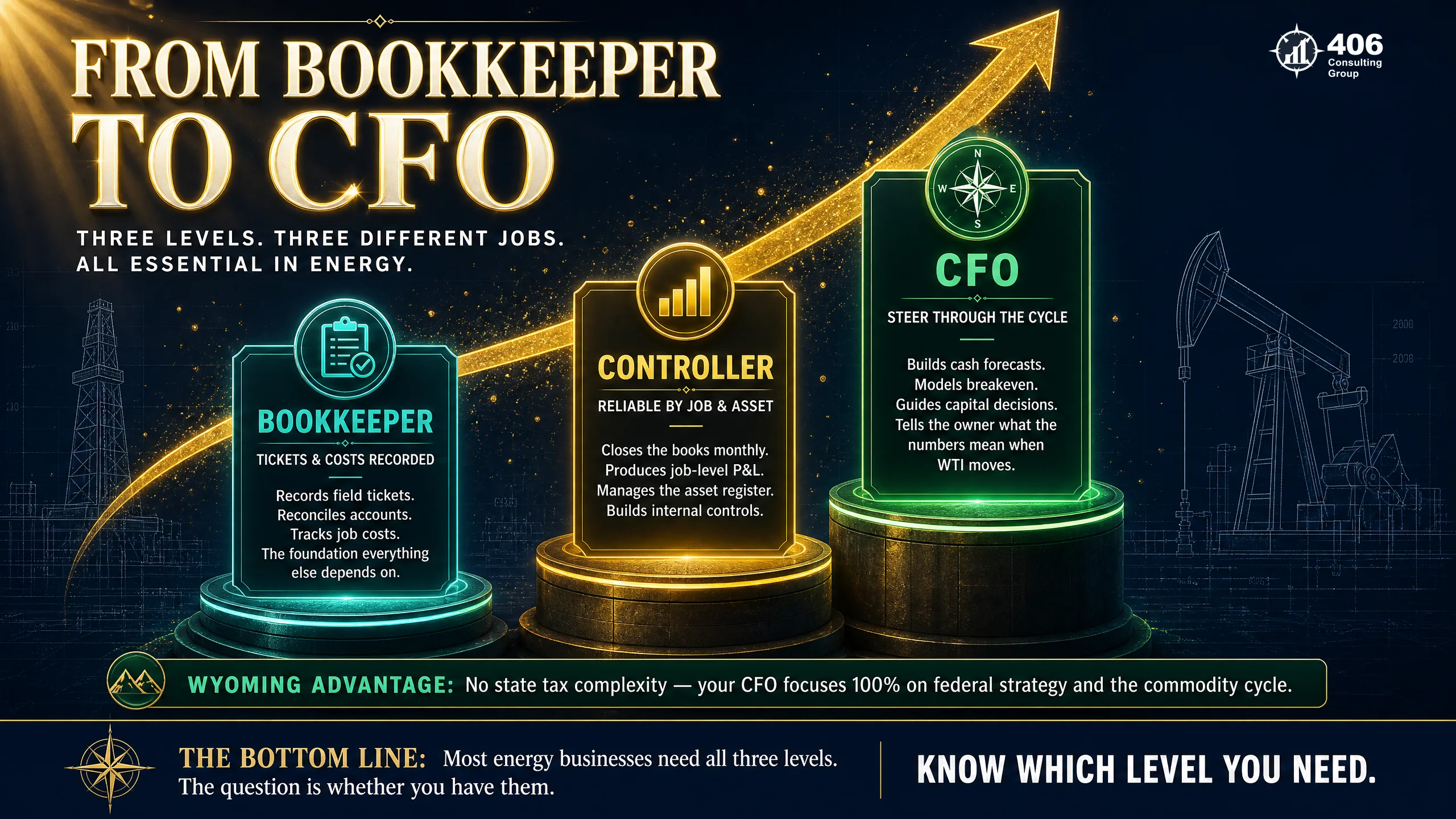
The question is which kind of help you need, and how to get it without overpaying. That starts with the roles.
Bookkeeper vs. Controller vs. CFO
These three roles get blurred constantly, but they're distinct — and hiring the wrong one for your problem is a common, expensive mistake.
| Role | Core question they answer |
|---|---|
| Bookkeeper | "Are the field tickets, costs, and transactions recorded and reconciled?" |
| Controller | "Are the financials right, on time, and controlled — by job and by asset?" |
| CFO | "What do the numbers tell us to do next — through the cycle?" |
A quick rule: if your numbers are late or wrong, you need a controller. If your numbers are clean but you can't see the breakeven or the cash runway, you need a CFO. Many growing Casper energy businesses need some of both — which a coordinated fractional engagement delivers. We cover the first step up in upgrading from bookkeeping to a controller.
The Cost Math: Fractional vs. Full-Time
Full-time financial leadership is expensive, and at most growing energy businesses it isn't a 40-hour-a-week job yet — and in a downcycle, a big fixed salary is exactly the kind of overhead you don't want locked in. Fractional gives you the expertise scaled to what you actually need, and flexes with the cycle.
| Role | Fractional (per month) | Full-time (annual) |
|---|---|---|
| Controller | ~$2,500–$6,000 | $85K–$120K + ~25% benefits |
| Fractional CFO | ~$2,500–$5,000 | $150K–$300K+ + benefits |
| Both, coordinated | ~$4,000–$8,000 | $235K–$420K+ |
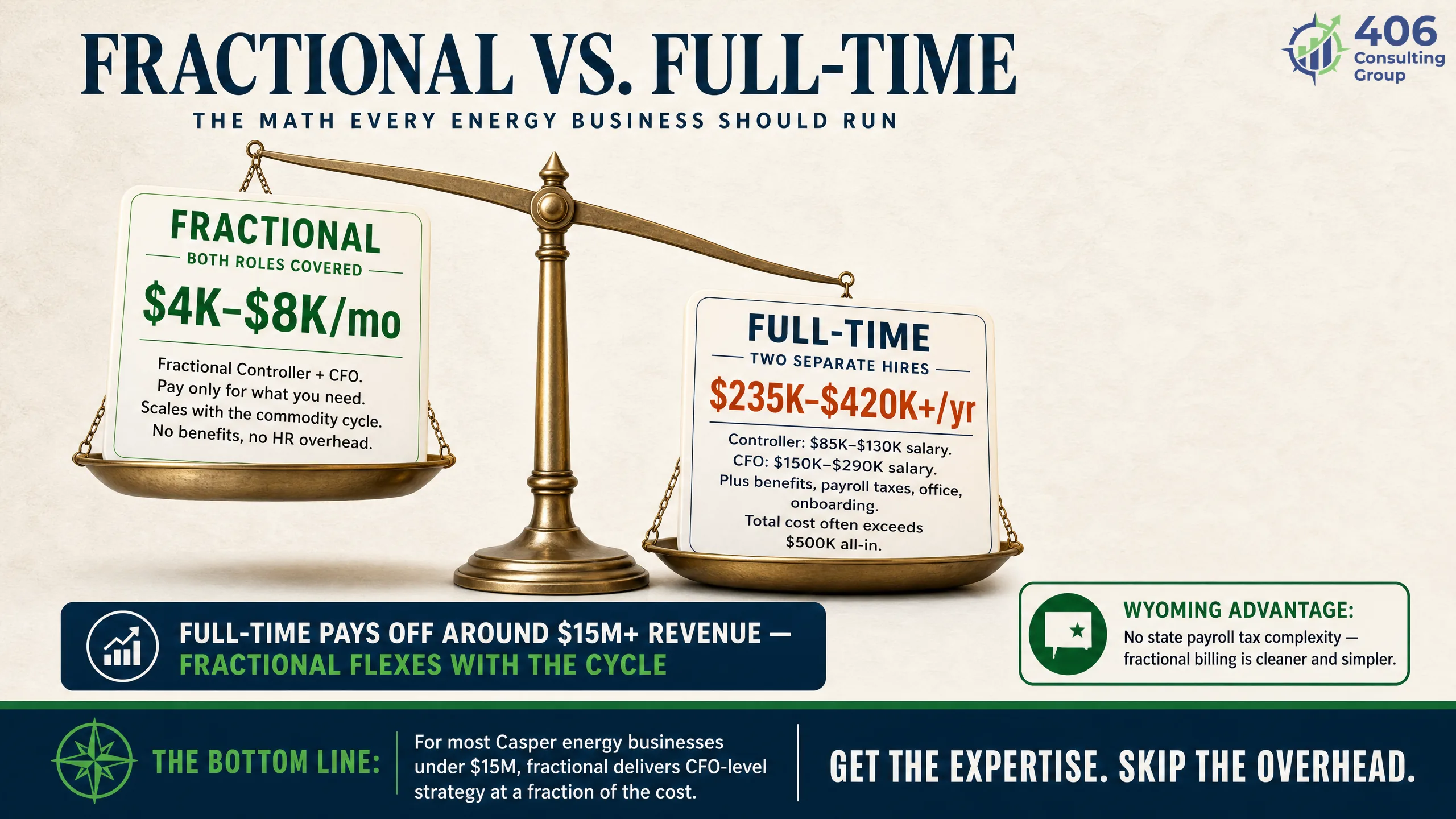
Fractional is dramatically more cost-effective until a business reaches the scale — generally $15M+ — that keeps a full-time hire busy year-round. Estimate the controller piece with our Controller Estimator.
What a Controller Delivers
A controller owns the integrity of your financials. For an energy business that means a reliable monthly close, accurate statements you can trust, clean job-costing so every rig and job is tracked, and a current fixed-asset register for all that equipment. It also means the controls that keep things clean as you scale — approval flows, reconciliations, and reporting that ties field tickets to revenue.
Because we come from the field and build around the whole operation, controller processes get set up the way energy work actually runs — jobs, tickets, equipment, crews — not a generic template. That's what keeps the numbers useful for decisions, not just compliant for the return.
Once the monthly numbers are reliable, most owners want to use them — which is the CFO's job.
What a CFO Delivers
A CFO turns reliable numbers into forward strategy — and in energy, that strategy is dominated by the cycle. The core work: cash-flow forecasting far enough ahead to act, breakeven analysis by rig and job, financing strategy for equipment, budgeting and scenario planning across price swings, and a seat at the table for the big calls — buy or lease, expand or hold, take the contract or pass.
For a Casper energy business, the CFO's highest-value work is usually two things: making sure growth is funded and financed without over-leveraging into a downturn, and building the cash discipline to survive one. Both are about seeing around the corner instead of reacting to last month's bank balance.
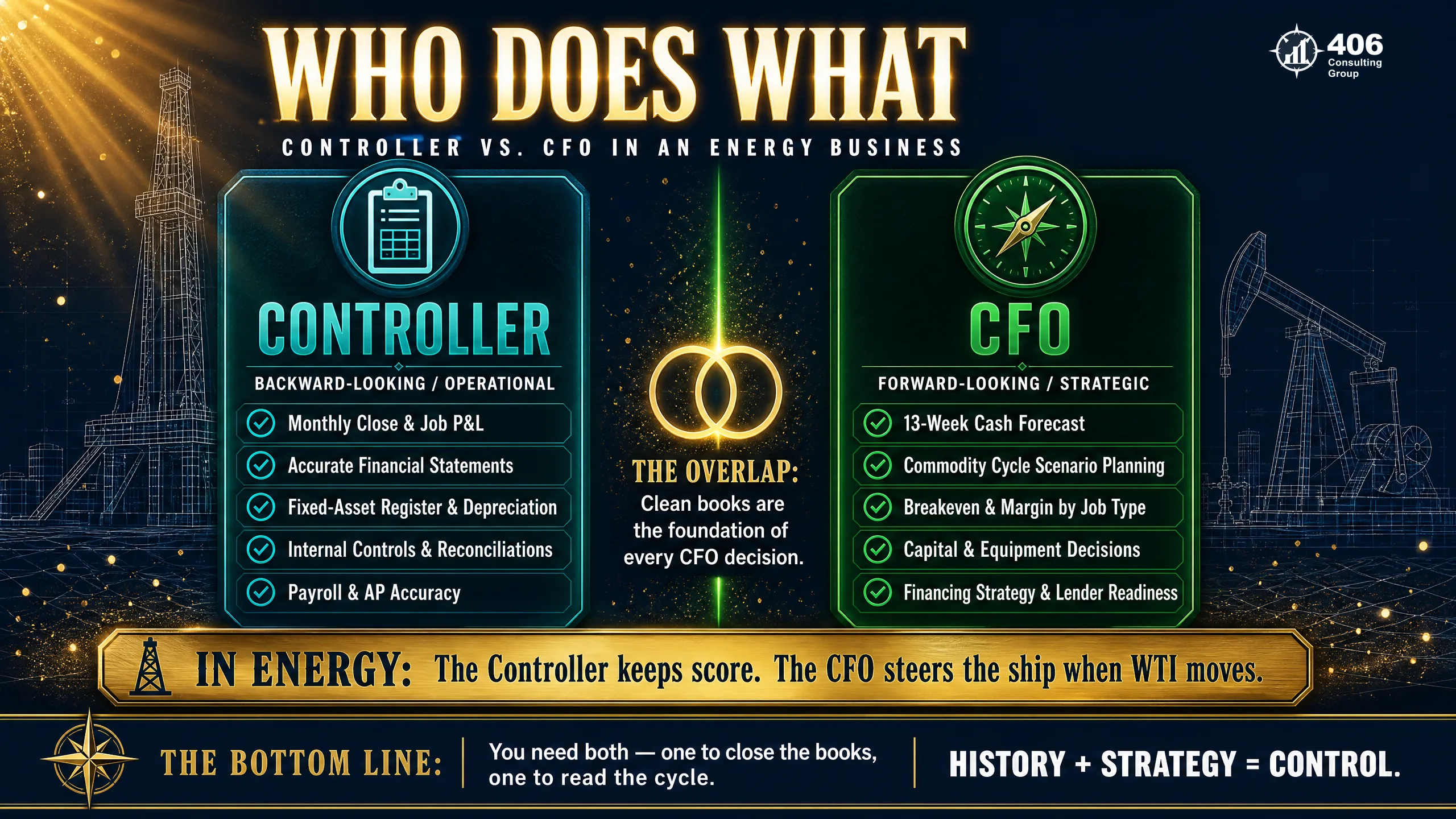
You rarely need both at full strength at once — which is why a coordinated fractional engagement, dialed to your stage and the cycle, is usually the right answer.
Cash Forecasting & Surviving the Cycle
This is the heart of energy CFO work. Revenue swings with commodity prices and slow-paying customers, while big equipment outflows and payroll roll on regardless — so a 13-week cash forecast, plus a longer capital plan, is the tool that keeps a good company alive through a bad stretch. It maps when cash actually lands against when it has to go out, and it flags a squeeze while there's still time to act.
The discipline works in both directions. In the boom, the forecast argues for building reserves and resisting the urge to over-expand; in the bust, it drives fast, deliberate cuts and protects the cash that gets you to the other side. Having lived the cycles, we build forecasts that flag the turn early — receivables stretching, utilization dropping, margins compressing — rather than confirming it after the cash is gone.
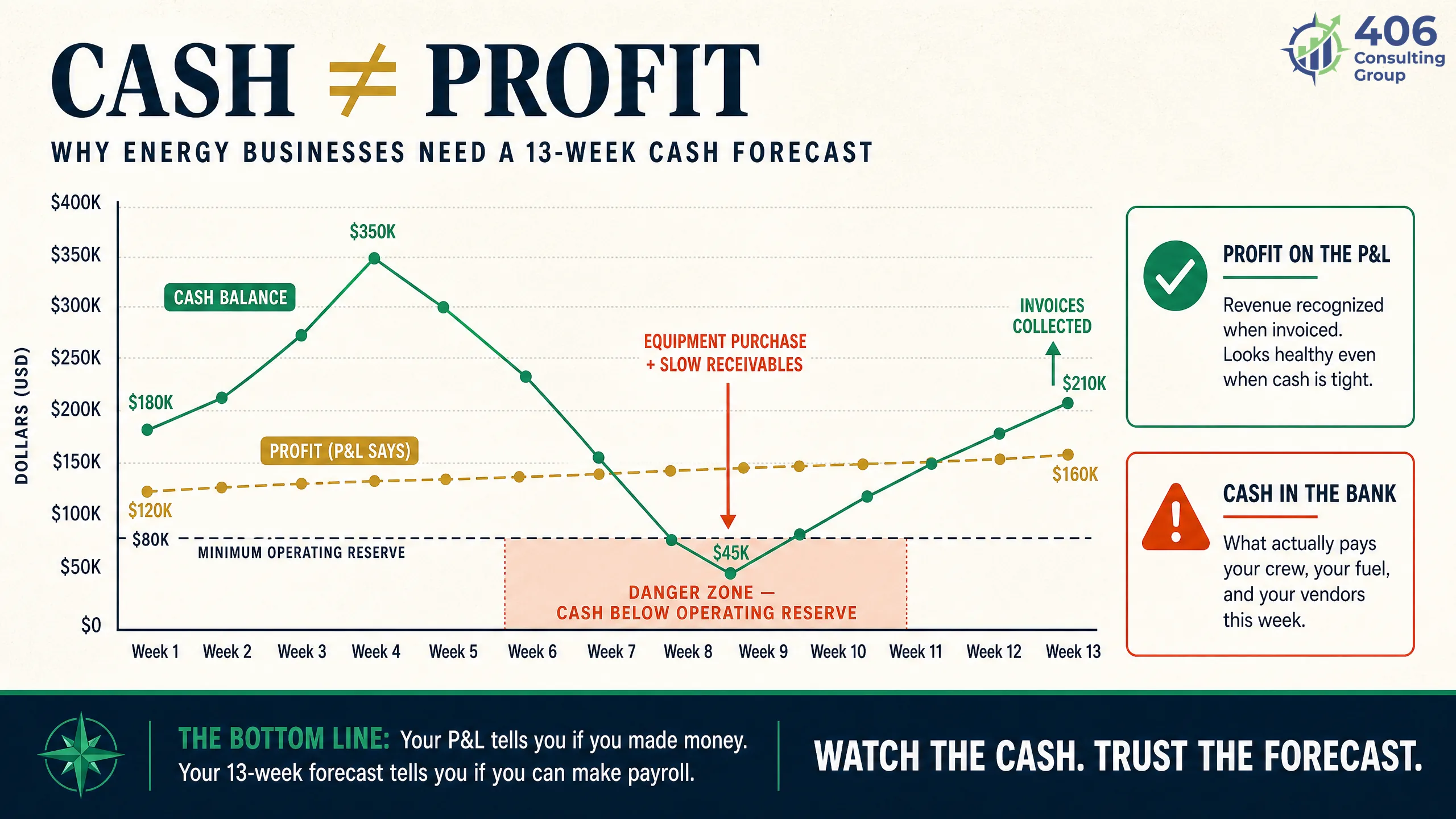
Want a quick read on your runway? Try our Cash Flow Runway tool, and see why profit and cash aren't the same.
Margin & Breakeven per Rig, Well & Job
In a cyclical business, knowing your breakeven is survival, not a nicety. A CFO digs into the real margin on each rig, crew, and job once you load in equipment, fuel, labor, maintenance, and overhead — and calculates the day rate or job price you need to actually make money, not just stay busy. In a downturn, that number tells you which work is worth taking at lower prices and which is bleeding you.
The insight is often uncomfortable and always valuable: the busiest rig isn't always the most profitable, and chasing revenue at any price in a soft market can accelerate the very cash crunch you're trying to avoid. Clear breakeven math turns pricing and utilization decisions from gut calls into deliberate ones.
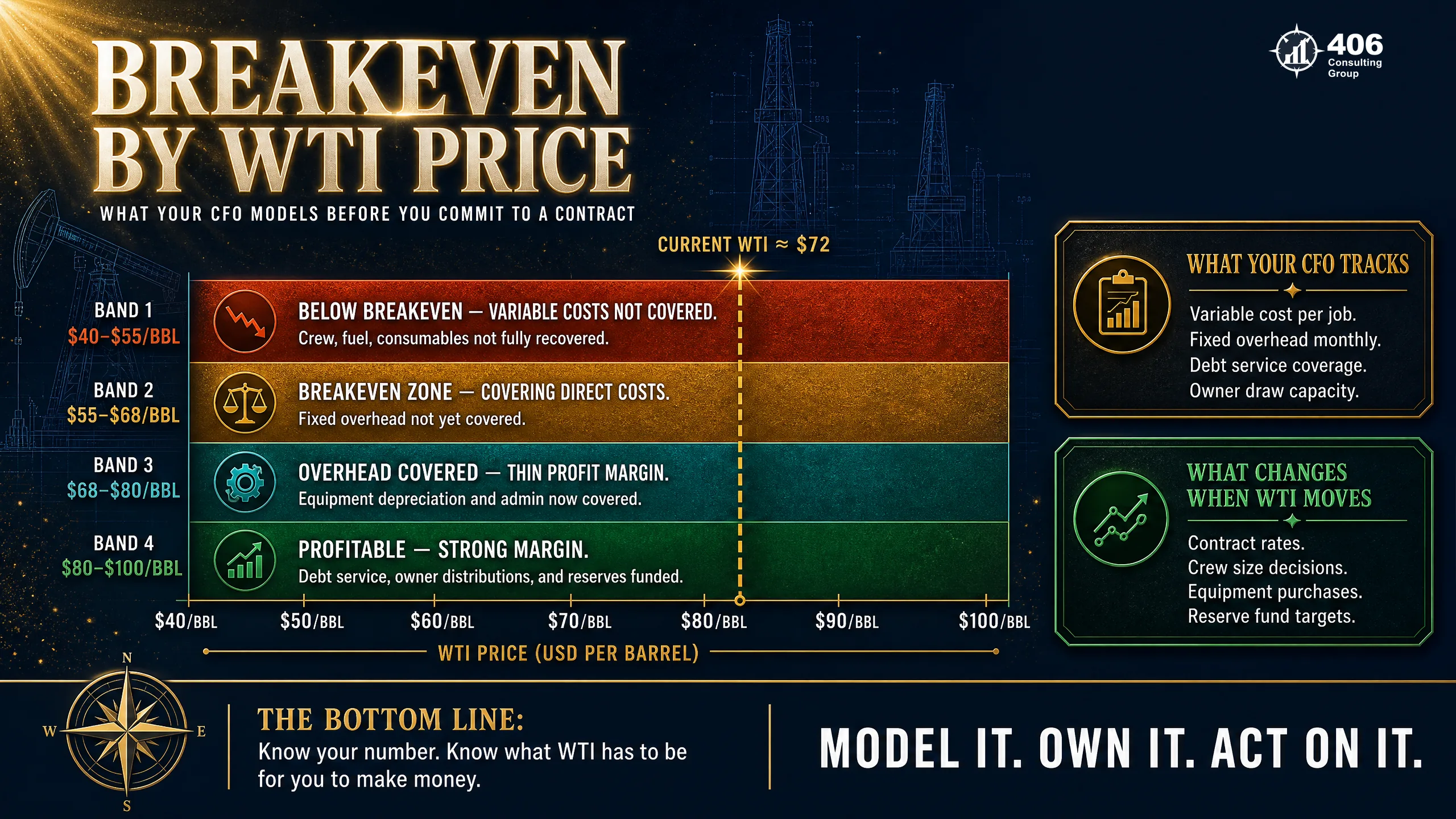
That single shift — pricing and dispatching off real breakeven — often funds the cost of the CFO several times over.
Financing Equipment & Bank Covenants
Energy growth runs on financed iron — rigs, trucks, and equipment — and how you finance it determines whether you survive the next downturn. The trap is over-leveraging in the boom: debt payments that look easy at $80 oil become crushing at $50. A CFO structures financing the cycle can actually service, and gets the business genuinely ready for the lender before you ask.
This is where my banking background pays off directly: I've sat on the underwriting side of 300+ loan reviews, so we prepare your business the way a lender evaluates an energy borrower — clean financials, a credible forecast, and realistic collateral values that account for volatility. Just as important, we help you understand and manage loan covenants, so a soft quarter doesn't trip a technical default when you can least afford it.

See our loan readiness work for how we get a business bank-ready.
When to Hire — and the Fractional Path
A few clear signals mean it's time for financial leadership:
You don't know your real breakeven
If you can't say what a rig or job needs to earn to make money, you're pricing blind — dangerous in a soft market.
Financials are late, or you don't trust them
If the monthly close is a scramble or the job numbers feel off, you need a controller first.
You're financing equipment or carrying real debt
Capital to fund and covenants to manage through a cycle — a CFO's core problem.
A downturn is squeezing cash
If a soft market is tightening cash, you need a forecast and a plan now, not next quarter.

The fractional path lets you start with exactly what you need — often a controller to get job costing and the close right, then CFO strategy for cash, breakeven, and financing — and scale up or down with the cycle, without the risk of a six-figure hire.
Local vs. a Great Remote Partner
Financial leadership is analysis and judgment — building the forecast, calculating breakeven, structuring financing, managing covenants, and talking through the big calls. None of it depends on being in the room; what matters is whether your partner understands energy's cycle and capital intensity and can do the thinking. A great remote CFO who knows the industry beats an okay local one who doesn't, every time.
It's also how we already work. Around 70–80% of our own local clients never come into the office; forecasts and reviews run on shared screens and live dashboards, with regular strategy calls. So whether you're in Casper, out in Natrona County, or running crews across the basin, you get the same financial leadership our in-town clients do — with a banker's eye and real field experience behind the numbers.
Distance isn't the variable. Knowing energy — and knowing the numbers — is.
How to Get Started
Getting financial leadership in place is three steps.
Diagnose what you actually need
Late/wrong job numbers point to a controller; clean-but-unused numbers point to a CFO. We start by pinpointing the real gap.
Get the foundation right
Reliable job costing, a clean asset register, and a trustworthy monthly close — the CFO work is only as good as the numbers under it.
Layer on cycle strategy
Cash forecasting, breakeven per rig/job, and financing readiness, scaled to your stage and the market.
Not sure which layer you need? Our Financial Maturity Assessment maps it out in about eight minutes.
FAQ: Casper CFO & Controller Questions
How much do CFO and controller services cost in Casper, WY?
Fractional pricing typically runs about $2,500–$6,000 per month for a controller and about $2,500–$5,000 per month for a fractional CFO, depending on complexity and scope. A coordinated engagement covering both often runs roughly $4,000–$8,000 per month. Compare that to full-time salaries — $85K–$120K for a controller and $150K–$300K+ for a CFO, plus roughly 25% in benefits — and fractional is dramatically more cost-effective until a business reaches the scale (generally $15M+) that keeps a full-time hire busy year-round. In a cyclical energy business, fractional also avoids locking in a big fixed salary through a downturn.
What does a CFO actually do for an energy-services business?
The core work is cycle-driven: cash-flow forecasting far enough ahead to act, breakeven analysis by rig and job, financing strategy for equipment, and scenario planning across price swings. A controller keeps the job costing, close, and asset register reliable; the CFO uses those numbers to decide how much equipment you can afford, what price a job needs to clear, how to finance without over-leveraging, and how much cash to hold for the next downturn. In energy, that forward view is often the difference between surviving a bad stretch and not.
Why is cash forecasting so important in the energy business?
Because energy revenue swings with commodity prices and slow-paying customers, while equipment payments and payroll roll on regardless. Profitable companies fail in downturns when cash runs out before the cycle turns. A 13-week cash forecast plus a longer capital plan maps when cash lands against when it must go out, flags a squeeze while there's still time to act, and enforces the discipline to build reserves in the boom and cut fast in the bust. It's the single most valuable tool a CFO brings to a cyclical business.
When should a Casper energy business hire financial leadership?
When you can't state the real breakeven on a rig or job; when the monthly financials are late or you don't trust the job numbers; when you're financing equipment or carrying real debt through a cycle; or when a downturn is squeezing cash. Late or untrusted numbers point to a controller first; clean-but-unused numbers point to a CFO. The fractional path lets you start with what you need now and scale with the market.
Can 406 Consulting Group provide CFO and controller services remotely?
Yes — it's how the work is done now. Forecasting, breakeven, financing prep, and strategy reviews all happen over shared screens, live dashboards, and regular calls; none of it requires being in the room. Around 70–80% of our own local clients never come into the office either. What matters is understanding energy's cycle and capital intensity and doing the analysis well — and with a commercial-banking background plus real oil-field experience behind the numbers, you get both a lender's eye and someone who's worked the field, whether you're in Casper or anywhere in Wyoming.
Keep Reading
CFO & Controller — Casper, WY
Survive the Cycle. Steer by the Numbers.
406 Consulting Group gives Casper energy businesses fractional controller and CFO leadership — job costing, cash forecasting, breakeven, and financing readiness — delivered remotely, with a banker's eye and real field experience.
Fractional vs. Full-Time
Casper, WY — typical ranges
Riding the Cycle Blind?
Breakeven, cash & financing, handled.
About the Author
Carrie Anderson
Co-Founder, 406 Consulting Group
Commercial banking and underwriting background — 300+ loan reviews — plus extensive oil-field experience. Carrie helps Casper energy businesses forecast cash through the cycle, price off real breakeven, and finance equipment without over-leveraging — a banker's eye and field experience on the numbers.
Read the Full Story