
Tax Planning in Houston, TX:
No Income Tax, Real Planning Still Pays
No state income tax makes Texas look simple — so the moves that matter get missed. The margin-tax election, property and sales-tax exemptions, and the federal levers where a Houston business actually saves.

No state income tax should make Texas tax planning simple — and in one sense it does: a huge category of state-level maneuvering that businesses in California or New York obsess over simply doesn't exist here. But that's exactly why the planning that does matter gets overlooked. The real levers in Texas are the franchise (margin) tax — where a single election can meaningfully change what you owe — property tax and its exemptions, the sales-tax exemptions that Houston's industrial base leaves on the table, and the federalplanning that no-income-tax owners often under-use because they assume "Texas is easy."
This is the planning companion to our Houston bookkeeping guide. Where that one covers recording the margin tax, the BPP rendition, and sales tax, this one is about the decisions that lower the bill: the COGS-versus-compensation election, the Freeport and manufacturing exemptions, entity structure, and the federal depreciation and QBI moves that matter most to equipment-heavy energy and industrial businesses. All delivered remotely.
By Jason Anderson — Co-Founder, 406 Consulting Group. Big-firm-trained accountant with oil & gas industry experience, advising energy, construction, and small businesses across the Mountain West and Southwest on tax strategy that actually moves the number.
Quick Answer: Tax Planning for a Houston Business
- →No income tax — so no PTE/SALT workaround to chase; the leverage is on margin tax, property tax, and federal.
- →Margin-tax election: deducting the greater of COGS or compensation can meaningfully change your taxable margin.
- →Property-tax exemptions like Freeport and manufacturing can cut the equipment/inventory bill — if you claim them.
- →Federal is where the dollars are: depreciation (bonus/§179), cost seg, QBI, and estimates.
- →Delivered remotely — Texas + energy expertise matters far more than a local office.
Table of Contents
Why Houston Tax Planning Is Different
In a high-income-tax state, planning is mostly about the income tax — brackets, timing, entity elections, and SALT-cap workarounds. Texas erases that entire layer, which is genuinely valuable but also lulls owners into thinking there's nothing to plan. There is; it just lives in different places. The margin tax has a real election baked into it. Property tax — the price Texas charges instead of income tax — has exemptions most businesses never claim. And with no state return to fuss over, the federal return becomes the main event, where equipment-heavy Houston businesses have some of the biggest levers available anywhere.
That's the thing a "Texas is easy" mindset misses. A generic preparer files the franchise report, renders the property, and moves on — leaving the COGS-versus-compensation choice unoptimized, the Freeport and manufacturing exemptions unclaimed, and federal depreciation and QBI under-planned. In Houston, the money is in the moves nobody thinks to make because the state income tax isn't there to force the conversation.

Start with what "no income tax" actually changes about the plan.
No Income Tax Changes the Whole Game
The absence of a state income tax has real, positive planning consequences beyond the obvious savings. There's no state pass-through entity (PTE) election to make, because there's no state income tax to work around the federal SALT cap on — a whole planning exercise that businesses in Arizona, Utah, and dozens of other states have to run simply doesn't apply. There's no state-level bracket management, no state timing of income, no state credits to chase.
What that means practically: your planning energy should shift almost entirely to the three places Texas does tax — the margin tax, property, and sales/use — plus the federal return, which for a profitable Texas business carries essentially all of the income-tax weight. Owners who come from income-tax states sometimes keep planning as if the state matters most; in Texas, the federal side and the property/exemption side are where the real dollars move.
It's a genuinely simpler picture — but simpler isn't the same as "nothing to do."
The Margin Tax's Hidden Lever: COGS vs. Comp
Here's the planning lever most Texas owners don't realize they have. The franchise tax is calculated on your margin, and margin is broadly your total revenue minus the greater of a few allowed deductions — most importantly, either your cost of goods sold or your compensation, with margin capped at 70% of revenue. (Smaller filers can instead choose a simplified "E-Z" computation that skips the deduction analysis entirely — its own trade-off worth checking.) Because you generally take whichever deduction is larger, the way your business is structured and how your books classify costs directly affects which deduction wins — and therefore what you owe.
A labor-heavy energy-services or professional firm may do better on the compensation deduction; a goods- or materials-heavy operation may do better on COGS. There are real definitional rules about what counts as COGS and what counts as compensation in Texas (they don't always match the federal definitions), and getting the classification and the calculation right is exactly the kind of thing a generic preparer skips. This matters most once you're over the roughly $2.47 million no-tax-due threshold (verify current) — below it many small businesses owe no franchise tax at all — but once you're above it, it's recurring money for getting the analysis right, and it compounds every year.
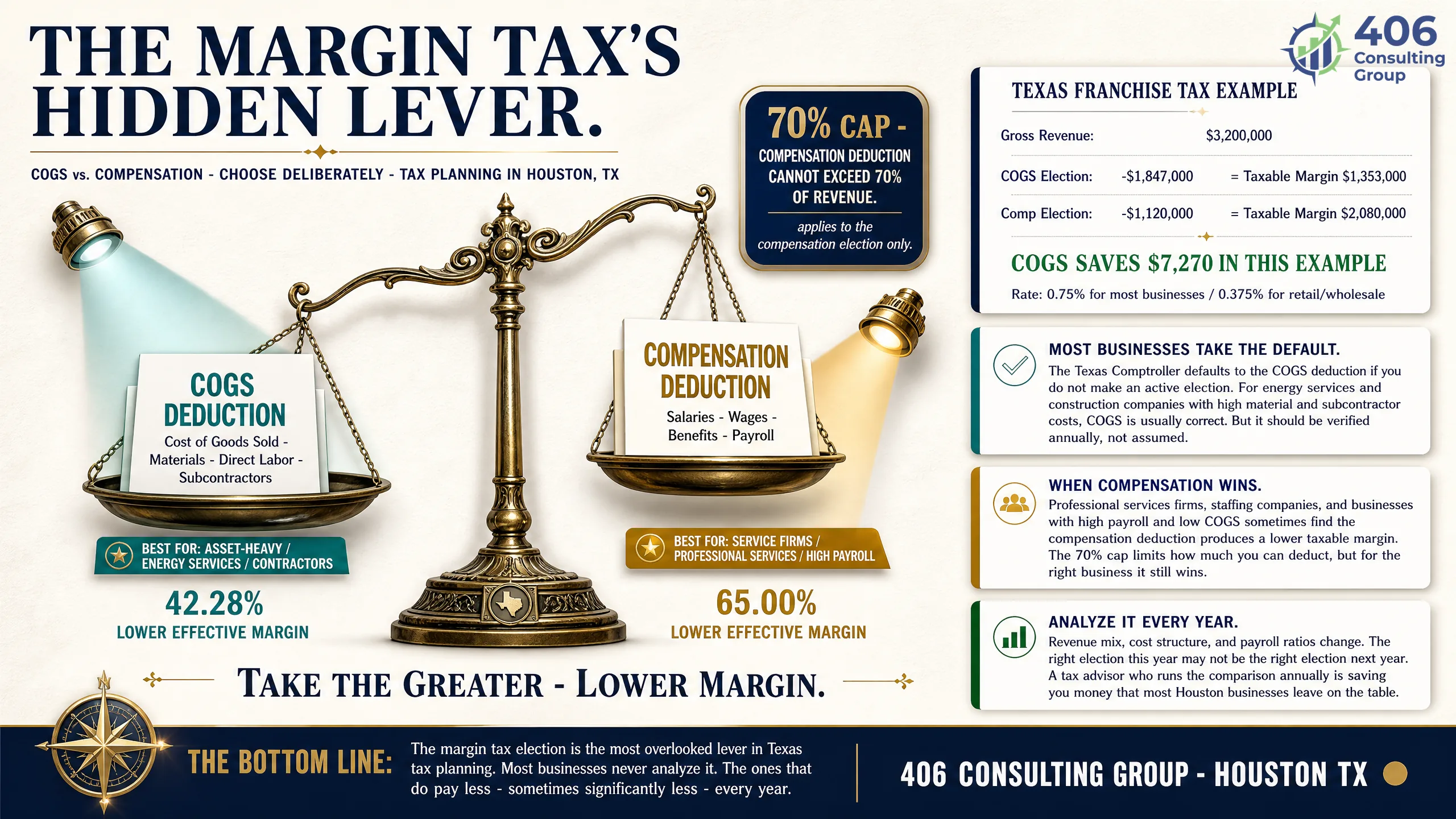
Confirm the current rules and definitions with the Texas Comptroller — and run the COGS-versus-compensation analysis deliberately, not by default.
Property-Tax Planning & the Exemptions
Because Texas leans on property tax — including the business personal property (BPP) tax on equipment and inventory — property is a genuine planning arena, not just a compliance chore. Two exemptions matter especially for Houston's industrial and logistics businesses. The Freeport exemption can exempt certain inventory that leaves Texas within a set window (often cited as 175 days) from property tax — big for distributors and manufacturers shipping out of state. The goods-in-transit exemption addresses inventory held temporarily in transit. There are also exemptions for certain pollution-control property, relevant to petrochem and industrial operations.
These aren't automatic — they generally have to be applied for, on time, with documentation, and some are locally adopted so availability varies by jurisdiction. Beyond exemptions, planning includes keeping a clean fixed-asset schedule so you're not rendering (and paying on) equipment you've retired, and being ready to protest an over-assessed valuation. Getting property planning right can move real money for an asset-heavy Houston business.

Confirm what your county and taxing units offer with your appraisal district — and claim what you're entitled to, on time.
Capturing the Sales-Tax Exemptions
Sales and use tax is a planning area too, because Texas offers meaningful exemptions that Houston's industrial base routinely under-claims. The manufacturing exemption can cover equipment and items used in producing a product for sale; there are specific rules for oil & gas and oilfield uses; and resale and other exemptions apply where goods pass through rather than being consumed. The catch is that these require correct classification and valid exemption and resale certificates on file — and the taxability of many oilfield services in particular is genuinely nuanced.
The planning payoff runs both directions: claiming exemptions you're entitled to (so you stop paying tax on exempt equipment) and correctly accruing use tax where you owe it (so an audit doesn't surprise you). Set up deliberately, this is a quiet, recurring saving; ignored, it's either overpayment or exposure. For oilfield-services taxability specifically, it's worth confirming treatment with a pro or the Comptroller.
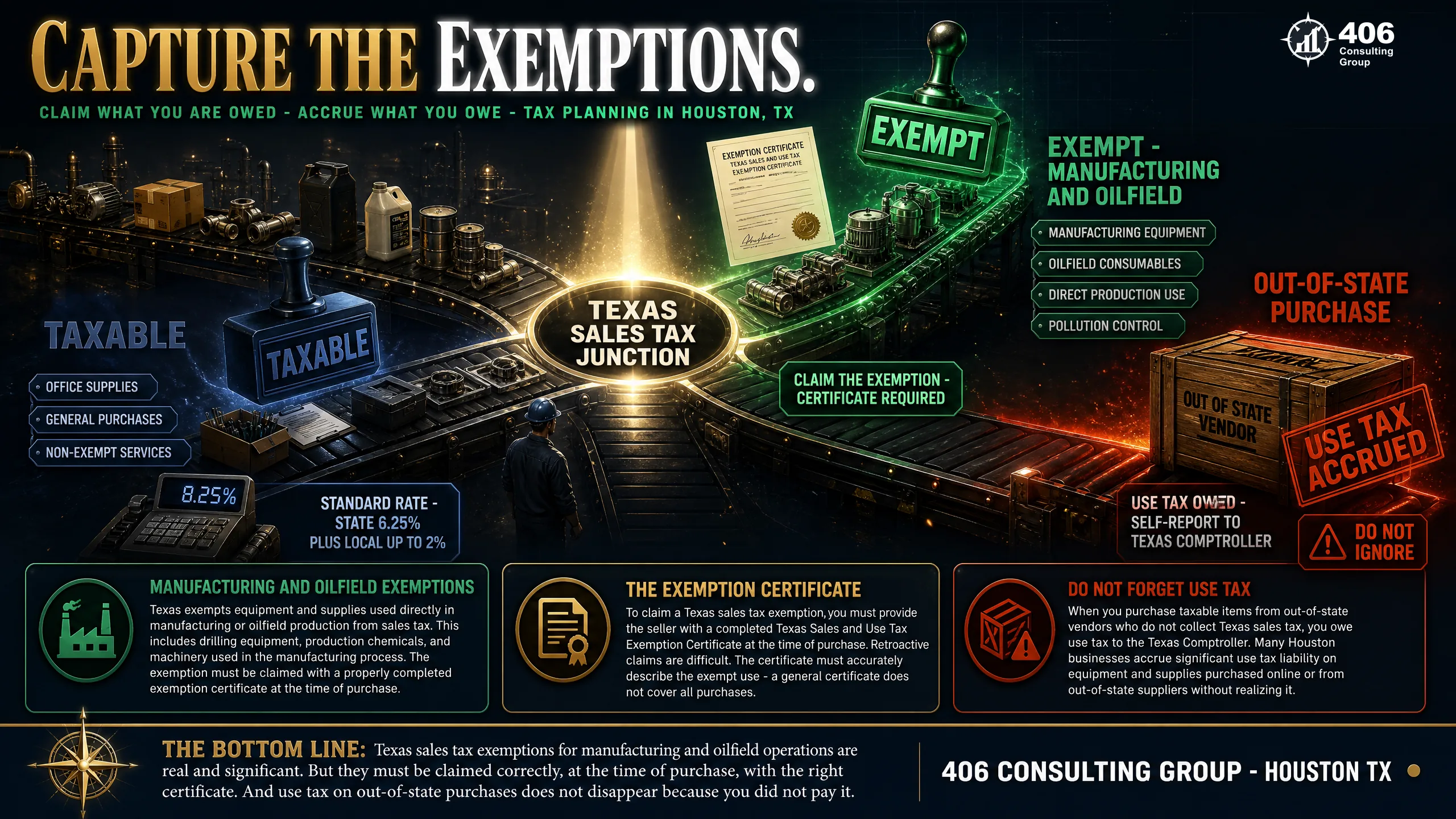
The mechanics of tracking taxable-versus-exempt live in the bookkeeping guide; the decisions that capture the savings live here.
Entity Choice Without a State Income Tax
Entity choice looks different in Texas because the usual state-tax reasons for it are gone. The classic S-corp benefit is still fully in play, but it's entirely federal: paying yourself a reasonable salary and taking the rest as distributions can reduce self-employment tax, exactly as it would anywhere. What Texas removes is any state-income-tax angle — there's no state rate to optimize and no PTE election to unlock.
Texas does add one wrinkle: the franchise tax generally applies to entities like LLCs, corporations, and S-corps, while sole proprietorships and certain general partnerships of natural persons are typically outside it — so the entity you choose can affect whether you're in the franchise-tax system at all. The decision usually comes down to federal self-employment savings and liability protection, weighed against franchise-tax and administrative considerations. Our S-Corp Calculator gives a first-pass federal estimate, and we pressure-test it against the Texas specifics.
The point is to choose the entity deliberately, knowing exactly which benefits are federal and which are Texas.
Equipment, Depreciation & Cost Seg
For equipment-heavy Houston businesses — energy services, industrial, construction — depreciation is where federal planning earns real money. Section 179 expensing and bonus depreciation can let you deduct a large share of equipment purchases in the year you buy, and because there's no state income tax in the mix, the analysis is cleaner than in states where federal and state depreciation diverge. For businesses that own or build real property, a cost-segregation study can accelerate depreciation on components of a building, front-loading deductions.
Faster isn't automatically better — accelerating deductions interacts with your QBI deduction, your multi-year income, and your plans to buy or sell equipment — but for a growing, asset-heavy energy business, deliberate depreciation planning is one of the largest federal levers available. There's also a Texas angle: how and when you hold equipment ties back to the BPP rendition, so federal depreciation and property planning are worth coordinating rather than running separately.
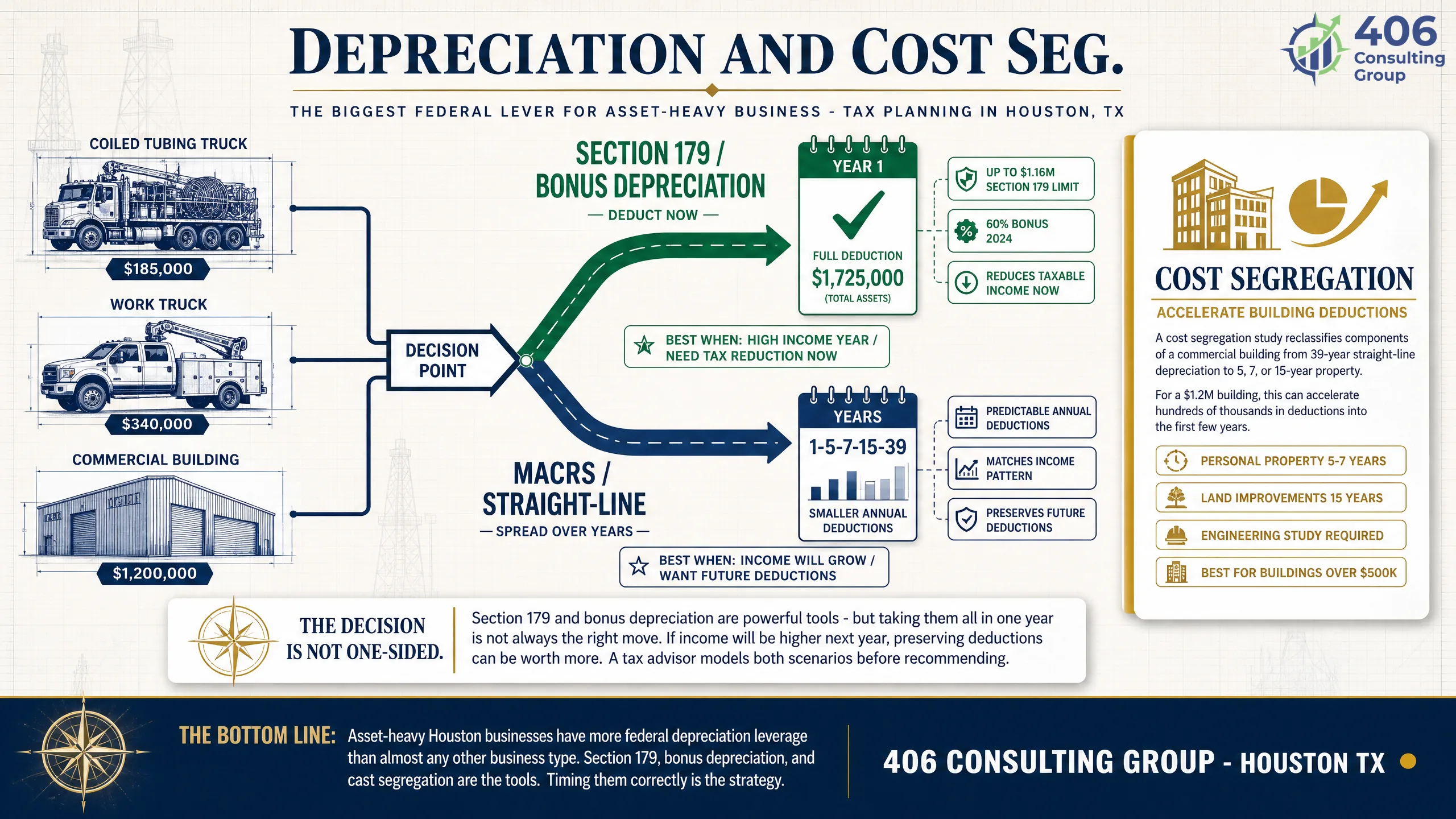
The right answer is whatever fits your multi-year picture — not "deduct it all now" by reflex.
Federal Levers: QBI & Estimates
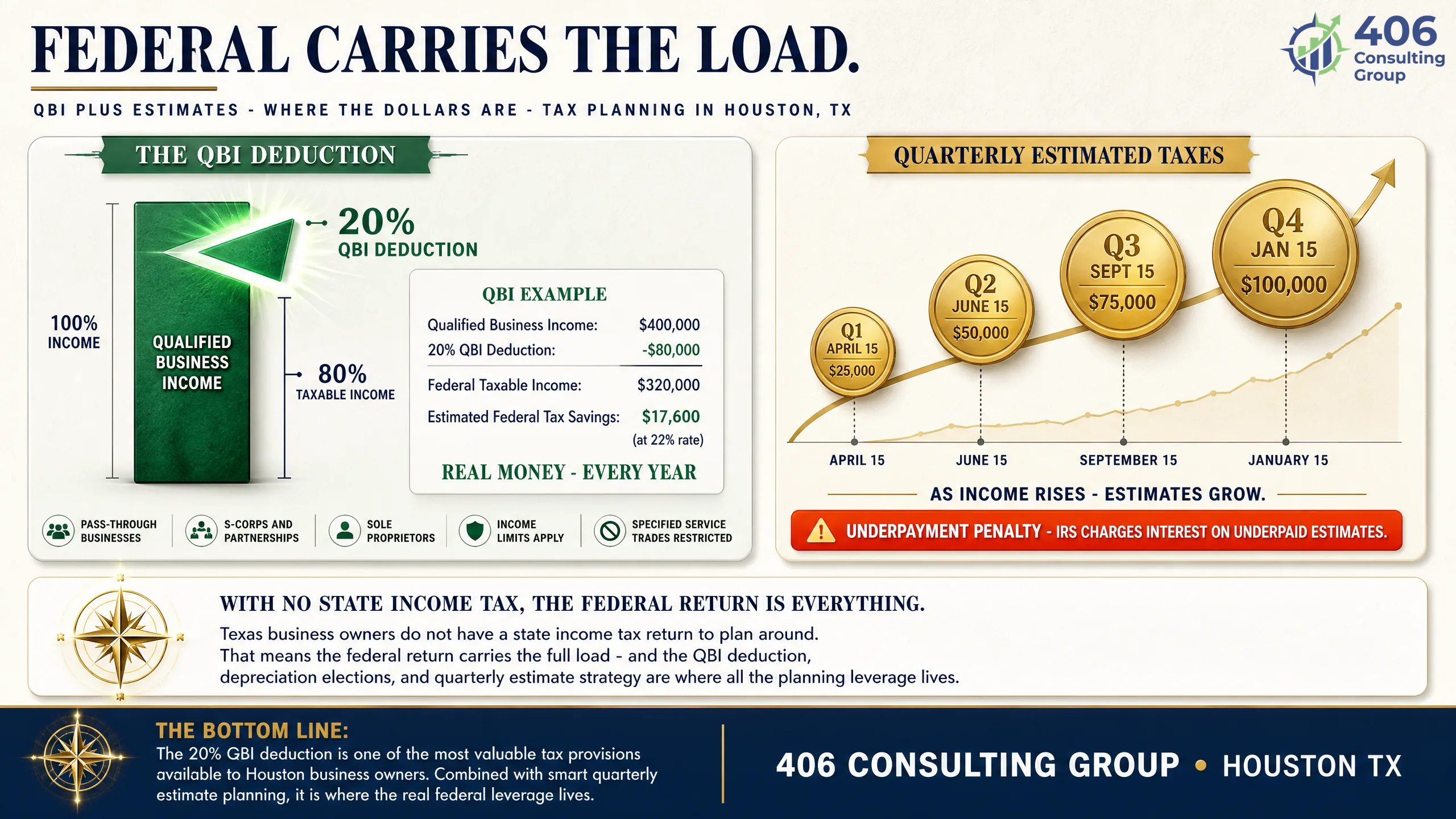
With no state income tax, the federal return carries the load — so the federal levers matter more, not less. The Qualified Business Income (QBI) deduction — up to 20% of qualified pass-through income, subject to thresholds and limits — is one of the biggest for a Houston small business, and it interacts with your salary, entity choice, and depreciation decisions, so it rewards planning them together rather than discovering them at filing.
Profitable owners also owe federal quarterly estimated taxes, and in Texas that's essentially the whole estimated-tax picture since there's no state counterpart. In a business tied to energy and commodity cycles, income can swing hard year to year, so estimates should track real results rather than a stale prior-year number — underpaying just adds penalties to the bill.
It's the throughline of Texas planning: the state is light, so make the federal moves count.
The Houston Tax Calendar
Texas swaps income-tax dates for its own rhythm — the franchise report and the property cycle are the ones that catch newcomers.
| Obligation | Rough cadence |
|---|---|
| Franchise (margin) report | Annually, generally due May 15 (verify current) |
| BPP rendition | Annually to the county appraisal district, generally due mid-April (verify) |
| Sales & use tax | Monthly, quarterly, or annually per your assigned frequency |
| Federal estimated tax | Quarterly — mid-Apr, mid-Jun, mid-Sep, mid-Jan |
| Payroll & 1099s | Per federal schedule; W-2s & 1099s in January (no state withholding) |
Confirm your specific due dates with the Texas Comptroller and your appraisal district — the May franchise date and the spring rendition are the two that most often surprise businesses new to Texas.

Common Houston Tax Mistakes
The costly mistakes here cluster around assuming "no income tax" means "no planning."
Not optimizing the margin-tax deduction
Failing to run COGS versus compensation leaves the franchise tax higher than it needs to be, every year.
Leaving property exemptions unclaimed
Freeport, goods-in-transit, and pollution-control exemptions must be applied for — miss them and you overpay.
Under-claiming sales-tax exemptions
Manufacturing and oilfield exemptions go unused without the right certificates and classification.
Under-using federal levers
Assuming Texas is 'easy' leads owners to under-plan depreciation, cost seg, and QBI — where the real dollars are.
Stale estimated taxes in a swing year
Energy-tied income moves fast; paying on last year's number leaves a shortfall plus penalties.
Every one is avoidable with planning that starts before year-end — not at the filing deadline.
Local vs. a Great Remote Partner
Tax planning is even less about geography than bookkeeping is. What lowers a Houston business's bill is expertise — knowing the margin-tax election, the property exemptions, the oilfield sales-tax rules, and the federal depreciation and QBI interactions — not whether your accountant's office is off the Beltway. A remote partner who plans Texas taxes and understands the energy business beats a nearby generalist who files the franchise report and stops there.
And planning is naturally a remote, year-round conversation: a mid-year check-in over a screen share, a quick call before a big equipment purchase or a new contract, a clean hand-off to filing. We do this with businesses across Houston and Harris County the same way we do across the Mountain West — and our genuine oil & gas experience means the conversation is grounded in how an energy business actually runs, not just the tax code.
The bill is set by the decisions, and the decisions are set by expertise — not by a zip code.
How to Get Started
Getting ahead of your Houston taxes is three steps.
Optimize what Texas taxes
Run the COGS-versus-compensation margin analysis, claim the property and sales-tax exemptions you're entitled to, and confirm your entity fits.
Make the federal moves count
Plan depreciation (§179/bonus), cost seg where it fits, QBI, and estimates that track real income — that's where the dollars are.
Review through the year
A mid-year check and pre-decision calls turn tax from a surprise into a managed number — especially in a swing-income business.
Want a first read on whether an S-corp election pays off for you? Start with our S-Corp Calculator, then let's pressure-test it together.
FAQ: Houston Tax Questions
If Texas has no income tax, is there anything to plan?
Yes — quite a lot, it just lives in different places than in an income-tax state. The franchise (margin) tax has a real planning lever in the choice between deducting cost of goods sold or compensation. Property tax — which Texas leans on instead of income tax — has exemptions (like Freeport) most businesses never claim. Sales tax has manufacturing and oilfield exemptions that go under-used. And because there's no state income tax, the federal return carries all the income-tax weight, making federal moves like depreciation, cost segregation, and QBI more important, not less. 'No income tax' removes one layer; it doesn't remove planning.
What is the COGS-versus-compensation election on the margin tax?
The Texas franchise tax is calculated on your margin, which is broadly total revenue minus the greater of certain deductions — most importantly either cost of goods sold or compensation, with margin capped at 70% of revenue. (Smaller filers can instead choose a simplified E-Z computation that skips this deduction analysis.) Because you generally take whichever deduction is larger, a labor-heavy business often does better deducting compensation while a goods-heavy one does better on COGS. Texas has its own definitions of what counts as COGS and compensation, so getting the classification and choice right can lower the tax. It matters most once you're above the roughly $2.47 million no-tax-due threshold (many smaller businesses owe no franchise tax at all), but above it, it's recurring money for doing the analysis.
What property-tax exemptions can a Houston business claim?
Because Texas taxes business personal property (equipment and inventory), exemptions matter. The Freeport exemption can exempt certain inventory that leaves Texas within a set window (often cited as 175 days), which helps distributors and manufacturers shipping out of state. The goods-in-transit exemption covers inventory held temporarily in transit, and there are exemptions for certain pollution-control property relevant to petrochem and industrial operations. These generally must be applied for, on time and with documentation, and some are locally adopted so availability varies. Confirm what your county and taxing units offer with your appraisal district.
How should an energy or equipment-heavy business plan depreciation?
Depreciation is one of the biggest federal levers for asset-heavy Houston businesses. Section 179 expensing and bonus depreciation can deduct a large share of equipment purchases in the year of purchase, and with no state income tax in the mix the analysis is cleaner than in states where federal and state depreciation diverge. A cost-segregation study can accelerate depreciation on components of a building. Faster isn't always better — it interacts with QBI, multi-year income, and equipment plans, and it ties back to the Texas BPP rendition — so it's worth planning federal depreciation and property together rather than separately.
Can 406 Consulting Group handle my Houston tax planning remotely?
Yes. Tax planning is a year-round, naturally remote conversation — a mid-year review over a screen share, a call before a big equipment purchase or new contract, and a clean hand-off to filing. We work with Houston and Harris County businesses the same way we do across the Mountain West, and our genuine oil and gas experience means the planning is grounded in how an energy business actually runs. What lowers your bill is Texas and energy expertise — the margin-tax election, the exemptions, depreciation and QBI — not whether we share a zip code.
Keep Reading
Tax Planning — Houston, TX
No Income Tax. Real Planning Still Pays.
406 Consulting Group plans Houston taxes around what actually moves the number — the margin-tax election, property and sales-tax exemptions, entity choice, depreciation, and QBI — delivered remotely, by a firm that knows Texas and the energy business.
Houston Tax Quick Reference
Houston, TX — Harris County
Leaving Texas Money on the Table?
The margin-tax election, exemptions & federal moves.
About the Author
Jason Anderson
Co-Founder, 406 Consulting Group
Big-firm-trained accountant with oil & gas industry experience, advising energy, construction, and small businesses across the Mountain West and Southwest. Jason helps Houston owners optimize the margin-tax election, claim the property and sales-tax exemptions they're owed, and make the federal moves that matter most.
Read the Full Story