
Bookkeeping Services in Houston, TX:
No Income Tax, Still Plenty to Get Right
Texas has no income tax — but the franchise margin tax, sales-tax exemptions, and an annual property tax on your equipment all still apply. Here's what a Houston energy or small business really needs from its books.

"Texas has no income tax" is the first thing everyone says about doing business here — and it's true. It's also where a lot of Houston owners stop thinking about tax, which is exactly the mistake. Texas simply collects differently: through the franchise tax (better known as the "margin tax"), through sales and use tax, and — the one that ambushes equipment-heavy businesses — through an annual business personal property tax on your gear, inventory, and furniture. For an energy or industrial company in Houston, that last one alone can dwarf what you'd have paid in a state income tax.
Clean books in Houston mean getting the margin tax right, handling sales-and-use tax and its manufacturing and oilfield exemptions correctly, and rendering your business personal property every year — on top of the job costing an energy-services or construction company lives and dies by. This guide walks all of it, delivered remotely, so "no income tax" becomes an actual advantage instead of a false sense of security.
By Carrie Anderson — Co-Founder, 406 Consulting Group. Commercial banking and underwriting background — 300+ loan reviews — with deep oil & gas and energy-industry experience, advising energy, construction, and small businesses across the Mountain West and Southwest.
Quick Answer: Bookkeeping for a Houston Business
- →No state income tax — but Texas collects through the franchise (margin) tax, sales & use tax, and property tax.
- →Franchise/margin tax: based on your margin, with a revenue threshold below which many owe nothing — but filing still matters.
- →Business personal property tax: an annual county tax on equipment, inventory, and furniture — big for energy/industrial.
- →Energy & oilfield services mean equipment-heavy books, job costing, and specific sales-tax rules.
- →Delivered remotely — even most of our local clients never come into the office.
Table of Contents
Why Houston Bookkeeping Is Different
The no-income-tax headline hides how Texas actually works. There's no personal state income tax and no corporate income tax in the usual sense — but there isthe franchise tax on business margin, there's sales and use tax with a tangle of exemptions that matter enormously to manufacturers and oilfield-services firms, and there's an annual property tax on business personal property that most owners moving in from other states have never dealt with. Miss any of those and "no income tax" turns into surprise liabilities and penalties.
Houston layers its own economy on top: energy and oilfield services, petrochemicals, the world's largest medical center, the port and logistics, and the construction that serves all of it. Many of these businesses are equipment- and project-heavy, which makes both the property-tax rendition and real job costing central to clean books — not optional niceties. Bookkeeping built for a Houston business has to speak Texas tax and Houston industry at once.

Start with the tax backdrop — because it's not what the "no income tax" line suggests.
The Texas Tax Backdrop
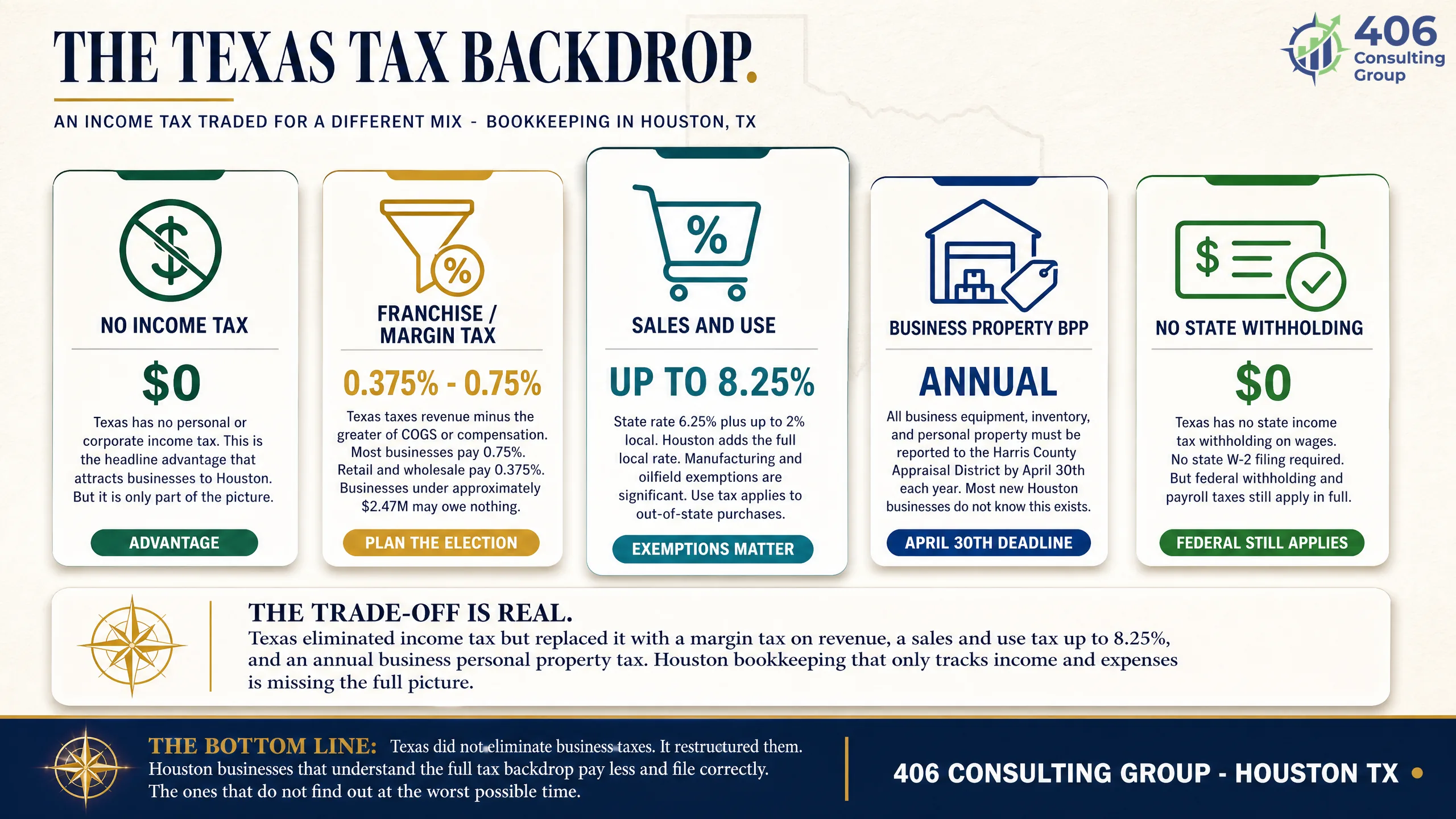
Texas trades an income tax for a different mix. Here's the picture for a Houston business:
| Tax | Texas reality |
|---|---|
| State income tax | None — no personal or traditional corporate income tax |
| Franchise (margin) tax | On taxable margin; below a revenue threshold (~$2.47M, verify) most owe nothing |
| Sales & use tax | State 6.25% + local up to 2% = ~8.25% in Houston; big manufacturing/oilfield exemptions |
| Business personal property tax | Annual county tax on equipment, inventory & furniture — rendition due each spring |
| Payroll / workers' comp | No state income-tax withholding; workers' comp is optional in Texas |
Confirm current thresholds, rates, and rules with the Texas Comptroller and your county appraisal district. We cover planning in the Houston tax guide.
The Franchise (Margin) Tax
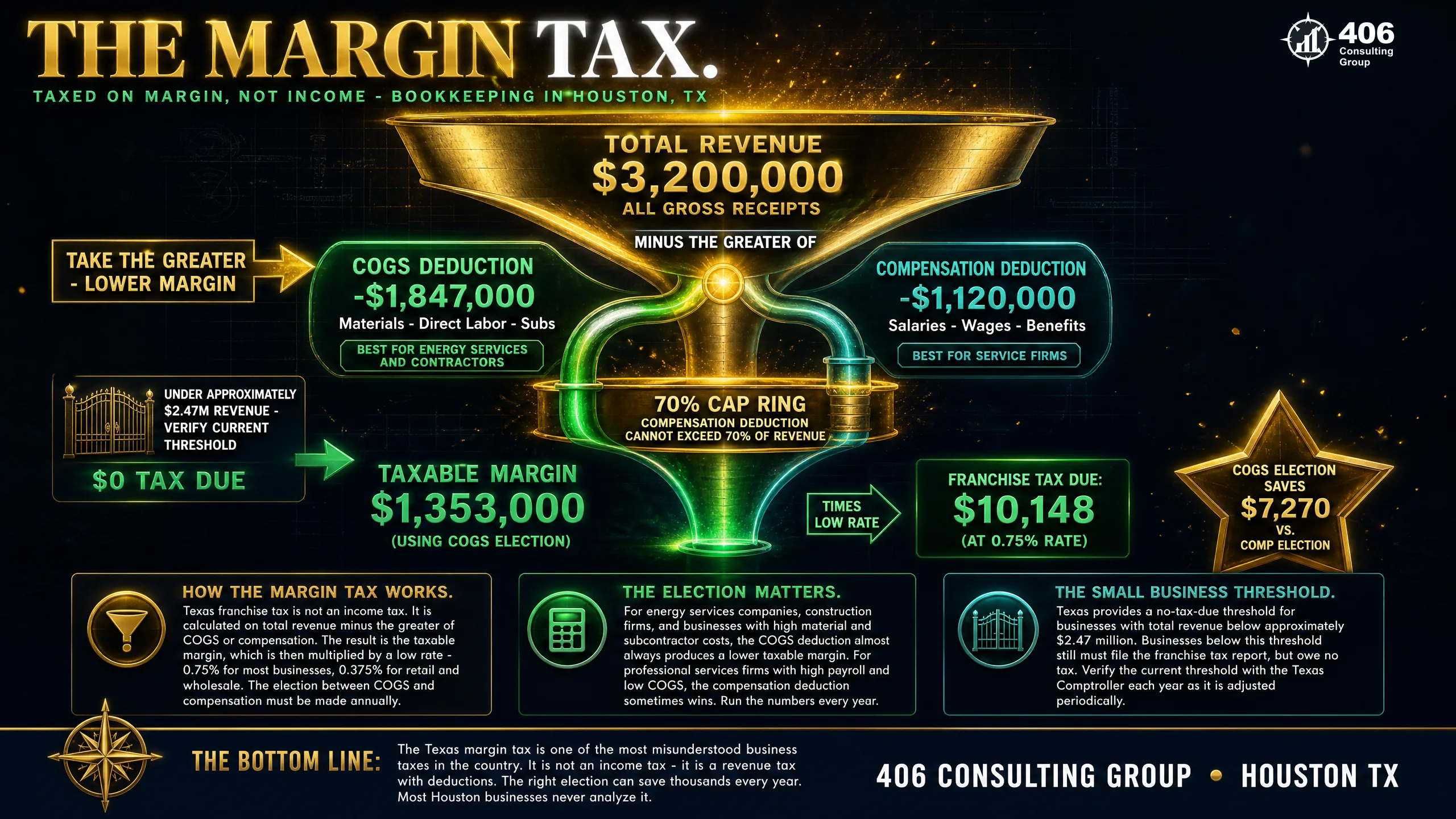
Texas's version of a business tax is the franchise tax, almost always called the "margin tax" because it's based on your taxable marginrather than income. Broadly, margin is your total revenue minus the greater of a few allowed deductions — generally cost of goods sold or compensation — and is capped at 70% of total revenue (there's also a simplified "E-Z" computation for smaller filers). The tax rate on that margin is low and depends on your business type — a reduced rate for retailers and wholesalers, a standard rate for most others — so the dollars are usually modest, but the mechanics reward getting your COGS and compensation figures clean.
The friendly part: there's a no-tax-due revenue threshold(around $2.47 million in recent years — verify the current figure), and many small businesses fall under it and owe no franchise tax at all. But "owe nothing" doesn't always mean "file nothing" — Texas has changed its reporting requirements in recent years, and entities may still have filings such as the Public Information Report to keep current. Good books make the whole thing a non-event; messy ones turn a low-dollar tax into a compliance headache.
The "no income tax so I'm fine" trap
No income tax doesn't mean no filings. The margin tax, its thresholds, and any required reports still apply, and rules have shifted recently — confirm current requirements with the Texas Comptroller so a low-dollar tax never becomes a penalty.
The Tax No One Warns You About: BPP
Here's the one that surprises people, and the reason "no income tax" is only half the story. Texas has no state income tax in part because it leans heavily on property tax — and that includes business personal property (BPP): the equipment, machinery, tools, inventory, and furniture your business owns. Each year you're generally required to file a rendition with your county appraisal district listing that property, which is then valued and taxed. For an equipment-heavy energy-services, industrial, or construction company, this can be one of the largest tax bills of the year.
This is where clean, accurate books earn their keep. A well-kept fixed-asset schedule — what you own, when you bought it, what it cost, and how it's depreciating — is exactly what a correct rendition needs, and it's what keeps you from over-reporting (and overpaying) on assets you've retired or that have fallen in value. Miss the rendition deadline (generally in the spring) and penalties follow; over-report and you pay tax on ghosts. Getting BPP right is one of the highest-value things Houston bookkeeping does.

Confirm deadlines and rules with your county appraisal district — in the Houston area that's usually the Harris County Appraisal District or the appraisal district for your county.
Sales & Use Tax and the Exemptions
Texas has a normal-style sales and use tax — state 6.25% plus local rates up to 2%, so roughly 8.25% in most of the Houston area. What makes it complex for Houston's industrial base is the exemptions: manufacturing equipment used in production, items that become part of a manufactured product, and certain oilfield and agricultural uses can be exempt, while other closely related purchases are fully taxable. The taxability of many oilfield services in particular is genuinely nuanced — it can hinge on exactly what the service does and to what.
For the books, that means tracking taxable versus exempt sales and purchases carefully, keeping valid exemption and resale certificates on file, and accruing use tax on out-of-state or untaxed purchases you consume. Get it right and you neither overpay on exempt equipment nor build an audit exposure on taxable items; get it wrong and both happen. This is an area to set up deliberately and, for oilfield-services taxability, to confirm with a pro or the Comptroller.

The exemptions are real money for the right business — but only if the books are set up to capture them correctly.
Energy & Oilfield-Services Bookkeeping
Houston runs on energy, and energy-services businesses have their own bookkeeping shape. They're equipment-heavy (which drives the BPP rendition and depreciation planning), they work under master service agreements and generate field tickets that have to tie to invoicing, and they need real job or project costing to know the margin on a well, a site, or a contract rather than a blended company number. Add subcontractors and 1099s, mobilization and per-diem costs, and equipment utilization, and the books get specific fast.
This is home turf for us. Beyond the accounting, we bring genuine oil & gas and energy-industry experience — we understand how these companies actually operate, from the field ticket to the AFE to the way work ebbs and flows with commodity cycles. That means books that reflect how an energy-services business really runs, not a generic template forced onto an industry it doesn't understand.
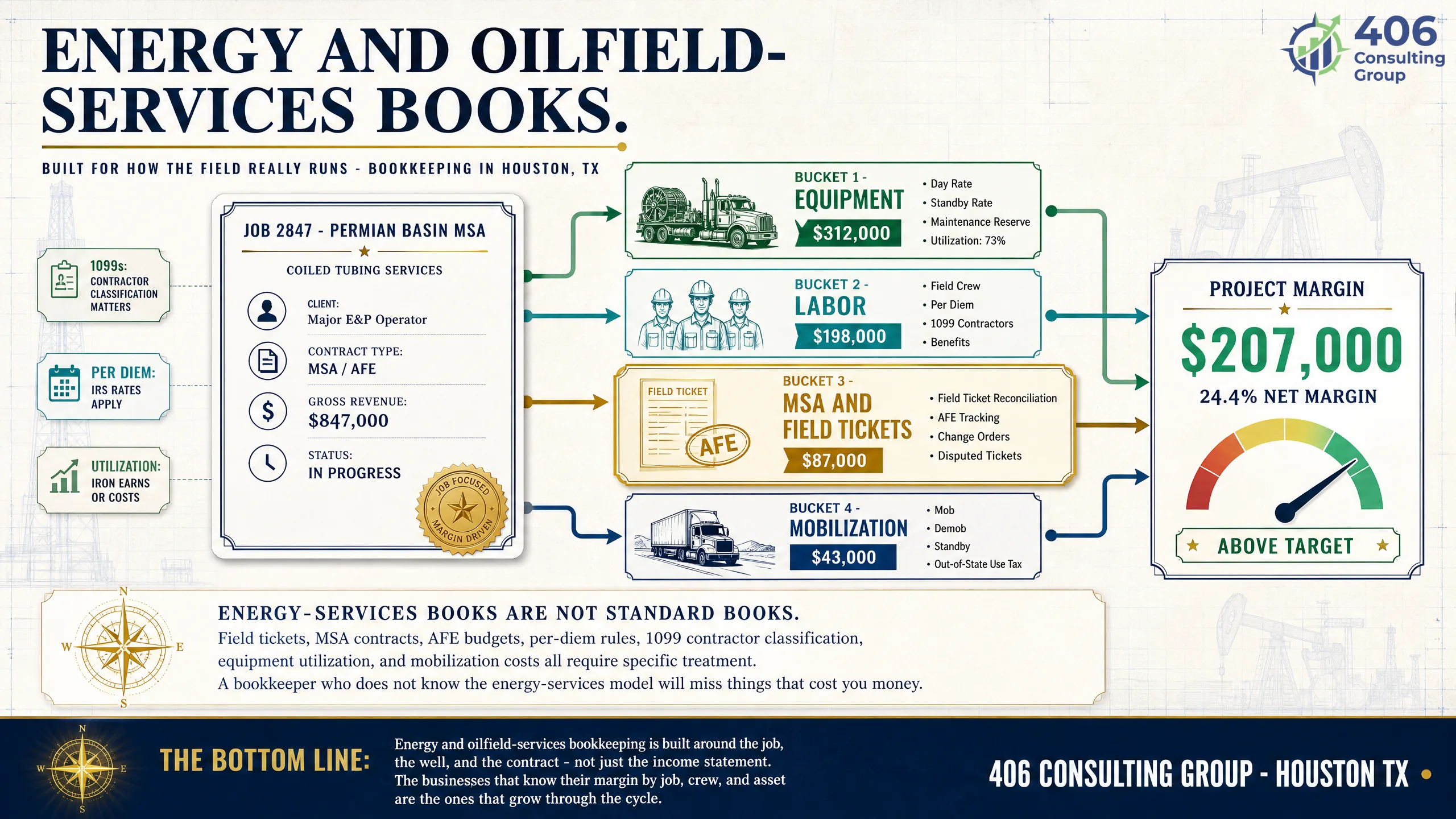
Want to know which jobs actually make money? That's the heart of our unit-economics work — and project-level costing is how an energy-services company sees it.
Texas Payroll (and Optional Comp)
One place Texas genuinely simplifies things: no state income tax means no state income-tax withholding, so payroll here is lighter than in income-tax states. You still handle federal payroll taxes and Texas unemployment insurance (employer-paid), but there's one line less to manage on every check.
Texas is also unusual on workers' compensation: it's one of the few states where private employers generally aren't required to carry it. Many do anyway — and in energy and construction, clients and prime contractors often require it — but "non-subscriber" status is a real choice with real legal and insurance trade-offs. For field-heavy businesses, class codes and coverage matter a lot, so it's worth handling deliberately rather than by default.
Handled properly, Texas payroll is low-friction — which is what our payroll work keeps it.
A Chart of Accounts Built for Texas
Your chart of accounts is the skeleton of your books, and a Texas one carries structure a generic template lacks. It needs a clean cost-of-goods-sold and compensation structure (because those drive the margin-tax calculation), a well-maintained fixed-asset schedule (because that drives the BPP rendition and depreciation), taxable-versus-exempt tracking for sales and use tax, and job-costing structure for energy-services and construction work.
Built right, that structure makes the margin-tax filing, the property rendition, and sales-tax compliance almost mechanical; built as a generic out-of-state template, it blends together exactly the figures Texas needs separated. Getting the structure right once is what makes every filing afterward fast and defensible.
This is where designing books around how the business — and Texas — actually work pays off, the difference between compliant and quietly exposed.
Bookkeeping by Houston Segment
Houston's economy is broad, and each corner asks something different of the books.
| Segment | What the books need to track |
|---|---|
| Energy & oilfield services | Equipment/BPP, job costing, MSAs & field tickets, sales-tax exemptions, 1099s |
| Petrochem & industrial/fabrication | COGS, WIP, fixed assets & depreciation, manufacturing exemptions |
| Construction & trades | Job costing, retainage, change orders, subs/1099s, BPP on equipment |
| Medical & professional | Receivables/insurance, payroll, clean reporting, margin-tax COGS/comp |
| Logistics, retail & services | Sales-tax by location, inventory, payroll, use tax on purchases |

Different details, same backbone: margin-tax figures clean, fixed assets tracked for BPP, sales tax classified right, payroll handled, and profit readable.
Common Houston Bookkeeping Mistakes
A handful of avoidable mistakes cause most of the trouble for Houston businesses. Here's what we see most.
Assuming 'no income tax' means no tax work
The margin tax, sales/use tax, and property tax all still apply — ignoring them invites penalties.
Forgetting the BPP rendition
Missing the annual business-personal-property filing draws penalties; over-reporting means paying tax on assets you no longer have.
Sloppy COGS and compensation
Those figures drive the margin tax — messy books can inflate what you owe or fail an audit.
Mishandling sales-tax exemptions
Missing manufacturing/oilfield exemptions overpays; misapplying them builds audit exposure.
No real job costing
Blending all projects into one P&L hides which wells, sites, or contracts actually make money.
Every one is a setup-and-habit problem — and every one disappears once the books are built for Texas and maintained on a monthly rhythm.
Local vs. a Great Remote Partner
For a Houston business, what matters in a bookkeeper isn't whether their office is off the Katy Freeway — it's whether they understand Texas tax and Houston industry: the margin tax, the BPP rendition, the sales-tax exemptions, and how an energy-services or industrial company actually operates. A bookkeeper who doesn't know Texas is a real liability here, because those are exactly the things a generic setup gets wrong.
And remote is how modern bookkeeping already works — even for clients across town. The large majority of our own local clients never set foot in our office; everything runs on secure cloud accounting, connected bank feeds, and a steady monthly rhythm. So whether you're in Houston, out in the energy corridor, or anywhere across the metro, you get the same responsive, Texas-savvy, energy-literate service. What we bring is knowing Texas tax and the energy business cold — which matters far more than a zip code.
Distance isn't the variable. Knowing Texas and the industry is.
How to Get Started
Getting your Houston books in order is three steps.
Set up for Texas correctly
Build a chart of accounts with clean COGS/compensation for the margin tax, a fixed-asset schedule for BPP, and taxable-vs-exempt sales-tax tracking.
Get job costing and payroll right
Project/job costing for energy-services and construction, plus Texas payroll (no state withholding) and a deliberate workers'-comp decision.
Run it monthly
Monthly reconciliation, sales-tax filing, the annual BPP rendition and franchise filing, and job reporting that shows what's making money.
Not sure whether you need bookkeeping, tax help, or something more? Our Financial Maturity Assessment maps it out in about eight minutes.
FAQ: Houston Bookkeeping Questions
Does Texas really have no business tax?
Texas has no personal state income tax and no traditional corporate income tax, but it does have the franchise tax — commonly called the 'margin tax' — on business margin, plus sales and use tax and property tax. The franchise tax is based on your taxable margin (broadly, revenue minus the greater of cost of goods sold or compensation, capped at 70% of revenue), with a no-tax-due revenue threshold (around $2.47 million in recent years — verify current) below which many small businesses owe nothing. So 'no income tax' is true, but it doesn't mean no tax or no filings.
What is the Texas business personal property tax?
Texas leans on property tax partly because it has no income tax, and that includes business personal property (BPP) — the equipment, machinery, tools, inventory, and furniture your business owns. Each year you're generally required to file a rendition with your county appraisal district (in the Houston area, often the Harris County Appraisal District) listing that property, which is then valued and taxed. For equipment-heavy energy-services, industrial, and construction companies this can be a significant annual bill, which is why a clean, accurate fixed-asset schedule matters so much. Confirm deadlines with your county appraisal district.
What taxes does a Houston, Texas business deal with?
No state income tax, but the franchise/margin tax on business margin (with a revenue threshold below which many owe nothing), sales and use tax at roughly 8.25% in the Houston area with important manufacturing and oilfield exemptions, and property tax — including the annual business personal property rendition on equipment and inventory. Payroll is lighter because there's no state income-tax withholding, though you still handle federal payroll taxes and Texas unemployment insurance, and workers' compensation is optional in Texas. Confirm specifics with the Texas Comptroller and your county appraisal district.
Do you understand oilfield and energy-services accounting?
Yes — it's a core strength. Beyond the accounting, we bring genuine oil and gas and energy-industry experience, so we understand how energy-services businesses actually operate: equipment-heavy balance sheets and the BPP rendition, master service agreements and field tickets tying to invoicing, project/job costing to see the margin on a well or contract, mobilization and per-diem costs, and how work moves with commodity cycles. That means books that fit the industry, not a generic template forced onto it.
Can 406 Consulting Group do my Houston bookkeeping remotely?
Yes. We work with Houston and Harris County businesses through secure cloud accounting — connected bank feeds, shared screens, and a steady monthly rhythm. What matters for a Texas business is expertise in the margin tax, the BPP rendition, sales-tax exemptions, and the energy industry, not office proximity. The large majority of our own local clients never come into the office either, so you get the same responsive, Texas-savvy, energy-literate service whether you're in Houston or anywhere across the metro.
Keep Reading
Bookkeeping — Houston, TX
No Income Tax. Still Plenty to Get Right.
406 Consulting Group keeps Houston energy and small businesses clean and compliant — the margin tax, the BPP rendition, sales-tax exemptions, job costing, and reliable financials — delivered remotely, by a firm that knows Texas and the energy business.
Houston Bookkeeping Quick Reference
Houston, TX — Harris County
Margin Tax & BPP Got You Guessing?
Texas tax, exemptions & job costing, handled.
About the Author
Carrie Anderson
Co-Founder, 406 Consulting Group
Commercial banking and underwriting background — 300+ loan reviews — with deep oil & gas and energy-industry experience. Carrie helps Houston owners get the margin tax and BPP rendition right, capture sales-tax exemptions, and keep clean, job-costed books that fit how an energy business really runs.
Read the Full Story