
CFO & Controller Services in Houston, TX:
Built to Compound Across Cycles
Commodity cycles punish companies that run on gut and bank balance. Here's what a controller and a CFO each do, what they cost fractionally vs. full-time, and the cycle-proof, energy-literate finance a Houston company needs.

Houston businesses live with something most cities don't: commodity cycles. Energy-services and industrial companies can double in a boom and halve in a bust, sometimes in the same eighteen months — and the financial function that coasted through the up-cycle is exactly what fails in the down one. Add the capital intensity of an equipment-heavy business, the property-tax weight Texas puts on those assets, and the pressure of fast growth, and you have a company that needs a real CFO-level view well before it needs a full-time executive.
The good news: you don't need a $250,000 full-time hire to get it. This guide walks the difference between a controller and a CFO, what each costs full-time versus fractional, when a Houston company actually needs one, and the energy-specific finance work — utilization, cycle-proof cash forecasting, capital and bonding — that a commodity-driven economy demands. All delivered remotely, by a firm that knows both the numbers and the energy business.
By Carrie Anderson — Co-Founder, 406 Consulting Group. Commercial banking and underwriting background — 300+ loan reviews — with deep oil & gas experience, helping energy, construction, and growth companies build the financial function scaling and cycles demand.
Quick Answer: CFO & Controller Help for a Houston Business
- →Controller owns accurate, timely books and reporting; a CFO owns strategy, cash, capital, and forecasting.
- →Fractional gets you the expertise for roughly $2,500–$8,000/mo versus a full-time all-in cost of $235K–$420K+.
- →Most companies don't need full-time until roughly $15M+ in revenue.
- →Energy here needs cycle-proof cash forecasting, equipment/utilization economics, and bonding-ready financials.
- →Delivered remotely — the expertise matters more than the office.
Table of Contents
Why a Houston Energy Company Needs This
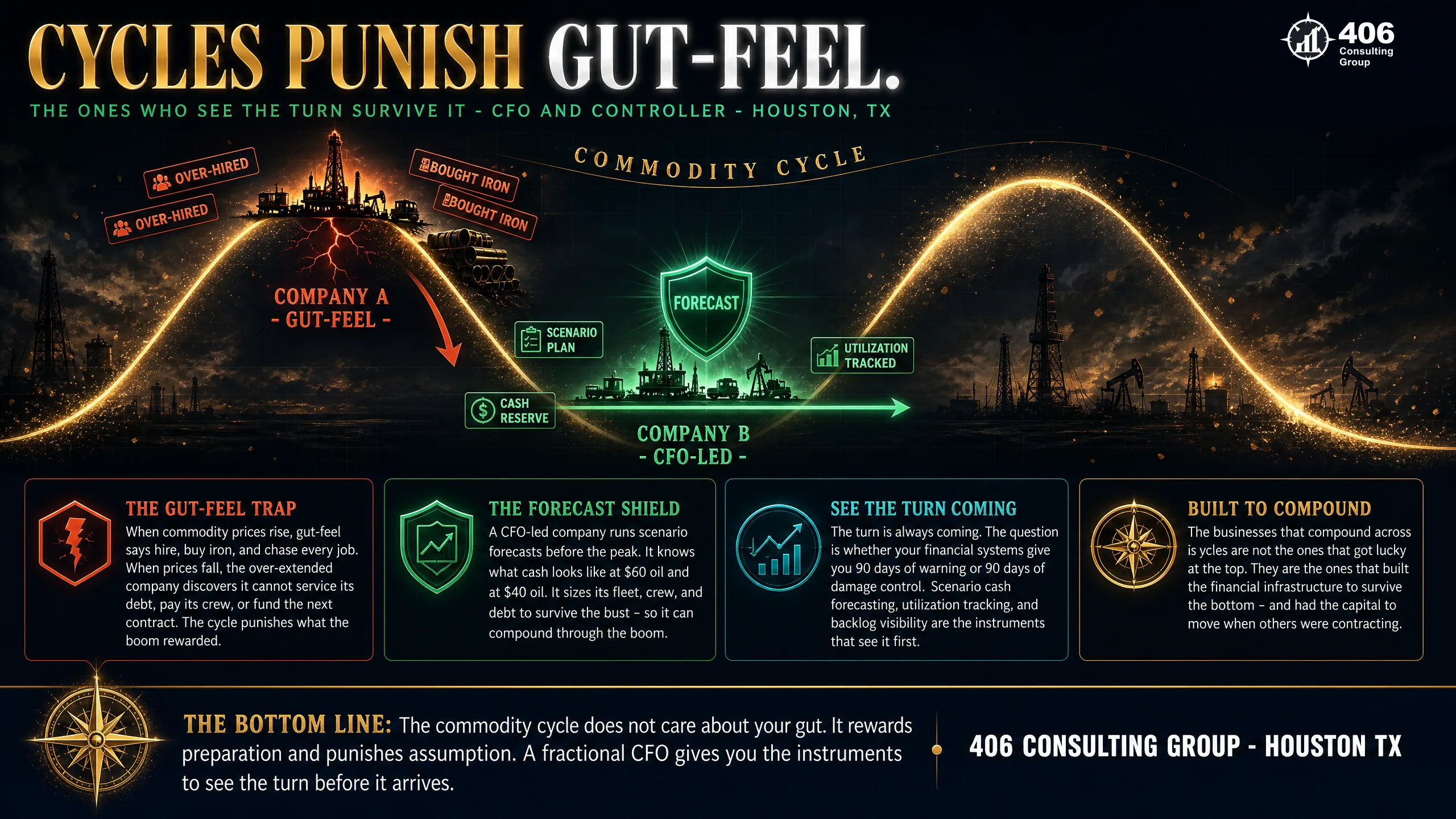
Cycles punish companies that run on gut and bank balance. When oil is up, revenue floods in, everyone's busy, and a thin margin or a messy back office feels irrelevant — right up until the cycle turns and the same company discovers it over-hired, over-bought equipment, and has no forecast telling it how long the cash will last. The businesses that survive downturns and compound through upturns are the ones that saw the turn coming in their numbers, because someone was watching the numbers that predict it.
That's the CFO-and-controller function: accurate books that close on time, a forecast you can trust through a cycle, utilization and margin visibility on expensive equipment, and an early warning before cash becomes a crisis. In a commodity economy, waiting until you're big enough to "afford" a full-time CFO usually means waiting until a downturn has already done damage that foresight would have prevented.
The first step is knowing which role you actually need — and they're not the same job.
Controller vs. CFO: Two Different Jobs
People use the titles loosely, but they solve different problems. A controller looks backward and makes it accurate: they own the books, the monthly close, reporting, controls, and making sure the numbers are right and on time. A CFO looks forward and makes it strategic: forecasting, cash-flow planning, pricing and margin strategy, capital and financing, and the big decisions about where the business is going.
| Controller (accuracy, backward) | CFO (strategy, forward) |
|---|---|
| Monthly close & accurate books | Forecasting & scenario planning |
| Financial reporting & controls | Cash-flow strategy through cycles |
| Job/project costing & margin reporting | Pricing, margin & utilization strategy |
| Payroll oversight & compliance | Banking, bonding & capital raising |
| Clean books for the CFO to use | The decisions those books inform |

Many growing companies need the controller function first — accurate, timely books — and the CFO function as the decisions and the cycles get bigger. Plenty need a blend. The wrong move is paying full-time-executive money for either before you need it.
The Cost Math: Fractional vs. Full-Time
This is where fractional makes the case for itself. A full-time senior hire in these roles is expensive — and the salary is only part of it.
| Option | Rough cost |
|---|---|
| Fractional controller | ~$2,500–$6,000/mo |
| Fractional CFO | ~$2,500–$5,000/mo |
| Both, fractional | ~$4,000–$8,000/mo |
| Full-time controller | $85K–$120K salary + ~25% benefits |
| Full-time CFO | $150K–$300K+ salary |
| Both, full-time (all-in) | $235K–$420K+ per year |
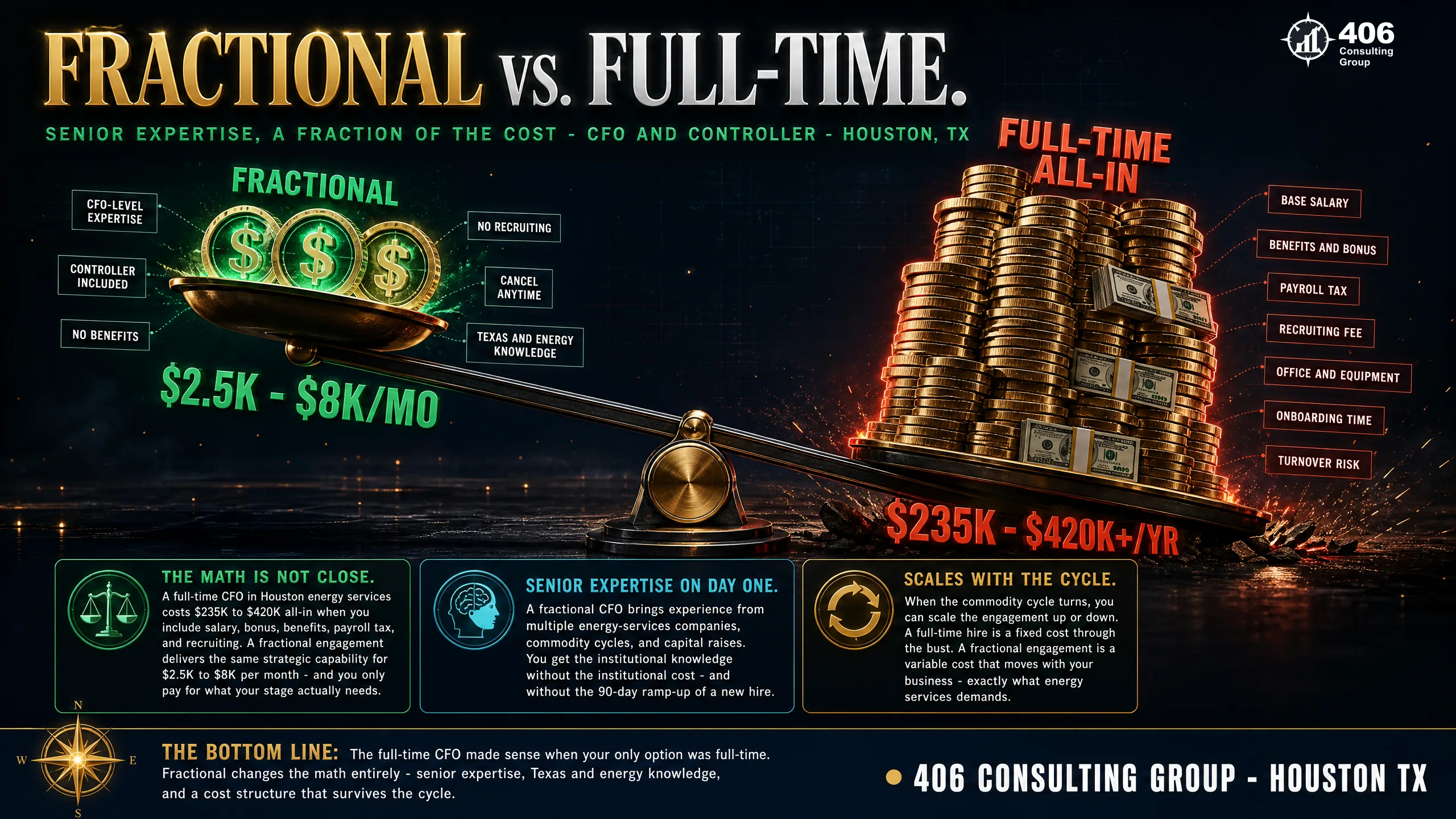
Fractional gets you senior expertise for a fraction of a full-time salary — the right answer for most companies until they're big enough to keep an executive genuinely busy full-time. In a cyclical business, it also flexes: more support when you're scaling or raising capital, less when you're steady.
When to Hire — and at What Size
The honest rule of thumb: most companies don't need a full-time CFO until somewhere around $15 million+ in revenue — below that, a full-time executive usually isn't kept busy enough to justify the cost, which is exactly why fractional exists. But the need for the function shows up much earlier, and in a cyclical business it's often triggered by events.
The close keeps slipping
Books aren't done until weeks after month-end, so every decision runs on stale numbers — a controller problem.
A cycle is turning
Boom or bust, you need a forecast and a plan — over-expanding at the top or running out of runway at the bottom is how cyclical companies die.
You're buying or financing equipment
Capital-intensive purchases need a return and cash-timing analysis an owner shouldn't do alone.
You're seeking financing or bonding
Banks and sureties want financials and projections that a CFO-level function produces.
You're flying blind on utilization
You can't say which crews, rigs, or jobs actually make money — you need the reporting a controller builds.
Hit two or three of these and it's time — and fractional lets you add exactly the level you need without an executive salary. Our Financial Maturity Assessment helps you place yourself.
The Energy-Services CFO
Energy-services and industrial finance is its own discipline, and it's where our oil & gas experience matters as much as the accounting. These businesses are capital-intensive — expensive equipment whose utilization makes or breaks the return, and whose ownership drives both depreciation and the Texas business-personal-property tax. They work under master service agreements, generate field tickets that have to convert to cash, and see revenue swing with rig counts and commodity prices. A real CFO function here tracks revenue and margin per crew, per rig, or per contract; models equipment purchases against expected utilization; and keeps the balance sheet strong enough to weather a downturn.
This is the opposite of forcing a generic CFO playbook onto an industry it doesn't understand. Knowing how an AFE works, how work moves with the cycle, and how lenders and sureties view an energy-services balance sheet is what makes the financial guidance actually fit the business.
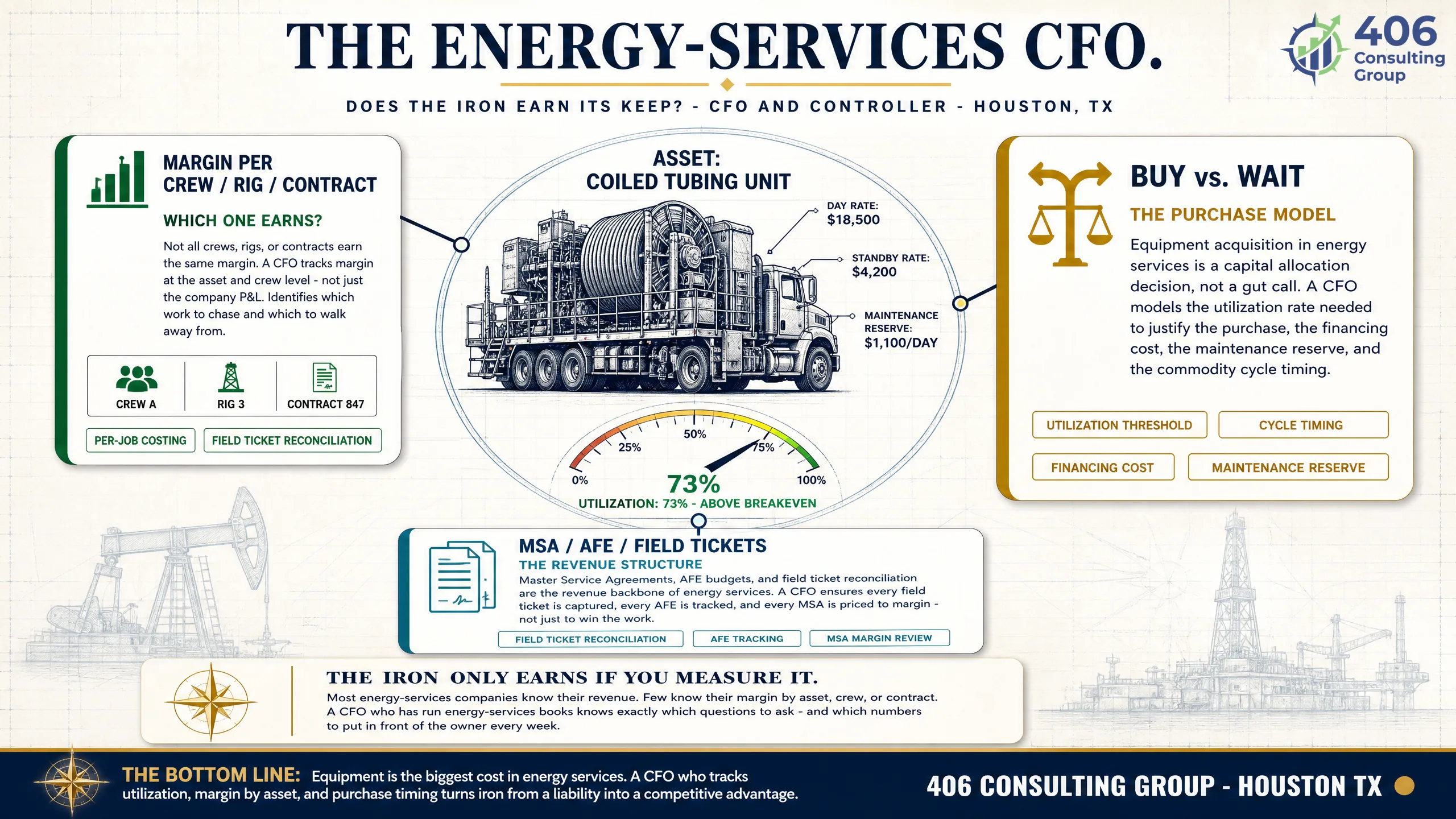
Curious which crews or jobs actually drive profit? That's the heart of our unit-economics work — and utilization-aware costing is how an energy-services company sees it.
Cash Flow Through Commodity Cycles
Cash management is where a cyclical business is won or lost. In an up-cycle, growth is cash-hungry — you fund labor, equipment, and mobilization now and collect later, and the temptation to add crews and buy iron at the peak is strongest exactly when it's most dangerous. In a down-cycle, the companies that prepared — built reserves, arranged credit before they needed it, kept fixed costs flexible — are the ones that survive to buy up assets cheap while over-extended competitors fold.
A CFO's core job here is a forward cash-flow forecast that respects the cycle: mapping inflows and outflows across scenarios so you can act early — accelerate collections, stage a purchase, arrange a line of credit at the top rather than begging for one at the bottom. That foresight is the difference between a company that compounds across cycles and one that white-knuckles each one.
Managing cyclical cash isn't about fear — it's about seeing far enough ahead to play offense when everyone else is playing defense.
Banking, Bonding & Capital
Capital-intensive, cyclical businesses lean on outside capital — lines of credit for working capital, equipment financing, term loans for expansion, and bonding capacity for bigger contracts. Every one is a credibility test, and the thing being tested is your financials. Lenders and sureties want clean statements, believable projections, and an owner who can speak to the numbers — and in a cyclical industry they look hard at how you'd hold up in a downturn.
This is where our background genuinely helps. Having sat on the underwriting side of the table — 300+ loan reviews — we know how a bank or surety reads an energy-services company, what strengthens a file, and what quietly sinks it. We help you go in prepared, presenting the business the way the people with the capital need to see it. Our loan-readiness work exists for exactly this.
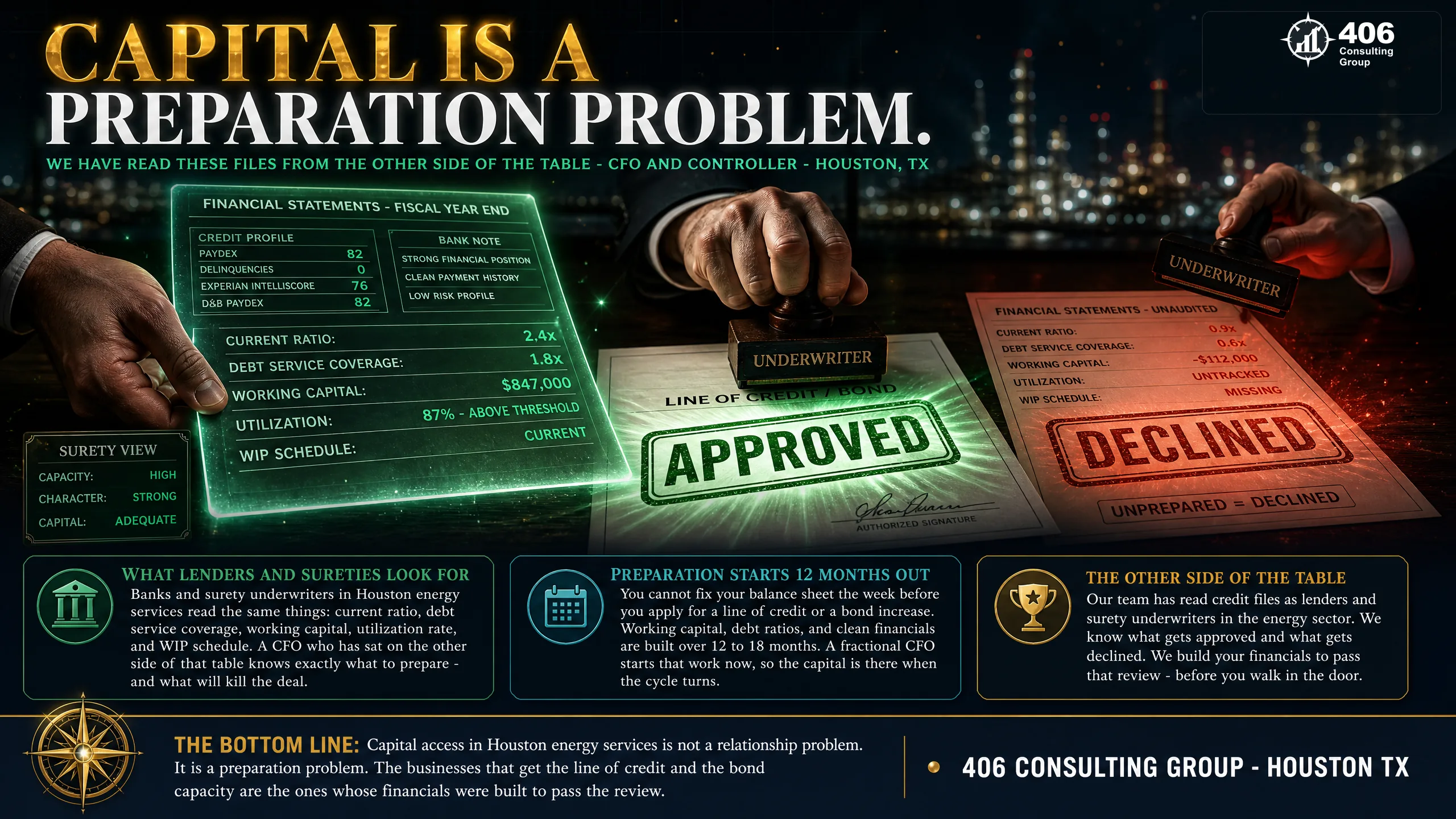
The capital is out there for solid Houston companies; getting it on good terms is a preparation problem — and preparation is exactly what a CFO function provides.
Systems Across the Whole Company
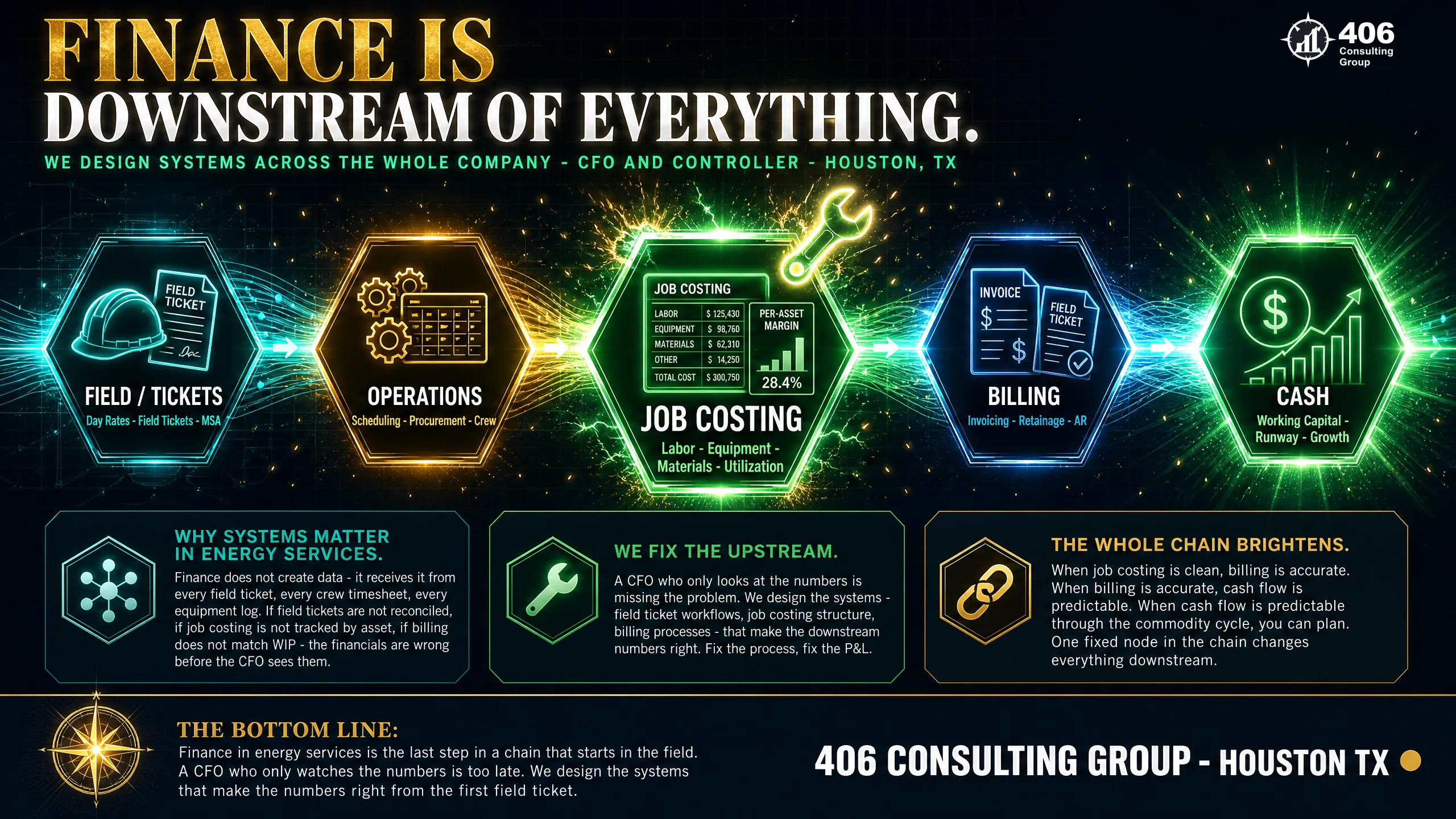
Here's what sets our CFO work apart: we don't look at finance in isolation. The best financial function designs systems and processes from a whole-company view — how the field reports hours and tickets, how operations feeds job costing, how dispatch and equipment tracking connect to billing, how billing becomes cash. The finance numbers are downstream of everything else the company does, so fixing them for real usually means fixing the process that produces them.
That cross-departmental lens is how a growing energy-services company turns field chaos into something that scales: fewer tickets lost, cleaner data flowing into the books, and decisions based on numbers that are right because the process behind them is right. It's the difference between an accountant who reports the past and a partner who helps you build a business that runs.
We go deeper on this in the hidden cost of no systems — the quiet price a growing company pays for operational chaos disguised as hustle.
The Numbers a CFO Puts in Front of You
A good CFO function replaces "how much is in the bank?" with a short list of numbers that actually tell you how the business is doing and where it's heading — especially through a cycle.
| Metric | What it tells you |
|---|---|
| Cash-flow forecast (scenario) | Whether you can fund growth — or weather a downturn — over the coming months |
| Margin by crew / rig / job | Which work and equipment actually make money, so you deploy the right assets |
| Equipment utilization | Whether capital-intensive iron is earning its keep or bleeding cash |
| Backlog & pipeline | Revenue you've already won versus what you still need to sell — a cycle early-warning |
| Working capital & AR days | How much cash the business is tying up, and how fast you collect |
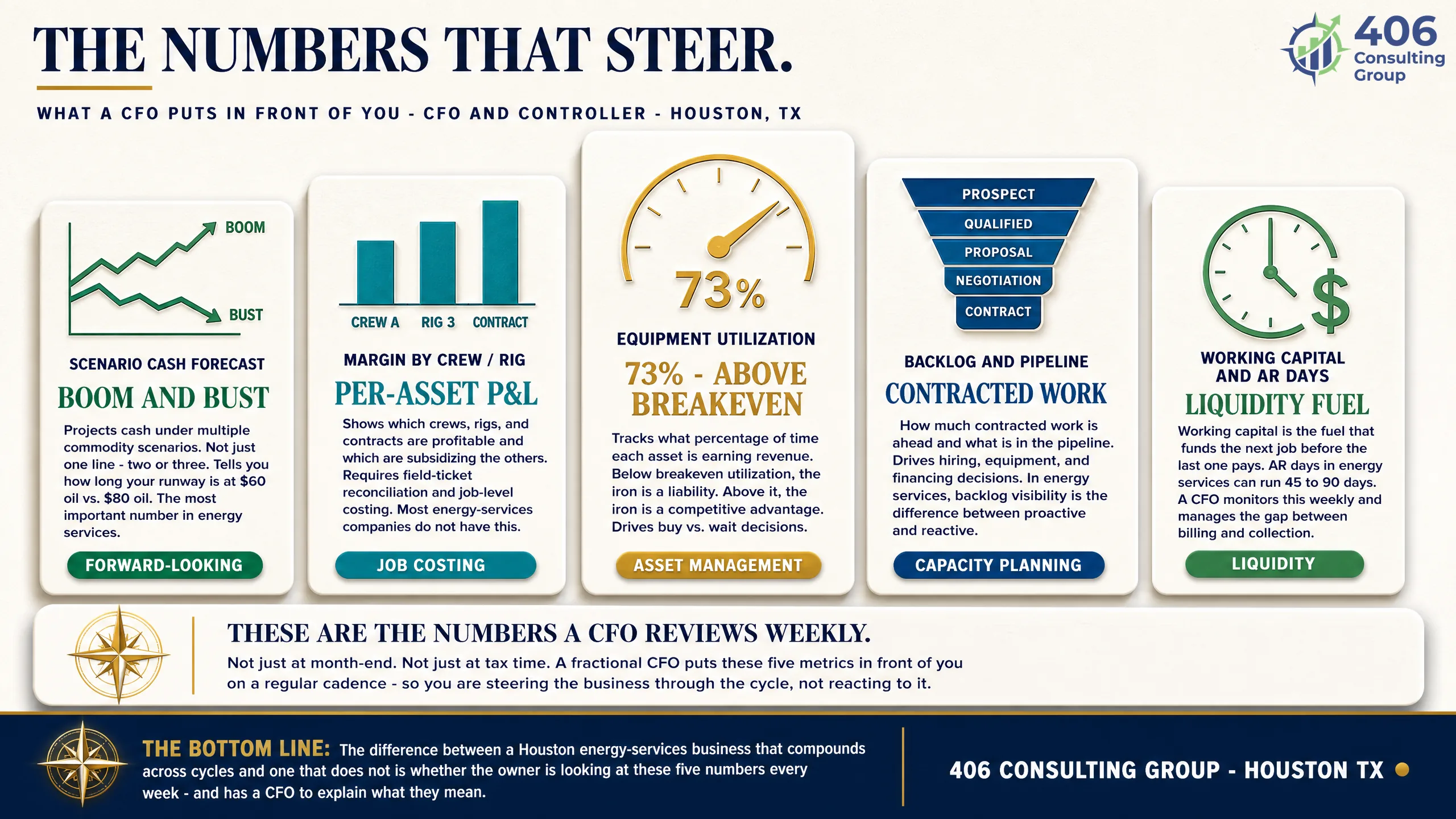
These are the numbers that turn a busy company into a well-run one — and most owners have never had them presented clearly.
Local vs. a Great Remote Partner
A CFO's value is in judgment and expertise, not proximity — which makes it one of the most natural roles to deliver remotely. What a Houston energy company needs is someone who has built forecasts, read bank and surety requirements, and guided companies through both scaling and downturns — with genuine understanding of the energy business. That experience matters far more than whether they're across town, and a specialized remote partner routinely beats whatever local generalist happens to be nearby.
Modern CFO work is a screen-share, a shared dashboard, and a standing strategy call — a mid-month cash review, a pre-purchase conversation, a projection built together before you sit down with a lender. We work this way with companies across Houston and Harris County exactly as we do across the Mountain West: close, responsive, strategic, and energy-literate, without needing to share a parking lot.
For a role this senior, expertise is the whole game — and expertise travels.
How to Get Started
Adding a CFO or controller function to your Houston business is three steps.
Figure out which function you need
Controller (accurate, timely books and reporting), CFO (strategy, cash, capital), or a blend — and at what level.
Start fractional
Bring in senior expertise for a few thousand a month instead of a full executive salary, scaled to where you are in the cycle.
Build the forward view
Cycle-aware cash forecasting, utilization and margin by asset, and capital readiness — so you're steering, not reacting.
Not sure where you stand? Our Financial Maturity Assessment maps your financial function in about eight minutes and shows what to build next.
FAQ: Houston CFO & Controller Questions
What's the difference between a controller and a CFO?
A controller looks backward and makes it accurate — they own the books, the monthly close, financial reporting, controls, and job/project-cost and margin reporting. A CFO looks forward and makes it strategic — forecasting, cash-flow planning, pricing and margin strategy, and banking, bonding, and capital decisions. Put simply, the controller makes sure the numbers are right and on time; the CFO uses those numbers to steer the business. Many growing companies need the controller function first and add the CFO function as decisions and cycles get bigger; plenty need a blend of both.
How much does a fractional CFO or controller cost in Houston?
Fractionally, a controller typically runs about $2,500–$6,000 per month and a fractional CFO about $2,500–$5,000 per month, with both together often around $4,000–$8,000 per month depending on scope. Compare that to full-time: a controller is roughly $85,000–$120,000 in salary plus about 25% in benefits, and a full-time CFO is $150,000–$300,000+, so both full-time run an all-in $235,000–$420,000+ per year. Fractional gives you the senior expertise for a fraction of the cost, and in a cyclical business it flexes with your needs — which is why it's the right fit for most growing companies.
When does my business actually need a CFO?
Most companies don't need a full-time CFO until roughly $15 million or more in revenue — below that, a full-time executive usually isn't kept busy enough to justify the cost, which is exactly what fractional solves. But the need for the function shows up earlier and is often event-driven, especially in a cyclical business: your month-end close keeps slipping, a cycle is turning, you're buying or financing equipment, you're seeking financing or bonding, or you can't tell which crews, rigs, or jobs actually make money. Hit two or three of those and it's time — you just don't have to hire full-time to get it.
Do you understand energy-services and oilfield finance?
Yes — it's a core strength. Beyond the accounting, we bring genuine oil and gas experience, so we understand capital intensity and equipment utilization, master service agreements and field tickets, revenue that swings with rig counts and commodity prices, and how lenders and sureties read an energy-services balance sheet. A real CFO function here tracks margin per crew, rig, or contract, models equipment purchases against expected utilization, and keeps the balance sheet strong enough to weather a downturn — the opposite of forcing a generic playbook onto the industry.
Can 406 Consulting Group be our CFO remotely?
Yes. CFO and controller work is about judgment and expertise, not proximity, which makes it a natural fit for remote delivery — screen-shares, a shared dashboard, and standing strategy calls: a mid-month cash review, a pre-purchase conversation, a projection built together before you meet a lender. We serve Houston and Harris County companies the same way we do across the Mountain West, and our commercial-banking background plus real energy experience means we prepare your financials the way lenders and sureties actually read them. For a role this senior, expertise matters far more than a local office.
Keep Reading
CFO & Controller — Houston, TX
Built to Compound Across Cycles.
406 Consulting Group gives Houston energy and growth companies a CFO and controller function — cycle-aware forecasting, utilization and margin by asset, bonding readiness, and capital strategy — fractionally and remotely, from a firm that knows energy and banking.
Houston CFO Quick Reference
Houston, TX — Harris County
Riding the Cycle Blind?
Fractional CFO & controller — energy-literate.
About the Author
Carrie Anderson
Co-Founder, 406 Consulting Group
Commercial banking and underwriting background — 300+ loan reviews — with deep oil & gas experience. Carrie helps Houston energy and growth owners forecast cash through cycles, see the true margin on crews and equipment, and present financials the way lenders and sureties actually read them.
Read the Full Story