
Tax Planning in Phoenix, AZ:
The Flat Rate Is the Easy Part
Arizona's flat ~2.5% income tax makes tax planning look simple. The real leverage is elsewhere — the PTE election, contractor TPT, entity choice, and depreciation. Here's where a Phoenix business actually saves.

Arizona is one of the friendlier states in the country on income tax — a single flat rate of about 2.5% — which makes it easy to assume tax planning here is simple. It isn't. The flat rate is the easy part; the real planning happens around the Transaction Privilege Tax (TPT), the contractor rules that decide how a whole job is taxed, the pass-through election that can move state tax off your personal return, and the equipment decisions a construction-heavy, fast-growing metro throws at you every year. Phoenix rewards businesses that plan and quietly overcharges the ones that don't.
This guide is the planning companion to our Phoenix bookkeeping guide. Where that one covers recording TPT and keeping clean books, this one is about the decisions that lower the bill: how to use the flat rate and the PTE election together, how to think about contractor TPT before you bid, when an S-corp election pays off, and how to time equipment. All of it delivered remotely.
By Jason Anderson — Co-Founder, 406 Consulting Group. Big-firm-trained accountant advising construction and small businesses across the Mountain West and Southwest on tax strategy that actually moves the number.
Quick Answer: Tax Planning for a Phoenix Business
- →Flat ~2.5% income tax — simple, low, and it changes the S-corp and PTE math versus high-tax states.
- →PTE election: Arizona lets pass-throughs pay state tax at the entity level to work around the federal SALT cap.
- →TPT is a planning problem: classification, jurisdiction, and contractor treatment all affect what you owe.
- →Contractors: prime-contracting vs. MRRA should be priced into the bid, not discovered at filing.
- →Delivered remotely — Arizona expertise matters far more than a local office.
Table of Contents
Why Phoenix Tax Planning Is Different
In a high-income-tax state, tax planning is mostly about the income tax — brackets, timing, entity elections to shave the rate. Arizona flips that. With a flat rate near 2.5%, the income tax is low and predictable, so the leverage moves elsewhere: to the Transaction Privilege Tax, to the contractor rules, and to the federal return, where a state-level election can still change what you pay the IRS.
That's the thing a generic, out-of-state tax preparer misses. They'll get the flat rate right — it's hard not to — and then leave real money on the table because they don't plan around TPT classification, don't price contractor TPT into a bid, don't run the PTE election, and don't time equipment against a growing book of work. In Phoenix, the planning that matters usually isn't on the income-tax line at all.

Let's start with the income tax — because even the easy part has a move worth making.
The Flat 2.5% Income Tax — and the PTE Move
Arizona taxes individual income at a flat rate of about 2.5% (confirm the current rate) — among the lowest in the nation, and simple: no brackets to manage, no big swing from timing income into one year versus the next. For most owners the state income tax itself isn't where planning pays off.
The move worth making is the pass-through entity (PTE) election. Like many states, Arizona lets an S-corp or partnership elect to pay the state income tax at the entity level rather than passing it to owners' personal returns. Because that entity-level tax is a business expense, it sidesteps the federal cap on the SALT deduction — effectively letting you deduct your Arizona income tax on the federal return when you otherwise couldn't. Even at a low 2.5% rate, on a healthy profit that's a real federal deduction most out-of-state preparers never elect. The mechanics and deadlines matter, so it's worth setting up deliberately.
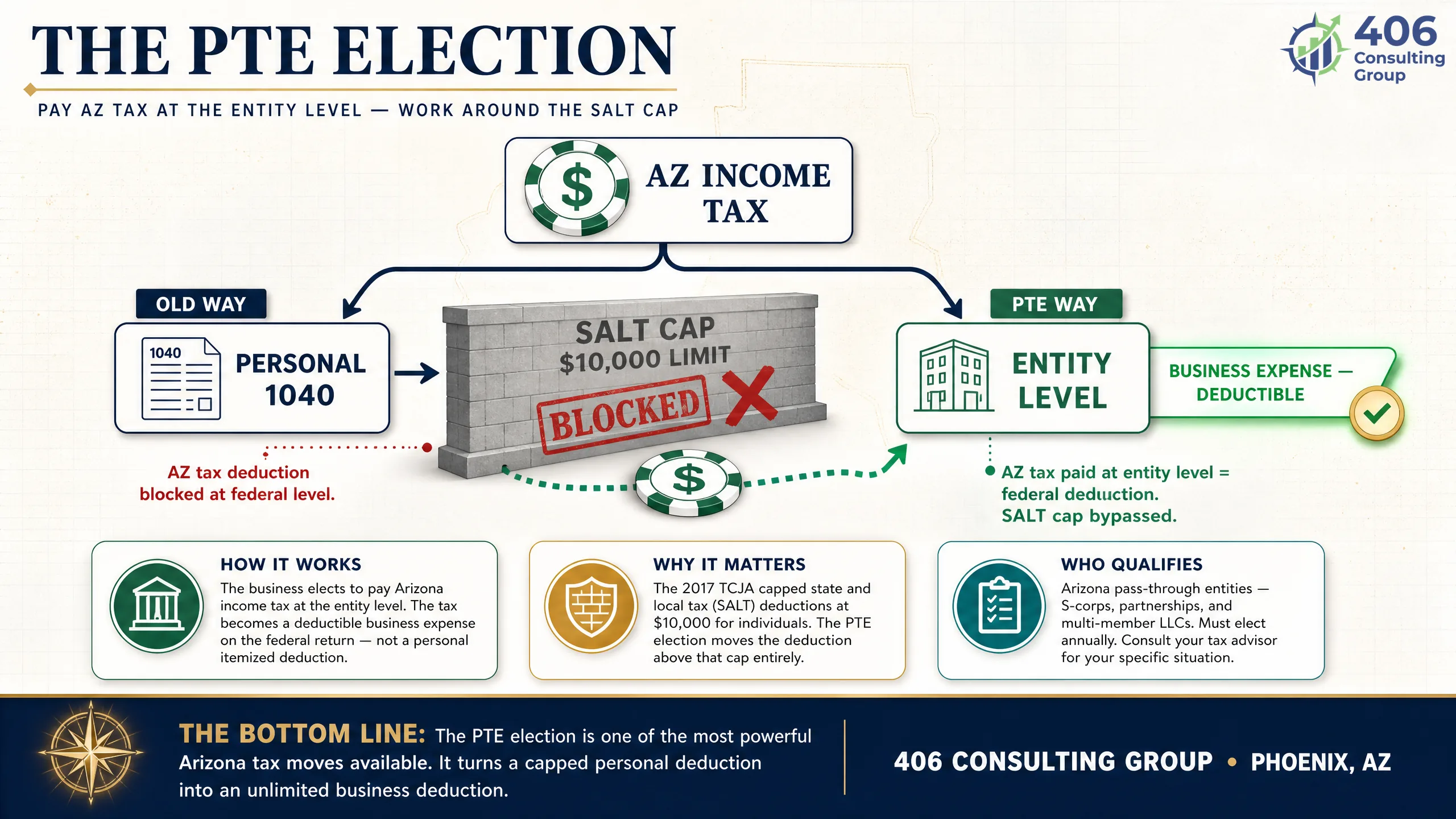
Confirm current rates and the PTE rules with the Arizona Department of Revenue — and run the election with someone who does it regularly.
TPT Is a Planning Problem, Not Just a Filing
Most businesses treat TPT as a compliance chore — collect it, file it, done. But because TPT is organized by business classification and layered by city, the way you're set up and the way you structure transactions genuinely affects what you owe. Which classification your revenue falls under, which jurisdictions you're liable in, what deductions and exemptions apply to your line of business, whether resale and exemption certificates are in place — these are planning decisions, not just data entry.
Get them right and TPT is a predictable, correctly sized cost. Get them wrong — misclassified revenue, missed exemptions, unregistered jurisdictions — and you either overpay quietly for years or build up a liability that surfaces in an audit. Since the TPT liability is legally the business's, both failure modes land on you. Planning TPT up front, with the classifications and certificates set correctly, is one of the highest-return things a Phoenix business can do.

The mechanics of recording it live in the bookkeeping guide; the decisions that size it live here.
Contractor Tax Planning: Prime vs. MRRA
For contractors, the biggest tax-planning question in Arizona isn't the income tax at all — it's whether a job is taxed as prime contracting (new construction and larger modification, taxed under the prime-contracting classification on gross receipts after a standard deduction) or as MRRA (maintenance, repair, replacement, and alteration, where you generally pay TPT or use tax on materials at purchase instead). Those are completely different tax bases, and which one applies changes the true cost of a job.
The planning insight: you need to know the TPT treatment before you bid, not after you've signed. A job priced as if it were MRRA that turns out to be prime contracting — or vice versa — can erase the margin you thought you had. Smart Arizona contractors build the expected TPT treatment into every estimate, keep the documentation to support each job's classification, and get advice on the genuinely gray ones (mixed jobs, modification-versus-repair calls). The rules are intricate and can change, so confirm current treatment with a pro and the Arizona DOR.
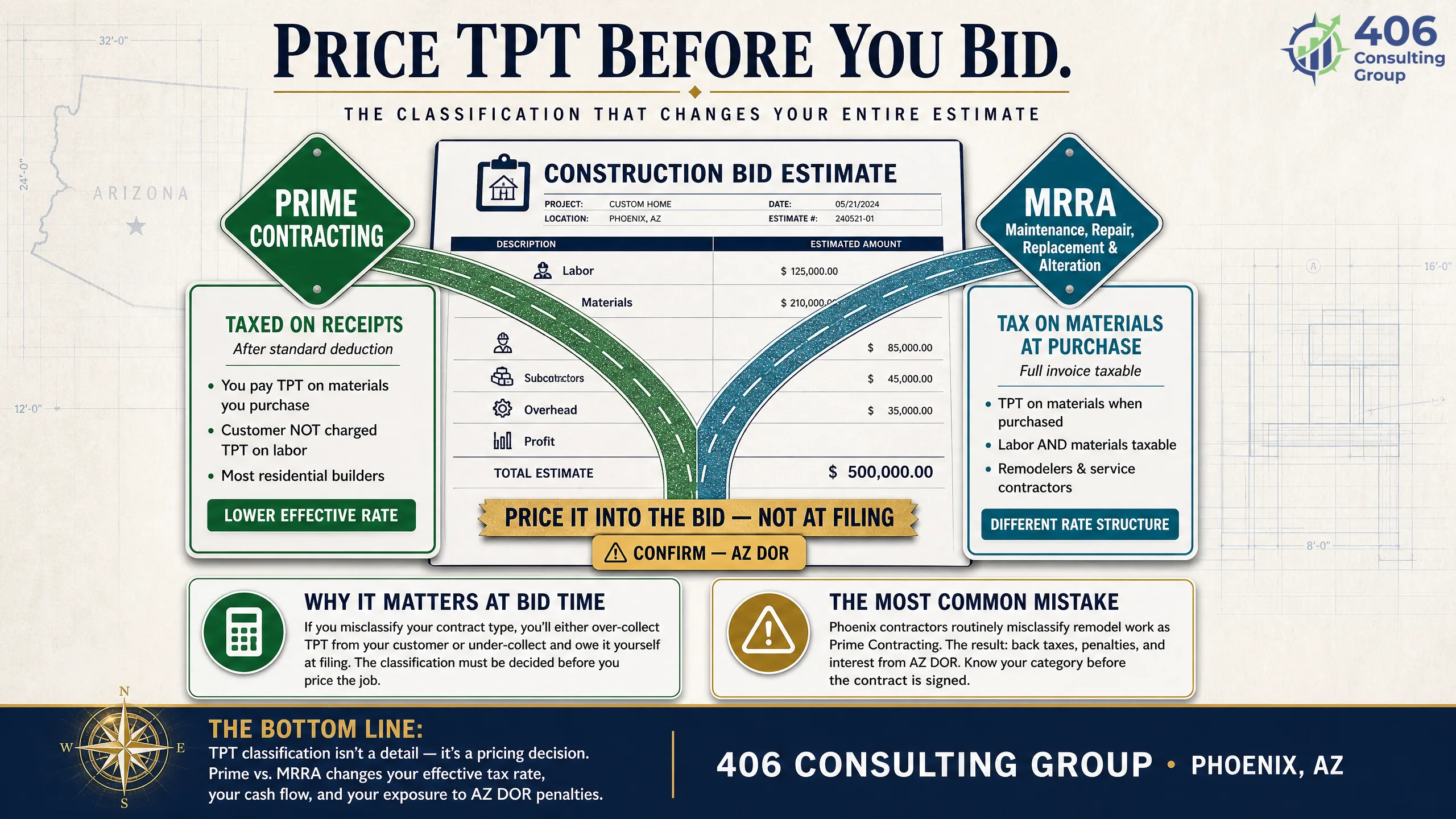
This is the single biggest reason an Arizona contractor should plan taxes with someone who knows the state — and where we most often protect a builder's margin.
Entity Choice on a Low Flat Rate
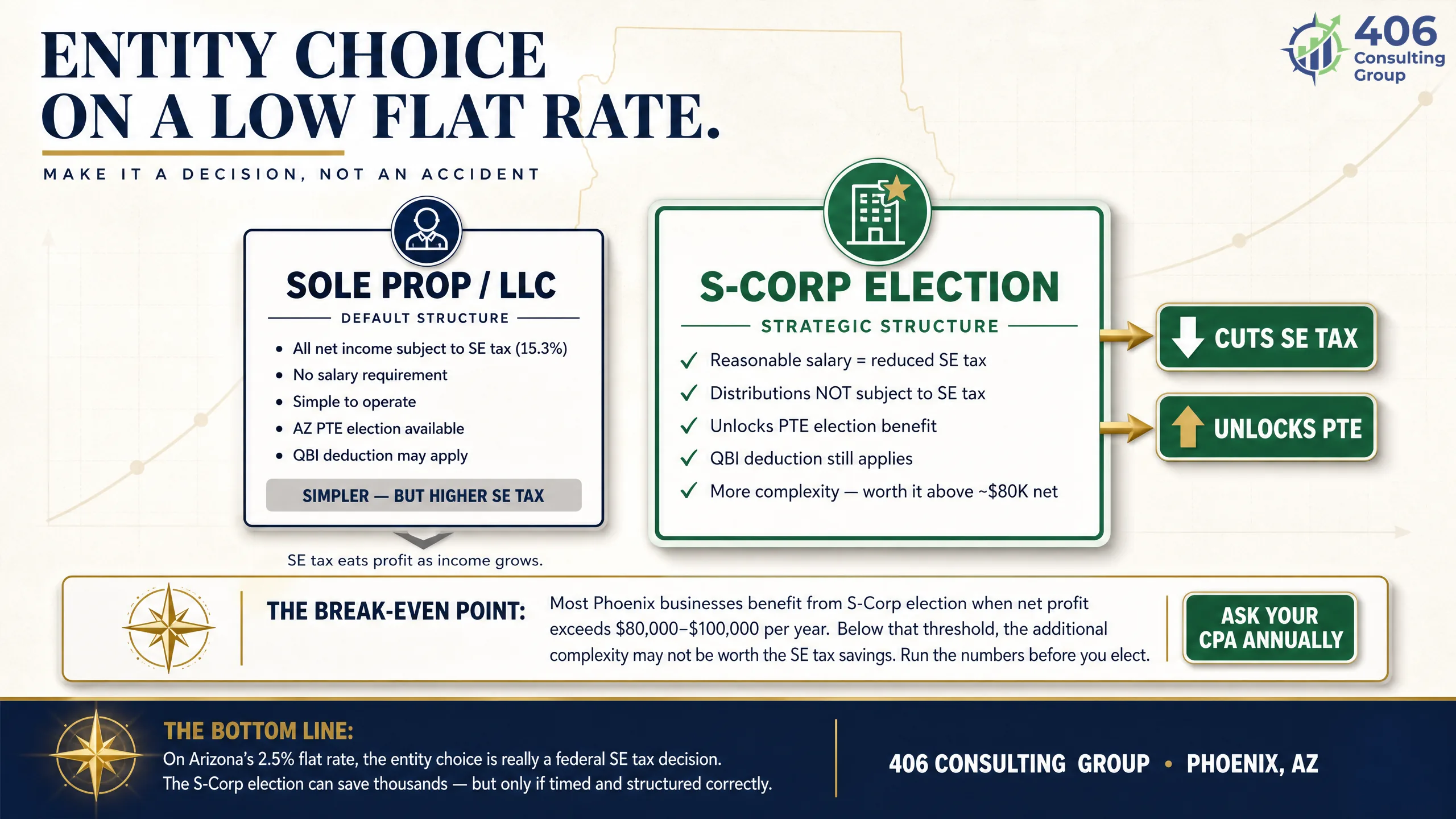
The S-corp question looks a little different in a low-flat-tax state. The classic S-corp benefit is federal: paying yourself a reasonable salary and taking the rest as distributions can cut self-employment tax, and that math is the same in Arizona as anywhere. What Arizona adds is that the state side is cheap and simple — a flat ~2.5% — and that electing S-corp (or partnership) status is also what unlocks the PTE election above.
So the decision usually comes down to federal self-employment savings plus the PTE benefit, weighed against the cost and formality of running a corporation. There's a profit level where it clearly pays and one where it doesn't yet; the honest answer is that it depends on your numbers. Our S-Corp Calculator gives you a first-pass estimate, and we pressure-test it against your real situation.
The point is to make the entity a deliberate choice, not an accident of whatever box got checked when the business started.
Equipment, Depreciation & the Boom
A growing, construction-heavy metro means equipment — trucks, machinery, tools, tech — and equipment means depreciation decisions worth real money. Section 179 expensing and bonus depreciation can let you deduct a large share of a purchase in the year you buy it, which is powerful when you're scaling. But faster isn't always better: in a low-flat-tax state, accelerating deductions into a year when your rate is already low can be worth less than spreading them, and heavy write-offs interact with the QBI deduction and your overall picture.
There's also a TPT/use-tax angle: equipment bought out of state without TPT generally owes Arizona use tax, so the true cost of a purchase includes more than the sticker. Planning purchases and their tax treatment together — timing, method, and use tax — is how you turn the boom's spending into an actual tax advantage instead of just cash out the door.
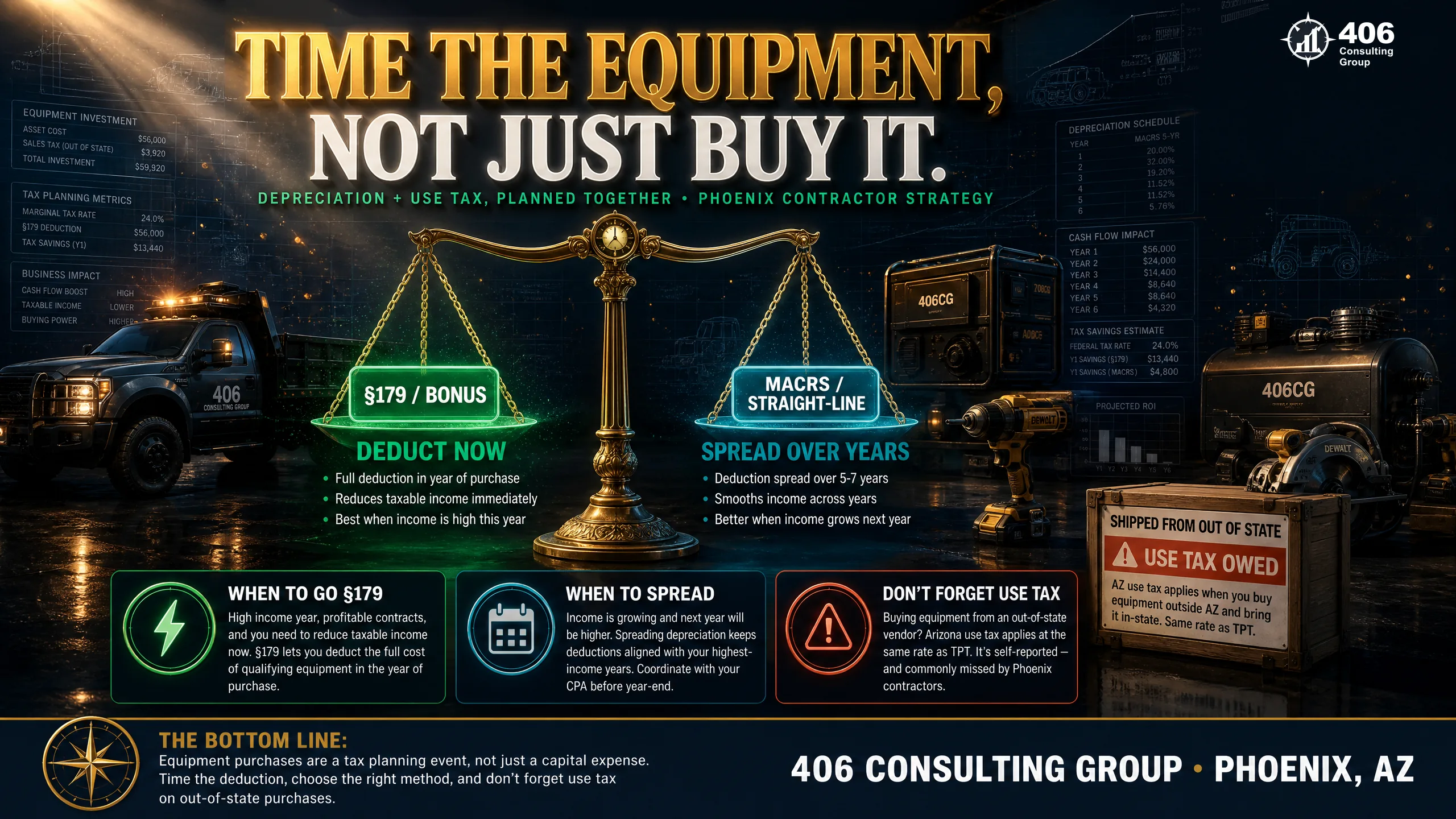
The right answer is rarely "deduct it all now" by reflex — it's whatever fits your multi-year picture.
Estimated Taxes & QBI
Profitable pass-through owners generally owe quarterly estimated taxes to both the IRS and Arizona, and the federal side is where most of the dollars are. Miss or underpay them and you draw penalties on top of the tax — an avoidable, pure-waste cost. In a fast-growing business, estimates also need to keep pace with a rising income; last year's safe-harbor number can leave you badly short when this year's profit jumps.
The Qualified Business Income (QBI) deduction — up to 20% of qualified pass-through income, subject to income thresholds and limits — is one of the biggest federal levers for a Phoenix small business, and it interacts with your salary, entity choice, and depreciation decisions. Planning these together, rather than discovering them at filing, is most of what good tax work is.
It's the same theme throughout: the flat state rate is easy; the federal decisions around it are where the planning lives.
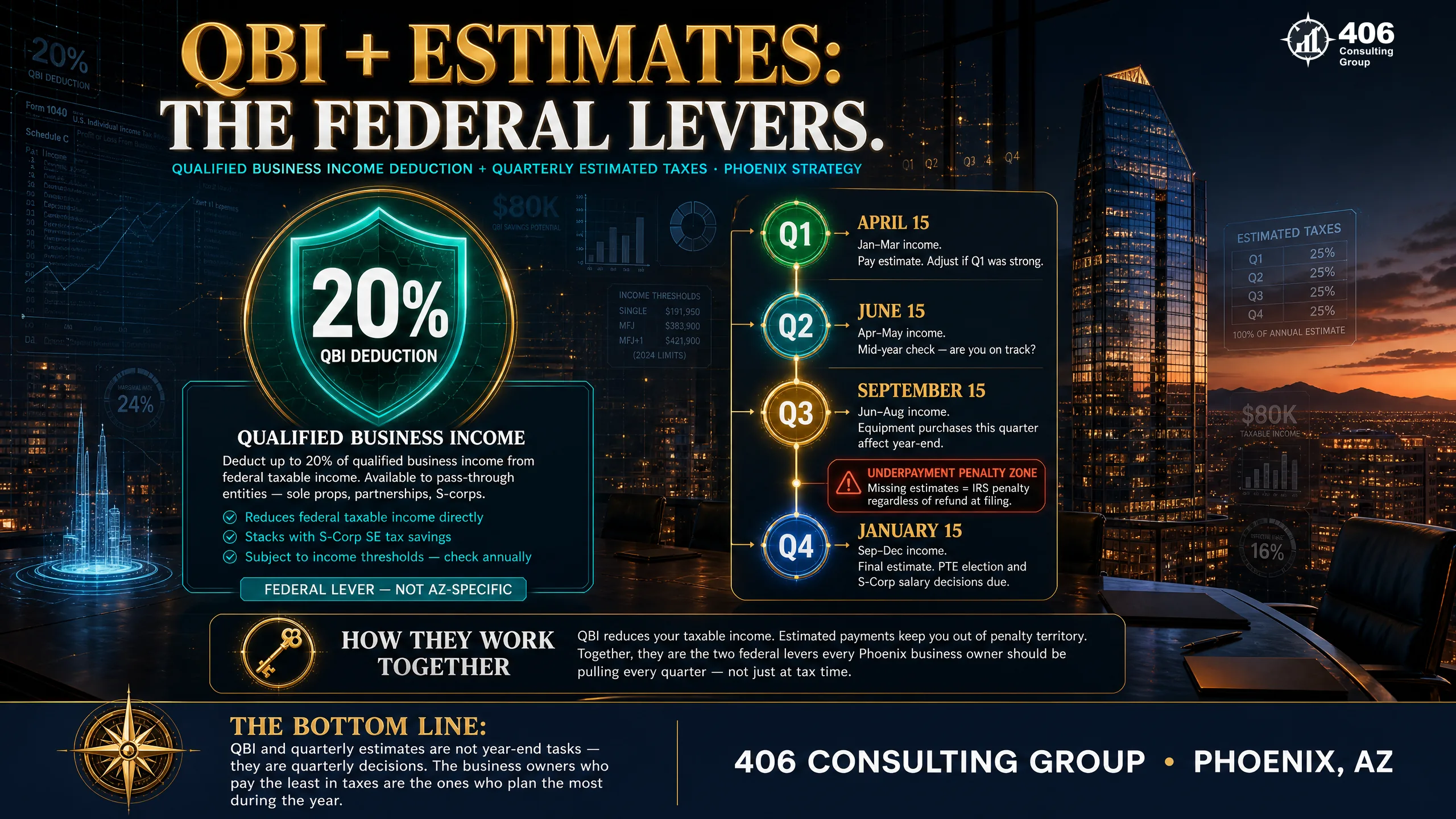
The Phoenix Tax Calendar
Arizona adds a rhythm most states don't: TPT is typically filed monthly for many businesses (some qualify for quarterly or annual), which means a recurring cadence on top of the usual income-tax dates.
| Obligation | Rough cadence |
|---|---|
| TPT return | Often monthly (quarterly/annual for smaller filers); due on Arizona's schedule |
| Federal estimated tax | Quarterly — mid-Apr, mid-Jun, mid-Sep, mid-Jan |
| Arizona estimated tax | Quarterly, aligned with federal for most |
| Payroll deposits & filings | Per federal/AZ schedule; W-2s & 1099s in January |
| Income-tax returns | Spring, with extensions available; PTE election on its own timeline |
Confirm your specific due dates and filing frequency with the Arizona Department of Revenue — the monthly TPT cadence is the piece that surprises businesses new to Arizona.
Common Phoenix Tax Mistakes
The costly mistakes here cluster around the things the flat rate distracts people from.
Skipping the PTE election
Leaving the SALT-cap workaround on the table means paying federal tax you could have deducted around — pure lost money.
Not pricing contractor TPT into bids
Discovering a job's prime-vs-MRRA treatment at filing instead of at bid can erase the margin.
Misclassified TPT revenue
Wrong classification or missed exemptions means overpaying quietly for years or building an audit liability.
Reflexively expensing every asset
Accelerating deductions into an already-low-rate year can be worth less than spreading them.
Stale estimated taxes in a growth year
Paying on last year's income while this year jumps leaves a shortfall plus penalties.
Every one is avoidable with planning that starts before year-end — not at the filing deadline.
Local vs. a Great Remote Partner
Tax planning is even less about geography than bookkeeping is. What lowers a Phoenix business's bill is expertise — knowing the PTE election, the contractor TPT rules, the QBI and depreciation interactions — not whether your accountant's office is off the 101. A remote partner who plans Arizona taxes all day beats a nearby generalist who files the return and stops there.
And planning is naturally a remote, year-round conversation: a mid-year check-in over a screen share, a quick call before you sign a big job or buy a truck, a clean hand-off to filing. We do this with businesses across Phoenix and Maricopa County the same way we do it across the Mountain West — secure document exchange, real planning conversations, and proactive moves before deadlines instead of scrambling after them.
The bill is set by the decisions, and the decisions are set by expertise — not by a zip code.
How to Get Started
Getting ahead of your Phoenix taxes is three steps.
Get the structure right
Confirm your entity, run the PTE election if it fits, and make sure your TPT classifications and certificates are set correctly.
Plan the big moves before they happen
Price contractor TPT into bids, time equipment and depreciation deliberately, and size estimated taxes to this year's income.
Review through the year, not just at filing
A mid-year check and pre-decision calls turn tax from an April surprise into a managed number.
Want a first read on whether an S-corp election pays off for you? Start with our S-Corp Calculator, then let's pressure-test it together.
FAQ: Phoenix Tax Questions
What is Arizona's income tax rate for a small business?
Arizona taxes individual income at a flat rate of about 2.5% (confirm the current rate) — one of the lowest in the country. Most small businesses are pass-throughs (S-corps, partnerships, sole props), so business profit flows to the owners' personal returns and is taxed at that flat rate. C-corporations pay Arizona's corporate rate instead. The low flat rate is why Arizona planning focuses less on the income-tax line and more on TPT, the contractor rules, the pass-through entity election, and federal levers like QBI.
What is the Arizona PTE election and should I make it?
The pass-through entity (PTE) election lets an S-corp or partnership pay Arizona income tax at the entity level rather than passing it through to owners' personal returns. Because that entity-level tax is a business expense, it works around the federal cap on the SALT deduction — effectively letting you deduct your Arizona income tax federally when you otherwise couldn't. For many profitable pass-throughs it's worth making, even at Arizona's low rate, but the mechanics and deadlines matter, so set it up deliberately with a pro and confirm current rules with the Arizona Department of Revenue.
How does TPT affect tax planning for a contractor?
Heavily. Whether a job is taxed as 'prime contracting' (new construction/modification, taxed on gross receipts after a standard deduction) or as 'MRRA' (maintenance, repair, replacement, alteration — where you generally pay TPT or use tax on materials at purchase) changes the tax base entirely, and therefore the true cost of the job. The planning move is to determine the expected treatment before you bid and price it in, keep documentation to support each job's classification, and get advice on the gray ones. The rules are intricate and can change, so confirm current treatment with the Arizona DOR.
Do I need to pay quarterly estimated taxes in Arizona?
Most profitable pass-through owners do — to both the IRS and Arizona — and the federal portion is usually the larger one. Underpaying draws penalties on top of the tax, and in a fast-growing business, estimates based on last year's income can leave you short when this year's profit jumps. It's worth updating your estimates during the year rather than relying on a stale safe-harbor number. Arizona also has its TPT filing cadence (often monthly) running alongside the income-tax calendar.
Can 406 Consulting Group handle my Phoenix tax planning remotely?
Yes. Tax planning is a year-round, naturally remote conversation — a mid-year review over a screen share, a quick call before you sign a big contract or buy equipment, and a clean hand-off to filing. We work with Phoenix and Maricopa County businesses the same way we do across the Mountain West: secure document exchange and proactive planning before deadlines. What lowers your bill is Arizona expertise — the PTE election, contractor TPT, QBI and depreciation — not whether we share a zip code.
Keep Reading
Tax Planning — Phoenix, AZ
The Flat Rate Is Easy. The Rest Is Where We Earn It.
406 Consulting Group plans Phoenix taxes around what actually moves the number — the PTE election, contractor TPT, entity choice, depreciation, and QBI — delivered remotely, by a firm that knows Arizona.
Phoenix Tax Quick Reference
Phoenix, AZ — Maricopa County
Leaving Money on the Table?
The PTE election, contractor TPT & entity choice.
About the Author
Jason Anderson
Co-Founder, 406 Consulting Group
Big-firm-trained accountant advising construction and small businesses across the Mountain West and Southwest. Jason helps Phoenix owners plan around what actually moves the number — the PTE election, contractor TPT, entity choice, and depreciation — instead of just filing a return in April.
Read the Full Story