
CFO & Controller Services in Phoenix, AZ:
Grow on Purpose, Not on Luck
Fast growth breaks the finance function that worked a few million ago. Here's what a controller and a CFO each do, what they cost fractionally vs. full-time, and the WIP-and-bonding work a building metro demands.

Phoenix is growing fast, and fast growth is exactly where good businesses get into trouble. Revenue climbs, headcount climbs, jobs get bigger — and the financial function that worked at $2 million quietly stops working at $8 million. The owner is still the de facto CFO, decisions get made on gut and bank balance, and nobody's watching the numbers that actually predict whether the growth is profitable or just busy. That's the gap a controller or CFO fills, and in a boom metro it fills sooner than owners expect.
The good news: you almost certainly don't need — or want — a $250,000 full-time hire to close it. This guide walks the difference between a controller and a CFO, what each costs full-time versus fractional, when a growing Phoenix company actually needs one, and the construction-specific finance work (WIP schedules, percentage-of-completion, surety bonding) that a fast-building metro demands. All delivered remotely.
By Carrie Anderson — Co-Founder, 406 Consulting Group. Commercial banking and underwriting background — 300+ loan reviews — helping construction and growth companies across the Mountain West and Southwest build the financial function scaling demands.
Quick Answer: CFO & Controller Help for a Phoenix Business
- →Controller owns accurate, timely books and reporting; a CFO owns strategy, cash, capital, and forecasting.
- →Fractional gets you the expertise for roughly $2,500–$8,000/mo versus a full-time all-in cost of $235K–$420K+.
- →Most companies don't need full-time until roughly $15M+ in revenue.
- →Construction here needs WIP, percentage-of-completion, and surety-bonding-ready financials.
- →Delivered remotely — the expertise matters more than the office.
Table of Contents
Why a Phoenix Growth Company Needs This
Growth hides problems. When revenue is climbing, a thin margin and a messy back office feel fine because the bank balance keeps going up. Then a big job goes sideways, a slow-paying customer stretches cash, or you land the contract you wanted and realize you can't staff and fund it at once — and suddenly the lack of a real financial function isn't abstract. In a metro expanding as fast as Phoenix, companies hit that wall earlier and harder, because they're scaling into a growing market instead of a stable one.
A controller or CFO is what turns financial data into foresight — accurate books that close on time, a forecast you can trust, and an early warning before cash or margin becomes a crisis. The mistake most growing owners make isn't hiring the wrong person; it's waiting too long and staying the accidental CFO while running everything else too.

The first step is knowing which role you actually need — and they're not the same job.
Controller vs. CFO: Two Different Jobs
People use the titles loosely, but they're distinct roles that solve different problems. A controller looks backward and makes it accurate: they own the books, the monthly close, reporting, controls, and making sure the numbers are right and on time. A CFO looks forward and makes it strategic: forecasting, cash-flow planning, pricing and margin strategy, capital and financing, and the big decisions about where the business is going.
| Controller (accuracy, backward) | CFO (strategy, forward) |
|---|---|
| Monthly close & accurate books | Forecasting & scenario planning |
| Financial reporting & controls | Cash-flow strategy & runway |
| Job costing & margin reporting | Pricing, margin & profitability strategy |
| Payroll oversight & compliance | Banking, bonding & capital raising |
| Clean books for the CFO to use | The decisions those books inform |

Many growing companies need the controller function first — accurate, timely books — and the CFO function as the decisions get bigger. Plenty need a blend. The wrong move is paying full-time-executive money for either before you need it.
The Cost Math: Fractional vs. Full-Time
This is where fractional makes the case for itself. A full-time senior hire in these roles is expensive — and the salary is only part of it.
| Option | Rough cost |
|---|---|
| Fractional controller | ~$2,500–$6,000/mo |
| Fractional CFO | ~$2,500–$5,000/mo |
| Both, fractional | ~$4,000–$8,000/mo |
| Full-time controller | $85K–$120K salary + ~25% benefits |
| Full-time CFO | $150K–$300K+ salary |
| Both, full-time (all-in) | $235K–$420K+ per year |

Fractional gets you senior expertise for a fraction of a full-time salary — the right answer for most companies until they're big enough to keep an executive genuinely busy full-time.
When to Hire — and at What Size
The honest rule of thumb: most companies don't need a full-time CFO until somewhere around $15 million+ in revenue — below that, a full-time executive usually isn't kept busy enough to justify the cost, which is exactly why fractional exists. But the need for the function shows up much earlier, and it's usually triggered by events, not just size.
The close keeps slipping
Books aren't done until weeks after month-end, so every decision runs on stale numbers — a controller problem.
You're bidding or taking on bigger jobs
Larger contracts mean WIP, bonding, and cash-timing questions an owner shouldn't answer alone.
Growth is straining cash
Profitable on paper but tight in the bank is the classic signal a CFO's forecasting is overdue.
You're seeking financing or bonding
Banks and sureties want financials and projections that a CFO-level function produces.
You're flying blind on margin
You can't say which jobs or lines actually make money — you need the reporting a controller builds.
Hit two or three of these and it's time — and fractional lets you add exactly the level you need without an executive salary. Our Financial Maturity Assessment helps you place yourself.
The Construction CFO: WIP, POC & Bonding
In a building-driven metro, a big share of the companies that need this are contractors — and construction finance is its own discipline. Three things separate a real construction CFO function from generic accounting: a work-in-progress (WIP) schedule that tracks each job's costs, billings, and estimated cost-to-complete; percentage-of-completion (POC) accounting, which recognizes revenue as a job progresses rather than all at once; and surety bonding readiness, because a contractor's bonding capacity — the size and number of jobs they can take — depends directly on the strength and credibility of their financial statements.
Over- and under-billing, retainage, change orders, and job-level margin all flow through the WIP schedule, and getting it right is what lets a growing contractor bid bigger with confidence instead of guessing. This is also where a banking-informed eye matters: sureties and lenders read these statements the way an underwriter does, and a financial function built to that standard is what unlocks the next tier of work.
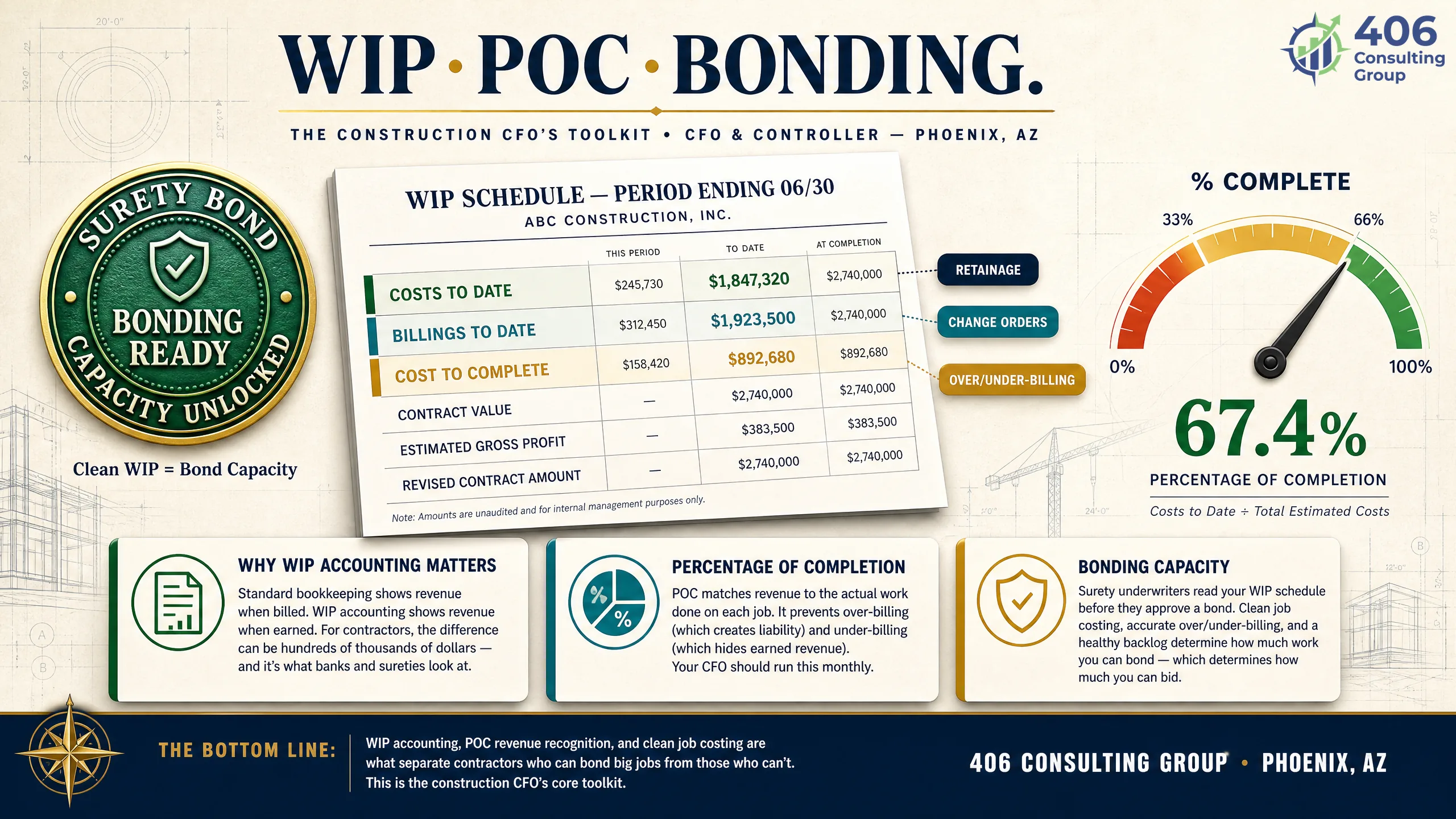
Curious which of your jobs actually drives profit? That's the heart of our contractor unit economics piece — and a WIP-literate CFO function is how you see it.
Cash Flow in a Boom
Fast growth is cash-hungry in a way that surprises profitable owners. You fund labor, materials, and payroll now and collect later; every new job and every new hire pulls cash forward before it comes back. It's entirely possible to be growing, profitable, and nearly out of cash at the same time — and in a boom, the temptation to say yes to everything makes it more likely, not less.
A CFO's core job here is a real cash-flow forecast: mapping what's coming in and going out over the next weeks and months so you can see a squeeze before it arrives and act early — accelerate collections, time a purchase, arrange a credit line before you need it rather than during the crunch. That foresight is the difference between growth that compounds and growth that quietly strangles itself.
Managing cash in a boom isn't about spending less — it's about seeing far enough ahead to fund the growth on purpose.
Banking, Bonding & Capital for Growth
Scaling usually means outside capital at some point — a line of credit for working capital, equipment financing, a term loan for expansion, or bonding capacity for bigger jobs. Every one of those is a credibility test, and the thing being tested is your financials. Lenders and sureties want clean statements, believable projections, and an owner who can speak to the numbers — and how well you present shapes whether you get the money and on what terms.
This is where our background genuinely helps. Having sat on the underwriting side of the table — 300+ loan reviews — we know how a bank or surety reads a company, what strengthens a file, and what quietly sinks it. We help you go in prepared, presenting your business the way the people with the capital need to see it. Our loan-readiness work exists for exactly this.

The capital is out there for growing Phoenix companies; getting it on good terms is a preparation problem — and preparation is exactly what a CFO function provides.
Systems Across the Whole Company
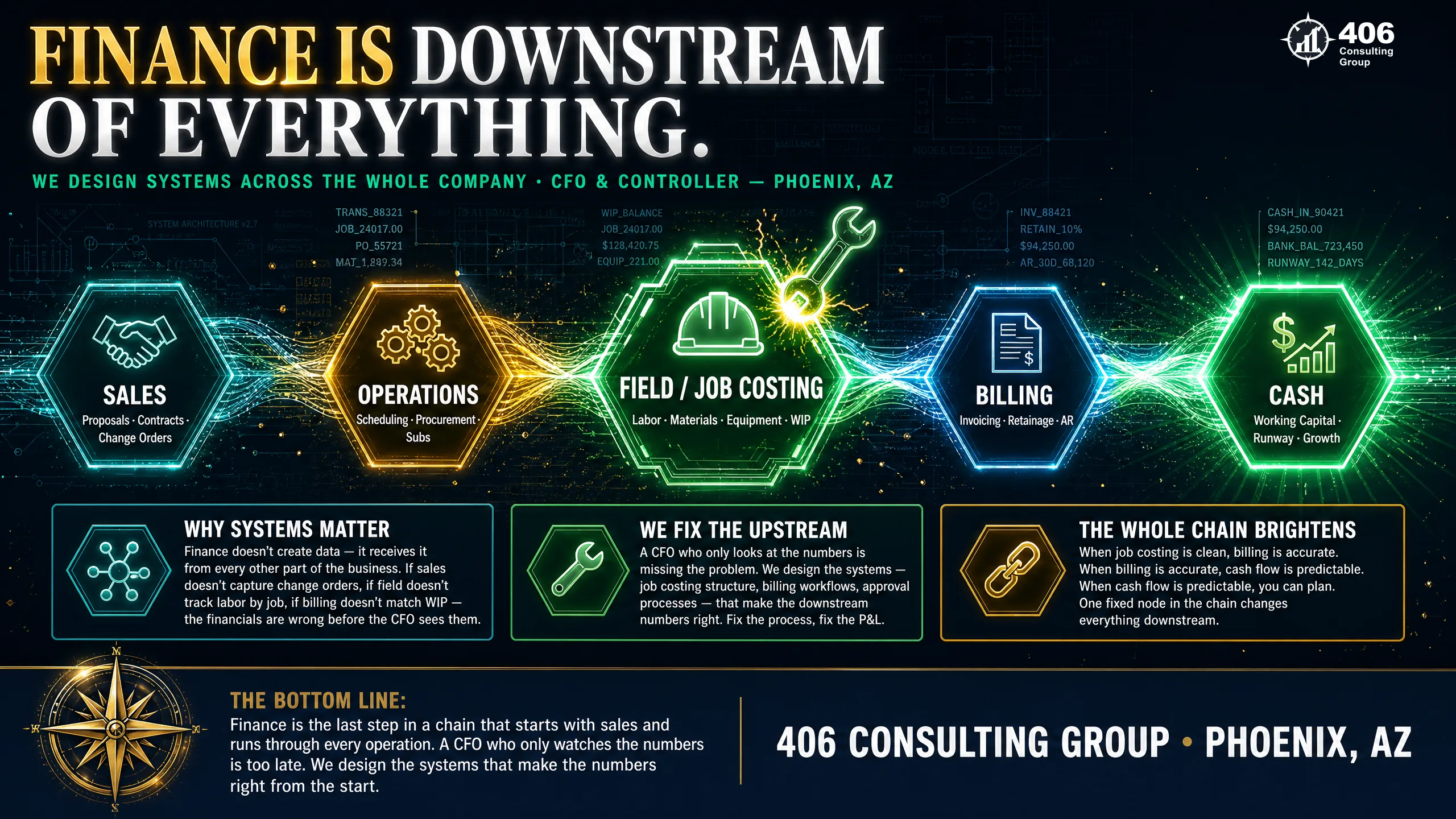
Here's what sets our CFO work apart: we don't look at finance in isolation. The best financial function designs systems and processes from a whole-company view — how sales hands off to operations, how operations feeds job costing, how the field reports hours, how billing connects to cash. The finance numbers are downstream of everything else the company does, so fixing them for real usually means fixing the process that produces them.
That cross-departmental lens is how a growing company turns chaos into something that scales: fewer things falling through the cracks, cleaner data flowing into the books, and decisions based on numbers that are right because the process behind them is right. It's the difference between an accountant who reports the past and a partner who helps you build a business that runs.
We go deeper on this in the hidden cost of no systems — the quiet price a growing company pays for operational chaos disguised as hustle.
The Numbers a CFO Puts in Front of You
A good CFO function replaces "how much is in the bank?" with a short list of numbers that actually tell you how the business is doing and where it's heading.
| Metric | What it tells you |
|---|---|
| Cash-flow forecast | Whether you can fund the next few months of growth — the number that prevents crises |
| Gross margin by job/line | Which work actually makes money, so you bid and chase the right jobs |
| WIP / over- & under-billing | The true position of every open job — essential for contractors |
| Backlog & pipeline | Revenue you've already won versus what you still need to sell |
| Working capital & AR days | How much cash the growth is tying up, and how fast you collect |
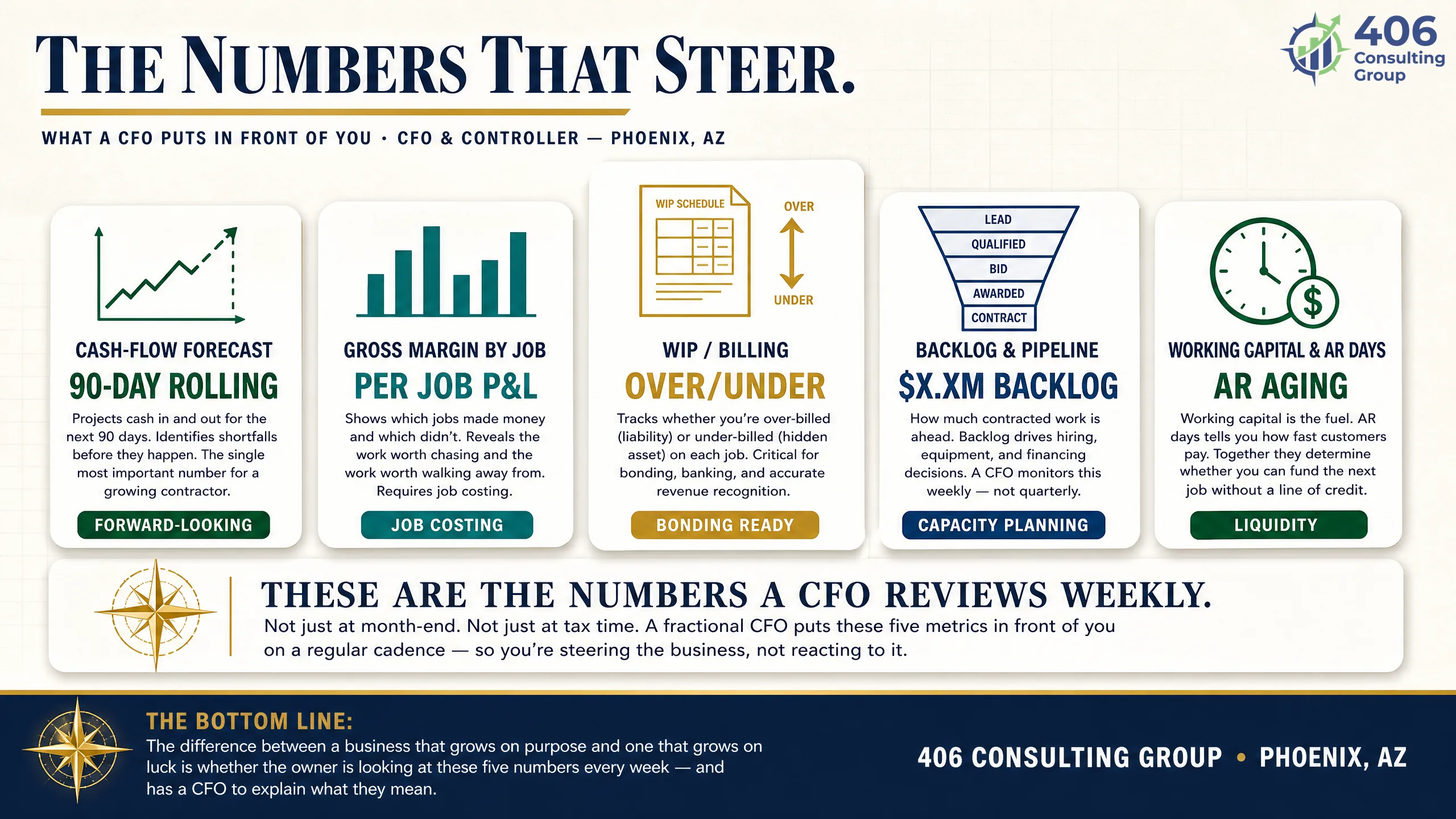
These are the numbers that turn a busy company into a well-run one — and most owners have never had them presented clearly.
Local vs. a Great Remote Partner
A CFO's value is in judgment and expertise, not proximity — which makes it one of the most natural roles to deliver remotely. What a growing Phoenix company needs is someone who has built forecasts, read bank and surety requirements, and guided companies through scaling — construction finance included. That experience matters far more than whether they're across town, and a specialized remote partner routinely beats whatever local generalist happens to be nearby.
Modern CFO work is a screen-share, a shared dashboard, and a standing strategy call — a mid-month cash review, a pre-bid conversation, a projection built together before you sit down with a lender. We work this way with companies across Phoenix and Maricopa County exactly as we do across the Mountain West: close, responsive, and strategic, without needing to share a parking lot.
For a role this senior, expertise is the whole game — and expertise travels.
How to Get Started
Adding a CFO or controller function to your Phoenix business is three steps.
Figure out which function you need
Controller (accurate, timely books and reporting), CFO (strategy, cash, capital), or a blend — and at what level.
Start fractional
Bring in senior expertise for a few thousand a month instead of a full executive salary, scaled to what you actually need now.
Build the forward view
Forecasting, job-level margin, WIP if you build, and capital readiness — so you're steering, not reacting.
Not sure where you stand? Our Financial Maturity Assessment maps your financial function in about eight minutes and shows what to build next.
FAQ: Phoenix CFO & Controller Questions
What's the difference between a controller and a CFO?
A controller looks backward and makes it accurate — they own the books, the monthly close, financial reporting, controls, and job-cost/margin reporting. A CFO looks forward and makes it strategic — forecasting, cash-flow planning, pricing and margin strategy, and banking, bonding, and capital decisions. Put simply, the controller makes sure the numbers are right and on time; the CFO uses those numbers to steer the business. Many growing companies need the controller function first and add the CFO function as decisions get bigger; plenty need a blend of both.
How much does a fractional CFO or controller cost in Phoenix?
Fractionally, a controller typically runs about $2,500–$6,000 per month and a fractional CFO about $2,500–$5,000 per month, with both together often around $4,000–$8,000 per month depending on scope. Compare that to full-time: a controller is roughly $85,000–$120,000 in salary plus about 25% in benefits, and a full-time CFO is $150,000–$300,000+, so both full-time run an all-in $235,000–$420,000+ per year. Fractional gives you the senior expertise for a fraction of the cost, which is why it's the right fit for most growing companies.
When does my business actually need a CFO?
Most companies don't need a full-time CFO until roughly $15 million or more in revenue — below that, a full-time executive usually isn't kept busy enough to justify the cost, which is exactly what fractional solves. But the need for the function shows up earlier and is usually event-driven: your month-end close keeps slipping, you're bidding bigger jobs, growth is straining cash, you're seeking financing or bonding, or you can't tell which work actually makes money. Hit two or three of those and it's time — you just don't have to hire full-time to get it.
Do you handle construction accounting like WIP and bonding?
Yes — it's central to serving a building-driven metro like Phoenix. A real construction finance function needs a work-in-progress (WIP) schedule tracking each job's costs, billings, and cost-to-complete; percentage-of-completion accounting that recognizes revenue as a job progresses; and financial statements strong enough to support surety bonding, since bonding capacity depends directly on the credibility of your financials. Over- and under-billing, retainage, and change orders all flow through the WIP schedule, and getting it right is what lets a contractor bid bigger with confidence.
Can 406 Consulting Group be our CFO remotely?
Yes. CFO and controller work is about judgment and expertise, not proximity, which makes it a natural fit for remote delivery — screen-shares, a shared dashboard, and standing strategy calls: a mid-month cash review, a pre-bid conversation, a projection built together before you meet a lender. We serve Phoenix and Maricopa County companies the same way we do across the Mountain West, and our commercial-banking background means we prepare your financials the way lenders and sureties actually read them. For a role this senior, expertise matters far more than a local office.
Keep Reading
CFO & Controller — Phoenix, AZ
Grow on Purpose, Not on Luck.
406 Consulting Group gives Phoenix growth companies a CFO and controller function — forecasting, job-level margin, WIP and bonding readiness, and capital strategy — fractionally and remotely, from a firm that knows construction and banking.
Phoenix CFO Quick Reference
Phoenix, AZ — Maricopa County
Outgrowing Your Back Office?
Fractional CFO & controller — scaled to you.
About the Author
Carrie Anderson
Co-Founder, 406 Consulting Group
Commercial banking and underwriting background — 300+ loan reviews — helping construction and growth companies across the Mountain West and Southwest build the financial function scaling demands. Carrie helps Phoenix owners forecast cash, read a job's true margin, and present financials the way lenders and sureties actually read them.
Read the Full Story