
Bookkeeping Services in Phoenix, AZ:
TPT, Contracting & the Boom, Handled
Arizona doesn't have a normal sales tax — it has the Transaction Privilege Tax, and its contractor rules are among the most complex anywhere. Here's what a Phoenix business really needs from its books, on a flat 2.5% income base.

Phoenix is one of the fastest-growing metros in the country, and its economy shows it: a massive construction boom, semiconductor and tech relocation, healthcare, logistics, and a steady stream of new businesses chasing all of it. But the thing that trips up almost everyone doing business in Arizona isn't growth — it's the tax. Arizona doesn't have a normal sales tax. It has the Transaction Privilege Tax (TPT), a tax on the seller that works differently than the sales tax you know, with its own classifications, its own multi-jurisdiction rules, and — for contractors — some of the most complicated rules in the country.
For a Phoenix business, clean books mean getting TPT right, and if you build things, getting the contractor version of TPT right — the difference between new-construction work and repair-and-maintenance work is a genuine minefield. Layer on Arizona's flat income tax, construction job costing for the boom, and payroll, and you have a bookkeeping job that a generic, out-of-state setup consistently botches. This guide walks the TPT, the contractor rules, and everything else a Phoenix business needs — delivered remotely.
By Carrie Anderson — Co-Founder, 406 Consulting Group. Commercial banking and underwriting background — 300+ loan reviews — advising construction and small businesses across the Mountain West and Southwest, where sales/privilege tax and job costing are everyday work.
Quick Answer: Bookkeeping for a Phoenix Business
- →TPT, not sales tax: Arizona taxes the seller for the privilege of doing business — different rules, multiple classifications.
- →Contractors, beware: new-construction (prime contracting) work is taxed very differently than repair/maintenance (MRRA) work.
- →Arizona taxes: a low flat income tax (~2.5%), TPT around 8.6% combined in Phoenix, no separate B&O.
- →Construction boom means job costing and WIP matter for a big share of the market.
- →Delivered remotely — even most of our local clients never come into the office.
Table of Contents
Why Phoenix Bookkeeping Is Different
Most bookkeeping advice assumes a normal state sales tax — you charge it to the customer, collect it, and remit it. Arizona breaks that assumption. The Transaction Privilege Tax is legally a tax on you, the seller, for the privilege of doing business in Arizona — you can pass it on to customers, but the liability is yours, it's organized into business classifications with different rules, and cities layer their own on top. It's close enough to a sales tax to lull an out-of-state bookkeeper into treating it like one, and different enough to create real problems when they do.
For the construction side of Phoenix — and in a metro building this fast, that's a huge slice — it gets harder still, because contractors have their own TPT rules that hinge on what kind of work they're doing. Add the growth-driven need for real job costing, and books built for a Phoenix business have to speak TPT, contracting, and construction, not just record deposits. Maricopa County is where most of this plays out.

The rest of this guide walks each piece — starting with the Arizona tax backdrop everything sits on.
The Arizona Tax Backdrop
Arizona is business-friendly on income and unusual on transactions. Here's the picture for a Phoenix business:
| Tax | Arizona reality |
|---|---|
| State income tax | Low flat rate (~2.5%) on individual income — one of the lowest; verify current |
| Transaction Privilege Tax (TPT) | Arizona's 'sales tax' — on the seller; ~8.6% combined in Phoenix (state + county + city); verify |
| Gross-receipts / B&O | None separate — TPT is the gross-receipts-style tax |
| Use tax | Companion to TPT on untaxed purchases |
| County / classifications | Maricopa County; TPT is organized by business classification |
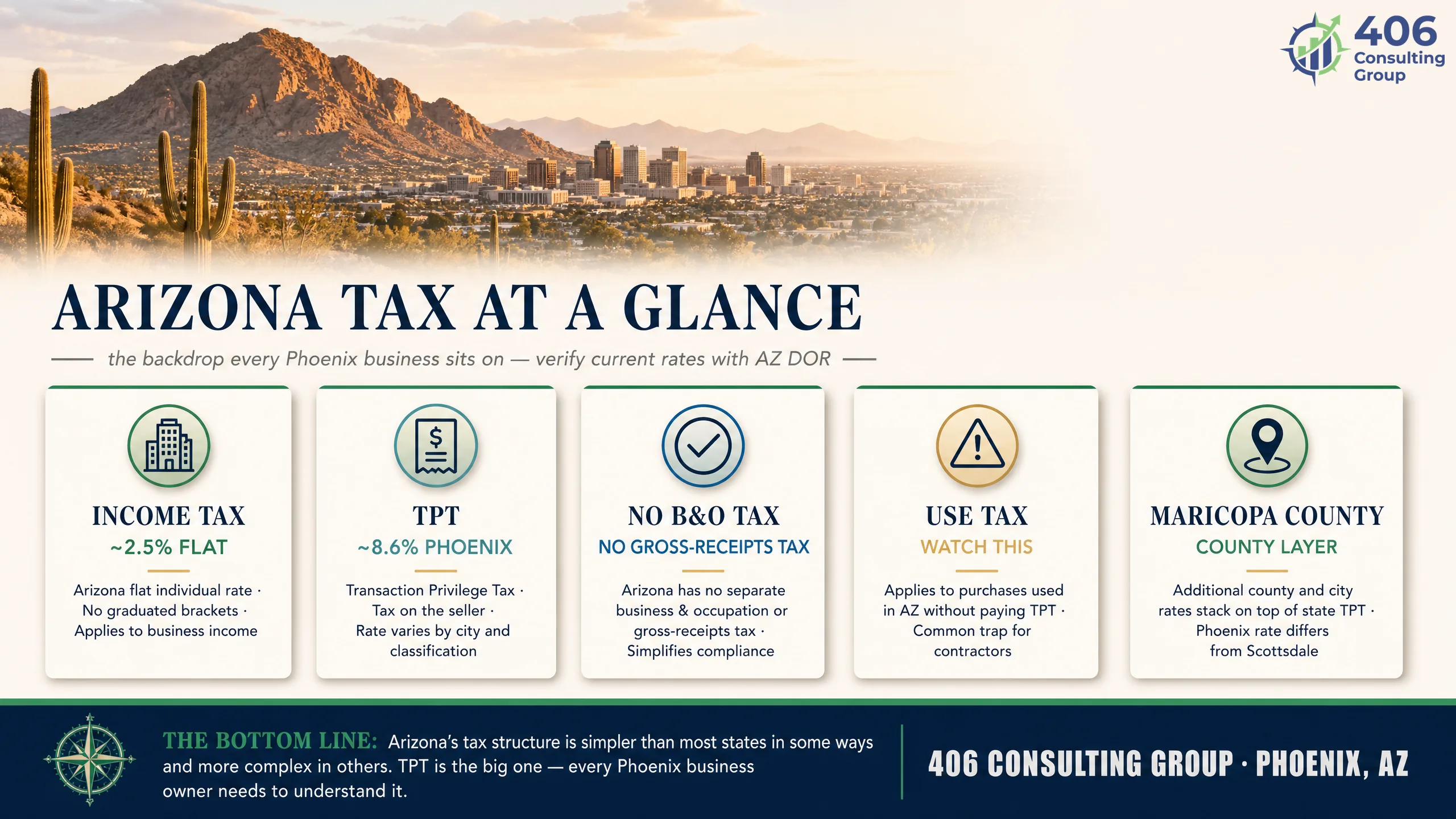
The flat income tax is simple; the TPT is where the work is. Confirm current rates, classifications, and city rules with the Arizona Department of Revenue. We cover planning in the Phoenix tax guide.
TPT: It's Not a Normal Sales Tax
The single most important thing to understand about doing business in Phoenix: the Transaction Privilege Tax is a tax on the business, not the customer. Practically, most businesses pass it through on the invoice like a sales tax, but legally the obligation is the seller's — which means the liability, the filing, and the risk are yours. TPT is also organized into business classifications (retail, restaurant, contracting, commercial lease, and more), each with its own rate and rules, and Arizona's cities impose their own TPT on top of the state and county pieces, so the rate and even the taxability can depend on where the transaction happens.
For clean books, that means recording TPT collected as a liability (never as revenue — it's the state's money), tracking it by the right classification, and being set up to file across the jurisdictions you owe. The good news is that most TPT is now filed through a single state system; the bad news is that an out-of-state bookkeeper who treats it as a plain sales tax will misclassify income and misstate what you owe. Use tax is its companion, owed on equipment and supplies bought without TPT.
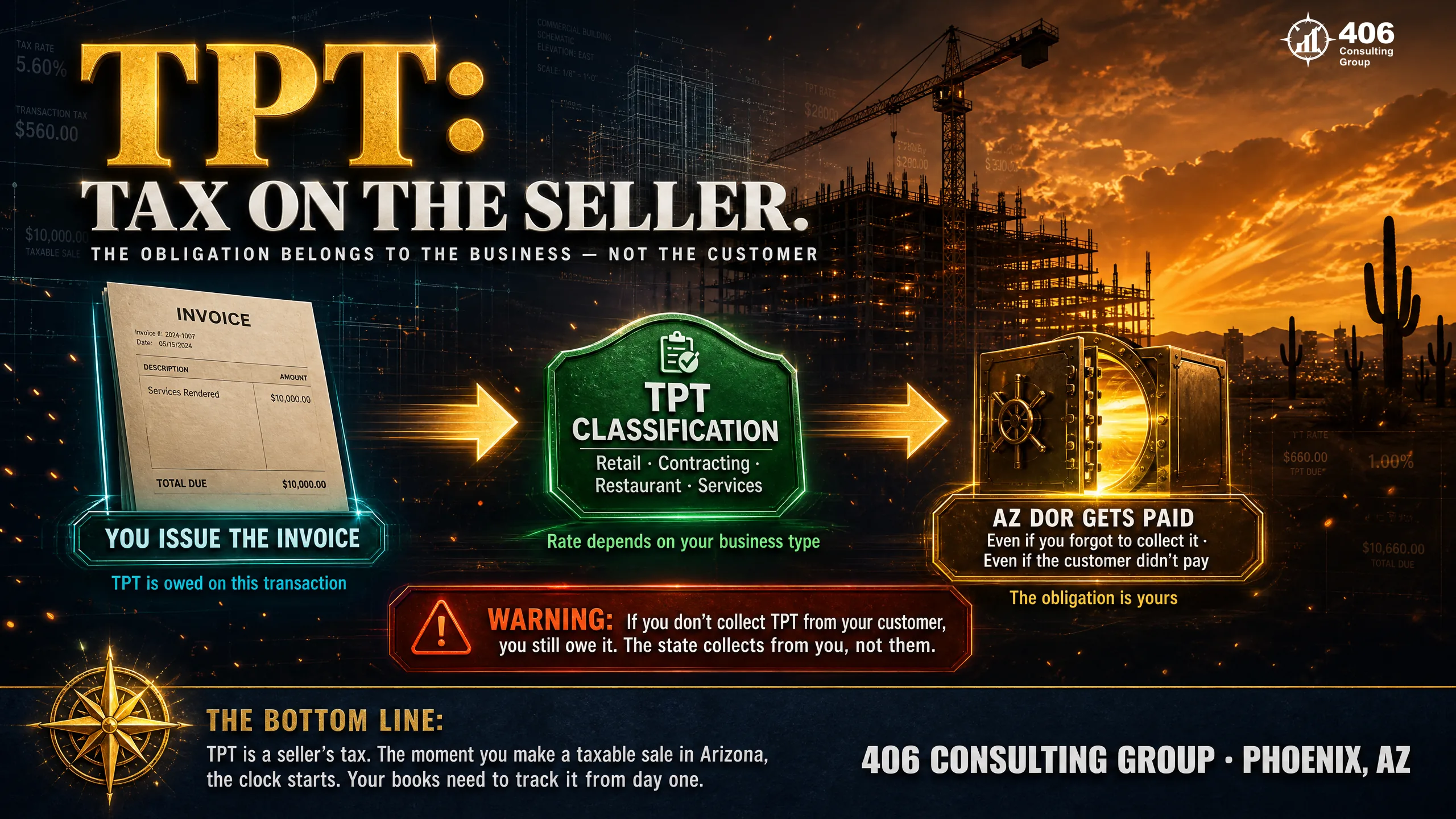
The out-of-state-bookkeeper trap
TPT looks enough like a sales tax that a generic bookkeeper treats it like one — wrong classification, wrong jurisdiction, wrong number. Because the liability is the business's, those mistakes land on you. Confirm classifications and rates with the Arizona Department of Revenue.
The Contractor TPT Maze
If you build in Arizona, this is the section that matters most — and it's genuinely one of the most complicated tax areas in the country. Arizona treats construction contractors under special TPT rules that hinge on what kind of work you're doing. Broadly, "prime contracting" — new construction and larger modification work — is taxed under the prime contracting classification, where the tax is calculated on your gross receipts after a standard deduction (a portion of the contract is deducted before tax). "MRRA" work — maintenance, repair, replacement, and alteration on existing property — is treated very differently: rather than prime contracting tax on the job, the contractor generally pays TPT or use tax on the materials at purchase.
Get the classification of a job wrong and you can badly over- or under-pay — bidding a job as one type and being taxed as the other is a real way to lose money or invite an assessment. The lines between modification and MRRA, and how mixed jobs are handled, are subtle enough that even seasoned Arizona contractors get advice on them. Clean books that capture each job's contract type, materials, and TPT treatment from the start are what keep this manageable instead of a year-end disaster. This is squarely a work-with-someone-who-knows-Arizona area, and the rules can change, so confirm current treatment.
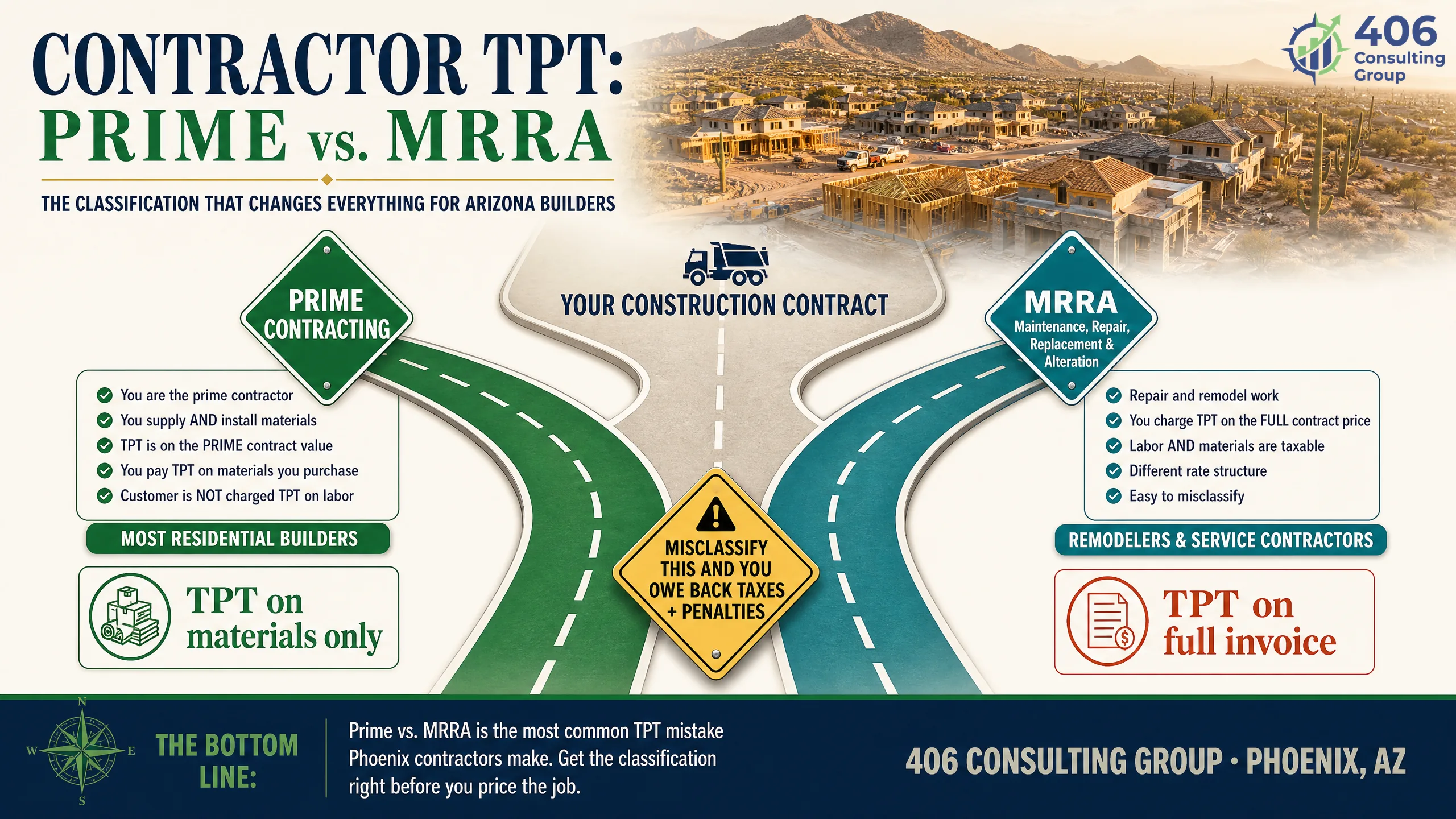
It's the single biggest reason a Phoenix contractor should not use an out-of-state or generic bookkeeper — and the biggest place we save Arizona builders from expensive mistakes.
Construction Job Costing
Beyond the TPT rules, Phoenix's building boom rewards contractors who actually know their numbers job by job — and punishes the ones flying on a single blended P&L. When a metro is growing this fast it's easy to mistake a full schedule for a profitable one; real job costing is what tells them apart. Every project should carry its own labor, materials, subcontractor, and equipment costs, plus work-in-progress, retainage, change orders, and 1099 tracking, so you can see which builds earned their keep and bid the next one on facts instead of hope.
In Arizona there's an extra reason to keep job costing tight: it dovetails with the contractor TPT rules, since the materials, contract type, and job details that drive your tax treatment are the same details clean job costing already tracks. Do both together and compliance and profitability reinforce each other instead of fighting.
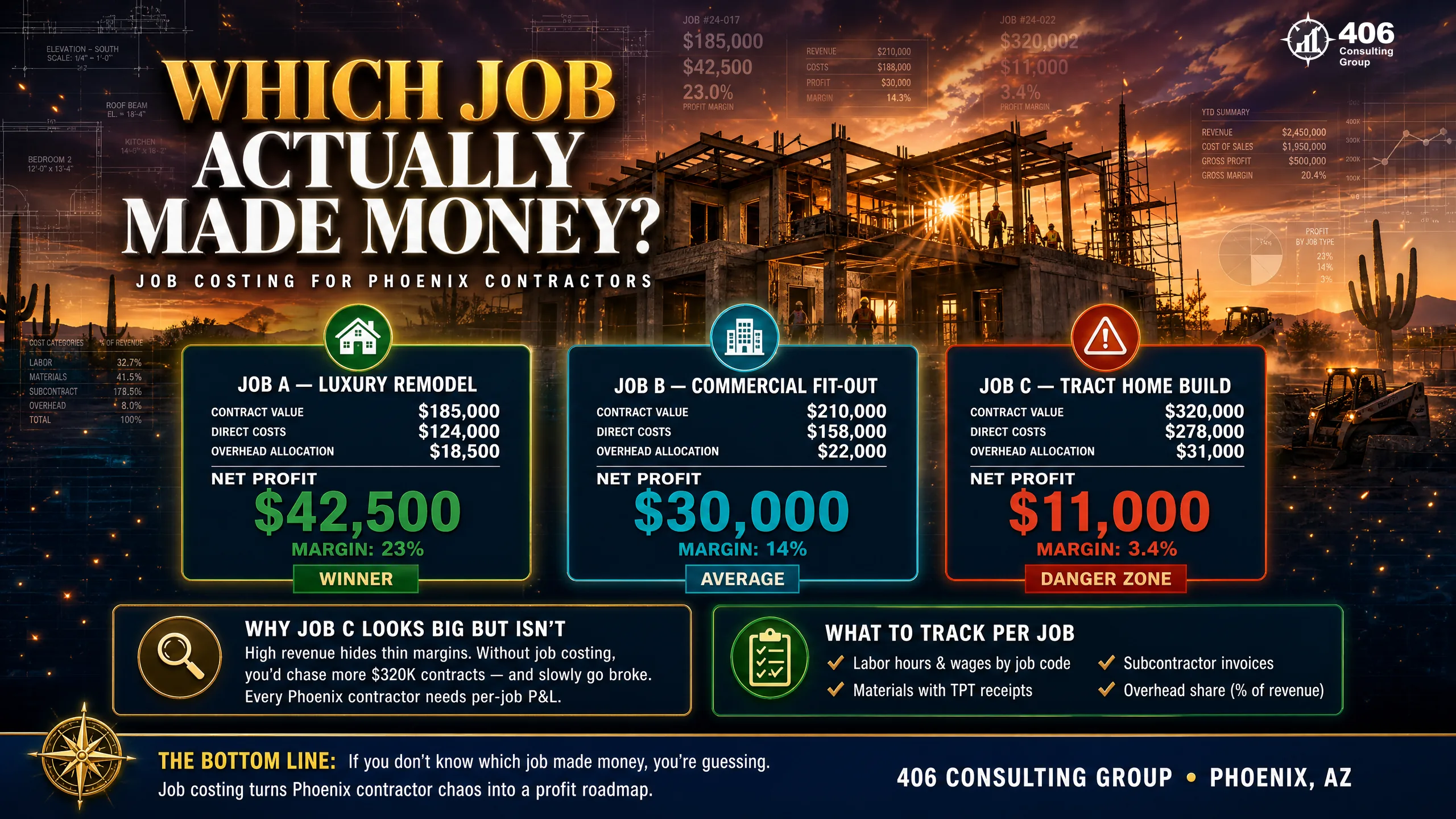
Curious which of your crews or jobs actually makes money? That's exactly what our flagship on contractor unit economics digs into — and clean job costing is what makes the answer visible.
Arizona Payroll
Because Arizona has a state income tax, payroll here includes state income-tax withholding — though at a low flat rate, Arizona withholding is relatively simple. Add federal payroll taxes, Arizona unemployment insurance (employer-paid), and workers' compensation, which in Arizona runs through a competitive private market. For construction especially, workers' comp class codes on trade work matter and aren't small, and a fast-growing metro means a lot of hiring — and a lot of subcontractors, where correct 1099 tracking and worker classification are essential.
Handled properly, Arizona payroll is genuinely low-friction — which is what our payroll work keeps it.
A Chart of Accounts Built for TPT
Your chart of accounts is the skeleton of your books, and an Arizona one has to carry the TPT structure a generic template lacks. It needs TPT collected tracked as a liability (never revenue), ideally broken out by classification and jurisdiction so filing is clean; job-costing structure for construction; and — for contractors — a way to separate prime-contracting work from MRRA work, since they're taxed on completely different bases.
Built right, that structure makes TPT filing routine and keeps your income correctly classified; built as a generic out-of-state template, it blends everything together and hides exactly the distinctions Arizona cares about. Getting the structure right once is what makes every month afterward fast and compliant.

This is where designing books around how the business — and Arizona — actually work pays off, the difference between compliant and quietly exposed.
Bookkeeping by Phoenix Segment
Phoenix's economy is led by construction and a wave of tech and logistics, with healthcare and hospitality around them — and each asks something different of the books.
| Segment | What the books need to track |
|---|---|
| Construction & trades | Contractor TPT (prime vs. MRRA), job costing, WIP, subs/1099s, retainage |
| Tech, semiconductor & logistics | Capital assets and depreciation, multi-state nexus, payroll, contracts |
| Retail & restaurants | TPT by classification, inventory or food cost, tips/payroll |
| Healthcare & professional | Receivables/insurance, payroll, utilization, clean reporting |
| Hospitality & retiree services | TPT/lodging where it applies, seasonality, receivables, payroll |
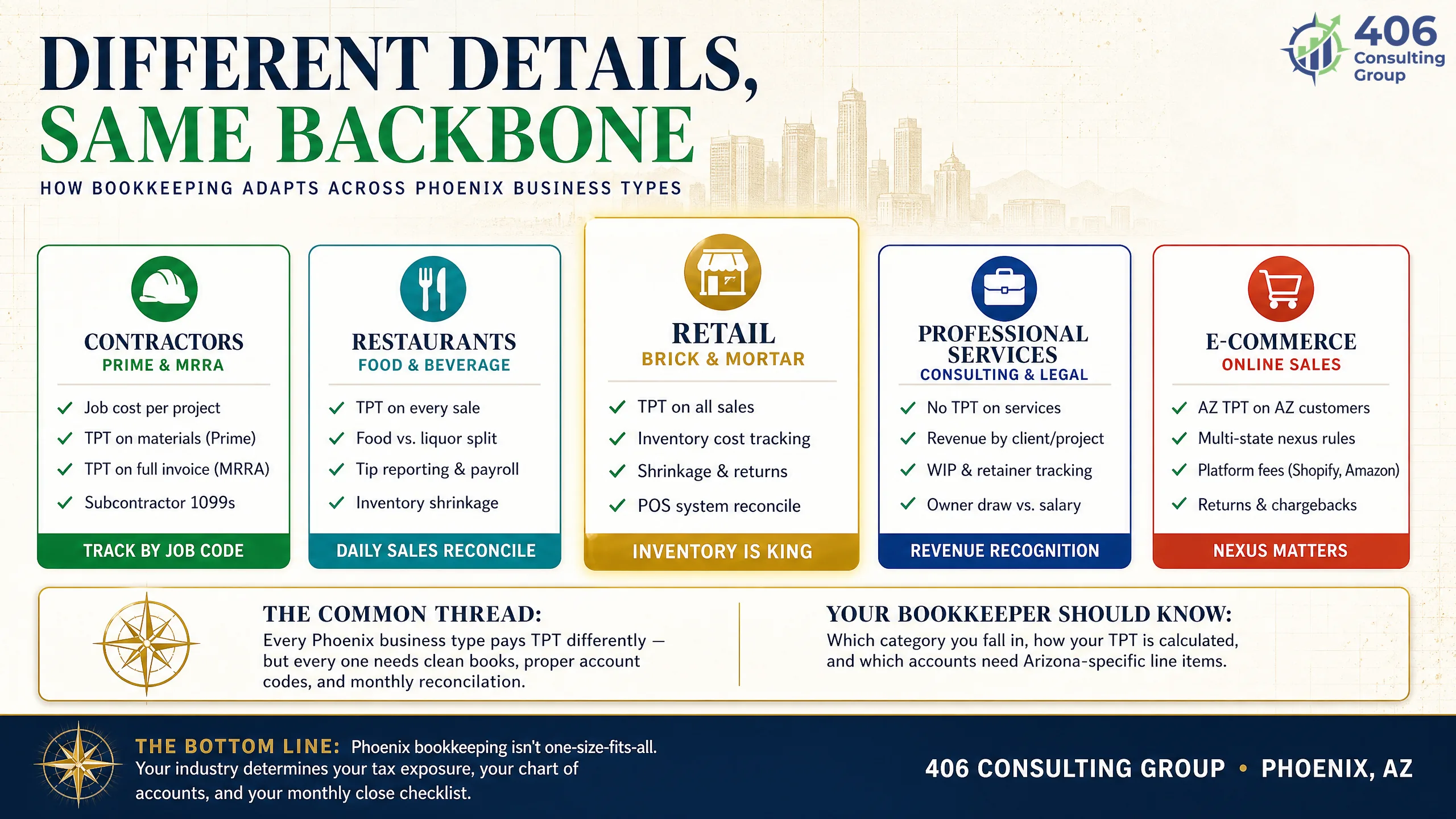
Different details, same backbone: TPT classified and tracked right, job or inventory costing clean, payroll handled, and profit readable for the Arizona and federal returns.
Common Phoenix Bookkeeping Mistakes
A handful of avoidable mistakes cause most of the trouble for growing Phoenix businesses. Here's what we see most.
Treating TPT like a normal sales tax
It's on the seller, organized by classification, with city rules — a generic setup misclassifies income and misstates what's owed.
Getting a contractor job's TPT class wrong
Prime contracting vs. MRRA are taxed on completely different bases; misclassifying a job over- or under-pays, sometimes badly.
Spending collected TPT
It's the state's money in your account — treating it as cash flow creates a shortfall at filing.
No real job costing
Blending all builds into one P&L, so you can't tell which jobs made money or quote the next accurately.
Missing use tax on equipment
Gear and supplies bought out of state without TPT usually owe Arizona use tax.
Every one is a setup-and-habit problem — and every one disappears once the books are built for Arizona and maintained on a monthly rhythm.
Local vs. a Great Remote Partner
For a Phoenix business, what matters in a bookkeeper isn't whether their office is on Camelback — it's whether they understand TPT, the contractor rules, and construction job costing. In fact, a bookkeeper who doesn't know Arizona is a real liability here, because the TPT and contracting rules are exactly what a generic setup gets wrong. A great partner who knows Arizona beats a local generalist who treats TPT like a sales tax, every time.
And remote is how modern bookkeeping already works — even for clients across town. Roughly 70–80% of our own local clients never set foot in our office; everything runs on secure cloud accounting, connected bank feeds, and a steady monthly rhythm. So whether you're in Phoenix, out across Maricopa County, or running jobs around the Valley, you get the same responsive, Arizona-savvy service. What we bring is knowing TPT and contracting cold — which matters far more than a zip code.
Distance isn't the variable. Knowing Arizona is.
How to Get Started
Getting your Phoenix books in order is three steps.
Set up for TPT correctly
Build a chart of accounts that tracks TPT as a liability by classification and jurisdiction — and separates prime-contracting from MRRA work if you build.
Get job costing and payroll right
Job costing and WIP for construction, and Arizona payroll (flat-rate withholding), workers' comp codes, and 1099s handled correctly.
Run it monthly
Monthly reconciliation, TPT filing, and job reporting keep compliance routine and show you what's actually making money.
Not sure whether you need bookkeeping, tax help, or something more? Our Financial Maturity Assessment maps it out in about eight minutes.
FAQ: Phoenix Bookkeeping Questions
What is TPT and how is it different from sales tax?
The Transaction Privilege Tax is Arizona's version of a sales tax, but with a key difference: it's legally a tax on the seller for the privilege of doing business in Arizona, not a tax on the customer. Most businesses pass it through on the invoice, but the liability, filing, and risk are the business's. TPT is also organized into business classifications (retail, contracting, restaurant, commercial lease, and more) with different rules, and Arizona cities impose their own TPT on top of the state and county pieces. It's close enough to a sales tax to fool an out-of-state bookkeeper and different enough to cause real problems when it does.
How does TPT work for Arizona contractors?
It's one of the most complicated tax areas in the country. Arizona taxes contractors under special TPT rules that depend on the type of work. Broadly, 'prime contracting' — new construction and larger modification work — is taxed under the prime contracting classification, calculated on gross receipts after a standard deduction. 'MRRA' work — maintenance, repair, replacement, and alteration on existing property — is treated differently: the contractor generally pays TPT or use tax on the materials at purchase instead of prime contracting tax on the job. Misclassifying a job can badly over- or under-pay, so it's an area to handle with someone who knows Arizona, and to confirm current rules with the Arizona Department of Revenue.
What taxes does a Phoenix, Arizona business deal with?
Arizona has a low flat state income tax (around 2.5% — confirm the current rate), the Transaction Privilege Tax (TPT) that functions like a sales tax at around 8.6% combined in Phoenix (state, county, and city), and a companion use tax; there's no separate gross-receipts or B&O tax because TPT plays that role. You also handle federal income tax and payroll, Arizona unemployment insurance, and workers' compensation through a competitive private market. Because Arizona has an income tax, planning helps on both the state and federal return.
Why shouldn't I just use my out-of-state bookkeeper for my Arizona business?
Because Arizona's TPT and contractor rules are exactly what a generic, out-of-state setup gets wrong. A bookkeeper who treats TPT like a normal sales tax will misclassify your income, misstate what you owe, and — for a contractor — likely mishandle the prime-contracting-versus-MRRA distinction, and since the TPT liability is the business's, those mistakes land on you. What matters is Arizona expertise, not proximity. A remote partner who knows TPT and contracting cold is far safer than a local generalist who doesn't.
Can 406 Consulting Group do my Phoenix bookkeeping remotely?
Yes. We work with Phoenix and Maricopa County businesses through secure cloud accounting — connected bank feeds, shared screens, and a steady monthly rhythm. What matters for an Arizona business is expertise in TPT, the contractor rules, and construction job costing, not office proximity. Roughly 70–80% of our own local clients never come into the office either, so you get the same responsive, Arizona-savvy service whether you're in Phoenix or anywhere in the Valley.
Keep Reading
Bookkeeping — Phoenix, AZ
TPT, Contracting & the Boom — Handled.
406 Consulting Group keeps Phoenix construction and small businesses clean and compliant — TPT by classification, the contractor rules, job costing, and reliable financials — delivered remotely, by a firm that knows Arizona.
Phoenix Bookkeeping Quick Reference
Phoenix, AZ — Maricopa County
TPT Got You Second-Guessing?
Classifications, contracting & job costing, handled.
About the Author
Carrie Anderson
Co-Founder, 406 Consulting Group
Commercial banking and underwriting background — 300+ loan reviews — advising construction and small businesses across the Mountain West and Southwest. Carrie helps Phoenix owners get TPT and the contractor rules right, keep clean job-costed books, and stop overpaying a tax most bookkeepers misunderstand.
Read the Full Story