
Tax Planning in Provo, UT:
Profitable? Then Planning Pays — Twice
Provo's e-commerce and bootstrapped brands are often profitable pass-throughs — so the big levers are the S-corp, the QBI deduction, retirement, and the Utah pass-through election, plus inventory rules and sales-tax nexus cleanup. Here's the playbook.

Tax planning in Provo has a distinct flavor. Where the venture-backed startups up in Salt Lake are often pre-profit and chasing credits, a lot of Provo's e-commerce brands and bootstrapped businesses are the opposite: genuinely profitable, owner-run, and pass-through. That changes the whole playbook. The biggest levers here aren't R&D credits and QSBS — they're the ones that cut tax on real, distributed profit: the right entity, the QBI deduction, retirement, and Utah's pass-through election. And because Utah has a state income tax, every one of them usually saves you twice.
On top of that sit two e-commerce-specific issues that can cost real money if ignored: the tax rules around inventory, and cleaning up sales-tax nexus you may have built up selling nationwide. Handled well, a profitable Provo brand keeps a meaningfully larger share of what it earns; handled badly, it overpays the IRS and Utah and carries a hidden sales-tax liability into its next chapter. This guide walks the levers that matter for a profitable pass-through, plus the e-commerce pieces — all delivered remotely.
By Carrie Anderson — Co-Founder, 406 Consulting Group. Commercial banking and underwriting background — 300+ loan reviews — advising e-commerce, tech, and profitable small businesses across the Mountain West.
Quick Answer: Tax Planning for a Provo Business
- →Deductions save twice — Utah's flat income tax (~4.5%) plus your federal bill.
- →Profitable & pass-through: the S-corp question and the QBI deduction are the biggest levers.
- →Inventory has tax rules — how you account for it affects timing, with small-business exemptions.
- →Sales-tax nexus built up selling nationwide may need cleaning up before it compounds.
- →Utah pass-through election and retirement round out a profitable owner's plan.
Table of Contents
Why Planning Here Saves Twice
In a no-income-tax state, tax planning only works against the federal return. In Utah, it works against two: the federal bill and the state's flat rate (about 4.5% in recent years — confirm the current figure). Every legitimate deduction or deferral cuts both. For a profitable, owner-run Provo business, that stacking is meaningful — and it makes the pass-through-focused levers below worth real money.
The mistake we see most in profitable bootstrapped brands is simply not planning. A founder pours everything into growing the business, takes profit as it comes, and never structures it — leaving the S-corp savings, the QBI deduction, and retirement contributions on the table, year after year, on both returns. Profit is exactly what makes proactive planning pay; the more you make, the more these levers are worth.

Let's walk the levers — the general ones first, then the ones that matter most for a profitable pass-through, plus the two e-commerce-specific pieces.
The Levers That Cut Both Bills
Start with the core levers every profitable business should be pulling. In Utah, each works against the federal and the state return.
| Lever | What it does |
|---|---|
| Entity choice (S-corp) | Cuts self-employment/payroll tax once profit is high enough |
| QBI deduction | Up to a 20% deduction on qualified pass-through income, subject to limits |
| Retirement plans | SEP, Solo 401(k), or defined-benefit shelter large amounts from both bills |
| Equipment & clean deductions | Section 179, home office, and every legitimate expense — captured with clean books |
For a profitable pass-through, the first two — entity and QBI — are usually where the biggest dollars live. Let's take them in turn.
Entity & the S-Corp Question
For a profitable owner-run brand, entity choice is often the single biggest lever — and here's where Provo differs from the venture world. A venture-track startup usually wants to be a C-corp for investors and QSBS; a profitable, bootstrapped e-commerce business usually does not. As a sole proprietor or single-member LLC, every dollar of profit is hit with self-employment tax (roughly 15.3% up to the Social Security wage base). Elect S-corp treatment and you split income into a reasonable salary (payroll-taxed) plus distributions (not subject to self-employment tax) — frequently saving thousands a year once profit justifies it.
The catch is "reasonable" — the IRS wants a defensible market wage for the work you do — plus the cost and paperwork of running payroll and a separate return. So it's a math question, not a default, but for a consistently profitable Provo brand it's often a clear win.
Run your own numbers
Our S-Corp Calculator estimates the payroll-tax savings at your profit level, and LLC vs. S-Corp compares the structures. See also the election deadline.
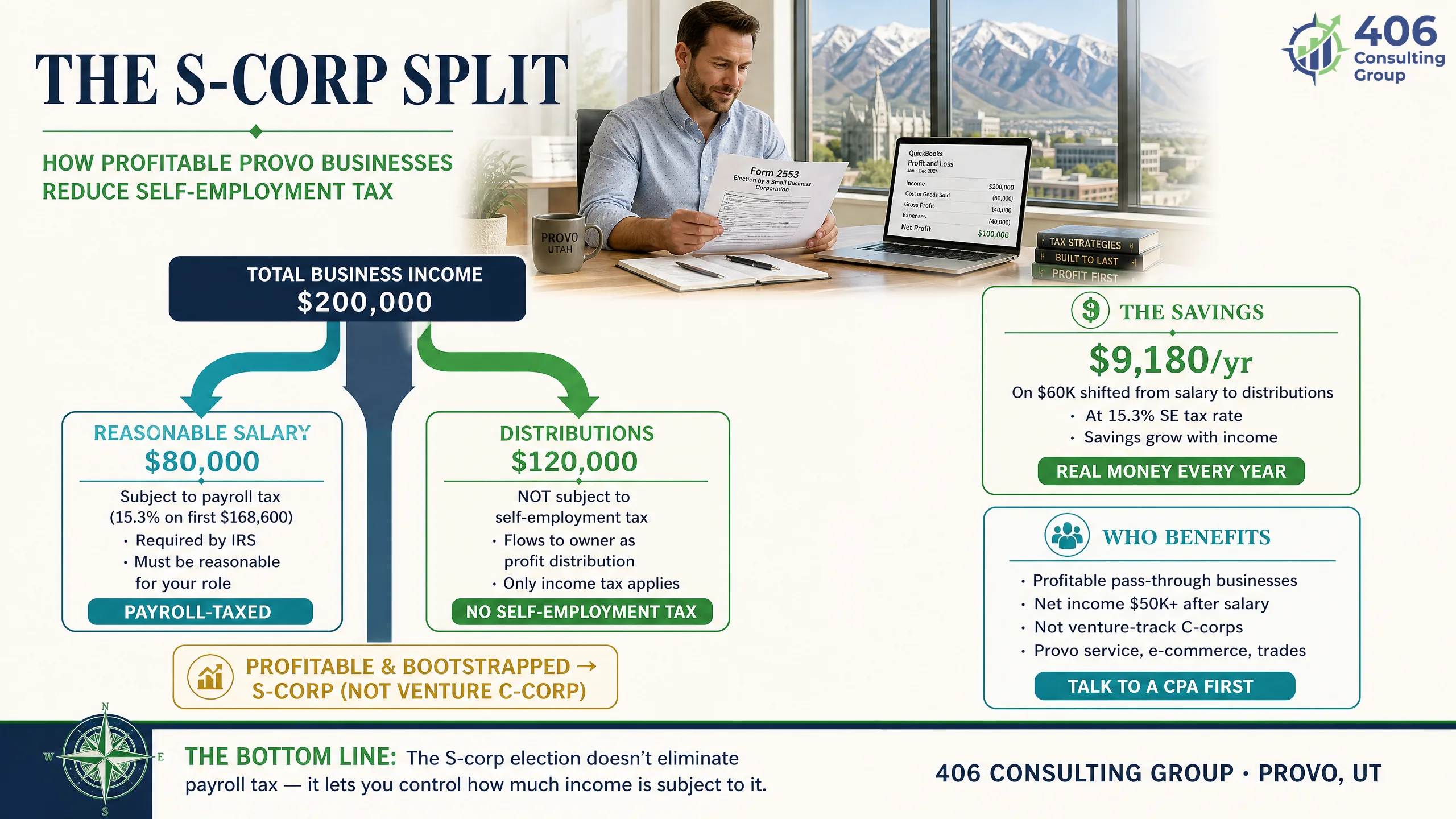
The S-corp decision also interacts with the QBI deduction below, so the two are best modeled together.
The QBI Deduction
Here's a lever that's tailor-made for profitable Provo pass-throughs and largely irrelevant to venture C-corps: the qualified business income (QBI) deduction. In broad strokes, it can let owners of pass-through businesses deduct up to 20% of their qualified business income on their federal return — a substantial break that a profitable e-commerce or services owner should absolutely be planning around.
The rules have real nuance: the deduction phases in limits above certain income levels (tied to W-2 wages paid and business property), and some service businesses face additional restrictions at higher incomes — though a product-selling e-commerce brand is generally better positioned there than a pure service firm. Because QBI interacts with your entity choice, your salary if you're an S-corp, and your retirement contributions, it's something to optimize as a system, not in isolation. For a profitable owner, getting it right is often worth more than any single deduction.

We model QBI alongside the S-corp decision, because the choices that maximize one can affect the other — the kind of thing a once-a-year preparer rarely optimizes.
Inventory & the Tax Rules
For a product business, inventory isn't just a bookkeeping topic — it has tax consequences. You generally can't deduct inventory when you buy it; its cost becomes deductible as cost of goods sold when you sell it, which affects the timing of your deductions and therefore your taxable income each year. There are also rules (often called UNICAP, under Section 263A) that can require capitalizing certain additional costs into inventory — though smaller businesses under a gross-receipts threshold are generally exempt, which covers many Provo brands.
The practical upshot: your inventory accounting method and how you handle these rules affect what you owe and when, so they're worth getting right rather than guessing. Thresholds and details change, so this is a confirm-with-a-pro area — but for a growing product brand, the difference between doing it correctly and doing it by feel can be a real number.
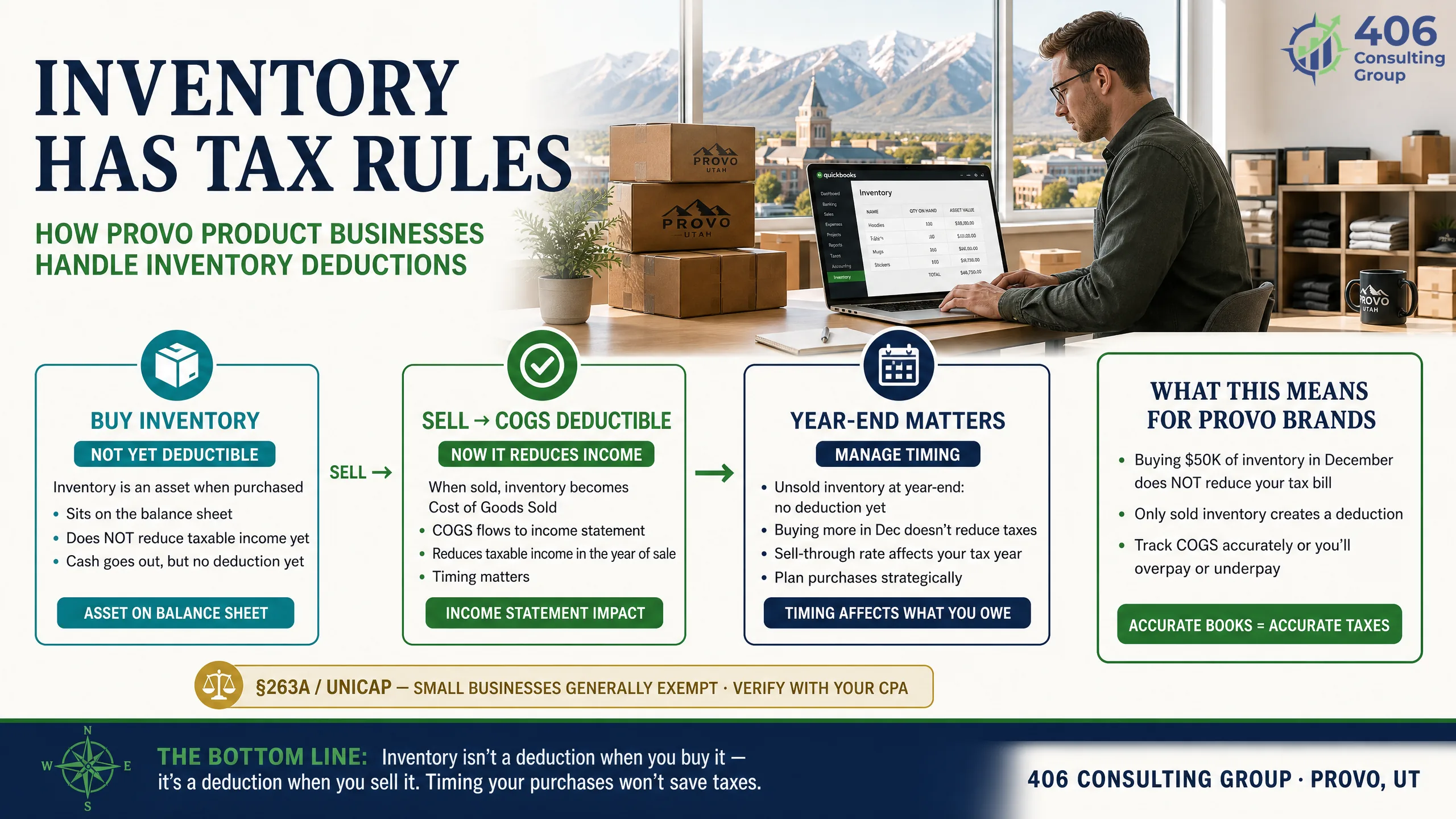
The bookkeeping foundation for all of this — tracking inventory and COGS accurately — is covered in the Provo bookkeeping guide.
Sales-Tax Nexus: Cleanup & Strategy
Here's the one that quietly grows into a problem. Selling nationwide builds up economic nexus — sales-tax obligations in states where you've crossed their thresholds — and many Provo brands have been selling for a while before anyone maps it. The result is a hidden liability: uncollected sales tax in several states, compounding with penalties and interest, that a founder often doesn't discover until an audit or, painfully, during due diligence when they try to sell the business.
The strategy side is about getting ahead of it: mapping where you actually have nexus, deciding where to register going forward, and — where there's meaningful past exposure — using tools like voluntary disclosure agreements, which can often limit the look-back period and reduce penalties for coming forward proactively. Marketplace-facilitator collection helps for platform sales, but your own store's history usually doesn't clean itself up. This is a plan-and-fix area, not a hope-it-goes-away one.

If you've been selling across state lines for a couple of years without addressing this, it's worth a proactive look before it's forced on you.
Retirement for a Profitable Founder
Retirement plans are the most underused big lever for profitable owners, and Provo's bootstrapped brands are exactly the profile that benefits. A SEP-IRA or Solo 401(k) can shelter tens of thousands from federal and Utah tax each year, and for an older, high-income owner a defined-benefit or cash-balance plan can shelter far more — turning profit into the owner's own wealth instead of a bigger tax bill.
Paired with an S-corp, the plan choice interacts with your salary level, so it's worth coordinating with the entity and QBI decisions. For a founder who's been reinvesting everything and taking little off the table, starting a retirement plan is often the single most tax-efficient way to finally pay yourself.
The Utah Pass-Through Election
Utah's pass-through entity election is a quieter lever, aimed squarely at profitable pass-throughs like many Provo brands. If you run an S-corp or partnership, the business can elect to pay Utah income tax at the entity level — turning it into a deductible business expense — rather than letting that tax hit your personal return, where the federal SALT cap limits the deduction. The net effect is recovering a federal write-off you'd otherwise forfeit to the cap.
It has specific rules and deadlines and doesn't help every owner equally, so it's worth modeling before electing — but for a profitable Provo pass-through, it's a real, Utah-specific lever many owners either don't know about or aren't using.

We model whether the election helps as part of planning — it's exactly the kind of thing that separates proactive tax work from once-a-year filing.
Equipment Timing & a Year-Round Rhythm
Rounding out the plan: for a brand buying equipment, packaging machinery, or warehouse gear, Section 179 and bonus depreciation let you deduct qualifying purchases in the year placed in service, cutting both the Utah and federal bill in a strong year (bonus percentages shift over time, so confirm current rules). And because most of these levers are timing-driven, planning is a year-round rhythm, not an April event: confirm the entity and elections early, watch profit build, and make the equipment, retirement, and election moves before December 31, when most have to happen to count.
On estimates, set aside for both the federal quarterlies and the Utah balance as you go, so April isn't a shock. Always confirm current Utah rules with the Utah State Tax Commission or your advisor — the details move.

The through-line: for a profitable business, the money is made in the moves you make before year-end, not the return you file after it.
Local vs. a Great Remote Partner
Tax planning is expertise, not proximity — modeling an S-corp with QBI, handling inventory rules, mapping and cleaning up sales-tax nexus, structuring retirement. What matters is whether your advisor knows e-commerce and profitable-pass-through tax and multi-state work, not whether they're on University Avenue. A great remote partner who knows this terrain beats a local generalist who files your return and calls it planning.
It's also how the work runs now, and an online brand is already run remotely. Roughly 70–80% of our own local clients never come into the office; planning happens over shared screens and secure document exchange, with numbers in the cloud. So whether you're in Provo, Orem, or running your brand from a laptop while you sell nationwide, you get proactive, model-specific planning — and our multi-state experience is a genuine edge for an e-commerce seller.
The goal is the same wherever you sit: pay Utah and the IRS what you owe, and not a dollar more.
How to Get Started
A Provo tax plan comes together in three steps.
Optimize the entity & QBI together
Model sole prop vs. S-corp with the QBI deduction and the Utah pass-through election as one system.
Handle inventory & retirement
Get your inventory tax treatment right, and put a retirement plan to work sheltering profit.
Clean up multi-state sales tax
Map your nexus, register where you should, and address any past exposure proactively.
Start with the S-Corp Calculator or our Financial Maturity Assessment, then let's talk.
FAQ: Provo Tax Questions
How much is Utah's income tax, and does planning really help?
Utah has a low flat state income tax (about 4.5% in recent years — confirm the current rate), on top of federal income tax. Because there are two income taxes, most legitimate deductions and deferrals cut both bills, so proactive planning is worth more here than in a no-income-tax state. For a profitable, owner-run Provo business, the biggest levers — the S-corp election, the QBI deduction, retirement plans, and the Utah pass-through election — save on both returns. The most common (and costly) mistake among profitable bootstrapped brands is simply never structuring the business.
Should my profitable e-commerce brand elect S-corp status?
Often yes, once profit is high enough. As a sole proprietor or single-member LLC, all profit is hit with self-employment tax (roughly 15.3% up to the Social Security wage base). An S-corp splits income into a reasonable salary (payroll-taxed) and distributions (not subject to self-employment tax), frequently saving thousands a year. Note this is the opposite of a venture-track startup, which usually wants a C-corp — a profitable, bootstrapped brand usually wants the pass-through S-corp. The salary must be defensibly 'reasonable,' and it adds payroll and a return, so it's a math question worth modeling, ideally alongside the QBI deduction.
What is the QBI deduction and can my Provo business use it?
The qualified business income (QBI) deduction can let owners of pass-through businesses deduct up to 20% of their qualified business income on their federal return — a substantial break for a profitable e-commerce or services owner. It has real nuance: limits phase in above certain income levels (tied to W-2 wages and business property), and some service businesses face additional restrictions at higher incomes, though a product-selling brand is generally better positioned than a pure service firm. Because QBI interacts with your entity choice, S-corp salary, and retirement contributions, it's best optimized as a system with a pro rather than in isolation.
I've been selling online for a while — do I have a sales-tax problem?
Possibly, and it's worth checking before it's forced on you. Selling nationwide builds economic nexus — sales-tax obligations in states where you've crossed their thresholds — and many brands accumulate exposure for years before mapping it. Marketplace facilitators like Amazon often collect on sales made through them, but your own store's history usually doesn't clean itself up, leaving uncollected sales tax that compounds with penalties and surfaces at audit or during a sale of the business. The fix is proactive: map your nexus, register where you should going forward, and where there's meaningful past exposure, tools like voluntary disclosure agreements can often limit the look-back and reduce penalties.
Can 406 Consulting Group handle my Provo taxes remotely?
Yes. Tax planning and preparation run well remotely — planning over shared screens, secure document exchange, and numbers in the cloud — and an online brand is already run that way. What matters is deep knowledge of e-commerce and profitable-pass-through tax (entity, QBI, inventory rules, retirement) plus multi-state sales-tax work, not office proximity. Roughly 70–80% of our own local clients never come into the office either, and for a brand selling nationwide our multi-state experience is a real advantage. You get proactive, year-round planning wherever you are.
Keep Reading
Tax Planning — Provo, UT
Profitable? Then Planning Pays — Twice.
406 Consulting Group builds year-round tax plans for profitable Provo businesses — the S-corp and QBI, inventory rules, sales-tax nexus cleanup, retirement, and the Utah pass-through election — delivered remotely.
Provo Tax Quick Reference
Provo, UT — Utah County
Profitable & Overpaying?
S-corp, QBI & nexus, handled.
About the Author
Carrie Anderson
Co-Founder, 406 Consulting Group
Commercial banking and underwriting background — 300+ loan reviews — advising e-commerce, tech, and profitable small businesses across the Mountain West. Carrie helps Provo owners structure for the S-corp and QBI, handle inventory and nexus, and plan for both the Utah and federal bill.
Read the Full Story