
Bookkeeping Services in Provo, UT:
Know Your Real Margin, Product by Product
Provo is e-commerce and bootstrapped-founder country — where the books live on inventory, COGS, multi-channel reconciliation, and multi-state sales tax. Here's what a product business really needs, on Utah's flat-tax base.

Provo and Utah County punch far above their weight as a place to start a business. It's one of the youngest, most entrepreneurial corners of the country — BYU and UVU feeding a constant stream of founders — and a genuine hub for e-commerce and direct-to-consumer brands, from Amazon sellers to Shopify stores to the next viral consumer product. Add a healthy layer of software startups, services, and a fast-growing residential market, and you get a business scene that's mostly young, mostly bootstrapped, and moving fast.
That shapes the books in a specific way. An e-commerce brand lives or dies on inventory, cost of goods sold, and margin per product — and it collects money across Shopify, Amazon, Stripe, and PayPal, each with its own fees and payout quirks. It also sells nationwide, which drags in multi-state sales tax and marketplace rules. Clean books that handle inventory, reconcile every channel, and get sales tax right are what keep a growing Provo business profitable and out of trouble — on Utah's low, flat-tax base.
This guide covers how e-commerce, bootstrapped growth, and Utah's taxes shape your books — and how a remote firm delivers all of it.
By Jason Anderson — Co-Founder, 406 Consulting Group. Big-firm-trained accountant advising e-commerce, tech, and small businesses across the Mountain West, where inventory, multi-channel reconciliation, and multi-state sales tax are everyday work.
Quick Answer: Bookkeeping for a Provo Business
- →E-commerce lives on inventory: COGS and margin per product are the numbers that matter.
- →Reconcile every channel: Shopify, Amazon, Stripe, and PayPal each pay out net of fees — gross ≠ deposit.
- →Multi-state sales tax: selling nationwide triggers economic nexus; marketplaces may collect for you, but not always.
- →Utah taxes: a low flat income tax (~4.5%), ~7.25% sales tax in Utah County, no gross-receipts/B&O tax.
- →Delivered remotely — even most of our local clients never come into the office.
Table of Contents
Why Provo Bookkeeping Is Different
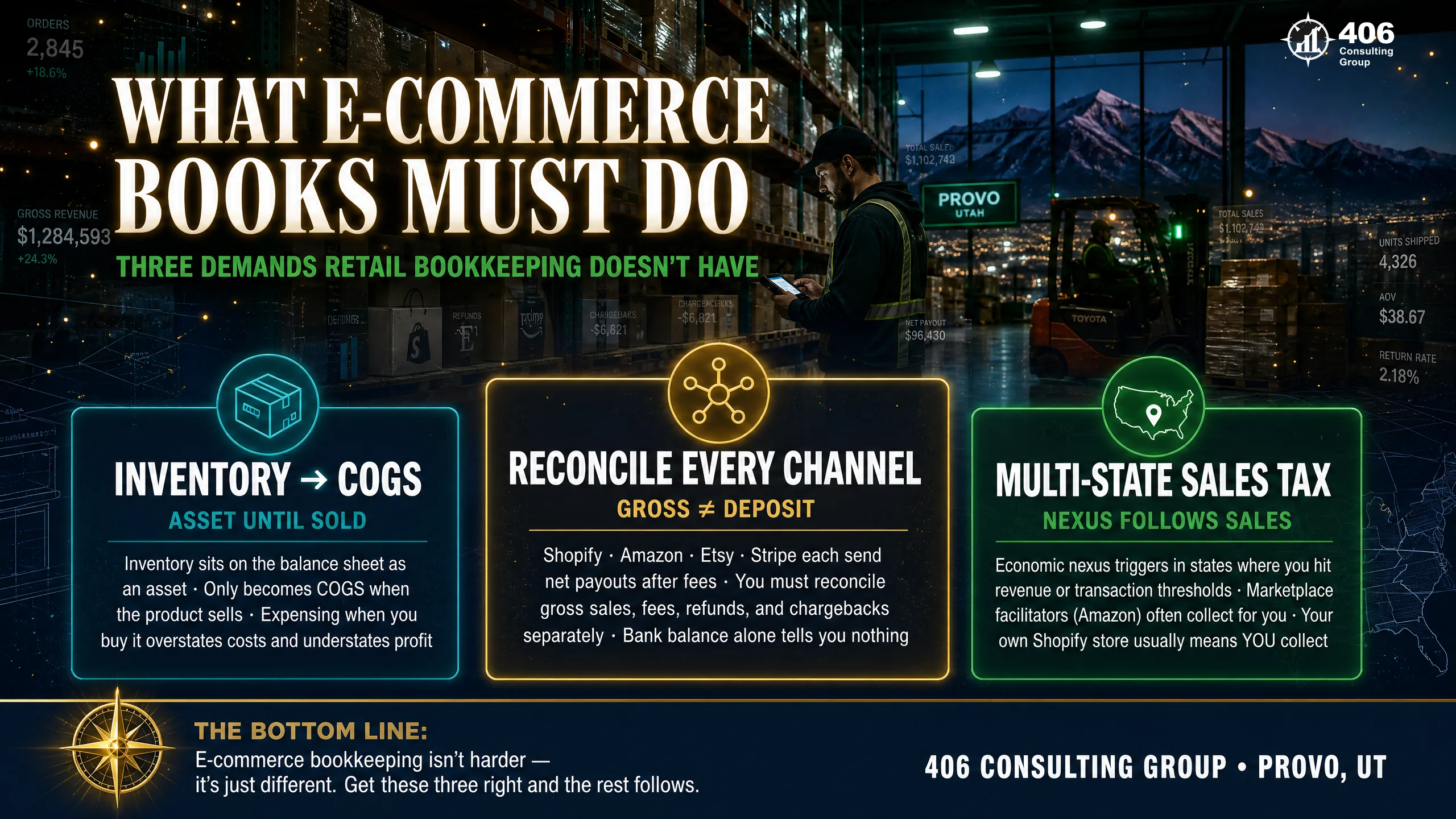
A lot of Provo businesses sell physical products online, and that changes the books more than owners expect. Where a service business records a sale and moves on, an e-commerce brand has to track inventory as an asset, recognize cost of goods soldas it sells, and reconcile money arriving across several platforms that each take a cut. Miss any of that and your profit is a guess — you can be "doing $2M in sales" and have no idea whether you're actually making money.
Provo sits in Utah County, the heart of a young, bootstrapped, fast-moving business scene. Many founders are running their first real company and doing the books themselves at the kitchen table — which works right up until inventory, sales tax across a dozen states, and platform reconciliation make it a genuine job. Books built for a Provo business have to speak e-commerce, not just record deposits.
The rest of this guide walks each piece — starting with the Utah tax backdrop everything sits on.
The Utah Tax Backdrop
Utah keeps it simple and business-friendly. Here's the picture for a Provo business:
| Tax | Utah reality |
|---|---|
| State income tax | Low flat rate (~4.5%) on business and personal income — verify current |
| Sales tax | ~7.25% combined in Provo (Utah County); use tax on untaxed purchases |
| Gross-receipts / B&O | None |
| Selling nationwide | Economic nexus can create sales-tax duties in many states |
| County | Utah County |

Because Utah has an income tax, your books also have to stay clean enough to support both the state and federal return, and to set aside for the flat rate as you go. Confirm current rates with the Utah State Tax Commission. We cover planning in the Provo tax guide.
Multi-State Sales Tax & Marketplaces
This is the piece that catches Provo e-commerce sellers off guard. Sell to customers around the country and you can create economic nexus — an obligation to collect and remit sales tax — in states where you've never set foot, once your sales or transactions there cross that state's threshold. There are dozens of states with their own rules, and ignoring them doesn't make the liability go away; it compounds with penalties and interest.
The wrinkle is marketplace facilitator rules. When you sell through Amazon or a similar marketplace, the platform often collects and remits sales tax on those sales for you — but on your own Shopify store, that's typically your responsibility. So a brand selling on both has to know which sales are covered and which aren't, and file accordingly. Clean books track sales-tax collected as a liability by state and reconcile what each channel handled versus what you still owe.

The nexus trap
Economic-nexus liabilities build silently as you grow, and are most expensive when discovered late — often during a sale of the business or an audit. Map where you have nexus early. Confirm Utah rules with the Utah State Tax Commission, and get multi-state mapping from a pro.
Inventory & COGS: The Heart of It
For a product business, inventory and cost of goods sold are the whole ballgame — and the thing DIY books get wrong most. Inventory is an asset until you sell it; only then does its cost become COGS and hit your profit. Expense inventory when you buy it and your books swing wildly — you look like you lost money the month you restocked and made a fortune the month you didn't. Neither is true, and neither helps you run the business.
Done right, e-commerce books track inventory accurately (including landed cost — the product plus freight, duties, and fees), recognize COGS as you sell, and give you a true gross marginby product. That's the number that tells you which SKUs make money, what you can afford to spend on ads, and when a "bestseller" is actually a low-margin trap. Get inventory right and everything downstream — margin, pricing, cash — finally makes sense.

This is where a generic bookkeeper who's never handled inventory falls down — and where books built for e-commerce earn their keep.
Multi-Channel Reconciliation
Here's a trap unique to selling online: the money that lands in your bank is not your sales. Shopify, Amazon, Stripe, and PayPal each pay out net — after their fees, refunds, chargebacks, and holds. A $10,000 sales day might deposit $8,600, and if you book the deposit as revenue, you've understated both your sales and your fees, and your numbers are quietly wrong. Multiply that across several platforms and the books drift far from reality.
Proper reconciliation ties each platform's gross sales, fees, refunds, and payouts back to the bank, so your revenue, your processing costs, and your margin are all recorded correctly. For a brand running Shopify plus Amazon plus a couple of payment processors, that reconciliation is real, recurring work — and it's the foundation every other number depends on.

We set this up so it runs cleanly every month, instead of becoming a year-end nightmare at tax time.
Product Economics & Ad Spend
Once inventory and channels are clean, the real question comes into focus: which products actually make money once you load in COGS, platform fees, shipping, and — the big one for DTC — ad spend? Many Provo brands pour money into Meta and Google ads to drive sales, and it's entirely possible to grow revenue fast while every order loses money after the cost to acquire the customer. Books that surface contribution margin by product tell you the truth before the ad budget does the damage.
It's the same idea as our flagship on unit economics — which truck (or here, which product) actually makes money — applied to e-commerce. Clean books make that answer visible instead of a guess.
Utah Payroll & Contractors
Because Utah has a state income tax, payroll here includes state income-tax withholding at the flat rate, alongside federal payroll taxes, Utah unemployment insurance, and workers' compensation through a competitive private market. But many young Provo businesses run lean on employees and heavy on contractors — freelance designers, developers, agencies, and creators — which means 1099 tracking and correct worker classification matter as much as payroll.
Misclassifying a worker who should be an employee as a contractor is a common and costly mistake, and paying a dozen freelancers without clean 1099 records turns into a January scramble. Books that track contractor payments and payroll cleanly all year keep both simple.
Handled properly, it's routine — which is what our payroll work keeps it.
Bookkeeping by Provo Segment
Provo's economy is led by e-commerce and startups, with services, construction, and the university around them — and each asks something different of the books.
| Segment | What the books need to track |
|---|---|
| E-commerce & DTC brands | Inventory, COGS, multi-channel reconciliation, multi-state sales tax, ad spend |
| Software & tech startups | Deferred revenue, burn & runway, R&D, multi-state — see the SLC guides |
| Agencies & creators | Project/client profitability, 1099s, receivables, retainers |
| Construction & trades | Job costing, WIP, subs/1099s, equipment |
| Retail, services & healthcare | Sales tax, receivables, payroll, inventory or utilization |
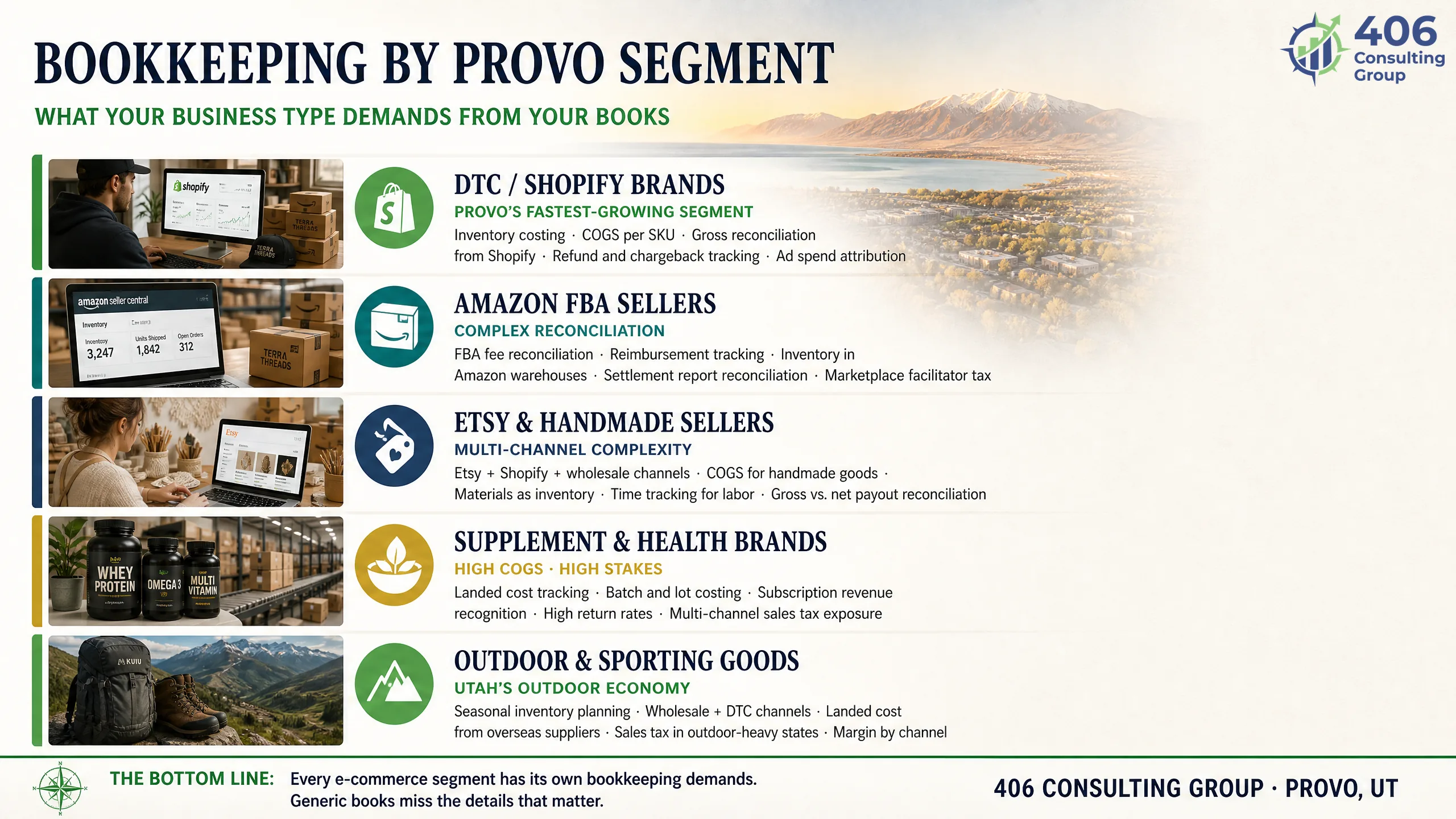
Different details, same backbone: inventory and channels reconciled, sales tax handled, payroll and 1099s right, and profit readable for the Utah and federal returns.
Common Provo Bookkeeping Mistakes
A handful of avoidable mistakes cause most of the trouble for growing Provo brands. Here's what we see most.
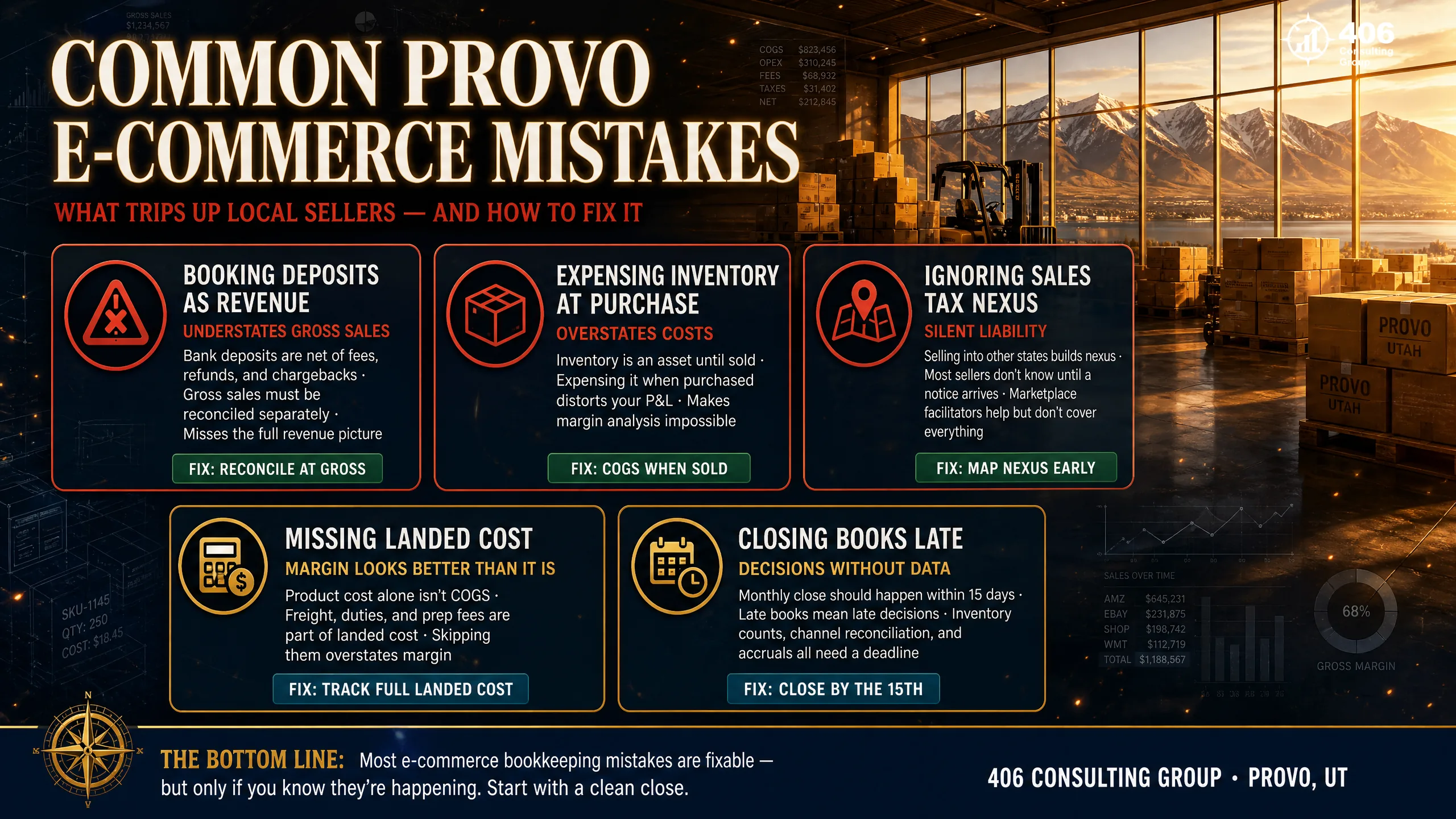
Expensing inventory when you buy it
Instead of recognizing COGS as you sell, which makes profit swing wildly and hides your true margin.
Booking payouts as revenue
Platform deposits are net of fees; recording them as sales understates both revenue and processing costs.
Ignoring multi-state sales tax
Economic-nexus obligations build silently as you sell nationwide, and compound with penalties if left unaddressed.
Not knowing margin by product
Scaling ad spend on a product that loses money after COGS and fees — growing revenue while losing cash.
Messy contractor / 1099 records
Paying freelancers all year with no clean records turns January into a scramble and risks misclassification.
Every one is a setup-and-habit problem — and every one disappears once the books are built for an e-commerce business and maintained on a monthly rhythm.
Local vs. a Great Remote Partner
For a Provo e-commerce brand, what matters in a bookkeeper isn't whether their office is on Center Street — it's whether they understand inventory and COGS, multi-channel reconciliation, and multi-state sales tax. A great remote partner who knows e-commerce beats a local generalist who's never reconciled a Shopify payout, every time. And an online business is already run from a laptop; a physical office is the last thing it needs from its accountant.
Remote is simply how this works now. Roughly 70–80% of our own local clients never set foot in our office; everything runs on secure cloud accounting, connected bank and platform feeds, and a steady monthly rhythm. So whether you're in Provo, Orem, or anywhere in Utah County — or running your brand from a laptop while you sell to all fifty states — you get the same responsive, e-commerce-savvy service, and our multi-state experience is a real plus.
Distance isn't the variable. Knowing your model is.
How to Get Started
Getting your Provo books in order is three steps.
Clean up and structure for e-commerce
Set up inventory and COGS correctly, connect and reconcile every sales channel, and structure sales tax by state.
Get taxes, payroll, and 1099s right
Map multi-state nexus, set up Utah payroll (flat-rate withholding), and track contractor payments all year.
Run it monthly
Monthly reconciliation and margin-by-product reporting keep compliance routine and show you what actually makes money.
Not sure whether you need bookkeeping, tax help, or something more? Our Financial Maturity Assessment maps it out in about eight minutes.
FAQ: Provo Bookkeeping Questions
What makes bookkeeping for a Provo e-commerce business different?
Selling physical products online changes the books in three big ways. First, inventory: it's an asset until you sell it, and only then does its cost become COGS — expensing it when you buy it makes profit swing wildly and hides your margin. Second, multi-channel reconciliation: Shopify, Amazon, Stripe, and PayPal pay out net of fees, so the deposit isn't your sales. Third, multi-state sales tax: selling nationwide can create economic-nexus obligations in many states. Handle those three well and you finally know your real margin by product; handle them badly and your numbers are a guess.
What taxes does a Provo, Utah business deal with?
Utah has a low flat state income tax (around 4.5% — confirm the current rate), a combined sales tax around 7.25% in Provo/Utah County with a companion use tax, and no gross-receipts or B&O tax. If you sell nationwide, economic-nexus rules can require you to collect and remit sales tax in other states too. You also handle federal income tax and payroll, Utah unemployment insurance, and workers' compensation through a competitive private market. Because Utah has an income tax, planning helps on both the state and federal return.
How should an e-commerce brand handle sales tax across states?
Carefully, and early. Selling to customers nationwide can create economic nexus — an obligation to collect and remit sales tax — in states once you cross their sales or transaction thresholds. Marketplace facilitator rules mean platforms like Amazon often collect and remit for sales made through them, but on your own Shopify store that's usually your responsibility. So you need to know which channels cover which states, track sales-tax collected as a liability by state, and file accordingly. These liabilities build silently and are most expensive when discovered late, so mapping your nexus with a pro is worth doing before it's a problem.
Why does inventory accounting matter so much?
Because for a product business it drives everything downstream. Inventory is an asset on your books until it sells; at sale, its cost becomes cost of goods sold and reduces profit. If you expense inventory when you purchase it instead, your profit lurches around with restocking and tells you nothing useful. Done right — tracking inventory including landed cost and recognizing COGS as you sell — you get a true gross margin by product, which tells you which SKUs make money, how much you can spend to acquire a customer, and when a bestseller is actually a low-margin trap.
Can 406 Consulting Group do my Provo bookkeeping remotely?
Yes. We work with Provo and Utah County businesses through secure cloud accounting — connected bank and platform feeds, shared screens, and a steady monthly rhythm. What matters for an e-commerce or startup business is expertise in inventory and COGS, multi-channel reconciliation, and multi-state sales tax, not office proximity — and an online brand is already run from a laptop. Roughly 70–80% of our own local clients never come into the office either, and our multi-state experience is a real advantage for a brand selling nationwide.
Keep Reading
Bookkeeping — Provo, UT
Know Your Real Margin, Product by Product.
406 Consulting Group keeps Provo e-commerce and startup businesses clean and clear — inventory and COGS, multi-channel reconciliation, multi-state sales tax, and reliable financials — delivered remotely.
Provo Bookkeeping Quick Reference
Provo, UT — Utah County
Behind on the Books in Provo?
Inventory, channels & sales tax, handled.
About the Author
Jason Anderson
Co-Founder, 406 Consulting Group
Big-firm-trained accountant advising e-commerce, tech, and small businesses across the Mountain West. Jason helps Provo brands get inventory, COGS, and multi-channel reconciliation right — and finally see their real margin, product by product.
Read the Full Story