
CFO & Controller Services in Provo, UT:
Grow Profit, Not Just Revenue
The faster an e-commerce brand grows, the tighter cash gets. Here's how fractional controller and CFO leadership — contribution margin by product, the inventory cash cycle, ad-spend discipline, and acquisition readiness — helps a Provo brand grow profit, not just revenue.

Here's the paradox that catches Provo e-commerce founders off guard: the faster you grow, the tighter cash gets. You're doing record revenue, but the money is locked up in inventory you bought months ahead, ad spend that's climbing, and platform fees skimming every order — and somehow the bank balance is scarier at $3M in sales than it was at $1M. That's not bad luck. It's what happens when a product business outgrows the founder's ability to run it by gut, and it's exactly where real financial leadership starts to pay for itself.
E-commerce is deceptively hard to manage financially: contribution margin that a top-line P&L hides, inventory that eats cash as you scale, ad spend that can grow revenue while losing money per order, and — for many Provo brands — an eventual acquisition that rewards clean numbers with a higher price. A controller keeps the inventory and channel numbers reliable; a CFO turns them into which products to push, how to fund the growth, and how to build a brand worth buying. And you don't need a full-time hire to get it.
This guide covers what controllers and CFOs do for a growing brand, what each costs, the margin and cash realities of e-commerce, getting acquisition-ready, and how to know which you need.
By Jason Anderson — Co-Founder, 406 Consulting Group. Big-firm-trained accountant advising e-commerce, tech, and growing businesses across the Mountain West — where contribution margin, inventory cash cycles, and clean books for an exit are the daily work.
Quick Answer: CFO & Controller Help for a Provo Brand
- →A controller makes the inventory and channel numbers reliable; a CFO turns them into decisions.
- →Contribution margin after ad spend — not revenue — is the number that tells you if you're really making money.
- →Inventory eats cash: profitable brands go broke funding growth without a cash plan.
- →Acquisition-ready — clean books and documented earnings can raise the multiple when you sell.
- →Fractional delivers both roles for ~$4,000–$8,000/month — a fraction of full-time — remotely.
Table of Contents
Why a Growing Brand Needs Financial Leadership
Most e-commerce businesses hit a financial ceiling when growth outpaces the founder's ability to run the numbers in their head. The questions get bigger and more expensive: which products actually make money after ad spend? How much inventory can we afford to buy without running out of cash? Is scaling this ad campaign printing money or burning it? For a Provo brand riding a fast-growth curve, those answers can't come from a top-line revenue number — they require someone living in the unit economics.
Financial leadership is what turns clean books into decisions: the true contribution margin by product, a cash plan that funds inventory without a crunch, ad-spend discipline, and — when the time comes — a set of books that makes the business worth more to a buyer. It's the difference between a brand that grows revenue and one that grows profit, and they are very different outcomes.

The question is which kind of help you need, and how to get it without overpaying. That starts with the roles.
Bookkeeper vs. Controller vs. CFO
These three roles get blurred constantly, but they're distinct — and hiring the wrong one for your problem is a common, expensive mistake.
| Role | Core question they answer |
|---|---|
| Bookkeeper | "Are inventory, channels, and transactions recorded and reconciled?" |
| Controller | "Are the financials — COGS, margins, inventory — right, on time, and controlled?" |
| CFO | "What do the numbers tell us — which products, how to fund growth, how to exit?" |
A quick rule: if your inventory and channel numbers are late or wrong, you need a controller. If they're clean but you can't see your real margin or your cash runway, you need a CFO. Many growing Provo brands need some of both — which a coordinated fractional engagement delivers. We cover the first step up in upgrading from bookkeeping to a controller.
The Cost Math: Fractional vs. Full-Time
Full-time financial leadership is expensive, and at most growing brands it isn't a 40-hour-a-week job yet — cash you'd rather put into inventory or ads. Fractional gives you the expertise scaled to what you actually need.
| Role | Fractional (per month) | Full-time (annual) |
|---|---|---|
| Controller | ~$2,500–$6,000 | $85K–$120K + ~25% benefits |
| Fractional CFO | ~$2,500–$5,000 | $150K–$300K+ + benefits |
| Both, coordinated | ~$4,000–$8,000 | $235K–$420K+ |
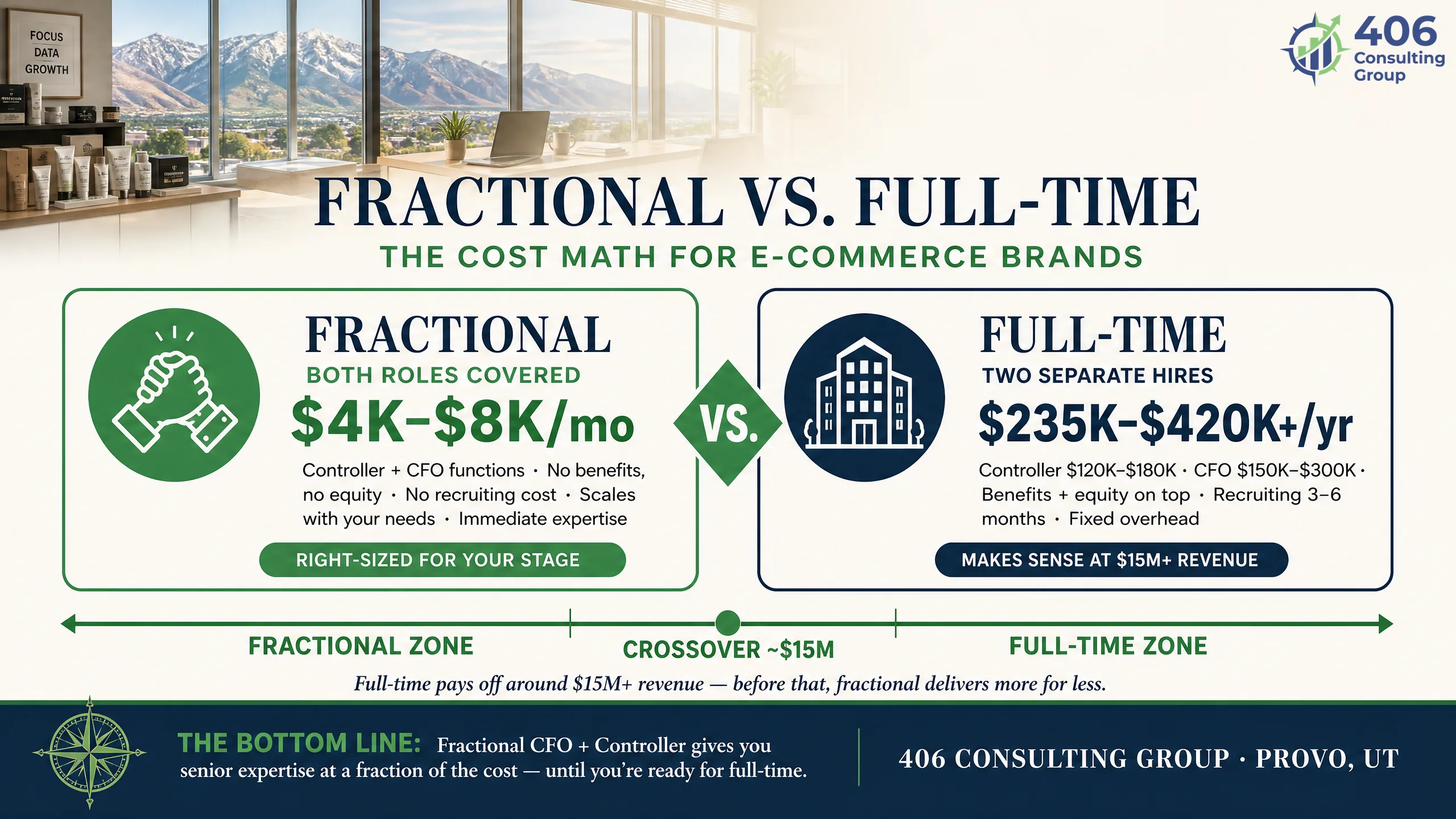
Fractional is dramatically more cost-effective until a business reaches the scale — generally $15M+ — that keeps a full-time hire busy year-round. Estimate the controller piece with our Controller Estimator.
What a Controller Delivers
A controller owns the integrity of your financials — and for an e-commerce brand, that centers on inventory and channels. A reliable monthly close, accurate COGS and inventory valuation, clean reconciliation across Shopify, Amazon, and every processor, and the controls that keep it all solid as you scale. Without a controller, the margin and cash numbers a CFO and a future buyer rely on are built on sand.
This matters more in e-commerce than owners expect: you can't calculate trustworthy contribution margin or a real cash forecast from books where inventory is mis-stated and payouts are booked as revenue. Clean, accrual, inventory-accurate financials are the raw material for every number that follows.
Once the numbers are reliable, most founders want to use them — which is the CFO's job.
What a CFO Delivers
A CFO turns reliable numbers into forward strategy: contribution margin by product and channel, cash-flow forecasting around inventory buys, ad-spend and pricing strategy, and — for many Provo brands — preparing the business to be acquired at the best possible multiple. The CFO is the person who can tell you which SKUs to double down on, how much inventory you can afford to order, what you can spend to acquire a customer, and whether that record month actually made money.
For a growing brand, the highest-value CFO work is usually two things: making sure growth is funded without a cash crunch, and building the financial discipline (and clean books) that turn a good brand into a valuable one. Both are about seeing around the corner instead of reacting to last month's payout.
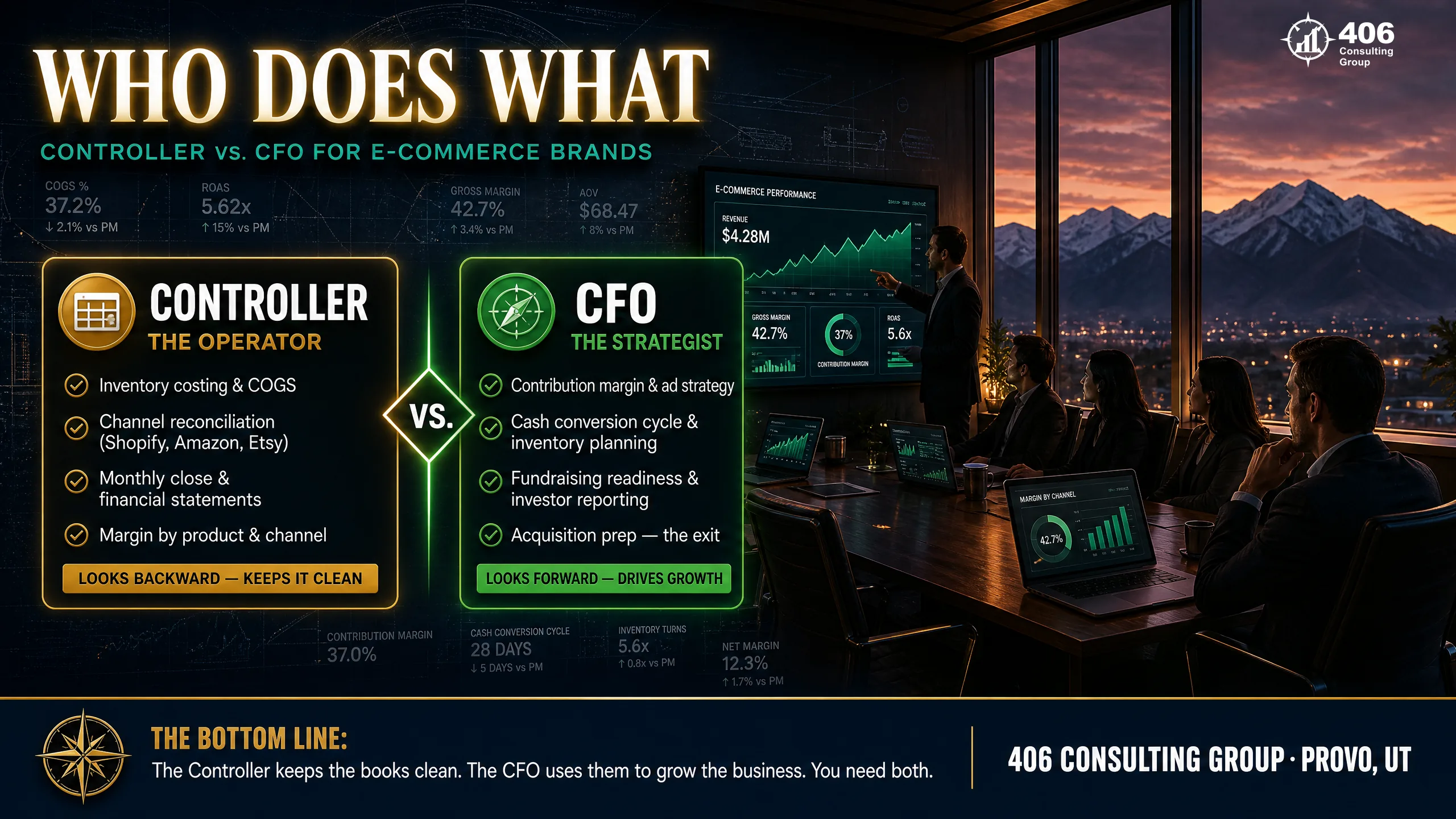
You rarely need both at full strength at once — which is why a coordinated fractional engagement, dialed to your stage, is usually the right answer.
Contribution Margin After Ad Spend
This is the number that runs an e-commerce business, and the one revenue hides. Start with the price, subtract COGS, then subtract the real per-order costs — platform and payment fees, shipping and fulfillment, returns, and the big one, advertising. What's left is contribution margin, and it's entirely possible to have a healthy gross margin and a negative number after ad spend. A brand can scale revenue fast on paid ads while losing money on every order — the classic way DTC founders grow themselves broke.
A CFO builds this by product and channel and ties it to the ad metrics founders live in — ROAS, CAC, and blended efficiency — so "can we afford to spend more here?" becomes a number, not a hope. Knowing your contribution margin after ad spend tells you which products to scale, which to cut, and exactly how hard you can push paid acquisition before it turns unprofitable.
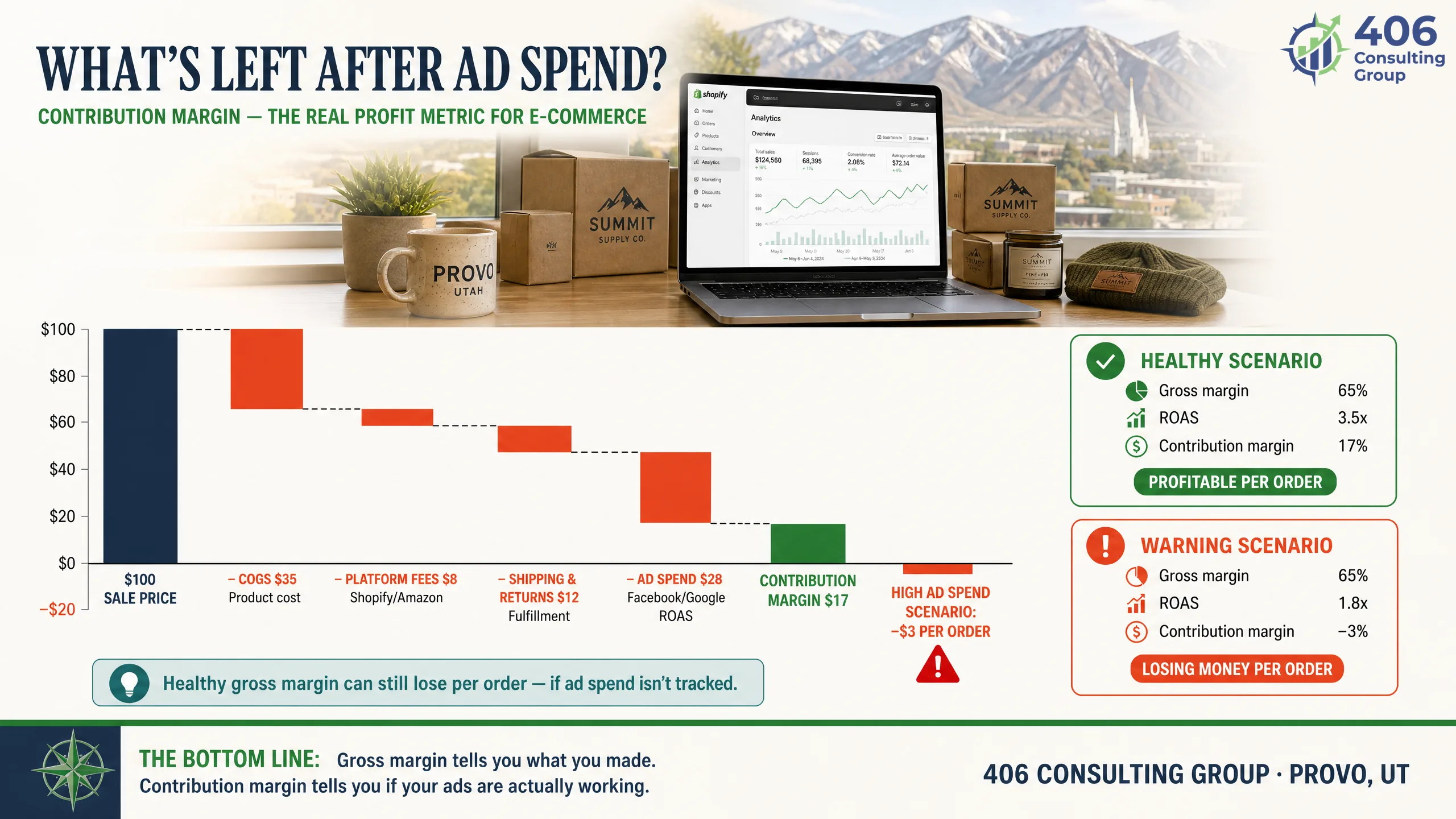
It's the same idea as our flagship on unit economics — which unit actually makes money — applied to products and ad channels.
Inventory & the Cash Cycle
This is the one that sinks profitable brands. Inventory ties up cash: you pay for goods — often months ahead, and increasingly with overseas lead times — long before you sell them and collect. Grow fast and each bigger inventory order demands more cash up front than the last, so a genuinely profitable brand can hit a wall where it simply can't fund the next purchase order. Revenue is up, profit is real, and there's no cash to buy stock.
A CFO manages this with a cash-flow forecast built around the cash conversion cycle — how long cash is locked in inventory before it comes back as sales — so you can plan purchase orders, time them against cash, and line up financing (a line of credit or inventory financing) before the crunch, not during it. It's the single most valuable discipline for a scaling product business, and the one most founders learn the hard way.
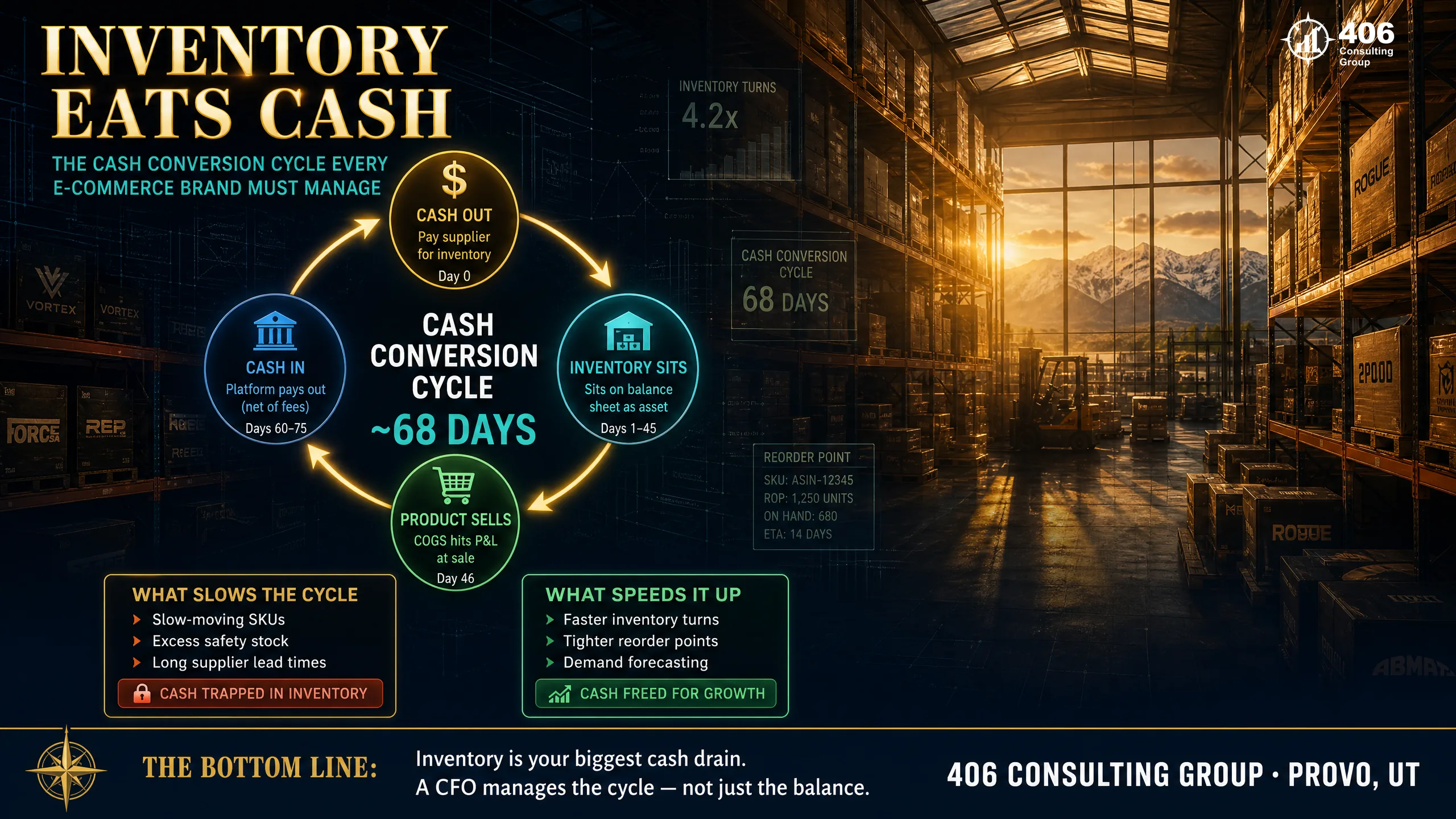
Want a quick read? Try our Cash Flow Runway tool, and see why profit and cash aren't the same — a lesson e-commerce teaches fast.
Getting Acquisition-Ready
Many Provo brands are built to be sold — to an aggregator, a strategic buyer, or a private-equity roll-up — and how ready your financials are directly affects the price. Buyers value brands on a multiple of earnings, and they pay more, and close faster, for a business with clean books, clearly documented margins, and a credible, defensible profit number. Messy books don't just slow diligence; they lower the multiple or kill the deal.
A CFO gets you ready long before you list: clean accrual financials, contribution margin a buyer can trust, properly documented owner add-backs, and channel and customer data that stands up to scrutiny. The same clarity that helps you run the business also makes it worth more — and preparing early, rather than scrambling when an offer appears, is often worth a real bump in the final number.

See our financing & readiness work for how we get a business ready for lenders or a sale.
When to Hire — and the Fractional Path
A few clear signals mean it's time for financial leadership:
You don't know contribution margin by product
If you can't say which SKUs make money after ad spend, you're scaling blind.
Cash is tight despite good profit
Inventory is eating cash faster than sales bring it back — the classic e-commerce squeeze.
Ad spend is climbing but profit isn't
Growing revenue while margin erodes means the paid-acquisition math needs a hard look.
A sale or raise is on the horizon
Get the books, margins, and add-backs clean before diligence, not during it.
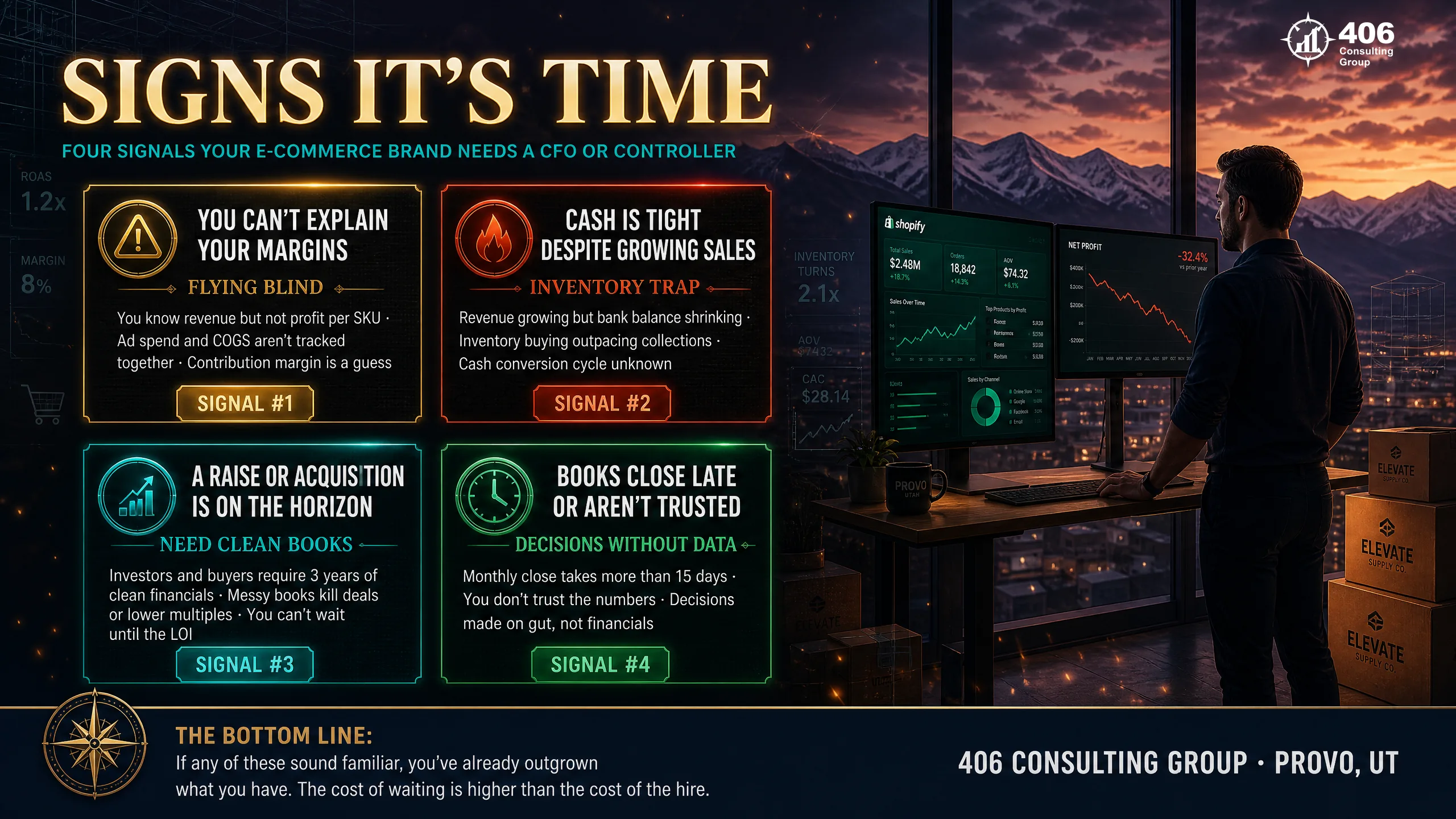
The fractional path lets you start with exactly what you need — often a controller to get inventory and channels right, then CFO strategy for margin, cash, and the exit — and scale up as you grow, without a premature six-figure hire.
Local vs. a Great Remote Partner
Financial leadership for a brand is analysis and judgment — building contribution margin, forecasting the inventory cash cycle, setting ad-spend guardrails, preparing for a sale. None of it depends on being in the room, and an e-commerce business is already run from a laptop. What matters is whether your partner understands product margin, inventory, and paid acquisition — not their zip code. A great remote CFO who knows e-commerce beats a local generalist who doesn't, every time.
It's also how we already work. Roughly 70–80% of our own local clients never come into the office; margin models, cash forecasts, and ad dashboards run on shared screens with regular calls. So whether you're in Provo, Orem, or running your brand from anywhere while you sell to all fifty states, you get the same e-commerce-savvy financial leadership our in-town clients do.
Distance isn't the variable. Knowing your model is.
How to Get Started
Getting financial leadership in place is three steps.
Diagnose what you actually need
Late/wrong inventory and channel numbers point to a controller; clean-but-unused numbers point to a CFO. We pinpoint the real gap.
Get the inventory foundation right
Accurate COGS, inventory valuation, and channel reconciliation — every margin and cash number depends on it.
Layer on margin & cash strategy
Contribution margin by product, inventory cash planning, ad-spend discipline, and acquisition readiness, scaled to your stage.
Not sure which layer you need? Our Financial Maturity Assessment maps it out in about eight minutes.
FAQ: Provo CFO & Controller Questions
How much do CFO and controller services cost in Provo, UT?
Fractional pricing typically runs about $2,500–$6,000 per month for a controller and about $2,500–$5,000 per month for a fractional CFO, depending on complexity and scope. A coordinated engagement covering both often runs roughly $4,000–$8,000 per month. Compare that to full-time salaries — $85K–$120K for a controller and $150K–$300K+ for a CFO, plus roughly 25% in benefits — and fractional is dramatically more cost-effective until a business reaches the scale (generally $15M+) that keeps a full-time hire busy year-round.
What does a CFO actually do for an e-commerce brand?
The core work is turning reliable numbers into decisions: contribution margin by product and channel, cash-flow forecasting around inventory buys, ad-spend and pricing strategy, and preparing the business to be acquired at the best multiple. A controller keeps the inventory, COGS, and channel reconciliation reliable; the CFO uses those numbers to tell you which SKUs to scale, how much inventory you can afford, what you can spend to acquire a customer, and whether a record month actually made money. For a brand built to sell, that forward view and clean-book discipline directly affect the price.
Why do profitable e-commerce brands run out of cash?
Because inventory ties up cash. You pay for goods — often months ahead, with long overseas lead times — before you sell them and collect, so each bigger inventory order as you grow demands more cash up front than the last. A genuinely profitable brand can hit a wall where it can't fund the next purchase order: revenue up, profit real, no cash to buy stock. The fix is a cash-flow forecast built around the cash conversion cycle, so you can plan and time purchase orders and line up financing before the crunch rather than during it.
How do I make my brand more valuable to a buyer?
Clean, credible numbers. Buyers — aggregators, strategics, PE roll-ups — value brands on a multiple of earnings, and they pay more and close faster for a business with clean books, clearly documented contribution margins, properly documented owner add-backs, and channel and customer data that stands up to diligence. Messy books lower the multiple or kill the deal. A CFO gets you acquisition-ready well before you list, and preparing early rather than scrambling when an offer lands is often worth a real bump in the final price.
Can 406 Consulting Group provide CFO and controller services remotely?
Yes — it's how the work is done now, and an e-commerce business is already run from a laptop. Margin modeling, cash forecasting, ad-spend analysis, and acquisition prep all happen over shared screens, live dashboards, and regular calls; none of it requires being in the office. Roughly 70–80% of our own local clients never come into the office either. What matters is deep expertise in your model — product margin, inventory, paid acquisition, and clean books for a sale — plus multi-state fluency for a brand selling nationwide.
Keep Reading
CFO & Controller — Provo, UT
Grow Profit, Not Just Revenue.
406 Consulting Group gives Provo e-commerce and growing businesses fractional controller and CFO leadership — contribution margin, inventory cash planning, ad-spend discipline, and acquisition readiness — delivered remotely.
Fractional vs. Full-Time
Provo, UT — typical ranges
Growing Revenue, Not Cash?
Margin, inventory & the exit, handled.
About the Author
Jason Anderson
Co-Founder, 406 Consulting Group
Big-firm-trained accountant advising e-commerce, tech, and growing businesses across the Mountain West. Jason helps Provo brands see contribution margin by product, plan the inventory cash cycle, and build clean books that are worth more at exit.
Read the Full Story