
Tax Planning in Salt Lake City, UT:
The Big Breaks Are Made Years Early
Utah's flat income tax means planning cuts both bills — and the Wasatch Front opens up the R&D credit, QSBS, and equity-comp strategy worth real money. Here's the playbook for tech and construction owners, plus the multi-state reality of scaling.

Tax planning in Salt Lake City has two things going for it and one thing to respect. In its favor: Utah's flat income tax is low, and because it's a state income tax, every smart move usually saves you twice — once federally, once on the Utah bill. And the Wasatch Front economy opens up some of the most valuable tax breaks in the code: the R&D credit and QSBS for tech, equipment and entity levers for everyone. What to respect: as a fast-growing tech or construction company, you'll hit multi-state complexity sooner than you think.
The result is that proactive planning is worth a lot here — the difference between a founder who exits with a huge chunk of gain excluded from tax and one who didn't know QSBS existed until it was too late, or a company that funds growth with an R&D credit versus one that leaves it on the table. This guide covers the levers that cut both bills, the tech-specific breaks worth real money, the Utah pass-through election, and the multi-state reality of scaling — all delivered remotely.
By Carrie Anderson — Co-Founder, 406 Consulting Group. Commercial banking and underwriting background — 300+ loan reviews — advising tech, construction, and small businesses across the Mountain West.
Quick Answer: Tax Planning for a Salt Lake City Business
- →Deductions save twice — Utah's flat income tax (~4.5%) plus your federal bill.
- →R&D credit: software and product development often qualify — and startups can offset payroll tax with it.
- →QSBS (Section 1202): founders and early investors may exclude a large chunk of stock gain — if structured right.
- →Equity comp (ISOs, NSOs, 83(b), AMT) and the Utah pass-through election are real levers.
- →Multi-state nexus arrives fast when you hire remote or sell nationwide.
Table of Contents
Why Planning Here Saves Twice
In a no-income-tax state, tax planning only works against the federal return. In Utah, it works against two returns: the federal bill and the state's flat rate (around 4.5% — confirm the current figure). Every legitimate deduction, credit, or deferral cuts both. That doesn't double your savings, but it does stack — and combined with the tech-specific breaks below, it means proactive planning is worth real money for a Salt Lake business.
The flip side is the trap: skip planning and you overpay on both returns, and you may miss breaks — like the R&D credit or QSBS — that are worth far more than the routine deductions. In a fast-moving startup or a booming construction company, it's easy to be too busy to look ahead. That's exactly when the biggest opportunities get left on the table.

Let's walk the levers — the general ones first, then the ones that can be worth the most for a tech company.
The Levers That Cut Both Bills
Start with the core levers every profitable business should be pulling. In Utah, each works against the federal and the state return.
| Lever | What it does |
|---|---|
| Entity choice (S-corp) | Cuts self-employment/payroll tax once profit is high enough |
| Equipment & timing | Section 179 / bonus depreciation — meaningful for builders and hardware |
| Retirement plans | SEP, Solo 401(k), or defined-benefit shelter large amounts from both bills |
| Credits & clean deductions | R&D credit, plus every legitimate expense — captured only with clean books |
These are the foundation. But for a Salt Lake tech company, the credits and equity items below are often where the biggest dollars live.
Entity & the S-Corp Question
For a profitable owner-operated business, entity choice is a major lever. As a sole proprietor or partnership, every dollar of profit is hit with self-employment tax (roughly 15.3% up to the Social Security wage base). Elect S-corp treatment and you split income into a reasonable salary (payroll-taxed) plus distributions (not subject to self-employment tax) — often saving thousands a year once profit justifies it.
There's an important caveat in the tech world, though: if you're planning to raise venture money or want to pursue QSBS (below), a C-corporation is usually the right structure, not an S-corp — investors expect it and QSBS requires it. So entity choice for a Salt Lake business depends heavily on the path: an S-corp is often ideal for a profitable services or construction firm, while a venture-track startup usually wants to be a C-corp. This is a decision to make deliberately, early, with someone who knows both worlds.
Run your own numbers
For a profitable non-venture business, our S-Corp Calculator estimates the savings and LLC vs. S-Corp compares structures. For a venture-track startup, the C-corp/QSBS analysis comes first.
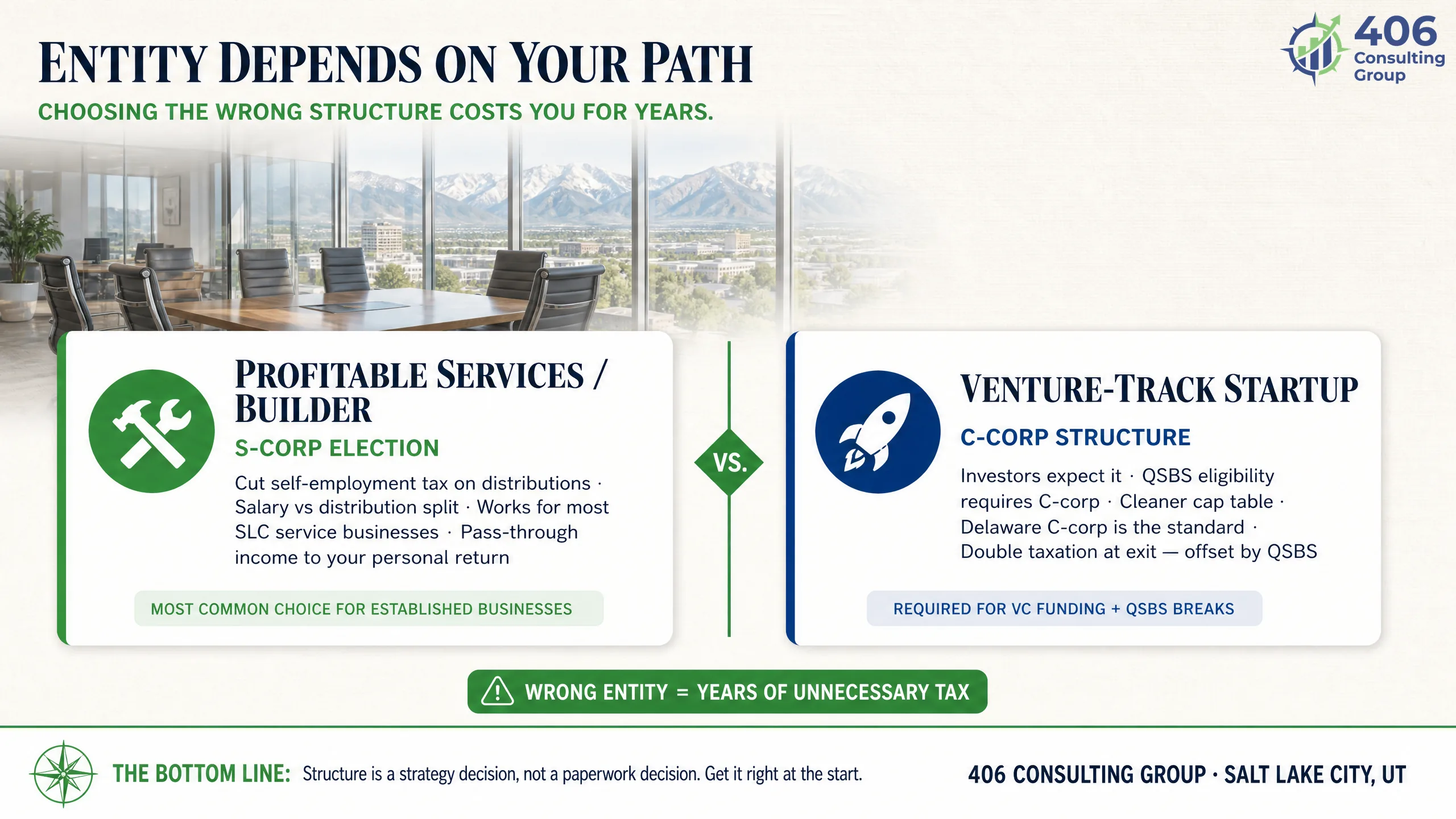
Get the entity right for your path first; the rest of the plan builds on it.
The R&D Tax Credit
This is one of the most valuable and most underclaimed breaks for a Salt Lake tech company. The federal research & development credit rewards spending on developing or improving products, software, and processes — and the definition is broader than most founders assume. Building software, engineering a product, and solving technical problems can all generate qualifying costs, mostly wages for the people doing the work. Utah also offers a state-level research credit that can stack on top.
Here's the part startups miss: even a pre-profit company with no income-tax liability can benefit, because qualified small businesses can apply a portion of the R&D credit against payroll taxes — real cash back while you're still burning. The credit has specific rules, documentation requirements, and limits, so it's a work-with-a-specialist area — but for a company doing genuine development, it's often found money worth chasing.
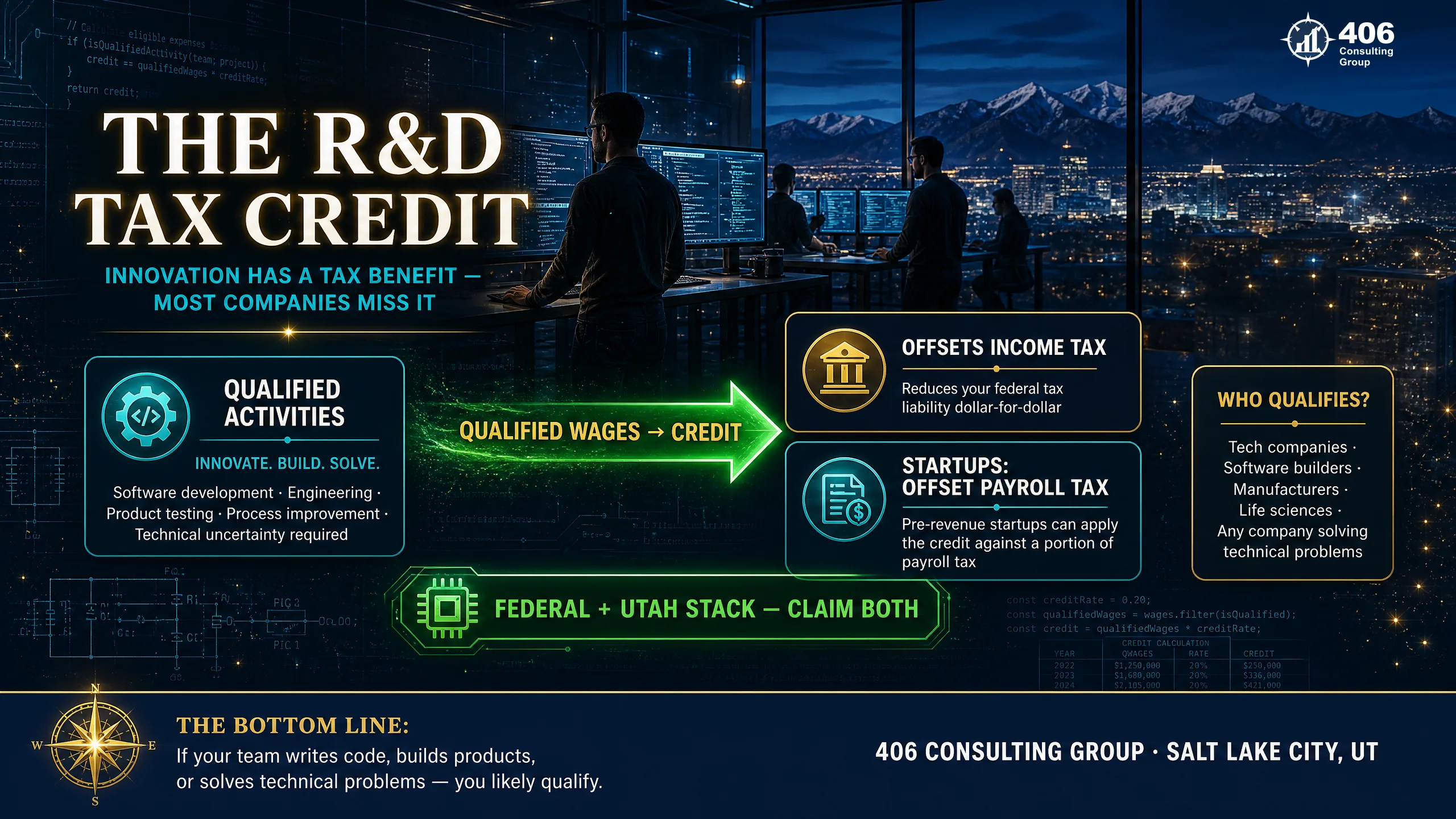
If you're building software or products and have never looked at the R&D credit, that's usually the first place we dig.
QSBS: The Founder's Tax Break
If there's one tax break that can change a founder's life, it's QSBS — qualified small business stock, under Section 1202. In broad strokes, if you hold qualifying stock in a C-corporation that meets the requirements and you hold it long enough, you may be able to exclude a very large amount of the gain from federal tax when you sell. For a founder or early employee at a Salt Lake startup that exits well, that can mean excluding millions of dollars of gain — an enormous difference.
The catch is that QSBS has strict requirements: the company generally must be a C-corp, meet asset limits when the stock is issued, be in a qualifying business, and the stock must be held for a required period. The rules were recently expanded, and the details matter enormously — miss a requirement and the benefit can vanish. This is the definition of a plan-ahead item: the decisions that determine whether you qualify are made years before the exit, which is exactly why founders should understand it early, not at sale.
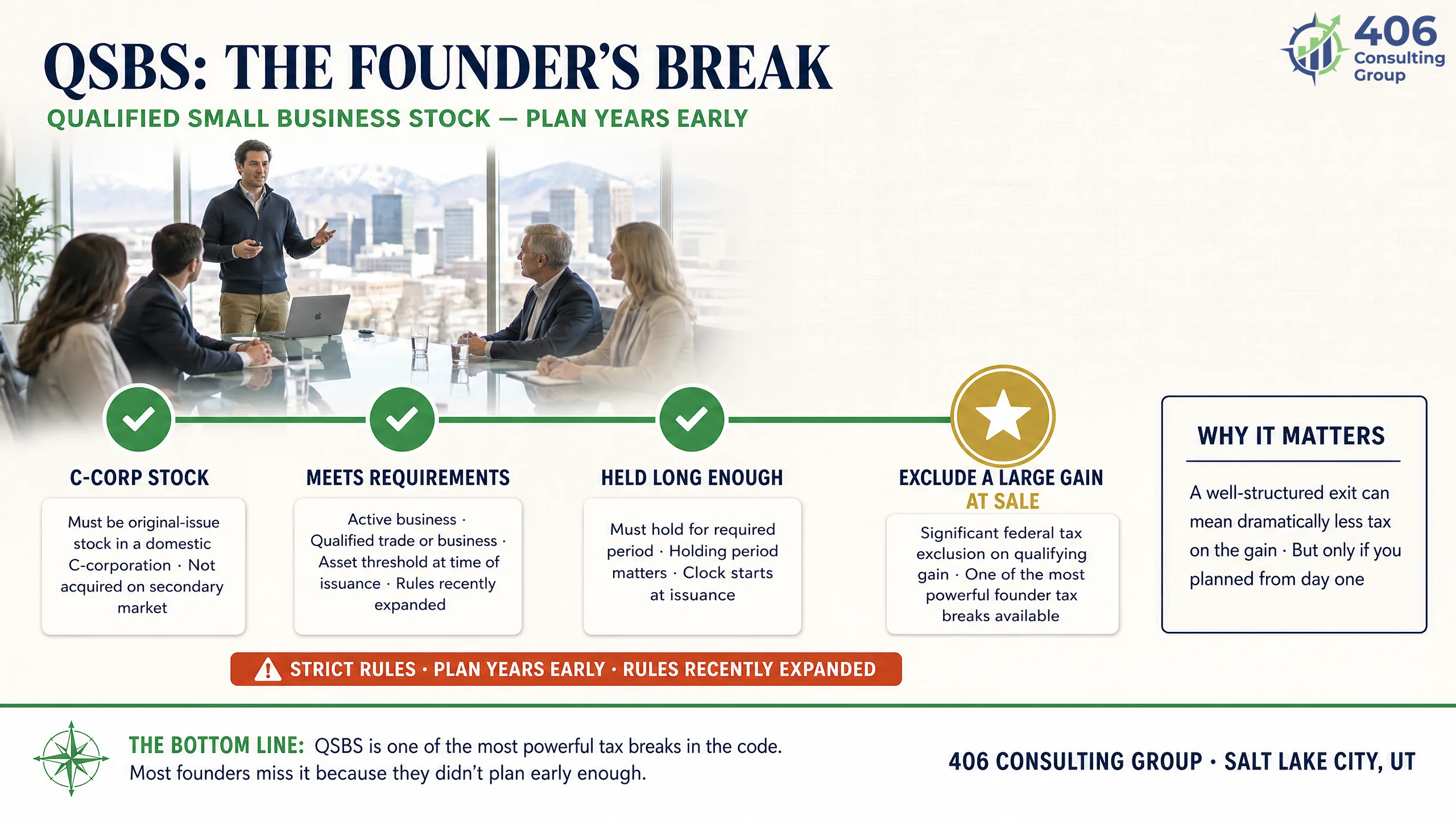
We flag QSBS eligibility as part of structuring a venture-track company — because the value at stake is measured in years and millions, not in a filing.
Equity Comp: ISOs, NSOs & 83(b)
Startups pay with equity, and the tax treatment of that equity is full of traps and opportunities. Incentive stock options (ISOs) and non-qualified options (NSOs) are taxed differently; exercising ISOs can trigger the alternative minimum tax (AMT) even before you sell; and for restricted stock, an 83(b) election made within a tight window after grant can dramatically change the tax outcome. These are decisions with real dollars attached, often made by founders and early employees who don't realize a deadline is ticking.
None of this is a reason to shy away from equity — it's a reason to get advice before you grant, exercise, or file. The difference between handling an 83(b) election or an ISO exercise well versus badly can be tens of thousands of dollars, and some of the choices can't be undone once the window closes.

If you're granting or receiving equity, loop in a tax advisor before the paperwork, not after.
The Utah Pass-Through Election
If your business is a pass-through — an S-corp or partnership — Utah offers an election that can work around the federal cap on deducting state and local taxes (the "SALT cap"). In broad strokes, the business elects to pay Utah income tax at the entity level, where it's a deductible business expense, instead of that tax flowing to your personal return where the deduction is capped. For a profitable pass-through owner, it can recover a federal deduction you'd otherwise lose.
It has specific rules and deadlines and doesn't help every owner equally, so it's worth modeling before electing — but it's a real, Utah-specific lever that many Salt Lake pass-through owners either don't know about or aren't using. (Note this applies to pass-throughs; a venture-track C-corp is a different analysis.)
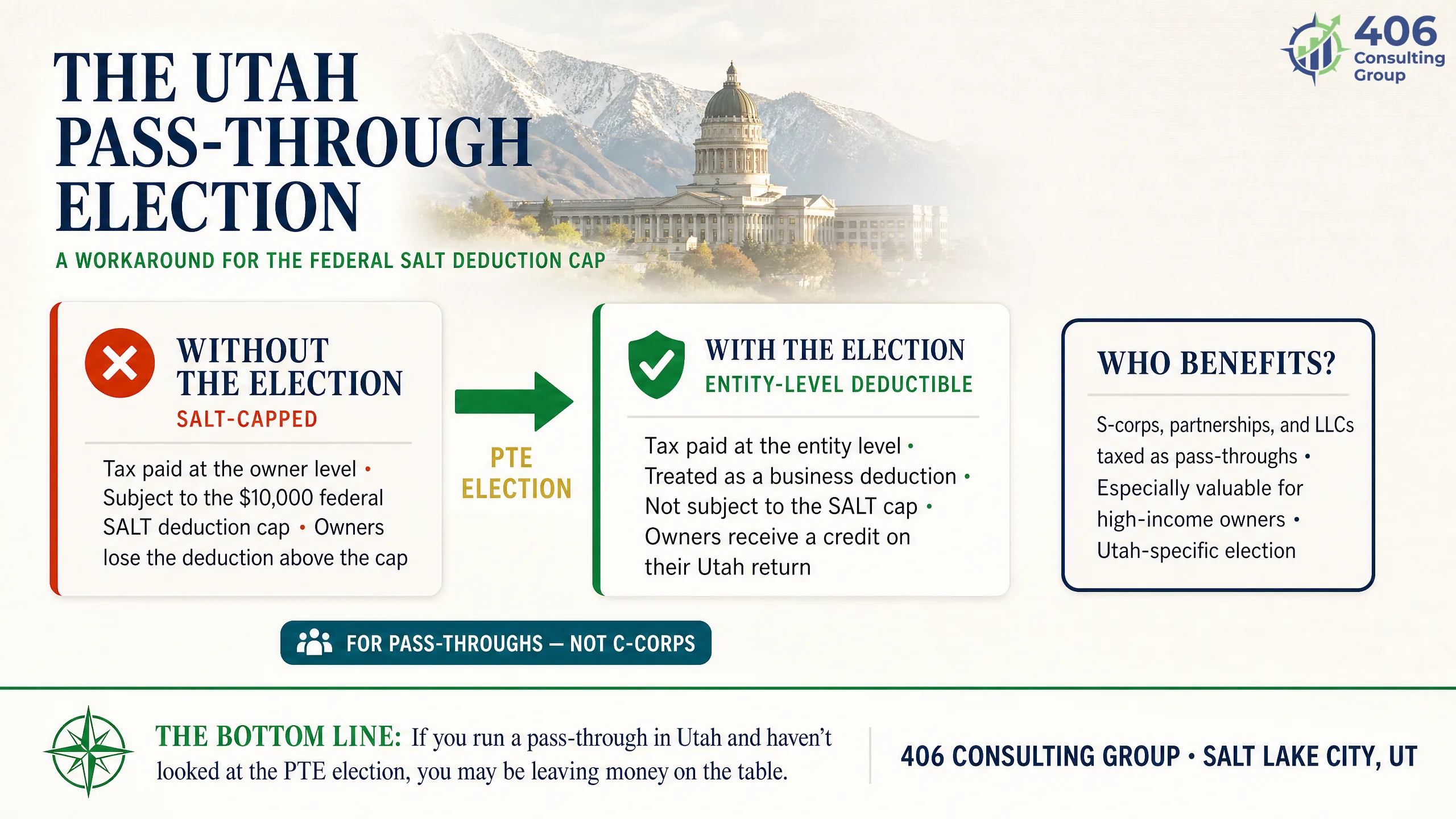
We model whether the election helps as part of planning — it's exactly the kind of thing that separates proactive tax work from once-a-year filing.
Multi-State Nexus as You Scale
A fast-growing Salt Lake company hits multi-state complexity faster than almost any other kind of business. Hire a remote engineer in another state and you may create income-tax nexus and payroll-withholding obligations there. Sell software nationwide and economic-nexus rules can require you to collect and remit sales tax in many states. Send crews across state lines and the same applies to that work. None of it is a reason not to grow — it's a reason to know where you have obligations before a state tells you.
The cost of ignoring it is real: back taxes, penalties, and interest in states you didn't realize you'd triggered, often discovered during a fundraise or acquisition when it's most expensive. Mapping your nexus — people, property, and sales, state by state — and filing accordingly keeps a small problem from compounding into a big one.

This is where our multi-state experience earns its keep — keeping a scaling company clean everywhere it does business.
Equipment Timing & a Year-Round Rhythm
For the construction and equipment-heavy side of Salt Lake, the timing of big purchases is a familiar lever: Section 179 and bonus depreciation let you deduct qualifying equipment in the year it's placed in service, cutting both the Utah and federal bill in a strong year. Bonus depreciation percentages shift over time, so confirm the current-year rules before counting on them.
Whatever your model, most of these levers are timing-driven, which makes planning a year-round rhythm rather than an April event: confirm entity and elections early, watch the year's profit and R&D spend build, and make the equipment, retirement, and election moves before December 31, when most have to happen to count. On estimates, remember Utah has its own rules — set aside for the state balance alongside your federal quarterlies so April isn't a surprise. Always confirm current specifics with the Utah State Tax Commission or your advisor.
The through-line: the money is made in the moves you make before year-end, not the return you file after it.
Local vs. a Great Remote Partner
Tax planning is expertise, not proximity — running an R&D credit study, structuring for QSBS, modeling an 83(b) election, weighing the pass-through election, mapping multi-state nexus. What matters is whether your advisor knows tech and construction tax and multi-state work, not whether they're downtown. A great remote partner who knows this terrain beats a local generalist who files your return and calls it planning.
It's also how the work runs now. Roughly 70–80% of our own local clients never come into the office; planning happens over shared screens and secure document exchange, with numbers in the cloud. So whether you're a founder in Salt Lake City, a builder on the Wasatch Front, or scaling across state lines, you get proactive, model-specific planning — and in a multi-state world, that experience is a genuine edge.
The goal is the same wherever you sit: pay Utah and the IRS what you owe, and not a dollar more.
How to Get Started
A Salt Lake City tax plan comes together in three steps.
Get the entity right for your path
S-corp for a profitable services or construction firm; C-corp with QSBS in mind for a venture-track startup.
Capture the big breaks
R&D credit, equity-comp elections (83(b)/ISO timing), and the Utah pass-through election, mapped to your situation.
Stay clean multi-state
Map nexus across the states where you have people, property, and sales, and file accordingly as you scale.
Start with the S-Corp Calculator or our Financial Maturity Assessment, then let's talk.
FAQ: Salt Lake City Tax Questions
How much is Utah's income tax, and does planning really help?
Utah has a low flat state income tax (about 4.5% in recent years), on top of federal income tax. Because there are two income taxes, most legitimate deductions and deferrals cut both bills, so proactive planning is worth more here than in a no-income-tax state. And the Wasatch Front economy opens up high-value breaks — the R&D credit, QSBS, equity-comp planning, the pass-through election — that dwarf routine deductions for the right company. Skipping planning means overpaying on two returns and, often, missing the breaks worth the most.
What is the R&D tax credit and can my startup use it?
The federal research & development credit rewards spending on developing or improving products, software, and processes — mostly the wages of the people doing that work — and Utah offers a state credit that can stack on top. The definition is broader than most founders assume: building software and solving technical problems often qualifies. Crucially, even a pre-profit startup with no income-tax liability can benefit, because qualified small businesses can apply a portion of the credit against payroll taxes — real cash back while burning. It has specific rules and documentation requirements, so it's a work-with-a-specialist area, but it's frequently found money.
What is QSBS and why does it matter for founders?
QSBS — qualified small business stock under Section 1202 — can let founders and early investors exclude a very large amount of gain from federal tax when they sell, if the stock and company meet the requirements and it's held long enough. For a Salt Lake startup that exits well, that can mean excluding millions of dollars of gain. But QSBS has strict rules: the company generally must be a C-corporation, meet asset limits when the stock is issued, be in a qualifying business, and the stock must be held for a required period, and the rules were recently expanded. Because the decisions that determine eligibility happen years before a sale, founders should understand it early — not at exit.
I'm getting stock options — what tax decisions do I need to make?
Several, and some are time-sensitive. Incentive stock options (ISOs) and non-qualified options (NSOs) are taxed differently; exercising ISOs can trigger alternative minimum tax (AMT) even before you sell; and for restricted stock, an 83(b) election made within a short window after grant can dramatically change the outcome. These choices carry real dollars and some can't be undone once the window closes, so the right move is to get advice before you grant, exercise, or file — not after.
Can 406 Consulting Group handle my Salt Lake City taxes remotely?
Yes. Tax planning and preparation run well remotely — planning over shared screens, secure document exchange, and numbers in the cloud. What matters is deep knowledge of tech and construction tax, the R&D credit and QSBS, equity comp, and multi-state work, not office proximity. Roughly 70–80% of our own local clients never come into the office either, and for a company hiring and selling across state lines, our multi-state experience is a real advantage. You get proactive, year-round planning wherever you are.
Keep Reading
Tax Planning — Salt Lake City, UT
The Big Breaks Are Made Years Early.
406 Consulting Group builds year-round tax plans for Salt Lake City businesses — the R&D credit, QSBS, equity-comp strategy, the Utah pass-through election, and multi-state clarity — delivered remotely.
SLC Tax Quick Reference
Salt Lake City, UT — Salt Lake County
Leaving Money on the Table?
R&D credit, QSBS & equity, handled.
About the Author
Carrie Anderson
Co-Founder, 406 Consulting Group
Commercial banking and underwriting background — 300+ loan reviews — advising tech, construction, and small businesses across the Mountain West. Carrie helps Salt Lake City owners capture the big breaks — R&D, QSBS, equity comp — and plan for both the Utah and federal bill.
Read the Full Story