
Bookkeeping Services in Salt Lake City, UT:
Books Built for How You Actually Run
Silicon Slopes tech and a construction boom, on Utah's flat-tax base — Salt Lake businesses need books that handle SaaS revenue recognition, burn and runway, or construction job costing. Here's what that takes.

Salt Lake City sits at the center of one of the fastest-growing economies in the country. The Wasatch Front runs on two engines: Silicon Slopes — a dense cluster of software, SaaS, and venture-backed startups — and a construction and commercial building boom feeding all that growth. Add a healthy base of finance, healthcare, and professional services, and you get a market where the accounting needs are more sophisticated than a generic bookkeeper is built for.
A SaaS startup needs revenue recognition, deferred revenue, and investor-ready books that show burn and runway. A builder needs job costing and work-in-progress. Both sit on Utah's flat-tax base — a low flat income tax plus a ~7.75% sales tax with its own software-taxability wrinkles. Clean books that speak startup and construction, and handle Utah's specifics, are what keep a growing Salt Lake business fundable, compliant, and clear on how it's actually doing.
This guide covers how the tech and construction booms, and Utah's taxes, shape your books — and how a remote firm delivers all of it.
By Jason Anderson — Co-Founder, 406 Consulting Group. Big-firm-trained accountant advising tech, construction, and small businesses across the Mountain West, where SaaS revenue recognition, job costing, and investor-ready books are everyday work.
Quick Answer: Bookkeeping for a Salt Lake City Business
- →Tech needs more: SaaS revenue recognition, deferred revenue, and burn/runway reporting are core, not optional.
- →Utah taxes: a low flat income tax (~4.5%), ~7.75% combined sales tax, and no gross-receipts/B&O tax.
- →Software is a gray area: Utah sales-tax treatment of software and SaaS is nuanced — worth getting right.
- →Construction too: the building boom means job costing and WIP for a big share of the market.
- →Delivered remotely — even most of our local clients never come into the office.
Table of Contents
Why Salt Lake City Bookkeeping Is Different
Most bookkeeping advice assumes a straightforward business selling a product or service and recording the sale when the money lands. A lot of the Salt Lake economy doesn't work that way. A SaaS company collects a year of subscription up front but earns it over twelve months — so recording it all as revenue on day one makes the books lie. A venture-backed startup lives or dies on burn rate and runway, numbers a standard P&L doesn't even show. And a commercial builder needs job costing and work-in-progress. None of that is exotic; it's just specialized, and a generic setup handles none of it well.
Salt Lake City anchors the Wasatch Front in Salt Lake County — the hub of Silicon Slopes and a construction market growing to keep up with it. Books built for a Salt Lake business have to speak the language of whichever engine you're part of: recurring revenue and investor metrics for tech, jobs and WIP for construction, on top of Utah's flat-tax rules.

The rest of this guide walks each piece — starting with the Utah tax backdrop everything sits on.
The Utah Tax Backdrop
Utah's tax setup is relatively simple and business-friendly. Here's the picture for a Salt Lake City business:
| Tax | Utah reality |
|---|---|
| State income tax | Low flat rate (~4.5%) on business and personal income — verify current |
| Sales tax | ~7.75% combined in Salt Lake City; use tax on untaxed purchases |
| Gross-receipts / B&O | None |
| Software / SaaS | Sales-tax treatment is nuanced — some taxable, some not |
| County | Salt Lake County |
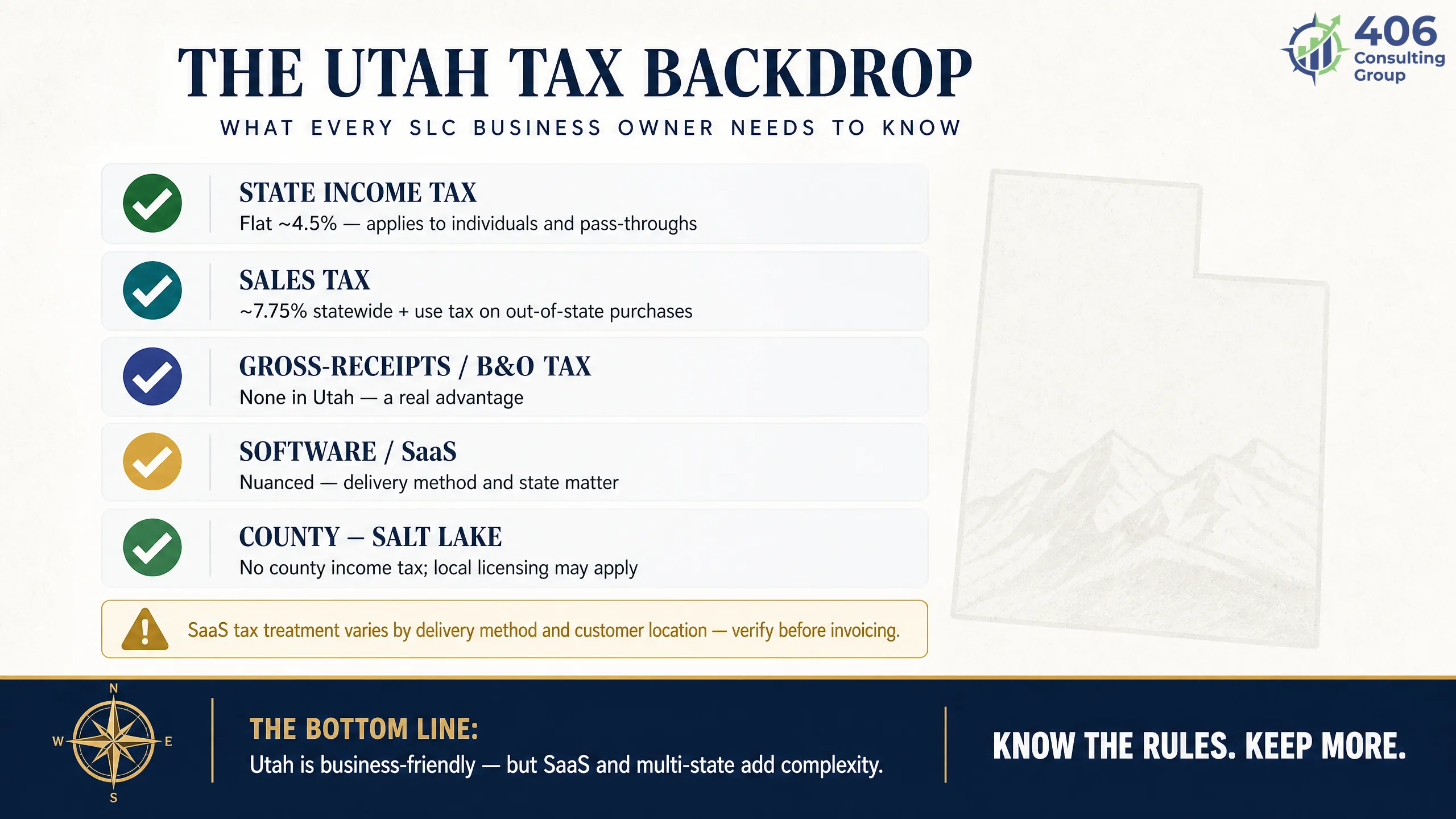
Because Utah has an income tax, your books also have to stay clean enough to support the state and federal return and to set aside for the flat rate as you go. Confirm current rates with the Utah State Tax Commission. We cover planning in the Salt Lake City tax guide.
Sales Tax & the Software Question
If you sell taxable goods you collect Utah's ~7.75% combined sales tax, hold it as the state's money, and remit it — and you owe use tax on equipment or supplies bought without sales tax. Standard so far. The Salt Lake wrinkle is software: for a tech company, whether what you sell is even taxable can be a genuine question. Utah's treatment of prewritten software, electronically delivered software, and remotely accessed software (SaaS) is nuanced — some is taxable, some isn't, and it can hinge on how the product is delivered and used.
Getting this wrong cuts both ways: fail to collect tax you owed and you're liable for it later; charge tax you didn't need to and you've overcharged customers and created a mess. And if you sell nationwide — as most SaaS does — economic nexus means other states' rules come into play too. This is an area to map deliberately with someone who knows both software and multi-state sales tax, not to guess at.
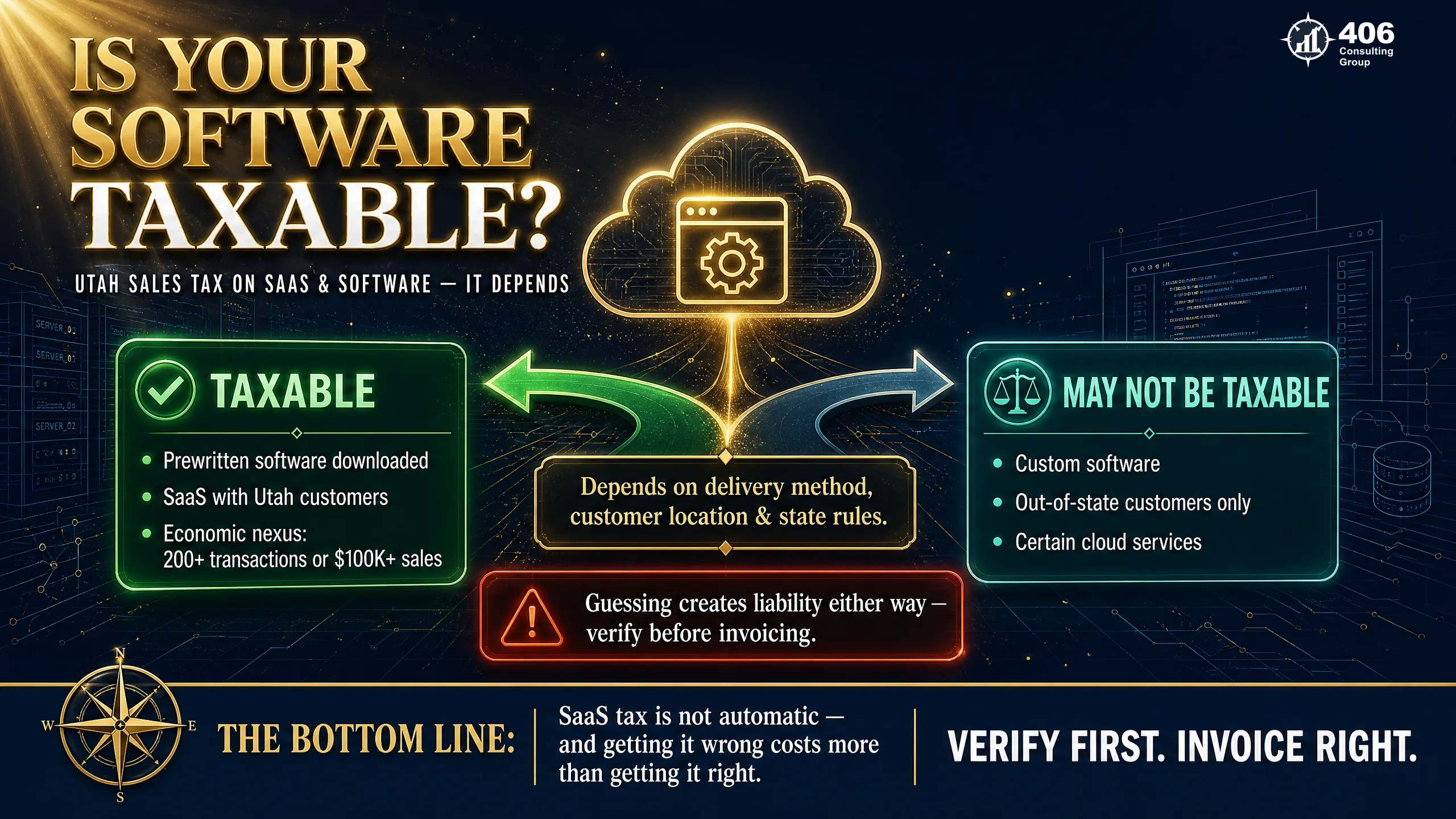
The SaaS sales-tax trap
Software taxability varies by state and by how the product is delivered, and selling nationwide can create sales-tax obligations in many states at once. Map your nexus and taxability early. Confirm Utah specifics with the Utah State Tax Commission.
Revenue Recognition & Deferred Revenue
This is the heart of tech bookkeeping and the thing generic setups get wrong most often. When a SaaS company sells an annual subscription and collects $12,000 up front, it hasn't earned $12,000 — it's earned $1,000, and it owes the customer eleven more months of service. The right way to book it is deferred revenue: record the cash as a liability and recognize $1,000 into revenue each month as it's earned. Do that and your revenue line reflects reality; skip it and every up-front annual deal makes you look wildly more profitable than you are, then wildly less the following year.
This matters for more than tidiness. Investors and acquirers expect revenue recognized on an accrual basis (broadly, the ASC 606 framework), and messy or cash-basis revenue is a red flag in diligence that can cost you a round or a deal. Clean deferred-revenue tracking, a proper subscription schedule, and accrual books are table stakes for a fundable Salt Lake startup.
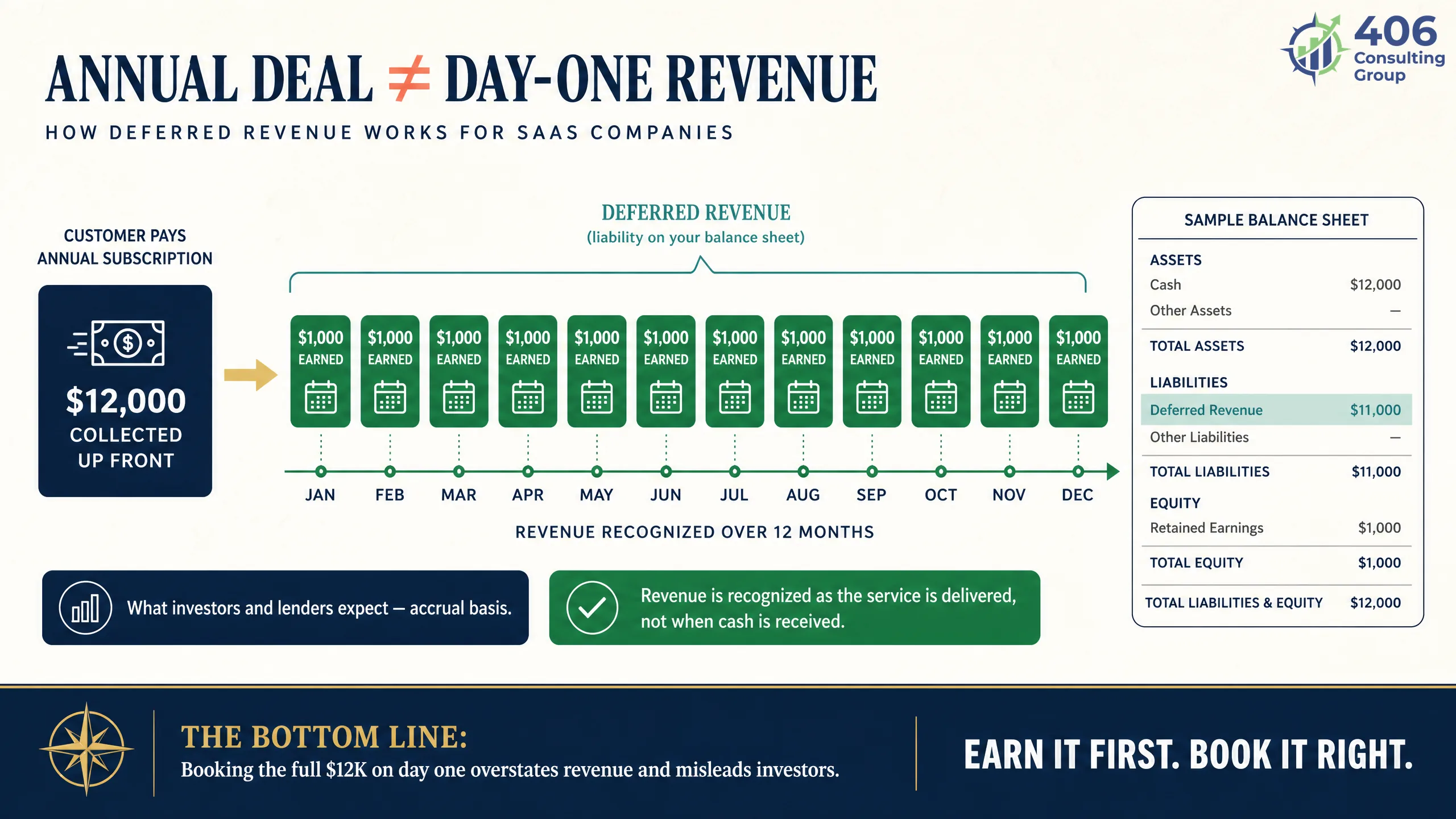
Getting revenue recognition right from the start is far cheaper than untangling it under the pressure of a fundraise or an audit.
Burn Rate, Runway & Investor-Ready Books
A venture-backed startup runs on two numbers a standard P&L doesn't surface: burn rate (how much cash you're consuming each month) and runway (how many months of cash you have left). Miss the moment runway gets short and you're raising from weakness or scrambling to cut — both expensive. Books built for a startup track burn and runway continuously, so the founder always knows exactly where the line is.
Investor-ready books go further: clean monthly financials on an accrual basis, the SaaS metrics investors ask for, and a data room that doesn't fall apart under diligence. In a market as investor-dense as Silicon Slopes, being genuinely fundable — numbers an investor can trust in minutes — is a real competitive advantage.

Want a quick read on your runway? Try our Cash Flow Runway tool — and see the Salt Lake City CFO guide for the strategy side.
Equity Comp & the Cap Table
Startups pay with equity as well as cash, and stock options bring their own accounting and compliance. Option grants generally require expensing over the vesting period, exercises and the cap table have to be tracked, and there are real compliance touchpoints — a defensible valuation for setting strike prices (a 409A valuation) and payroll and reporting consequences when options are exercised. None of it is a reason to avoid equity comp; it's a reason to have books and advisors that handle it correctly.
The bookkeeping job is to keep the equity records clean and coordinated with payroll and the cap table, so a grant or an exercise doesn't turn into a surprise at tax time or in a financing. It's specialized, and it's exactly the kind of thing a generalist bookkeeper isn't set up for.
Utah Payroll & Workers' Comp
Because Utah has a state income tax, payroll here includes state income-tax withholding at the flat rate, alongside federal payroll taxes, Utah unemployment insurance (employer-paid), and workers' compensation, which in Utah runs through a competitive private market rather than a state monopoly. For a tech company, add the equity-comp payroll touchpoints noted above; for a builder, workers' comp class codes on trade work matter and aren't small.
Fast-growing companies also tend to hire across state lines — a remote engineer in another state, a sales rep on the road — and each out-of-state employee can create that state's payroll obligations. It's very manageable, but it's a place multi-state fluency pays off.
Handled properly, it's routine — which is what our payroll work keeps it.
Bookkeeping by Salt Lake City Segment
Salt Lake's economy is led by tech and construction, with finance, healthcare, and services around them — and each asks something different of the books.
| Segment | What the books need to track |
|---|---|
| Tech & SaaS / startups | Deferred revenue, ASC 606, burn & runway, equity comp, multi-state sales tax |
| Construction & trades | Job costing, WIP, subs/1099s, retainage, equipment, bonding |
| Professional & financial services | Receivables, utilization, payroll, clean accrual reporting |
| Healthcare & life sciences | Insurance receivables, payroll, R&D, compliance reporting |
| Retail, restaurants & outdoor | Sales tax, inventory or food cost, seasonality, tips/payroll |

Different details, same backbone: revenue recognized correctly, sales and use tax handled, payroll right, and profit readable for the Utah and federal returns.
Common Salt Lake City Bookkeeping Mistakes
A handful of avoidable mistakes cause most of the trouble for growing Salt Lake businesses. Here's what we see most.
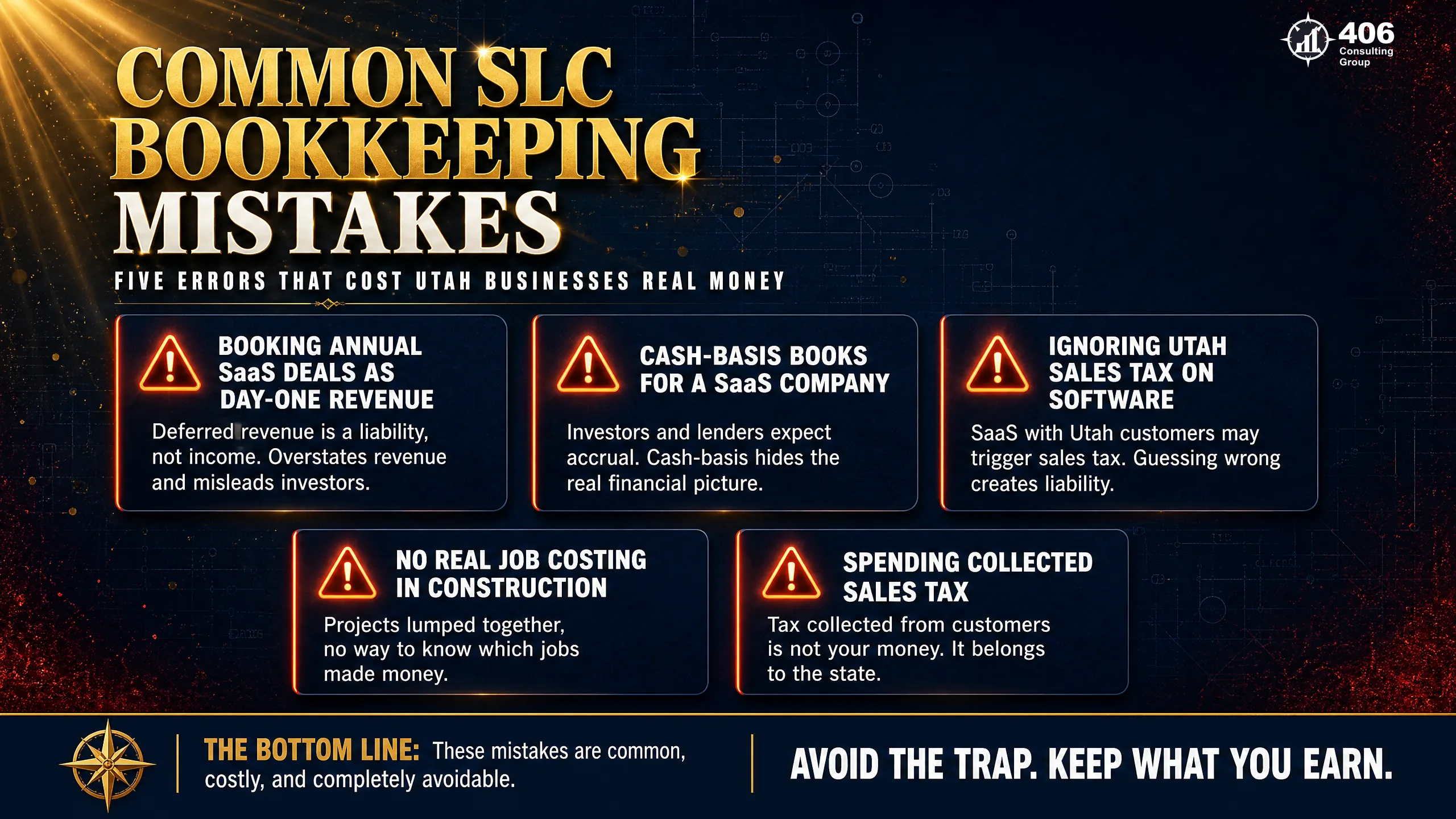
Booking annual deals as day-one revenue
Skipping deferred revenue makes a SaaS company look far more profitable than it is, then far less — and it's a diligence red flag.
Not tracking burn and runway
A startup that doesn't watch runway raises from weakness or cuts in a panic. It should be a live number, always.
Guessing on software sales tax
Utah and multi-state software/SaaS taxability is nuanced; guessing creates liability either way.
Ignoring equity-comp accounting
Option expensing, 409A, and exercise reporting handled late turn into surprises in a raise or at tax time.
Cash-basis books for an accrual business
Tech and construction both need accrual (deferred revenue, WIP); cash-basis books hide the real picture.
Every one is a setup-and-habit problem — and every one disappears once the books are built for how a Salt Lake business actually operates and maintained on a monthly rhythm.
Local vs. a Great Remote Partner
For a Salt Lake business, what matters in a bookkeeper isn't whether their office is downtown — it's whether they understand SaaS revenue recognition and startup metrics, or construction job costing and WIP, plus Utah's tax specifics and multi-state work. A great remote partner who knows your model beats a local generalist who doesn't, every time — and tech companies, already cloud-native, are the last to care about a physical office.
It's also how modern bookkeeping already works. Roughly 70–80% of our own local clients never set foot in our office; everything runs on secure cloud accounting, connected bank feeds, and a steady monthly rhythm. So whether you're a startup in Salt Lake City, a builder along the Wasatch Front, or a services firm anywhere in the region, you get the same responsive, model-savvy service — and our multi-state experience is a real plus for companies hiring and selling across state lines.
Distance isn't the variable. Knowing your business model is.
How to Get Started
Getting your Salt Lake City books in order is three steps.
Clean up and structure for your model
Accrual books with deferred revenue for SaaS, or job costing and WIP for construction — plus clean Utah sales/use-tax tracking.
Get taxes, payroll, and equity right
Software/multi-state sales tax mapped, Utah payroll (flat-rate withholding), and equity-comp accounting handled.
Run it monthly
Monthly reconciliation, burn/runway or job reporting, and investor- or bank-ready financials that stay current.
Not sure whether you need bookkeeping, tax help, or something more? Our Financial Maturity Assessment maps it out in about eight minutes.
FAQ: Salt Lake City Bookkeeping Questions
What makes bookkeeping for a Salt Lake City tech company different?
Recurring-revenue businesses need accrual accounting done right. When a SaaS company collects an annual subscription up front, it's earned only one month of it — the rest is deferred revenue, a liability recognized over the term. Booking it all as day-one revenue makes the company look far more profitable than it is and is a red flag in fundraising diligence. On top of that, startups need burn-rate and runway tracking, equity-comp accounting, and multi-state sales-tax mapping for software sold nationwide. It's specialized work a generic bookkeeper isn't built for.
What taxes does a Salt Lake City, Utah business deal with?
Utah has a low flat state income tax (about 4.5% in recent years), a combined sales tax around 7.75% in Salt Lake City with a companion use tax, and no gross-receipts or B&O tax. Software and SaaS sales-tax treatment is nuanced and worth confirming. You also handle federal income tax and payroll, Utah unemployment insurance, and workers' compensation through a competitive private market. If you hire or sell across state lines — common for tech — other states' payroll and sales-tax rules can apply too.
Is software or SaaS taxable in Utah?
It depends, and it's genuinely nuanced. Utah's treatment of prewritten software, electronically delivered software, and remotely accessed software (SaaS) varies with how the product is delivered and used — some is taxable and some isn't. Getting it wrong cuts both ways: failing to collect tax you owed leaves you liable, while charging tax you didn't need to overcharges customers. And selling nationwide can create sales-tax obligations in many states via economic nexus. It's an area to map deliberately with someone who knows software and multi-state sales tax, and to confirm current rules with the Utah State Tax Commission.
Why does deferred revenue matter so much for a startup?
Because it's the difference between books that tell the truth and books that mislead you and your investors. Recognizing an annual subscription over its twelve-month term — rather than all at once — keeps your revenue line accurate month to month. Investors and acquirers expect revenue recognized on an accrual basis, and messy or cash-basis revenue is a diligence red flag that can cost you a round or a deal. Clean deferred-revenue tracking and a proper subscription schedule are table stakes for a fundable company.
Can 406 Consulting Group do my Salt Lake City bookkeeping remotely?
Yes. We work with Salt Lake City and Wasatch Front businesses through secure cloud accounting — connected bank feeds, shared screens, and a steady monthly rhythm. What matters is expertise in your model — SaaS revenue recognition and startup metrics, or construction job costing and WIP — plus Utah's tax specifics and multi-state work, not office proximity. Roughly 70–80% of our own local clients never come into the office either, and tech companies are already cloud-native, so remote is a natural fit.
Keep Reading
Bookkeeping — Salt Lake City, UT
Books Built for How You Actually Run.
406 Consulting Group keeps Salt Lake City tech, construction, and small businesses clean and fundable — revenue recognition, job costing, Utah taxes, and investor-ready financials — delivered remotely.
SLC Bookkeeping Quick Reference
Salt Lake City, UT — Salt Lake County
Fundable Books in SLC?
Revenue rec, burn & runway, handled.
About the Author
Jason Anderson
Co-Founder, 406 Consulting Group
Big-firm-trained accountant advising tech, construction, and small businesses across the Mountain West. Jason helps Salt Lake City owners get revenue recognition, burn and runway, and Utah taxes right — and keep books an investor or bank can trust.
Read the Full Story