
CFO & Controller Services in Salt Lake City, UT:
Know Your Numbers, Raise From Strength
Investors fund companies that know their metrics cold. Here's how fractional controller and CFO leadership — unit economics, runway management, and fundraising readiness — helps a Salt Lake startup or growing business scale on purpose.

Growth is exciting until the numbers get too big to run in your head. A Salt Lake startup adding customers, headcount, and a burn rate needs to know its unit economics, its runway, and whether it's genuinely ready to raise. A growing construction or services firm needs to know which work makes money and how to fund the expansion. In both cases, the moment arrives when clean books aren't enough — you need someone turning them into decisions. That's financial leadership, and for most Wasatch Front companies it doesn't require a full-time hire.
For a venture-track startup especially, this is existential: investors fund companies that know their metrics cold, and a founder who can't speak to CAC, churn, and runway in a board meeting loses credibility fast. A controller keeps the accrual numbers reliable; a CFO turns them into the SaaS metrics, the model, and the fundraising story. Get it right and you raise from strength; get it wrong and you're guessing with someone else's money.
This guide covers what controllers and CFOs do for a growing SLC company, what each costs, the metrics that matter, runway management, fundraising readiness, and how to know which you need.
By Jason Anderson — Co-Founder, 406 Consulting Group. Big-firm-trained accountant advising tech, construction, and growing businesses across the Mountain West — where unit economics, runway, and investor-ready numbers are the daily work.
Quick Answer: CFO & Controller Help for a Salt Lake City Company
- →A controller makes the accrual numbers reliable; a CFO turns them into metrics and strategy.
- →SaaS metrics — MRR/ARR, CAC, LTV, churn, gross margin, burn multiple — are the language of growth and fundraising.
- →Runway is the number that matters most for a startup — manage it, don't just watch it.
- →Fundraising readiness — a clean model, a data room, and metrics investors trust — is a real advantage.
- →Fractional delivers both roles for ~$4,000–$8,000/month — a fraction of full-time — remotely.
Table of Contents
Why a Growing SLC Company Needs Financial Leadership
Most companies hit a financial ceiling when growth outpaces the founder's ability to run the numbers by feel. For a startup, that ceiling shows up as questions a P&L can't answer: What's our real cost to acquire a customer, and are they worth it? How many months of runway do we have, and what does the next hire do to it? Are we actually ready to raise? For a construction or services firm, it's which jobs make money and how to fund growth. Either way, the answers require someone who lives in the numbers.
Salt Lake City — the heart of Silicon Slopes — is dense with fast-growing companies hitting exactly this wall, and dense with investors who expect them to have answers. Financial leadership is what turns clean books into unit economics, a defensible model, and a fundraising story that holds up in diligence. It's the difference between a company that scales on purpose and one that hopes.
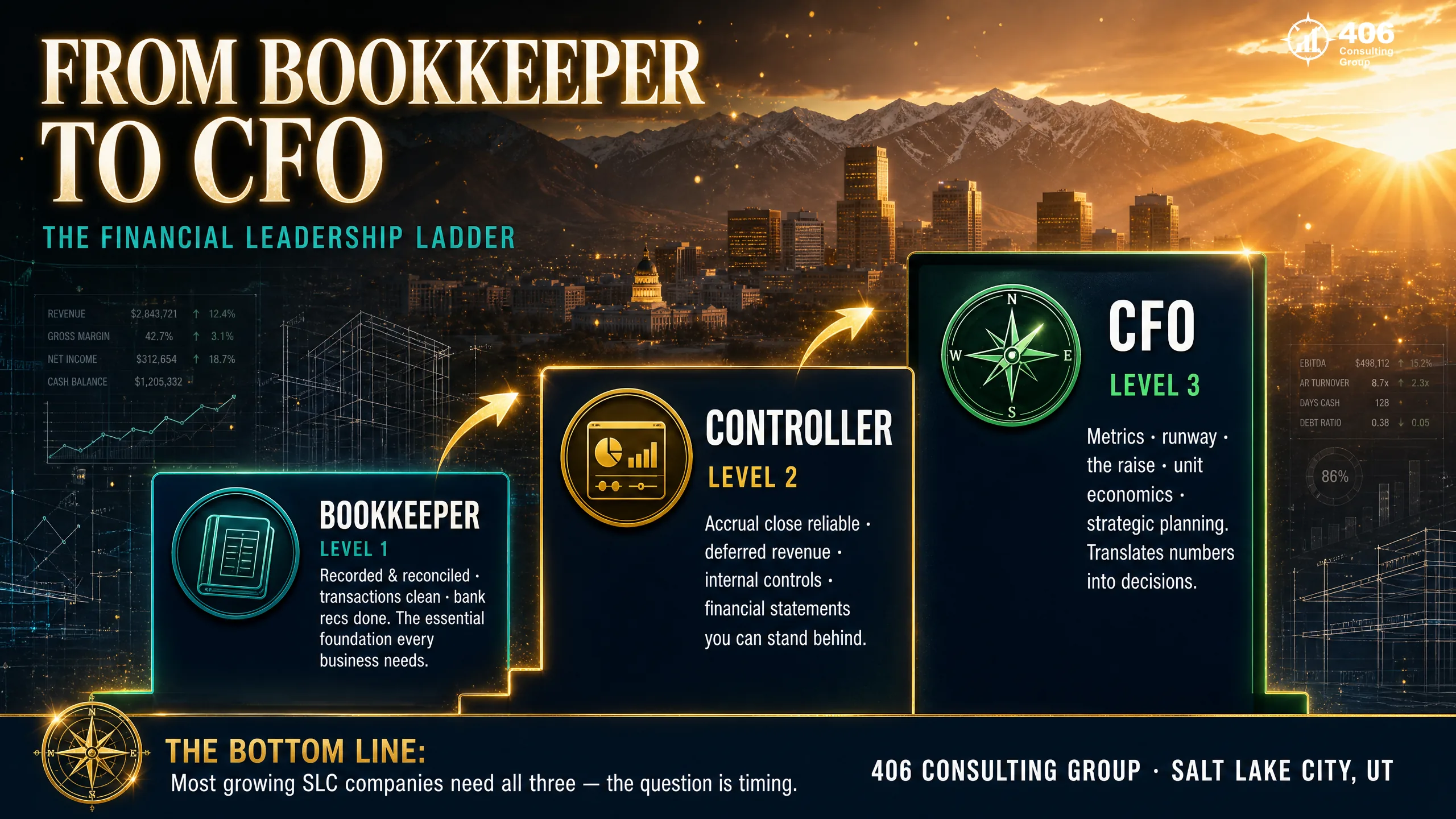
The question is which kind of help you need, and how to get it without overpaying. That starts with the roles.
Bookkeeper vs. Controller vs. CFO
These three roles get blurred constantly, but they're distinct — and hiring the wrong one for your problem is a common, expensive mistake.
| Role | Core question they answer |
|---|---|
| Bookkeeper | "Are the transactions recorded and reconciled?" |
| Controller | "Are the accrual financials right, on time, and controlled?" |
| CFO | "What do the numbers tell us — unit economics, runway, when to raise?" |
A quick rule: if your numbers are late or wrong, you need a controller. If they're clean but you can't speak to your metrics or your runway, you need a CFO. Many growing SLC companies need some of both — which a coordinated fractional engagement delivers. We cover the first step up in upgrading from bookkeeping to a controller.
The Cost Math: Fractional vs. Full-Time
Full-time financial leadership is expensive, and at most growing companies it isn't a 40-hour-a-week job yet — cash you'd rather put into product or growth. Fractional gives you the expertise scaled to what you actually need.
| Role | Fractional (per month) | Full-time (annual) |
|---|---|---|
| Controller | ~$2,500–$6,000 | $85K–$120K + ~25% benefits |
| Fractional CFO | ~$2,500–$5,000 | $150K–$300K+ + benefits |
| Both, coordinated | ~$4,000–$8,000 | $235K–$420K+ |

Fractional is dramatically more cost-effective until a company reaches the scale — generally $15M+ — that keeps a full-time hire busy year-round (a well-funded startup may bring finance in-house sooner around a major raise). Estimate the controller piece with our Controller Estimator.
What a Controller Delivers
A controller owns the integrity of your financials — and for a growing SLC company, that means accrual books done right. Reliable monthly close, accurate statements you can trust, deferred-revenue and subscription tracking for SaaS (or job costing and WIP for construction), and the clean processes and controls that keep everything solid as you scale. Without a controller, the numbers a CFO and your investors rely on are built on sand.
This matters more for a metrics-driven business than owners expect: you can't calculate trustworthy unit economics or runway from messy, cash-basis books. Clean accrual financials are the raw material for every number that follows.
Once the numbers are reliable, most founders want to use them — which is the CFO's job.
What a CFO Delivers
A CFO turns reliable numbers into forward strategy: the financial model, unit economics, runway planning, board and investor reporting, fundraising support, and a seat at the table for the big calls — how much to spend on growth, when to hire, when and how much to raise. For a Salt Lake startup, the CFO is often the person who builds the model investors scrutinize and translates the business into the metrics that get it funded.
For a construction or services firm, the same role focuses on job-level margin, cash forecasting, and financing growth. Either way, the highest-value CFO work is seeing around the corner — spotting the runway cliff, the unprofitable channel, or the cash crunch before it arrives, while there's still time to act.
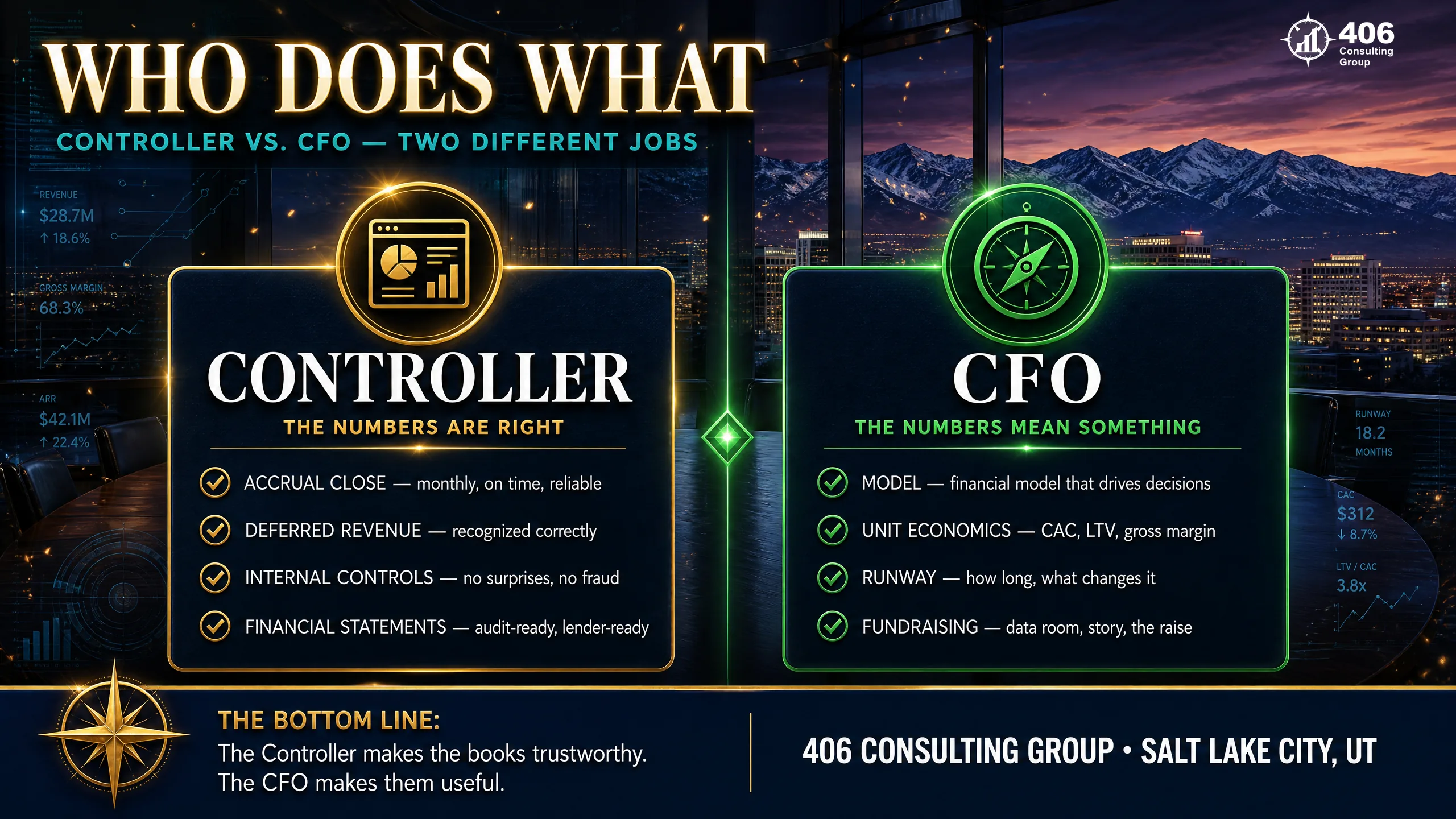
You rarely need both at full strength at once — which is why a coordinated fractional engagement, dialed to your stage, is usually the right answer.
The SaaS Metrics That Matter
For a software business, a handful of metrics tell the real story — and investors expect you to know them cold. These are the ones a CFO builds, tracks, and pressure-tests:
| Metric | What it tells you |
|---|---|
| MRR / ARR | Monthly / annual recurring revenue — the size and momentum of the business |
| CAC & LTV | Cost to acquire a customer vs. their lifetime value — is growth economical? |
| Churn | How fast you lose revenue or customers — the leak in the bucket |
| Gross margin | What's left after the cost of delivering the product — SaaS should be high |
| Burn multiple | Net burn per dollar of new recurring revenue — capital efficiency |
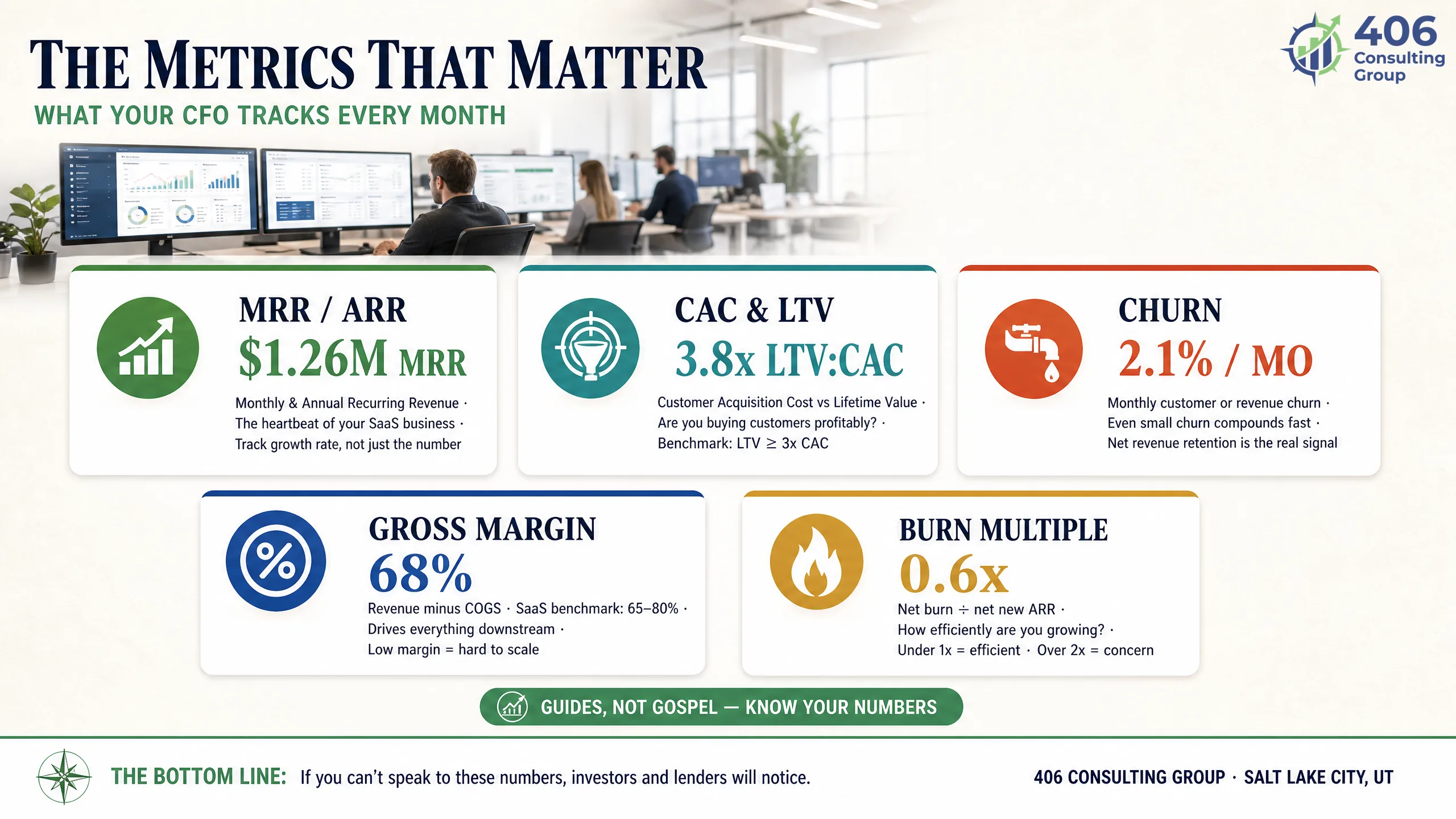
The common benchmarks (an LTV comfortably above CAC, healthy gross margins, controlled churn) are guides, not gospel — the real value is understanding your numbers and what moves them. This is the same idea as our flagship on unit economics, applied to software.
Managing Burn & Runway
Runway — how many months of cash you have at your current burn — is the number that decides a startup's fate. Run out and even a great company dies; misjudge it and you raise from weakness. The CFO's job isn't just to report runway but to manage it: model how each hire, campaign, or pricing change moves the burn, plan the raise well before the cliff, and make sure you're spending against the milestones that unlock the next round.
Good runway management is proactive. It answers "if we do X, we have Y months and hit milestone Z" before you commit — so growth decisions are deliberate bets, not hopes. In a downturn or a tight funding market, it's the discipline that keeps a company alive to fight another quarter.

Want a quick read? Try our Cash Flow Runway tool, and see why profit and cash aren't the same.
Fundraising Readiness
Raising money is a sales process, and your numbers are the product. Investors move fast on companies whose financials, model, and metrics hold up — and walk away from messy ones. Fundraising readiness means a defensible financial model, clean accrual financials, the SaaS metrics investors ask for, and a data room that doesn't fall apart under diligence. In an investor-dense market like Silicon Slopes, showing up genuinely ready is a real competitive edge.
This is where a CFO earns their keep before, during, and after a raise: building the model and the story going in, answering diligence questions credibly, and then delivering the board and investor reporting that keeps the relationship strong afterward. The same discipline applies to a construction or services firm getting bank- or bond-ready — different audience, same principle: present the company the way the money evaluates it.
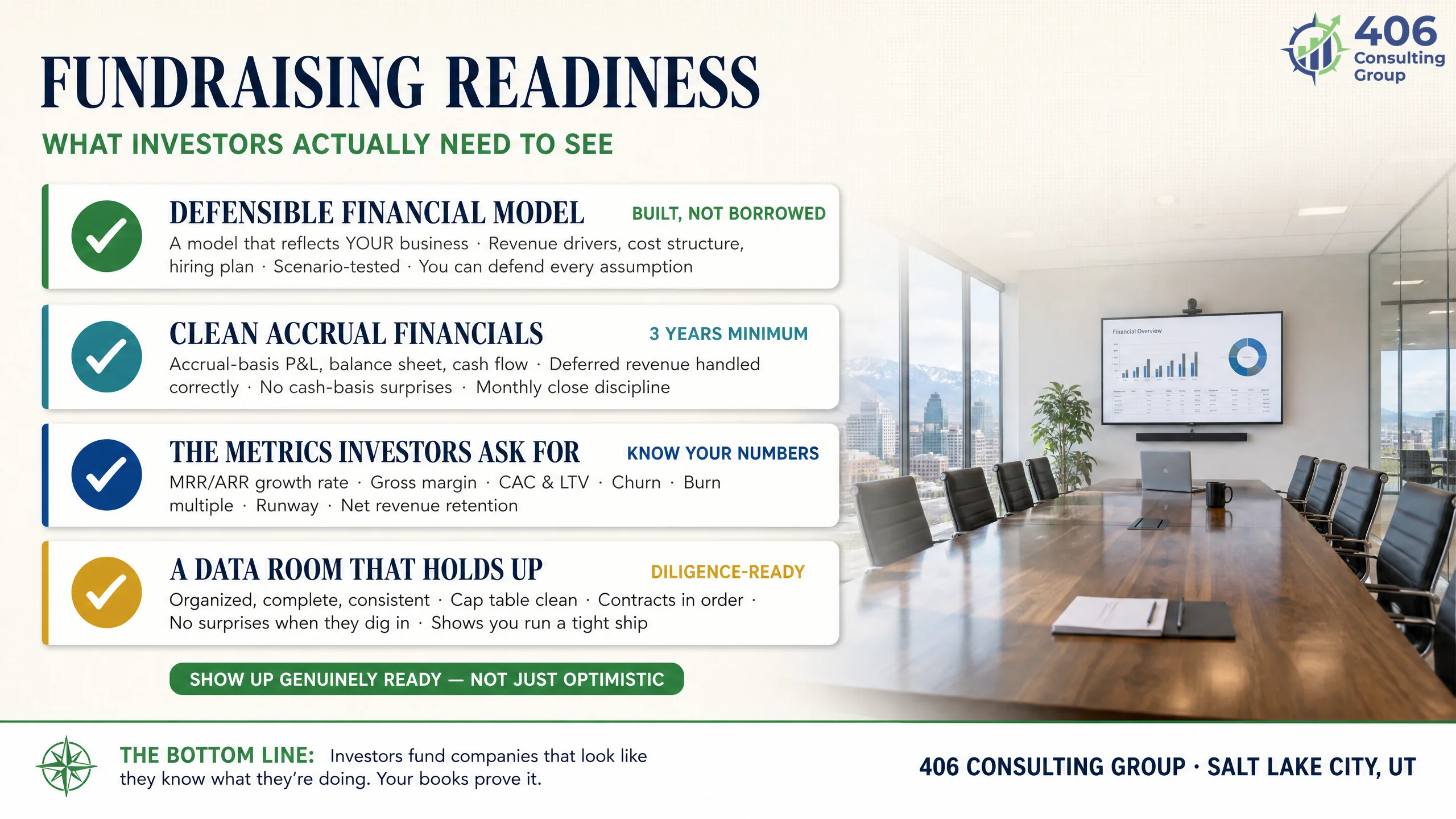
See our financing readiness work for how we get a company ready for investors or lenders.
When to Hire — and the Fractional Path
A few clear signals mean it's time for financial leadership:
You can't speak to your unit economics
If you don't know your real CAC, LTV, or margin, you're scaling blind — and investors will notice.
Runway is a guess, not a number
If you can't say how many months you have and what changes it, you need a CFO on it now.
A raise (or a loan) is on the horizon
Get the model, metrics, and data room ready before you start, not during diligence.
The financials are late or you don't trust them
Metrics built on messy books are worse than none. Fix the close with a controller first.

The fractional path lets you start with exactly what you need — often a controller to get the accrual close right, then CFO strategy for metrics, runway, and the raise — and scale up as you grow, without a premature six-figure hire.
Local vs. a Great Remote Partner
Financial leadership is analysis and judgment — building the model, calculating unit economics, managing runway, preparing the raise. None of it depends on being in the office, and tech companies are already cloud-native. What matters is whether your partner understands SaaS metrics and fundraising, or construction margin and financing — not their zip code. A great remote CFO who knows your model beats a local generalist who doesn't, every time.
It's also how we already work. Roughly 70–80% of our own local clients never come into the office; models, metrics, and board decks run on shared screens and live dashboards, with regular calls. So whether you're a startup in Salt Lake City, a builder on the Wasatch Front, or scaling across state lines, you get the same growth-savvy financial leadership our in-town clients do.
Distance isn't the variable. Knowing your model is.
How to Get Started
Getting financial leadership in place is three steps.
Diagnose what you actually need
Late/wrong numbers point to a controller; clean-but-unused numbers and no metrics point to a CFO. We pinpoint the real gap.
Get the accrual foundation right
Reliable close, deferred revenue or WIP, and clean processes — every metric depends on it.
Layer on metrics & strategy
Unit economics, runway management, and fundraising or financing readiness, scaled to your stage.
Not sure which layer you need? Our Financial Maturity Assessment maps it out in about eight minutes.
FAQ: Salt Lake City CFO & Controller Questions
How much do CFO and controller services cost in Salt Lake City, UT?
Fractional pricing typically runs about $2,500–$6,000 per month for a controller and about $2,500–$5,000 per month for a fractional CFO, depending on complexity and scope. A coordinated engagement covering both often runs roughly $4,000–$8,000 per month. Compare that to full-time salaries — $85K–$120K for a controller and $150K–$300K+ for a CFO, plus roughly 25% in benefits — and fractional is dramatically more cost-effective until a company reaches the scale (generally $15M+) that keeps a full-time hire busy year-round. A well-funded startup may bring finance in-house sooner around a major raise.
What does a CFO actually do for a startup?
The core work is turning reliable numbers into decisions and a story investors trust: building the financial model, tracking unit economics (CAC, LTV, churn, gross margin, burn multiple), managing runway, preparing for fundraising, and delivering board and investor reporting. A controller keeps the accrual close and deferred-revenue books reliable; the CFO uses them to answer what your metrics say, how much runway each decision costs, and when and how much to raise. For a venture-track company, that forward view and credibility with investors is often the difference between raising from strength and scrambling.
Which SaaS metrics do investors actually care about?
The ones that reveal whether growth is real and economical: MRR/ARR (recurring revenue and momentum), CAC and LTV (what a customer costs to acquire versus what they're worth), churn (how fast you lose revenue), gross margin (efficiency of delivering the product), and capital-efficiency measures like the burn multiple. Common benchmarks exist — an LTV comfortably above CAC, healthy gross margins, controlled churn — but they're guides, not gospel. What matters is knowing your own numbers cold and what moves them; a CFO builds and pressure-tests them so you can defend them in a board meeting or a raise.
Why is runway management so important?
Because running out of cash kills even great companies, and misjudging runway forces you to raise from weakness. Managing runway means more than watching a number — it's modeling how each hire, campaign, or pricing change moves your burn, planning the raise well before the cliff, and spending against the milestones that unlock the next round. Done well, growth decisions become deliberate bets with a known cash cost rather than hopeful guesses, and in a tight funding market it's the discipline that keeps you alive to the next quarter.
Can 406 Consulting Group provide CFO and controller services remotely?
Yes — it's how the work is done now, and tech companies are already cloud-native. Model-building, metrics, runway planning, board decks, and fundraising prep all happen over shared screens, live dashboards, and regular calls; none of it requires being in the office. Roughly 70–80% of our own local clients never come into the office either. What matters is deep expertise in your model — SaaS metrics and fundraising, or construction margin and financing — plus multi-state fluency for companies scaling across state lines.
Keep Reading
CFO & Controller — Salt Lake City, UT
Know Your Numbers. Raise From Strength.
406 Consulting Group gives Salt Lake City startups and growing businesses fractional controller and CFO leadership — unit economics, runway management, and fundraising readiness — delivered remotely.
Fractional vs. Full-Time
Salt Lake City, UT — typical ranges
Scaling Blind?
Metrics, runway & the raise, handled.
About the Author
Jason Anderson
Co-Founder, 406 Consulting Group
Big-firm-trained accountant advising tech, construction, and growing businesses across the Mountain West. Jason helps Salt Lake City founders build the model, know their unit economics and runway, and show up to a raise genuinely ready.
Read the Full Story