
Tax Planning in Spokane Valley, WA:
No Income Tax Doesn't Mean No Planning
Washington has no state income tax — but that shifts your planning to the federal bill, the B&O tax, and sales-tax compliance, not away from it. Here are the four federal levers that cut your taxes, how to minimize B&O, and how proactive planning works, from a WA-savvy remote firm.

There's a myth that Spokane Valley business owners quietly enjoy: "Washington has no income tax, so tax planning doesn't really matter here." The first half is true and genuinely great — Washington taxes no ordinary business or personal income. But the conclusion is exactly backwards. No state income tax doesn't mean less to plan; it means your planning energy moves to different places — the federal tax bill (still your largest), the B&O tax that's easy to overpay, and the sales-tax compliance that turns into a surprise if you ignore it.
And here's the part owners miss most: the biggest tax-saving moves for a Washington business are federal, and they're every bit as powerful here as in an income-tax state. Electing S-corp status, timing equipment purchases, funding a retirement plan — these lower what you send the IRS regardless of what your state does. A Spokane Valley owner who assumes "no income tax" means "nothing to plan" leaves real money on the table every April.
This guide covers the four federal levers that actually move a small business's tax bill, how to minimize the B&O tax, how to keep sales tax from becoming a surprise, and how proactive planning works year-round. It sits on top of clean books, so if yours aren't there yet, start with our Spokane Valley bookkeeping guide.
By Carrie Anderson — Co-Founder, 406 Consulting Group. Commercial banking and underwriting background — 300+ loan reviews — plus advisory work with small businesses across the Northwest, where entity strategy, federal tax planning, and multi-state compliance are everyday work.
Quick Answer: Tax Planning for a Spokane Valley Business
- →No state income tax — but that shifts planning to the federal bill, the B&O tax, and sales-tax compliance.
- →The big levers are federal: S-corp election, equipment timing, and retirement plans save you regardless of state.
- →S-corp still wins in WA — the self-employment-tax savings are federal, so they apply here in full.
- →The B&O tax is easy to overpay — right classification and the small-business credit can cut it.
- →Planning beats preparing: the savings come from moves made during the year, not the April return.
Table of Contents
What a Washington Business Actually Owes
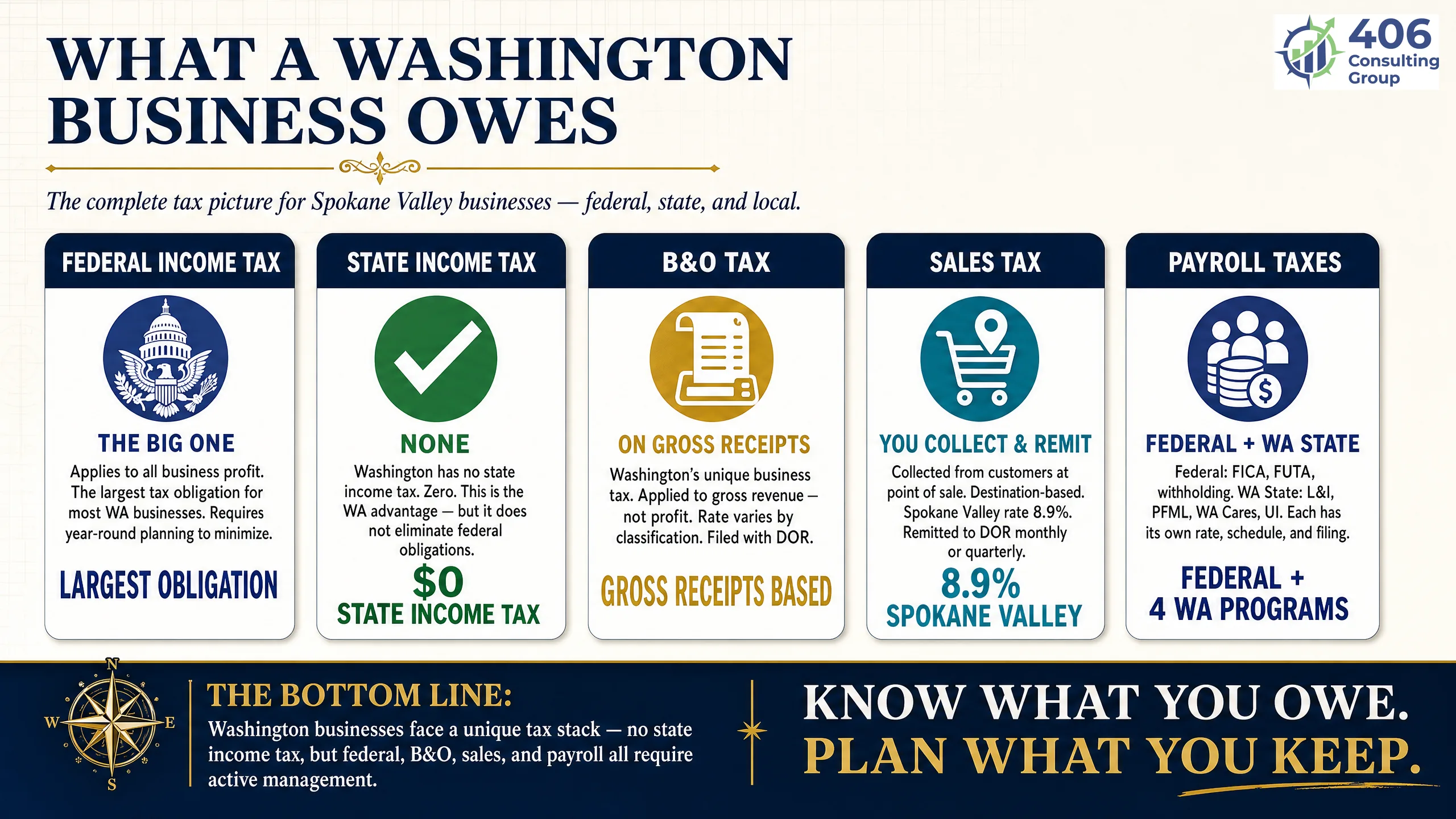
The short answer: with no state income tax, a Spokane Valley business's tax picture has three parts — federal income tax (the big one), the state B&O and sales taxes, and payroll taxes. Knowing which is which is the first step to planning, because each is minimized in a completely different way.
| Tax | Who / how | How you minimize it |
|---|---|---|
| Federal income tax | IRS, on your profit | Entity choice, equipment timing, retirement — the four levers |
| State income tax | None in Washington | Nothing to plan — a genuine advantage |
| B&O tax | State, on gross receipts | Right classification + small-business credit |
| Sales tax | Collected from customers | Compliance, not planning — just don't spend it |
| Payroll taxes | Federal + WA (L&I, PFML) | Correct setup and clean processing |
One caveat worth knowing: Washington does levy an excise tax on very large long-term capital gains, which can matter if you sell a business or major assets — but it doesn't touch ordinary operating income, so for day-to-day planning the federal bill and the B&O tax are where the attention goes. Confirm specifics with the Washington Department of Revenue.
Reactive Filing vs. Proactive Planning
The short answer: tax preparation records what already happened and files it; tax planning changes what happens before the year closes so there's less to owe. The federal return is still where a Washington business's largest tax lives, and by April, every move that could have lowered it is already off the table.
Picture a Spokane Valley contractor or shop netting $150,000. In April, a good preparer files an accurate federal return — and there's nothing left to change. But if that owner had elected S-corp status, they'd have kept several thousand dollars in self-employment tax. If they'd timed a truck or equipment purchase into the high-income year, the deduction would have been worth more. If they'd funded a retirement plan, more of the profit would still be theirs. None of those doors are open at filing. They were open in October.
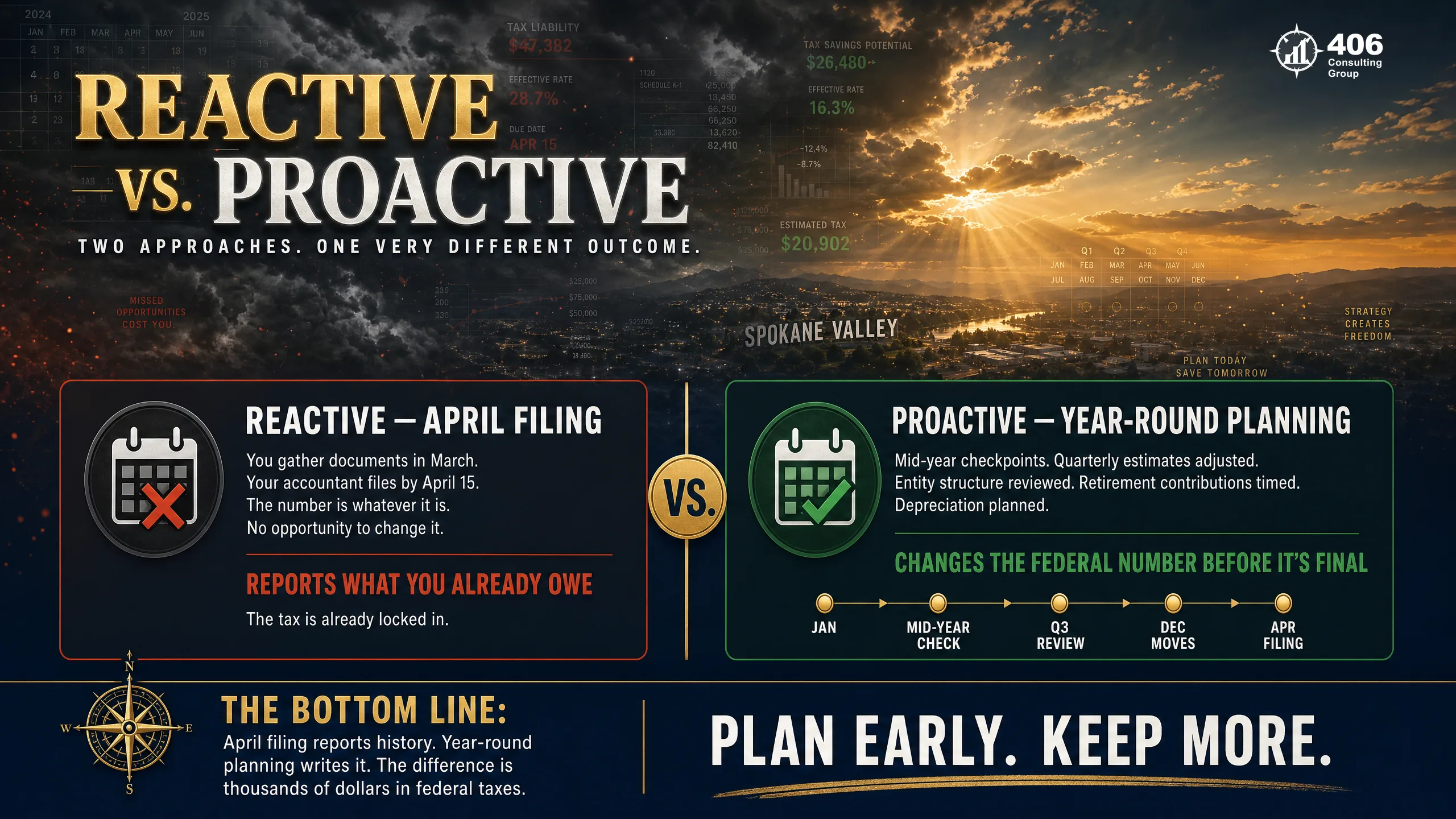
Proactive planning means someone looks at your numbers mid-year and tells you what to do before the window closes. The four federal levers below are where those decisions get made.
The Keep-More Tax Framework
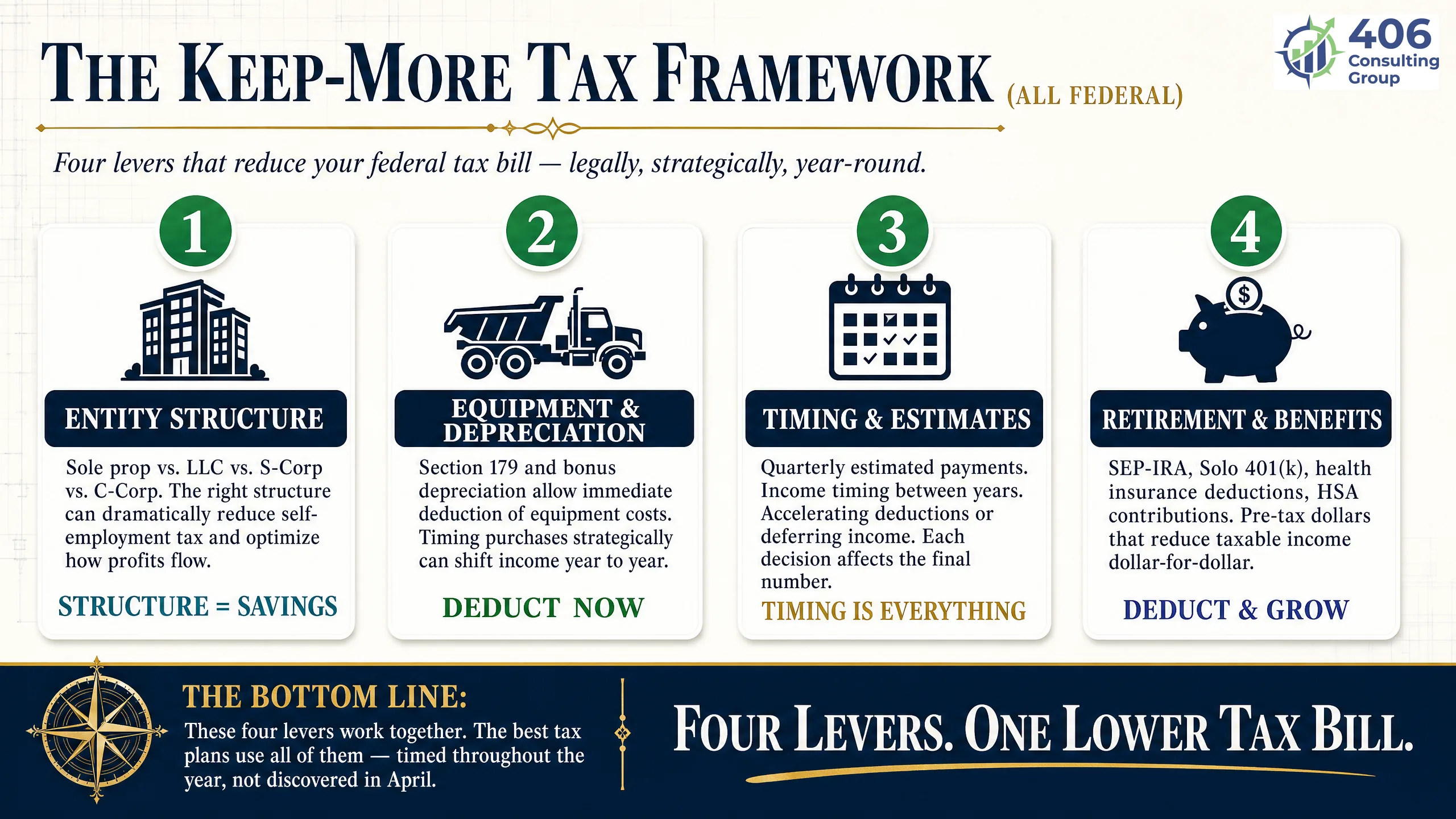
Nearly every legitimate tax-saving move for a small business falls into one of four buckets. We call them the Keep-More levers. The key insight for a Washington business: all four work at the federallevel, so they save you exactly as much here as they would in an income-tax state — the "no income tax" advantage is a bonus on top, not a reason to skip planning.
Entity Structure
How you're set up — sole prop, LLC, or S-corp — determines how much profit is exposed to federal self-employment tax.
Equipment & Depreciation
When and how you deduct vehicles, machinery, and gear. Timing a purchase can shift a big federal deduction between years.
Timing & Estimates
Federal estimated payments and controlling which year income and expenses land in — no state income estimates in WA to worry about.
Retirement & Benefits
Plans that turn money you'd owe the IRS into money that stays yours and grows — often the biggest lever for a profitable owner.
The rest of this guide takes each lever in turn, then covers the two state-specific costs — B&O and sales tax.
Lever 1 — Entity & the S-Corp Election
The short answer: once your business is consistently profitable, electing S-corp status can save you thousands a year by lowering the profit exposed to self-employment tax — and because that's a federal tax, the savings are just as real in no-income-tax Washington as anywhere else.
Here's the mechanic. As a sole proprietor or standard LLC, every dollar of profit gets hit with self-employment tax — 15.3% for Social Security and Medicare. Elect to be taxed as an S-corp and you split profit into a reasonable salary (which still owes the 15.3%) and distributions (which don't). Take a Spokane Valley business netting $150,000: pay a reasonable salary of $75,000 and take $75,000 as a distribution, and that distribution sidesteps the 15.3% — on the order of $11,000 saved a year, for filling out a form and running real payroll.

The catch most people miss
The S-corp only wins if the salary is genuinely "reasonable" — the IRS expects it to reflect what the work is worth, and lowballing it is what they audit. It also adds payroll and a separate return, and it doesn't change your Washington B&O tax (that's on gross receipts regardless of entity). So it pays off around consistent profit — often $50,000–$80,000+ over a fair salary — and getting the salary right is where a planner earns their fee.
Weighing it? Our S-Corp savings calculator gives you a quick estimate on your own numbers.
Lever 2 — Equipment & Depreciation
The short answer: when you buy equipment, the federal tax code often lets you deduct most or all of its cost right away instead of spreading it over years — and deciding which year to buy is a powerful, overlooked planning move.
Section 179 lets you deduct the full purchase price of qualifying equipment — vehicles, machinery, tools, furniture, even certain software — in the year you place it in service, up to a generous annual limit (well over $1 million). Bonus depreciation can cover much of the rest. For a Spokane Valley business buying a $60,000 piece of equipment or a work truck, that can mean deducting the whole cost this year rather than a slice at a time. The planning move is timing: placing a major purchase in service by December 31 in a high-income year pulls the federal deduction to where it's worth most.
Don't let the tax tail wag the dog
A deduction is not a discount — you still spent the cash. Never buy equipment you don't need just to lower a tax bill. The move is timing purchases you were already going to make. Note too that equipment you buy is generally subject to Washington sales or use tax, so factor that into the real cost. Exact federal limits and bonus percentages change year to year — confirm the current rules before you buy.
Lever 3 — Timing & Estimates
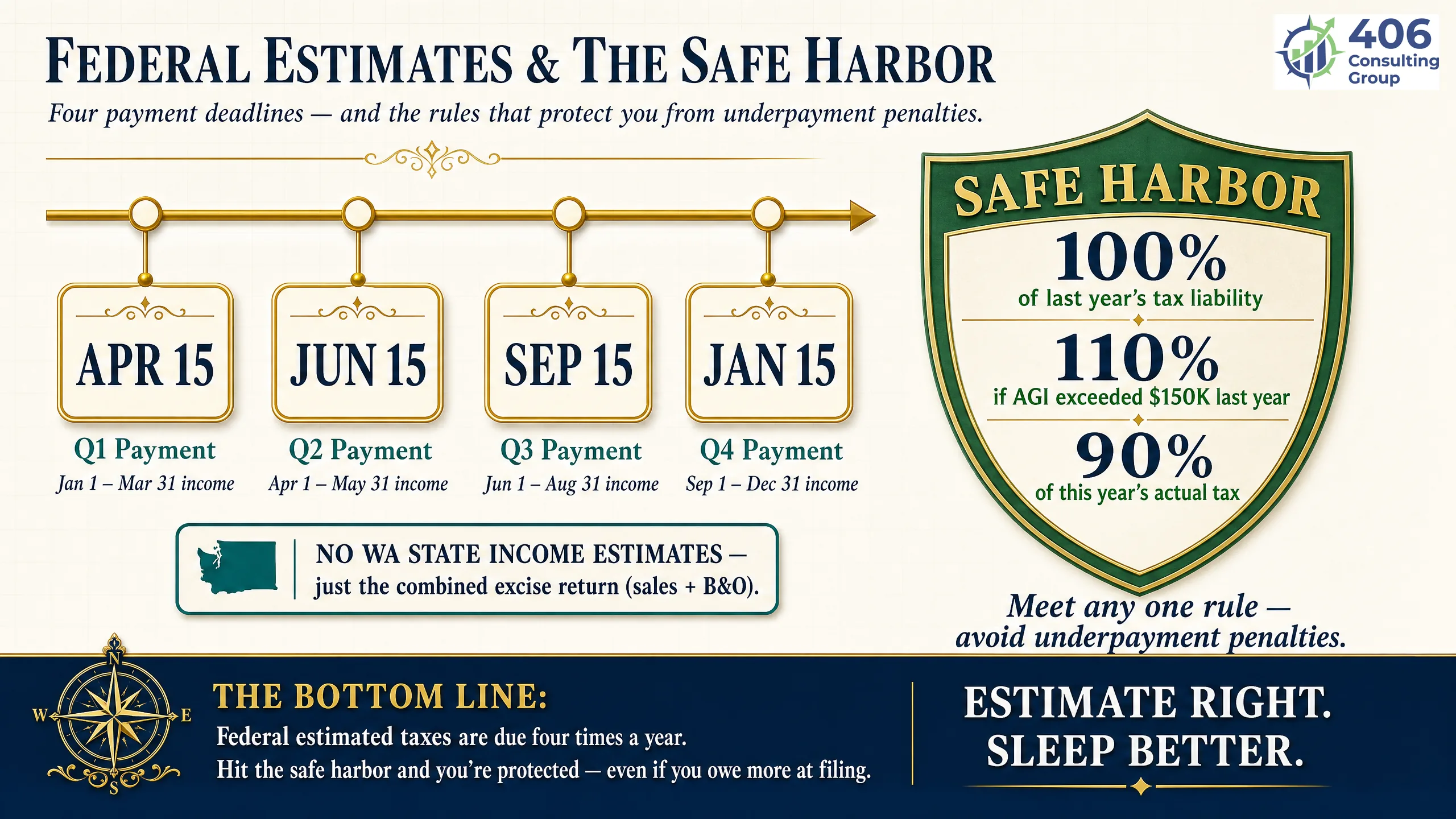
The short answer: if you're self-employed or own a pass-through business, you pay federal taxes as you go — four estimated payments a year — and controlling the timing of income and expenses lets you smooth your federal bill. One nice simplification in Washington: there are no state income-tax estimates to manage, because there's no state income tax.
Federal estimated payments are generally due April 15, June 15, September 15, and January 15. The safe-harbor rule protects you: pay in at least 100% of last year's tax (110% if higher-income) or 90% of this year's, and you avoid underpayment penalties. What you dostill file with the state on a schedule is your combined excise tax return (sales tax and B&O) — monthly, quarterly, or annually depending on your size — so the state filing rhythm is about remittance, not income estimates.
If a strong December is coming, you might accelerate a deductible expense into this year or defer income where appropriate — smoothing so no single year spikes your federal bracket. This is where tax planning meets cash-flow planning, which we dig into in Profitable But No Cash.
Lever 4 — Retirement & Benefits
The short answer: retirement plans are the rare move that lowers your federal taxes and builds your net worth at the same time — you deduct the contribution now and the money stays yours. For a profitable Spokane Valley owner, this is often the single biggest lever of the four.
A self-employed owner isn't limited to a $7,000 IRA. A SEP-IRA lets you contribute up to about 25% of compensation, and a Solo 401(k) lets you stack an employee deferral on top of a profit-sharing contribution — either can shelter tens of thousands of dollars a year, with combined limits well north of $60,000 for those who can fund it. Every dollar in is a dollar that isn't taxed federally this year. Run the math on a good year: contribute $40,000, and in a typical federal bracket you can knock roughly $10,000–$14,000 off the bill while that money goes into your future.
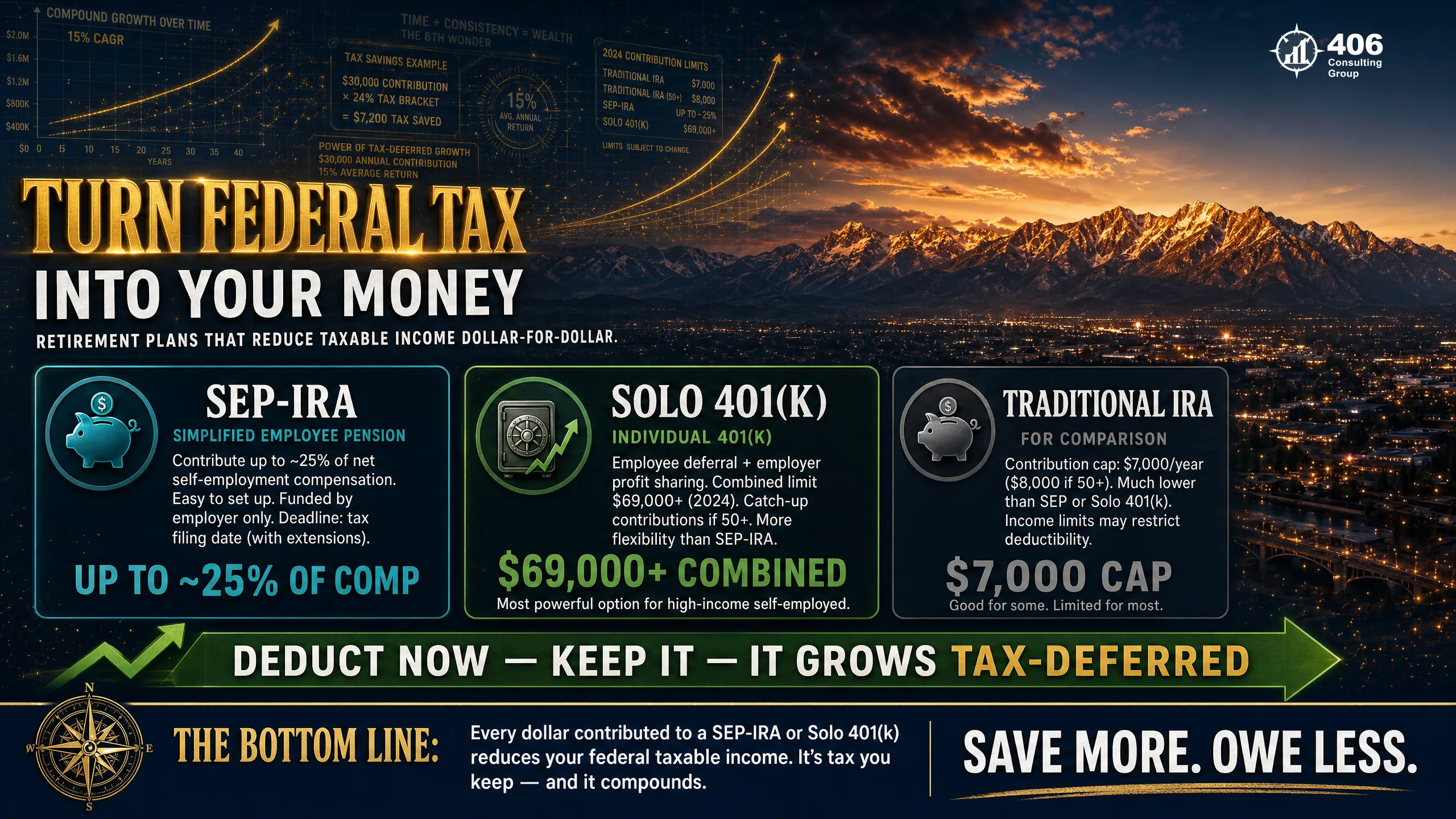
Which plan fits, and how much you can contribute, depends on your entity and payroll — which is why this lever and the S-corp decision get made together. Benefits round it out: health coverage, an HSA, and the right mix all carry federal tax advantages worth structuring on purpose.
Minimizing the B&O Tax
The short answer: the B&O tax is Washington's main state-level business tax — on gross receipts, not profit — and while you can't "plan it away" like a federal deduction, you can absolutely avoid overpaying it. Most B&O overpayment comes from sloppy classification and missed credits, not from the rate itself.
Three things keep your B&O bill honest. First, correct classification: Washington taxes retailing, wholesaling, and manufacturing at much lower rates than services, so a business with mixed activities must report each stream under the right classification instead of dumping everything into the higher-rate bucket. Second, the small-business B&O credit, which can reduce or eliminate the tax for smaller filers. Third, legitimate deductions and exemptions — certain interstate sales, specific industries, and other categories qualify. Your books have to be set up to capture revenue by classification for any of this to work.
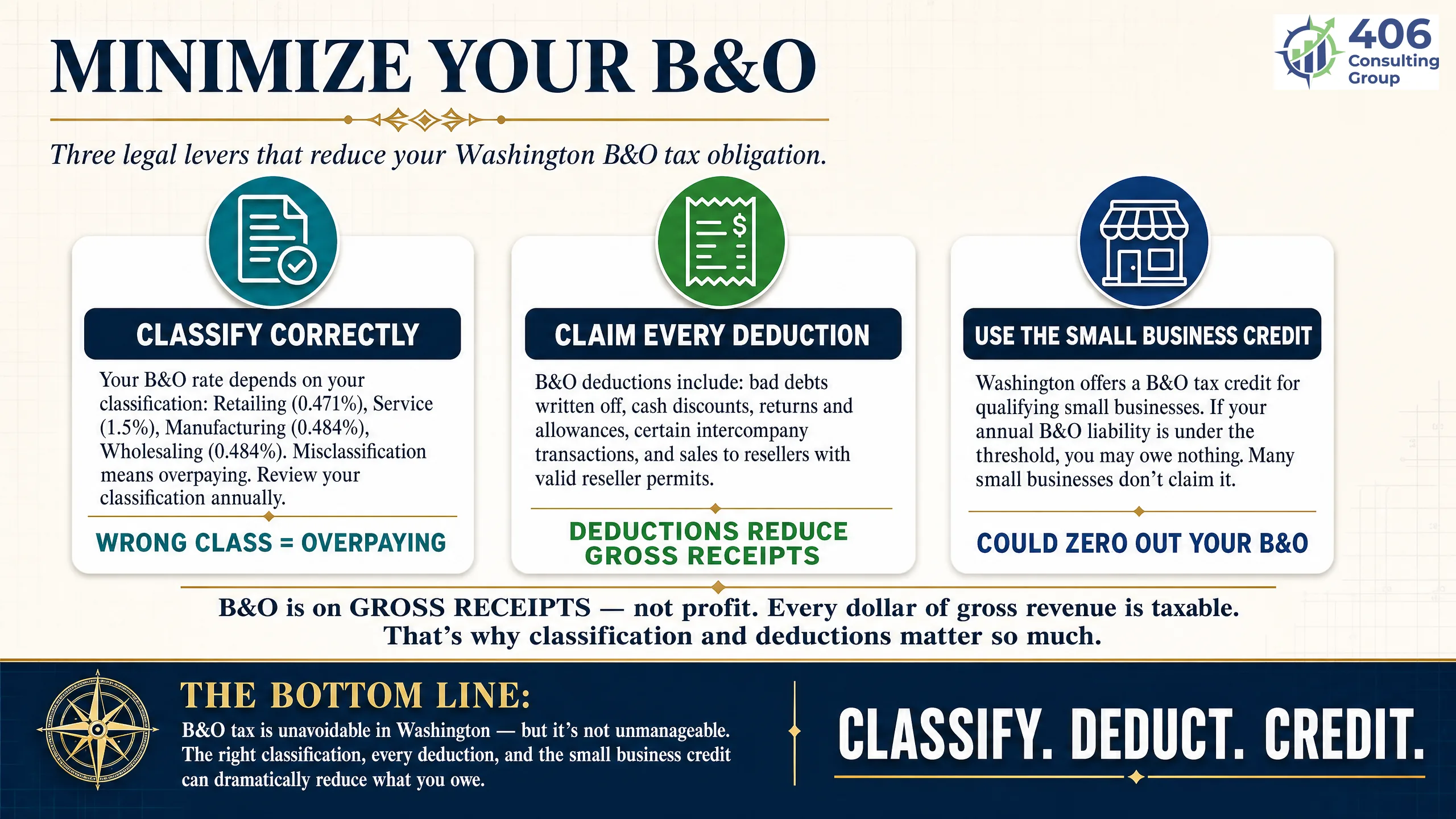
This is where a WA-savvy accountant pays for themselves — the difference between a correctly classified return and a lazy one is real money every filing period. We cover the bookkeeping foundation in the Spokane Valley bookkeeping guide.
Sales Tax: Compliance, Not a Surprise
The short answer: sales tax isn't a planning lever — it was never your money — but mishandling it is one of the fastest ways a Washington business gets into trouble. The goal here is clean compliance so it never becomes a surprise bill you can't cover.
Three things matter. You collect Washington sales tax (around 8.9% combined in Spokane Valley) on taxable sales and hold it as a liability — spending it as cash flow is the classic trap. Washington is destination-based, so for goods you deliver, the rate follows where the customer receives them. And if you sell across the Idaho line or online, economic nexus can create obligations in other states. Handled through clean books, sales tax is just a monthly remittance; ignored, it compounds into penalties fast.
We walk through sales-tax sourcing and nexus in detail in the bookkeeping guide; the point for tax planning is simply to keep it clean so it never eats into the savings the federal levers create.
Working With a Remote WA-Savvy Team
The short answer: what matters in a tax relationship is whether your accountant works your numbers all year and knows both federal planning and Washington's B&O and sales-tax rules — not whether they're in Spokane Valley. A proactive remote firm beats an okay local preparer who only files in April.
And honestly, remote is how this work already happens — even for clients down the road. Roughly 70–80% of our own local clients never come into the office; the planning conversations — should I elect the S-corp, do I buy the equipment this year, am I safe on my federal estimates, is my B&O classified right — all happen over a screen share with live numbers. Distance simply isn't the variable it used to be, so a Spokane Valley business gets the same proactive, WA-savvy planning our in-town clients do.
And because our background is in running whole businesses, we look at how a tax move affects operations, payroll, and cash — not just the line on the return. Your tax plan should fit the rest of the company, and that's the lens we bring.
How to Get Started
Getting off the once-a-year treadmill is three steps.
Get your books current & WA-ready
Planning runs on real numbers, with revenue tracked by B&O classification. If your books are behind, that's step one.
Run a mid-year projection
Before year-end, estimate where you'll land federally and identify which levers apply — entity, equipment, estimates, retirement.
Act before December 31
Make the federal moves while the window's open and keep the B&O and sales-tax side clean — then April is just paperwork.
Not sure which layer you need first — cleaner books or tax strategy? Our Financial Maturity Assessment maps it out in about eight minutes.
FAQ: Spokane Valley Business Tax Questions
If Washington has no income tax, is there anything to plan for?
Yes — arguably more, because your planning energy moves to where it actually saves money. Washington has no state income tax on ordinary business or personal income, which is a real advantage, but your federal income tax is still your largest bill, and the biggest tax-saving moves (S-corp election, equipment timing, retirement plans) are federal — they work exactly as well in Washington as anywhere. On top of that, the state B&O tax is easy to overpay and sales tax has to be handled cleanly. 'No income tax' means different planning, not no planning.
Does electing S-corp status still save money in Washington?
Yes. The S-corp's main benefit is reducing federal self-employment tax by splitting profit into a reasonable salary and distributions, and since that's a federal tax, the savings apply fully in Washington. A profitable Spokane Valley business can save on the order of thousands a year. Note that the S-corp election doesn't reduce your Washington B&O tax, which is on gross receipts regardless of entity — so the S-corp is a federal play, and B&O is minimized separately through correct classification and credits.
What is the B&O tax and how do I avoid overpaying it?
The business & occupation (B&O) tax is Washington's tax on gross receipts — total revenue, with no deduction for expenses. You can't plan it away like a federal deduction, but you can avoid overpaying it: report revenue under the correct classification (retailing, wholesaling, and manufacturing are taxed much lower than services), claim the small-business B&O credit if you qualify, and capture any legitimate deductions or exemptions. Most overpayment comes from lumping all revenue into the highest-rate bucket, which clean, classification-aware books prevent.
How much can I deduct for buying equipment or a vehicle?
Often the full cost in the year you place it in service, using federal Section 179 (up to a generous annual limit, well over $1 million) plus bonus depreciation for much of the rest — as long as it's genuinely used for the business. The bigger lever is timing: placing a major purchase in service before year-end in a high-income year pulls the federal deduction to where it's worth more. Remember the purchase is generally subject to Washington sales or use tax, and never buy something you don't need just for the deduction.
Do I make quarterly estimated tax payments in Washington?
You make federal estimated payments if you're self-employed or own a pass-through and expect to owe — generally April 15, June 15, September 15, and January 15, using the safe harbor (100% of last year, 110% if higher-income, or 90% of this year) to avoid penalties. There are no Washington state income-tax estimates, because there's no state income tax. What you do file with the state on a schedule is your combined excise tax return for sales tax and B&O — monthly, quarterly, or annually depending on your size.
Does 406 Consulting Group provide tax services in Spokane Valley, WA?
Yes. 406 Consulting Group provides proactive federal tax planning and preparation, B&O and sales-tax compliance, bookkeeping, payroll, and fractional controller and CFO services to businesses in Spokane Valley and across Washington. We plan year-round — entity strategy, equipment timing, estimates, and retirement on the federal side, plus correct B&O classification on the state side — and work remotely through secure cloud accounting. In fact, roughly 70–80% of our own local clients never come into the office. Because our background is in running whole businesses, we look at how each tax move affects operations and cash, not just the return.
Keep Reading
Tax Planning & Preparation — Spokane Valley, WA
No Income Tax Doesn't Mean No Planning.
406 Consulting Group plans the moves that actually save a Washington business money — federal entity strategy, equipment timing, and retirement, plus correct B&O classification and clean sales-tax compliance. Proactive, year-round, delivered remotely across Washington.
Spokane Valley Tax Quick Reference
Spokane Valley, WA — Spokane County
The Keep-More Tax Framework
All four levers are federal
Overpaying the IRS or B&O?
Federal planning + B&O done right.
About the Author
Carrie Anderson
Co-Founder, 406 Consulting Group
Commercial banking and underwriting background — 300+ loan reviews — plus advisory work with small businesses across the Northwest. Carrie helps Spokane Valley owners get proactive about federal entity strategy, equipment timing, and B&O classification, so a good year stays a good year after taxes.
Read the Full Story