
Bookkeeping Services in Spokane Valley, WA:
Sales Tax, B&O & Clean Books
A Spokane Valley business runs on three tax systems at once — sales tax you collect, the B&O gross-receipts tax, and no state income tax. Here's what your books have to capture to keep all of it clean, from a firm that knows Washington and works remotely.

If you run a business in Spokane Valley, your books have to do something a Montana business's never will: keep three separate tax systems straight at once. Washington charges a retail sales tax you collect and remit, a business & occupation (B&O) tax on your gross receipts, and — refreshingly — no state income tax at all. Miss the first two and you can owe money you already spent; misunderstand the third and you'll plan your whole year around the wrong assumptions. None of it is hard once your books are set up for it, but a generic bookkeeper who learned on a no-sales-tax state will get it wrong.
That's what this guide is about. Whether you run a shop off Sprague, a manufacturer or distributor in the Valley's industrial core, a contractor, or a service or healthcare practice, the Washington tax environment shapes what your bookkeeping has to capture — and getting it right is the difference between clean, calm compliance and a scramble when a return comes due.
Below: how sales tax, the B&O tax, and Washington payroll actually work for a Spokane Valley business, what a growing company needs from its books, and how a remote firm delivers all of it. If you're weighing whether you've outgrown DIY books, start here.
By Jason Anderson — Co-Founder, 406 Consulting Group. Background in large-scale operational finance at BP before building financial infrastructure for small businesses across the Northwest, where multi-state sales tax, gross-receipts taxes, and payroll compliance are everyday work.
Quick Answer: Bookkeeping for a Spokane Valley Business
- →Three tax systems: Washington sales tax (you collect & remit), the B&O gross-receipts tax, and no state income tax.
- →Sales tax in Spokane Valley runs around 8.9% combined — destination-based, so where you deliver matters.
- →B&O tax is on gross receipts, not profit — with different rates by activity and a possible small-business credit.
- →Payroll adds Washington specifics — L&I workers' comp, Paid Family & Medical Leave, and WA Cares.
- →Delivered remotely — even most of our local clients never come to the office, so location is no barrier.
Table of Contents
Why Washington Bookkeeping Is Different
The short answer: Washington funds itself very differently from an income-tax state, and that changes what your books have to track. Instead of taxing profit, the state taxes activity — sales tax on what you sell and B&O tax on what you take in — so your bookkeeping has to capture gross receipts and taxable sales precisely, not just tally profit at year-end.
The upside is real: no state income tax means your business profit isn't taxed at the state level, and there's no state return on your personal income either. But the trade-off is that the taxes you do owe are tied to revenue whether or not you made money that period. A business can have a break-even month and still owe B&O tax and still have to remit the sales tax it collected. That's why "we'll figure out the taxes at year-end" doesn't work in Washington — the obligations are monthly or quarterly, and they run on numbers your books have to produce on time.
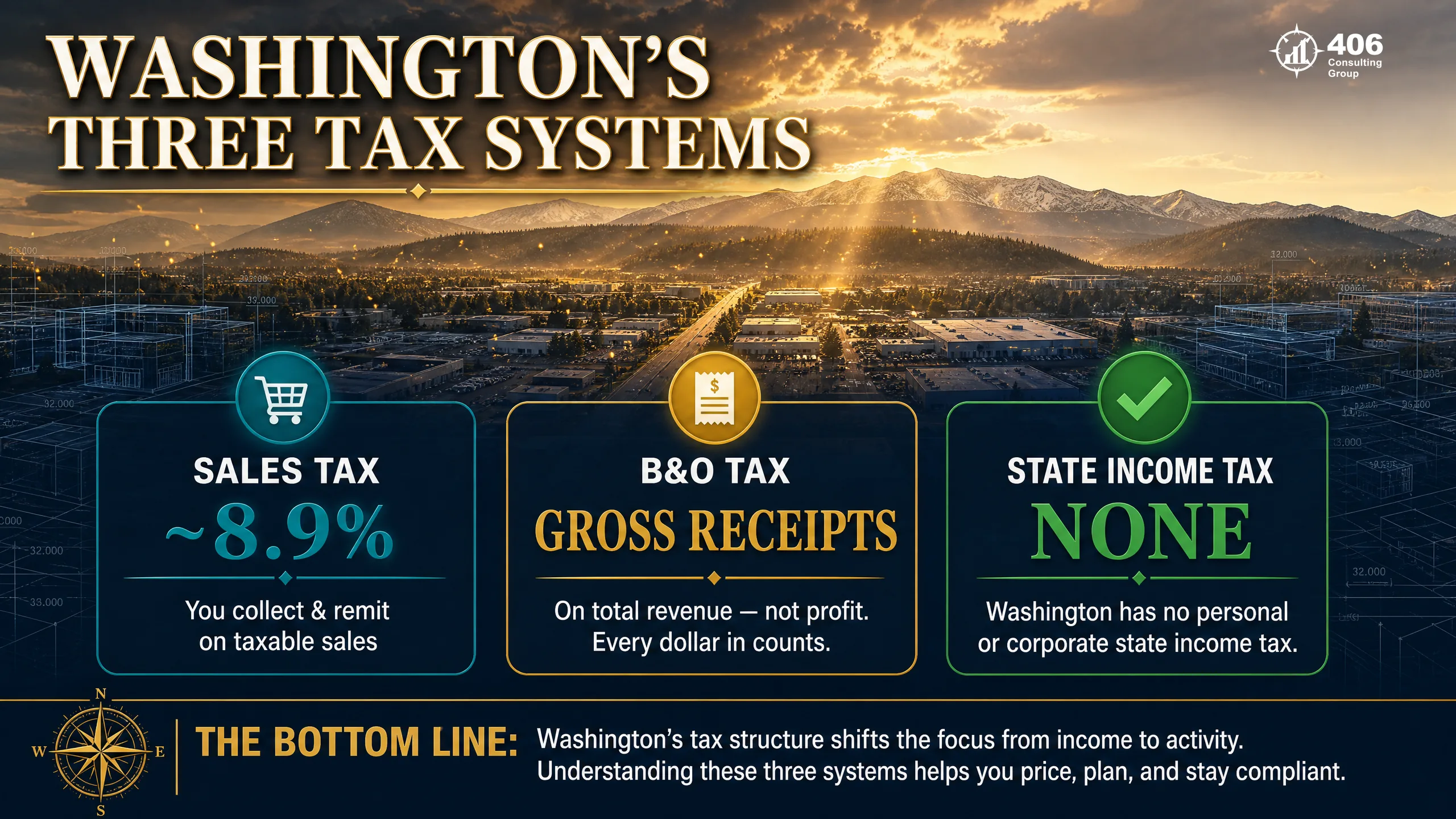
The rest of this guide walks through each piece. Get your books set up around them and Washington compliance becomes routine instead of stressful.
Sales Tax, Done Right
The short answer: if you sell taxable goods or services, you collect Washington sales tax from your customer and remit it to the state — it was never your money, so spending it is borrowing against a bill you'll definitely get. In Spokane Valley the combined rate runs around 8.9% (state plus local), though you should confirm the current rate for your exact location.
The wrinkle most owners miss is that Washington is destination-based: for goods you deliver or ship, the rate is generally set by where the customer receives them, not where your business sits. Sell across the county or the state and you may be collecting several different local rates. Add e-commerce or out-of-state sales and economic nexus rules come into play. Your books need to record tax collected accurately and by jurisdiction, so your excise tax return is a report you run — not a puzzle you reconstruct.
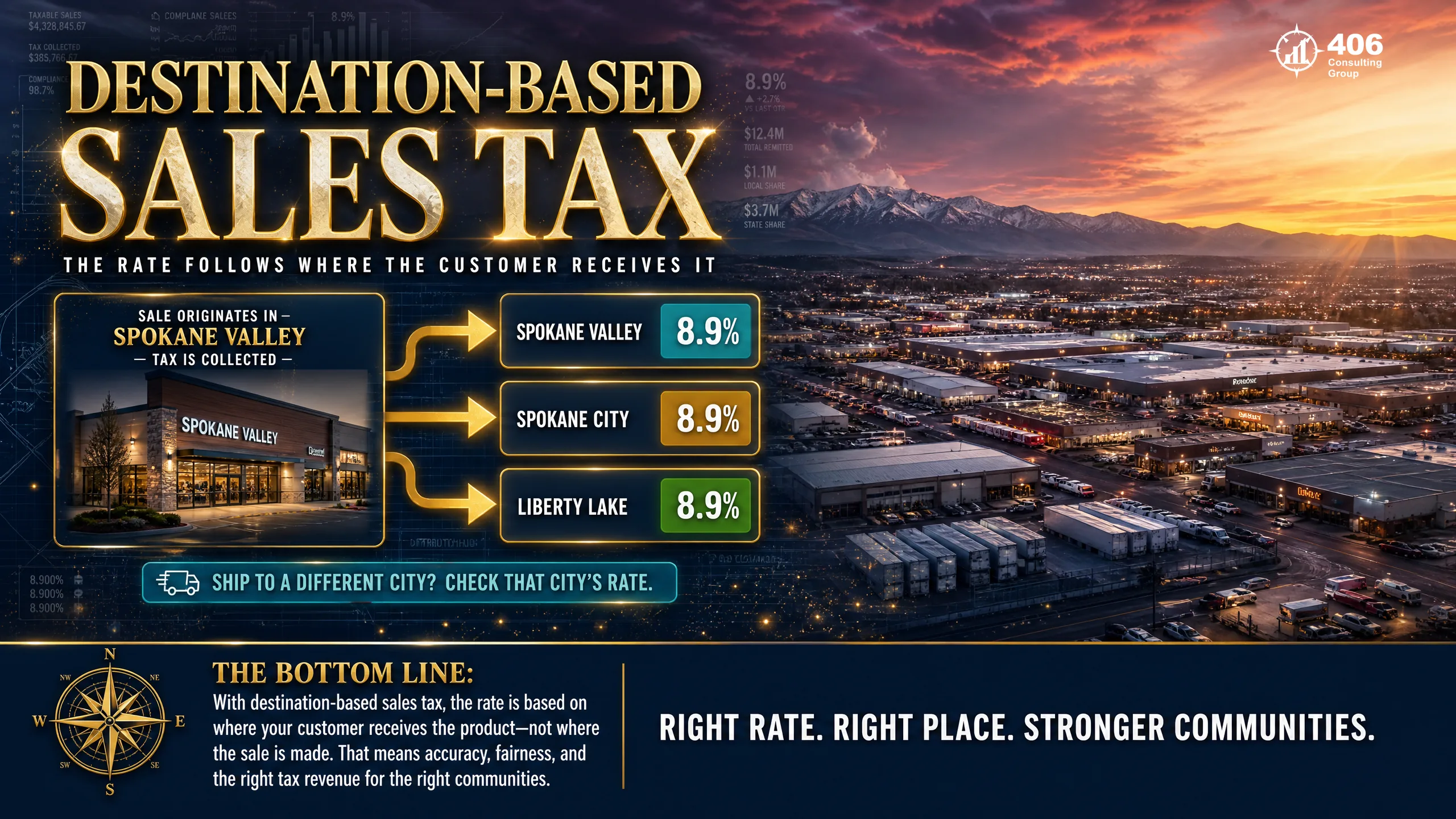
The trap: spending sales tax you collected
Sales tax sitting in your account isn't revenue — it belongs to the state. Treating it like cash flow is one of the most common ways Washington small businesses dig a hole. Clean books keep collected sales tax visible as a liability, so you always know what's yours and what's the state's. Confirm current rates and rules with the Washington Department of Revenue.
Selling Across the Idaho Line: Nexus
The short answer: Spokane Valley sits about twenty minutes from the Idaho border, so a lot of Valley businesses sell to, deliver to, or buy from customers in another state — and that raises "nexus," the question of which state's taxes you're responsible for. Get it right and it's a non-issue; ignore it and you can rack up obligations in a state you never filed in.
Two kinds of nexus matter. Physical nexus comes from having a location, employees, inventory, or regular activity in a state. Economic nexus — the post-Wayfair rule — kicks in when your sales into a state cross a threshold, even with no physical presence. So a Spokane Valley business that delivers into Idaho, or sells online to customers there, can develop an Idaho sales-tax obligation (Idaho does have a sales tax); and an out-of-state seller shipping into Washington can owe Washington tax. Marketplace facilitator laws add another layer for anyone selling through platforms like Amazon or Etsy, which often collect on your behalf.
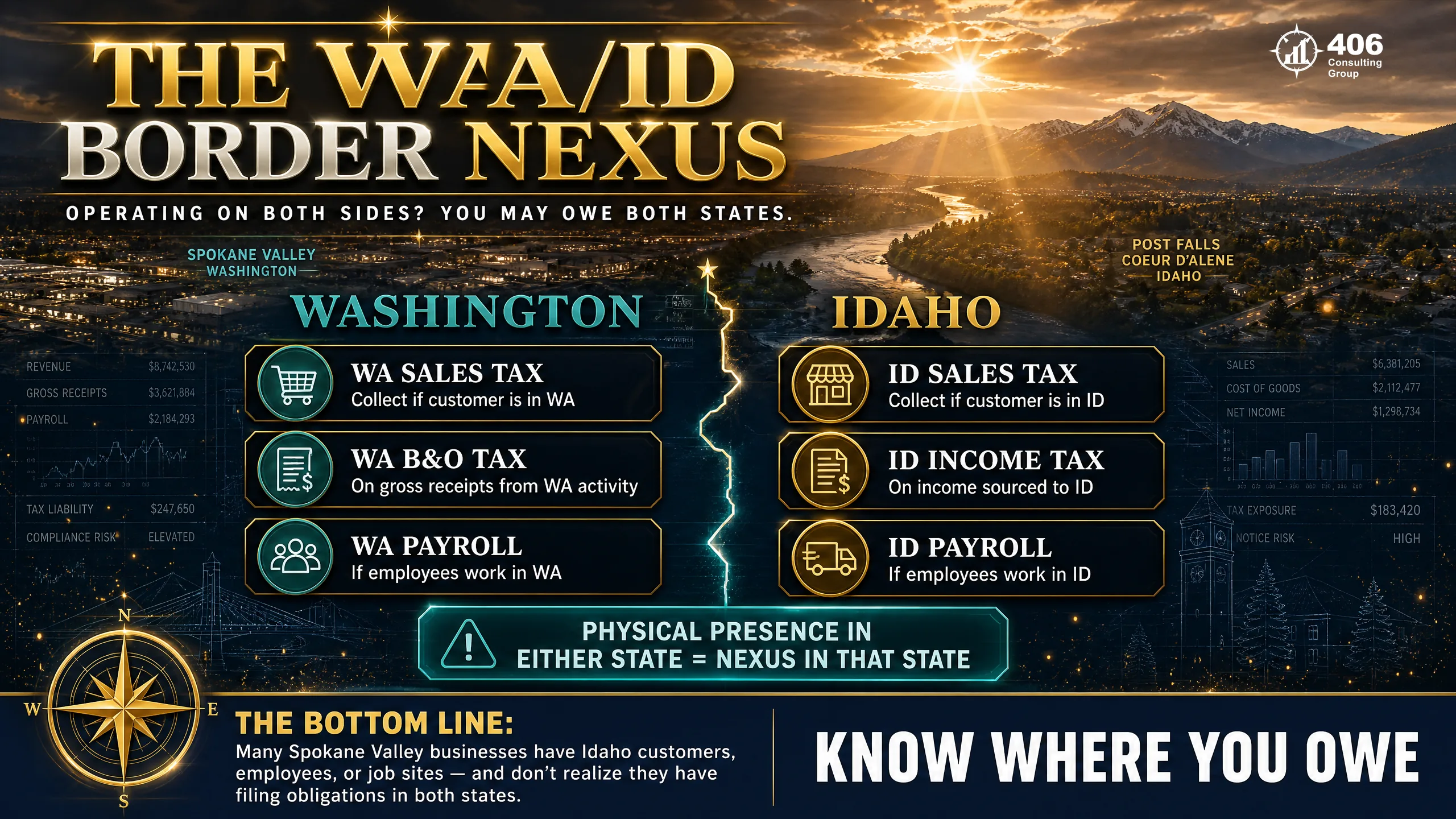
You don't need to panic about this — you need books that track sales by state and jurisdiction so you can see when a threshold is approaching and register before it becomes a problem. That visibility is exactly what a bookkeeper who works across state lines builds in from the start.
The B&O Tax and How to Track It
The short answer: Washington's business & occupation (B&O) tax is a tax on your grossreceipts — the total you take in, with no deduction for your costs. It catches a lot of newcomers, because you can owe B&O tax in a period where you barely broke even. It's not large as a percentage, but it's real, it's ongoing, and it has to be tracked.
The rate depends on your activity — Washington assigns different B&O classifications, with retailing and wholesaling/manufacturing taxed at a much lower rate than services. A business that does more than one kind of activity (say, a manufacturer that also does retail sales) reports gross receipts under more than one classification, at different rates. Your books need to categorize revenue by B&O classification so the return is accurate and you're not overpaying by lumping everything into the highest-rate bucket.
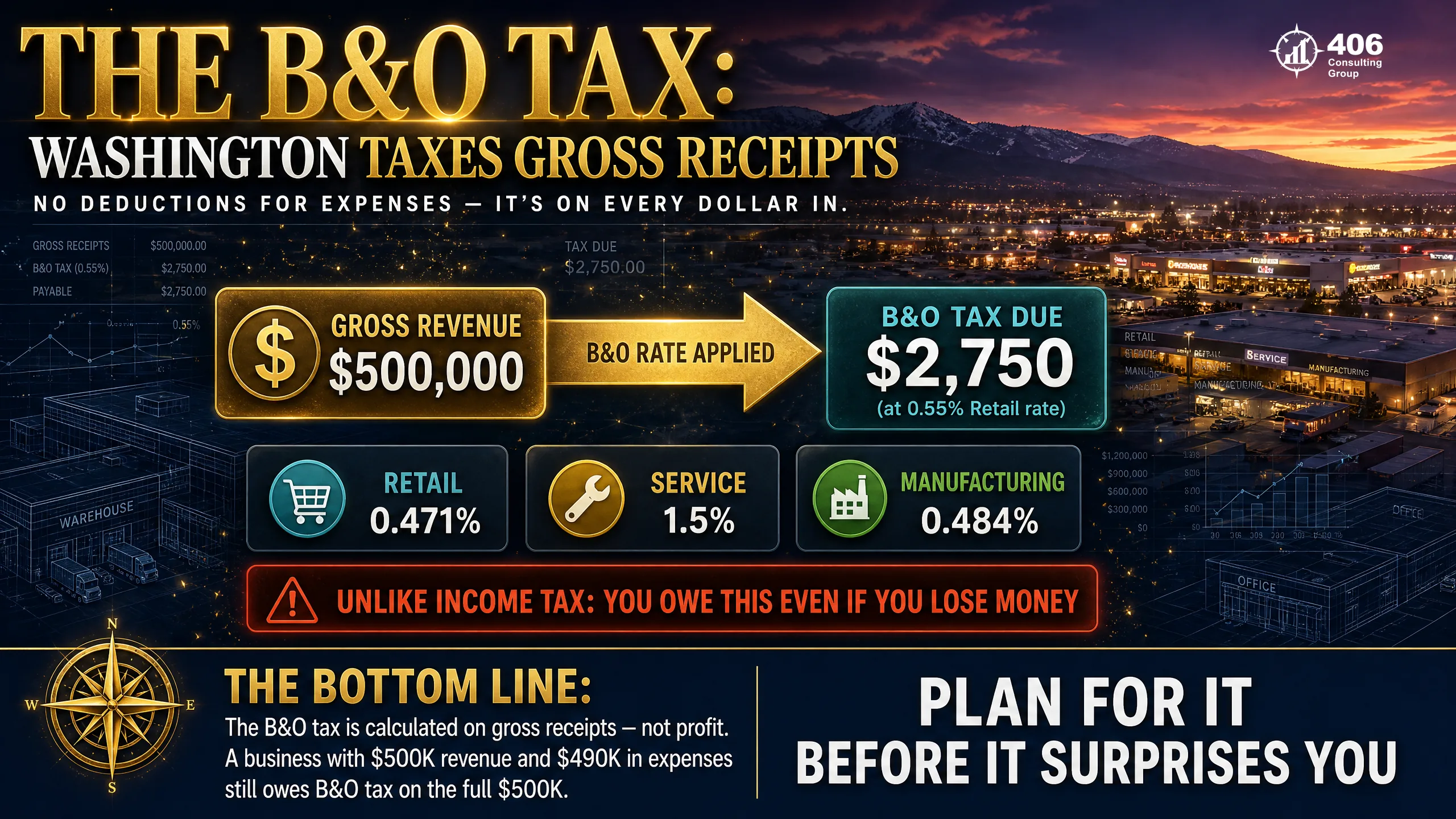
Good news for smaller businesses
Washington offers a small-business B&O tax credit that can reduce — or entirely eliminate — the B&O owed for businesses under certain income levels, and very small filers may file less frequently. Whether it applies depends on your gross receipts and classification, so it's worth confirming with the Washington Department of Revenue or your accountant rather than assuming you owe the full amount.
Washington Payroll: L&I, PFML & More
The short answer: once you have employees, Washington adds its own payroll layers on top of the federal ones — workers' comp through the state, Paid Family & Medical Leave, and the WA Cares long-term-care premium. Each has its own rates, filings, and employee-vs-employer splits, and getting them right from the first paycheck saves real headaches later.
| Item | What it is | Bookkeeping note |
|---|---|---|
| L&I workers' comp | State-run workers' compensation, generally by hours worked | Tracked by risk class; part is employee-withheld |
| Paid Family & Medical Leave | State PFML premium, shared employer/employee | Quarterly reporting on wages and hours |
| WA Cares Fund | Long-term-care premium withheld from wages | Employee-paid; reported with PFML |
| Unemployment (SUI) | State unemployment insurance, employer-paid | Experience-rated; quarterly filing |
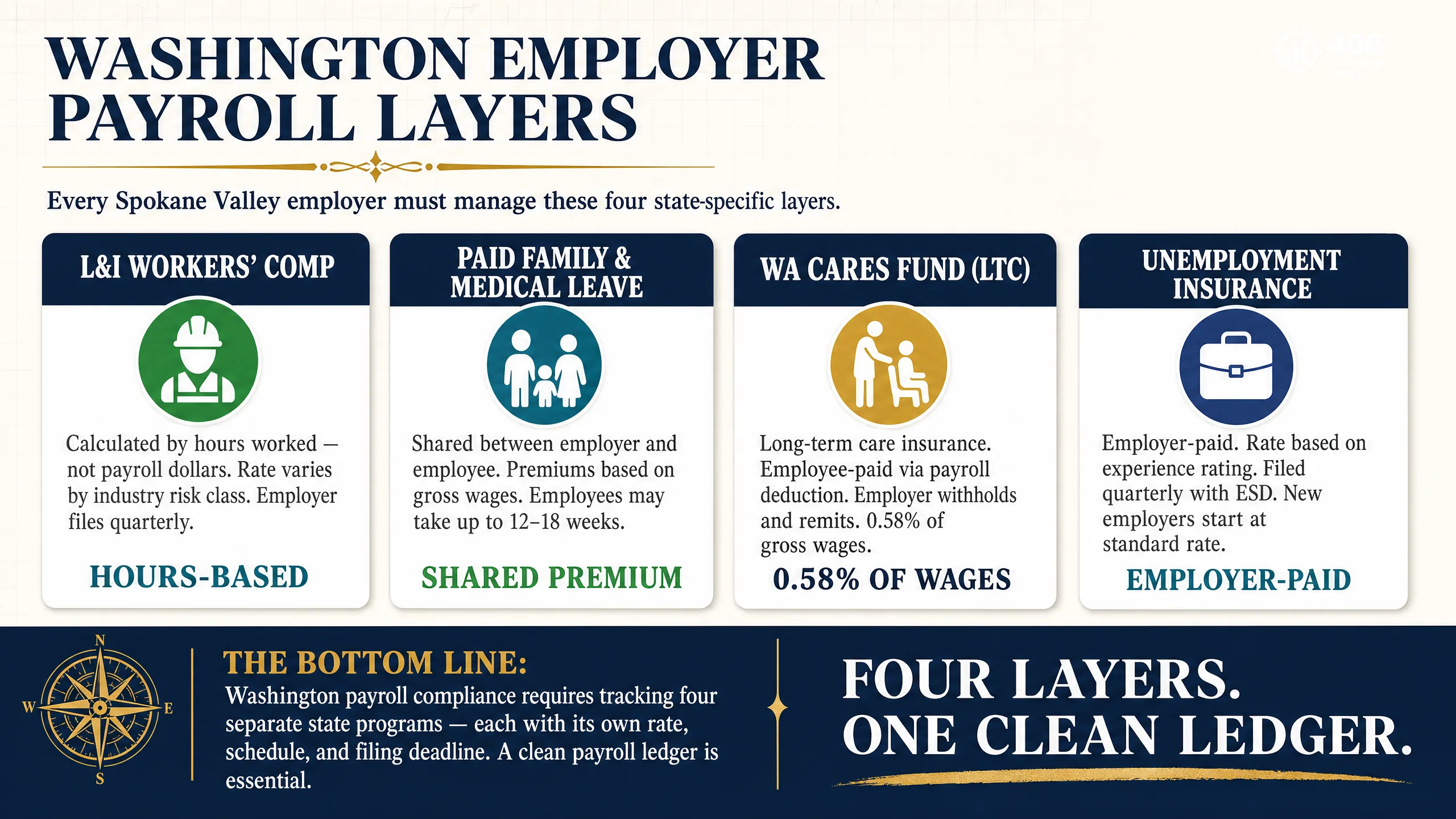
None of this is exotic, but it's easy to set up wrong, and fixing payroll retroactively is painful. Verify current rates with Washington L&I and the state's paid-leave program. Handled properly, it's a clean routine — which is what our payroll work gives a Spokane Valley business.
A Chart of Accounts Built for Washington
The short answer: your chart of accounts is the skeleton of your books, and for a Washington business it has to be built with the state's tax structure in mind from day one — otherwise every excise return becomes a reconstruction project instead of a report you run.
A WA-ready chart of accounts keeps a few things separate and visible: sales tax collected as a liability (never mixed into revenue), revenue split by B&O classification (so retailing, wholesaling, manufacturing, and service income are each in their own bucket at the right rate), and payroll liabilitiesbroken out for L&I, PFML, WA Cares, and withholding. Set up that way, filing your combined excise tax return is a matter of pulling the numbers your books already track — not digging through transactions in April trying to figure out what was taxable and under which classification.
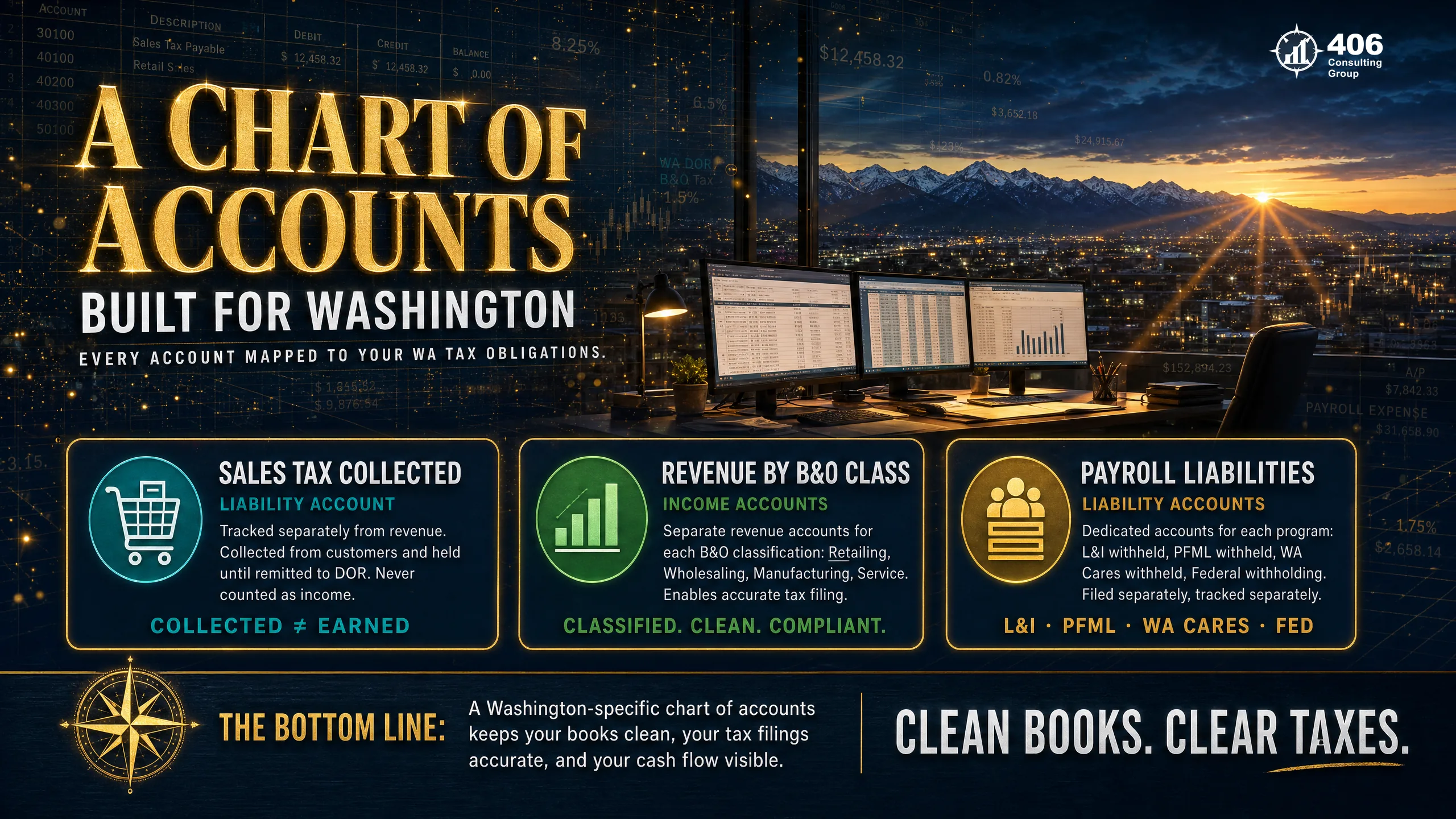
This is exactly the kind of setup work that pays off every single month afterward — and it's the first thing we fix when we take on a Washington business whose books grew up without it.
What a Growing Business Needs From Its Books
The short answer: beyond compliance, a growing Spokane Valley business needs books that inform decisions — accurate monthly financials, a read on which products or services actually make money, and a cash-flow picture that accounts for the sales tax and B&O obligations coming due.
Clean, reconciled books each month are the baseline. From there, the value climbs: margin visibility so you know what to sell more of, payroll handled correctly as you hire, and a cash-flow forecast so growth doesn't outrun the bank account — especially with sales tax and B&O siphoning off cash that can feel like yours but isn't. Good books turn Washington's tax complexity from a source of anxiety into just another well-run process, and they give you the numbers to make hiring, pricing, and expansion decisions on facts instead of gut.
If your books have fallen behind the pace of the business, that's the signal it's time for help. When reliable numbers become the basis for real decisions, many businesses step up from bookkeeping to controller-level support — a path we cover in our guide to upgrading from bookkeeping to a controller.
Bookkeeping by Spokane Valley Industry
Spokane Valley's economy is a mix, and each corner asks something a little different of the books — especially in how B&O classification and sales tax apply.
| Industry | What the books need to track |
|---|---|
| Retail & restaurants | Sales tax by location, retailing B&O, daily sales reconciliation, inventory |
| Manufacturing & distribution | Manufacturing/wholesaling B&O, COGS and inventory, multi-classification revenue |
| Construction & trades | Sales tax on materials and labor, job costing, B&O, prevailing-wage jobs |
| Services & healthcare | Higher service-rate B&O, payroll-heavy costs, receivables and billing |
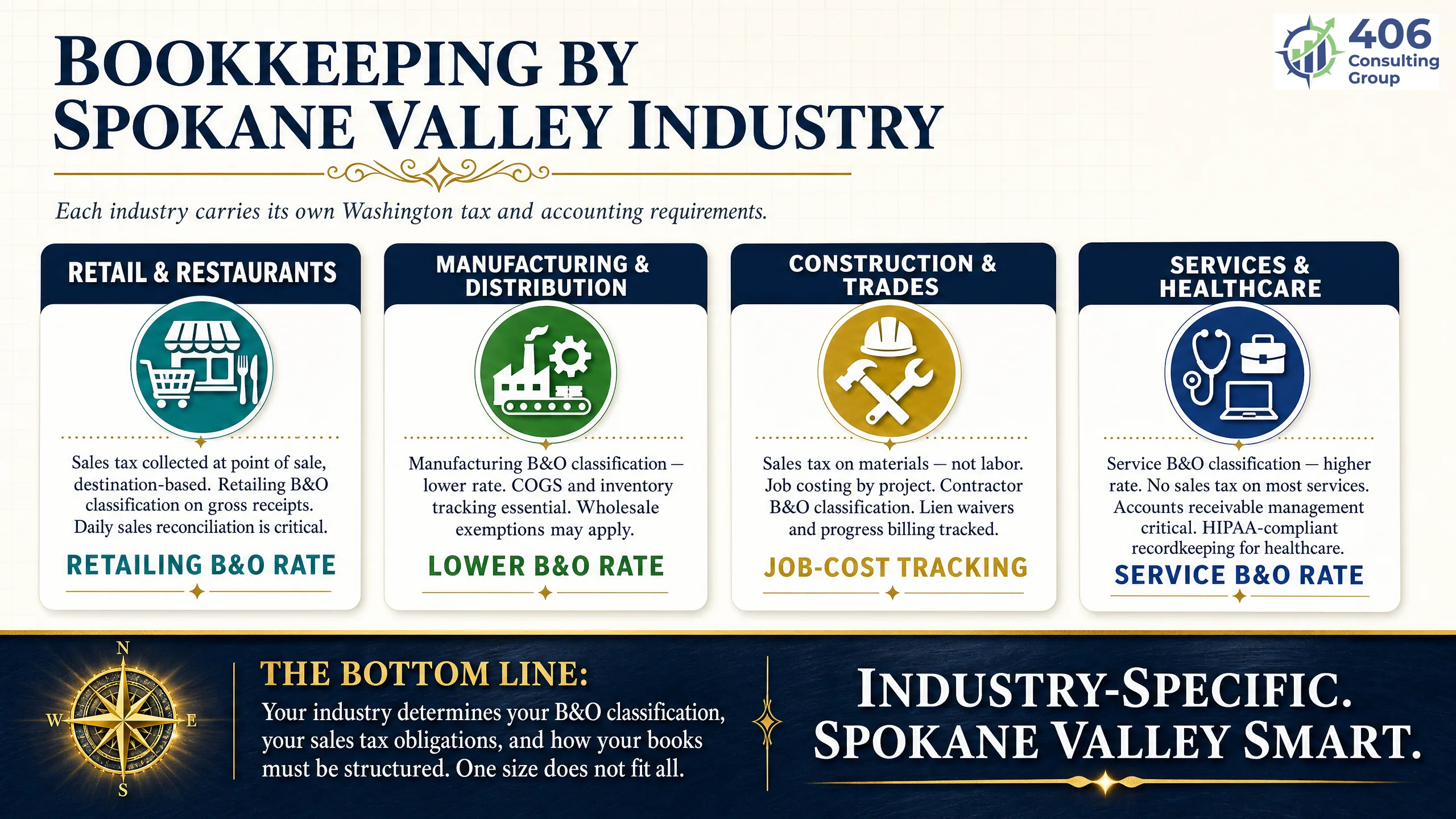
Different details, same backbone: capture revenue by the right B&O classification, track sales tax by jurisdiction, and keep the cash picture honest. Because our background is in running whole businesses, we set books up around how they affect the entire operation — pricing, purchasing, and cash — not just tax-time tidiness.
Common Washington Bookkeeping Mistakes
Most Washington bookkeeping trouble comes from the same handful of avoidable mistakes. Here's what we see most often — and what clean books prevent.
Treating collected sales tax as revenue
It's the state's money sitting in your account. Spend it as cash flow and you're short when the return comes due.
Assuming no profit means no tax
B&O is on gross receipts, so you can owe it in a break-even month. It has to be tracked regardless of profit.
Lumping all revenue into one B&O bucket
Reporting everything at the service rate when some is retailing or manufacturing means overpaying B&O tax.
Ignoring destination-based rates
Charging your home rate on goods delivered elsewhere in the state creates under- or over-collection you'll have to fix.
Missing out-of-state nexus
Selling across the Idaho line or online without watching thresholds can create obligations you didn't file for.
Setting up WA payroll wrong
L&I, PFML, and WA Cares each have rules; fixing them retroactively is far more painful than getting them right up front.
Every one of these is a bookkeeping-setup problem, not a character flaw — and every one disappears once the books are built for Washington and maintained on a monthly rhythm.
Local vs. a Great Remote Partner
The short answer: what matters in a bookkeeper is whether they know Washington's tax environment — sales tax sourcing, B&O classifications, state payroll — not whether their office is in Spokane Valley. A great remote partner who understands WA compliance beats an okay local generalist, and the work is a natural fit for remote delivery.
And honestly, remote is how modern bookkeeping already works — even for the clients right down the road. Roughly 70–80% of our own local clients never set foot in our office; the whole relationship runs on secure cloud accounting, connected bank feeds, shared screens, and a steady monthly rhythm. Distance simply isn't the variable it used to be. So whether you're in Spokane Valley, greater Spokane County, or anywhere in Washington, you get the same responsive, WA-savvy service our in-town clients do.
If you also do business across the state line or serve customers in multiple states, that multi-jurisdiction experience matters more than a local address — and it's exactly the kind of thing a specialized remote firm brings.
How to Get Started
Getting your Washington books in order is three steps.
Clean up and set the baseline
Reconcile the accounts and build a chart of accounts that separates sales tax collected, B&O by classification, and payroll liabilities.
Get the tax rhythm right
Set up sales tax and B&O tracking so your excise returns are reports you run, and payroll compliant from the first check.
Run it monthly
Monthly reconciliation and clean financials keep compliance routine and give you numbers you can actually run the business on.
Not sure whether you need bookkeeping, tax help, or something more? Our Financial Maturity Assessment maps it out in about eight minutes.
FAQ: Spokane Valley Bookkeeping Questions
What taxes does a Spokane Valley business have to deal with?
Three main ones. First, Washington retail sales tax — you collect it from customers (around 8.9% combined in Spokane Valley) and remit it to the state. Second, the business & occupation (B&O) tax, a tax on your gross receipts with rates that vary by activity. Third, federal income tax — but notably, Washington has no state income tax on business or personal income, so there's no state income return on your profit. Payroll adds Washington-specific items like L&I workers' comp, Paid Family & Medical Leave, and WA Cares.
What is the B&O tax and do I owe it even if I didn't make a profit?
The business & occupation (B&O) tax is a Washington tax on your gross receipts — the total revenue you take in, with no deduction for expenses. So yes, you can owe B&O tax in a period where you barely broke even or lost money, because it's based on revenue, not profit. Rates vary by classification (retailing and manufacturing are taxed lower than services). A small-business B&O credit may reduce or eliminate it for smaller businesses, so confirm your situation with the Washington Department of Revenue or your accountant.
How does Washington sales tax work if I deliver to customers?
Washington sales tax is destination-based, meaning for goods you deliver or ship, the rate is generally determined by where the customer receives them, not where your business is located. So if you deliver across Spokane County or the state, you may be collecting several different combined rates. Your books need to record sales tax collected accurately and by jurisdiction so your excise tax return is straightforward. Selling online or out of state brings economic nexus rules into play as well.
Does Washington really have no income tax?
Correct — Washington has no state income tax on business profit or on personal income, which is a genuine advantage and one reason the state relies on sales tax and the B&O tax instead. Your business still owes federal income tax, and you still file a federal return. But there's no Washington state income return on your earnings, so state-level planning centers on sales tax, B&O, and payroll rather than income-tax strategy.
What Washington payroll taxes do I need to handle as an employer?
On top of federal payroll taxes, Washington employers deal with L&I workers' compensation (state-run, generally based on hours worked and risk class), Paid Family & Medical Leave (a shared employer/employee premium), the WA Cares Fund long-term-care premium (employee-paid), and state unemployment insurance (employer-paid, experience-rated). Each has its own rates and quarterly filings. Getting the setup right from the first paycheck avoids painful retroactive corrections.
Can 406 Consulting Group do my Spokane Valley bookkeeping remotely?
Yes. We work with Spokane Valley and Washington businesses through secure cloud accounting — connected bank feeds, shared screens, and a steady monthly rhythm. What matters for a Washington business is expertise in sales tax sourcing, B&O classification, and state payroll, not office proximity. In fact, roughly 70–80% of our own local clients never come into the office either, so the relationship is effectively remote for them too. A WA-savvy remote partner serves you better than a local generalist, and multi-state experience is a real plus if you sell across the region.
Keep Reading
Bookkeeping — Spokane Valley, WA
Washington Books, Done Right.
406 Consulting Group keeps Spokane Valley businesses clean and compliant — sales tax, B&O, and Washington payroll handled, with financials you can actually run the business on. Delivered remotely, by a firm that knows Washington.
Spokane Valley Bookkeeping Quick Reference
Spokane Valley, WA — Spokane County
Behind on Washington Compliance?
Sales tax, B&O & payroll, handled.
About the Author
Jason Anderson
Co-Founder, 406 Consulting Group
Background in large-scale operational finance at BP before building financial infrastructure for small businesses across the Northwest. Jason helps Spokane Valley owners keep Washington's sales tax, B&O, and payroll straight — with books they can actually run the business on.
Read the Full Story