
Bookkeeping Services in Wenatchee, WA:
A Small Business Guide
Washington has no state income tax — but the B&O gross-receipts tax catches more Wenatchee businesses off guard than anything else in their books. Here's how professional bookkeeping built for Washington's rules keeps small businesses compliant, accurate, and ready.
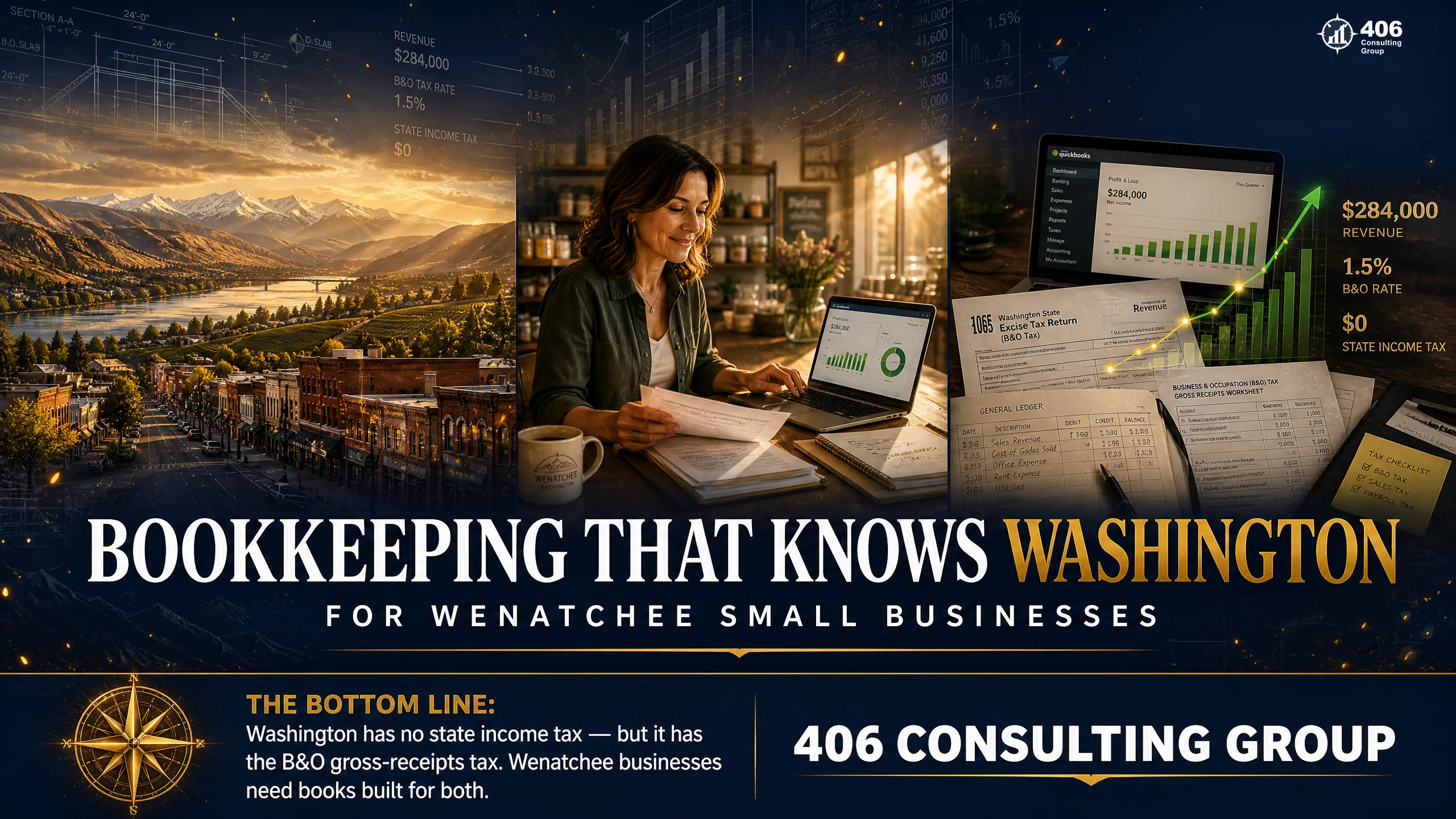
Most Wenatchee small business owners think bookkeeping is bookkeeping — that a set of books is a set of books whether you're in Washington, Montana, or anywhere else. It isn't. Washington has no state income tax, which sounds simple until you meet the tax that replaces it: the B&O tax, a levy on your gross revenue that catches more Wenatchee businesses off guard than any other single thing in their books.
Bookkeeping services in Wenatchee, WA have to be built around Washington's rules — the B&O tax, sales and use tax, and the seasonal cash flow that comes with an economy built on tree fruit, tourism, and everything that supports them. A bookkeeper who sets your books up the way they would in a state with an income tax will leave you exposed: overpaying B&O on income that could be classified correctly, misfiling sales tax, or discovering at year-end that the numbers don't support a single good decision.
This guide covers what professional bookkeeping actually delivers for a Wenatchee business, the Washington-specific rules that trip up most bookkeepers, how to structure your books so the B&O tax works for you instead of against you, and how to know when it's time to hand the books to someone who does this for a living. We'll use one running example — a Wenatchee shop that both sells products and does service work — because it shows exactly where Washington's rules bite.
By the team at 406 Consulting Group — bookkeeping, controller, and tax services for small businesses across the Northwest, including Wenatchee and the Columbia Valley. Carrie Anderson's banking and tax background and Jason Anderson's operational finance experience inform how we build books that hold up.
Quick Answer: Bookkeeping in Washington Is Different
- →No state income tax in Washington — but a B&O tax on your gross revenue takes its place.
- →B&O is a gross-receipts tax: you're taxed on total income, with no deduction for your costs.
- →One business can owe multiple B&O rates — retail income and service income are taxed at different rates on the same return.
- →Sales tax you collect isn't your money — it's a liability you hold and remit to the state.
- →Seasonality is real: a Wenatchee business needs books that plan for the slow months, not just record the busy ones.
Table of Contents
What Professional Bookkeeping Actually Delivers
The short answer: professional bookkeeping delivers accurate, current financial records that keep you compliant with Washington's tax rules and give you numbers you can actually run the business on. It's not data entry — it's the financial foundation everything else stands on.
For a Wenatchee small business, good bookkeeping does four jobs at once. It keeps you compliant — B&O and sales tax filed correctly and on time. It keeps you accurate — books that reconcile to the bank, so the numbers are real. It keeps you informed — reports that tell you what's working and what isn't. And it keeps you ready — for tax season, for a loan, for a decision — instead of scrambling.
Compliance you can trust
B&O returns filed on the right schedule, sales tax remitted correctly, and 1099s issued on time — the things that quietly generate penalties when they slip.
Books that reconcile
Every account tied out to the bank and reconciled monthly, so when you look at a number, you can believe it.
Reports you can use
A profit-and-loss and balance sheet you can actually read — not a tangle only an accountant understands.
Year-round readiness
Clean books mean tax time is a handoff, a loan application is a download, and a big decision is backed by real numbers.
The Washington Difference: No Income Tax, But the B&O Tax
The short answer: Washington does not have a state business or personal income tax — but it does have the B&O (Business & Occupation) tax, which is charged on your gross revenue rather than your profit. That single difference reshapes how a Wenatchee business should keep its books.
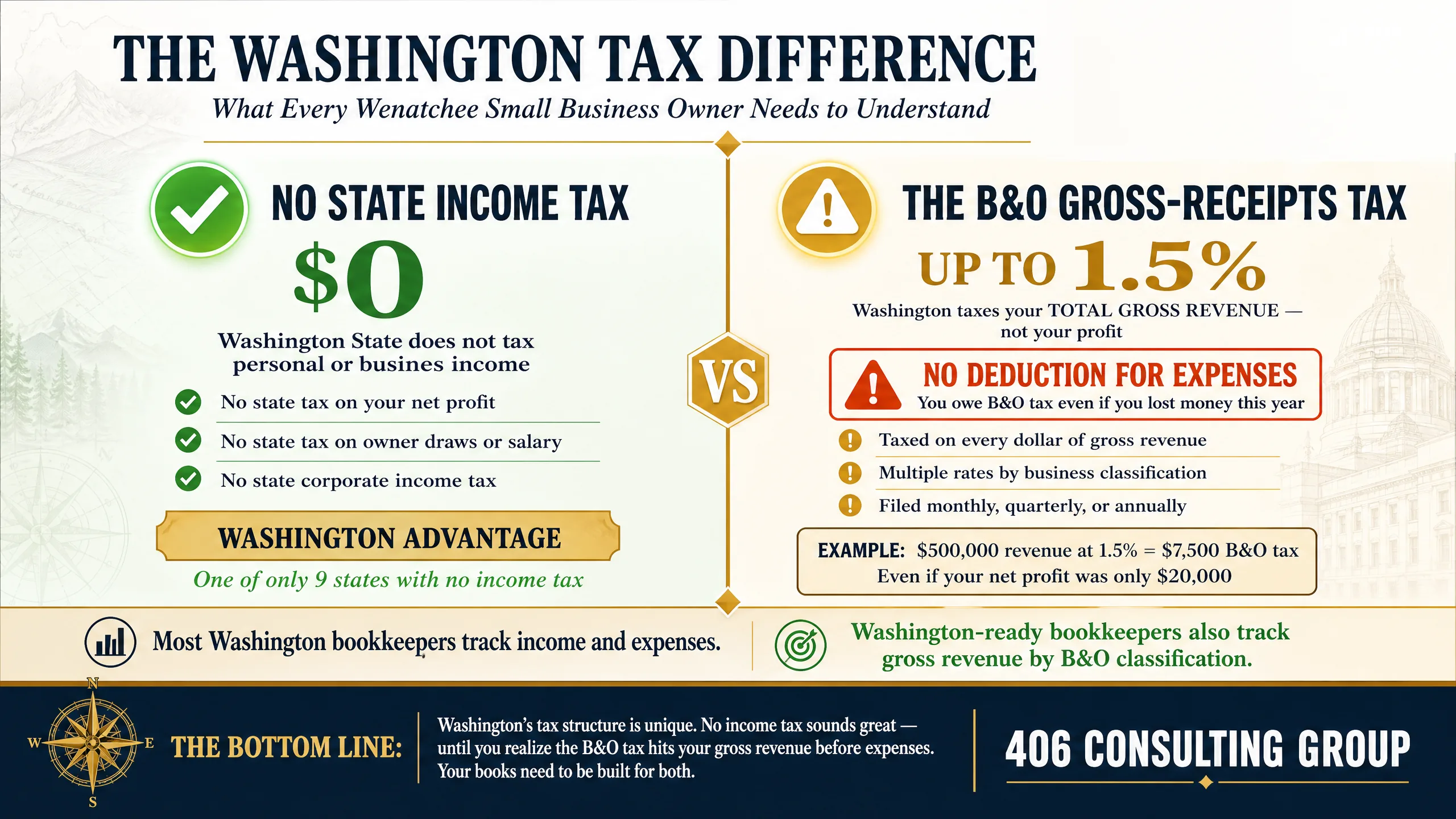
Here's why "gross" is the word that matters. Define it plainly: the B&O tax is calculated on your total gross income — every dollar that comes in — with no deduction for the costs of doing business. You cannot subtract labor, materials, rent, or supplies the way you would before figuring an income tax. A business with thin margins can owe B&O tax in a year it barely broke even, because the tax doesn't care about your profit — only your revenue.
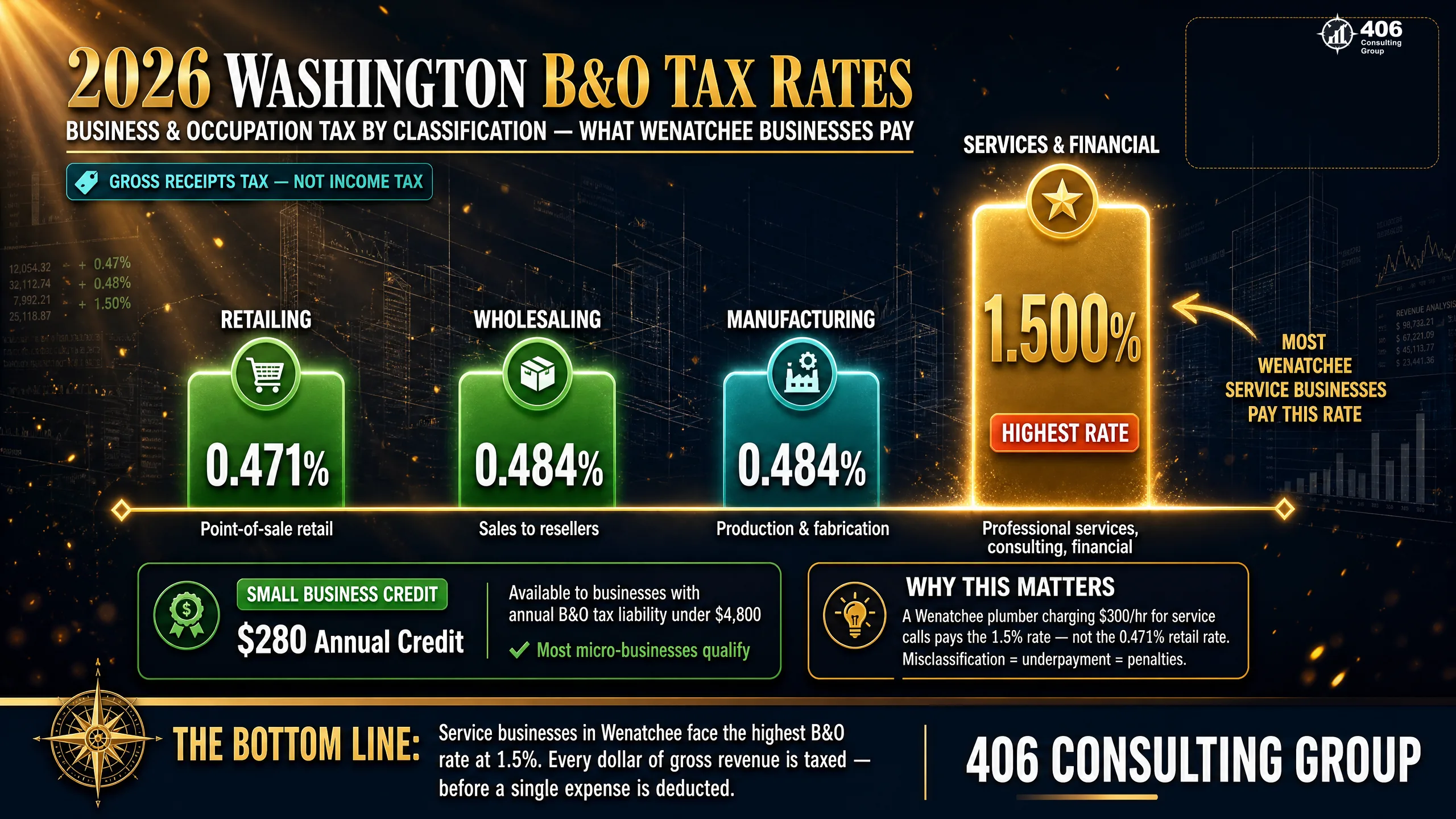
| B&O Classification | Typical Rate | Applies To |
|---|---|---|
| Retailing | 0.471% | Retail sales of goods and certain services to end users |
| Wholesaling | 0.484% | Sales for resale (buyer provides a reseller permit) |
| Manufacturing | 0.484% | Making products from raw materials |
| Service & Other Activities | 1.5% | Most service and professional income — the highest common rate |
Two things to know
First, Washington offers a small business B&O credit that can reduce or eliminate the tax for very small businesses — worth confirming your eligibility. Second, B&O rates, thresholds, and credits are adjusted periodically by the legislature, so always verify current figures with the Washington Department of Revenue. The rates above reflect the long-standing classification structure; the discipline that matters is tracking your revenue by classification in the first place.
B&O by Classification: Why One Business Owes Multiple Rates
The short answer: many Wenatchee businesses earn income in more than one B&O classification — and each type is taxed at its own rate on the same return. If your bookkeeping lumps all revenue into one bucket, you're almost certainly filing your B&O tax wrong, and usually paying more than you owe.
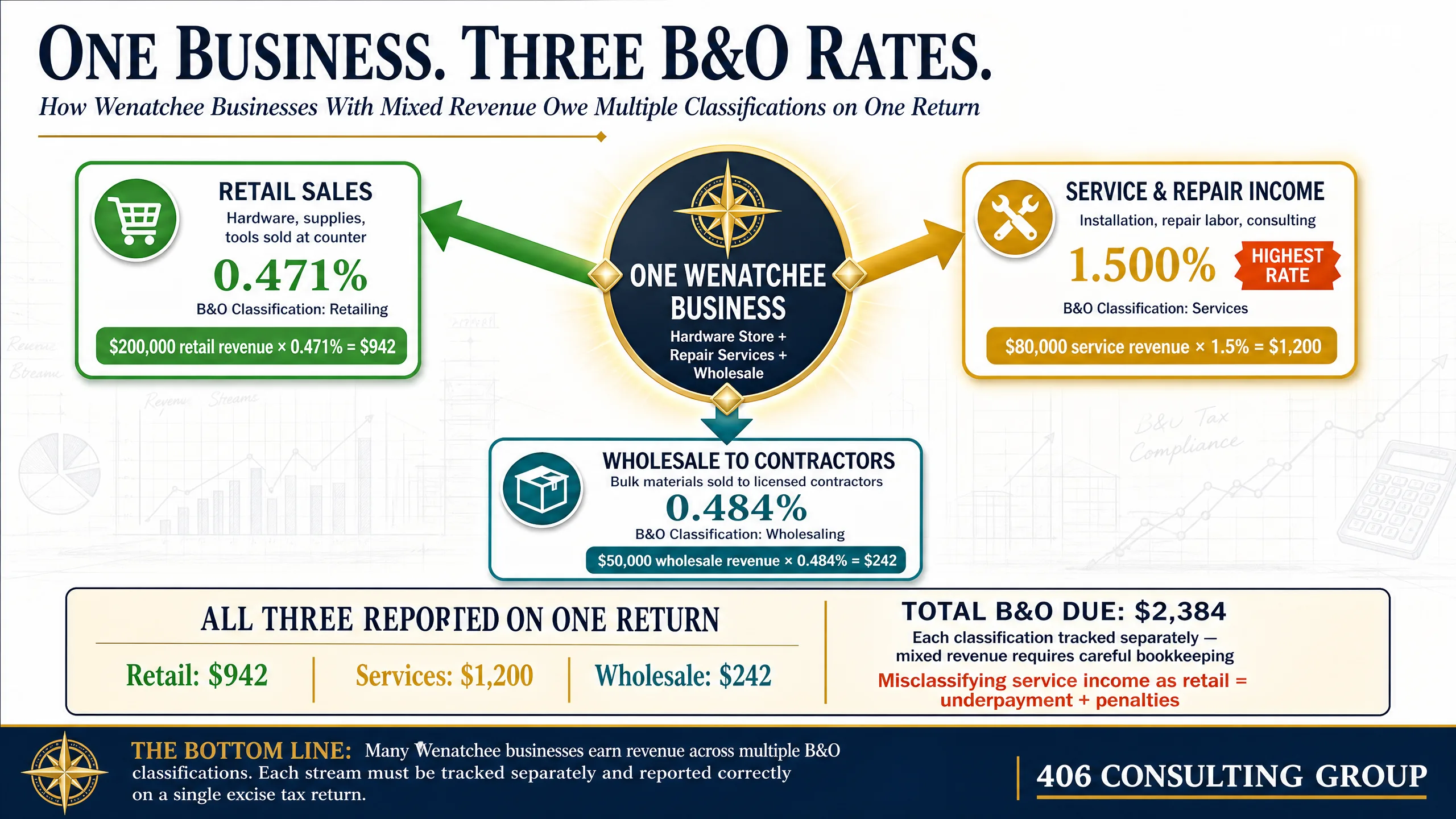
The Wenatchee shop, in numbers
Take a Wenatchee shop doing about $1.2M a year. It sells products over the counter (retail), and it also does installation and repair work (service). Those are two different B&O classifications at two different rates — and they have to be split on the return.
Filed wrong (all as service)
$1,200,000 taxed at 1.5%
B&O owed: ~$18,000
Overpaying on the retail portion
Filed right (split by activity)
$800K retail @ 0.471% = ~$3,768
$400K service @ 1.5% = ~$6,000
B&O owed: ~$9,768
Same business, same revenue — roughly $8,000 a year difference, purely from classifying income correctly. That gap exists only if your books track revenue by B&O classification. If everything lands in one "sales" account, nobody can file it right. (Illustrative; confirm your own classifications and rates with the DOR.)
This is the single most valuable thing Washington-aware bookkeeping does that out-of-state or generic bookkeeping misses. It requires a chart of accounts that separates revenue by activity from day one — which is exactly what we set up in Section 7.
Sales & Use Tax: Collecting, Remitting & the Reseller Permit
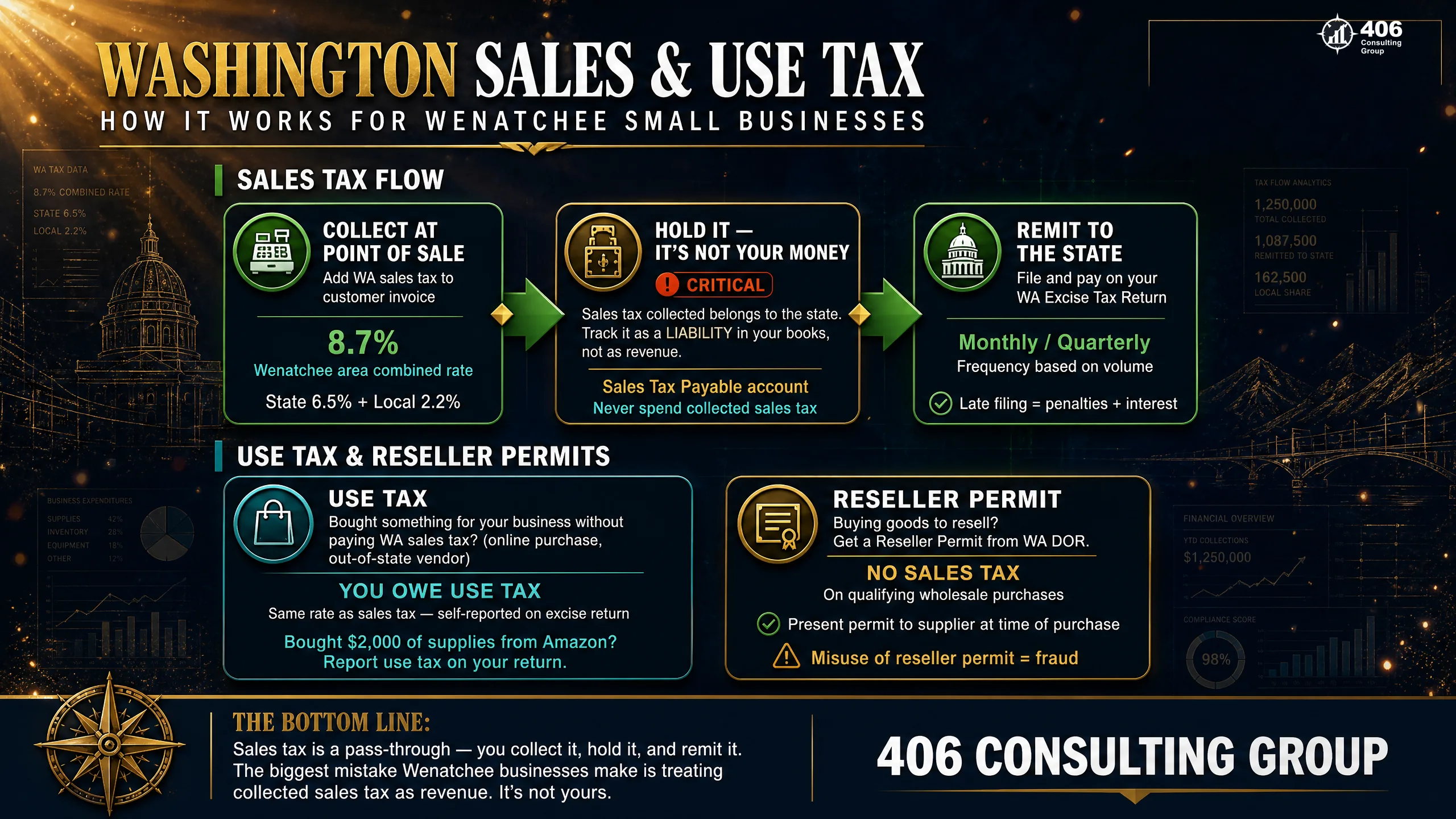
The short answer: if you sell taxable goods or services in Wenatchee, you collect sales tax from your customers, hold it, and remit it to the state — it is never your money. And you owe use tax on taxable items you buy without paying sales tax. Getting this wrong is one of the fastest ways to end up owing the state money you already spent.
Sales tax — a liability, not income
The single most common bookkeeping error we see: recording collected sales tax as revenue. It isn't. It's money you're holding on the state's behalf, and it belongs in a liability account until you remit it. Booked as income, it inflates your revenue (and your B&O), and the cash gets spent instead of set aside — so when the sales tax return comes due, the money's gone.
Use tax — the one people forget
If you buy equipment or supplies for the business without paying sales tax — say from an out-of-state seller — you generally owe Washington use tax on it. It's the mirror image of sales tax, and the DOR checks for it. Good bookkeeping flags these purchases so use tax gets reported instead of quietly becoming a liability that surfaces in an audit.
The reseller permit
If you buy goods to resell, a reseller permit lets you purchase them without paying sales tax — you collect it from the end customer instead. If you sell wholesale to other businesses, you keep reseller permits on file to document why you didn't charge them sales tax. Missing documentation is a classic audit finding.
Rates vary by location
Washington sales tax combines a state rate with local rates that vary by jurisdiction, so the total rate in Wenatchee differs from other parts of the state — and it's the buyer's location that often governs. Your point-of-sale system and your books need to capture the right rate and the right amount collected. Verify current local rates with the Washington DOR.
Industry Notes: Retail, Service, Hospitality & Ag
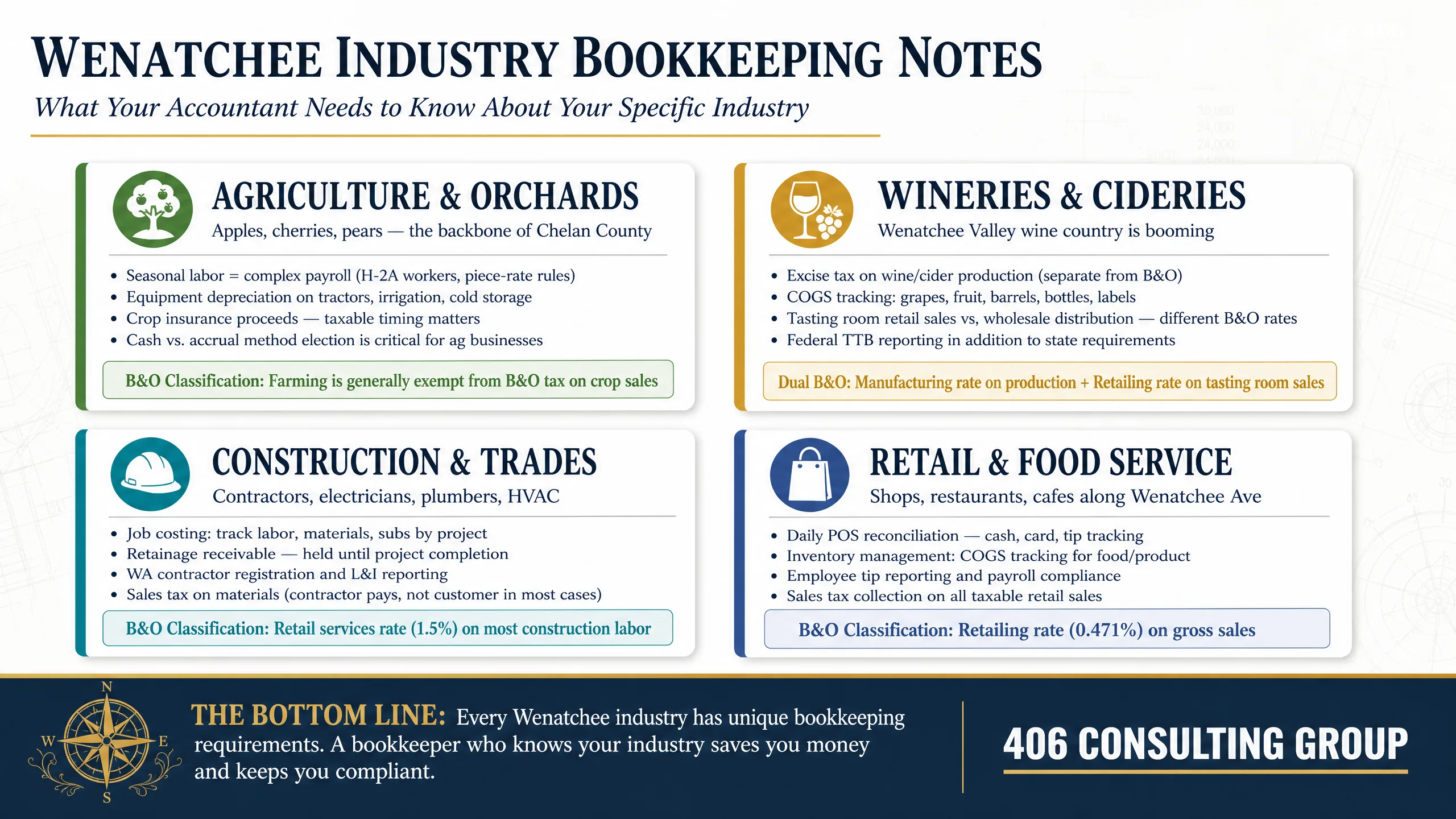
The short answer: the Washington rules apply to everyone, but they show up differently depending on what you do. Here's what to watch for in the sectors that make up most of Wenatchee's economy.
Retail & e-commerce
Sales tax collection and remittance is the big one, plus inventory tracking. If you sell online across jurisdictions, destination-based sales tax adds complexity your books need to handle.
Service & trades
Most service income falls in the 1.5% B&O classification — the highest common rate — so separating any retail or wholesale income from service income matters even more here. Job-level tracking helps you see true margins.
Hospitality & tourism
Wenatchee and the greater Chelan County tourism economy bring lodging taxes, tip handling, and heavy seasonality. Books need to separate taxable categories and plan for the swing between peak and off-season.
Agriculture & related
Apple Country's tree-fruit economy has its own wrinkles — certain agricultural activities qualify for B&O exemptions or deductions, and seasonal labor and cold-storage inventory complicate the books. If you're in or adjacent to ag, this is worth getting right with someone who knows the exemptions.
Seasonal Cash Flow: The Wenatchee Reality
The short answer: a lot of Wenatchee revenue is seasonal, and books that only record the past won't help you survive the slow months. The businesses that make it plan cash flow across the whole year — building reserves in the busy season to carry the quiet one.
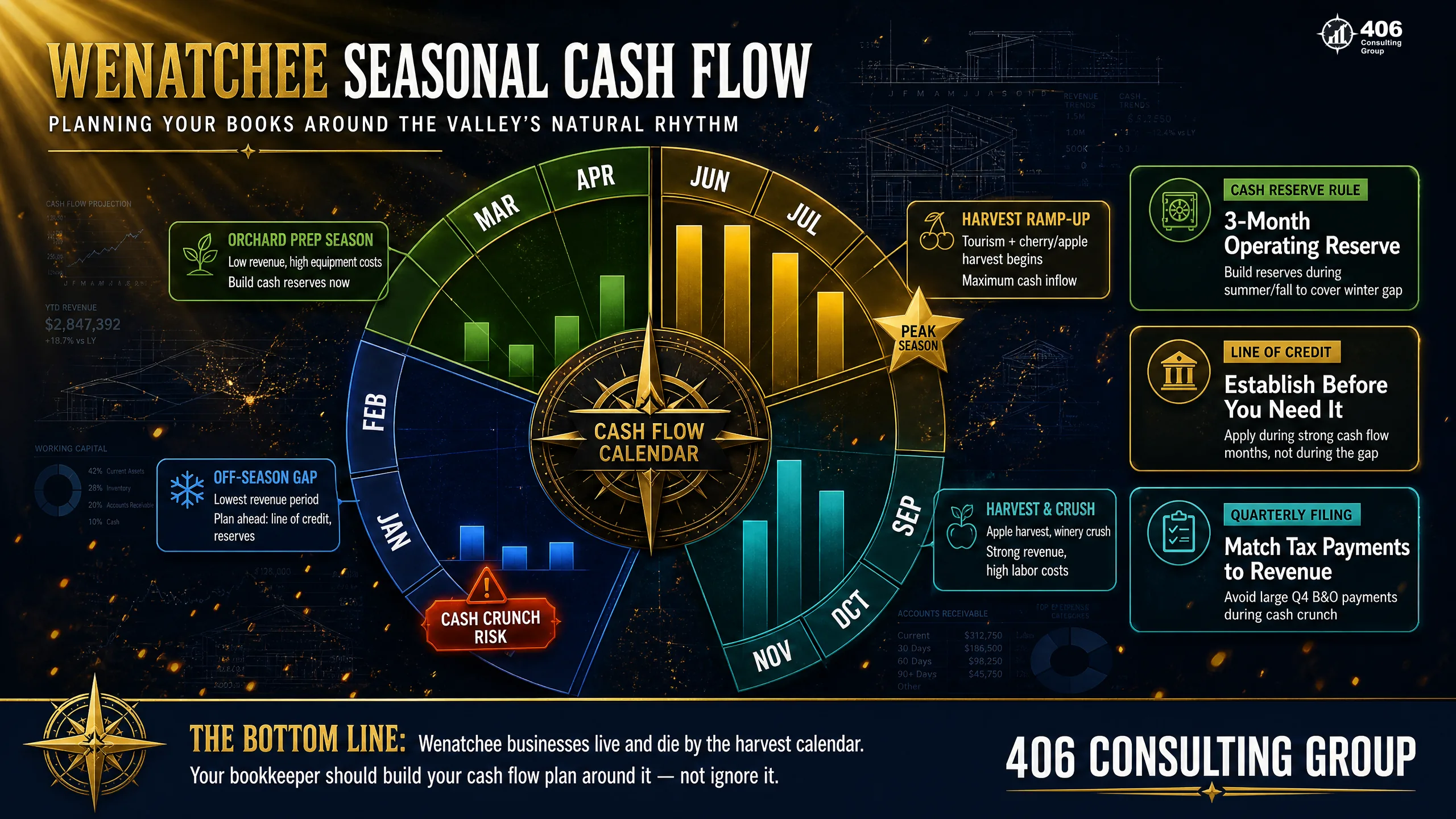
Between summer tourism, fall harvest, and the businesses that supply and serve both, a large share of Wenatchee's economy earns unevenly across the calendar. A shop might do half its year in four months. That's fine — if the books help you see it coming. It's a problem if every winter feels like a surprise.
See the pattern
Clean monthly books reveal your real seasonal curve, so you know which months fund which.
Build the reserve
Knowing the trough is coming lets you set aside cash — and your sales tax and B&O — in the peak.
Forecast forward
A simple rolling cash forecast turns 'I hope we're okay in February' into a number you can plan around.
The trap: spending peak-season cash as if it's all yours — when part of it is next quarter's sales tax and B&O, and part of it has to carry you through the slow months. Books that separate what you owe from what you keep are what prevent the February scramble.
The Chart of Accounts a Wenatchee Business Needs
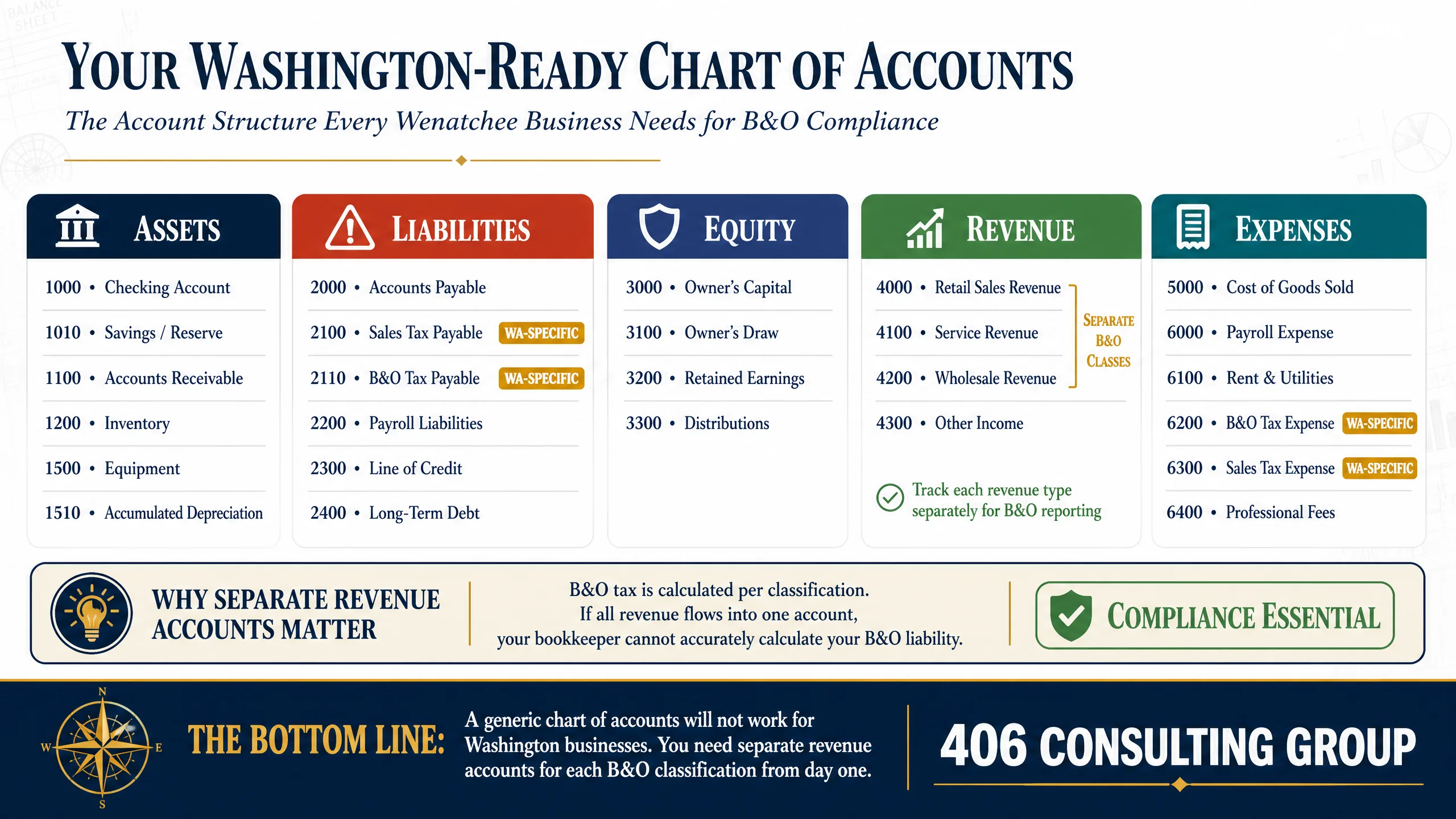
The short answer: the default chart of accounts in your accounting software is built for a generic business in a state with an income tax. A Wenatchee business needs a few Washington-specific additions — mainly revenue split by B&O classification and sales tax handled as a liability — so the books produce the right numbers automatically.
Revenue — split by B&O activity
Retail Sales
Taxed at the retailing B&O rate + sales tax collected
Service Income
Taxed at the higher service B&O rate
Wholesale Sales
Wholesaling rate; reseller permits on file
Tax liabilities — not income
Sales Tax Payable
Collected from customers, owed to the state
Use Tax Payable
Owed on untaxed business purchases
B&O Tax Payable
Accrue it so it's never a surprise
Cost of goods / job costs
Inventory / COGS
For retail and product-based businesses
Materials & Subcontractors
For service and trades work
Direct Labor
Separated from overhead for true margins
Operating & seasonal
Operating Expenses
Rent, utilities, insurance, admin
Owner Compensation
Separated for clean reporting and tax planning
Cash Reserve (tracked)
The buffer that carries the slow season
What Bad Bookkeeping Actually Costs
The short answer: bad bookkeeping in Washington costs you in ways you often can't see — overpaid B&O, sales tax penalties, spent money you owed the state, and decisions made on numbers that were never right. The cost is rarely one big event; it's a steady leak.
Overpaid B&O tax
Failing to split revenue by classification means paying the high service rate on income that qualified for a lower one — often thousands a year, as the Wenatchee shop example showed.
Sales tax penalties and interest
Late or incorrect sales tax filings generate penalties and interest. Recording sales tax as income makes it worse — the money gets spent before it's remitted.
Use tax surprises in an audit
Unreported use tax on untaxed purchases surfaces in a DOR audit, often with years of back tax plus penalties attached.
Missed deductions and exemptions
Washington has legitimate B&O deductions and exemptions — a bookkeeper who doesn't know them leaves money on the table.
Decisions on bad numbers
The biggest hidden cost: pricing, hiring, and spending decisions made on books that don't reflect reality. You can't manage what you can't measure.
The Washington-Ready Books Framework
Here's the setup we build for a Wenatchee business so the books handle Washington's rules automatically instead of leaving them to chance. Five layers, in order.
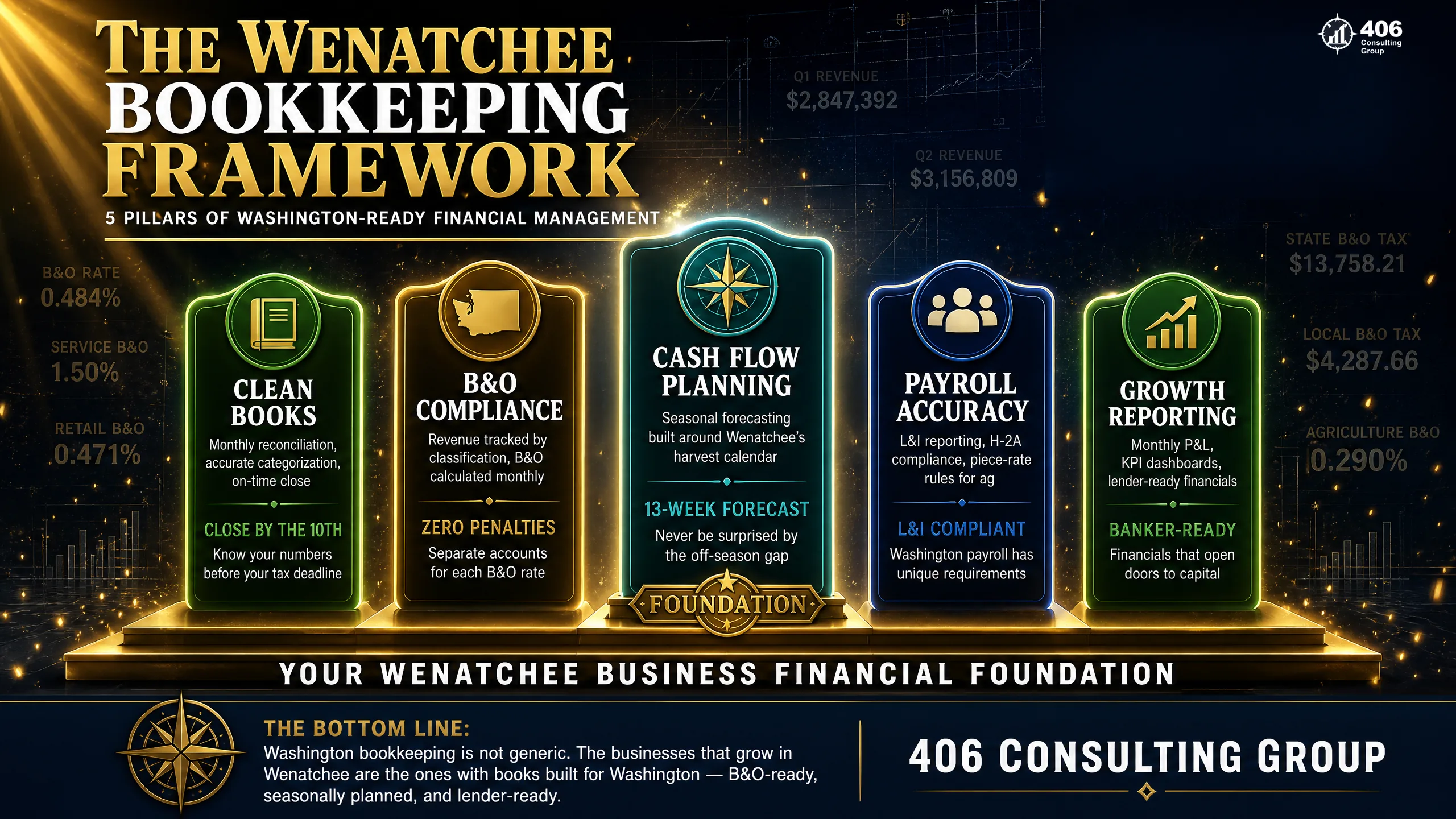
Revenue tagged by B&O classification
Retail, service, and wholesale income tracked separately from the first transaction — so the B&O return is right and you never overpay.
Sales & use tax handled as liabilities
Collected tax parked in liability accounts, use tax flagged on purchases, so the money is there when it's due.
A clean monthly close
Books reconciled to the bank every month, closed on a schedule — the difference between current reality and a year-old guess.
A seasonal cash-flow forecast
A simple rolling forecast that shows the slow months coming and confirms the reserve will carry them.
Year-round tax readiness
B&O accrued, records organized, and your CPA handed clean books — so filing is a handoff, not a fire drill.
DIY vs. Professional vs. Virtual
The short answer: DIY works when you're small and simple, professional bookkeeping pays for itself once Washington's rules and your volume get real, and virtual bookkeeping gives a Wenatchee business access to that expertise without needing someone local in the office.
It helps to know how common this already is: 70 to 80 percent of the clients we'd consider local never step into our office. Bank feeds flow into cloud accounting, documents go up to a secure portal, and we meet by video on a set schedule. A Wenatchee business gets that exact workflow — which means being in the Wenatchee Valley, elsewhere in Washington, or over in Idaho or Montana simply doesn't change the bookkeeping you get. Modern bookkeeping is remote bookkeeping; the distance disappears the moment your numbers live in the cloud.
| Option | Best for | The catch |
|---|---|---|
| DIY | Brand-new or very small, single-activity businesses | Easy to misfile B&O and sales tax; your time is worth more than the savings once you grow |
| Local professional | Businesses wanting in-person, hands-on help | Higher cost; you're limited to whoever is nearby and available |
| Virtual professional | Most Wenatchee small businesses | You give up the in-person visit — but gain Washington expertise, secure cloud access, and lower cost |
For most Wenatchee businesses, virtual bookkeeping is the sweet spot: you get someone who actually understands the B&O tax and Washington's rules, working in your cloud accounting file, for less than a local hire — and you're not limited to who happens to be down the street. See how we do it in our guide to virtual accounting for Washington businesses, and estimate your own scope with our bookkeeping estimator.
How to Choose a Bookkeeper for a Washington Business
The short answer: choose a bookkeeper who genuinely understands Washington — the B&O tax, sales and use tax, and revenue classification — not just one who knows accounting software. The wrong questions get you a tidy set of books that are quietly filed wrong.
Ask these questions
Red flags
The B&O question alone tells you most of what you need to know. A bookkeeper who can explain classification and how they'd handle your mix of income is a bookkeeper who will save you money. One who can't will cost you it.
Frequently Asked Questions: Wenatchee Bookkeeping
Does Wenatchee or Washington have a business income tax?
No. Washington does not levy a state personal or corporate income tax. Instead, businesses pay the Business & Occupation (B&O) tax, which is charged on gross revenue rather than net profit, along with sales and use tax. Because there's no income tax to plan around but a gross-receipts tax that most out-of-state bookkeepers aren't familiar with, Wenatchee bookkeeping has to be set up specifically for Washington's rules.
What is the Washington B&O tax and how is it calculated?
The Business & Occupation (B&O) tax is Washington's tax on the gross income of a business. It's calculated on your total gross receipts — the full amount you take in — with no deduction for the costs of doing business like labor, materials, or rent. You multiply your gross income in each tax classification by that classification's rate and add them together. Because it's based on gross revenue, a business can owe B&O tax even in a year it makes little or no profit, which is why tracking and classifying revenue correctly matters so much.
What B&O tax rate does my Wenatchee business pay?
It depends on your activity. The most common classifications are retailing (about 0.471%), wholesaling and manufacturing (about 0.484%), and service and other activities (1.5% — the highest common rate). A single business often has income in more than one classification — for example, retail sales and service work — and each portion is taxed at its own rate on the same return. Washington also offers a small business credit that can reduce or eliminate the tax for very small businesses. Always verify current rates, thresholds, and credits with the Washington Department of Revenue, as they're adjusted periodically.
Do I have to collect sales tax in Wenatchee, WA?
If you sell taxable goods or certain services, yes — you collect sales tax from your customers at the applicable rate, hold it, and remit it to the Washington Department of Revenue on your assigned filing schedule. The total rate combines the state rate with local rates and varies by location. Collected sales tax is not your income; it's a liability you hold on the state's behalf. You may also owe use tax on taxable items you purchase for the business without paying sales tax.
Are agricultural businesses exempt from B&O tax in Washington?
Some agricultural activities qualify for B&O tax exemptions or deductions — for example, certain sales of agricultural products by the grower — but the rules are specific and not every ag-related activity qualifies. Packing, processing, warehousing, and retail activities can be treated differently than growing. Because Apple Country has so many businesses in and around agriculture, this is an area where working with a bookkeeper or accountant who knows the Washington exemptions can save real money. Confirm your specific situation with the Department of Revenue or a qualified professional.
How much do bookkeeping services cost in Wenatchee, WA?
Bookkeeping costs depend on your transaction volume, number of accounts, how many B&O classifications and sales tax jurisdictions you deal with, and how clean your books are to start. Most small business bookkeeping engagements are priced as a flat monthly fee based on scope. The right comparison isn't cost alone — it's cost against what bad bookkeeping quietly loses you in overpaid B&O, sales tax penalties, and decisions made on bad numbers. A scope-based estimate is the fastest way to see where you'd land.
Does 406 Consulting Group provide bookkeeping services in Wenatchee, WA?
Yes. 406 Consulting Group provides virtual bookkeeping, controller, payroll, and tax services for small businesses in Wenatchee, Chelan County, and across Washington and the greater Northwest. We set up books specifically for Washington — revenue classified for the B&O tax, sales and use tax handled correctly as liabilities, a clean monthly close, and cash-flow visibility for seasonal businesses. We work virtually through secure cloud accounting, so you get Washington-aware expertise without needing someone in your office. Contact us for a scope-based quote.
Official Resources
Related Tools & Resources
Bookkeeping — Wenatchee, WA
Books Built for Washington — B&O, Sales Tax, and All.
406 Consulting Group keeps the books for Wenatchee small businesses the Washington way — revenue classified for the B&O tax, sales tax handled correctly, and cash flow you can see coming. Virtual, secure, and priced to your scope. Let's get your books right.
Washington Tax Quick Reference
Verify current figures with the DOR
The Washington-Ready Books Framework
Wenatchee Small Business?
Get books built for Washington's rules.
About 406 Consulting Group
A Northwest bookkeeping, controller, and tax firm serving small businesses across Washington, Montana, Idaho, and Wyoming. We build books that fit each state's rules — including Washington's B&O and sales tax — and work virtually through secure cloud accounting.
Read the Full Story