
Virtual Accounting Solutions
for Spokane, WA Companies
Spokane businesses are ditching the local-only mindset for virtual accounting that's faster, more accurate, and tax-savvy. Here's what to look for and how it works.

Virtual accounting services for Spokane, WA businesses have moved from novelty to standard practice — and for good reason. Eastern Washington's business community has historically been underserved by accounting firms relative to the Seattle metro, which kept service levels modest and prices high for the complexity involved. That's changing. Cloud technology now gives a Spokane construction company or healthcare practice access to the same quality of financial management as any business in the country, without the constraint of who happens to be located nearby.
This guide covers what virtual accounting actually is, how it handles Washington state's unique tax environment (B&O tax, sales tax, no income tax), which Spokane industries benefit most, and exactly what to look for when evaluating a provider. If you're considering making the shift — or you're trying to understand whether it's right for your business — this is the guide to start with.
Table of Contents
Why Spokane Businesses Are Going Virtual
Spokane is the second-largest city in Washington state, with a metro population approaching 600,000 and one of the fastest-growing small business communities in the Pacific Northwest. But its accounting market has not kept pace with that growth. Large Seattle and Bellevue firms focus on the tech and enterprise corridor. Local Spokane firms tend toward generalist practice. The result: Spokane businesses with complex needs — multi-state operations, construction with job costing, healthcare with billing complexity — have historically had to choose between underpowered local service or expensive travel to the west side of the state.
600K+
Spokane metro population
Second-largest metro in Washington state
1.5%
B&O tax — services rate
Applied to gross revenue — no deduction for expenses or profit
3 states
Tri-state border region
WA, ID, MT — multi-state complexity local firms often miss
Three forces are driving Spokane businesses toward virtual accounting:
Access to specialization
Virtual accounting removes the geographic constraint on expertise. A Spokane healthcare practice can work with an accounting firm that specializes in healthcare billing and compliance. A Spokane contractor can access job-costing expertise and construction CFO knowledge without those specialists being physically located in eastern Washington.
Multi-state tax complexity
The Spokane region sits at the intersection of Washington, Idaho, and Montana — three states with meaningfully different tax structures. Washington has no income tax but levies B&O tax. Montana has income tax but no sales tax. Idaho has both. Businesses operating across state lines need accounting partners who know all three, not just the one their office happens to be in.
Real-time financial visibility
Traditional accounting relationships are event-driven: tax season, year-end close, the occasional phone call. Virtual accounting built on cloud platforms is relationship-driven: live data access, monthly close reviews, proactive advisory throughout the year. Business owners who have made the switch consistently describe it as the difference between a rearview mirror and a windshield.
What Virtual Accounting Actually Is (And What It Isn't)
Virtual accounting is a delivery method, not a quality reduction. The same bookkeeping, tax preparation, and financial advisory work is performed — by real professionals with real expertise — delivered through cloud-based tools instead of in-person appointments. What changes is geography and logistics. What doesn't change is the depth of the relationship or the quality of the output.
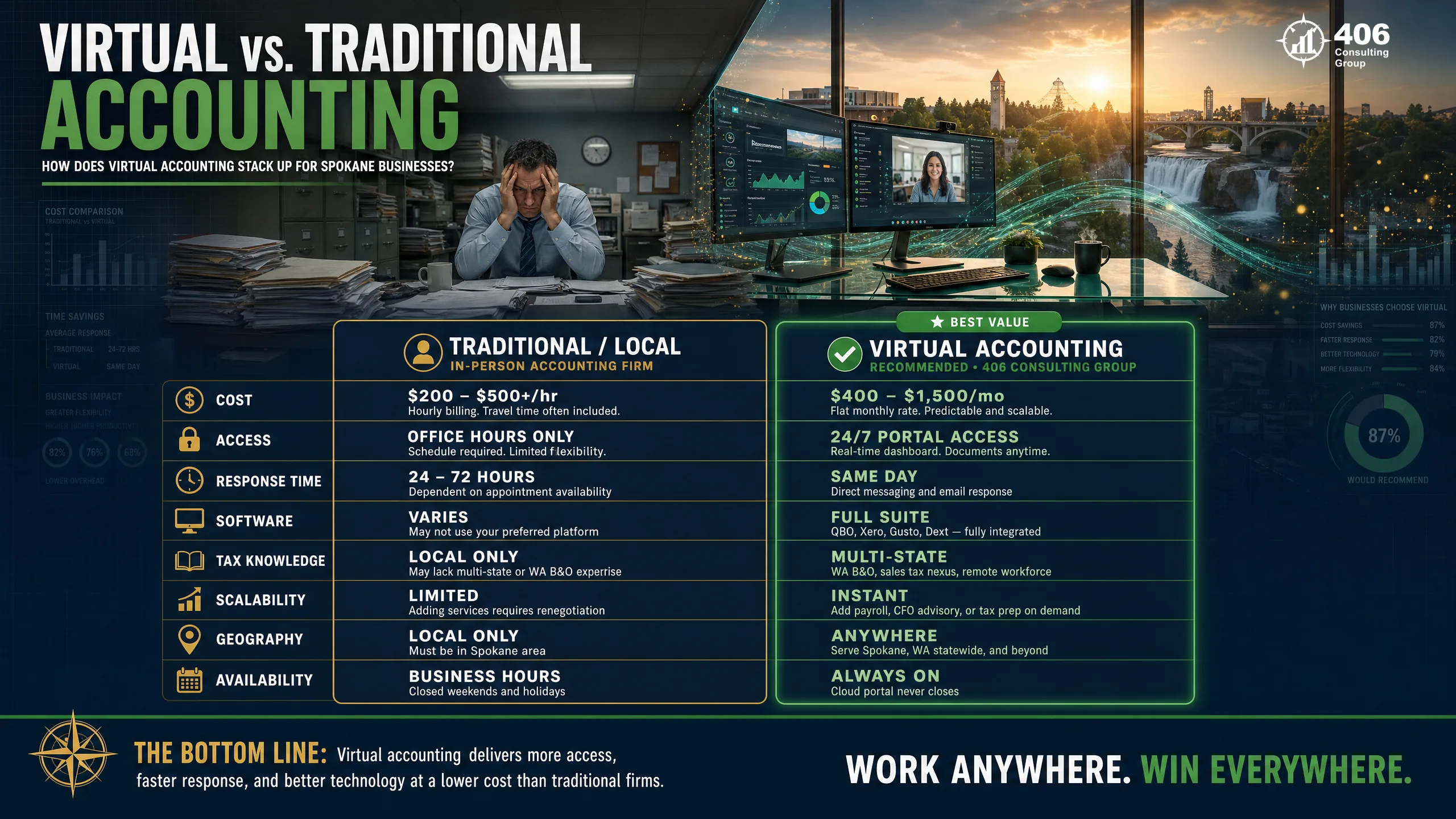
What Changes with Virtual Accounting
- No in-person office visits required
- Documents shared through secure cloud portals instead of dropped off
- Meetings by video call instead of in person
- Real-time access to your books for both you and your accountant
- Communication via email, phone, and secure messaging rather than waiting for an appointment
What Doesn't Change
- Quality and accuracy of bookkeeping and financial reporting
- Depth of the relationship — your accountant learns your business
- Tax expertise and strategic planning capability
- Responsiveness — good virtual firms respond faster than local ones
- Your ability to ask questions and get direct answers
What virtual accounting is NOT: Software-only accounting (TurboTax, Wave, or AI-generated bookkeeping with no professional review). Those tools have their place for very simple finances, but they are not a substitute for a professional relationship. Virtual accounting means a real accountant doing real work — the delivery channel is just different.
The Connected Financial System: 5 Components of a Complete Virtual Accounting Relationship
A virtual accounting relationship that works is more than just software access. It's five interconnected components operating together. When all five are present, the result is a financial management system that is more responsive, more proactive, and more tax-efficient than most in-person accounting relationships. When any one of the five is missing, the whole system develops gaps.
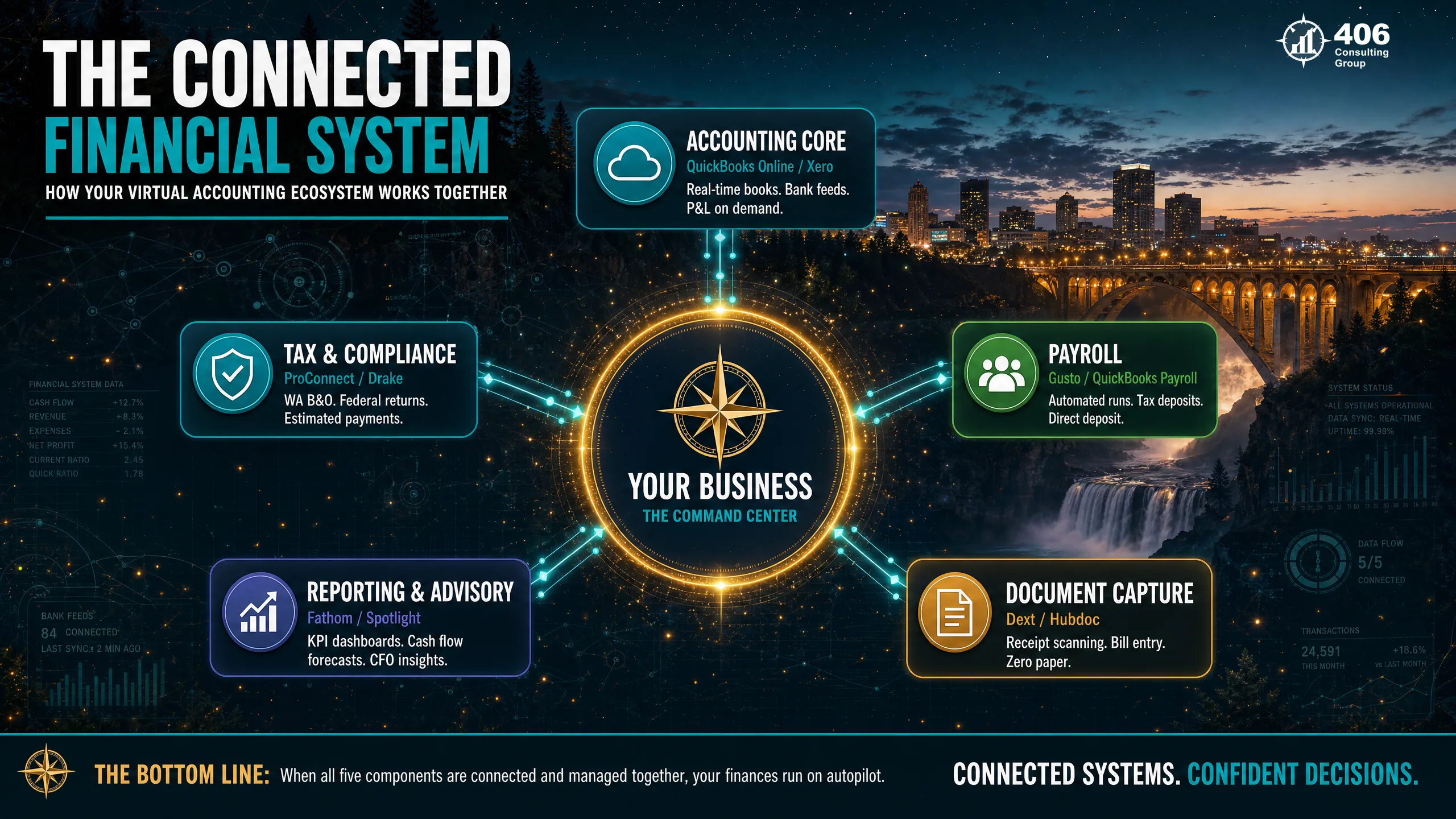
Cloud Infrastructure
All financial data lives in secure, cloud-based bookkeeping software (QuickBooks Online, Xero, or equivalent). No desktop software, no emailing spreadsheets, no "I need to get the file from the office." You and your accountant see the same live data from anywhere, on any device, at any time.
What breaks when this is missing
Without this, the relationship defaults to periodic batch updates — data arrives in chunks, errors compound, and neither party has a current view of the business.
Real-Time Data Access
Bank accounts and credit cards are connected directly to the bookkeeping platform via bank feeds. Transactions flow automatically — not once a month when someone downloads a statement. Both parties see live balances, recent transactions, and account activity without manual imports.
What breaks when this is missing
Without live bank feeds, transactions get missed, timing errors occur, and reconciliation becomes a reconstruction exercise instead of a verification.
Communication Cadence
Structured, predictable touchpoints that don't require scheduling an office visit: a monthly close review (30 minutes), a quarterly tax planning check-in, and an annual financial review. Plus responsive as-needed communication via email, phone, or video for questions that arise between scheduled calls.
What breaks when this is missing
Without a structured cadence, the relationship becomes purely reactive — you only talk when something goes wrong or tax season arrives. Proactive opportunities are missed.
Integrated Tax Strategy
Bookkeeping and tax preparation are handled by the same team or in close, documented coordination. The tax preparer is aware of the books throughout the year — not handed a trial balance in February for the first time. Decisions made during the year (entity elections, depreciation, retirement contributions) are reflected in the books in real time.
What breaks when this is missing
When bookkeeping and tax prep are siloed, deductions get missed, timing decisions are made without full information, and the year-end handoff creates a scramble.
Proactive Advisory
Your accountant initiates conversations — they don't wait to be asked. When your gross margin drops two points, they flag it. When a Washington B&O filing deadline is approaching, they remind you. When your cash flow trend suggests a problem in 90 days, they bring a solution before it becomes a crisis. This is what separates a financial partner from a compliance vendor.
What breaks when this is missing
Without proactive advisory, you have a transaction processor, not a financial partner. You pay for accounting but you don't benefit from it strategically.
Washington State Financial Landscape: What Makes Spokane Different
Washington state's tax structure is genuinely unusual — and it catches a lot of Spokane business owners off guard, especially those who moved from Montana, Idaho, or other states. The accounting implications are significant. Any virtual accounting partner serving Spokane businesses needs to understand all of these layers.

No Personal Income Tax
AdvantageWashington is one of nine states with no personal income tax. For Spokane business owners taking distributions or salaries, this is a meaningful financial advantage compared to neighboring Montana (5.9% top rate, effective 2024) or Idaho (~5.3% top rate). However, “no income tax” does not mean “no taxes” — Washington collects aggressively through the B&O tax and sales tax instead.
Note: Washington enacted a capital gains tax in 2022 (7% on gains over ~$262,000). While legally distinct from an income tax under Washington law, it functions as one for business owners considering exits or significant asset sales.
Business & Occupation (B&O) Tax
Critical — Unique to WAThe B&O tax is Washington's most significant business tax — and the one most misunderstood by business owners coming from other states. It is a gross receipts tax, meaning it is calculated on total revenue, not profit. If your Spokane services business generates $600,000 in revenue, you owe approximately $9,000 in B&O tax at the 1.5% services rate — even if your net income is zero.
Main B&O rates: Services & Other Activities 1.5% · Retailing 0.471% · Manufacturing 0.484% · Wholesaling 0.484%. Filed monthly, quarterly, or annually depending on liability (verify current thresholds at dor.wa.gov). Your virtual accountant must track B&O liability monthly and file on time — DOR penalties are swift.
Sales Tax
High ComplexityWashington's combined state and local sales tax in Spokane runs approximately 8.9% (6.5% state + local). This is one of the highest combined rates in the country. Montana has zero sales tax — businesses that operate in both states need careful transaction tracking to ensure Washington sales are taxed correctly and Montana sales are not.
Economic nexus: Washington requires out-of-state businesses with over $100,000 in Washington sales to collect and remit sales tax (the 200-transaction threshold was removed effective January 1, 2024) — relevant for Spokane businesses selling online or across state lines in either direction.
Paid Family & Medical Leave (PFML) and L&I
Payroll ComplexityWashington employers are required to participate in the state's Paid Family and Medical Leave program and carry workers' compensation through Labor & Industries (L&I). These obligations have payroll accounting implications that differ significantly from Montana's system. L&I rates vary by industry classification and are recalculated annually.
No federal W-2 income tax withholding is simpler in WA (no state income tax to withhold), but PFML premiums and L&I must be tracked and remitted correctly — misclassification or late remittance triggers audits.
The cross-border dimension: Many Spokane businesses have customers, employees, or operations in Idaho and Montana as well as Washington. Each state has different income tax treatment, sales tax rules, and payroll requirements. A virtual accounting firm that understands the full tri-state landscape — WA, ID, and MT — provides meaningfully better guidance than one that only knows Washington.
Industry Spotlight: Spokane Sectors That Benefit Most from Virtual Accounting
Virtual accounting is not a one-size-fits-all solution — some Spokane industries benefit more than others, specifically because their financial complexity exceeds what a generalist local bookkeeper typically handles. These are the sectors where we see the largest gap between what businesses need and what traditional local service provides.

Healthcare & Medical Practices
Spokane sector- 1Insurance reimbursement revenue recognition — income received differs significantly from services billed
- 2Provider and contractor classification — physicians as employees vs. partners creates payroll and K-1 complexity
- 3HIPAA-adjacent financial data handling — patient payment data intersects with financial records
- 4Multiple entity structures — often operate through professional corporations, partnerships, and management companies simultaneously
Providence Health and MultiCare dominate Spokane's healthcare landscape, creating a large ecosystem of independent practices, specialist groups, and ancillary service providers with complex financial structures.
Construction & Trades
Spokane sector- 1Washington prevailing wage requirements — construction projects on public works require certified payroll and specific wage rates by trade classification
- 2L&I workers compensation — rates vary significantly by trade classification and safety record
- 3Job costing and WIP scheduling — required for bonding and for knowing whether each job is profitable
- 4Subcontractor 1099 tracking and contractor vs. employee classification under WA's stricter standards
Spokane's construction market has grown substantially, creating a new generation of contractors who started small and are now operating at a scale their bookkeeping systems haven't caught up with.
Real Estate & Property Management
Spokane sector- 1Depreciation schedules — cost segregation studies, bonus depreciation elections, and MACRS class life determinations
- 21031 exchange tracking — replacement property timelines and basis calculations require precise record-keeping
- 3Security deposit liability accounts — tenant deposits are not income until earned
- 4Property-level P&L — investors need performance broken out by property, not just consolidated
Eastern Washington's real estate market has attracted investors from Seattle and California seeking lower prices. Many own multiple properties across WA, ID, and MT — requiring multi-state accounting coordination.
Agriculture & Food Processing
Spokane sector- 1Commodity price exposure — revenue fluctuates with wheat, hops, and potato markets in ways that require cash flow forecasting
- 2Farm equipment depreciation — Section 179 and bonus depreciation elections are high-value tax decisions for large equipment purchases
- 3Seasonal labor and H-2A visa payroll — complex payroll compliance for agricultural guest workers
- 4Crop insurance proceeds — treatment of insurance payments in the year of loss vs. the following year
Eastern Washington's agricultural sector is one of the most productive in the country. Farm operations increasingly need sophisticated financial management to navigate commodity markets, equipment financing, and succession planning.
Technology & SaaS
Spokane sector- 1Subscription revenue recognition — under ASC 606, revenue must be recognized as services are delivered, not when payment is received
- 2R&D tax credits — software development activities may qualify for federal R&D credits worth 6–10% of qualified expenses
- 3Multi-state nexus — SaaS companies selling nationally often have tax obligations in dozens of states
- 4Equity compensation tracking — options, RSUs, and phantom equity require specific accounting treatment
Spokane's technology sector is growing, with companies including Itron and a growing startup ecosystem that tends to outgrow local accounting resources quickly as complexity scales.
Professional Services
Spokane sector- 1B&O tax at the 1.5% services rate — the highest standard B&O rate applies to most professional services firms
- 2Retainer and prepaid revenue management — funds received before services are rendered must be treated as liability, not income
- 3Partner/owner draw vs. salary structuring — optimizing distributions between W-2 and K-1 income for tax efficiency
- 4Accounts receivable aging — service businesses that bill on net-30 or net-60 terms need disciplined AR tracking
Legal, engineering, architecture, and consulting firms in the Spokane market frequently have B&O exposure that goes undertracked and payment collection that goes unmanaged — two problems virtual accounting systematically solves.
Virtual vs. Local CPA: How to Make the Right Call
This is not a binary choice — virtual and local aren't mutually exclusive, and the right answer depends on your business's specific profile. Here's a practical decision framework:
And this isn't theory for us. Roughly 70 to 80 percent of the clients we'd call local never actually come into our office — the relationship runs entirely on secure cloud accounting, shared screens, and a set call rhythm, which is the identical way a Spokane business works with us. Remote isn't a lesser tier reserved for out-of-town clients; it's simply how the work gets done now, so whether you're in Spokane, across the line in Idaho, or over in Montana makes no practical difference to the accounting you receive.
Local presence is genuinely important when:
- → You're in active litigation and need a CPA who can serve as an expert witness in a Spokane court
- → Your entity structure involves complex local real estate transactions requiring coordination with local attorneys on specific deal timelines
- → A state regulatory board requires a locally licensed professional to sign specific filings
- → You prefer in-person relationship building as a cultural or personal priority — and that preference is more important than expertise or cost
Virtual is the better choice when:
- → You need industry specialization that isn't available from Spokane generalists (construction CFO, healthcare billing, SaaS revenue recognition)
- → You operate across WA, ID, and MT and need a firm that understands all three tax environments
- → You want real-time financial data access, not a once-a-year tax appointment
- → Your current local bookkeeper can't grow with you — you've outpaced their capabilities
- → You want proactive advisory, not just compliance — a firm that calls you, not just answers when you call
Decision Guide by Revenue and Complexity
| Revenue / Profile | Typical Need | Recommendation |
|---|---|---|
| Under $300K, simple service business | Basic bookkeeping + annual return | DIY + local tax preparer or virtual bookkeeper |
| $300K–$1M, growing business | Monthly bookkeeping, quarterly taxes, B&O compliance | Virtual bookkeeping + integrated tax prep |
| $1M–$5M, multi-state or complex | Full-service accounting, cash flow advisory, multi-state | Virtual full-service firm with WA+MT+ID expertise |
| $5M+, growth-stage | CFO-level oversight + accounting + tax strategy | Virtual fractional CFO + accounting team |
How Virtual Bookkeeping Works Day-to-Day
The most common question we hear from Spokane business owners considering virtual accounting: “How does it actually work?” Here's the workflow from onboarding through ongoing operations.
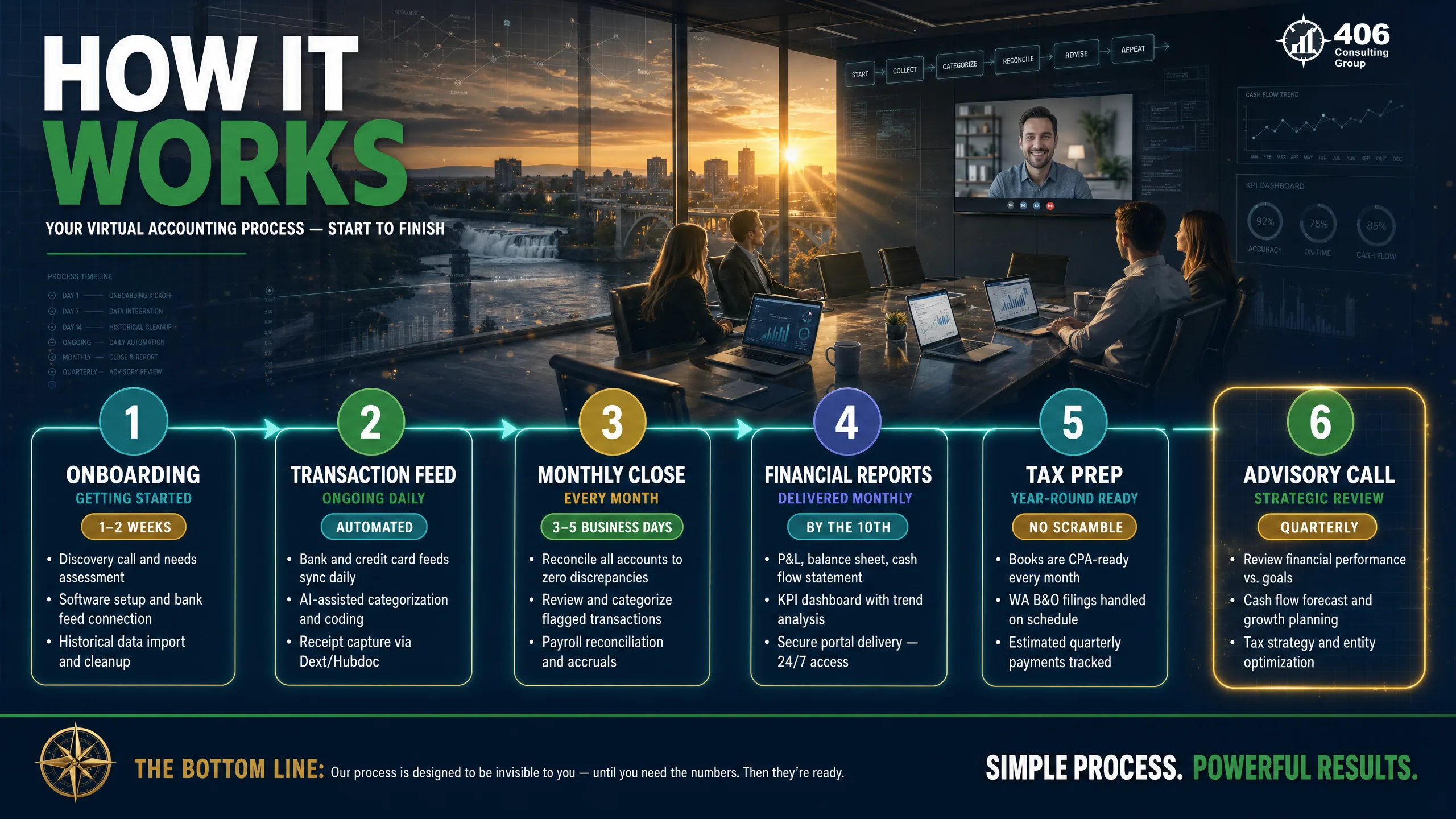
Onboarding (Weeks 1–4)
- Connect all bank accounts and credit cards to cloud bookkeeping platform via read-only bank feeds
- Review and customize the chart of accounts for your specific industry and business
- Import or migrate historical data from prior software or spreadsheets
- Set up document capture app (Dext or similar) for receipts and vendor invoices
- Kickoff call: establish communication preferences, reporting schedule, and response time expectations
Monthly Rhythm
- Transactions flow daily via bank feeds — no manual importing
- Bookkeeper categorizes and reconciles by the 10th of the month
- Uncategorized items sent to you via secure portal for clarification (takes 5–10 minutes to answer)
- Monthly close complete by the 15th
- Monthly report delivered: P&L, balance sheet, cash position, key metrics, and any flagged items
- Optional 30-minute monthly review call to walk through the numbers
Quarterly
- Washington B&O tax quarterly filing prepared and submitted
- Estimated federal and Washington tax payments calculated and confirmed
- Quarterly financial trend review — revenue, margin, and cash flow vs. prior quarters
- Tax planning check-in: anything to do before year-end to optimize tax position
Annual
- Books formally closed by January 31
- Tax-ready financials delivered to tax preparer by February 1 (not in March)
- Annual planning meeting: goals, financial projections, entity structure review
- Year-over-year performance review and benchmarking
Virtual Accounting and Washington State Taxes: How It All Gets Handled
Washington's tax environment requires specific handling that a general virtual accounting service may not be equipped for. Here's how each piece should be managed in a well-run virtual accounting relationship serving Spokane businesses:
B&O Tax
Filed with: WA DOR quarterly or annuallyYour virtual bookkeeper tracks revenue by B&O classification category (services vs. retail vs. manufacturing) as transactions are recorded. By the end of each quarter, the B&O liability is already calculated from the books — filing takes minutes, not hours. A firm unfamiliar with Washington will miss classification nuances (e.g., some services firms qualify for the lower manufacturing rate on certain activities).
Sales Tax
Filed with: WA DOR monthly or quarterlyRetail and some service businesses collect Spokane-area sales tax (~8.9%) at point of sale. In a virtual accounting system, sales tax collected is tracked as a liability in the books from the moment it's collected — not reconstructed at filing time. Businesses with out-of-state customers need nexus monitoring to identify when WA collection obligations arise in other states, and when non-WA sellers create WA obligations.
PFML Premiums
Filed with: WA ESD quarterlyWashington's Paid Family and Medical Leave premiums are split between employer and employee. Payroll software (Gusto, ADP) calculates and withholds the employee portion and tracks the employer portion. Your bookkeeper ensures these flow to the correct liability account and reconciles quarterly. Businesses with fewer than 50 employees are exempt from the employer portion of PFML — a detail that's easy to miss.
L&I (Workers Compensation)
Filed with: WA L&I quarterlyL&I rates vary by industry classification and are set annually. Construction firms in particular need precise hour tracking by classification code — mixing hours between classifications triggers audits. Your virtual bookkeeper tracks hours and payroll by L&I class code and reconciles the quarterly L&I report to payroll records before filing.
Federal Estimated Taxes
Filed with: IRS quarterlyWith no WA state income tax, estimated tax planning for Spokane business owners focuses entirely on federal obligations. Your virtual accounting team calculates estimated quarterly payments based on year-to-date net income and projects the full-year liability, adjusting for any major changes (large equipment purchase, unusual revenue month, etc.).
The Technology Stack Behind Virtual Accounting
Software is the infrastructure of virtual accounting — but the software alone is not the service. A strong virtual accounting firm has a consistent, integrated technology stack where each tool serves a specific purpose and connects to the others. Here's what a well-built stack looks like for a Spokane small business:
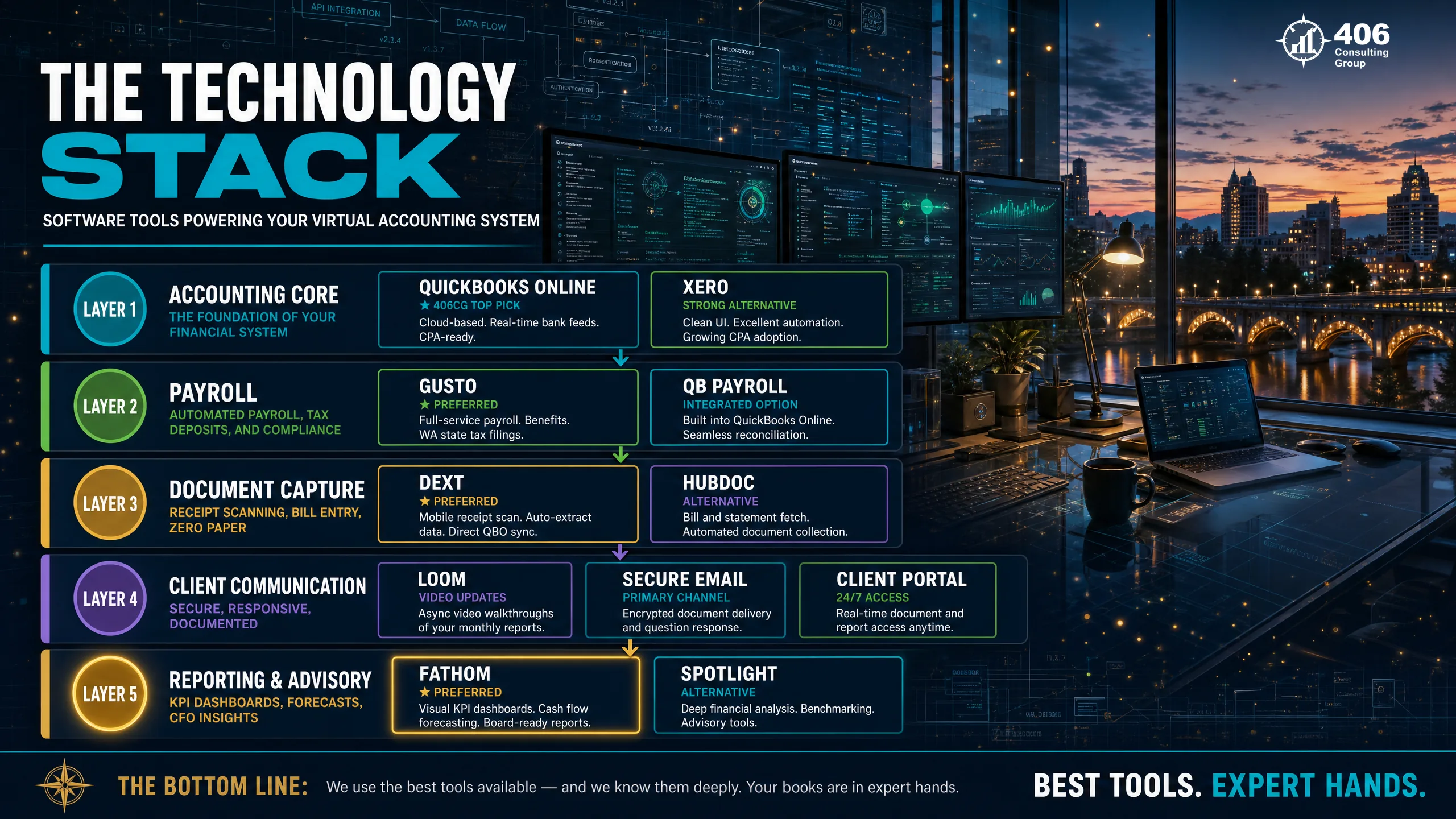
Core Bookkeeping Platform
QuickBooks Online or XeroThe single source of truth for all financial data. Bank feeds connect directly, financial reports are generated here, and both client and accountant have live access. QuickBooks Online is the most widely used and offers the broadest integration ecosystem. Xero is a strong alternative with a cleaner interface at lower cost.
Red flag: firms that still use QuickBooks Desktop as their primary platform for new clients or that work from spreadsheets and batch uploads.
Document Management
Dext (formerly Receipt Bank) or HubdocAuto-extracts data from receipts, vendor invoices, and bank statements using OCR. You photograph a receipt with your phone; it flows to the bookkeeping platform categorized and attached to the transaction. Eliminates the shoebox problem at the source.
Red flag: firms that ask you to email receipts as PDF attachments or manually enter expense data.
Payroll
Gusto (preferred for SMBs), ADP (larger businesses)Handles federal and state payroll tax filings, WA PFML, L&I integration (Gusto handles L&I for WA), direct deposit, and W-2/1099 generation. Syncs directly with QBO so payroll entries flow to the books automatically without manual journal entries.
Red flag: manual payroll or systems that require the bookkeeper to enter payroll data from a separate payroll report.
Communication & Collaboration
Secure client portal, Loom, email, video callSecure portals (built into QBO, or standalone tools like Canopy or TaxDome) are used for document exchange — never email for sensitive financial data. Loom is useful for async video explanations of financial reports. Scheduled video calls replace in-person meetings.
Red flag: firms that send financial documents, tax returns, or login credentials via unencrypted email.
Reporting & Advisory
QBO reports, Fathom or Spotlight Reporting (for advanced dashboards)Standard QBO reports cover P&L, balance sheet, cash flow, and AR aging. More sophisticated clients benefit from Fathom or Spotlight, which provide KPI dashboards, trend analysis, and board-ready financial reporting. These are the tools that enable the proactive advisory component of the Connected Financial System.
Red flag: firms whose only financial report is a PDF of the QBO default P&L with no context or analysis.
What to Look for in a Virtual Accounting Partner
Not all virtual accounting firms are equal. Some are excellent; some are automated bookkeeping platforms with a human name on them; some are generalists who will take your money without the expertise to optimize your Washington state tax position. Here are the eight criteria that separate a genuine accounting partner from a compliance vendor:
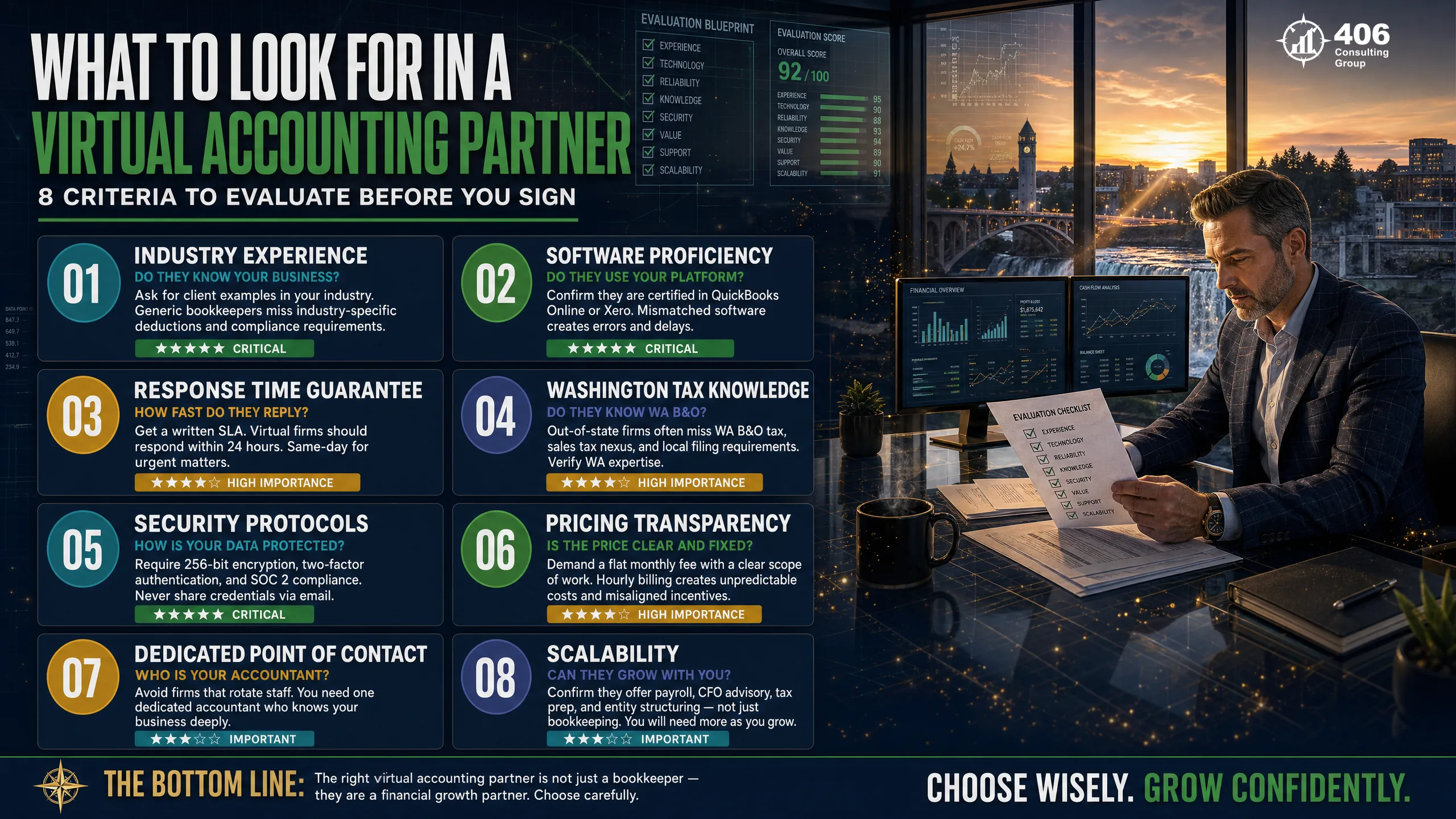
Washington state tax expertise
They can explain B&O tax, your specific rate classification, sales tax nexus, PFML, and L&I without looking it up. If they ask what B&O tax is, end the conversation.
Your industry experience
They have current clients in your sector — not just theoretical familiarity. Ask specifically: how many construction (or healthcare, or SaaS) clients do you serve and what are their typical accounting challenges?
Documented communication standards
They can tell you their guaranteed response time (ours is one business day), their monthly deliverables, and their structured touchpoint cadence. Vague answers here predict vague service.
Transparent flat-fee pricing
Monthly flat fees based on your transaction volume and service scope. No hourly billing surprises. You should know exactly what you pay before signing — and what additional services cost if your needs grow.
Cloud-native technology stack
They use QBO Online or Xero as their primary platform (not Desktop), Dext or Hubdoc for documents, and a proper payroll integration. Ask what software they use before discussing anything else.
Tax prep integration
Bookkeeping and tax preparation are handled by the same firm or in documented coordination. The tax preparer has access to your books throughout the year — not just at year-end.
Proactive vs. reactive culture
Ask them: in the last month, did they proactively contact any client about something the client wasn't already asking about? The answer tells you whether you're getting a partner or a processor.
Professional liability insurance
Any reputable accounting firm carries E&O (Errors & Omissions) insurance. Ask directly. A firm that doesn't carry it is a firm that doesn't take accountability for its work seriously.
Security and Data Privacy in Virtual Accounting
Financial data security is a legitimate concern when working with a remote accounting firm. Here's what reputable virtual accounting firms do — and the six questions you should ask any provider before handing over access to your books.
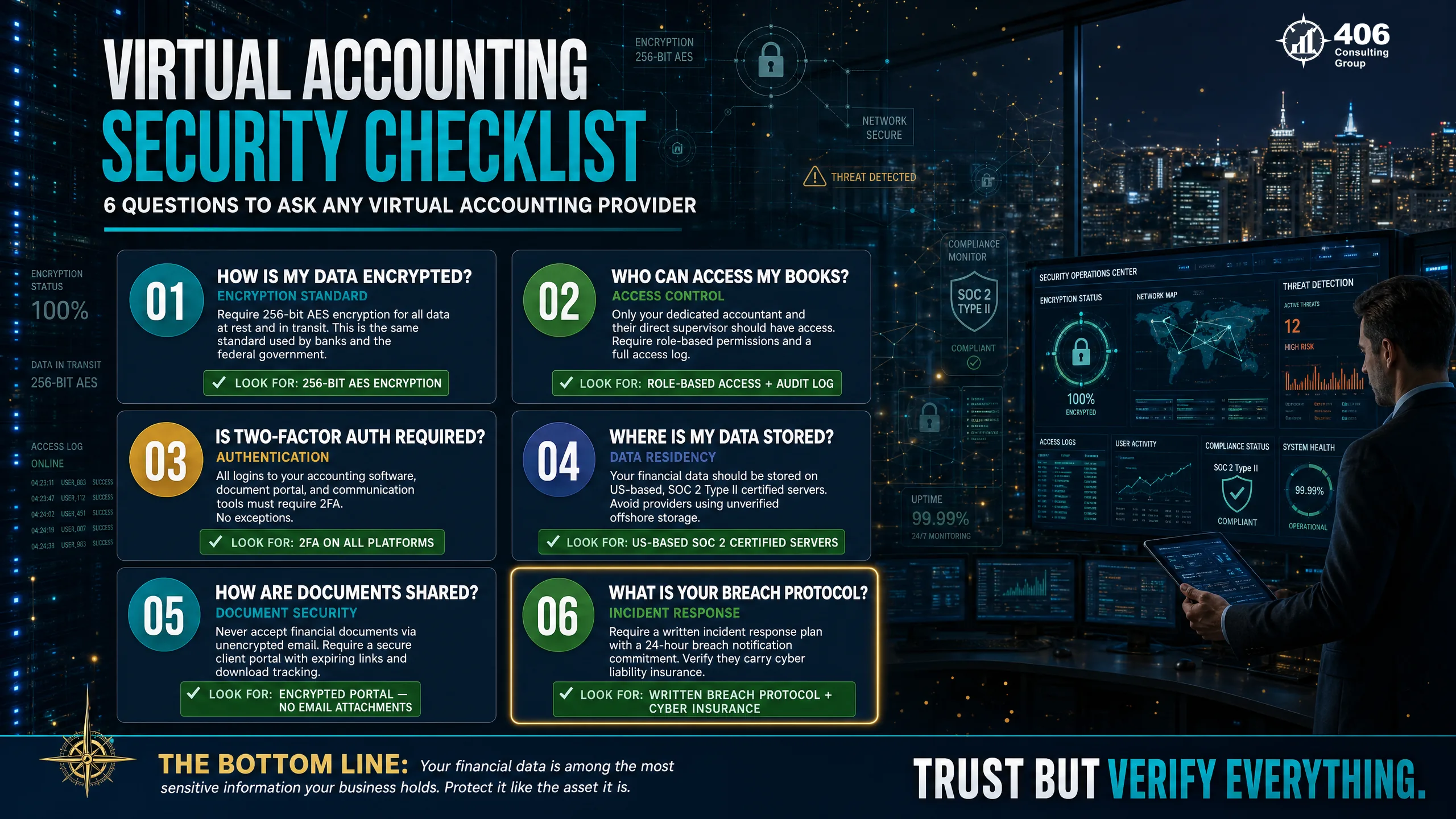
What Reputable Firms Do
- Use SOC 2 Type II certified platforms (QuickBooks Online, Xero — both are SOC 2 compliant)
- Require two-factor authentication on all client account access
- Use role-based permissions — staff see only the client accounts they work on
- Exchange documents through encrypted secure portals — never email
- Maintain professional liability (E&O) insurance covering data and accounting errors
- Have a documented breach response protocol and notify clients within 72 hours of any incident
6 Questions to Ask Any Provider
- 1What cloud platforms do you use and what are their security certifications?
- 2Who on your team has access to my financial accounts and books?
- 3How do you transmit sensitive documents — tax returns, bank statements, login credentials?
- 4What happens to my data if we end our engagement?
- 5Do you carry professional liability (E&O) insurance, and what does it cover?
- 6What is your protocol if a security incident occurs?
The reality:Your financial data is almost certainly more secure in a SOC 2 certified cloud platform with role-based permissions and 2FA than it was in your prior accountant's desktop software or email inbox. The security concern about virtual accounting is often the reverse of the actual risk — the old way was less secure, not more.
Common Objections to Virtual Accounting — Answered Directly
These are the five objections we hear most often from Spokane business owners considering virtual accounting. Direct answers, no spin.
"I need someone I can meet in person."
When did you last actually walk into your accountant's office — not just drop off documents? Most accounting relationships are already 90% phone and email. Video calls provide more scheduled face time than most in-person relationships, where you might drop by once a year. The question worth asking is whether in-person meetings are actually producing better outcomes, or whether they're just familiar.
"How do I know my data is safe?"
QuickBooks Online and Xero are SOC 2 Type II certified with bank-level encryption. Your data in those platforms is more secure than it was in your prior accountant's email attachments or desktop software. Reputable virtual firms also use secure portals for document exchange, role-based permissions, and 2FA. Ask any provider the six security questions above and evaluate their answers.
"Will they understand my industry and Washington state taxes?"
This is the right question — but it's about expertise, not geography. A generalist firm down the street may know less about Washington B&O tax classification or construction WIP scheduling than a virtual firm that specializes in those areas. Interview for specific knowledge, not proximity. Ask them to explain the B&O rate that applies to your business before you sign anything.
"What if I have a tax emergency or urgent question?"
Good virtual accounting firms have guaranteed response times — ours is one business day. A dedicated email or phone line for urgent matters. And because your books are in a shared cloud platform, your accountant already has context when you call — they don't need to pull a file or ask you to remind them of your situation. The responsiveness of a good virtual firm typically exceeds that of a local CPA juggling 400 clients.
"My situation is too complicated for virtual accounting."
Multi-state complexity, multiple entities, and complex Washington state taxes actually favor virtual specialists over local generalists. A Spokane business with operations in WA, ID, and MT is more complex than most local firms handle regularly — but it's exactly the profile a virtual firm serving the tri-state region sees routinely. Complexity is an argument for specialization, and specialization is one of virtual accounting's primary advantages.
Frequently Asked Questions
How much does virtual accounting cost for a Spokane business?
Virtual bookkeeping for a Spokane small business typically ranges from $400–$800/month for basic bookkeeping and monthly close, to $1,200–$2,500/month for full-service accounting including tax preparation, B&O filing, payroll coordination, and financial advisory. The right price depends on your transaction volume, number of accounts, payroll complexity, and service scope. Most Spokane businesses in the $300K–$2M revenue range find the monthly investment comparable to — or less than — their prior local provider, with significantly more included.
Does my virtual accountant need to be a Washington state CPA?
Not necessarily. Bookkeeping does not require any state license. Tax preparation can be performed by CPAs (who can be licensed in multiple states), Enrolled Agents (federally licensed, can practice in any state), or supervised preparers working under a licensed professional. What matters is that the firm has specific expertise in Washington state taxes — B&O, sales tax, PFML, L&I — regardless of where their license was issued. Ask about their Washington experience specifically, not just their credentials.
How do I switch from my current local accountant to a virtual provider?
The process is straightforward: your new virtual firm requests your prior year tax returns, current bookkeeping file (QBO export, spreadsheet, or whatever you have), and access to your bank and credit card accounts. They handle the migration, setup, and any catch-up bookkeeping needed. The typical onboarding takes two to four weeks. Your prior accountant is obligated to provide your records — it's your data. The most common complication is records in poor shape, which just extends the catch-up timeline.
Can a virtual accountant handle my Washington B&O tax filings?
Yes — and they should. B&O filing is a standard part of ongoing accounting for any Washington business. Your virtual bookkeeper tracks B&O-classifiable revenue as transactions are recorded throughout the quarter. By the due date, the liability is already calculated from the books. Filing the DOR return takes minutes when the underlying data is current. If a virtual firm doesn't include B&O filing as a standard service for Washington clients, that's a gap in their Washington expertise.
What industries does 406 Consulting Group serve in the Spokane area?
We serve Spokane-area businesses across construction and trades, healthcare practices, real estate and property management, professional services, and agriculture-adjacent businesses. Our tri-state background (Montana, Idaho, and Washington) gives us specific familiarity with the tax environments, industry regulations, and financial patterns common in eastern Washington. We serve clients fully virtually — no geographic limitation on who we work with.
How long does onboarding take?
For a business with reasonably current books and one to two bank accounts, onboarding takes two to three weeks: account connections in week one, chart of accounts review and setup in week two, and first monthly close in week three or four. For businesses with catch-up bookkeeping needed (books behind by months or years), plan for four to eight weeks depending on the backlog volume. We give every new client a specific timeline during the initial consultation based on their actual situation.
What can't virtual accounting do that in-person accounting can?
Honest answer: very little, for most businesses. The genuine limitations are: appearing in person at a Washington DOR audit examination (though most audits are handled by correspondence anyway), serving as an in-person expert witness in litigation, and informal walk-in availability for unscheduled conversations. For the vast majority of Spokane small businesses, none of these come up — and the tradeoff for real-time data access, industry specialization, and proactive advisory is well worth it.
External Resources
Spokane, WA
Virtual Accounting Built for Washington Businesses
406 Consulting Group serves Spokane businesses with full-service virtual accounting, B&O tax compliance, and financial advisory. We know Washington state taxes, the Spokane business landscape, and the tri-state complexity that local generalists miss.
The Connected Financial System
5 components of great virtual accounting
Cloud Infrastructure
Live data, anywhere, anytime
Real-Time Data Access
Bank feeds, not batch imports
Communication Cadence
Structured monthly and quarterly
Integrated Tax Strategy
Books and taxes coordinated
Proactive Advisory
They call you — not the reverse
Washington State Tax Quick Ref
Virtual Accounting Provider Checklist