
Trades & Construction Accounting in Livingston, MT:
Build the Yellowstone Gateway on Books You Can Trust
Montana has no sales tax, no GC license (registration or an ICEC instead), and its own prevailing wage on public work. The accounting a Livingston contractor really needs.
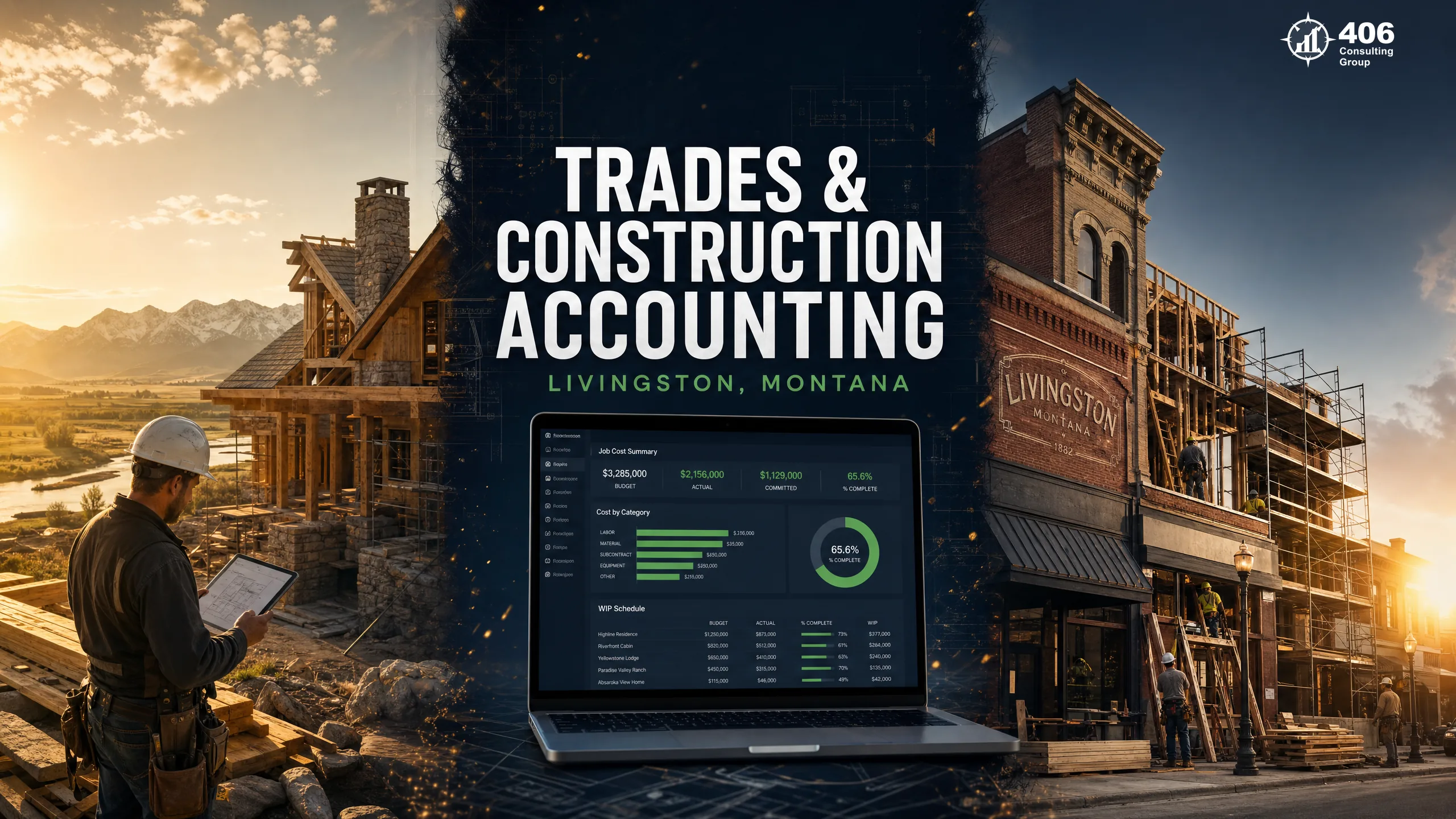
Livingston has always been Yellowstone's original gateway, and that address is doing something interesting to its building market. Priced-out demand spilling east from Bozeman is filling in housing along the I-90 corridor; Paradise Valley keeps drawing high-end custom homes, guest ranches, and working-ranch improvements south toward Gardiner; the historic downtown is being renovated storefront by storefront; and a tourism-and-hospitality economy of hotels, restaurants, and short-term rentals builds and remodels on the back of Yellowstone traffic. For the framers, electricians, plumbers, concrete and timber crews, and general contractors working all of it — often in Park County's famous wind — the calendar stays full. What makes the accounting its own animal is Montana's particular rulebook, and it looks nothing like the sales-tax states beyond the passes.
Three Montana realities shape a contractor's books here more than transplants expect. There's no state sales tax whatsoever, so the "consumer of your materials" puzzle that eats Idaho and Utah contractors alive simply isn't part of the job. Montana issues no general-contractor license — it runs on contractor registration and Independent Contractor Exemption Certificates instead, while electricians and plumbers hold state licenses. And Montana enforces its own prevailing-wage law on public work, so certified payroll turns up on far more than federal jobs. Wrap job costing, WIP, and equipment around a market this seasonal and this spread out, and construction bookkeeping becomes a discipline of its own. This guide walks all of it — from a Montana firm, delivered across the state.
By Jason Anderson — Co-Founder, 406 Consulting Group. A Montana firm, big-firm-trained — serving contractors and trades across the state, from job costing and WIP to the Montana rules that decide whether a Park County bid holds its margin.
Quick Answer: Accounting for a Livingston Contractor
- →No state sales tax in Montana — nothing to pay or collect on materials, and no consumer-vs-retailer question to untangle.
- →No GC license — you register as a contractor with the Dept. of Labor & Industry, or hold an ICEC if you run without employees; electricians and plumbers are state-licensed.
- →Montana runs its own prevailing wage (Little Davis-Bacon) on public works, so certified payroll is not just a federal-job concern.
- →State income tax (top rate ~5.9%, verify), workers' comp (State Fund or private), and a business-equipment tax with a large exemption fill out the frame.
- →Delivered by a Montana firm — statewide, remote-friendly, and fluent in the rules Park County builders actually work under.
Table of Contents
Why Construction Accounting Is Its Own Discipline
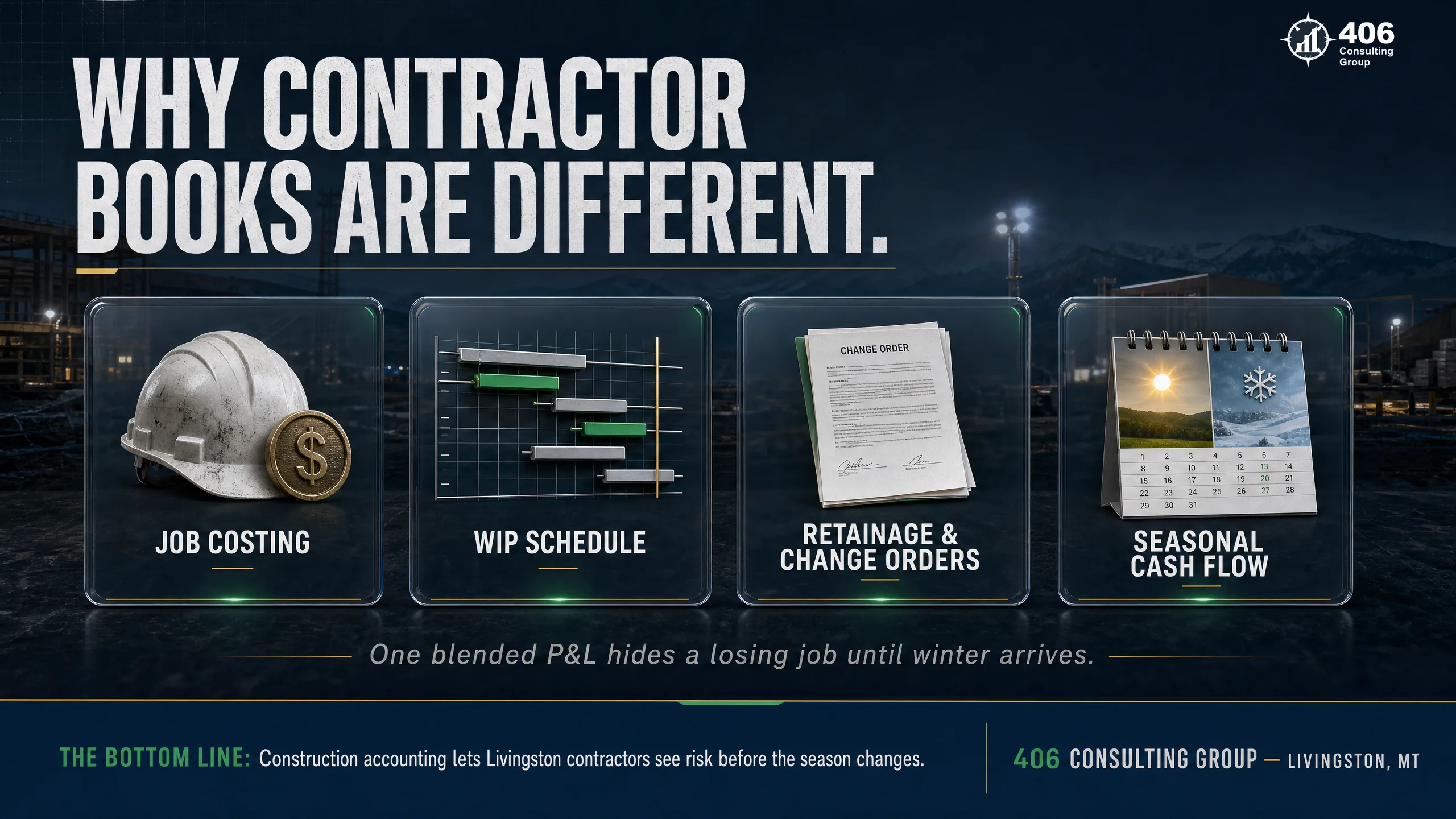
A construction company hides its real numbers in corners ordinary bookkeeping never checks. Revenue lands as draws on projects that stretch across seasons; costs fan out over labor, materials, subcontractors, and equipment that each must be tied back to the right job; owners hold retainage until closeout; change orders keep sliding the finish line; and a single underpriced contract can quietly eat the margin off several profitable ones. Books that only sort the bank feed and square up once at tax time leave a builder guessing on the two questions that actually matter: is this job beating its estimate, and is the company as a whole making money?
A Livingston contractor might run a Paradise Valley custom home, a downtown storefront remodel, and a ranch outbuilding in the same month — three cost structures that a single blended P&L will happily average into a lie.
On top of that variety sits Montana's own rulebook, which doesn't line up with the states next door. The seasonality of a Yellowstone-gateway market sharpens it further: a strong summer can paper over a job that lost money, and you won't feel it until the slow months arrive. Getting the accounting, the registration, and the Montana tax and wage rules right is what lets a Park County builder turn a busy season into a stronger business instead of a cash-flow scare.
It begins with Montana's tax and registration frame — which, with no sales tax in the picture, is simpler in some places and stricter in others than most newcomers assume.
The Montana Contractor Tax & Registration Picture
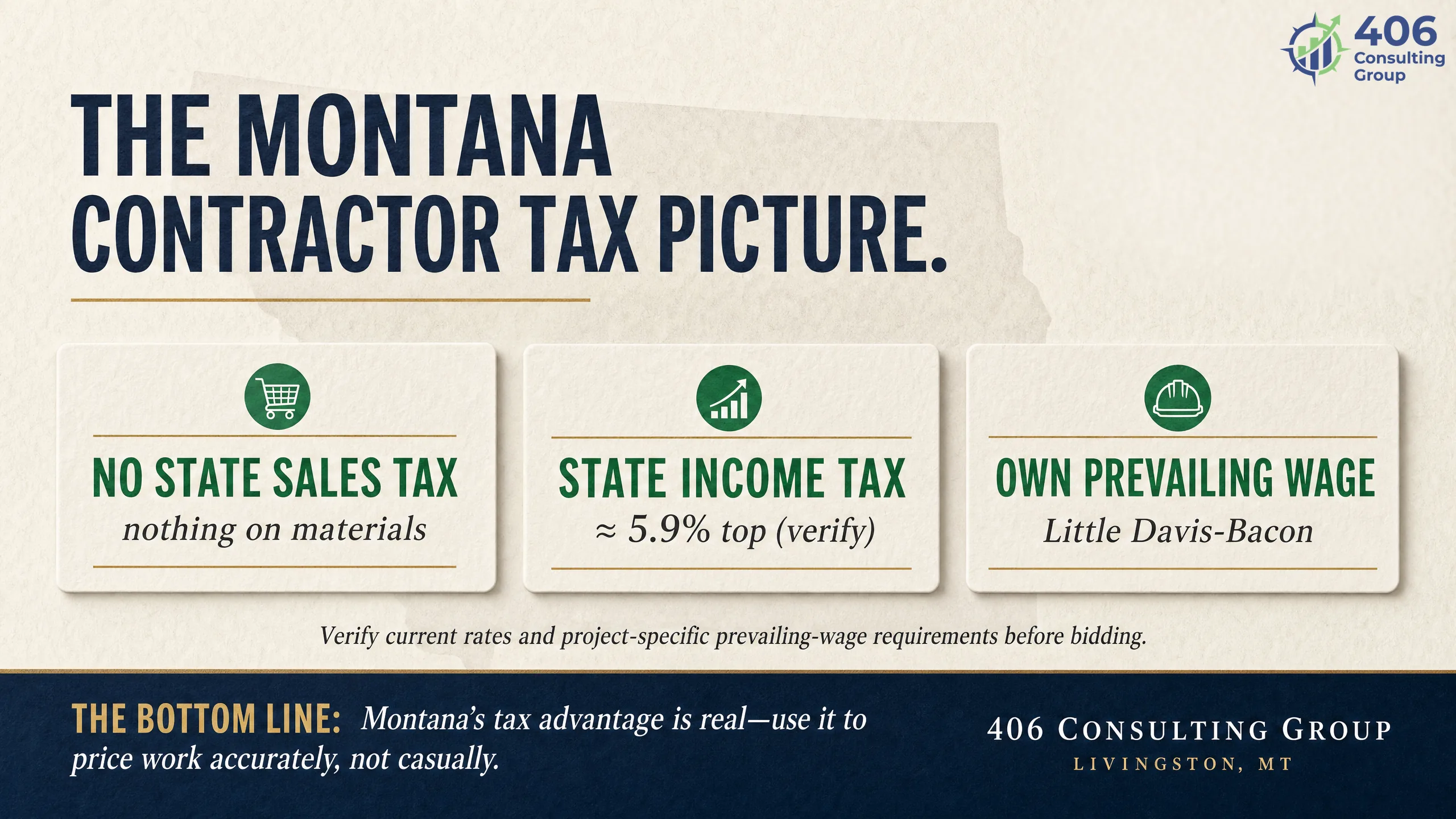
Montana is a genuine outlier: no sales tax, no GC license, but a real prevailing-wage law of its own. Here's the frame a Livingston contractor operates inside:
| Item | What it means for a contractor |
|---|---|
| Sales & use tax | None — Montana levies no general sales tax, so materials carry no tax to pay or collect (mind purchases and jobs across a state line) |
| State income tax | Yes — top rate near 5.9% (verify current) on your pass-through profit |
| Contractor status | No GC license; register with DLI as a contractor, or carry an ICEC when you work without employees |
| Trade licensing | Electricians and plumbers hold state licenses; local permits and inspections still apply |
| Prevailing wage | Montana's own Little Davis-Bacon on public works above a threshold — with federal Davis-Bacon layered on for federal jobs |
| Workers' comp | Required; competitive market — a private carrier or the Montana State Fund, not a monopoly |
| Equipment | Business-equipment tax applies, but a large exemption (raised in recent years — verify) clears many contractors |
Pin down the current rates and rules with the Montana Department of Revenue, and confirm registration, licensing, and prevailing-wage specifics with the Montana Department of Labor & Industry. Of everything here, prevailing wage is the piece that blindsides the most Park County contractors — so give it a hard look before you bid public work.
Registration, ICECs & Trade Licensing (Not a GC License)
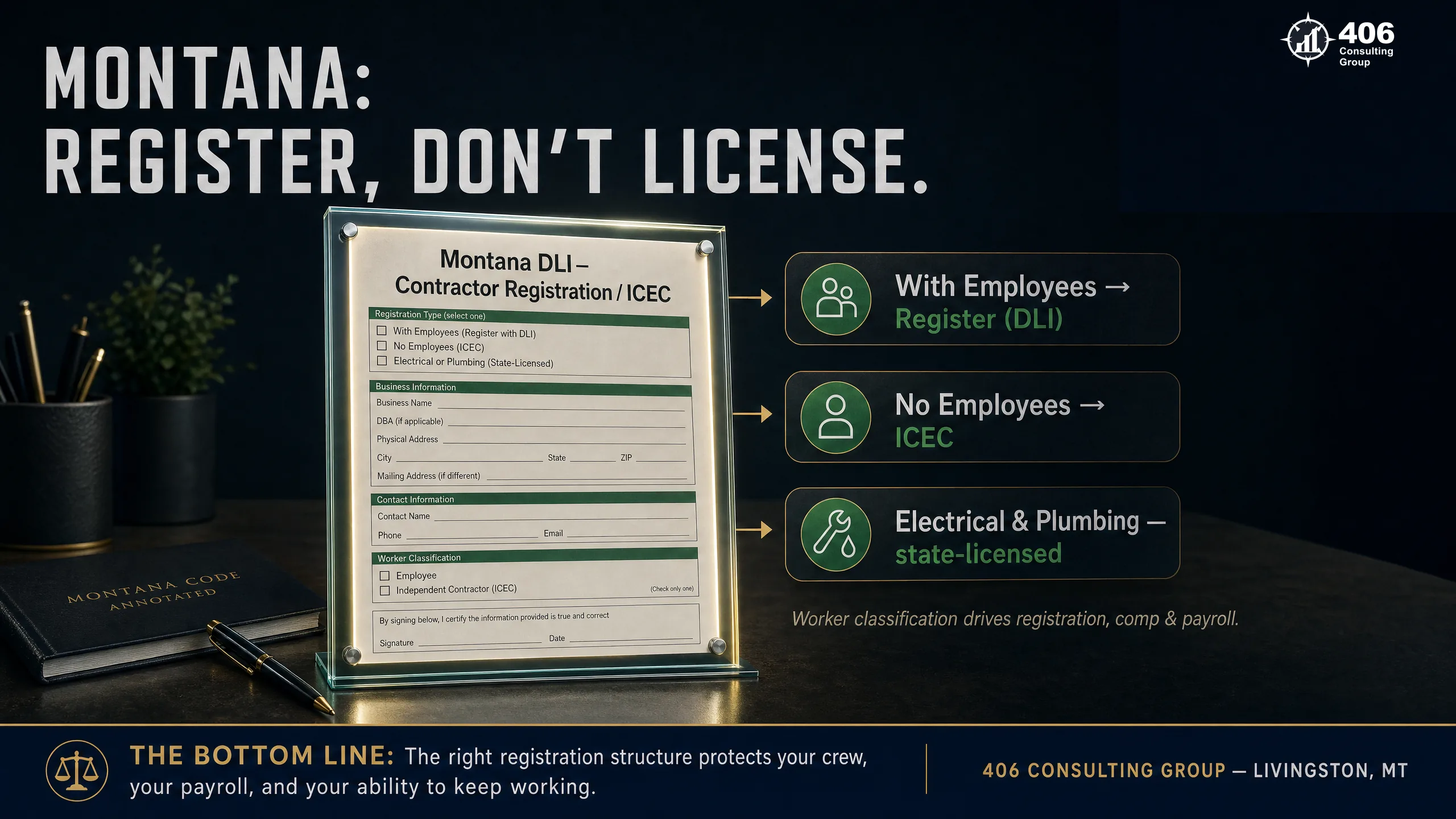
Montana skips the general-contractor licensing exam that states like Utah require. In its place, a contractor with employees generally has to register as a contractor with the Department of Labor & Industry, while a contractor working solo, without employees, typically holds an Independent Contractor Exemption Certificate (ICEC) — the paperwork that certifies you're truly independent and carry your own coverage. That line is where much of Montana's compliance trouble begins: whether the people on your crew count as employees or genuine independents drives registration, workers' comp, and payroll all at once.
In a small market like Livingston, where crews flex up for summer and lean out for winter, worker classification isn't a footnote — it's the setting that quietly governs your comp, your payroll, and your registration.
The specialty trades run on their own track: electricians and plumbers are licensed at the state level through their boards, and Park County and the City of Livingston add local permits and inspections on top. In the books, registration, ICEC status, and trade licenses are recurring obligations with real teeth if they lapse or a worker is misclassified — and once you bid public or bonded work, your financial statements become part of what backs your bonding. Confirm your exact registration, ICEC, and licensing requirements with the Montana Department of Labor & Industry.
Nail down worker classification and registration first — in Montana, it's the quiet hinge the rest of your compliance swings on.
No Sales Tax: What That Actually Means for Materials
Montana is one of the few states that levies no general sales tax, and for a contractor that's a real edge. There's no sales or use tax to pay on lumber, wire, pipe, or fixtures, no "consumer or retailer" riddle to solve, and no tax line to bake into a bid or hand back to the state. Next to a builder in Idaho or Utah, a whole stratum of cost and paperwork just isn't there.
Two cautions survive that break, though. First, skipping the tax doesn't excuse sloppy material tracking — every invoice still has to hit the right job at its true cost, or your job costing wanders and your bids lose their footing; the discipline is identical, tax or no tax. Second, a Yellowstone-gateway contractor buys and builds near state lines more than most — order materials from a supplier in a sales-tax state, or take a job just across a border, and that state's sales or use rules can reach you. Inside Montana, materials stay clean and simple, which frees your bookkeeping attention for the work that actually decides profit: job costing and WIP.
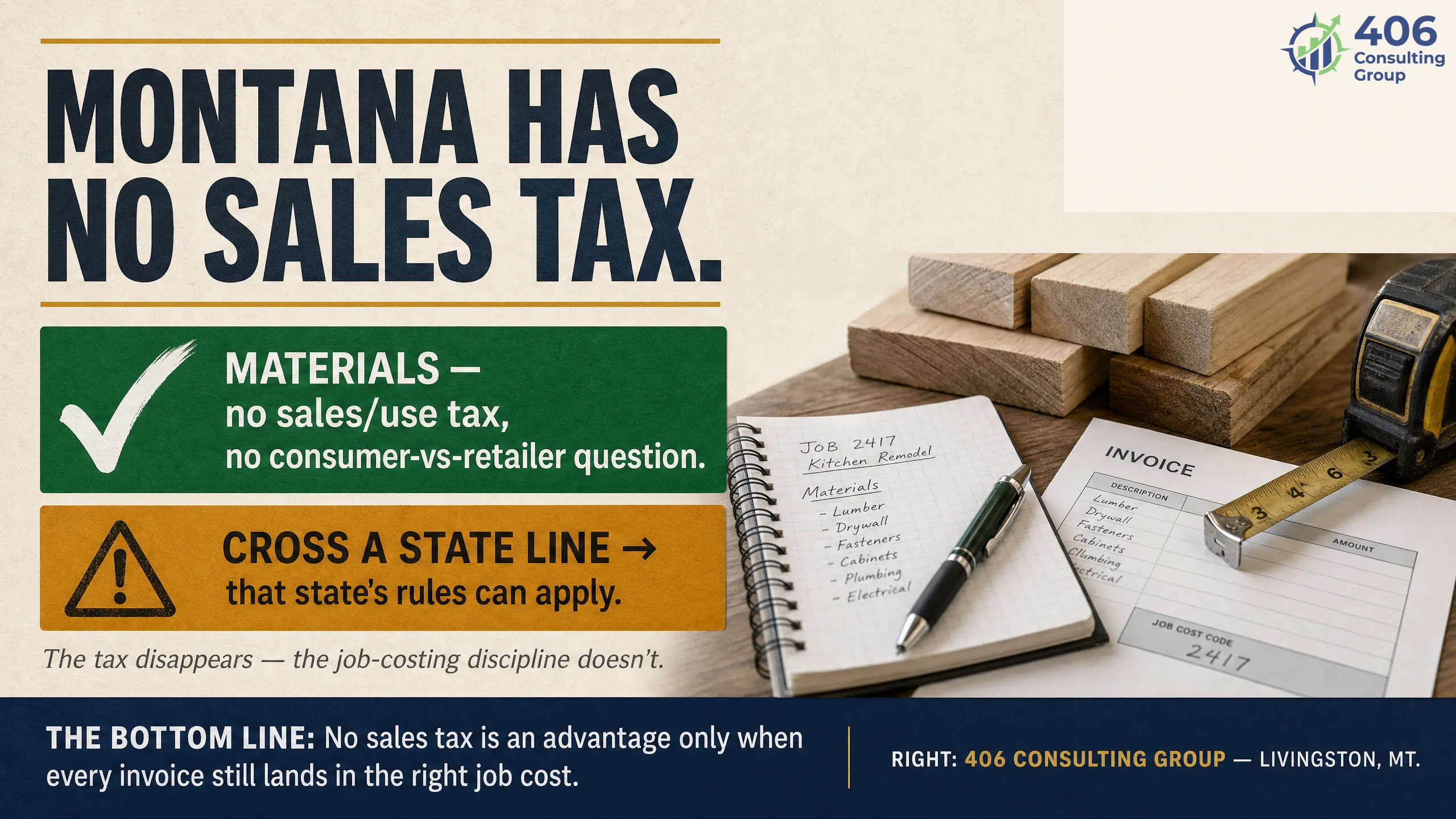
If you routinely buy or build across a state line, confirm how the other state's tax touches your work with the Montana Department of Revenue and that state's tax agency.
Building Paradise Valley & the Yellowstone Gateway
Livingston's construction market has a character all its own, distinct from Bozeman's just over the hill. Paradise Valley drives a steady stream of high-end custom homes, guest ranches, and working-ranch improvements running south toward Gardiner. A tourism-and-hospitality economy built on Yellowstone traffic keeps hotels, restaurants, and short-term rentals in a cycle of building and remodeling. The historic downtown — one of Montana's best-preserved — feeds ongoing renovation and adaptive-reuse work with its own preservation quirks. And Bozeman's overflow, priced buyers moving east along I-90, keeps residential demand in and around town well ahead of supply, alongside the ranch and agricultural building that has always anchored Park County.
A seasonal, tourism-tied market carries its own trap: a booming summer can mask a job that quietly lost money, and the shortfall only surfaces when the valley empties out for winter. More work turns into a stronger company only when you can read the margin on each job and carry the business across the slow months — which takes job costing, a live WIP schedule, and a cash forecast, not just a full summer. The Park County builders who come out of each season healthier are the ones whose books kept pace with the backlog.

Growth only counts when it's profitable — and in a seasonal market, that's a bookkeeping question well before it's a sales one.
Job Costing: Which Job Actually Makes Money
When the summer schedule fills up, the easy call is to keep taking work — but without job costing, you can't separate the projects carrying your company from the ones bleeding it dry. Job costing lays every labor hour, every material invoice, every subcontractor bill, and every hour of equipment time onto the job that incurred it, so each project's real margin stands alone instead of dissolving into a company-wide average. The day you can see that a Paradise Valley custom build runs thin on labor while your downtown remodels carry the year, you bid and chase work with entirely different judgment.
It's also the bedrock the rest of your reporting rests on — a reliable WIP schedule, accurate progress billing, and clear-headed change-order calls all need job-level costs beneath them. For a Livingston contractor working a seasonal, high-variety market, few habits do more to keep a busy year genuinely profitable rather than merely busy.
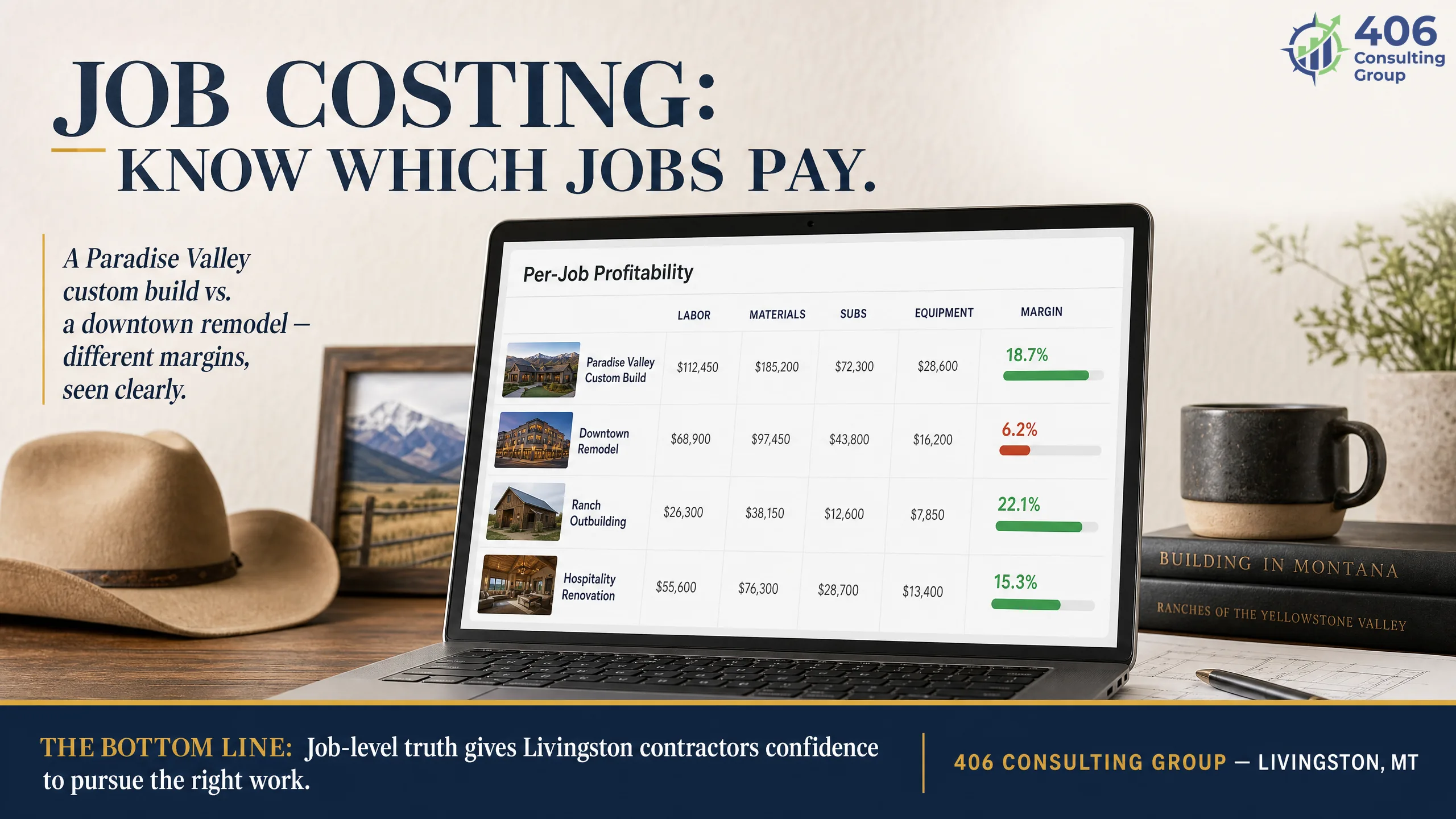
Working out which jobs and crews genuinely carry the business is the entire aim of our contractor unit economics work — and job costing is what brings the answer into view.
WIP, Percentage-of-Completion, Retainage & Change Orders
Jobs that run across seasons need a view a plain ledger can't give. A work-in-progress (WIP) schedule lines up each open job's costs, billings, and estimated cost-to-complete, and the gap between them reveals whether you're over- or under-billed. Bill ahead of the work and the extra cash can flatter your position while costs keep coming; bill behind it and you're bankrolling the owner out of your own pocket. Percentage-of-completion ties recognized revenue to how far the job has truly progressed, keeping the monthly picture honest instead of back-loaded to the end.
Add retainage — the slice held to closeout, which locks up cash and belongs in its own receivable — and change orders, which move scope and margin and must be logged and priced before the work vanishes into the job. In a seasonal market where your open jobs cluster into a few busy months, that WIP discipline is what keeps a packed summer from masquerading as a profitable one — and it's the first report your banker and bonding agent will want to see.

As you grow, this is where a controller or CFO function starts to pay for itself — and our Montana WIP and job-costing deep dive walks the mechanics job by job.
Payroll, Workers' Comp & Montana Prevailing Wage
Montana construction payroll has several levers, and one routinely ambushes contractors who've worked elsewhere. Since Montana taxes income, each check carries Montana withholding next to the federal lines. Employees have to be covered by workers' comp, and here the market is open — a private carrier or the state-chartered Montana State Fund will both quote you, with no monopoly in the middle — and construction class-code rates run high enough that they belong in burdened labor and job costs. The lever that surprises people is prevailing wage: Montana keeps its own statute, Little Davis-Bacon, over public-works contracts above a dollar threshold, demanding the state's standard or heavy/highway rates plus certified payroll — a requirement wholly apart from federal Davis-Bacon and stacked on top of it on federally funded jobs.
Montana prevailing wage
Little Davis-Bacon hits public jobs over a threshold — certified payroll and set rates, not just on federal work.
Competitive workers' comp
Buy from a private carrier or the Montana State Fund; construction class-code rates ride in burdened labor.
State withholding
Montana income-tax withholding runs beside federal on every construction paycheck.
So certified payroll surfaces on more Montana work than most expect — a school, a municipal building, or a stretch of infrastructure can all trigger it — and payroll has to be built to generate accurate certified reports and tie that labor back to the job. Add routing every hour to a job for costing and keeping a defensible line between employees and ICEC holders, and clean payroll setup stops being a nicety.
Our payroll work — Montana and federal certified payroll included — keeps every piece of it running quietly in the background.
Equipment, Depreciation & Montana's Business Equipment Tax
Equipment lands on the books from two sides. Federally, Section 179 and bonus depreciation can move much of a truck, loader, or machine into the year-of-purchase deduction — handy as you gear up for a busy season, though a decision to weigh against your multi-year income rather than take on reflex. On the Montana side, the state assesses a business-equipment tax on machinery and equipment, but a large exemption — lifted substantially in recent years, so confirm the current threshold — means many smaller contractors owe little or nothing, while bigger fleets should track it carefully and check where they fall.
A clean, current fixed-asset schedule pulls double duty: it keeps depreciation and any business-equipment reporting accurate, and — because a machine's hours belong on the job that ran them — it feeds job costing, so an idle rig reads as the cost it is instead of dissolving into overhead. Know what you own, what each piece costs to run, and which job it's parked on.
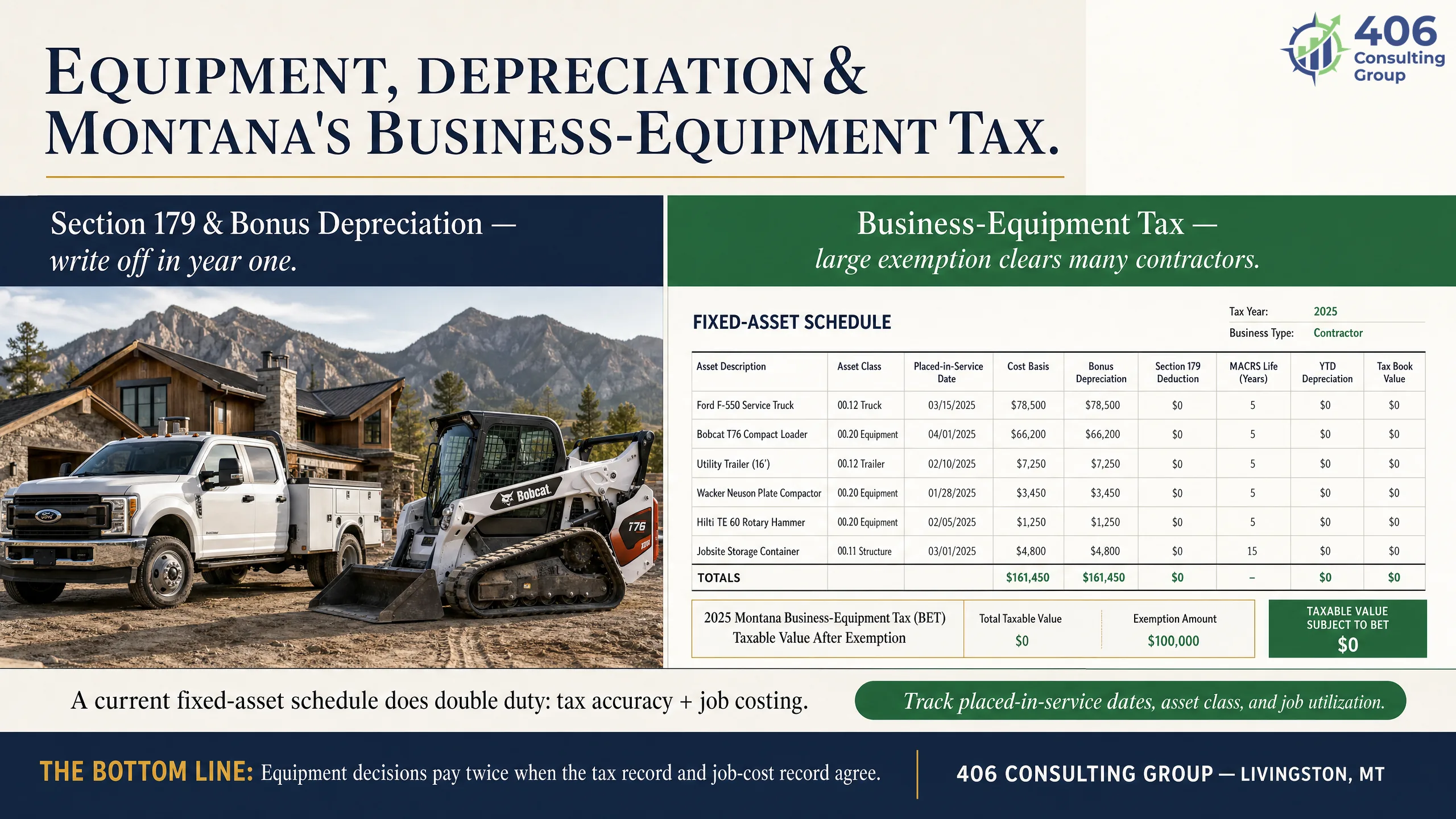
The depreciation strategy and Montana income-tax planning live in the Livingston tax guide; the tracking that powers both starts in the books.
Common Construction Bookkeeping Mistakes
A short list of avoidable errors drives most of the financial pain for Livingston contractors — and a seasonal market makes every one of them bite harder.
Getting worker classification and ICEC status wrong
Employee or true independent decides registration, comp, and payroll at once — miss it and Montana can unwind the whole thing at real cost.
Reading no sales tax as no discipline
Montana spares you the tax, not the bookkeeping — materials still have to land on the right job at real cost, or costing and bids drift.
Overlooking Montana prevailing wage on public work
Little Davis-Bacon triggers on public jobs over a threshold; wrong rates or missing certified payroll stall payment and stack up liability.
Riding a good summer without job costing
In a seasonal boom a losing job wears the same face as a winner on the P&L — with no per-job read, you notice only when winter arrives.
Letting the WIP schedule slide
Over- and under-billing bury where each job really stands, and no surety grows your bonding on Paradise Valley-scale work without a clean WIP.
None of these are talent problems — they're setup and habit. Build the books for Montana construction, close them on a dependable monthly rhythm, and they stop recurring.
A Montana Firm, Delivered Statewide
You can find a solid bookkeeper in Livingston without trying hard — but construction is its own specialty, and Montana construction runs on a rulebook most generalists never open. What actually matters isn't whether your accountant keeps an office on Main Street; it's whether they know contractor registration and ICECs, Montana prevailing wage and certified payroll, State Fund workers' comp, the business-equipment tax, and how to run true job costing and a bonding-grade WIP. We're a Montana firm — those rules are our daily work — and we serve Park County builders the same whether we're down the block or across the state.
In a town this size, the right accountant is rarely the nearest one — it's the one who already knows Montana construction cold and can serve you wherever the work is.
Our workflow suits a builder's day: cloud accounting and job-costing software, receipts and hours captured from the field, connected bank feeds, and a dependable monthly close — Montana-literate construction books without a drive into an office. From Livingston and Paradise Valley to Gardiner and out across Park County, you get a firm that already speaks Montana construction, not a generalist learning it on your dime.
What settles it is whether your accountant truly knows Montana construction — and being a Montana firm, that's the exact ground we stand on.
How to Get Started
Getting a Livingston contractor's books in order comes down to three steps.
Get the Montana pieces right
Keep contractor registration or ICEC status and any electrical/plumbing licenses current, confirm worker classification, and set up workers' comp cleanly with a carrier or the State Fund.
Build construction-grade books
Stand up phase-level job costing, a bonding-grade WIP schedule, retainage and change-order tracking, a fixed-asset schedule, and certified payroll for Montana and federal prevailing-wage work.
Run it monthly
A genuine monthly close, a WIP review, and job-level reporting — so you know which jobs pay and can carry the business across the slow season.
Unsure where your books stand right now? Our Financial Maturity Assessment lays it out in about eight minutes.
FAQ: Livingston Construction Accounting
Do I need a contractor's license in Montana?
Not the way most states mean it. Montana runs no general-contractor exam and issues no GC license. With employees, you register as a contractor with the Department of Labor & Industry; working on your own, you generally hold an Independent Contractor Exemption Certificate (ICEC) attesting that you're truly independent and carry your own coverage. The credentialed trades are electricians and plumbers, licensed through their state boards, and you'll still pull permits and pass inspections through Park County and the City of Livingston. The piece worth front-loading: how you classify the people on your crew sets your registration, your comp, and your payroll all at once — so settle that before the season ramps. The Montana Department of Labor & Industry can confirm what your setup requires.
Does Montana have a sales tax on construction materials?
Correct — Montana is one of the rare states with no general sales tax, so the lumber, wire, pipe, and fixtures you buy for a job carry no sales or use tax, and you never have to settle whether you're the consumer or the retailer the way an Idaho or Utah contractor does. That's an entire layer of cost and paperwork you simply skip. Two things still hold, though. Dropping the tax doesn't drop the discipline — each invoice has to land on the right job at real cost or your costing and bids wander. And because a gateway-town contractor often shops or builds close to a state line, a purchase or a job that crosses into a sales-tax state can bring that state's rules into play. For anything cross-border, check with the Montana Department of Revenue and the neighboring state's agency.
Is there prevailing wage or certified payroll in Montana?
Yes — and it's the rule that blindsides newcomers most. Montana keeps its own prevailing-wage statute, widely known as Little Davis-Bacon, entirely apart from the federal version. Once a public-works contract clears a set dollar threshold, you owe the state's standard or heavy/highway prevailing rates and have to file certified payroll for every worker on it. In practice, certified payroll is no federal-only chore — a county building, a school, or a stretch of infrastructure can each bring it into play, and a wrong rate or a late report can freeze your payment. Take a federally funded job and federal Davis-Bacon layers on as well. Since the trigger rides with the project, verify each one with the Montana Department of Labor & Industry.
How does Livingston's seasonal market change how I should run my books?
A Yellowstone-gateway economy compresses much of the year's work into a busy warm-weather stretch, and that seasonality is exactly where books go wrong. A strong summer can carry a money-losing job for months, and you won't feel the shortfall until the valley quiets down for winter. Job costing is what surfaces the problem early — it drops every labor hour, material bill, sub invoice, and equipment charge onto the job that caused it, so you see each project's real margin instead of a blended number that averages your winners and losers. Pair that with a live WIP schedule and a cash forecast and you can price the next season, carry the business through the slow months, and tell a genuinely profitable year from a merely busy one.
Can 406 Consulting Group handle my Livingston construction bookkeeping?
Yes. Being a Montana firm, we already work inside the framework Park County builders deal with daily: contractor registration and ICECs, Little Davis-Bacon prevailing wage and certified payroll, State Fund or private workers' comp, the business-equipment tax, and Montana's no-sales-tax treatment of materials. The day-to-day runs on cloud accounting and job-costing tools, with field-captured receipts and hours, linked bank feeds, and a monthly close you can count on — so distance never changes the service, whether you're in town or two valleys over. For a construction business the deciding factor isn't proximity but fluency in job costing, WIP, and Montana's specific compliance, and that fluency is what a Montana firm brings by default. From Livingston to Paradise Valley to Gardiner, you're hiring a team that already speaks Montana construction instead of one billing you to learn it.
Keep Reading
Trades & Construction — Livingston, MT
Build the Yellowstone Gateway on Books You Can Trust.
406 Consulting Group keeps Livingston and Paradise Valley contractors clean and compliant — contractor registration, Montana prevailing wage, job costing, WIP, and equipment handled — by a Montana firm that knows Montana construction.
Livingston Construction Quick Reference
Livingston, MT — Park County
Building in Park County?
Registration, prevailing wage & WIP, handled.
About the Author
Jason Anderson
Co-Founder, 406 Consulting Group
A Montana firm, big-firm-trained, serving contractors and trades statewide. Jason helps Park County builders keep registration and certified payroll current, run real job costing and WIP, and carry the business profitably through a seasonal market.
Read the Full Story