
Trades & Construction Accounting in Nashville, TN:
Build Nashville on Books You Can Trust
In Tennessee you're the consumer of your materials, you need a state contractor's license, and there's no prevailing wage — but your entity still owes F&E. The accounting a Nashville contractor really needs.

Few cities are building the way Nashville is — high-rises and hotels downtown, healthcare campuses, mixed-use across the counties, and residential racing to house relentless in-migration. For the framers, electricians, plumbers, HVAC and concrete crews, and general contractors chasing it, the backlog is deep. What makes the accounting its own discipline is Tennessee's particular setup: no personal income tax, but a Franchise & Excise tax on your entity, a high sales tax you pay on your materials as the consumer, a state contractor's license most owners underestimate, and — a relief compared with many states — no state prevailing wage.
Three things shape a Tennessee contractor's books most. On real-property work you're the consumer of your materials — you pay sales/use tax (~9.25% in Nashville) when you buy them and don't bill the customer for it. Tennessee requires a state license for most projects over $25,000, through the Board for Licensing Contractors. And your entity owes F&E even though there's no income tax. Wrap job costing, WIP, and equipment around a market moving this fast, and clean construction books become their own discipline. This guide walks all of it, delivered remotely.
By Jason Anderson — Co-Founder, 406 Consulting Group. Big-firm-trained accountant serving contractors and trades — job costing, WIP, and the state rules, Tennessee's included, that decide whether a bid holds its margin.
Quick Answer: Accounting for a Nashville Contractor
- →You're the consumer of your materials: pay Tennessee sales/use tax (~9.25%) at purchase and don't bill the owner sales tax on real-property work.
- →State contractor license required for most projects $25,000+ (Tennessee Board for Licensing Contractors); trades like electrical, plumbing, and HVAC are separately licensed.
- →No state prevailing wage — only federal Davis-Bacon on federally funded jobs.
- →No income tax, but F&E on the entity (6.5% excise + 0.25% franchise); workers' comp is required for construction employers with any employees.
- →Delivered remotely — Tennessee construction expertise over office proximity.
Table of Contents
Why Construction Accounting Is Its Own Discipline
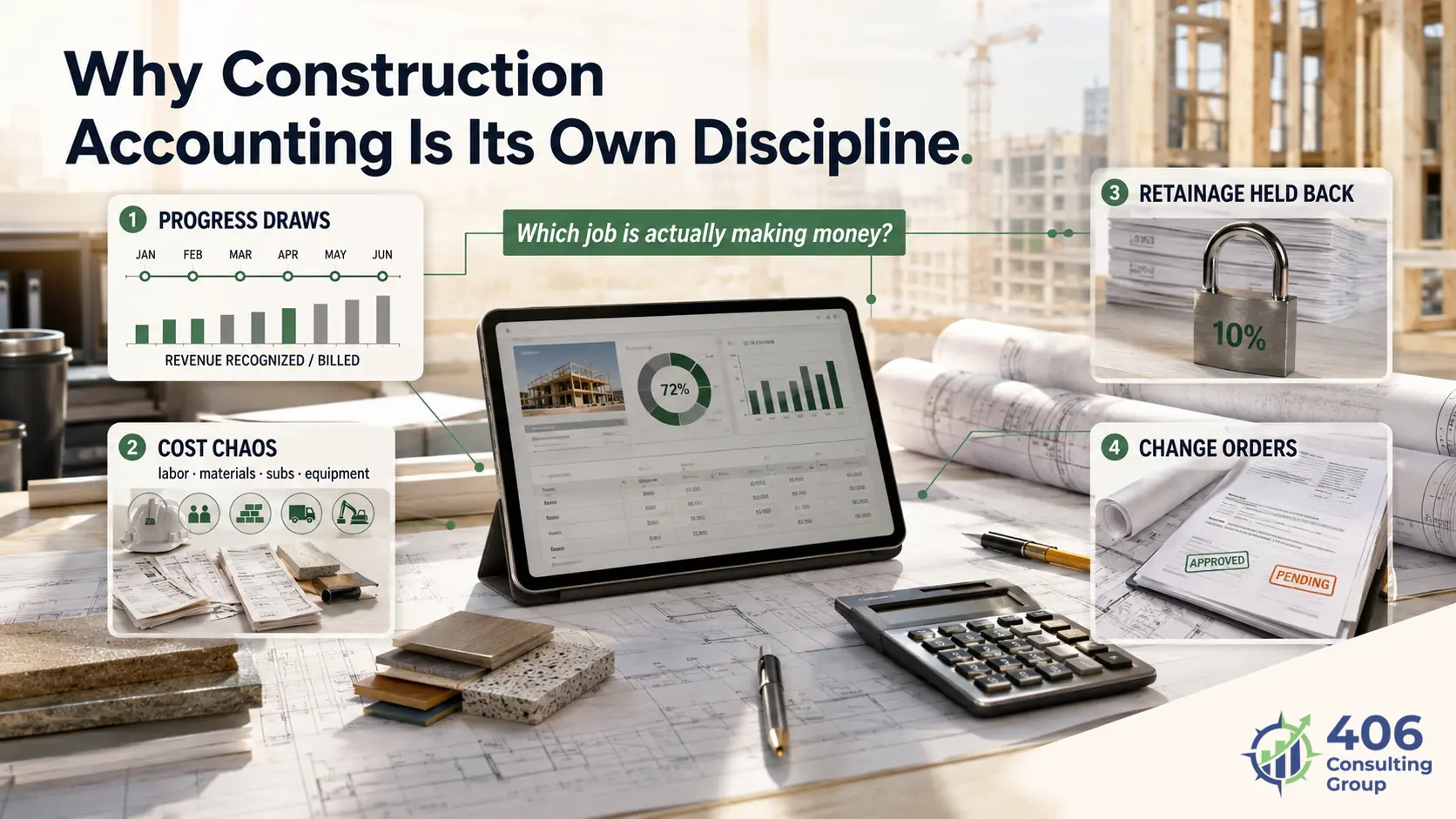
A contracting company hides its real numbers from ordinary bookkeeping. Revenue arrives as progress draws on jobs that run for months; costs scatter across labor, materials, subs, and equipment that each have to land on the right project; the owner holds retainage; change orders keep moving the target; and one underpriced bid can quietly swallow the profit from several good ones. Books that just categorize the bank feed and reconcile at tax time leave a builder guessing on the two questions that matter: is this job beating its estimate, and is the company as a whole making money?
In a market growing as fast as Nashville, a costing blind spot you could shrug off at a dozen jobs a year turns expensive at forty — and at a 9.25% materials-tax rate, forgetting to price the tax into a bid quietly erases the margin before you break ground.
Nashville raises the stakes with pace and with a tax setup that catches transplants off guard — materials tax you eat as the consumer, an F&E bill despite "no income tax," and a state license gating the bigger work. Getting the books, the licensing, and Tennessee's tax rules right is what lets a Nashville contractor grow with the boom instead of getting buried by it.
Start with Tennessee's tax and licensing frame — it's not what the "no income tax" line suggests.
The Tennessee Contractor Tax Picture
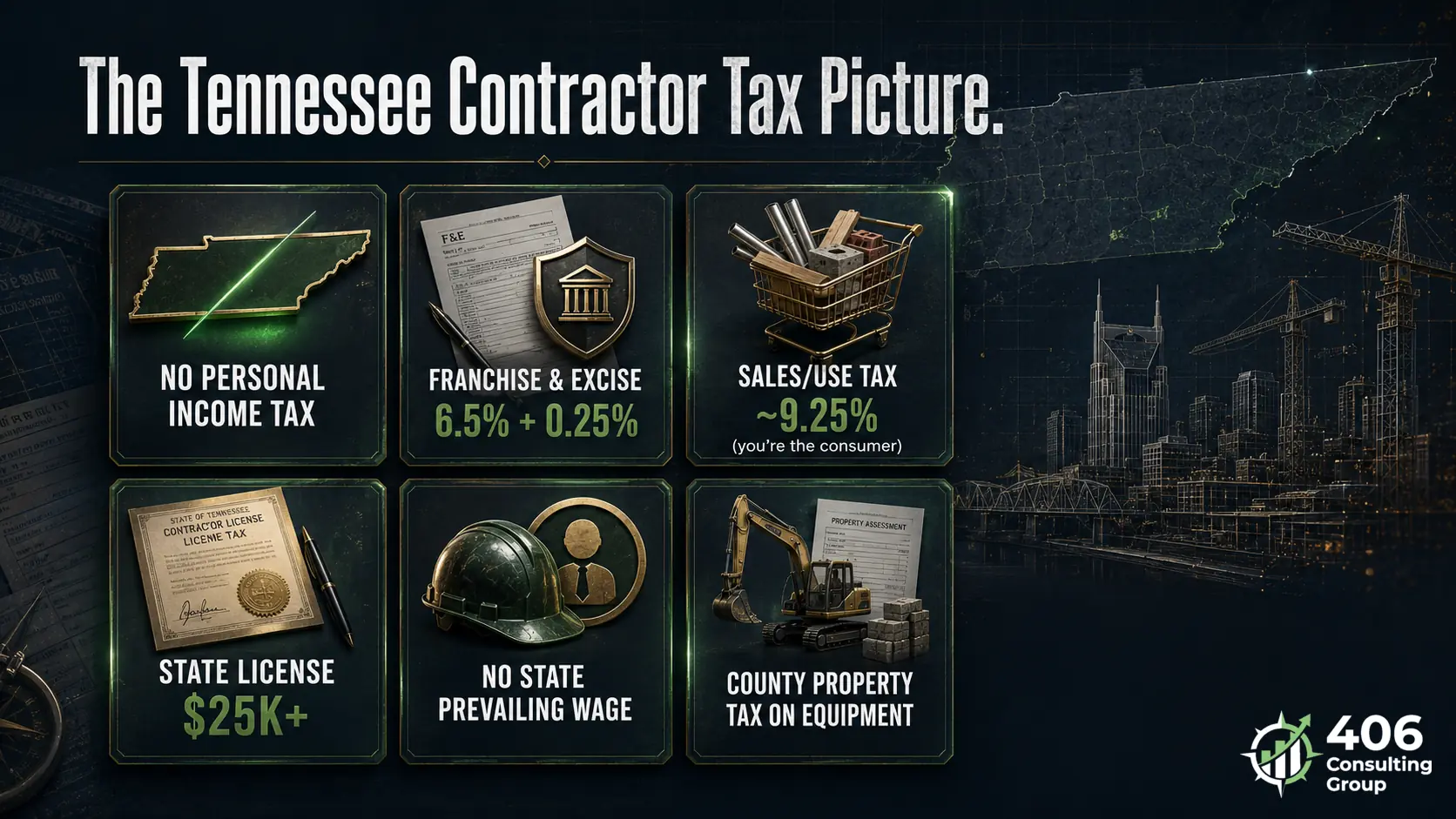
Tennessee pairs no personal income tax with an entity tax and a high sales tax. Here's the frame a Nashville builder works inside:
| Item | What it means for a contractor |
|---|---|
| Sales & use tax | ~9.25% in Nashville; on real-property work you're the consumer — pay it on materials, don't bill the customer |
| Personal income tax | None — no tax on your wages or pass-through profit personally |
| Franchise & Excise tax | 6.5% excise on net earnings + 0.25% franchise on net worth, at the entity (sole props exempt) |
| Licensing | State contractor's license for most jobs $25,000+; electrical/plumbing/HVAC separately licensed |
| Prevailing wage | No Tennessee state prevailing wage — only federal Davis-Bacon on federal jobs |
| Workers' comp | Required for construction employers with any employees; competitive market |
| Equipment | County tangible personal-property tax on machinery and tools — track it |
Verify current rates and rules with the Tennessee Department of Revenue and licensing with the Tennessee Board for Licensing Contractors. The state license and the materials tax are the two pieces that catch contractors most, so start there.
Tennessee's State Contractor License
Unlike states that leave general-contractor licensing to cities, Tennessee runs a real state licensing regime through the Board for Licensing Contractors. A contractor generally needs a state license before bidding or contracting on projects of $25,000 or more (the threshold applies to prime contractors and to major trades), and the license comes with a monetary limit and classification tied to a reviewed financial statement — which means your books directly affect how much work you're allowed to take. Electricians, plumbers, and HVAC contractors carry their own licensing, and residential home-improvement work has its own rules in some counties.
Here's the part that surprises people: Tennessee sets your license limit off a reviewed financial statement. Clean, credible books don't just keep you compliant — they determine the size of job you're legally allowed to bid.
For the books, that means the license, its financial-statement requirement, and any trade licenses are recurring obligations with real consequences — bidding over your limit or unlicensed can cost you the job and bring penalties. As you grow, the financial statement behind your license is exactly what a stronger balance sheet raises. Confirm your classification, limit, and requirements with the Tennessee Board for Licensing Contractors.

The license gets you working — and its limit grows with your financials. The rule that shapes every invoice is how Tennessee taxes your materials.
You're the Consumer: Sales/Use Tax on Materials
Tennessee generally treats a construction contractor as the end user of the materials permanently installed into real property. That means you pay sales or use tax when you buy the lumber, wire, pipe, and fixtures — you don't add sales tax to the owner's contract for the construction. The tax on your materials is a cost of doing the job, not a charge you collect and remit like a retailer. In Nashville, with a combined rate around 9.25%, that's a big number — and it has to live in your estimate.
The whole game: build the materials tax into your bid at the price you actually paid, ~9.25% included — or every estimate comes in short before the first day on site.
Two wrinkles matter. Use tax catches materials bought without Tennessee tax — an out-of-state supplier, an online order — and you owe it just the same, a commonly missed liability. And if part of your business sells materials over the counter without installing them, that side can be taxed as ordinary retail, so mixed operations need clean separation in the books. Handled right, the tax stays predictable and your pricing stays honest.

Confirm how the rule and use tax apply to your specific work with the Tennessee Department of Revenue — especially if you both install and sell.
Building Nashville: The Construction Boom
Nashville's construction market has a character worth building your books around. Commercial and high-rise work fills the downtown core; healthcare construction follows the region's hospital and management sector; hospitality — hotels, venues, and entertainment builds — rides the tourism boom; and residential and mixed-use stretch across Davidson and the fast-growing collar counties like Williamson and Rutherford to house the in-migration. It's a deep, mixed runway that rewards contractors who can price and cost very different job types accurately.
The lesson of a boom is counterintuitive: fast growth is where contractors most often lose money, because volume hides thin or negative margins until the cash runs short. Taking on more work only builds a stronger business if you can see the margin on each job and fund the growth — which means job costing, a real WIP schedule, and a cash forecast, not just a fuller schedule. It's also how you keep the financial statement behind your license strong enough to bid bigger work.

Growth is only good growth if it's profitable — and that's a bookkeeping question before it's a sales one.
Job Costing: Which Job Actually Makes Money
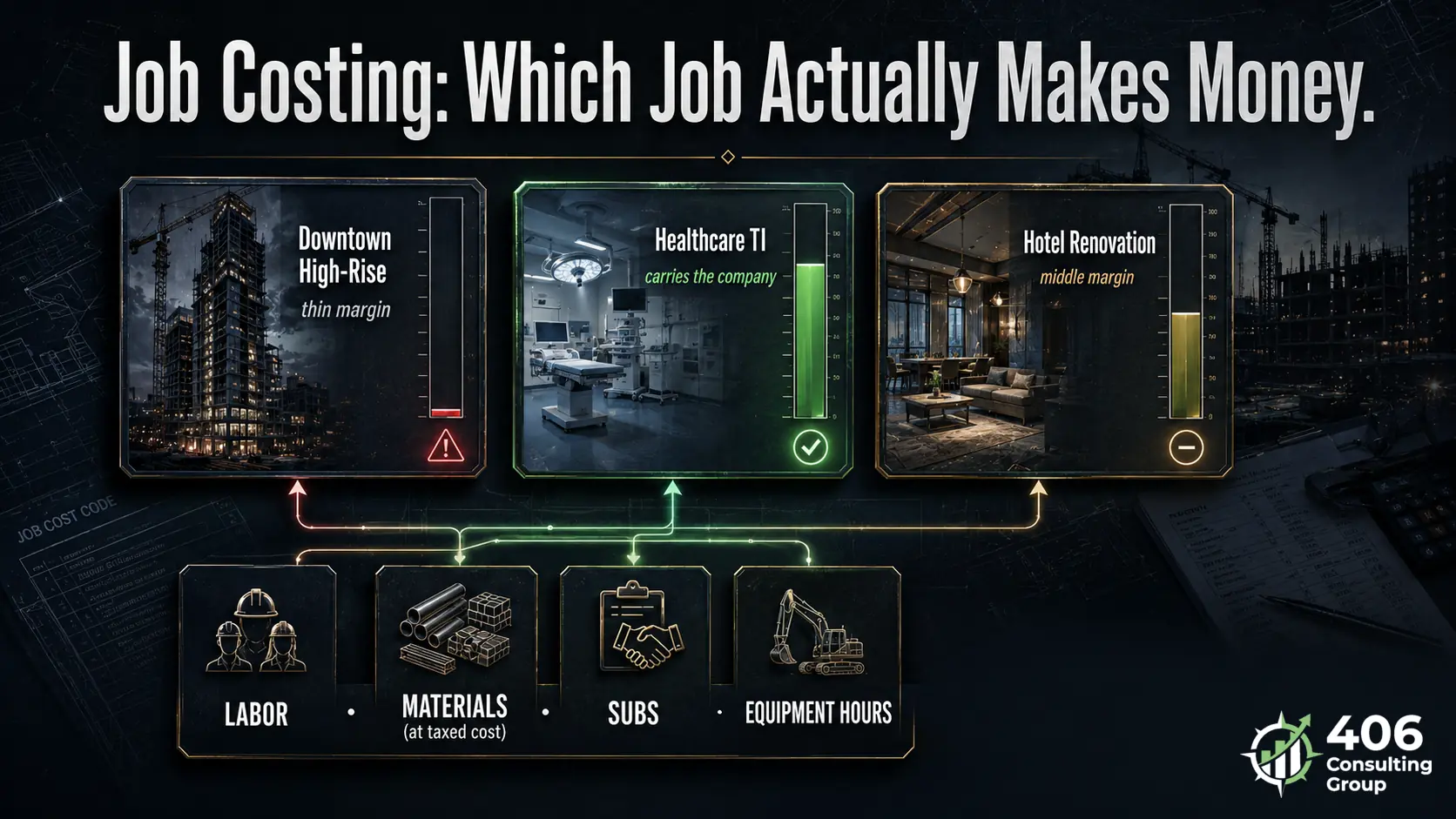
In a market this busy, the temptation is to keep saying yes — but without job costing, you can't tell the jobs that build your business from the ones quietly draining it. Job costing assigns every labor hour, every material invoice (at its taxed cost), every subcontractor bill, and every hour of equipment time to the specific project, so each job's true margin stands on its own instead of disappearing into a company-wide average. When you can see that a downtown high-rise runs thin while your healthcare tenant-improvement work carries the company, you bid and chase very differently.
It's also the layer the rest of your reporting stands on — an accurate WIP schedule, correct progress billing, and honest change-order decisions all require job-level costs beneath them. For a Nashville contractor scaling fast, job costing is the single most important habit for keeping the growth profitable rather than just large.
Figuring out which jobs and crews genuinely carry the business is the whole point of our contractor unit economics work — and job costing is what makes the answer visible.
WIP, Percentage-of-Completion, Retainage & Change Orders
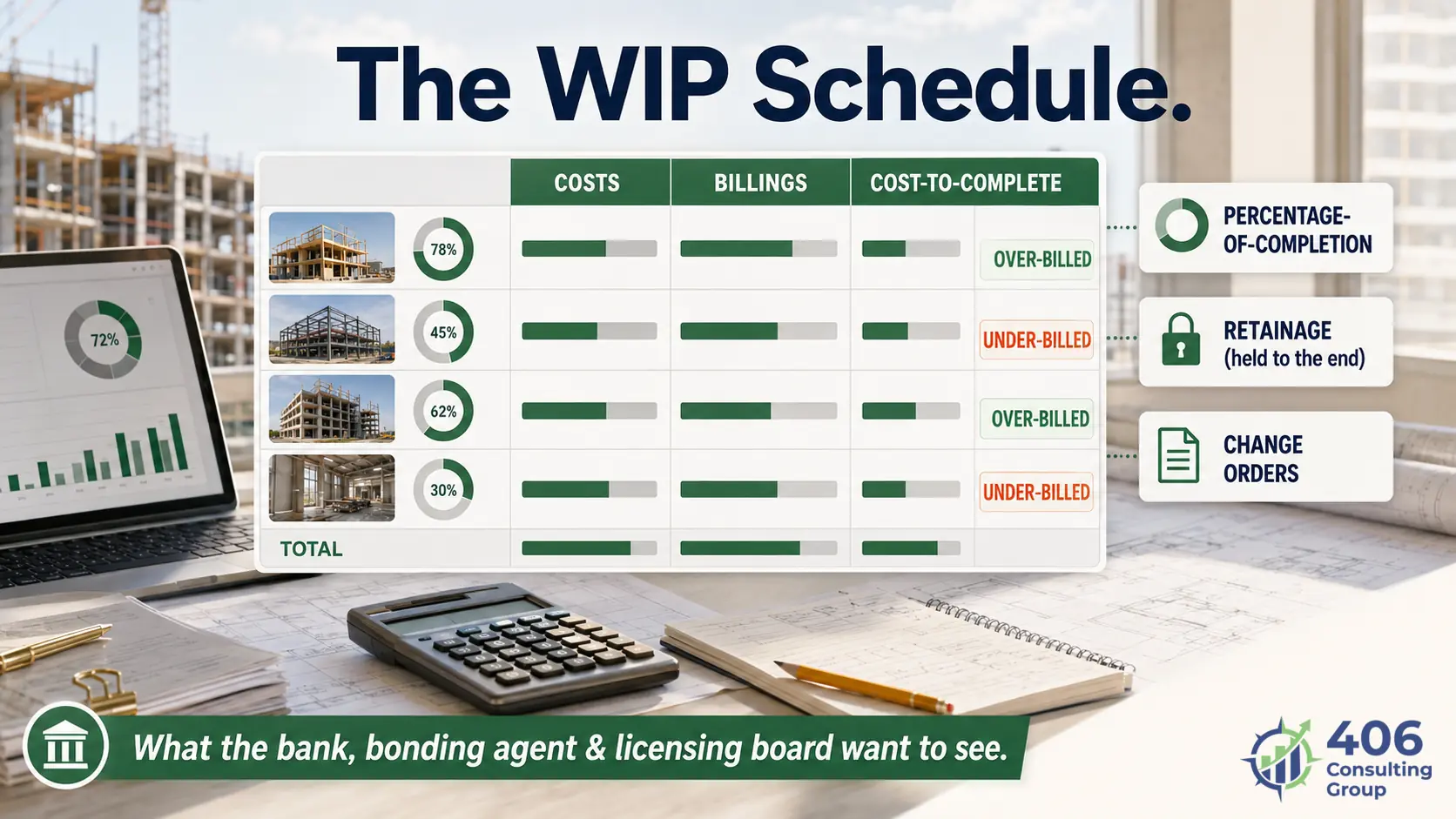
Jobs that span months need reporting a plain ledger can't give you. A work-in-progress (WIP) schedule holds each open job's costs, billings, and estimated cost-to-complete together, so the relationship among them reveals whether you're over- or under-billed. Bill out ahead of the work and the surplus can flatter your cash while the costs are still coming; bill behind it and you're quietly lending the owner your working capital. Percentage-of-completion ties revenue to how far the job has actually gotten, keeping the monthly picture honest.
Add retainage — the slice held back to the end, which parks cash and belongs in its own receivable — and change orders, which shift scope and margin and must be logged and priced before the work gets absorbed into the job. In a growth market where you may be running more open jobs than ever, WIP discipline keeps a busy schedule from masquerading as a profitable one — and a clean WIP is exactly what a bonding agent, a bank, and the licensing board's financial review all want to see.
As you scale, this is where a controller or CFO function becomes worth it — the WIP is the report that tells you where the business truly stands.
Payroll, Workers' Comp & No Prevailing Wage
Tennessee construction payroll is comparatively light on the tax side and specific on the insurance side. Because Tennessee has no personal income tax, there's no state income-tax withholding — one fewer line on every check than an income-tax state. You still handle federal payroll taxes and Tennessee unemployment insurance. And on prevailing wage, Tennessee is a relief: there's no state prevailing-wage law, so those obligations arise only from the federal Davis-Bacon Act on federally funded projects.
No state withholding
No Tennessee income tax means no state withholding to run — federal payroll only, plus TN unemployment.
Workers' comp required
Construction employers with any employees must carry it — stricter than the 5-employee rule for other industries.
No state prevailing wage
Certified payroll only shows up on federal Davis-Bacon jobs — not on state or local public work.
Beyond that, construction payroll means tracking labor to jobs so it feeds job costing, and handling a heavy mix of subcontractors and 1099s with correct worker classification — an area that draws scrutiny in a fast-growing trades market. Set up cleanly, payroll becomes accurate data flowing into your job costs rather than a monthly scramble.
Our payroll work — certified payroll on any federal job included — keeps it running quietly in the background.
Equipment, Depreciation & the F&E Angle
Equipment reaches the books from a few directions in Tennessee. Federally, Section 179 and bonus depreciation can pull a large share of a truck, lift, or machine into the deduction for its purchase year — helpful as you scale, but a decision to weigh against your multi-year income rather than a reflex. Because the 6.5% excise tax is based on your net earnings, a Section 179 deduction generally trims that state bill too (Tennessee adds back federal bonus depreciation, so time that piece with the add-back in mind). And the county assesses a tangible personal-property tax on your machinery and tools, filed on an annual schedule.
A clean, current fixed-asset scheduledoes triple duty: it keeps depreciation and the property filing accurate, it feeds the F&E calculation, and — because equipment hours belong on the jobs that used them — it feeds job costing so an idle machine shows up as the cost it is rather than hiding in overhead. Track what you own, what it costs to run, and where it's working.
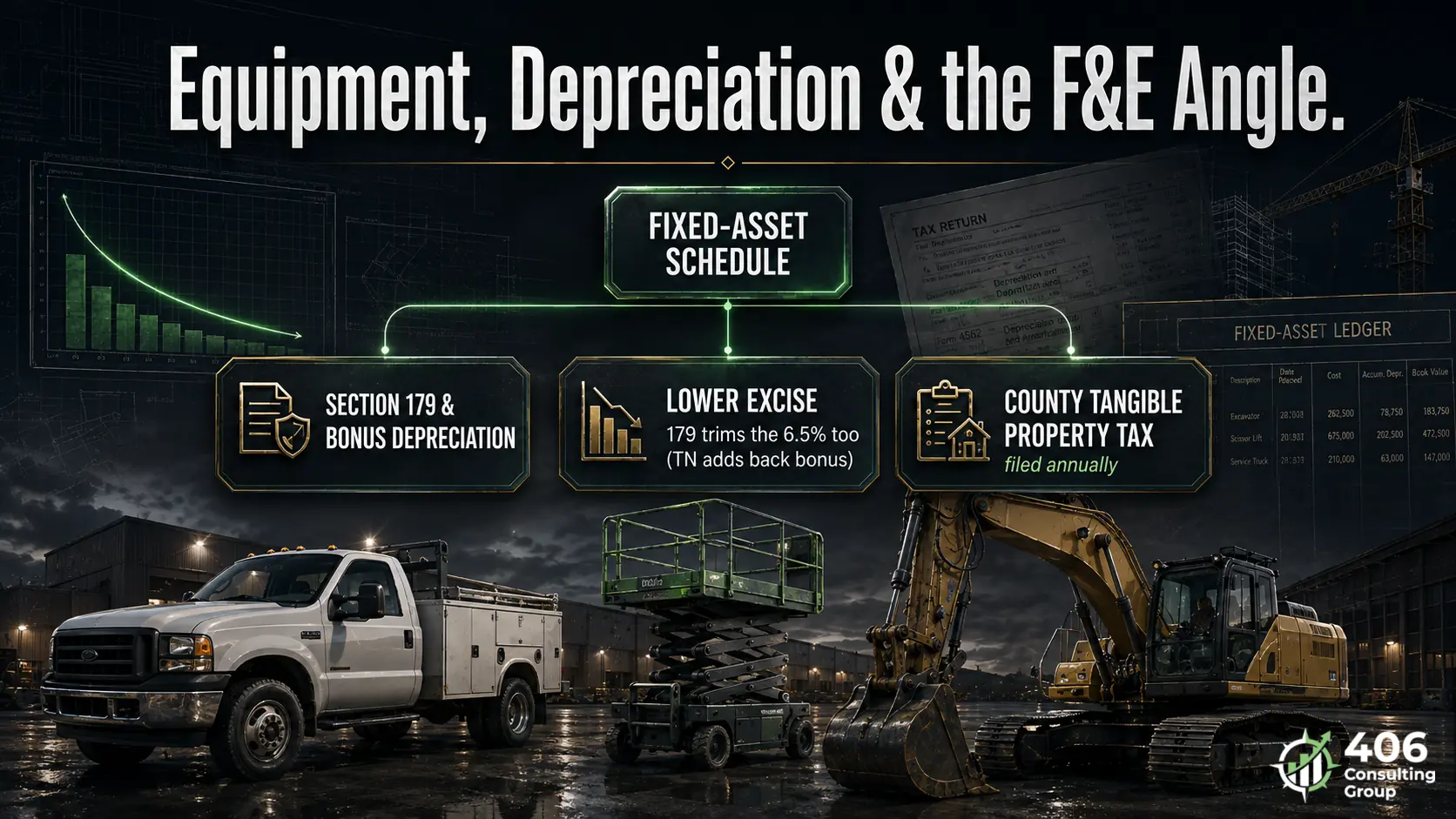
The depreciation strategy and Tennessee F&E planning live in the Nashville tax guide; the tracking that powers it starts in the books.
Common Construction Bookkeeping Mistakes
A handful of avoidable errors cause most of the financial pain for Nashville contractors — and a fast market makes each one bite harder.
Bidding materials at the pre-tax price
You pay Tennessee sales/use tax as the consumer at ~9.25%, so it's a job cost — leave it out, or miss use tax on an out-of-state order, and the estimate is short before day one.
Underestimating the state license
Bidding over your license limit or without a license can cost you the job and bring penalties — and the limit is tied to your financial statement.
Forgetting F&E after incorporating
Owners who ran as a sole prop don't realize the LLC or S-corp switched on the 6.5% excise and 0.25% franchise tax.
Growing without job costing
In a boom, volume hides thin margins; without per-job costs you can scale straight into losing money and not see it until cash is tight.
Ignoring the WIP schedule
Over- and under-billing mask where each job stands, and no surety or licensing review will love a bonding-scale contractor without a clean WIP.
None of these are hard problems — they're setup gaps. Build the books for Tennessee construction, close them every month, and they simply stop happening.
Local vs. a Great Remote Partner
A Nashville contractor's day runs between the job site and the truck, not an accountant's lobby — so a remote partner already matches how the business works. The question that matters is expertise: can your accountant handle Tennessee construction — the consumer-of-materials sales-tax rule, the state license and its financial-statement limit, F&E on the entity, job costing across commercial, healthcare, and residential work, and a bonding-grade WIP?
A specialist who lives in Tennessee's construction rules, wherever they sit, beats a nearby generalist who's never priced the consumer-of-materials rule into a bid or built the financial statement a license limit rides on.
Our workflow fits a builder's day: cloud accounting and job-costing software, receipts and hours captured from the field, connected bank feeds, and a monthly close you can rely on — Tennessee-literate construction books with no trip across town. Whether you're downtown, out in Williamson or Rutherford County, or anywhere across Middle Tennessee, the service and the expertise are the same.
What matters is whether your accountant knows Tennessee construction — the office location is beside the point.
How to Get Started
Getting a Nashville contractor's books in order is three steps.
Get the Tennessee pieces right
Keep the state license (and any trade licenses) current, price materials sales/use tax into every bid as a job cost, and set up workers' comp cleanly.
Build construction-grade books
Stand up phase-level job costing, a bonding- and license-grade WIP schedule, retainage and change-order tracking, a fixed-asset schedule, and certified payroll for any federal work.
Run it monthly
A dependable monthly close, a WIP review, sales/use-tax handling, and per-job reporting — so you know which jobs pay and can grow your license limit and bond the next one.
Not sure where your books stand today? Our Financial Maturity Assessment gives you a straight read in about eight minutes.
FAQ: Nashville Construction Accounting
Do I need a contractor's license in Tennessee?
Usually yes for meaningful work. Tennessee runs a state licensing regime through the Board for Licensing Contractors, and a contractor generally needs a state license before bidding or contracting on projects of $25,000 or more — the threshold covers prime contractors and major trades. The license carries a monetary limit and classification tied to a reviewed financial statement, so your books directly affect how large a job you can legally take. Electricians, plumbers, and HVAC contractors are separately licensed, and residential home-improvement work has its own rules in some counties. Confirm your requirements with the Tennessee Board for Licensing Contractors.
Do Tennessee contractors charge customers sales tax on a job?
Generally not on real-property construction. Tennessee treats a contractor who permanently installs materials into real property as the end user of those materials, so you pay sales or use tax when you buy them — around 9.25% in Nashville — and don't charge the property owner sales tax on the construction itself. That makes materials tax part of your job cost, which has to sit in your estimates at the taxed price. Use tax applies to materials bought without Tennessee tax, such as out-of-state or online orders. If you also sell materials at retail without installing them, that side can be taxed like normal sales. Confirm the details with the Tennessee Department of Revenue.
Is there prevailing wage or certified payroll in Tennessee?
There's no Tennessee state prevailing-wage law, so on ordinary private, city, county, and state work there's no state prevailing wage or certified payroll to file — a relief compared with many states. Certified payroll only enters the picture on federally funded projects, where the federal Davis-Bacon Act sets the wage rates and requires certified payroll for each worker. Because that obligation follows federal funding, confirm it project by project. Separately, workers' compensation is required for construction employers with any employees in Tennessee — stricter than the five-employee threshold that applies to other industries.
Does a Nashville contractor pay Tennessee business tax even with no income tax?
Yes, if you operate through an entity. Tennessee has no personal income tax, but the Franchise & Excise tax applies to LLCs, S-corps, and corporations: 6.5% excise on net earnings plus 0.25% franchise on net worth, at the entity level. Sole proprietors and general partnerships are generally exempt, so forming an entity for liability protection also switches on F&E. Because the excise is based on net earnings, deductions like Section 179 that lower your income generally lower it too. There's also a county tangible personal-property tax on your equipment. Confirm specifics with the Tennessee Department of Revenue.
Can 406 Consulting Group do my Nashville construction bookkeeping remotely?
Yes — a builder's office is the truck and the trailer, so working with a remote accountant matches how you already operate. Everything runs on cloud accounting and job-costing software, with field-captured receipts and hours, live bank feeds, and a monthly close you can rely on. For a Tennessee construction business the deciding factor is expertise — the consumer-of-materials rule, the state license and its financial-statement limit, F&E, job costing, and WIP — not how close the office is. We serve Nashville and Middle Tennessee contractors the same whether you're downtown, in Williamson County, or out toward Rutherford.
Keep Reading
Trades & Construction — Nashville, TN
Build Nashville on Books You Can Trust.
406 Consulting Group keeps Nashville contractors clean and compliant — the consumer-of-materials rule, the state license financial statement, F&E, job costing, and WIP handled — delivered remotely, by a firm that knows Tennessee construction.
Nashville Construction Quick Reference
Nashville, TN — Davidson County
Building in Middle Tennessee?
Materials tax, license financials & WIP, handled.
About the Author
Jason Anderson
Co-Founder, 406 Consulting Group
Big-firm-trained accountant serving contractors and trades. Jason helps Nashville builders handle Tennessee's consumer-of-materials rule, keep the state license financial statement strong, run real job costing and WIP, and grow profitably through the boom.
Read the Full Story