
Trades & Construction Accounting in St. George, UT:
Build Greater Zion on Books You Can Trust
Utah licenses contractors through DOPL — exam, education, and a bond — and makes you the consumer of your materials, all while Washington County builds at record pace. The accounting a St. George contractor really needs.

Few small metros in the country have grown the way St. George has. Retirees and remote workers keep arriving from California and the Wasatch Front, and Washington County has become a magnet for active-adult communities, custom and second homes, resort and hospitality projects, and the subdivisions spreading across Washington Fields, Little Valley, and out toward Hurricane and Ivins. Layer in the tourism pull of Greater Zion and Snow Canyon, and the pipeline for the trades — framers, concrete and masonry, HVAC built for desert heat, electricians, plumbers, and general contractors — stays deep. What sets the accounting apart is Utah's particular setup: genuine state licensing, a sales/use tax that lands on your materials, a flat income tax, and workers' comp on top.
Two Utah rules surprise contractors most. The state licenses contractors directly — with pre-license education, an exam, and a bond — so the license is a standing obligation you have to keep current, not a one-time hurdle. And on the materials you install, Utah generally treats you as the consumer: you pay the tax when you buy, instead of billing it to the homeowner or developer. Add job costing, WIP, and equipment to a market expanding this fast, and construction books turn into a discipline of their own. This guide covers all of it — delivered remotely.
By Carrie Anderson — Co-Founder, 406 Consulting Group. Commercial banking and underwriting background — 300+ loan reviews — serving contractors and trades across the Mountain West, from job costing and WIP to the state rules that decide whether a bid holds its margin.
Quick Answer: Accounting for a St. George Contractor
- →Utah licenses contractors through DOPL — pre-license education, an exam, and a bond — so the license is a standing obligation, not a one-time filing.
- →You're the consumer of your materials: Utah sales/use tax is paid at purchase, and you don't add sales tax to a real-property job.
- →Flat ~4.5% income tax and workers' comp (private, competitive market — required) fill out the Utah frame.
- →Explosive Washington County growth — retirement communities, resorts, and second homes — makes job costing and WIP matter more, not less.
- →Delivered remotely — the natural fit for a contractor whose desk is the truck.
Table of Contents
Why Construction Accounting Is Its Own Discipline
A contracting company keeps its truth in places ordinary bookkeeping never looks. Cash arrives as draws on projects that run for months; costs fan out across labor, materials, subcontractors, and equipment that each has to be tied back to the right job; the owner holds retainage until the very end; change orders keep moving the target; and a single underpriced contract can quietly eat the margin from several profitable ones. Software that only sorts the bank feed and squares up at tax time leaves a builder flying blind on the two questions that decide everything: is this job beating its estimate, and is the company actually earning a profit?
In St. George, that difficulty compounds because the market is expanding at a pace few places match and Utah takes contractor licensing seriously. When you're framing an active-adult community, a red-rock custom home, and a Washington Fields subdivision in the same stretch, speed magnifies every gap in the books — a costing blind spot you could absorb at a dozen jobs a year gets expensive at forty. Getting the accounting, the DOPL license, and the Utah tax rules right is what lets a Washington County builder ride the growth instead of drowning in it.
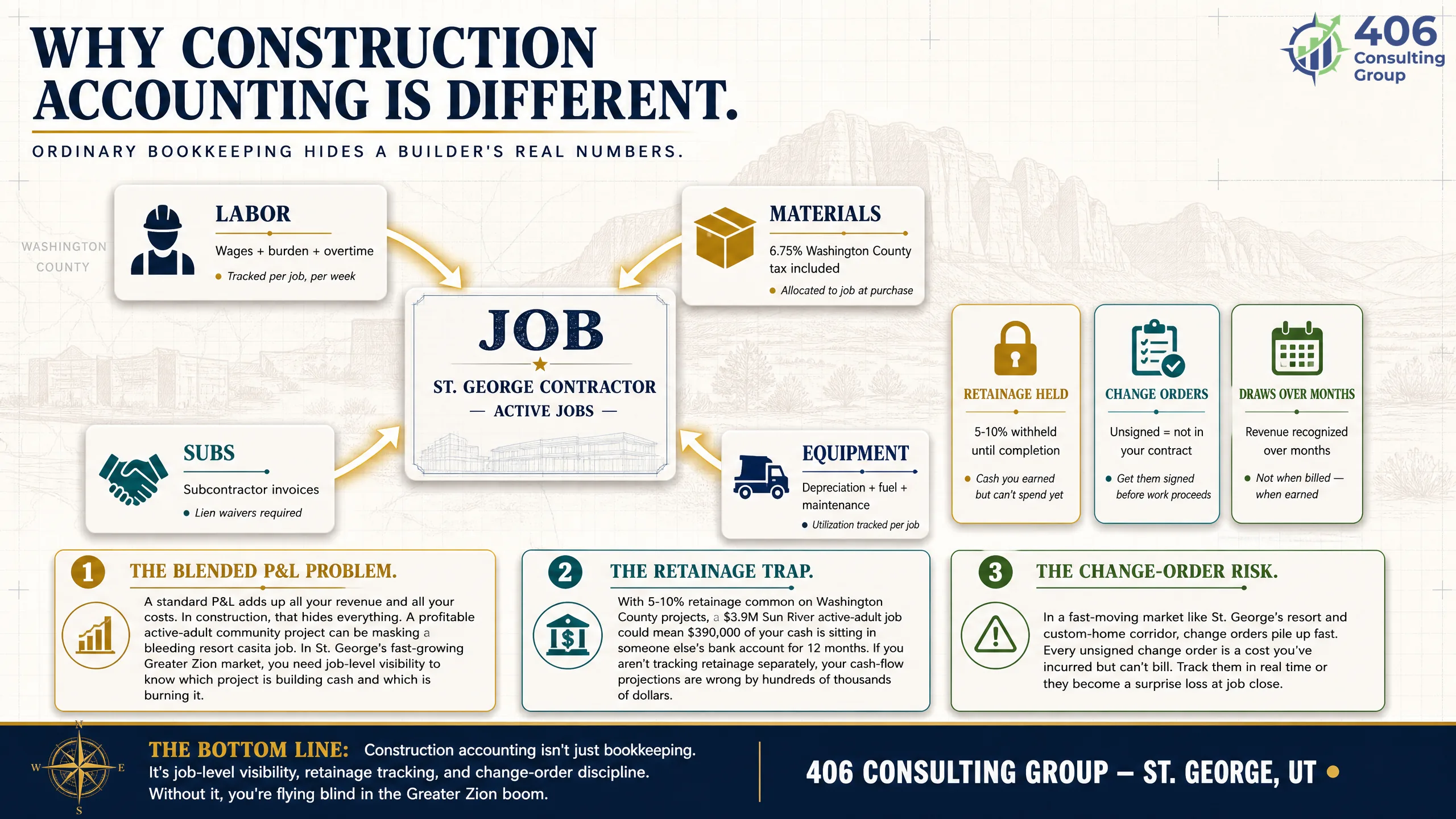
It begins with Utah's tax and licensing frame — and here the licensing side carries more weight than most newcomers expect.
The Utah Contractor Tax & Licensing Picture
Utah stays moderate on taxes and firm on licensing. Here's the frame a St. George contractor operates inside:
| Item | What it means for a contractor |
|---|---|
| State income tax | Flat rate, around 4.5% (verify current) on pass-through profit |
| Sales & use tax | ~6.75% in the St. George/Washington County area (verify); on real-property work you're the consumer of the materials |
| Contractor license | State-licensed through DOPL — experience, pre-license education, exam, and a bond |
| Prevailing wage | No Utah state prevailing wage — only federal Davis-Bacon on federally funded jobs |
| Workers' comp | Required; bought on the competitive private market (not a state-monopoly fund) |
| Equipment | Business personal property assessed by Washington County, with an exemption threshold — track it |
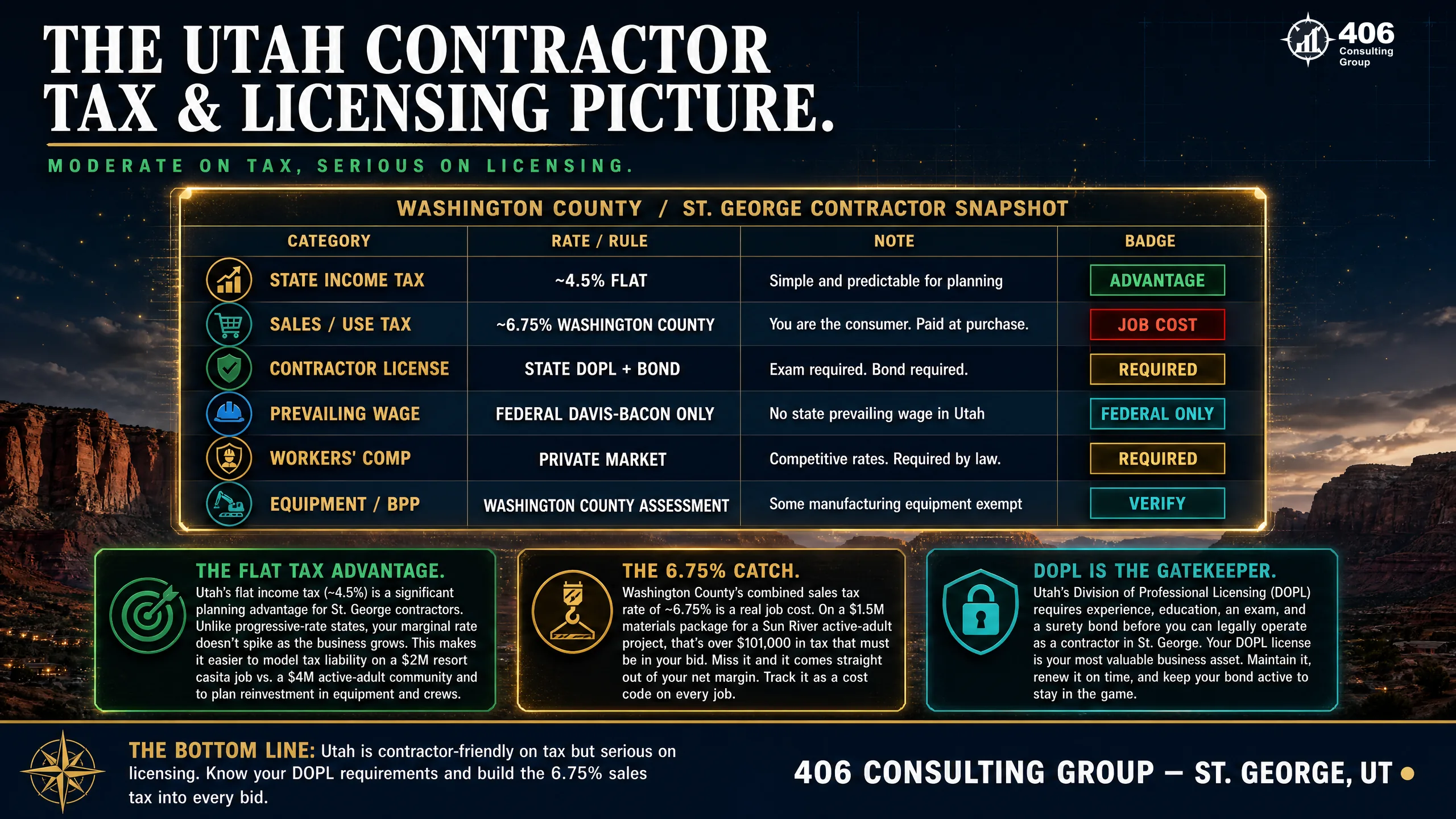
Verify current rates and rules with the Utah State Tax Commission and licensing with Utah DOPL. The licensing piece trips up most contractors new to the state, so start there.
Utah Licensing: DOPL, the Exam & the Bond
Where some states push general licensing down to city hall, Utah keeps it at the state level, run through the Division of Professional Licensing (DOPL). Most construction work calls for an active license in the right classification, and getting there usually means proving your experience, completing a required pre-license education course, passing an exam, and carrying a license bond plus insurance. The classifications — general building, general engineering, and the specialty trades — decide the scope you're legally cleared to bid, so the license you hold draws the line around your work.
For the books, the license, bond, and insurance are recurring costs and live responsibilities — and bidding beyond your classification or letting the license go dark can freeze payment and trigger penalties. When you pick up new classifications or move into bigger projects, licensing and bonding have to move with you, and your financial statements are part of what a surety weighs before extending the bonding that larger and public jobs require. Since the particulars vary by license type, confirm your classification, education, and bond requirements straight from Utah DOPL.

The license is the gateway to every job — and keeping it and your bonding in good standing depends on well-kept financials underneath.
Utah Sales/Use Tax on Your Materials
Sales tax works one way for a store and another entirely for a contractor. Once your materials are installed into real property, Utah generally counts you as their final consumer — you pay sales or use tax at the point of purchase, and you don't tack a sales-tax line onto the owner's bill for the construction. The tax on the block, rebar, ductwork, wire, and fixtures simply becomes part of what the job costs you, not a charge you collect from the customer and forward to the state the way a retailer does.
On the books that plays out two ways. First, materials tax has to be baked into your estimates and job costs at the true, tax-paid price — skip it and every bid comes up light. Second, use tax is the piece that slips through: it applies to anything you bought with no Utah tax charged — an out-of-state order for a specialty finish, or stock pulled from your own yard onto a job — which is easy to lose track of when a fast St. George project draws materials from all directions. And if you sell goods at retail without installing them, that side can be taxed like normal sales, so a mixed operation needs the two kept clearly apart. Set up correctly, the tax stays predictable and your pricing stays sound.

Especially if you run both an install side and a retail counter, check with the Utah State Tax Commission on exactly how the consumer rule and use tax fall out for your particular work.
Building Greater Zion: Retirement, Resorts & Red-Rock Growth
St. George's construction market has a shape worth building your books around, and it isn't the same as northern Utah's. The engine here is in-migration — retirees and remote workers drawn by the climate and the red rock — feeding a steady stream of active-adult and 55+ communities, custom and second homes, and the master-planned subdivisions filling Washington Fields and Little Valley. Around them, Greater Zion's tourism supports resort, hospitality, and short-term-rental construction from Ivins to Hurricane. It's a long runway — but also a market where competition is fierce, skilled labor is stretched thin, and desert-specific building demands push costs in their own direction.
The hard lesson of a boom is that it's where contractors most often lose money without seeing it coming — a full backlog can bury thin or negative margins until the cash simply isn't there. More work only makes the company stronger if you can read the margin on each job and finance the growth beneath it, and that takes job costing, a working WIP schedule, and a cash forecast, not merely a crowded calendar. The St. George builders who finish this cycle larger and healthier will be the ones whose books kept stride with the backlog.
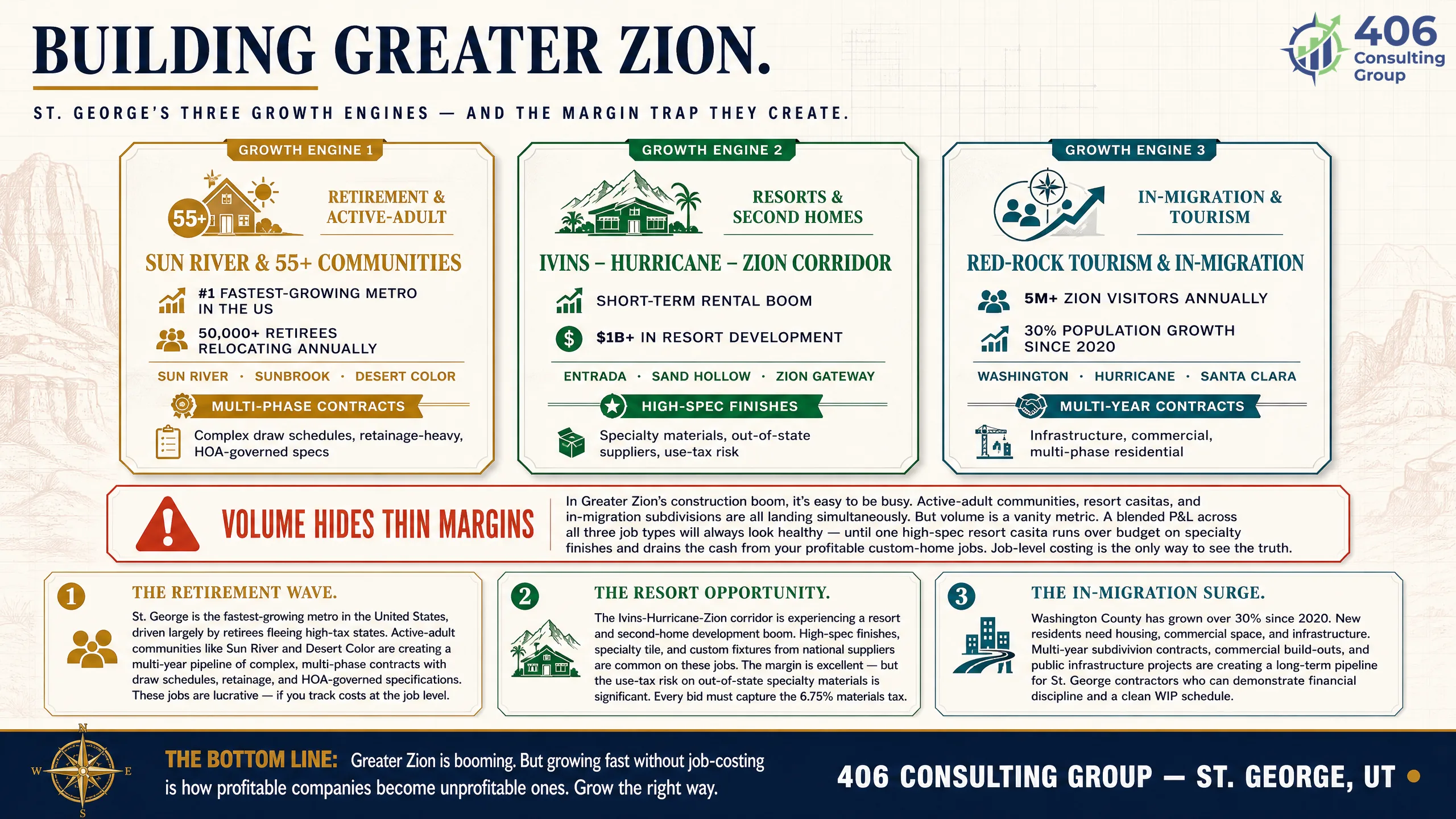
Growth is only worth having when it's profitable — and that starts as a bookkeeping question, not a sales one.
Job Costing: Which Job Actually Makes Money
With the work stacking up, the easy move is to keep taking it — but absent job costing, you can't tell the projects carrying your company from the ones quietly hollowing it out. Job costing assigns each labor hour, each material invoice at its tax-paid cost, each subcontractor bill, and each hour of equipment time to the specific job that used it, so every project's real margin surfaces on its own rather than blending into a company-wide blur. The moment you can see that a resort tenant build runs lean while your active-adult subdivisions keep the lights on, you bid and pursue work with completely different eyes.
It's the ground the rest of your reporting is built on, too — a trustworthy WIP schedule, accurate progress billing, and level-headed change-order decisions all depend on having job-level costs underneath. For a St. George contractor riding Washington County's growth, few habits do more to keep that growth profitable rather than just big.
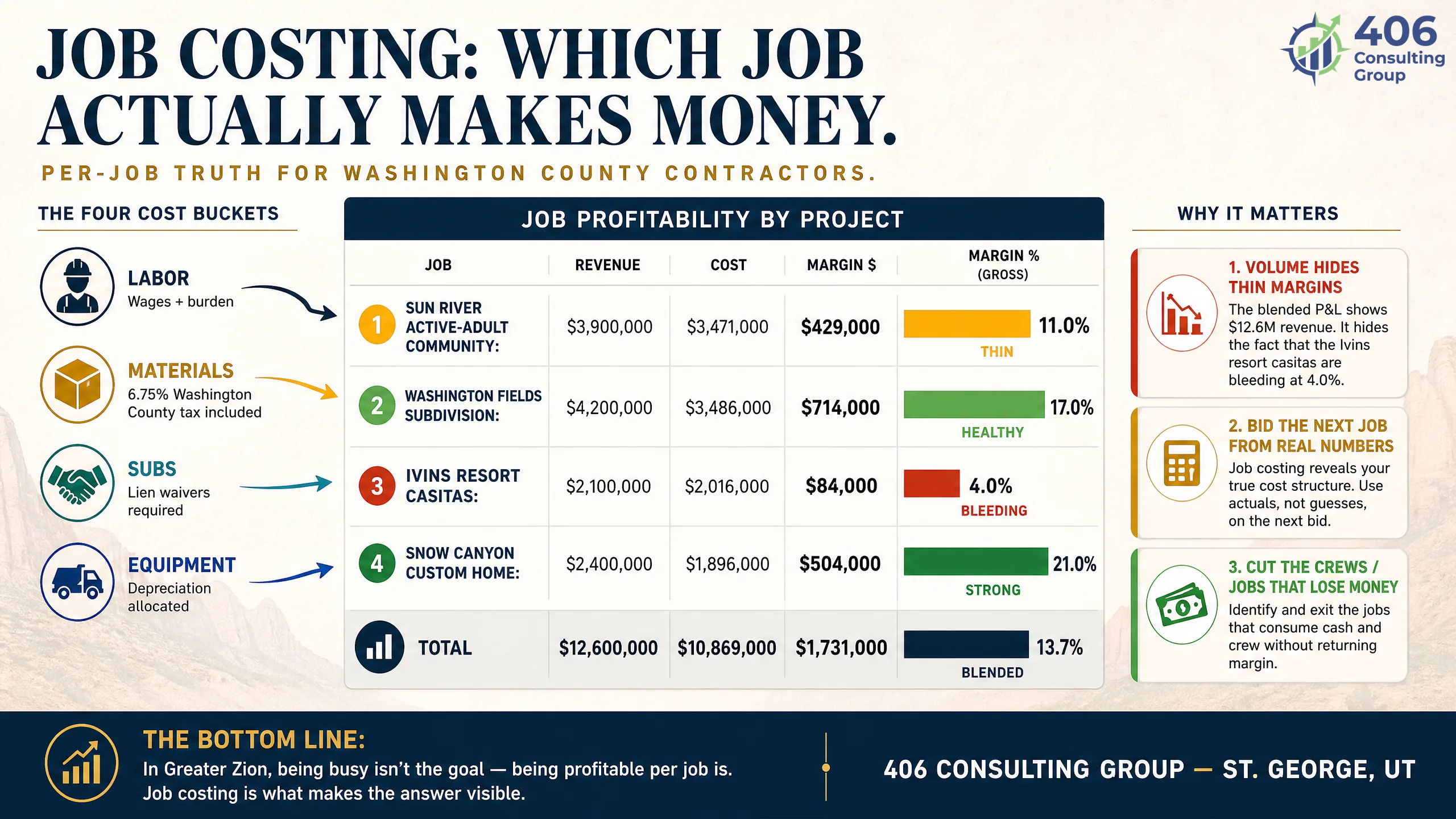
Pinning down which jobs and crews really carry the business is the entire aim of our contractor unit economics work — and job costing is what makes that answer legible.
WIP, Percentage-of-Completion, Retainage & Change Orders
Projects that run for months demand a view a basic ledger can't offer. A work-in-progress (WIP) schedule sets each open job's costs, billings, and estimated cost-to-complete beside one another, and the distance between them tells you whether you're over- or under-billed. Bill out in front of the work and the surplus can make your cash look healthier than it is while costs keep landing; bill behind it and you're floating the owner with your own capital. Percentage-of-completion pegs recognized revenue to how far the job has genuinely come, so the monthly numbers stay truthful instead of lumping at the finish.
Layer on retainage — the portion held back to the end, which locks up cash and belongs in its own receivable — and change orders, which shift both scope and margin and need to be recorded and priced before the work quietly disappears into the job. In a growth market where you're likely carrying more open jobs than ever, that WIP discipline is what keeps a packed schedule from passing for a profitable one — and it's the report your banker and bonding agent reach for first.
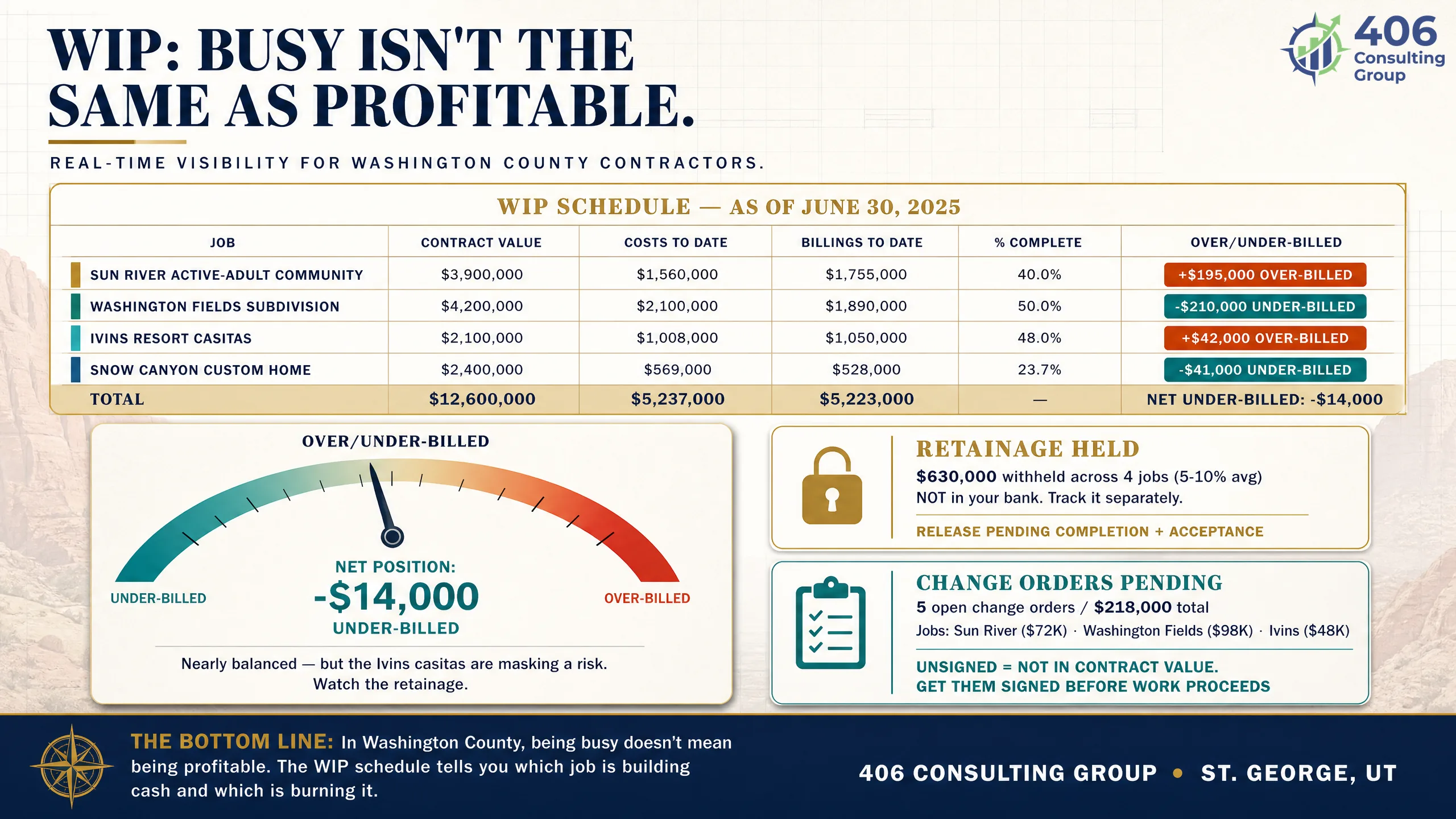
As you grow, this is where a controller or CFO function starts to pay for itself — the WIP is the one report that shows, job by job, exactly where the company stands.
Payroll, Workers' Comp & Prevailing Wage
A few pieces drive Utah construction payroll. Since the state runs a flat income tax, payroll carries Utah withholding beside the federal amounts. Workers' compensation is required for employees, and Utah's is a competitive private market — you buy coverage from a carrier, not a single state fund — with construction class-code rates high enough that they belong inside your burdened labor and your job costs. On public works, Utah has no state prevailing-wage law, so prevailing-wage and certified-payroll duties generally kick in only under the federal Davis-Bacon Act on federally funded projects — which in the St. George area can appear on federal-land, park-adjacent, or grant-funded work.
Past the filings, construction payroll means driving every labor hour to a job so it feeds your costing, and handling a deep bench of subcontractors and 1099s with worker classification you can defend — a soft spot that attracts scrutiny in a fast-growing trades market like Washington County's. Built right, payroll becomes clean data pouring into your job costs instead of a monthly scramble.
Our payroll work — certified payroll on federal jobs included — keeps all of it humming quietly in the background.
Equipment, Depreciation & Personal Property
Equipment shows up on the books from two sides at once. Federally, Section 179 and bonus depreciation let you pull a large share of a truck, lift, or machine into the year-of-purchase deduction — handy as you tool up for Washington County's growth, though it's a call to weigh against your multi-year income rather than make by reflex. On the Utah side, the county assesses business personal property, tempered by a de minimis exemption covering a threshold of equipment per taxpayer — so a lean outfit may owe little, while a bigger fleet should keep close track and confirm where it falls.
A tidy, up-to-date fixed-asset schedule works two jobs at once: it keeps depreciation and any personal-property filing correct, and — because a machine's hours belong on the job that ran them — it feeds job costing, so an idle rig registers as the cost it is rather than melting into overhead. Track what you own, what it costs to run, and which job it's on.

The depreciation strategy and Utah income-tax planning live in the St. George tax guide; the tracking that drives both begins in the books.
Common Construction Bookkeeping Mistakes
A handful of avoidable slip-ups drive most of the financial pain for St. George contractors — and a fast market makes each one sting harder.
Estimating materials before tax
Because Utah treats you as the consumer, that sales/use tax is a real line of job cost — price the bid without it, or overlook use tax on a finish shipped in from out of state, and you're behind before the first pour.
Letting the DOPL license or bond drift
An expired license, or the wrong classification for the job, can halt a payment and pile on penalties — keep renewal and bonding on the same calendar as your work.
Chasing volume without job costing
In a boom a money-losing job wears the same face as a winner on the P&L; with no per-job detail you spot the drain only once cash gets tight.
Neglecting the WIP schedule
Miss it and over- and under-billing blur each job's real position — and a surety won't grow bonding to Washington County scale without a WIP it can trust.
Careless 1099 and sub classification
A deep subcontractor bench in a hot market is what invites a closer look — sorting out misclassified workers later is slow and costly.
Each one is a matter of setup and habit — and each resolves once the books are built for Utah construction and run on a dependable monthly cadence.
Local vs. a Great Remote Partner
A St. George contractor's day plays out on the job and in the truck, not in an accountant's reception area — so a remote partner already suits how the business runs. What genuinely matters is expertise: can your accountant handle Utah construction — DOPL licensing and bonding, the consumer sales-tax rule, job costing across active-adult, custom-home, and resort work, and a WIP schedule a surety will stand behind? A specialist who lives in those specifics, wherever they sit, beats a nearby generalist who's never assembled a WIP or minded a contractor's license by a wide margin.
Our process is shaped around a builder's day: cloud accounting and job-costing software, receipts and hours logged from the field, connected bank feeds, and a monthly close you can trust — Utah-literate construction books without a drive into town. In St. George or Washington, out in Ivins and Santa Clara, or over toward Hurricane, the same construction-fluent team and know-how reach you all the same.
What decides it is whether your accountant truly understands Utah construction — the location of the office hardly enters into it.
How to Get Started
Getting a St. George contractor's books squared away runs in three steps.
Get the Utah pieces right
Keep your DOPL license, bond, and classification current, fold materials sales/use tax into every bid as a job cost, and set up workers' comp cleanly with a private carrier.
Build construction-grade books
Job costing by phase, a WIP schedule, retainage and change-order tracking, a fixed-asset schedule, and certified payroll wherever federal work calls for it.
Run it monthly
A genuine monthly close, WIP review, sales/use-tax handling, and job-level reporting — so you know which jobs pay and can fund and bond the next one.
Unsure where your books stand right now? Our Financial Maturity Assessment lays it out in about eight minutes.
FAQ: St. George Construction Accounting
Do I need a contractor's license in Utah?
Almost certainly. Contractor licensing in Utah is run statewide by the Division of Professional Licensing (DOPL) rather than by individual cities, and for most work in Washington County you'll need an active license in the classification that fits your scope — building, engineering, or a specialty trade. Expect to document qualifying experience, complete a required pre-license education course and exam, and post a license bond along with insurance. Step outside that classification or let the license expire and payments can stall while penalties accrue, so the license and bond need to scale right alongside the jobs you take on. Since the specifics depend on the classification you're after, confirm them with Utah DOPL before you bid.
Do Utah contractors add sales tax to a customer's job?
As a rule, no — not on the real-property construction itself. Utah treats a contractor who installs materials into real property as their final consumer, so you pay sales or use tax at purchase and never put a sales-tax line on the owner's construction bill. That folds materials tax into your job cost, where it needs to appear in your estimates at the tax-paid price. Use tax then covers anything bought without Utah tax charged — an out-of-state order, or stock drawn from your own yard — and if you also sell goods at retail without installing them, those sales can be taxed like any store's. Confirm how it lands for your work with the Utah State Tax Commission.
Is there prevailing wage or certified payroll in Utah?
Utah has no state prevailing-wage statute, so those duties generally arise only through the federal Davis-Bacon Act on federally funded projects — around St. George, that can surface on federal-land, park-adjacent, or grant-funded work. On a covered job you'll pay the published wage determinations and file certified payroll for every worker, typically each week, and a flawed report can stall your draw, so payroll should be built to turn out accurate certified reports. Since the obligation follows the funding, treat it project by project. Separately, workers' compensation is required for Utah employees and is bought on the competitive private market rather than through a state fund.
Why does job costing matter so much in a fast-growing market like Washington County's?
Because a booming market is the easiest place to lose money without noticing. When the schedule is full, thin or negative margins can hide inside the overall revenue until the bank balance forces the issue. Job costing pulls each labor hour, tax-paid material invoice, subcontractor bill, and equipment charge onto a specific job, so the real margin on each is visible and you can separate the work building your business from the work quietly draining it. It also underpins an accurate WIP schedule, correct progress billing, and sound change-order pricing. In a market expanding as fast as Washington County, that per-job clarity is what turns a bigger backlog into a stronger company rather than a shakier one.
Can 406 Consulting Group do my St. George construction bookkeeping remotely?
Yes — and for a contractor whose real office is the truck, remote simply fits how you already work. It all runs through cloud accounting and job-costing software, with receipts and hours captured in the field, connected bank feeds, and a monthly close you can rely on. What actually determines the outcome for a Utah construction business is expertise — job costing, WIP, DOPL licensing, the consumer sales-tax rule, workers' comp, and bonding-ready financials — not how many miles sit between you and the office. We support St. George and Washington County contractors the same whether you're in town, out in Ivins or Santa Clara, or over toward Hurricane.
Keep Reading
Trades & Construction — St. George, UT
Build Greater Zion on Books You Can Trust.
406 Consulting Group keeps St. George and Washington County contractors clean and compliant — DOPL licensing, Utah's consumer sales tax, job costing, WIP, and equipment handled — delivered remotely, by a firm that knows Utah construction.
St. George Construction Quick Reference
St. George, UT — Washington County
Growing Fast in Washington County?
Licensing, job costing & WIP, handled.
About the Author
Carrie Anderson
Co-Founder, 406 Consulting Group
Commercial banking and underwriting background — 300+ loan reviews — serving contractors and trades across the Mountain West. Carrie helps Washington County builders keep DOPL licensing and bonding current, handle Utah's consumer sales tax, run real job costing and WIP, and grow profitably through the region's boom.
Read the Full Story