
Accounting for Austin Businesses:
The Travis County Playbook
No income tax, but a franchise margin tax, a sales tax that lands on SaaS, and federal startup stakes — R&D, QSBS, equity — that dwarf any state return. Here's the whole accounting playbook for an Austin tech business.

Austin has become one of the country's great startup cities — a dense mix of SaaS companies, venture-backed startups, semiconductor and hardware firms, and the creative, real-estate, and services businesses growing around them, all drawn by talent, capital, and no state income tax. It's a phenomenal place to build. It's also a place where the accounting quietly trips founders up, because Austin's software economy runs inside a Texas tax system that never imagined the cloud: no income tax, but a franchise "margin" tax, a sales tax that lands on SaaS in a way founders never expect, and startup-specific federal stakes — R&D credits, QSBS, equity — that dwarf anything on a state return.
This is the overview — the Travis County playbook for getting your accounting right, from first investor-ready books to a CFO-level view of burn, runway, and a fundraise. It ties together our deeper Austin guides on bookkeeping, tax planning, and CFO & controller services — delivered remotely, the way software companies already work.
By Carrie Anderson — Co-Founder, 406 Consulting Group. Advising SaaS, startup, and technology businesses across the Mountain West and Southwest, and helping founders present clean financials to investors and lenders.
Quick Answer: Accounting for an Austin Business
- →No state income tax — but a franchise (margin) tax, sales tax, and property tax still apply.
- →SaaS is taxable in Texas (as a "data processing service," ~80% of the charge) — the surprise that catches most founders.
- →The real tax stakes are federal & early — R&D credits, QSBS, entity choice, stock comp.
- →Startups run on burn & runway — books and metrics have to be investor-ready.
- →Delivered remotely across Austin & Central Texas — startup + Texas expertise over office proximity.
Table of Contents
Running a Business in Austin
Austin's economy is led by technology — SaaS and software, a growing semiconductor and hardware base, and a venture ecosystem funding the next wave — with a vibrant creative and music scene, a hot real-estate and construction market, and the professional services that support all of it. For a founder, it's talent-rich, capital-rich, and tax-friendly on the surface. Underneath, though, a software company's finances are genuinely complex, and Texas's tax rules add wrinkles that a generic, out-of-state setup consistently gets wrong.
The companies that thrive here treat accounting as infrastructure for fundraising and scale: investor-ready books, tax planning that captures the federal startup incentives, and a financial view built around burn and runway. The ones that struggle usually have a great product and a back office that never got built for a subscription business or a diligence process. This playbook is about being the first kind — and it starts with understanding how Texas actually taxes a tech company.

Let's set the Texas tax landscape quickly, then hit the parts unique to software.
The Texas Tax Landscape
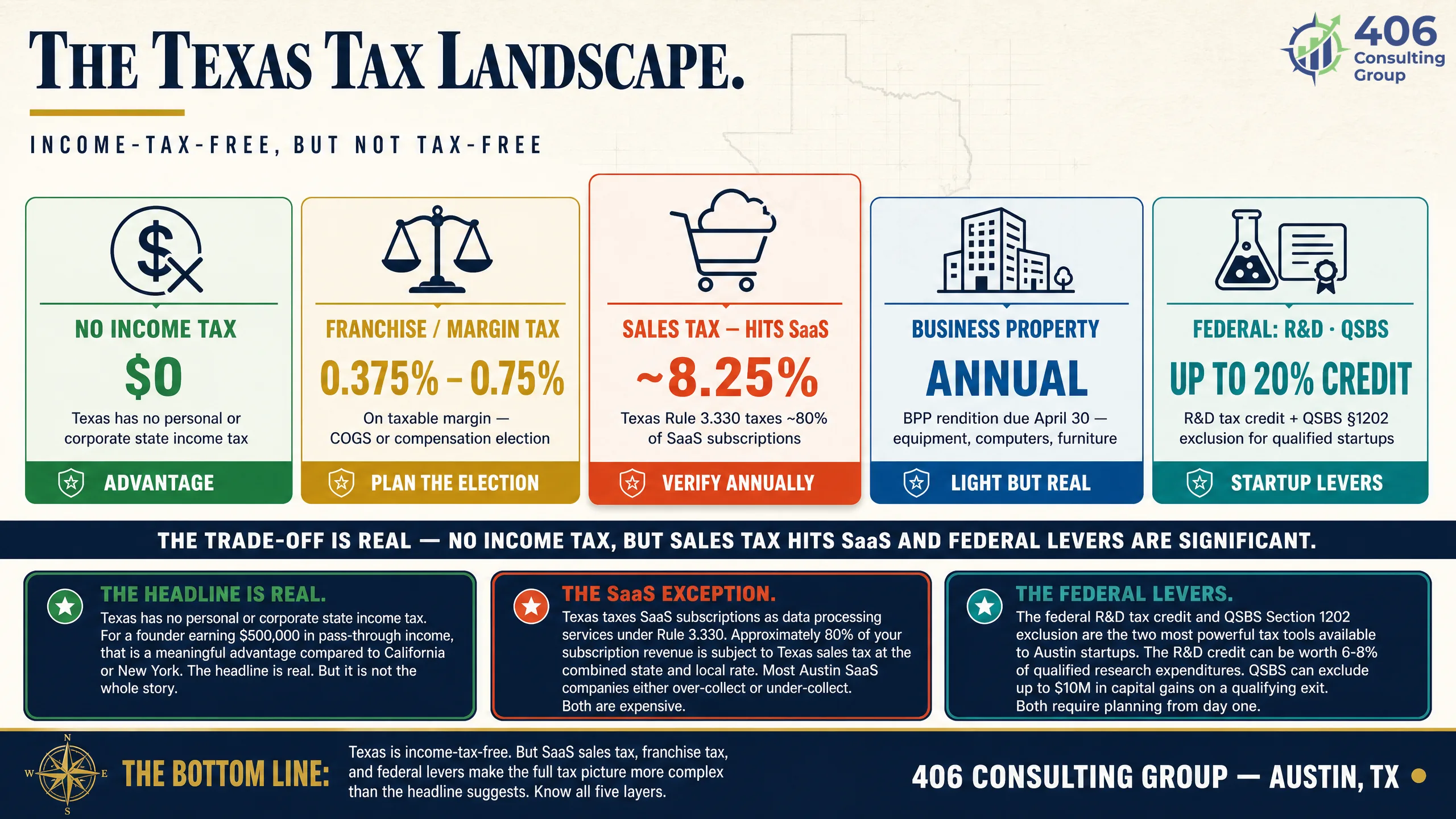
Texas famously has no income tax, but it collects in other ways. The short version for an Austin business — the mechanics are the same statewide, so here's the frame before we get to the tech specifics:
| Tax | What it means for a tech company |
|---|---|
| State income tax | None — a genuine draw for founders and employees |
| Franchise (margin) tax | On margin; people-heavy tech usually favors the compensation deduction |
| Sales & use tax | ~8.25% in Austin — and it often applies to SaaS (see below) |
| Business personal property | Annual rendition — light for asset-lean software, but not zero |
| Federal (the real stakes) | R&D credit, QSBS, stock comp — where a startup's tax future is decided |
Confirm current rates and rules with the Texas Comptroller. Now the wrinkle that surprises nearly every software founder.
The SaaS Tax Surprise Every Founder Meets
Here's the one almost no founder sees coming: in Texas, SaaS is generally taxable. The state treats most software-as-a-service as a "data processing service," and while there's a longstanding 20% exemption (so roughly 80% of the charge is taxable), the upshot is that you're generally expected to collect and remit Texas sales tax on subscriptions sold to Texas customers. Sell nationwide — as every SaaS company does — and you also pick up economic nexus in other states, each of which treats software differently.
This matters at the hub level because it's the single most common expensive surprise for Austin software companies: uncollected sales tax doesn't vanish — it compounds into a liability that a future acquirer's diligence team will find. Getting SaaS taxability and multi-state nexus right from the start is foundational, not optional. We go deep on the recording side in the bookkeeping guide and the where-to-register/how-to-fix-it strategy in the tax guide.

It's the number-one reason an Austin software business wants an accountant who actually knows SaaS and Texas — not a generalist.
The Austin Tech & Startup Ecosystem
Austin isn't only SaaS, and each corner of its economy asks something different of the books. SaaS and subscription companies live on deferred revenue and recurring-revenue metrics. Venture-backed startups live on burn, runway, and investor-grade reporting. Semiconductor and hardware firms add inventory, fixed assets, and heavier R&D. The creative, media, and music world runs on projects, gigs, royalties, and seasonal cash. And a red-hot real-estate and construction market brings job costing and entity-per-property structures.
Different details, one throughline: Texas's tax structure sits underneath them all, and the businesses that do well are the ones whose books are built for their model and whose founders can see their numbers clearly — especially the tech companies raising and scaling on those numbers.

Bookkeeping: The Foundation
Everything else sits on clean books. For an Austin tech business that means a chart of accounts built for software — real deferred-revenue structure, SaaS-standard gross-margin categories, sales-tax-collected liabilities broken out by state for nexus, clean R&D grouping for the credit, and the compensation detail the margin tax rewards. Add subscription revenue recognized ratably, MRR/ARR tracked consistently, equity and the cap table reconciled, and a steady monthly close, and you have the investor-ready foundation every tax and fundraising decision depends on.
The full detail — the SaaS sales tax, deferred revenue, nexus, and the common mistakes — lives in our Austin bookkeeping guide. If your books were set up for a generic small business rather than a subscription company, that's the place to start.
Tax Planning: R&D, QSBS & Entity
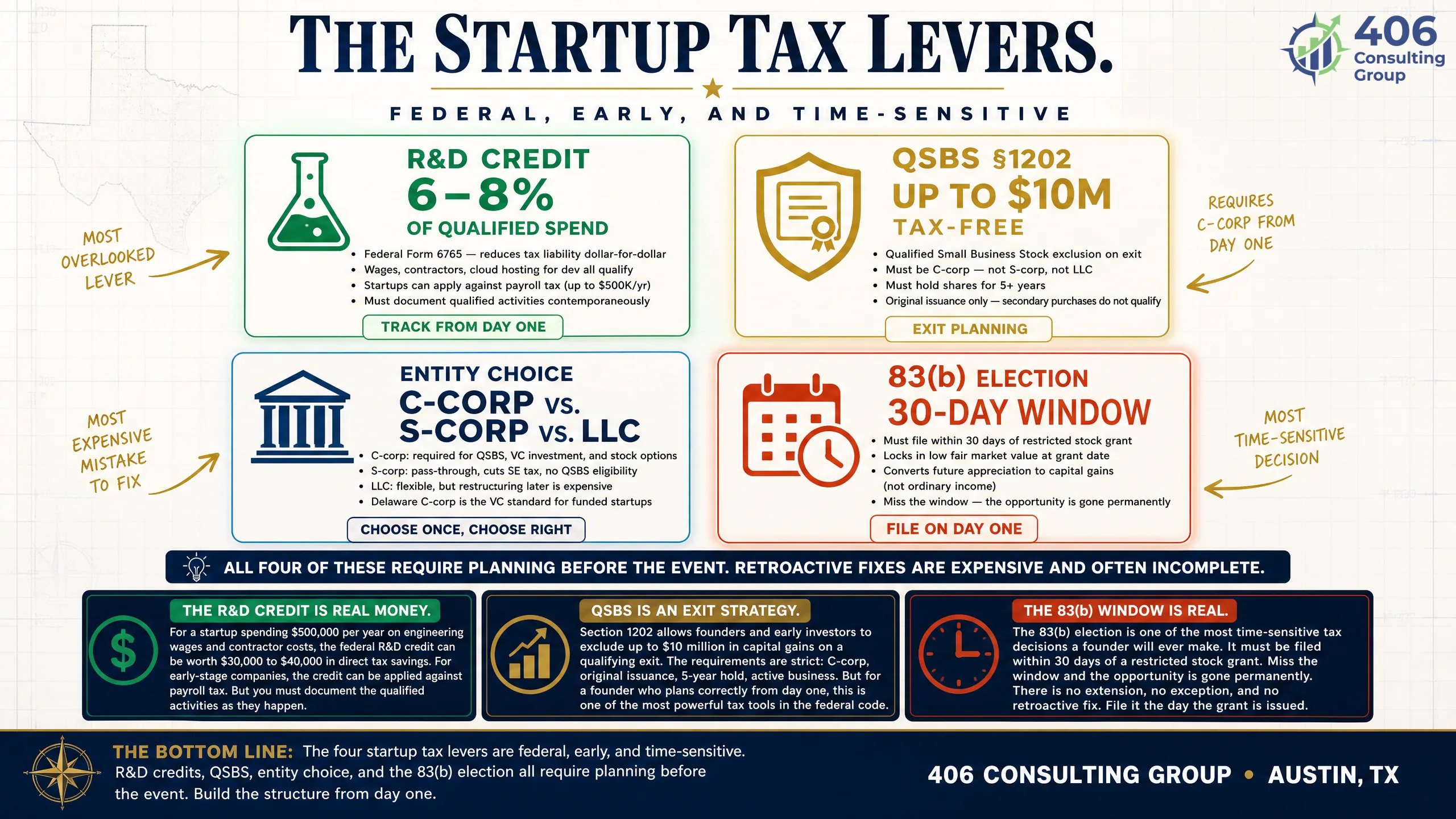
Because there's no state income tax, a startup's real tax leverage is federal and time-sensitive: the R&D credit (federal, plus a Texas franchise-tax R&D option, and a possible payroll-tax offset for pre-profit companies), the QSBS exclusion that can wipe out much of the tax on a future exit — but only if you're structured as a C-corp early — the entity choice that flows from your funding path, and stock-comp decisions like the 83(b) election with its unforgiving 30-day window. These are the moves that actually move a tech company's lifetime tax bill, and most are invisible to a generic preparer.
Our Austin tax-planning guide walks each one, and the S-Corp Calculator is a good first step for a profitable, bootstrapped company weighing an election.
When You Need a CFO or Controller
As a startup grows and raises, the finance function that worked at the seed stage stops working. A controller keeps the books accurate and investor-ready; a CFO adds burn and runway modeling, SaaS unit economics, board reporting, and fundraising support. Most companies don't need either full-time until roughly $15M+ in revenue — which is why fractional exists, delivering the expertise for a few thousand a month instead of spending precious runway on an executive salary.
The signals it's time — a raise on the horizon, a slipping close, an inability to state your burn and runway, or unit economics you can't see — and the full cost math are in our CFO & controller guide. For a startup, the need usually shows up at the first serious fundraise.
The Whole-Company Systems View
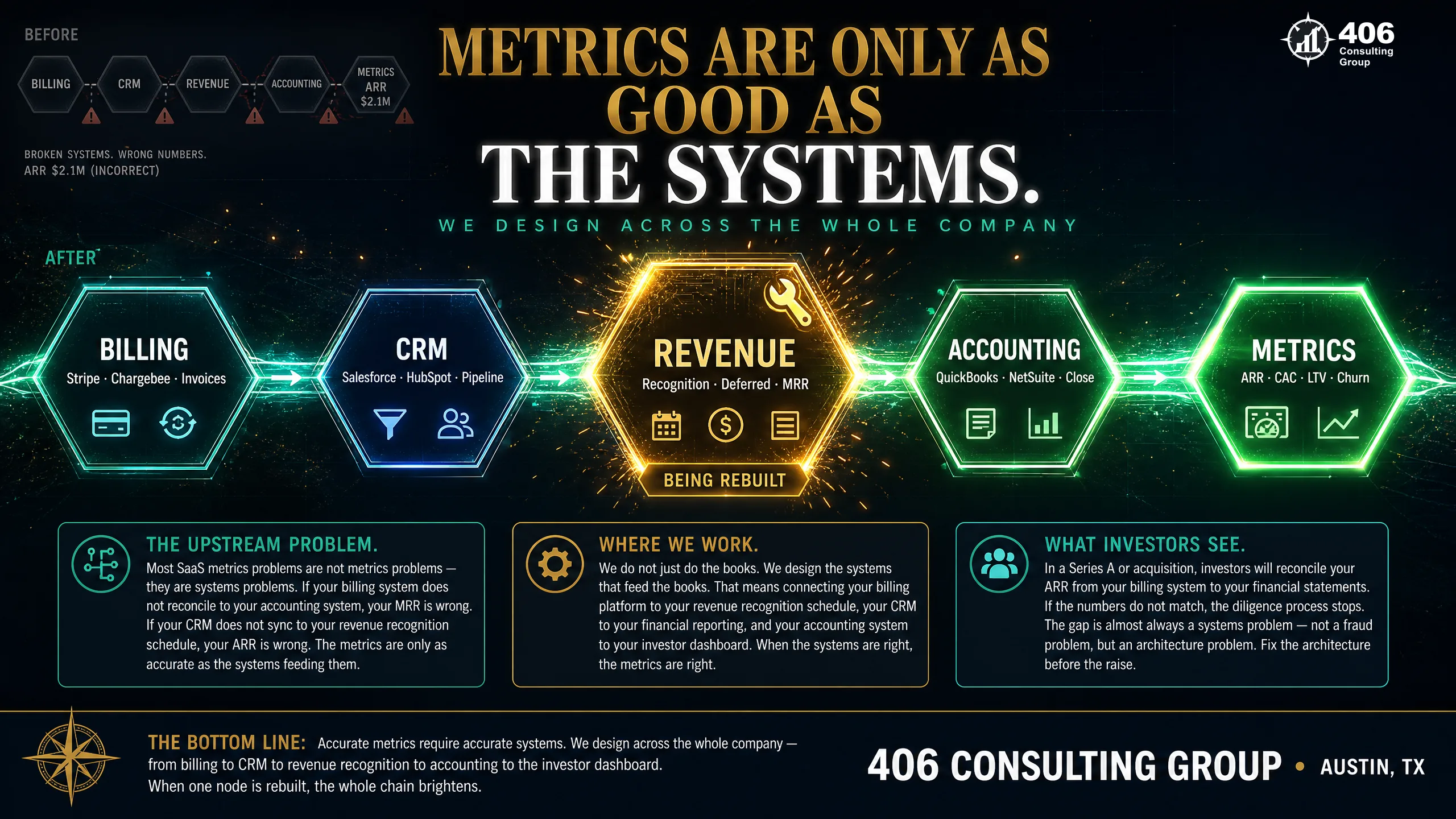
What sets our work apart is that we don't treat accounting as a silo. In a software company the numbers are downstream of your whole stack — how the billing system records subscriptions, how the CRM and sales-ops data flow into revenue, how product usage ties to expansion and churn, how it all reconciles with the general ledger. Metrics are only as trustworthy as the systems feeding them, so building a reliable financial function usually means fixing the whole-company data flow behind it, not just the books.
We dig into that in the hidden cost of no systems — how the reporting cracks a scaling startup papers over quietly distort the very metrics investors are judging, and why fixing the systems early costs far less than explaining them mid-diligence.
Choosing an Accountant: Local vs. Remote
For a cloud-native company, choosing an accountant by zip code is the one decision you'd never apply to the rest of the business. What matters is whether they know SaaS and Texas cold: the data-processing sales tax, multi-state nexus, deferred revenue, R&D and QSBS, burn and runway, and investor-grade reporting. A generalist nearby who's never closed a subscription company's books is a bigger risk than a specialist who does it daily — because the expensive mistakes here are domain mistakes, not distance ones.
And remote is simply how a modern software company runs — shared cloud accounting, connected billing and banking, and a steady close, with a team that may be distributed across time zones anyway. We serve Austin and Central Texas businesses exactly as we serve companies across the Mountain West: responsive, specialized, and available on a screen-share whenever a decision or a deadline is coming.
Pick for the expertise on the call, not the pin on the map — in a tech business, that's the whole difference.
A Roadmap by Stage
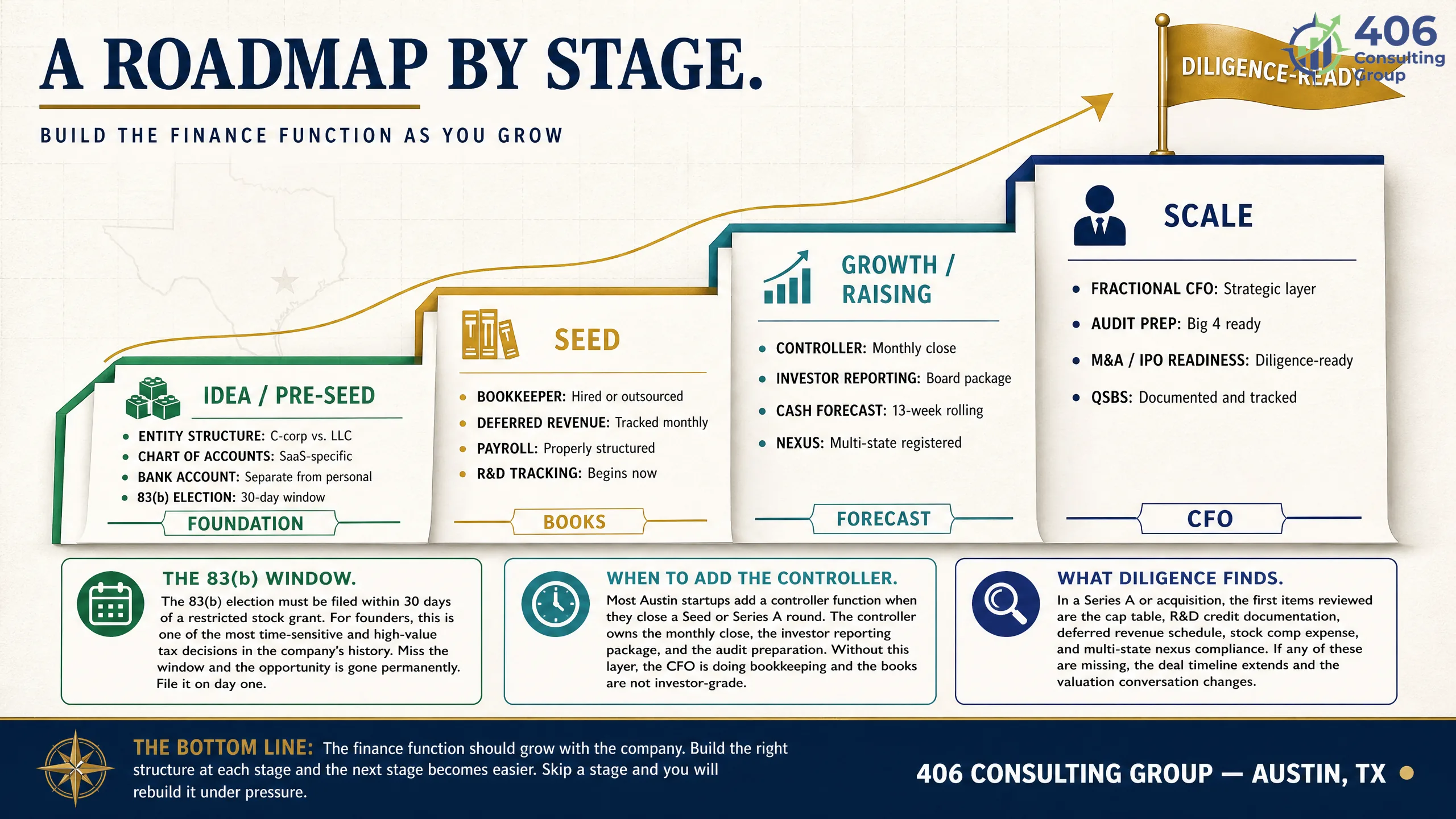
Where you focus depends on your stage. A rough Austin startup roadmap:
Get the structure right
Choose the entity for your path (C-corp if you'll raise), set the QSBS clock, handle 83(b) within 30 days, and open Texas-ready, SaaS-shaped books.
Investor-ready foundations
Deferred-revenue bookkeeping, SaaS sales-tax collection and by-state nexus, clean R&D tracking, and consistent MRR/ARR.
Add the forward view
Burn and runway modeling, SaaS unit economics, a controller for a reliable close, and board- and diligence-ready reporting.
CFO-level strategy
Fundraising support, venture-debt and capital decisions, and whole-company systems so metrics stay trustworthy as you grow.
Not sure where you land? Our Financial Maturity Assessment maps it in about eight minutes and points to what to build next.
FAQ: Austin Small-Business Accounting
What makes accounting in Austin different from other cities?
Two things: Austin's software-heavy economy and the way Texas taxes it. A tech company's books revolve around deferred revenue, SaaS metrics, R&D, and equity — none of which fit a generic template — and Texas layers on quirks a founder rarely expects, most notably that SaaS is generally taxable as a 'data processing service.' On top of that, a startup's biggest tax stakes are federal and time-sensitive (R&D credits, QSBS, stock comp), and the whole business runs on burn and runway. So Austin accounting is really startup-and-SaaS accounting inside the Texas system — a specialty, not a generic service.
Is SaaS really taxable in Texas?
Generally, yes. Texas treats most SaaS as a taxable 'data processing service,' with a longstanding 20% exemption, so roughly 80% of the charge is taxable and you're generally expected to collect and remit Texas sales tax on subscriptions to Texas customers. Selling nationwide also creates economic nexus in other states, each treating software differently. Many founders assume software is tax-free and get caught, because uncollected tax compounds into a liability that surfaces in diligence. Confirm your specifics with the Texas Comptroller or a professional, and set collection up correctly from the start.
What are the biggest tax moves for an Austin startup?
They're federal and early. The R&D credit rewards qualified research spending (a big share of engineering payroll), with a possible payroll-tax offset for pre-profit companies and a Texas franchise-tax R&D option on top. QSBS (Section 1202) can exclude a large portion of the gain on a future exit — but generally requires being a C-corp and is set at formation. Entity choice flows from whether you'll raise venture capital (usually a Delaware C-corp) or bootstrap (often an S-corp or LLC), and stock-comp decisions like the 83(b) election have hard, short deadlines. These are decided years before they pay off, so plan early.
When should a growing Austin startup get bookkeeping, tax, or CFO help?
Roughly by stage: get your entity, QSBS/83(b), and SaaS-shaped books right at formation; build investor-ready bookkeeping (deferred revenue, sales-tax nexus, R&D tracking, MRR/ARR) at the seed stage; add burn/runway modeling, unit economics, and a controller as you grow and raise; and bring in CFO-level fundraising and capital strategy as you scale — usually well before the ~$15M revenue point where a full-time hire makes sense. For a startup, the trigger is usually the first serious fundraise. Our Financial Maturity Assessment helps you place yourself.
Can 406 Consulting Group handle all of this remotely?
Yes — bookkeeping, tax planning, and CFO/controller work, delivered remotely to Austin and Central Texas companies through shared cloud accounting, connected billing and banking, and regular strategy calls. For a cloud-native, often-distributed startup it's the natural fit, and what matters is SaaS-and-Texas expertise — the data-processing sales tax, nexus, R&D and QSBS, burn and runway, investor-ready reporting — not office proximity. Our commercial-banking background also means we prepare you well for lenders and venture debt. Most Austin tech teams are distributed anyway, so you get the same specialized service wherever you sit.
The Austin Playbook — Full Series
Accounting — Austin, TX
The Travis County Playbook, Handled.
406 Consulting Group gives Austin tech and startups the whole stack — SaaS-ready bookkeeping, startup tax planning, and fractional CFO & controller work — delivered remotely, by a firm that knows software, Texas tax, and fundraising.
Austin Accounting Quick Reference
Austin, TX — Travis County
The Whole Stack, One Firm
Bookkeeping, tax & CFO — SaaS & Texas-savvy.
About the Author
Carrie Anderson
Co-Founder, 406 Consulting Group
Advising SaaS, startup, and technology businesses across the Mountain West and Southwest. Carrie helps Austin founders handle the Texas SaaS sales tax, capture R&D and QSBS, keep investor-ready books, and present clean financials to investors and lenders.
Read the Full Story