
Accounting for Casper Energy Businesses:
The Oil-Country Playbook
Casper runs on energy — and energy accounting runs on job costing, heavy equipment, boom-bust cash, and all-federal tax planning on Wyoming's low-tax backdrop. Here's the whole playbook: bookkeeping, tax, and financial leadership, from a firm that's worked the field.

Running a business in Casper means running it in oil country. Central Wyoming's economy is built on energy — drilling and well services, midstream, hauling, and equipment rental across the Powder River Basin — and that shapes what your accounting has to do. Field tickets and job costing, a fleet of heavy equipment, a mobile crew, boom-and-bust cash, and use tax on a lot of gear are the everyday reality. On top of that sits Wyoming's genuine gift: one of the lowest tax loads in the country.
This is the whole playbook — the one-page map of how accounting works for a Casper energy business, and where to go deeper on each piece. Bookkeeping, tax, and financial leadership each get their own detailed guide; this ties them together. And it's the industry we come from: both of our founders spent years in the oil field, so this isn't textbook advice — it's how we've seen the money actually move in energy.
By Jason Anderson — Co-Founder, 406 Consulting Group. Big-firm-trained accountant with extensive oil-field experience, helping Casper energy and small businesses turn a low-tax state and a cyclical industry into a durable advantage.
Quick Answer: Accounting for a Casper Energy Business
- →Built around jobs: field tickets, job costing, and heavy equipment drive energy books.
- →Low-tax backdrop: Wyoming has no income tax, no B&O — just sales/use tax (~5% in Casper).
- →Tax is all federal — equipment timing, depletion, and entity are the big levers.
- →Surviving the cycle — cash forecasting, breakeven, and smart financing keep you alive in downturns.
- →By oil-field veterans, delivered remotely — most of our local clients never come in.
Table of Contents
Why Oil-Country Accounting Is Different
A Casper energy business doesn't keep books like a retail shop. Revenue arrives as field tickets tied to specific wells and jobs; costs are dominated by equipment, fuel, and a mobile crew; the balance sheet is heavy with iron; and cash flow rises and falls with commodity prices. Add a low-tax state that pushes all tax planning to the federal level, and you have a distinct playbook — one a generic accountant rarely knows.
The four pillars are the same as any business — bookkeeping, tax, financial leadership, and the system underneath — but each takes an energy shape. Books built around jobs and equipment; tax built around equipment timing and depletion; financial leadership built around surviving the cycle. This guide maps all four and points to the deep dives.
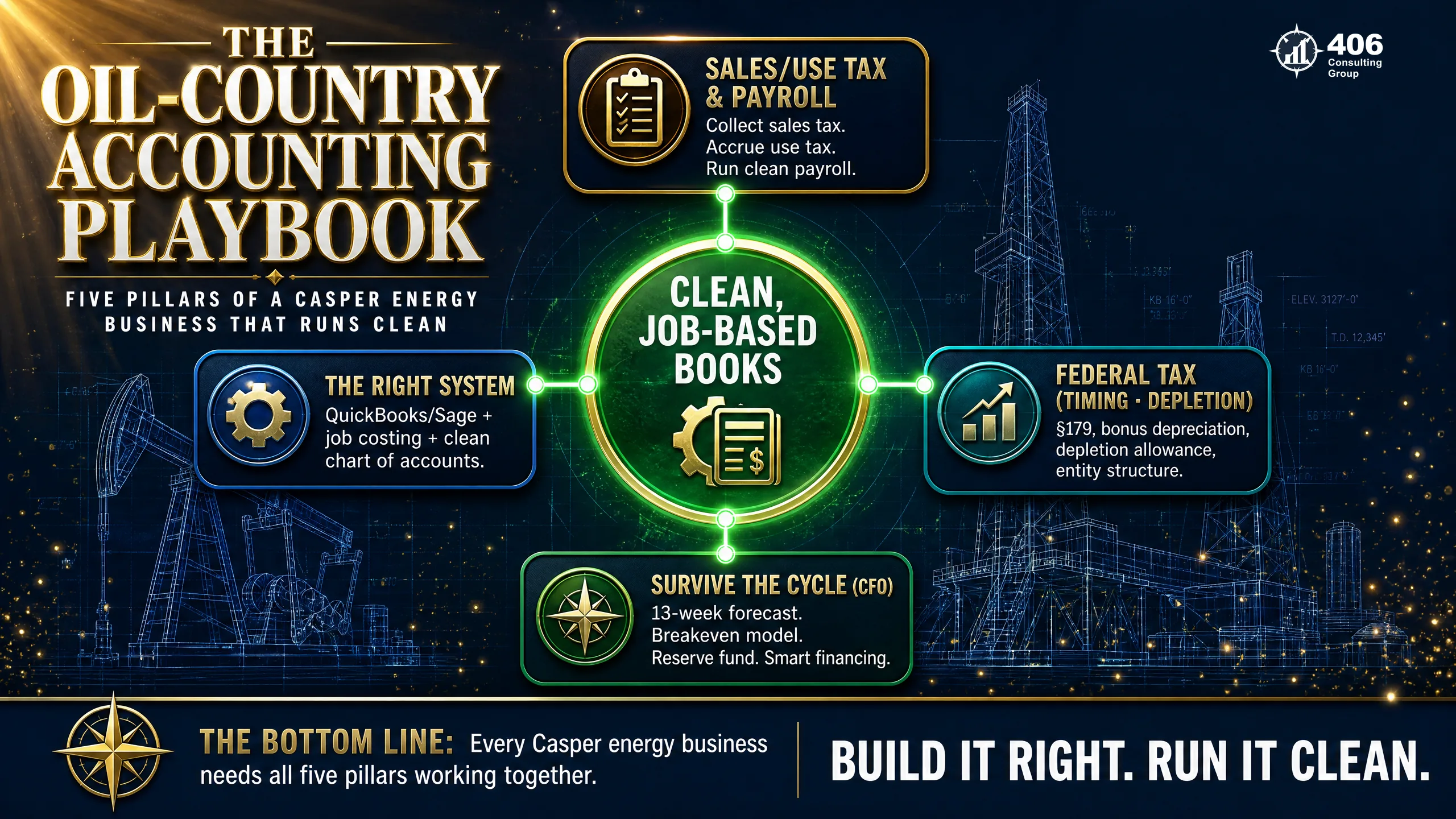
Start anywhere below — the big idea is that Wyoming's low-tax simplicity is an advantage only when the energy-specific fundamentals are actually handled.
The Wyoming Tax Backdrop
The backdrop everything sits on: Wyoming is one of the lowest-tax states in the country. No state income tax — personal or corporate — and no gross-receipts or B&O tax. The main state tax is sales and use tax, around 5% combined in Casper (a state rate plus a Natrona County portion; confirm the current rate locally). For an energy business, use tax on equipment bought without sales tax is the piece that bites if it's ignored.
| Tax | Wyoming reality |
|---|---|
| State income tax | None — personal or corporate |
| Gross-receipts / B&O | None |
| Sales & use tax | ~5% combined in Casper — watch use tax on equipment |
| Payroll (state) | No state withholding; state-run workers' comp; SUI |
| Federal | Income + payroll taxes — where all planning happens |

The planning side is covered in the Casper tax guide. The short version: with no state income tax, the tax game is entirely federal.
Energy Bookkeeping: Jobs & Use Tax
Energy books live and die on job costing. Field tickets tie work to specific wells and jobs, and the bookkeeping job is to connect the labor, equipment, fuel, and consumables behind each ticket back to the job — so you can see the true margin on every well and contract. Alongside that: a clean fixed-asset register for all the equipment, and disciplined tracking of use tax on the gear you buy without sales tax.
Get this structure right and the numbers reflect reality — which job made money, what the iron really costs, where the tax exposure sits. Get it wrong and you're guessing on the decisions that matter most.
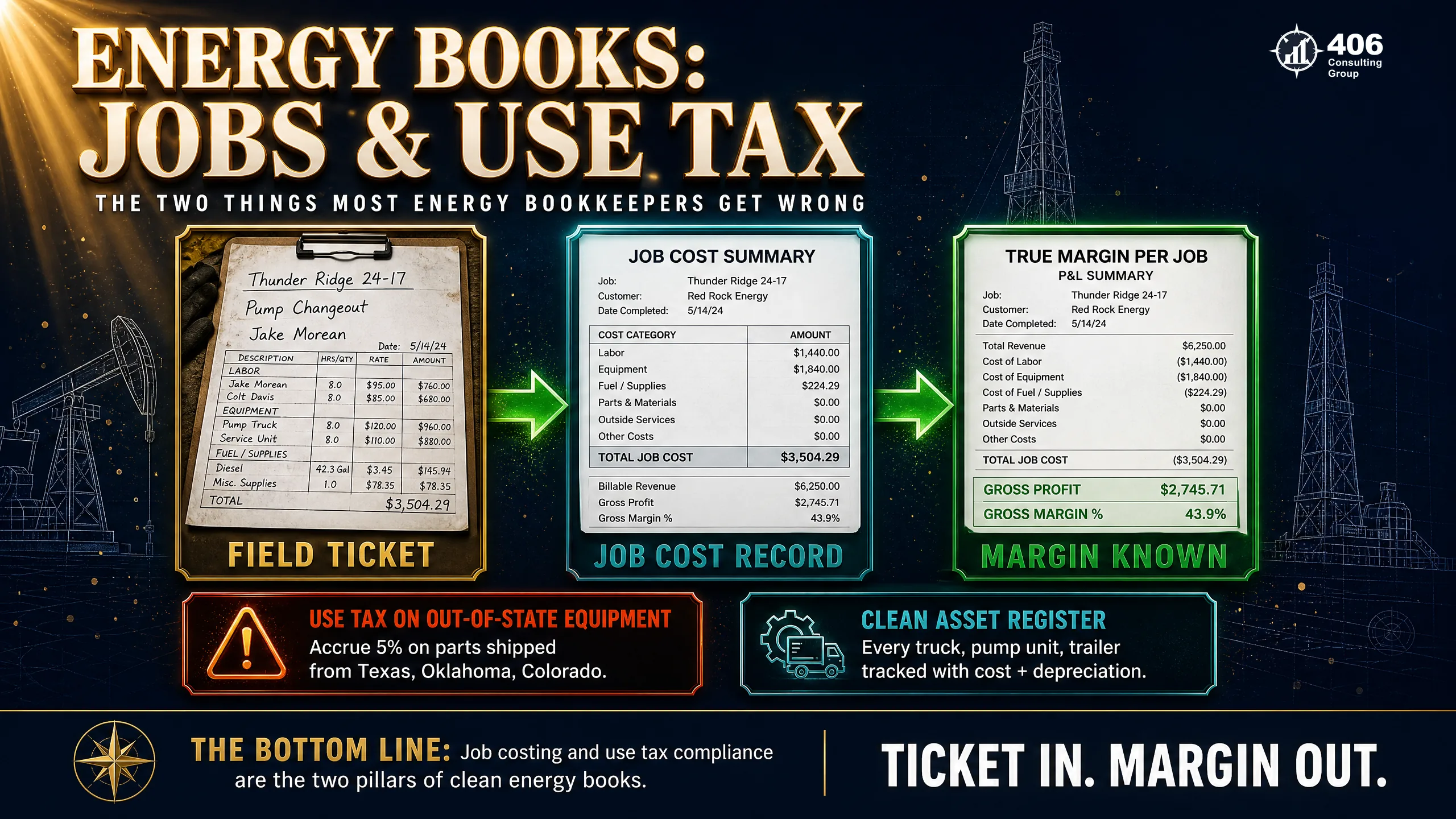
The full mechanics — field tickets, job costing, asset registers, use tax — are in the Casper bookkeeping guide.
Energy Payroll & Workers' Comp
Payroll in the field is simpler in one way and trickier in another. Wyoming has no state income tax, so there's no state withholding to compute. But energy work brings a mobile crew that may cross county or state lines, per-diems and travel to track, and — critically — workers' compensation on genuinely hazardous work, administered by the State of Wyoming, where the class codes and accurate reporting matter more than in almost any other industry.
Getting comp class codes and multi-state payroll right isn't a formality in energy — it's real money and real risk. We cover the details in the bookkeeping guide, and it's exactly what our payroll work keeps clean.
Energy Tax: Timing, Depletion & Entity
Because Wyoming takes nothing out of your income, all tax planning is federal — and for an energy business the levers are especially powerful. The biggest is equipment timing: Section 179 and bonus depreciation let you deduct big purchases in the year placed in service, and timing them against strong years in a cyclical business can move the tax bill dramatically. The right entity (often an S-corp) cuts federal payroll tax once profit is high enough.
And a lever unique to energy: depletion. If you hold a working or royalty interest in production, you may be entitled to a depletion deduction — an energy-specific item generalists routinely miss. Together, these federal moves are where the real savings live in a low-tax state.
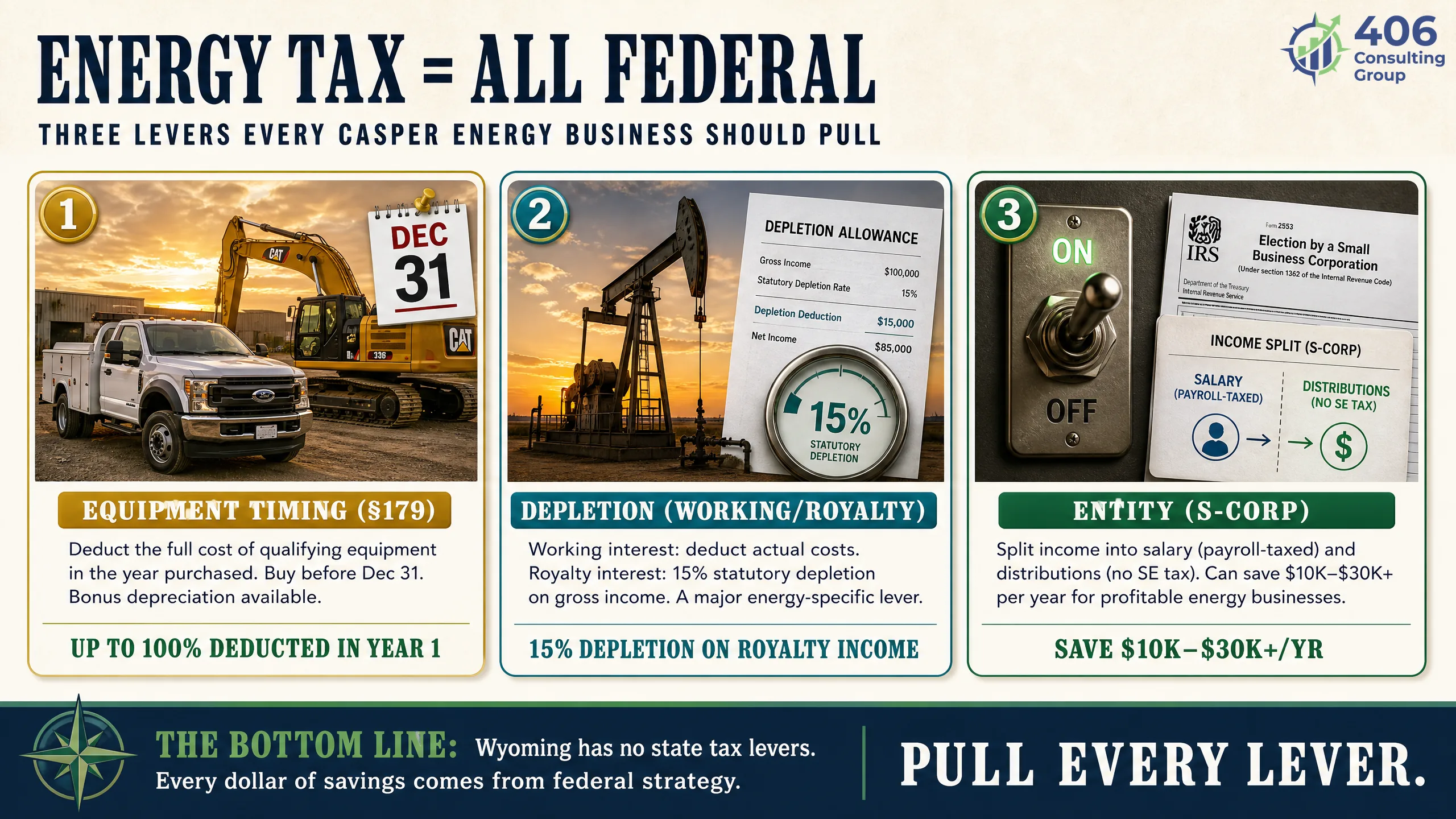
The full federal playbook — equipment timing, depletion, S-corp, and multi-state crews — is in the Casper tax guide.
Surviving the Cycle: Cash & Financing
Here's the hard truth of the energy business: profitable companies fail in downturns when cash runs out. As you grow, clean books stop being enough — you need financial leadership to survive the cycle. A controller keeps job costing and the monthly close reliable; a CFO forecasts cash far enough ahead to act, calculates breakeven per rig and job, and structures equipment financing the down cycle can actually service.
The discipline cuts both ways: build reserves and resist over-expansion in the boom, protect cash and cut fast in the bust. It's the difference between riding the cycle and being thrown by it — and you don't need a full-time hire to get it; fractional leadership scales to your stage and flexes with the market.
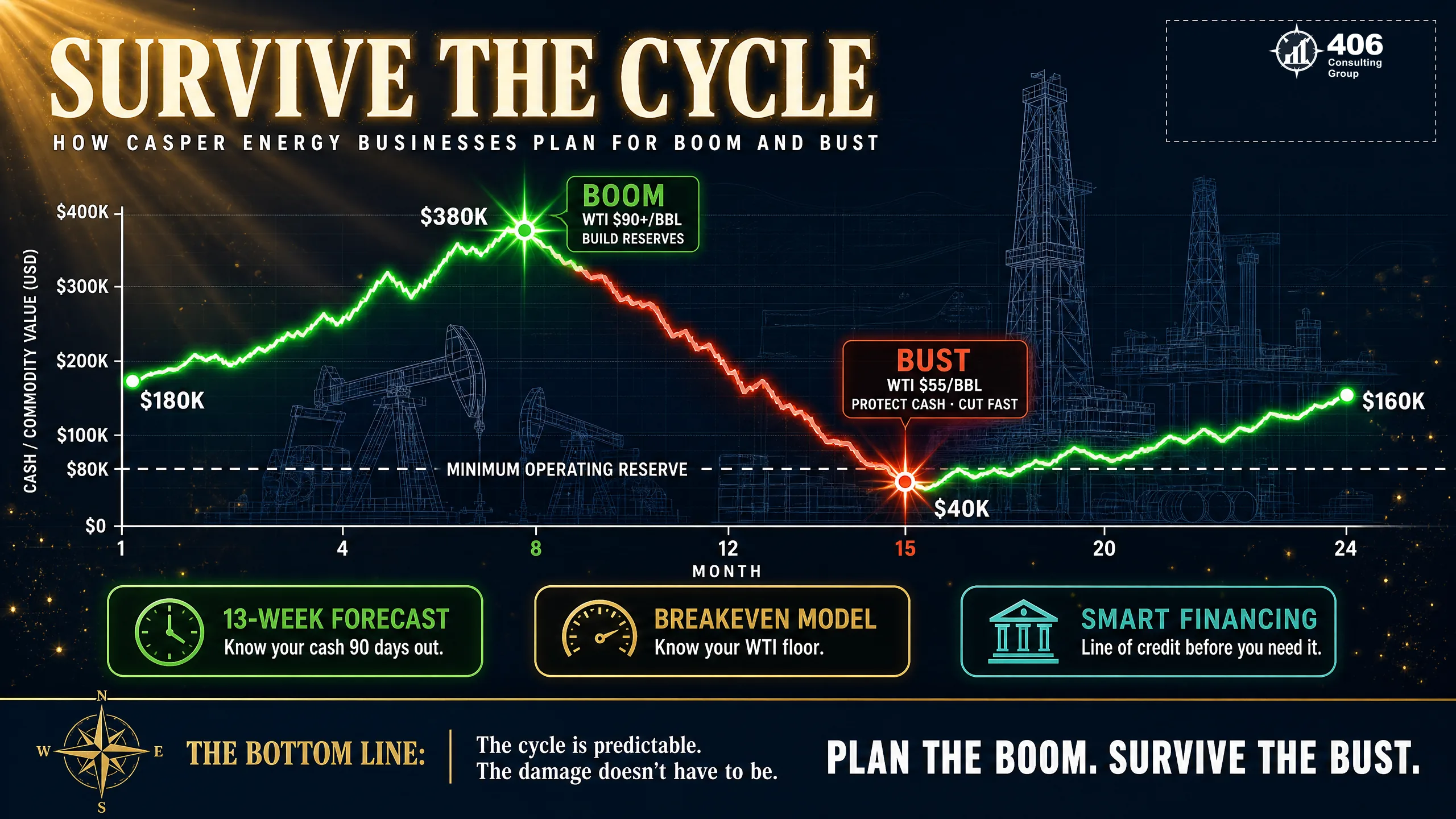
What each role delivers, what it costs, and the breakeven and financing work are in the Casper CFO & controller guide.
Accounting by Casper Segment
Casper's economy is energy-led but not energy-only — and each segment asks something different of the books.
| Segment | Accounting priorities |
|---|---|
| Drilling & well services | Field tickets, per-well job costing, crew payroll, equipment, consumables |
| Hauling & trucking | Per-mile/per-load costs, fuel, DOT/driver payroll, equipment |
| Equipment rental | Asset utilization, depreciation, maintenance, rental billing |
| Midstream & pipeline contractors | Project/job costing, progress billing, retainage, multi-site work |
| Healthcare, retail & services | Sales tax (retail), receivables, payroll, utilization or inventory |

Different details, same backbone: clean job costing, use tax handled, payroll and comp right, and profit readable for the federal return.
Building the Right Accounting System
In the energy business, the books are only as good as the system feeding them — and too often a generic template gets bolted onto a company whose work actually runs on jobs, crews, and iron. That's backwards. We design the system from a whole-company view — how a job is quoted, crewed, executed, ticketed, billed, and collected — because the numbers are only useful if they mirror how the work runs in the field.
For an energy business that means jobs, equipment, and crews wired into the books from the start, on Wyoming's lean low-tax structure — no income-tax-state clutter, just the pieces that matter. Having worked the field ourselves, we build the system to match reality, not a generic template.
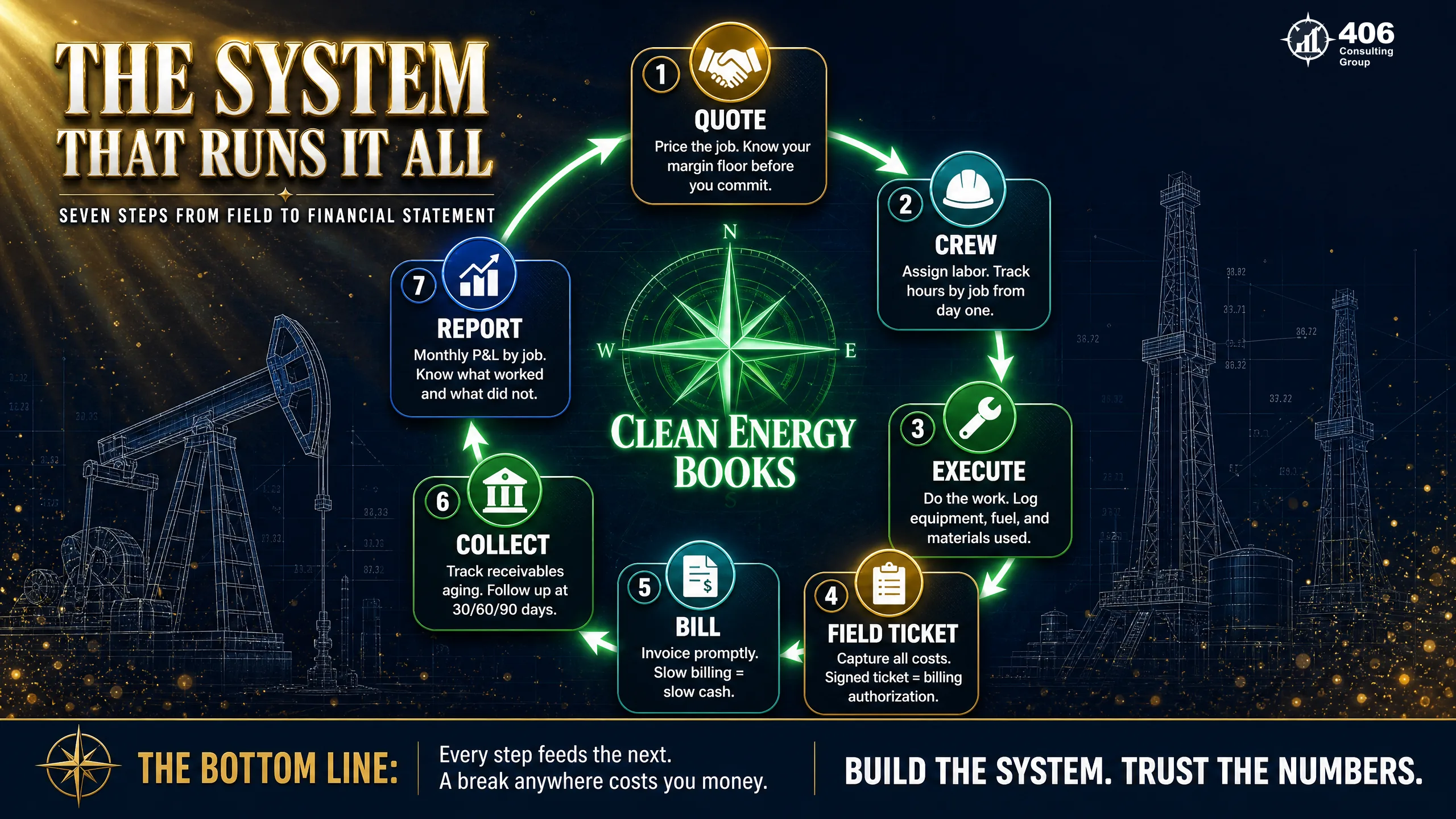
That whole-company perspective — plus real field experience — is why our clients' books stay useful as they grow, not just tidy at tax time.
Local vs. a Great Remote Partner
Accounting for an energy business is knowledge work — job costing, use tax, depletion, cash forecasting, financing. What matters is whether your partner knows both oil and gas and Wyoming's setup, not whether they're down the street. A great remote firm that understands the industry beats a local generalist who's never seen a field ticket, every time.
It's also how the work already happens. Around 70–80% of our own local clients never come into the office; everything runs on secure cloud accounting, digital field tickets and receipts, shared screens, and regular calls. So whether you're in Casper, out in Natrona County, or running crews across the basin, you get the same full-service support — from a team that's worked the field itself.
Distance isn't the variable. Knowing energy — and knowing accounting — is.
How to Get Started
Getting your Casper energy accounting right is three steps.
Build the books around the field
Job costing, a clean asset register, sales/use-tax tracking, and energy payroll — the foundation everything else needs.
Build the federal tax plan
Equipment timing, depletion, and entity choice mapped to your numbers and the cycle — where the savings live.
Add leadership to survive the cycle
Controller and CFO support for cash forecasting, breakeven, and financing as you grow.
Not sure which layer you need? Our Financial Maturity Assessment maps it out in about eight minutes.
FAQ: Casper Energy Accounting
What makes accounting for a Casper energy business different?
Energy accounting is built around jobs and equipment, not just months. Revenue comes in as field tickets tied to wells and jobs, costs are dominated by heavy equipment and a mobile crew, cash swings with commodity prices, and tax planning is entirely federal in a no-income-tax state. So the work centers on job costing, use tax on equipment, energy payroll and workers' comp, federal levers like equipment timing and depletion, and surviving the cycle — a distinct playbook a generalist rarely knows.
What taxes does a Casper, Wyoming business pay?
Wyoming is one of the lowest-tax states — no state income tax (personal or corporate) and no gross-receipts or B&O tax. The main state tax is sales and use tax, around 5% combined in Casper (a state rate plus a Natrona County portion; confirm locally), and use tax on equipment bought without sales tax is a big one for energy businesses. You still owe federal income tax and handle federal payroll, plus Wyoming unemployment insurance and state-administered workers' compensation. There's no state income-tax withholding.
What are the biggest tax levers for an energy business in Wyoming?
Because there's no state income tax, all planning is federal. The biggest lever is usually equipment timing — Section 179 and bonus depreciation let you deduct big purchases in the year placed in service, and timing them against strong years in a cyclical business is powerful. The right entity (often an S-corp) cuts federal payroll tax at higher profits, and depletion is an energy-specific deduction for those with working or royalty interests. The Casper tax guide covers all of it.
How do energy businesses survive downturns?
With cash discipline and financial leadership. Profitable companies fail in downturns when cash runs out, so the key tools are a cash-flow forecast that looks far enough ahead to act, a clear breakeven on every rig and job, and equipment financing structured so debt is serviceable when prices fall. Build reserves in the boom, protect cash and cut fast in the bust. A fractional controller and CFO deliver this without the cost of a full-time hire — covered in the Casper CFO & controller guide.
Can 406 Consulting Group handle everything remotely for a Casper energy business?
Yes — bookkeeping, tax, and CFO/controller work all run well remotely through secure cloud accounting, digital field tickets, shared screens, and regular calls. What matters is deep knowledge of energy and Wyoming's setup, not office proximity — and both of our founders spent years in the oil field, so we know the work. Around 70–80% of our own local clients never come into the office either, so you get the same full-service support whether you're in Casper or anywhere in Wyoming.
The Casper Series
Accounting — Casper, WY
The Whole Oil-Country Playbook, Handled.
406 Consulting Group gives Casper energy and small businesses full-service accounting — job costing, use tax, federal tax planning, and cycle-ready financial leadership — delivered remotely, by a firm with real oil-field experience.
The Casper Series
Hub & the three deep-dive guides
Energy Business Accounting
The whole playbook, handled remotely.
About the Author
Jason Anderson
Co-Founder, 406 Consulting Group
Big-firm-trained accountant with extensive oil-field experience. Jason helps Casper energy and small businesses turn a low-tax state and a cyclical industry into a durable advantage — books built around the field, a smart federal plan, and financial leadership through the cycle.
Read the Full Story