
Accounting for Cheyenne Small Businesses:
The Wyoming Playbook
Wyoming is one of the lowest-tax states in the country — no income tax, no B&O, just sales tax. Here's the whole accounting playbook for a Cheyenne business: clean books, compliance, federal planning, the entity advantage, and financial leadership as you grow.

Running a small business in Cheyenne comes with a genuine, underappreciated advantage: Wyoming is one of the lowest-tax states in the country. No state income tax — personal or corporate — and no gross-receipts or business & occupation tax. The state leans on a sales tax and little else. That doesn't make accounting optional; it changes where the work goes. Instead of wrestling a state income bill, your accounting focuses on clean books, correct sales and payroll compliance, smart federal planning, and using the Wyoming structure to your advantage.
This is the whole playbook — the one-page map of how accounting works for a Wyoming business, and where to go deeper on each piece. Think of it as the hub: bookkeeping, tax, and financial leadership each get their own detailed guide, and this ties them together for a Cheyenne owner who wants to see how it all fits.
By Jason Anderson — Co-Founder, 406 Consulting Group. Big-firm-trained accountant and advisor to small businesses across the Rocky Mountain West, helping Wyoming owners turn a low-tax state into a real, durable advantage.
Quick Answer: Accounting for a Cheyenne Business
- →Lowest-tax state: no income tax, no B&O — just sales tax and little else on the state side.
- →The work shifts to clean books, sales/payroll compliance, and federal planning.
- →The Wyoming entity — privacy, low fees, no state income tax — is a real, usable edge.
- →As you grow, controller and CFO leadership turn clean books into decisions.
- →All of it remote — most of our local clients never come into the office.
Table of Contents
Why Wyoming Accounting Is Different
Most states take a bite out of your profit through an income tax, and many add layers on top — Washington's B&O, Oregon's steep brackets, Idaho's combination of sales and income tax. Wyoming does almost none of that. There's no state income tax and no gross-receipts tax, so the state simply isn't pulling on your bottom line the way it does elsewhere.
The result is a different center of gravity for your accounting. The energy that would go to minimizing a state income bill goes instead to four things: keeping the books clean, handling sales and payroll compliance correctly, planning the federal return (where all the real tax levers now live), and using the Wyoming entity structure deliberately. Get those right and a Cheyenne business keeps more of what it earns than almost anyone in the country.

The sections below walk each piece, with links to the deeper guides. Start anywhere — but the big idea is that Wyoming's simplicity is an advantage only if the fundamentals are actually handled.
The Wyoming Tax Picture
Here's the whole state tax picture for a typical Cheyenne small business, at a glance:
| Tax | Wyoming reality |
|---|---|
| State income tax | None — personal or corporate |
| Gross-receipts / B&O | None |
| Sales & use tax | ~6% combined in Cheyenne — the main state tax |
| Payroll (state) | No state withholding; state-run workers' comp; SUI |
| Federal | Income tax + payroll taxes — where planning happens |
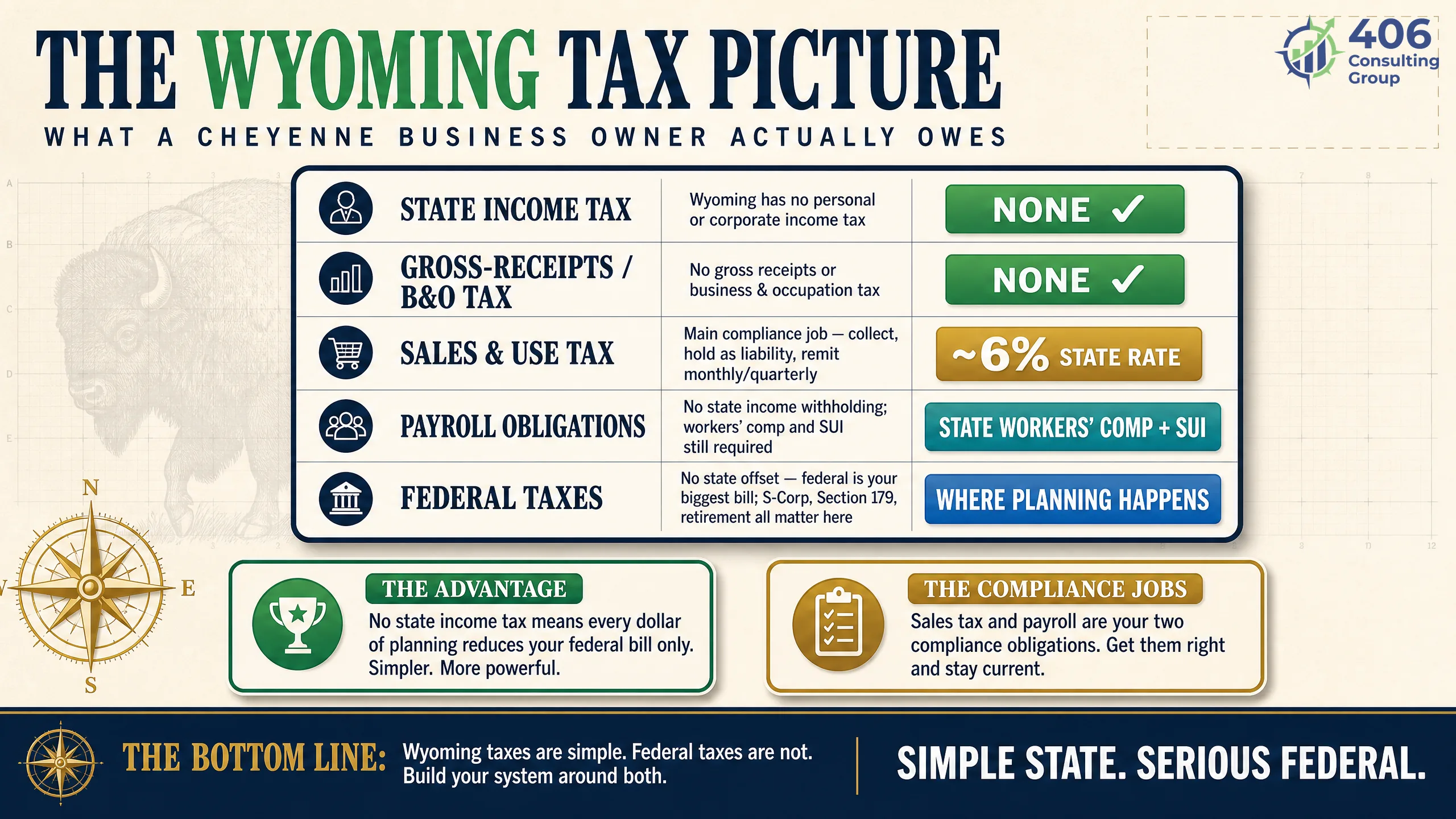
We break down the planning side in the Cheyenne tax guide. The short version: with no state income tax, the tax game is federal.
Sales Tax & Wyoming Payroll
Two compliance areas carry most of the state-side work. Sales and use tax is Wyoming's main state tax — around 6% combined in Cheyenne. You collect it, hold it as the state's money (never as revenue), and remit on schedule; you also owe use tax on equipment and supplies bought without sales tax. In a state with so few taxes, this is the one that bites if it's mishandled.
Payroll is simpler than most states in one big way — with no state income tax, there's no state withholding to compute — but with one twist: workers' compensation is administered by the State of Wyoming rather than bought from a private carrier, so you report and pay it to the state. Add federal payroll taxes and state unemployment insurance, and that's the payroll picture.
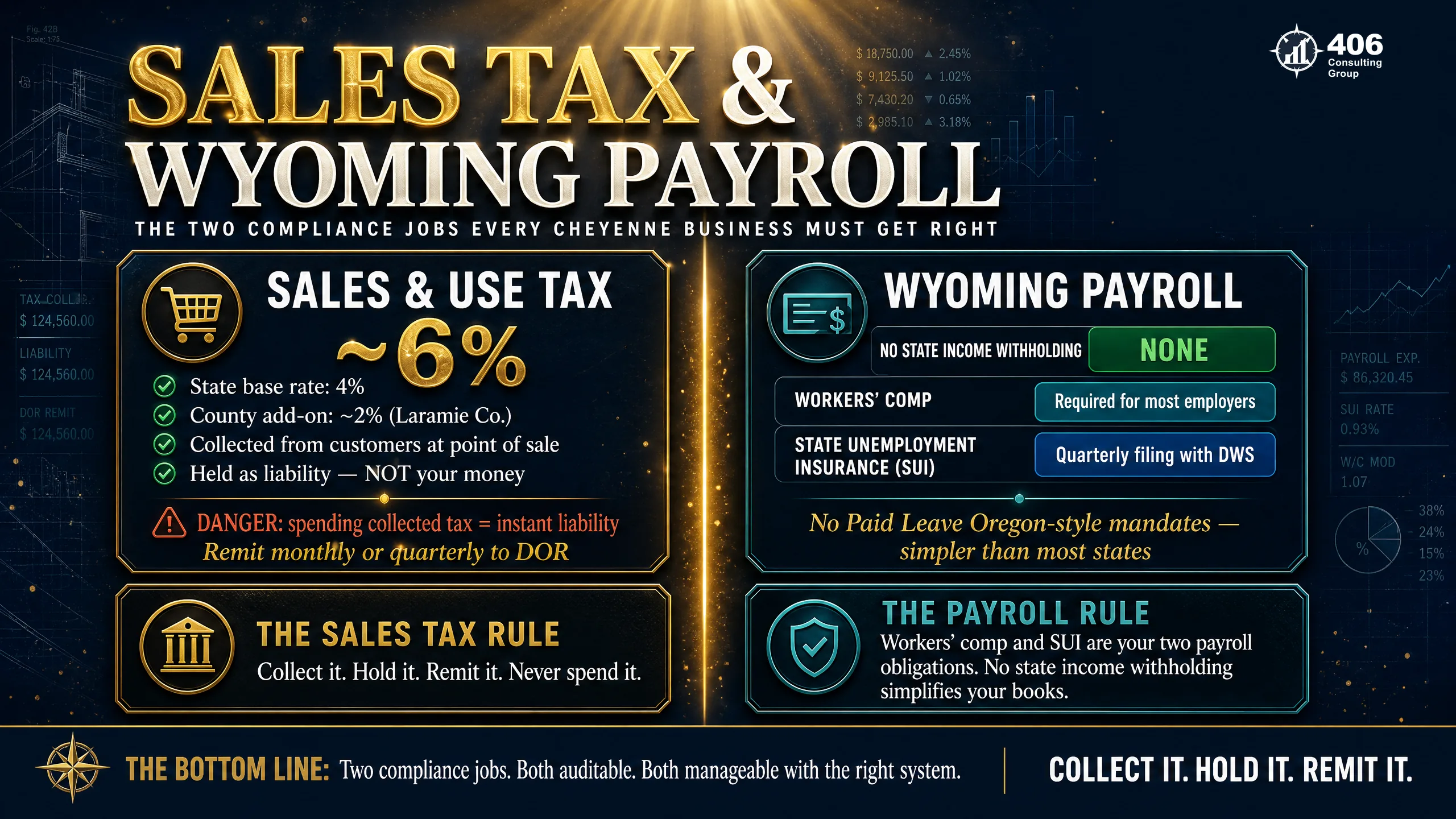
The mechanics — chart of accounts, sales-tax liability, payroll setup — live in the Cheyenne bookkeeping guide.
The Wyoming Entity Advantage
Wyoming is famous as a place to form a business, and for real reasons: no state income tax on the entity, strong owner privacy, solid asset-protection statutes, and low ongoing cost — an annual report with a small license fee rather than an income-based franchise tax. For a Cheyenne business operating here, that advantage is simply built in.
The key is to use it on purpose. A Wyoming entity is a strong base, but it doesn't erase federal tax, and it doesn't erase obligations in other states where you actually do business or have sales-tax nexus. Paired with clean books and the right federal election, it's one of the most favorable setups in the country.
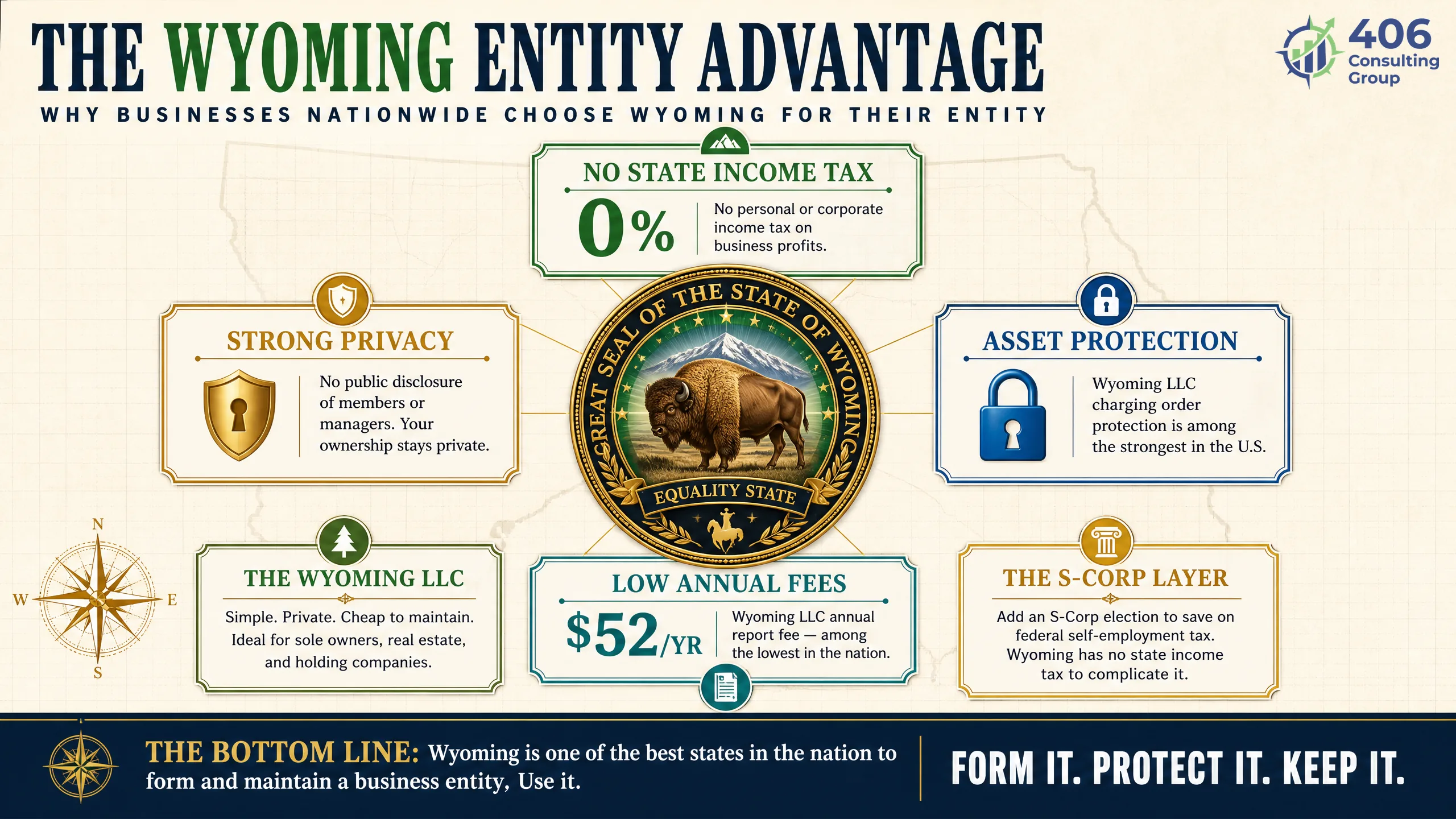
More on entity choice and the S-corp question in the tax guide.
Federal Planning Is the Game
Because Wyoming takes nothing out of your income, every dollar of income-tax planning happens at the federal level. The big levers — the right entity (often an S-corp once profit justifies it), equipment timing via Section 179, retirement plans, and clean complete deductions — all work against your federal bill, which Wyoming's low taxes don't touch.
The trap is assuming a low-tax state means there's nothing to do. The federal savings are exactly the same in Cheyenne as anywhere; owners who skip planning simply hand the IRS money. Clean books make that planning possible — you can't optimize what you can't see.
Run the numbers on an S-corp with our S-Corp Calculator, and see the full federal playbook in the Cheyenne tax guide.
When You Need More Than a Bookkeeper
As a Cheyenne business grows, clean books stop being enough — you start needing the numbers to tell you what to do. That's the step up from bookkeeping to financial leadership: a controller who makes the monthly financials reliable and controlled, and a CFO who turns them into forecasting, margin analysis, and financing strategy.
For Cheyenne and Wyoming's capital-intensive sectors especially — oil & gas and energy services, logistics, data centers, agriculture — the CFO questions matter early: can we fund this equipment without starving operations, is this contract actually profitable, and are we ready to finance the next phase? You don't need a six-figure hire to get that; fractional leadership scales it to your stage.

See what each role delivers and what it costs in the Cheyenne CFO & controller guide.
Accounting by Cheyenne Industry
Cheyenne and the wider Wyoming economy lean toward energy, transportation, agriculture, government, and a fast-growing data-center and distribution sector — and each asks something a little different of the books.
| Industry | Accounting priorities |
|---|---|
| Oil & gas / energy services | Field equipment and assets, per-well/per-job costing, cyclical cash flow, use tax on gear |
| Transportation & logistics | Fuel and fleet costs, per-mile margin, driver payroll, receivables |
| Agriculture & ranching | Equipment and livestock, seasonal income, use tax on gear |
| Data centers & tech | Capital assets and depreciation, multi-state nexus, contracts |
| Government & defense contracting | Contract/job costing, compliance docs, receivables timing |
| Retail, healthcare & services | Sales tax (retail), payroll, inventory or utilization |
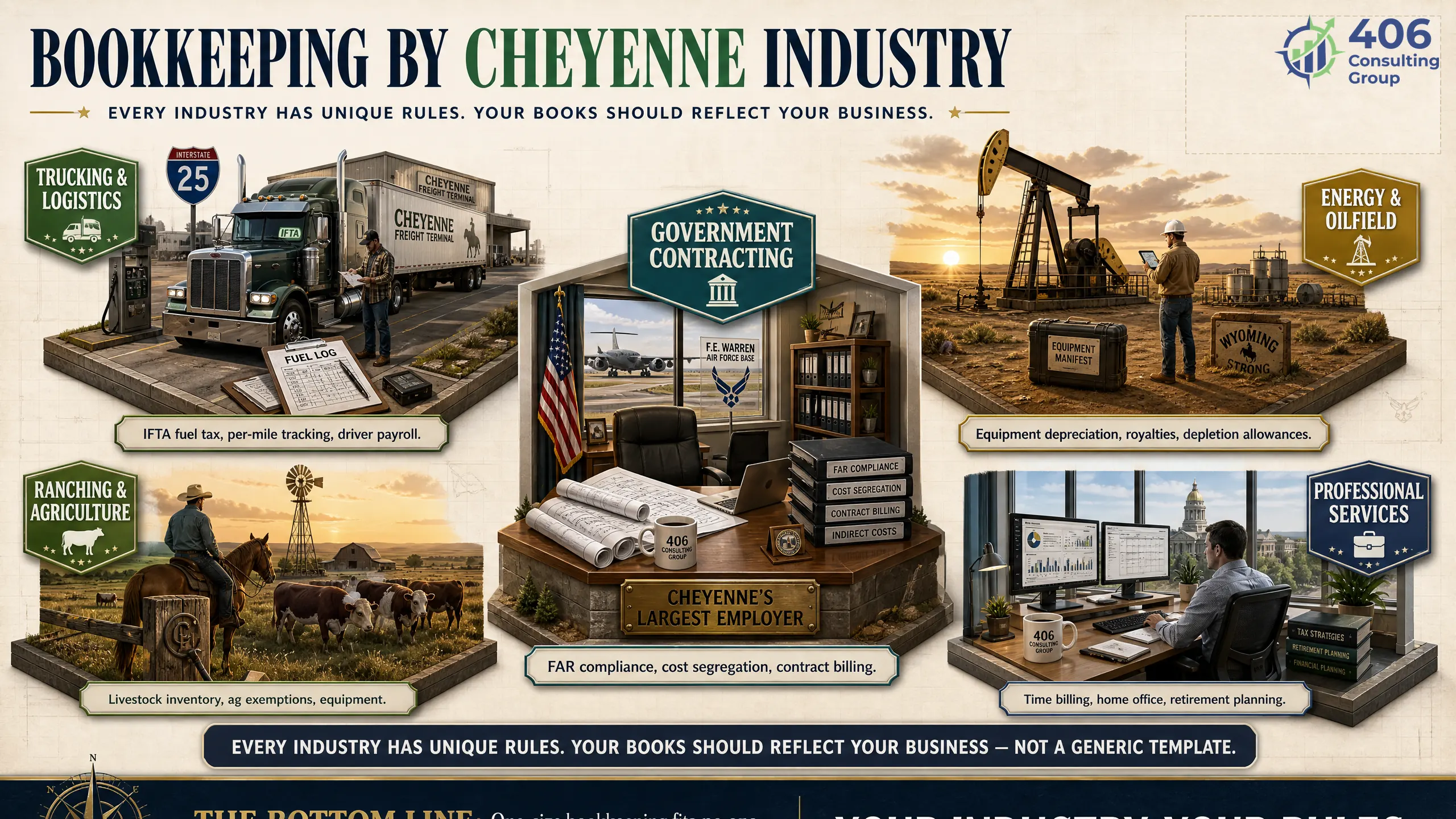
Oil & gas and energy services are a corner we know first-hand — both of our founders spent years in the oil field — so energy companies get an accountant who understands the capital cycles and boom-and-bust cash swings behind the numbers. Different details, same backbone: clean books, sales and payroll compliance handled, and profit readable for the federal return.
Building the Right Accounting System
The biggest difference between accounting that just keeps you compliant and accounting that actually helps you run the business is the system underneath it. Most firms look at your books through an accounting lens only. We design the system from a whole-company view — how work is quoted, delivered, billed, collected, and reported — because the numbers are only useful if they reflect how the business actually operates.
For a Wyoming business, that means a lean setup tuned to the low-tax reality: sales tax tracked as a liability, payroll and workers' comp handled cleanly, capital assets and depreciation straight, and profit reported so federal planning is easy. No income-tax-state clutter — just the pieces that matter, wired together.
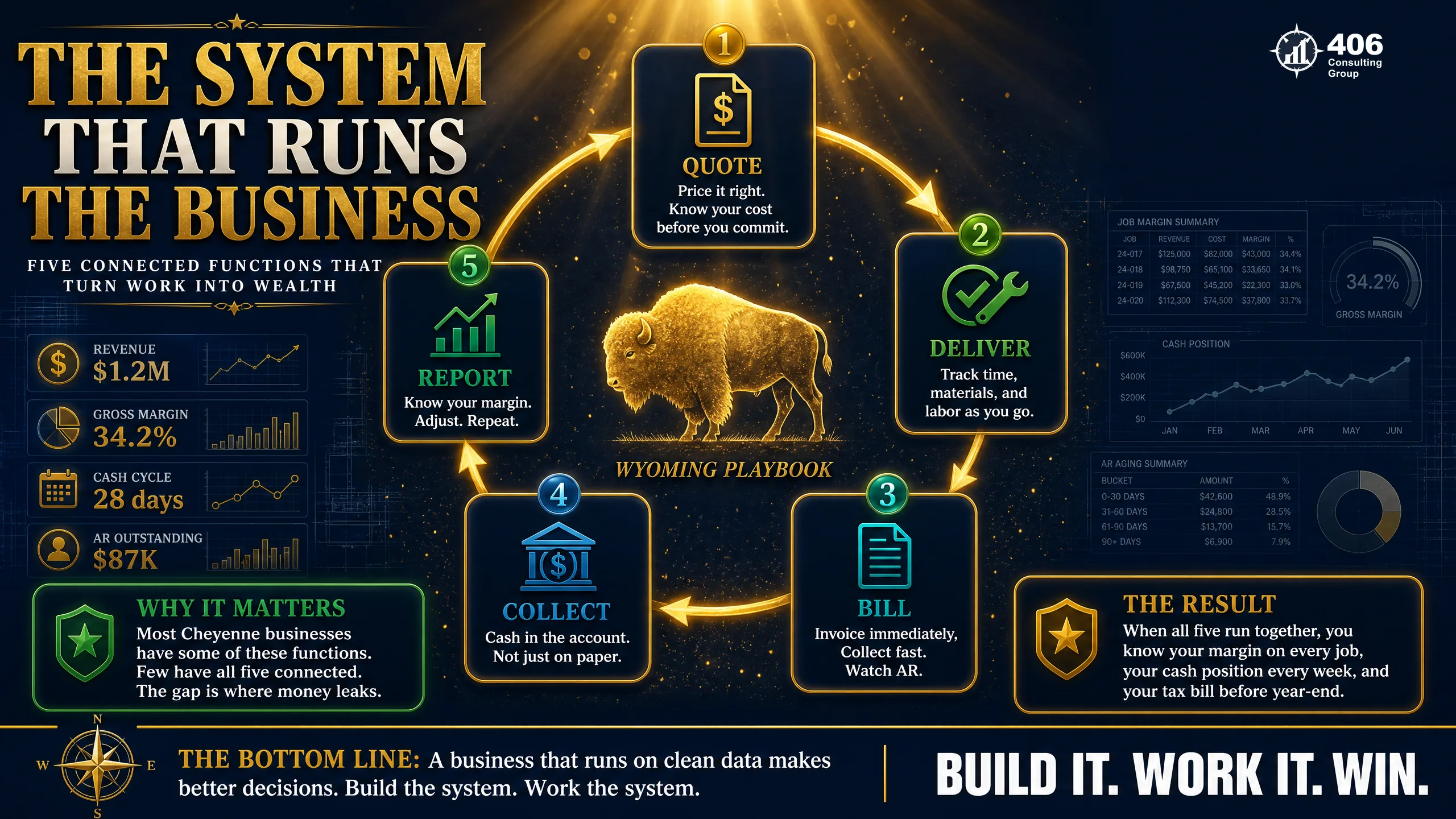
That whole-company perspective is our core differentiator — and why our clients' books stay useful as they grow, not just tidy at tax time.
Local vs. a Great Remote Partner
Accounting is knowledge work — clean books, correct compliance, federal planning, and financial leadership. What matters is whether your partner knows Wyoming's setup cold and can do the thinking, not whether they're down the street. A great remote firm that understands the low-tax playbook beats an okay local generalist every time.
It's also how the work already happens — even for clients nearby. Roughly 70–80% of our own local clients never set foot in our office; everything runs on secure cloud accounting, shared screens, and regular calls. So whether you're in Cheyenne, elsewhere in Laramie County, or anywhere in Wyoming, you get the same service our in-town clients do — and because Wyoming is such a common home for businesses run from elsewhere, our multi-state experience is a real plus.
Distance isn't the variable. Knowing Wyoming — and knowing accounting — is.
How to Get Started
Getting your Cheyenne accounting right is three steps.
Get the books clean
A lean Wyoming-ready chart of accounts, sales tax as a liability, payroll and workers' comp handled.
Build the federal plan
Entity choice, equipment timing, and retirement mapped to your numbers — where all the tax savings live.
Add leadership as you grow
Controller and CFO support to turn clean books into forecasting, margin clarity, and financing readiness.
Not sure which layer you need? Our Financial Maturity Assessment maps it out in about eight minutes.
FAQ: Cheyenne Small-Business Accounting
What taxes does a small business in Cheyenne, Wyoming pay?
Fewer than almost anywhere. Wyoming has no state income tax (personal or corporate) and no gross-receipts or B&O tax. The main state tax is sales and use tax — around 6% combined in Cheyenne. You still owe federal income tax and handle federal payroll, plus Wyoming unemployment insurance and state-administered workers' compensation. There's no state withholding on payroll. It's one of the lightest state tax loads in the country.
If Wyoming taxes are so low, do I still need real accounting?
Yes — the work just shifts. With no state income tax to minimize, your accounting focuses on clean books, correct sales-tax and payroll compliance, and federal planning (where all the tax levers now live). Skipping planning because 'Wyoming is low-tax' is a common, costly mistake — the federal savings are identical to anywhere. And as you grow, you'll want financial leadership to turn clean books into decisions.
Is forming a Wyoming LLC actually an advantage?
It's a genuine structural advantage — no state income tax on the entity, strong privacy and asset protection, and low ongoing fees (an annual report license fee, not an income-based franchise tax). But it doesn't erase federal tax, and if you operate in or sell into other states, those states can still tax that activity and require registration. Used deliberately as your operating home with clean books and the right federal election, it's one of the most favorable setups available.
How do I know if I need a bookkeeper, a controller, or a CFO?
A bookkeeper keeps the transactions recorded and reconciled. A controller makes the monthly financials reliable, on time, and controlled. A CFO turns those numbers into forecasting, margin analysis, and financing strategy. If your books are behind, start with bookkeeping; if they're clean but late or untrusted, a controller; if they're clean but you can't see where you're headed, a CFO. Many growing Cheyenne businesses use a mix, scaled fractionally to their stage.
Can 406 Consulting Group handle everything remotely for a Cheyenne business?
Yes — bookkeeping, tax, and CFO/controller work all run well remotely through secure cloud accounting, shared screens, and regular calls. What matters is deep knowledge of Wyoming's setup and federal planning, plus multi-state know-how, not office proximity. Roughly 70–80% of our own local clients never come into the office either, so you get the same full-service support whether you're in Cheyenne or anywhere in Wyoming.
The Cheyenne Series
Accounting — Cheyenne, WY
The Whole Playbook, Handled.
406 Consulting Group gives Cheyenne businesses full-service accounting — clean books, sales and payroll compliance, federal tax planning, and financial leadership — delivered remotely, by a firm that knows Wyoming and the Rocky Mountain West.
The Cheyenne Series
Hub & the three deep-dive guides
Wyoming Business Accounting
The whole playbook, handled remotely.
About the Author
Jason Anderson
Co-Founder, 406 Consulting Group
Big-firm-trained accountant, with extensive oil-field experience, advising small businesses across the Rocky Mountain West. Jason helps Cheyenne and Wyoming owners — including oil & gas and energy-services companies — turn a low-tax state into a durable advantage: clean books, a smart federal plan, and financial leadership as they grow.
Read the Full Story