
CFO & Controller Services in Cheyenne, WY:
Financial Leadership for Capital-Intensive Growth
Cheyenne's growth — logistics, data centers, equipment-heavy business — is capital-intensive, and that makes cash forecasting and financing readiness the core job. Here's what a controller and CFO deliver, what each costs, and how it works remotely.

Cheyenne and the wider Wyoming economy are growing — logistics and distribution along the rail and interstate corridors, data centers drawing power-hungry investment, oil & gas and energy services running through their capital cycles, agriculture modernizing, and the businesses that serve all of them. Growth like that is capital-intensive: rigs, trucks, equipment, facilities, inventory, and payroll all have to be funded before the revenue fully catches up. That's exactly the point where an owner's instincts, which got the business this far, start to need real financial leadership behind them.
Here's the good news for a Wyoming business: with no state income tax to reserve for, your cash-flow picture is actually cleaner than a peer's in Idaho or Oregon — but capital-intensive growth still has to be planned, financed, and priced correctly, and that's what a controller and a CFO do. The better news is you don't need a $250K full-time hire to get it. Fractional financial leadership gives a growing Cheyenne business the same reporting, forecasting, and financing horsepower for a fraction of the cost — delivered remotely.
This guide covers what controllers and CFOs actually do, what each costs, how to know which you need, and how it works remotely.
By Carrie Anderson — Co-Founder, 406 Consulting Group. Commercial banking and underwriting background — 300+ loan reviews — which is exactly the lens a growing, capital-intensive Cheyenne business needs when it's forecasting cash and getting ready to finance the next phase.
Quick Answer: CFO & Controller Help for a Cheyenne Business
- →A controller makes the numbers accurate and on time; a CFO makes them tell you what to do next.
- →Capital-intensive growth — equipment, facilities, inventory — makes cash forecasting and financing readiness the core job here.
- →No state income tax means a cleaner cash forecast than in neighboring states — but growth still has to be funded.
- →Fractional delivers both roles for ~$4,000–$8,000/month — a fraction of full-time salaries — remotely.
- →Full-time only pays off at scale — generally around $15M+ in revenue.
Table of Contents
Why Financial Leadership Matters Now
Most growing businesses hit a financial ceiling when growth outpaces the owner's ability to run the numbers by feel — too many customers, too much equipment, too many employees, and decisions that are too expensive to get wrong. The books that carried you to $1M can't steer you through $5M. In Cheyenne's capital-intensive sectors, that wall can arrive fast, because every step of growth requires funding a truck, a facility, or a payroll before the revenue lands.
Financial leadership is what turns clean books into decisions: how much equipment you can afford this year, whether that contract is actually profitable, how to fund the next hire or facility, and when to go to the bank. It's the difference between reacting to the bank balance and steering by a forecast.
The question is rarely "do I need help?" — it's "which kind, and how do I get it without overpaying?" That starts with understanding the roles.
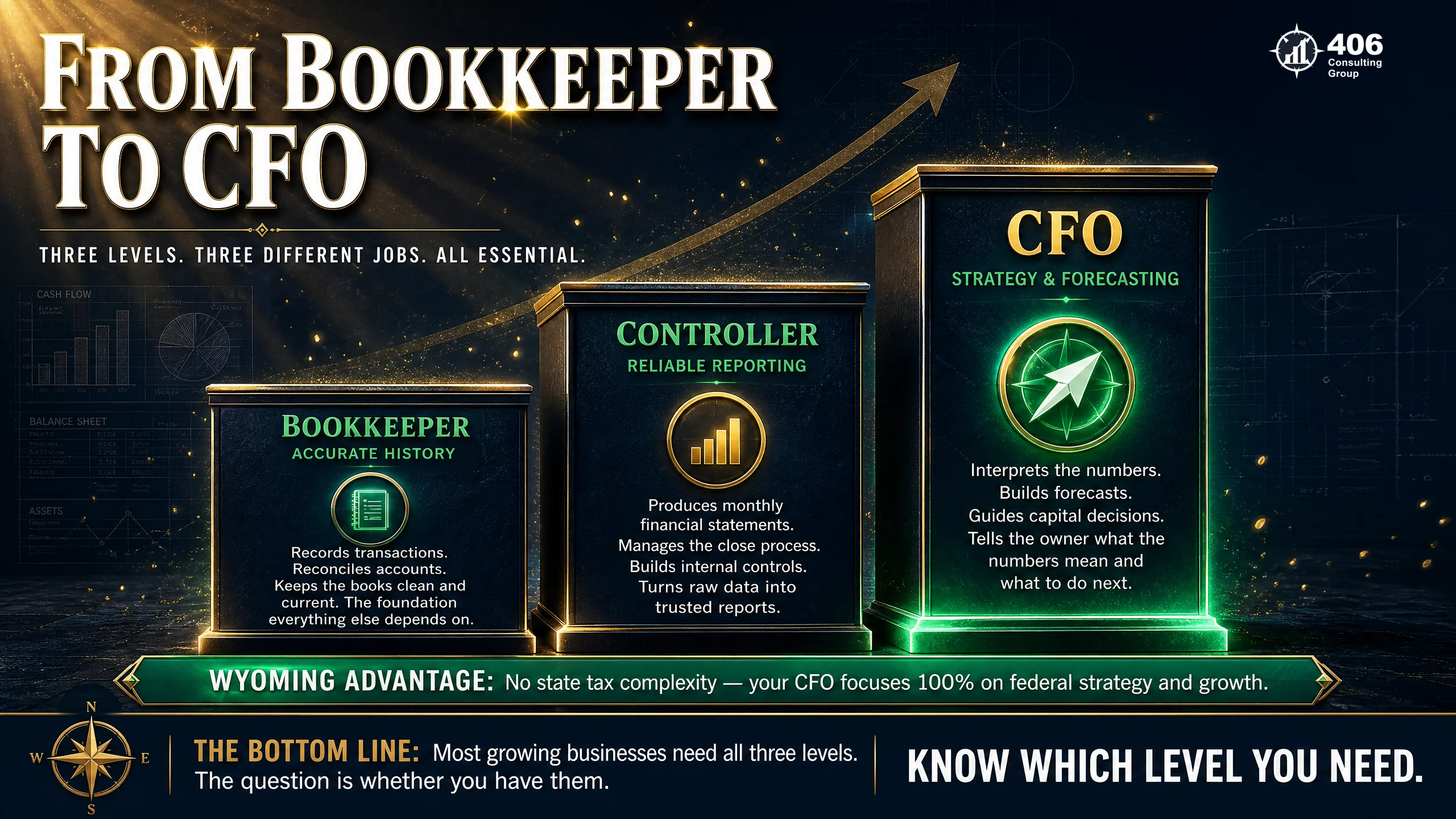
Bookkeeper vs. Controller vs. CFO
These three roles get blurred constantly, but they're distinct — and hiring the wrong one for your problem is a common, expensive mistake.
| Role | Core question they answer |
|---|---|
| Bookkeeper | "Are the transactions recorded and reconciled?" — accurate history |
| Controller | "Are the financials right, on time, and controlled?" — reliable monthly reporting |
| CFO | "What do the numbers tell us to do next?" — forecasting, strategy, financing |
A quick rule: if your numbers are late or wrong, you need a controller. If your numbers are clean but you can't see where you're headed, you need a CFO. Many growing Cheyenne businesses need a bit of both — which is exactly what a coordinated fractional engagement delivers. We cover the first step up in upgrading from bookkeeping to a controller.
The Cost Math: Fractional vs. Full-Time
This is where most owners are surprised — in a good way. Full-time financial leadership is expensive, and at most growing businesses it isn't a 40-hour-a-week job yet. Fractional gives you the expertise scaled to what you actually need.
| Role | Fractional (per month) | Full-time (annual) |
|---|---|---|
| Controller | ~$2,500–$6,000 | $85K–$120K + ~25% benefits |
| Fractional CFO | ~$2,500–$5,000 | $150K–$300K+ + benefits |
| Both, coordinated | ~$4,000–$8,000 | $235K–$420K+ |
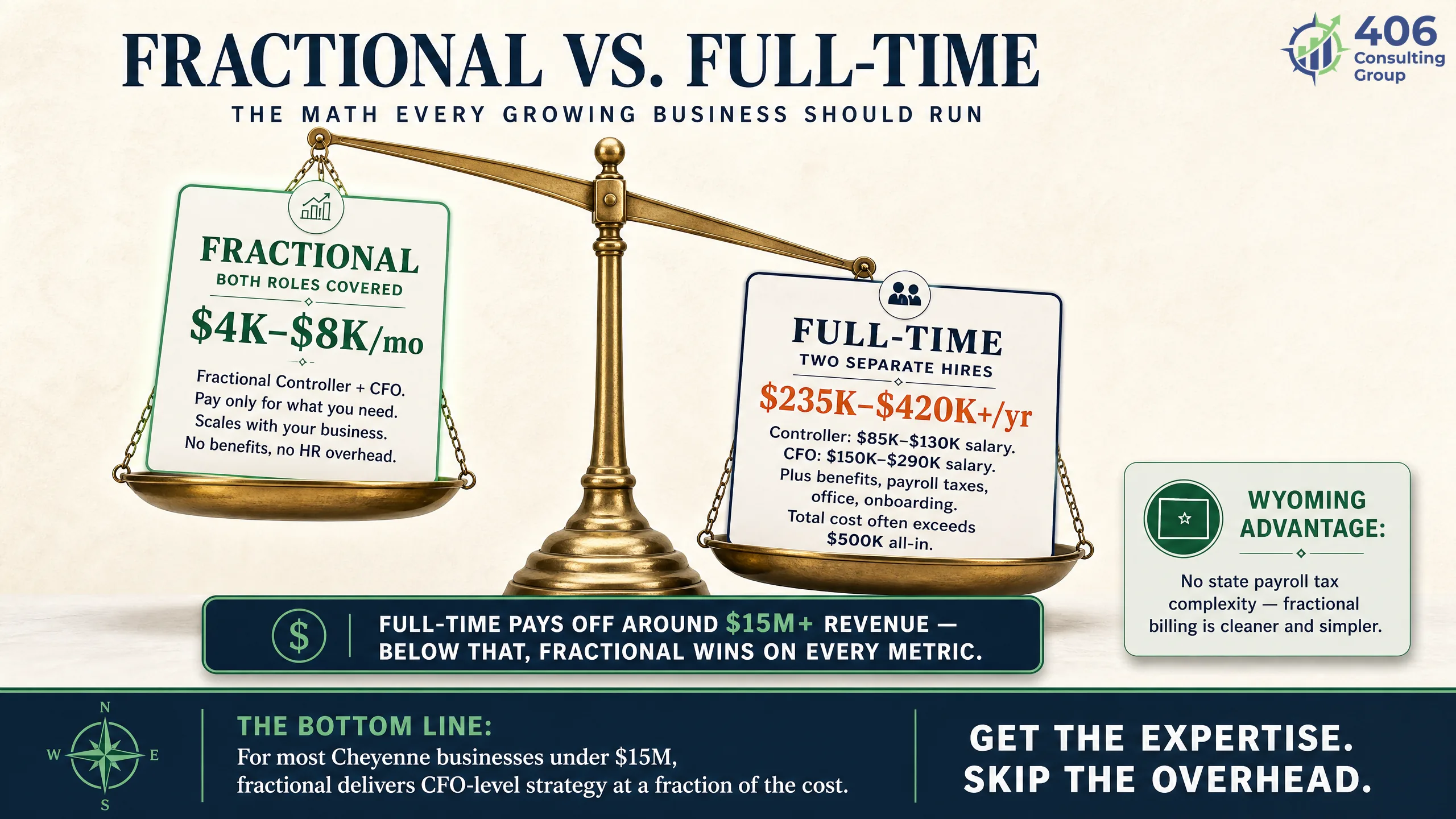
Fractional is dramatically more cost-effective until a business reaches the scale — generally $15M+ — that keeps a full-time hire busy year-round. Estimate the controller piece with our Controller Estimator.
What a Controller Delivers
A controller owns the integrity of your financials. That means a reliable monthly close, accurate statements you can actually trust, clean processes and internal controls, and the systems that keep everything running as you scale. For a capital-intensive Cheyenne business, a controller also keeps fixed assets, depreciation, and job or project costing straight — so you know the real cost of the equipment and contracts driving your growth.
Because our background is in running whole businesses — not just accounting — we build controller processes around your entire operation: how work is quoted, delivered, billed, and collected, not just how it's booked. That whole-company view is what keeps the financials useful for decisions, not just compliant.
When the monthly numbers are finally reliable, most owners realize they now want to use them — which is the CFO's job.
What a CFO Delivers
A CFO turns reliable numbers into forward strategy: cash-flow forecasting, margin and pricing analysis, budgeting and scenario planning, financing strategy, and a seat at the table for the big decisions — should we buy or lease that equipment, take on that contract, open that facility, or hire ahead of the growth?
For a growing Cheyenne business, the CFO's highest-value work is usually two things: making sure capital-intensive growth is funded without starving day-to-day operations, and getting the business genuinely ready to finance the next phase. Both are about seeing around the corner instead of reacting to last month's bank balance.
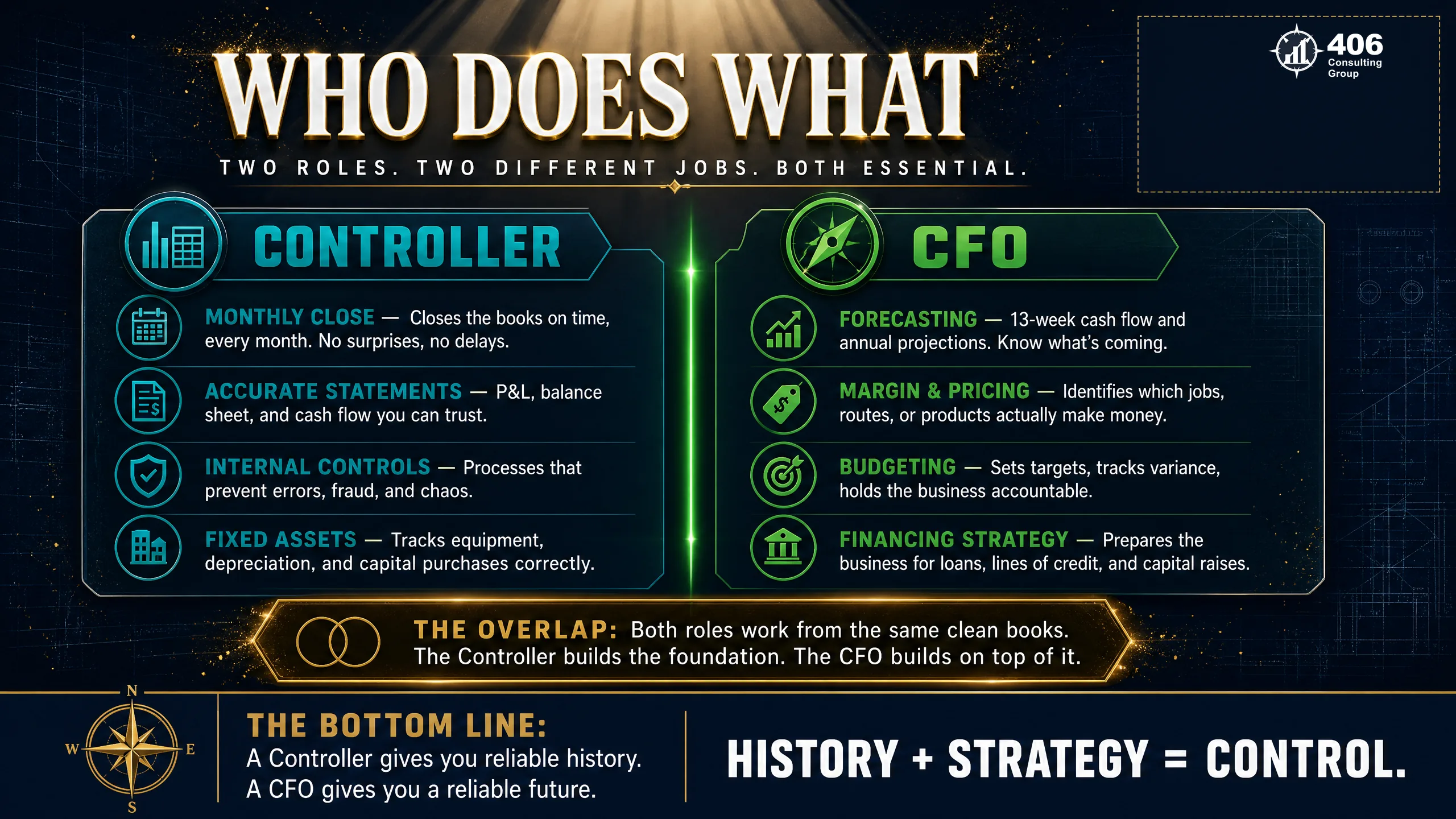
You rarely need both at full strength at once — which is why a coordinated fractional engagement, dialed to your stage, is usually the right answer.
Cash Forecasting for Capital-Intensive Growth
In Cheyenne's core sectors, cash and profit are two different stories. You buy the truck, the server hardware, or the equipment now; the revenue it generates arrives over months or years. A profitable business can still run out of cash if that timing isn't planned — which is the single most common way growing, capital-heavy businesses get into trouble.
A 13-week cash forecast, plus a longer capital-expenditure plan, is the tool that prevents it — mapping when big outflows hit against when receivables land. Wyoming actually makes this cleaner than most states: with no state income tax, there's no large state-tax reserve distorting the forecast, so the picture is mostly operations, capital, and the federal bill. Clean, but still essential to model. This matters even more for oil & gas and energy-services companies, where revenue swings hard with commodity cycles — and it's an industry both of our founders know first-hand from years in the oil field, so we forecast those boom-and-bust cash swings from experience, not theory.
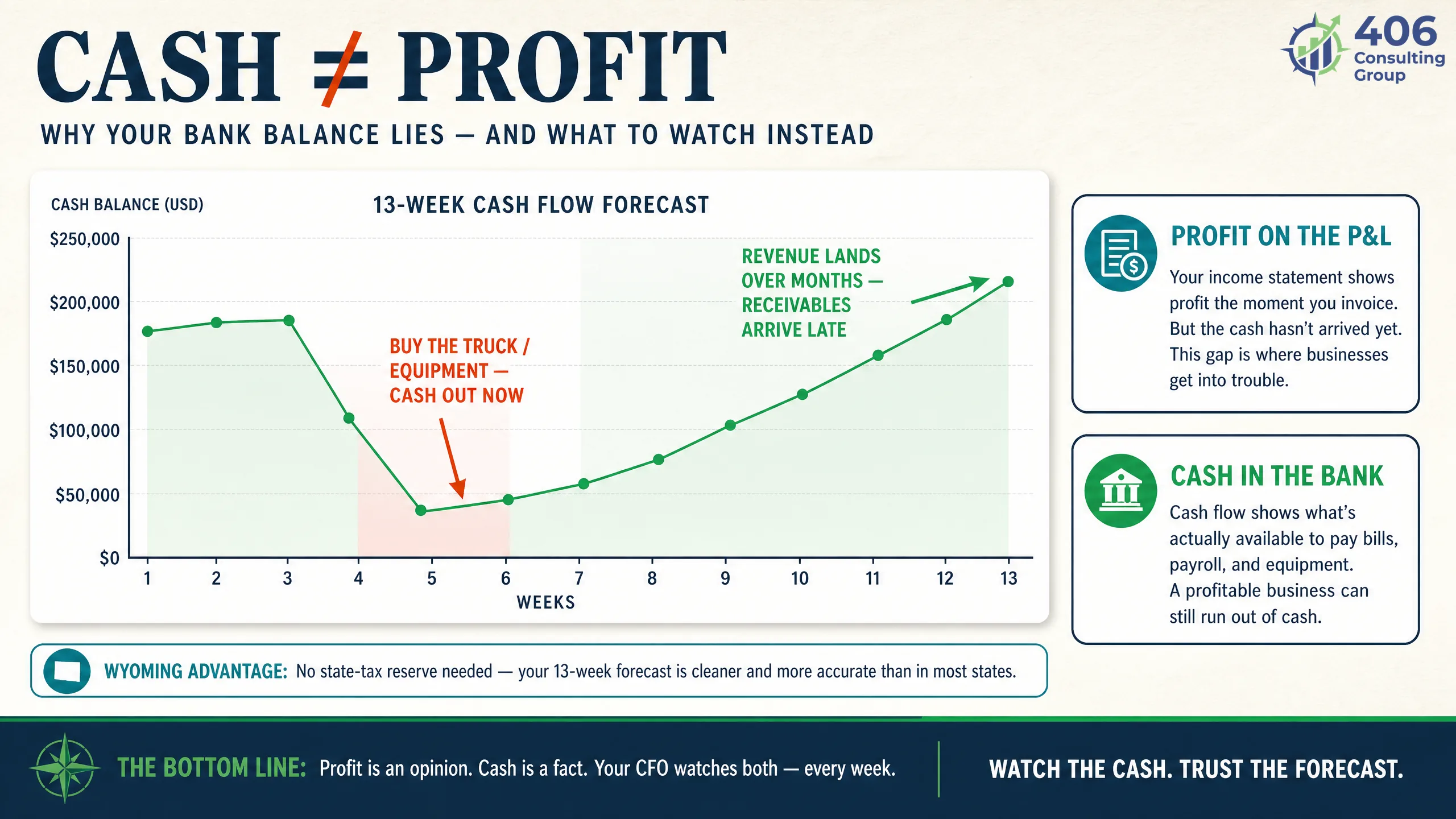
Want a quick read on your runway? Try our Cash Flow Runway tool, and see why profit and cash aren't the same.
Margin & Pricing
Growing revenue while margins quietly erode is a trap — you get busier and no richer. A CFO digs into which jobs, routes, customers, or product lines actually make money once you load in equipment, fuel, labor, and overhead, and which ones just create activity. In logistics and equipment-heavy work especially, the real cost per job or per mile is often very different from what the owner assumes.
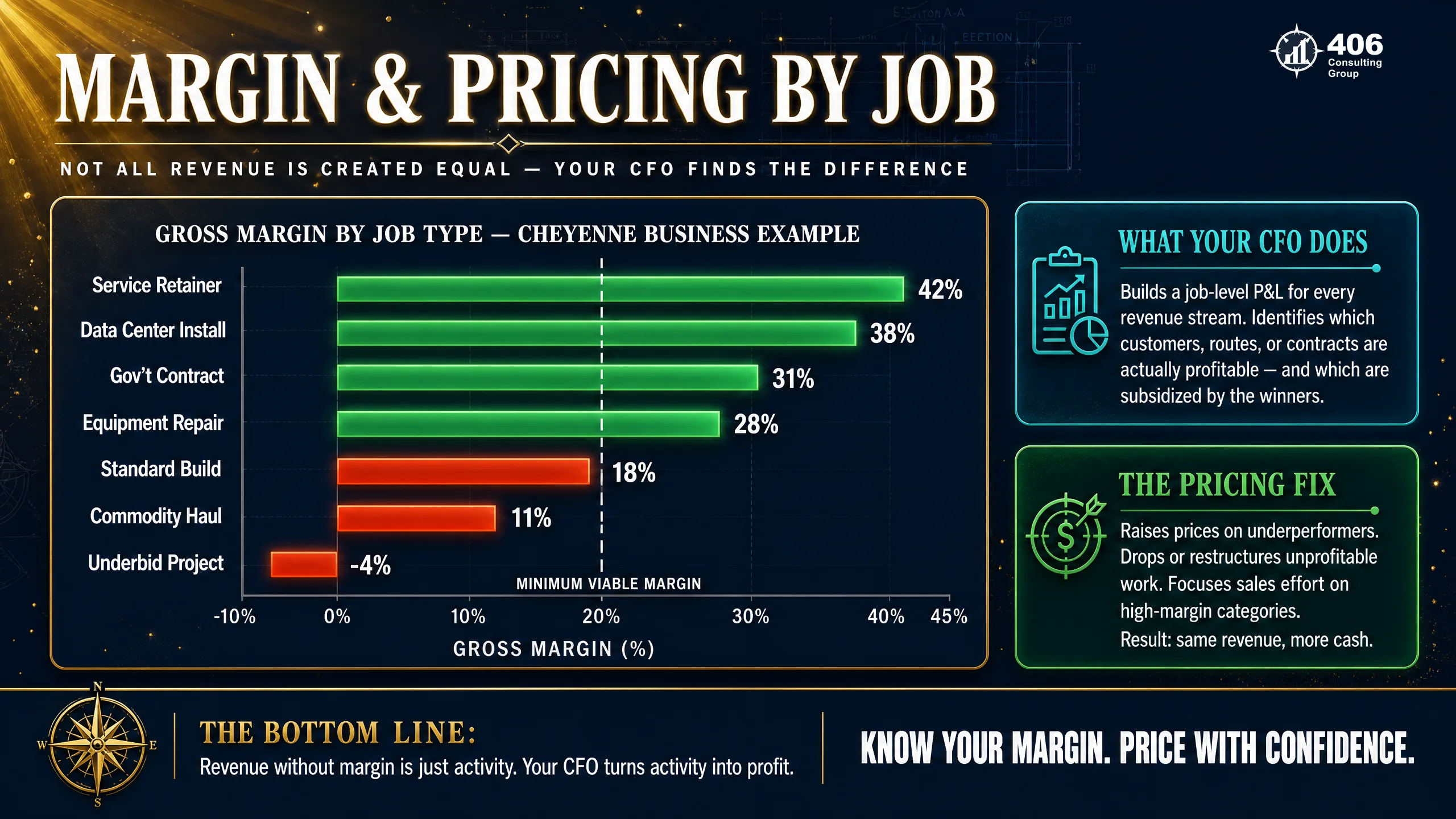
From there, pricing gets deliberate: raise it where you're underwater, walk away from work that can't be profitable, and lean into what actually drives the bottom line. That single shift often funds the cost of the CFO several times over.
Financing Readiness
Capital-intensive growth usually means borrowing — for equipment, facilities, or working capital — and how ready you are determines whether you get the money, and at what rate. Banks lend to businesses that present clean financials, a credible forecast, and an owner who can speak to the numbers. Show up with messy books and a vague plan, and you'll get a no or a punishing rate.
This is where my banking background pays off directly: I've sat on the underwriting side of 300+ loan reviews, so we prepare your business the way a lender actually evaluates it — the statements, the projections, the story — before you ever walk in. It's the difference between hoping for a yes and engineering one.

See our loan readiness work for how we get a business bank-ready.
When to Hire — and the Fractional Path
A few clear signals mean it's time for financial leadership:
You're flying blind past the bank balance
Decisions get made on the account balance, not a forecast — risky as the numbers get bigger.
Financials are late, or you don't trust them
If the monthly close is a scramble or the numbers feel off, you need a controller first.
Growth is capital-heavy and cash is tight
Equipment and facilities to fund, and cash always feels short despite profit — a CFO's core problem.
You're about to finance or make a big bet
A loan, a facility, a major hire — get the numbers and the plan bank-ready first.

The fractional path lets you start with exactly what you need — often a controller to get the numbers right, then CFO strategy layered on as you grow — and scale the engagement up or down without the risk of a six-figure hire.
Local vs. a Great Remote Partner
Financial leadership is analysis and judgment — building the forecast, pressure-testing the margins, preparing the financing package, and talking through the big decisions. None of it depends on being in the room. What matters is the caliber of the thinking and whether your partner understands Wyoming's setup and your capital-intensive reality — not their zip code. A great remote CFO beats an okay local one, every time.
It's also how we already work. Roughly 70–80% of our own local clients never come into the office; forecasts and reviews happen over shared screens, with live dashboards and regular strategy calls. So whether you're in Cheyenne, elsewhere in Laramie County, or anywhere in Wyoming, you get the same financial leadership our in-town clients do — with a banker's eye on the numbers.
Distance isn't the variable. Quality of thinking is.
How to Get Started
Getting financial leadership in place is three steps.
Diagnose what you actually need
Are the numbers late/wrong (controller) or clean-but-unused (CFO)? We start by pinpointing the real gap.
Get the foundation right
Reliable monthly reporting and clean processes first — the CFO work is only as good as the numbers under it.
Layer on strategy
Cash forecasting, margin and pricing, and financing readiness, scaled to your stage and growth plans.
Not sure which layer you need? Our Financial Maturity Assessment maps it out in about eight minutes.
FAQ: Cheyenne CFO & Controller Questions
How much do CFO and controller services cost in Cheyenne, WY?
Fractional pricing typically runs about $2,500–$6,000 per month for a controller and about $2,500–$5,000 per month for a fractional CFO, depending on complexity and scope. A coordinated engagement covering both often runs roughly $4,000–$8,000 per month. Compare that to full-time salaries — $85K–$120K for a controller and $150K–$300K+ for a CFO, plus roughly 25% in benefits — and fractional is dramatically more cost-effective until a business reaches the scale (generally $15M+) that keeps a full-time hire busy year-round.
What's the difference between a controller and a CFO?
A controller owns the accuracy and timeliness of your financials — the monthly close, reliable statements, clean processes and controls. A CFO is forward-looking: cash-flow forecasting, margin and pricing analysis, budgeting, financing strategy, and helping steer big decisions. Simply put, the controller makes the numbers right; the CFO makes them tell you what to do next. Many growing Cheyenne businesses need some of both, which a coordinated fractional engagement delivers.
Does no state income tax change what a CFO focuses on in Wyoming?
It simplifies one thing and sharpens another. On cash forecasting, there's no large state income-tax reserve to model, so the forecast is cleaner — mostly operations, capital spending, and the federal bill. But Cheyenne's growth tends to be capital-intensive (equipment, facilities, inventory), so the CFO's focus lands squarely on funding that growth without starving operations and on financing readiness. Wyoming's low taxes are a tailwind, not a substitute for planning.
When should a Cheyenne business hire financial leadership?
When decisions are being made off the bank balance instead of a forecast; when the monthly financials are late or you don't fully trust them; when capital-intensive growth keeps cash tight despite being profitable; or when you're about to finance a purchase or make a big bet. Late or untrusted numbers point to a controller first; clean-but-unused numbers point to a CFO. The fractional path lets you start with what you need now and scale up.
Can 406 Consulting Group provide CFO and controller services remotely?
Yes — it's how the work is done now. Forecasting, margin analysis, financing prep, and strategy reviews all happen over shared screens, live dashboards, and regular calls; none of it requires being in the room. Roughly 70–80% of our own local clients never come into the office either. What matters is the quality of the analysis and understanding Wyoming's setup and your capital-intensive reality — and with a commercial-banking background behind the numbers, you get a lender's-eye view whether you're in Cheyenne or anywhere in Wyoming.
Keep Reading
CFO & Controller — Cheyenne, WY
Fund the Growth. Steer by a Forecast.
406 Consulting Group gives growing Cheyenne businesses fractional controller and CFO leadership — reliable reporting, cash forecasting, margin clarity, and financing readiness — delivered remotely, with a banker's eye on the numbers.
Fractional vs. Full-Time
Cheyenne, WY — typical ranges
Outgrowing Your Numbers?
Fractional leadership, banker's eye.
About the Author
Carrie Anderson
Co-Founder, 406 Consulting Group
Commercial banking and underwriting background — 300+ loan reviews — plus extensive oil-field experience. Carrie helps growing Cheyenne businesses, including oil & gas and energy-services companies, forecast cash, sharpen margins, and get genuinely bank-ready — the financial leadership a capital-intensive business needs, with a lender's eye on the numbers.
Read the Full Story