
Accounting for Small Business in Los Angeles, CA:
Which Help You Need, and When
California is the highest-tax state in the country — so proactive planning matters MORE, not less. The four layers of accounting help an LA business actually needs (bookkeeping, tax, controller, CFO), which one you need now, and why a great remote firm beats an expensive local one.

Accounting for a small business in Los Angeles is really four jobs, not one — clean books, compliant tax, controller-level visibility, and CFO strategy — and knowing which one you need, in what order, is what keeps a growing company out of trouble. Los Angeles makes that sequence matter more than almost anywhere in the country, because California is the opposite of a no-income-tax state. It is the highest-tax state in the nation, with a top individual rate of 13.3%, an aggressive Franchise Tax Board, an $800 minimum franchise tax that starts the day you open, and an LLC gross-receipts fee stacked on top. In a place this expensive to get wrong, proactive planning is not a luxury — it is the whole game.
This is the hub guide to accounting for small business in Los Angeles: the California tax reality, the industries that define the LA economy, the four layers of financial help and when each one earns its keep, and why a great remote firm beats an expensive local one in a market this costly. Each layer links to a deeper guide, so treat this as the map — not the whole territory.
By 406 Consulting Group — a Montana-based, remote accounting firm serving Los Angeles and California businesses. Our team pairs a commercial-banking and underwriting background with big-firm tax and Six Sigma systems experience, and we design financial systems from a whole-company view.
Quick Answer: Accounting for an LA Small Business
- →Accounting is four layers — bookkeeping, tax, controller, CFO — and most owners only need the next one, not all four at once.
- →California is the highest-tax state: 13.3% top individual rate, 8.84% corporate, and an $800 minimum franchise tax from year one — so planning matters more, not less.
- →LLCs owe a gross-receipts fee on top of the $800, and the AB 150 PTE election is a real federal SALT-cap workaround you cannot get in a no-tax state.
- →AB 5 and its ABC test decide whether your people are 1099 or W-2 — every LA business has to get this right.
- →It's all remote — about 80% of our local clients run the entire relationship that way, and a great remote firm beats an expensive local one in a high-cost market.
Table of Contents
The Short Answer
Accounting for small business in Los Angeles breaks into four distinct kinds of help, and you almost never need all of them on day one. First you need clean books — an accurate record of what came in and went out. Then you need compliant tax — the returns filed and, far more valuable, a plan to legally shrink the bill. As you grow, you need controller-level visibility — someone making the numbers reliable and readable fast enough to act on. And eventually you need CFO strategy— someone turning those numbers into decisions about pricing, hiring, and capital.
We call that progression The Los Angeles Financial Stack, and it is a local read on our firm's Financial Maturity Ladder. The trick for an LA owner is knowing which layer you are actually standing on, because in the highest-tax state in the country, buying the wrong layer — or skipping the tax one — is expensive in a way it simply isn't in Texas or Florida.
You don't need "an accountant." You need the right one of four things — bookkeeping, tax, controller, or CFO — for where your Los Angeles business is right now.
Before we map the layers, you have to understand the ground they sit on: California tax.
Why Planning Matters MORE in California
Here is the mental shift a Los Angeles owner has to make. Owners in no-income-tax states like Texas, Florida, or Nevada can coast on tax — there is simply less state machinery to plan around. In California, the exact opposite is true. Every dollar of profit runs a gauntlet of the highest state income tax in the nation, a minimum franchise tax that bills you whether you made money or not, and a Franchise Tax Board with a reputation for chasing residency and nexus hard. The higher the tax, the more a good plan is worth — which means proactive planning in LA pays back more than the same work anywhere else.
Put plainly: in a low-tax state, sloppy tax planning costs you a little. In California, the same sloppiness costs you a lot, every single year, compounding. That is why the tax layer of the stack is never optional here, and why "my cousin does my books" quietly becomes one of the most expensive decisions a growing LA business makes.
13.3%
California's top individual income tax rate
The highest state rate in the country — roughly 14.4% on wages once the now-uncapped 1.1% SDI is added. Confirm current rates with the California Franchise Tax Board.
So what exactly are you up against? The California tax stack.
The California Tax Stack
California doesn't tax you one way — it taxes you in layers, and a Los Angeles business feels most of them. Here is the stack that shapes how your books and structure have to be built:
13.3% top individual rate
The highest state income tax in the country on pass-through owners — roughly 14.4% on wages once the uncapped 1.1% SDI is layered in. Your personal return is where most business profit lands.
8.84% corporate income tax
California taxes C-corporation net income at 8.84% (with an alternative minimum in some cases) — on top of federal corporate tax, so the entity decision is a real California cost.
$800 minimum franchise tax
Almost every LLC and corporation owes at least $800 a year to the FTB — profit or not, from essentially the day you register. It is the price of existing in California.
LLC gross-receipts fee
On TOP of the $800: $0 under $250K, ~$900 at $250K, ~$2,500 at $500K, ~$6,000 at $1M, and ~$11,790 at $5M+. It is based on revenue, not profit — so a thin-margin LLC can owe it while barely making money.
AB 150 PTE election (9.3%)
A REAL federal SALT-cap workaround: the pass-through entity pays a 9.3% elective tax on qualified net income, deductible federally. You cannot get this lever in a no-income-tax state — it is a California advantage worth planning for.
~9.75% LA sales tax + FTB
The City of Los Angeles combined sales tax runs about 9.75% (since April 1, 2025), and the Franchise Tax Board is aggressive on residency and nexus. EDD payroll taxes (UI/ETT/SDI) apply too.
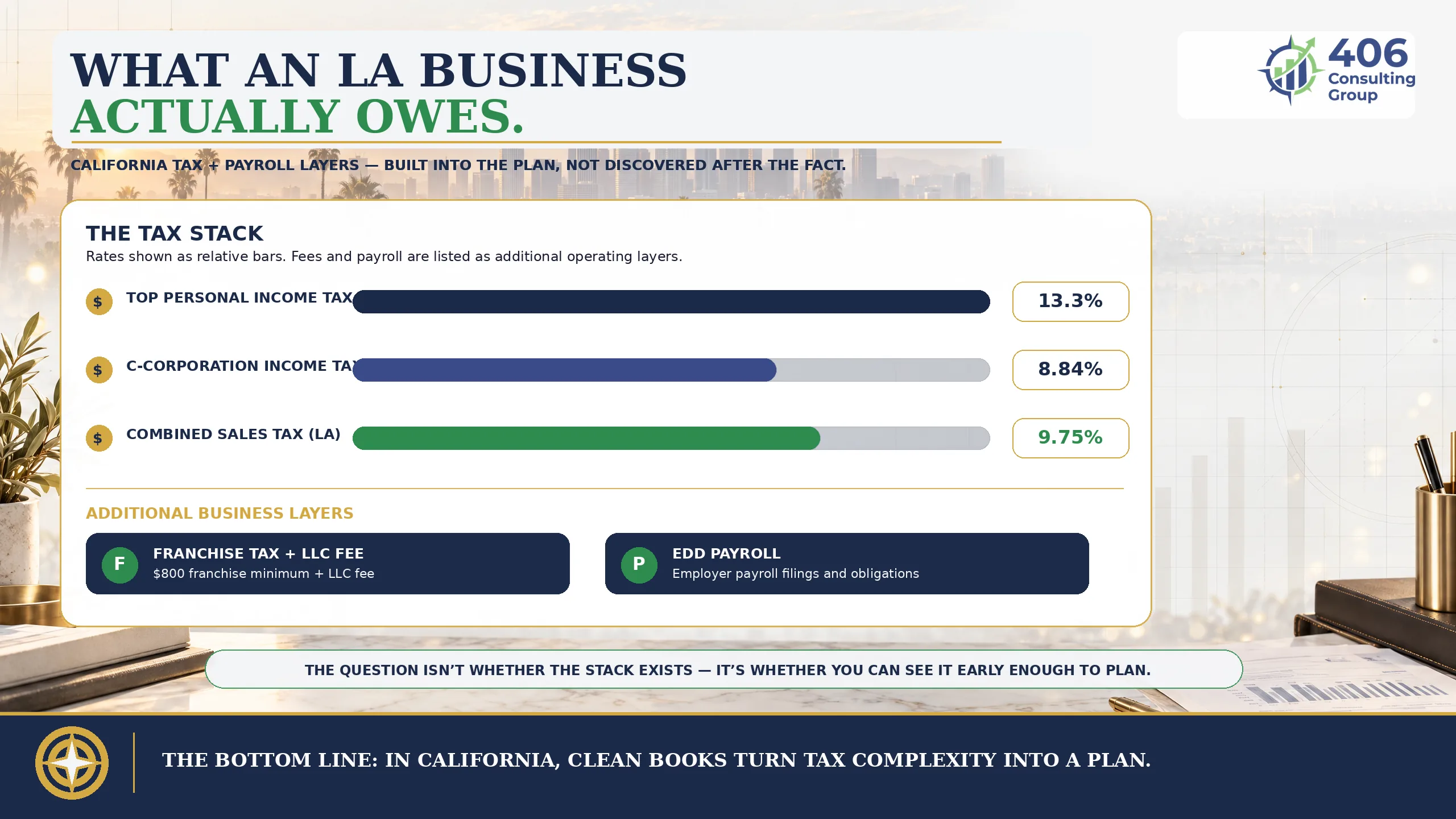
Confirm current rates and the fee schedule with the California Franchise Tax Board and sales-tax rates with the CDTFA. Notice the bright spot: the AB 150 PTE election is a genuine tax-saving lever that owners in no-tax states simply do not have. High tax cuts both ways — it punishes no plan and rewards a good one.
The LA Industry Snapshot
Los Angeles isn't one economy — it is several stacked on top of each other, and the accounting a business needs depends heavily on which one it lives in. A creator's books look nothing like a freight broker's. Here is the quick read on the sectors that define the LA small-business landscape:
Entertainment & creators
Production companies, agencies, YouTubers, and influencers — heavy on 1099 talent, project accounting, loan-out entities, and lumpy, deal-driven income that needs real planning.
Silicon Beach tech
Startups and agencies in Santa Monica, Venice, and Playa Vista — burn-rate tracking, R&D credits, investor-ready financials, and equity comp complexity.
Ports of LA / Long Beach trade
The largest port complex in the country drives logistics, import/export, warehousing, and freight — inventory, customs, and multi-state sales-tax exposure.
Real estate & hospitality
Developers, brokers, restaurants, and hotels — entity structuring, depreciation strategy, tip and seasonal payroll, and thin-margin cost control.

Different industries, same underlying need: a financial system that fits how the business actually runs. That is what the stack is for.
The Los Angeles Financial Stack
The Los Angeles Financial Stackis our local read on 406's Financial Maturity Ladder: four layers that build on each other, from recording the past to steering the future. You climb them in order, and you add the next layer only when the business genuinely needs it — not because a competitor has a CFO or because a sales pitch said you should.
Layer 1 — Bookkeeping
Clean, accurate, reconciled books. The foundation everything else stands on. Answers: what actually happened?
Layer 2 — Tax
Compliant filings plus a proactive plan to legally shrink the highest state tax bill in the country. Answers: what do we owe, and how do we owe less?
Layer 3 — Controller
Reliable, timely, readable numbers — a fast monthly close and real reporting. Answers: can I trust these numbers enough to act?
Layer 4 — CFO
Strategy from the numbers — pricing, hiring, cash, capital, growth. Answers: what should we do next, and what will it cost?

You can't skip a layer. A CFO's strategy is only as good as the controller's numbers, which are only as good as the bookkeeper's foundation. Build up, in order.
Not sure which layer you're on? The Financial Maturity Assessmentplaces you in a few minutes. Let's walk the layers.
Layer 1 — Bookkeeping
Bookkeeping is the foundation: an accurate, reconciled record of every dollar in and out, with a clean split between business and personal. If this layer is shaky, every layer above it inherits the mess — a tax plan built on bad books is guesswork, and a CFO forecast on bad books is fiction. For an LA business, clean books also mean you can actually calculate the LLC gross-receipts fee, track sales tax at the ~9.75% city rate, and hand a lender financials they trust.
You're on Layer 1 when you can't answer "how did we do last month?" without digging through a bank app. Fix the foundation first.
We go deep on this in the Los Angeles bookkeeping guide, and you can see the scope of the work on our bookkeeping services page. Once the books are clean, the next dollar of value is almost always in tax.
Layer 2 — Tax
Tax is two different jobs that get confused constantly: compliance (filing the returns correctly and on time) and planning(structuring the year so you legally owe less). In the highest-tax state in the country, the planning half is where the real money is. This is the layer where the AB 150 PTE election, the S-corp decision, entity choice around the 8.84% corporate rate, depreciation timing, and retirement plans all live — levers that, played well, save an LA owner far more than they cost.
High tax means high reward for planning.
The AB 150 PTE election alone is a federal SALT-cap workaround worth real money — and it's the kind of lever no-income-tax states simply don't have. Plan for it on purpose.
The full detail — the PTE math, the entity decision, and California's other taxes — lives in the Los Angeles tax services guide. When compliant books and a real tax plan are in place, growth tends to expose the next gap: visibility.
Layer 3 — Controller
A controller is the layer most growing LA businesses don't know they need until the numbers start arriving too late to matter. Where a bookkeeper records what happened, a controller makes the numbers reliable, timely, and readable— a fast monthly close, real reporting, systems and controls, and financials you can actually make decisions on. For a Silicon Beach agency or a port-adjacent logistics firm scaling fast, this is the layer that turns "I think we're profitable" into "here's our margin by client, closed by the 10th."
You need a controller when the books are clean but still too slow or too raw to steer by. The job is trustworthy numbers, fast enough to act on.
This is where our Six Sigma systems background earns its keep — we design the close and the reporting from a whole-company view, not just an accounting lens. More on it in the LA CFO & controller guide and on our controller services page. Reliable numbers set up the top of the stack: strategy.
Layer 4 — CFO
A CFO is the top of the stack: the person who turns reliable numbers into decisions. Pricing strategy, cash-flow forecasting, hiring plans, whether to raise or borrow, when to expand, and what a new location or product line actually does to the bottom line. In a high-cost, high-tax market like LA, CFO-level thinking is how you protect margin instead of just chasing revenue — and a fractional CFO gives a small business that strategic seat without a six-figure hire.
A CFO doesn't record the past or tidy the present — a CFO uses both to decide the future. It's the last layer because it depends on all three below it.
Our team pairs a commercial-banking and underwriting background — Carrie has reviewed 300+ loans — with big-firm tax and systems experience, so the strategy is grounded in how lenders and the numbers actually behave. See the same LA CFO & controller guide and our CFO services page. One issue, though, cuts across all four layers in California: worker classification.
AB 5 & the 1099-vs-W-2 Test
Every Los Angeles business that pays anyone has to get worker classification right, because California's AB 5 law makes misclassification expensive. AB 5 uses the ABC test: a worker is an employee (W-2), not an independent contractor (1099), unless you can prove all threeof these — (A) the worker is free from your control and direction, (B) the work is outside your usual course of business, and (C) the worker is in an independently established trade or business of the same kind. Miss any one, and they are a W-2 employee in California's eyes, with payroll taxes, workers' comp, and penalties attached.
A — Autonomy
The worker is free from your control and direction in how the work is done, in fact and under contract.
B — Business scope
The work is performed OUTSIDE your usual course of business — the hardest prong for most companies to meet.
C — Customary trade
The worker is customarily engaged in an independently established trade, occupation, or business of the same nature.
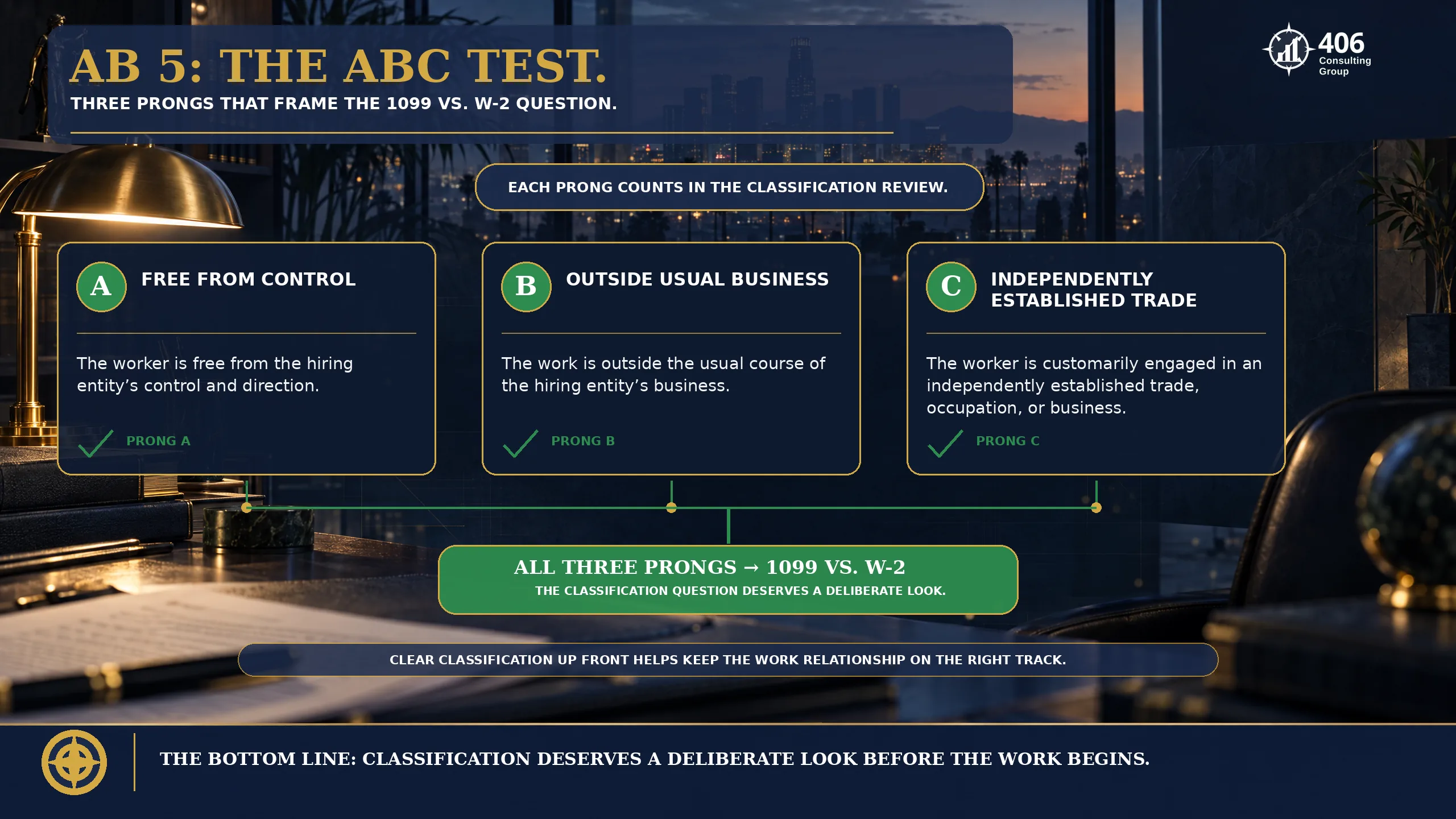
This bites hardest in industries built on contractors — entertainment talent, gig work, and especially the trades. We cover the construction and trades angle in the LA trades & construction accounting guide. Note that some occupations have statutory exemptions; confirm your specific situation with a professional.
Local vs. Remote in a High-Cost Market
It's natural to assume a Los Angeles business needs an LA accountant down the street. In one of the most expensive markets in the country, that instinct can cost you real money — because you're paying LA overhead baked into every invoice. Here is the reality that settles it: around 80% of our own local clients handle the entire relationship remotely and never come into an office. Modern accounting runs on secure cloud software, live bank feeds, and screen-share reviews, so the work happens the same whether your firm is in LA or in Montana.
~80%
of our local clients are fully remote
They never come into the office — the relationship is cloud-based, by choice.
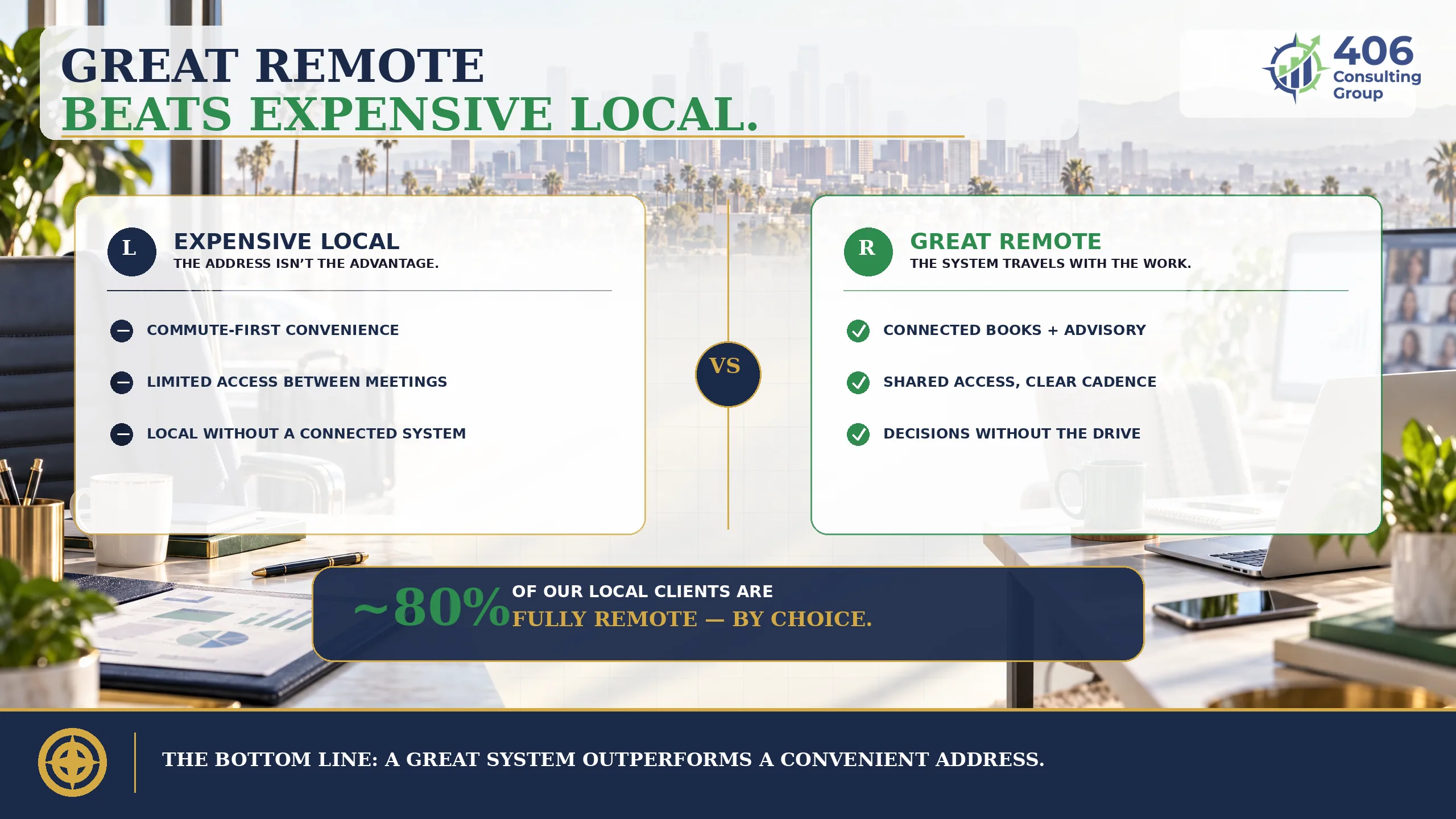
What matters is expertise, not a zip code. A great remote firm that knows California's 13.3% rate, the franchise tax and LLC fee, the AB 150 PTE election, and the AB 5 ABC test beats an okay expensive local onethat treats your books like any other — and does it without LA-office overhead in the bill. We serve Los Angeles and California businesses entirely remotely.
A Silicon Beach Agency, Illustrated
To make the stack concrete, here is an illustrative, hypothetical composite— not a real client, and the figures are round numbers chosen to show the pattern. Imagine a five-person creative agency in Playa Vista doing about $900,000 a year, run out of a shoebox: receipts in a drawer, books six weeks behind, and no idea which clients actually make money.
Layer 1 — Books cleaned
Reconciled books, a real chart of accounts, and business/personal finally separated. Now the numbers exist and can be trusted.
Layer 2 — Tax planned
S-corp election modeled and an AB 150 PTE election put in place — cutting the California and federal bill by more than the whole engagement costs.
Layer 3 — Controller added
Monthly close by the 10th, margin by client. Two 'busy' clients turn out to be barely breaking even; pricing gets fixed.
Layer 4 — CFO steering
A cash-flow forecast and hiring plan tied to a pipeline — the owner hires the sixth person on purpose, not on a hunch.

The lesson isn't that every LA business needs all four layers at once — it's that they climb in order, and each one only pays off when the layer below it is solid. The shoebox agency didn't need a CFO on day one. It needed clean books, then a tax plan, then visibility, then strategy — in that sequence.
In the highest-tax state in the country, the fastest return usually isn't more revenue — it's climbing the next layer of the stack on purpose, so tax becomes offense instead of a yearly surprise.
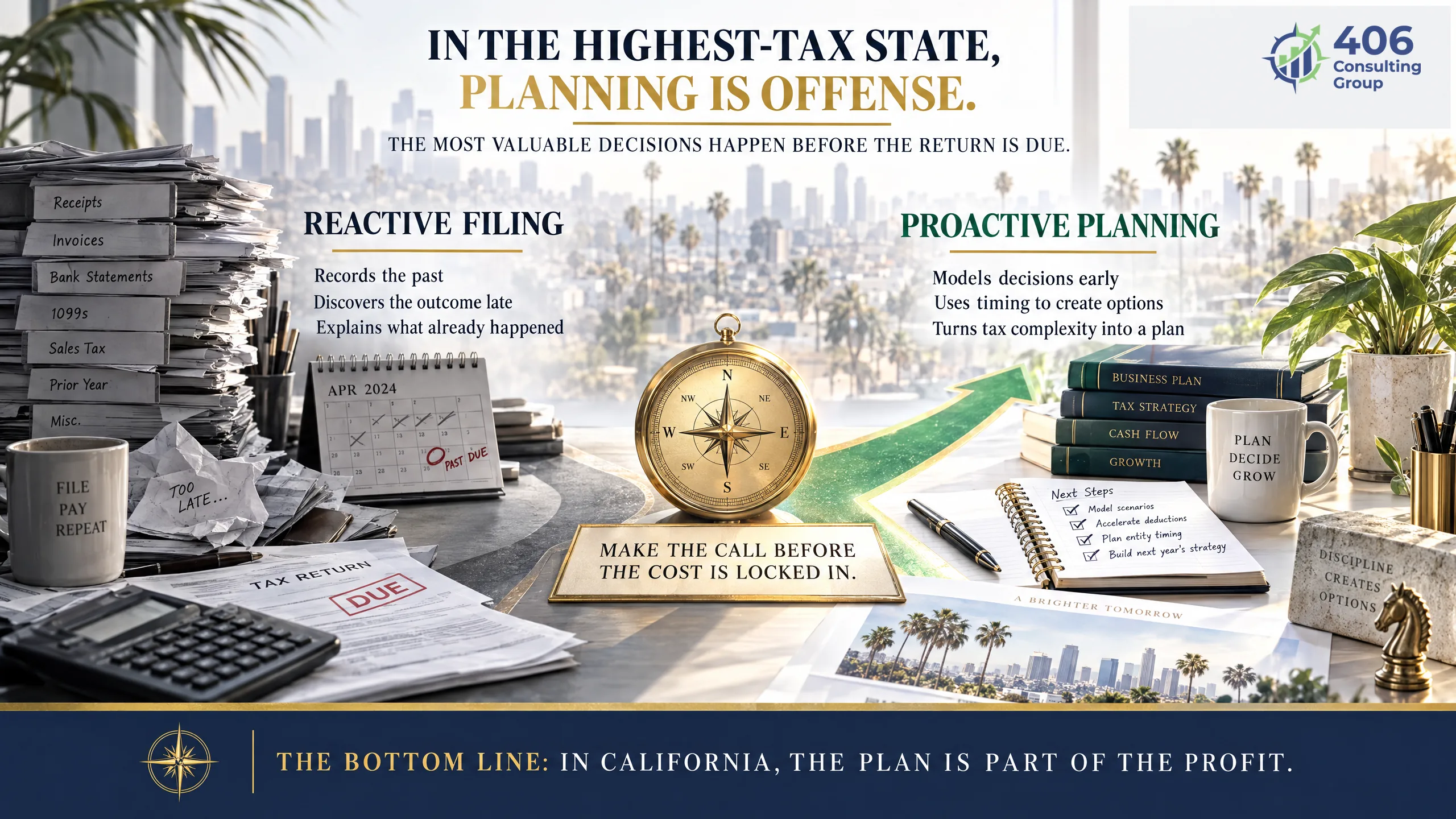
Want to know which layer you're on right now? Take the Financial Maturity Assessment, or talk to our team.
FAQ: LA Small Business Accounting
Do I need an LA-based accountant?
No. In one of the most expensive markets in the country, insisting on a local firm often just adds LA overhead to your bill. About 80% of our own local clients run the entire relationship remotely and never come into an office — modern accounting works over secure cloud software, live bank feeds, and screen-share reviews. What actually matters is California expertise: the 13.3% top rate, the $800 franchise tax and LLC gross-receipts fee, the AB 150 PTE election, and the AB 5 ABC test. A great remote firm that knows those beats an okay expensive local one that doesn't.
How much tax does an LA small business really pay?
It depends on entity type and income, but California is the highest-tax state in the country, so the number is usually higher than owners expect. Pass-through profit lands on a personal return with a top state rate of 13.3% (roughly 14.4% on wages once the uncapped 1.1% SDI is added); C-corporations pay 8.84% on net income. Almost every LLC and corporation also owes the $800 minimum franchise tax every year, LLCs owe a gross-receipts fee on top of that, and LA sales tax runs about 9.75%. That's exactly why proactive planning — the S-corp decision, the AB 150 PTE election, depreciation timing — matters more in California, not less. Confirm current rates with the California Franchise Tax Board.
What's the $800 franchise tax and the LLC fee?
The $800 is California's minimum annual franchise tax: almost every LLC and corporation owes at least $800 to the Franchise Tax Board every year, whether the business made money or not, from essentially the day it registers. The LLC gross-receipts fee is a SEPARATE charge stacked on top of the $800, and it's based on total revenue, not profit — roughly $0 under $250K, about $900 at $250K, about $2,500 at $500K, about $6,000 at $1M, and about $11,790 at $5M and up. Because it's tied to revenue, a thin-margin LLC can owe a meaningful fee while barely turning a profit. Confirm the current schedule with the California Franchise Tax Board.
What is AB 5 and does it affect me?
AB 5 is California's worker-classification law, and it affects nearly every business that pays anyone. It uses the ABC test: a worker is treated as a W-2 employee rather than a 1099 contractor unless you can prove all three of — (A) the worker is free from your control and direction, (B) the work is outside your usual course of business, and (C) the worker is independently established in that trade. Miss any one prong and they're an employee in California's eyes, with payroll taxes, workers' comp, and penalties attached. Some occupations have statutory exemptions, so it's worth reviewing your specific arrangements with a professional — misclassification is one of the more expensive mistakes an LA business can make.
How much does accounting cost in LA?
It depends on which layer of the stack you need and how complex your business is — transaction volume, number of entities, whether you need job costing or investor-ready reporting. Bookkeeping costs less than a controller engagement, which costs less than fractional CFO work. The better way to judge it is return: in the highest-tax state in the country, good tax planning routinely saves more than the whole engagement costs, and clean books are what let a lender actually fund you. Working with a remote firm also strips out the LA-office overhead baked into a local firm's rates. The most expensive option is usually the cheapest bookkeeper who mishandles the franchise fee, the PTE election, or worker classification.
Can you work with me remotely?
Yes — that's how we work by default. 406 Consulting Group is a Montana-based remote firm serving Los Angeles and California businesses across all four layers of the stack: clean bookkeeping, proactive California tax planning, controller-level reporting, and fractional CFO strategy. Our team pairs a commercial-banking and underwriting background with big-firm tax and Six Sigma systems experience, and we design financial systems from a whole-company view. The vast majority of our clients — including local ones — never step into an office.
California Tax Snapshot
The highest-tax state in the U.S.
LA Accounting
All four layers, remote.
About the Author
406 Consulting Group
Montana-based, remote — serving Los Angeles & California
Our team pairs a commercial-banking and underwriting background — 300+ loan reviews — with big-firm tax and Six Sigma systems experience, and designs financial systems from a whole-company view, delivered remotely.
Read the Full Story