
Tax Services in Los Angeles, CA:
Play Offense in the Highest-Tax State
California is the highest-tax state in the nation — so the money is in proactive planning, not April filing. The PTE election, S-corps and loan-out corporations, FTB residency, Measure ULA, and more — planned year-round and delivered remotely.

If you run a business or earn a serious income in Los Angeles, the single most valuable thing tax services in Los Angeles can do for you is play offense. California is the highest-tax state in the nation — a 13.3% top individual rate, an 8.84% corporate rate, an $800 minimum franchise tax, a gross-receipts fee on LLCs, and a stack of city and county taxes on top. In that environment, the money isn't made by filing a clean return in April. It's made by the decisions you lock in before the year closes: the PTE election, the entity structure, the residency file, the timing. That is what we call the California Tax Offense.
This guide walks the LA-specific levers that actually move your bill — the AB 150 pass-through entity elective tax, S-corps and loan-out corporations, the Franchise Tax Board's aggressive residency rules, the $800 franchise tax and LLC fee, Measure ULA, sales and use tax, EDD payroll taxes, and the AB 5 worker-classification rules — and shows how a remote firm plans all of it with you, year-round.
By Carrie Anderson — Co-Founder, 406 Consulting Group. Former commercial banker and underwriter who reviewed 300+ loans; she reads a California tax structure the way a lender does — for what it does to your cash, your borrowing, and your after-tax profit — and plans it remotely.
Quick Answer: Tax Services for a Los Angeles Business or Owner
- →California is the highest-tax state — up to 13.3% individual (about 14.4% on wages once the uncapped SDI is counted) and 8.84% corporate. Offense beats defense here.
- →The AB 150 PTE elective tax (9.3% of qualified net income) is the real workaround for the federal SALT cap — but it must be elected and paid on time.
- →Entertainers and creators route income through a loan-out corporation; a reasonable salary and an S-corp election drive the savings.
- →The FTB is aggressive on residency and nexus — leaving California, or earning California-source income, is a planning event, not an afterthought.
- →It's all remote — a great remote planner who knows California beats an okay local one who only files.
Table of Contents
Short Answer: What Tax Services in LA Should Actually Do
Tax services in Los Angeles should do far more than prepare a return. In the highest-tax state in the country, the return is the box score — the game was already won or lost by the moves you made during the year. Good tax services for an LA business or high earner mean proactive planning: choosing and maintaining the right entity, making the PTE election on time, setting a defensible reasonable salary, tracking California-source income and residency, and timing income and deductions before December 31. Tax preparation files what planning already decided.
In a low-tax state, sloppy planning costs you a little. In California, every structural decision is multiplied by one of the highest rate stacks in the country — which is exactly why offense pays here more than anywhere.

To see why offense matters so much here, start with the rate stack itself. Explore how we do this in tax planning and tax preparation.
The California High-Tax Reality — and Where the Leverage Is
California carries the highest top individual income-tax rate in the nation at 13.3%, and once you add the state's uncapped 1.1% disability (SDI) charge on wages, the effective top rate on wage income lands around 14.4%. Corporations pay 8.84%. Layer the federal top bracket on top and a successful LA owner can face a combined marginal rate well north of 50%. That is the bad news. The good news is that a high rate is also high leverage: every dollar you legally move off the taxable line is worth more here than almost anywhere else in the country.
13.3% top individual
The highest state rate in the U.S. — about 14.4% on wages once the uncapped 1.1% SDI is included. Confirm current brackets with the FTB.
8.84% corporate
California's franchise/income tax rate on C-corporation net income, stacked on top of the federal corporate tax.
$800 minimum franchise tax
The floor almost every entity pays just to exist in California — LLCs, corporations, and more — regardless of profit.
LLC gross-receipts fee
An additional fee on LLCs that scales with total California revenue, on top of the $800 — it is not a tax on profit.
The leverage lives in a handful of specific levers — and the biggest one for pass-through owners is a tax you choose to pay at the entity level so you can deduct it federally.
The PTE Elective Tax (AB 150) — the Real SALT-Cap Workaround
The pass-through entity (PTE) elective tax created by AB 150 is the single most powerful state-level lever for most LA pass-through owners. Here is the mechanics in plain English: the federal tax code caps the deduction for state and local taxes (SALT) that individuals can itemize. California lets your S-corp or partnership elect to pay a 9.3% tax on qualified net income at the entity level. Because the entity — not you personally — pays it, it becomes a fully deductible business expense on the federal return, sidestepping the personal SALT cap. You then get a credit against your California personal tax for what the entity paid. The election runs for tax years 2021 through 2025, and it is made annually with strict payment-timing rules.
The PTE election turns a non-deductible personal tax into a deductible business expense. For a profitable LA pass-through, that federal deduction can be worth tens of thousands of dollars — but only if you elect and pay on time.

The catch is timing: the election requires a prepayment by a mid-year deadline and the balance by the return due date — miss it and the door closes for the whole year. Whether the election even makes sense usually depends on your entity choice, which is where the S-Corp Calculator comes in. Confirm current rules and rates with the California Franchise Tax Board before electing.
S-Corps & Loan-Out Corporations
For LA's enormous base of entertainers, athletes, writers, directors, and creators, the S-corp shows up in a specific form: the loan-out corporation. A loan-out corp is a corporation — usually an S-corp — that you own and that "loans out" your services to studios, labels, leagues, and brands. Instead of being paid personally, you're paid through the entity. Done right, it separates your business income from your personal name, can unlock business deductions (agent and manager fees, equipment, travel, professional development), provides liability separation, and — through the S-corp structure — can reduce self-employment tax by splitting income between a reasonable salary and distributions.
The reasonable-salary requirement is where loan-outs get people in trouble. The IRS and the FTB both expect an S-corp owner to pay themselves a defensible wage for the work actually performed before taking distributions. Set it too low to dodge payroll tax and you invite reclassification, penalties, and interest. Set it thoughtfully and you keep the benefit while staying defensible.
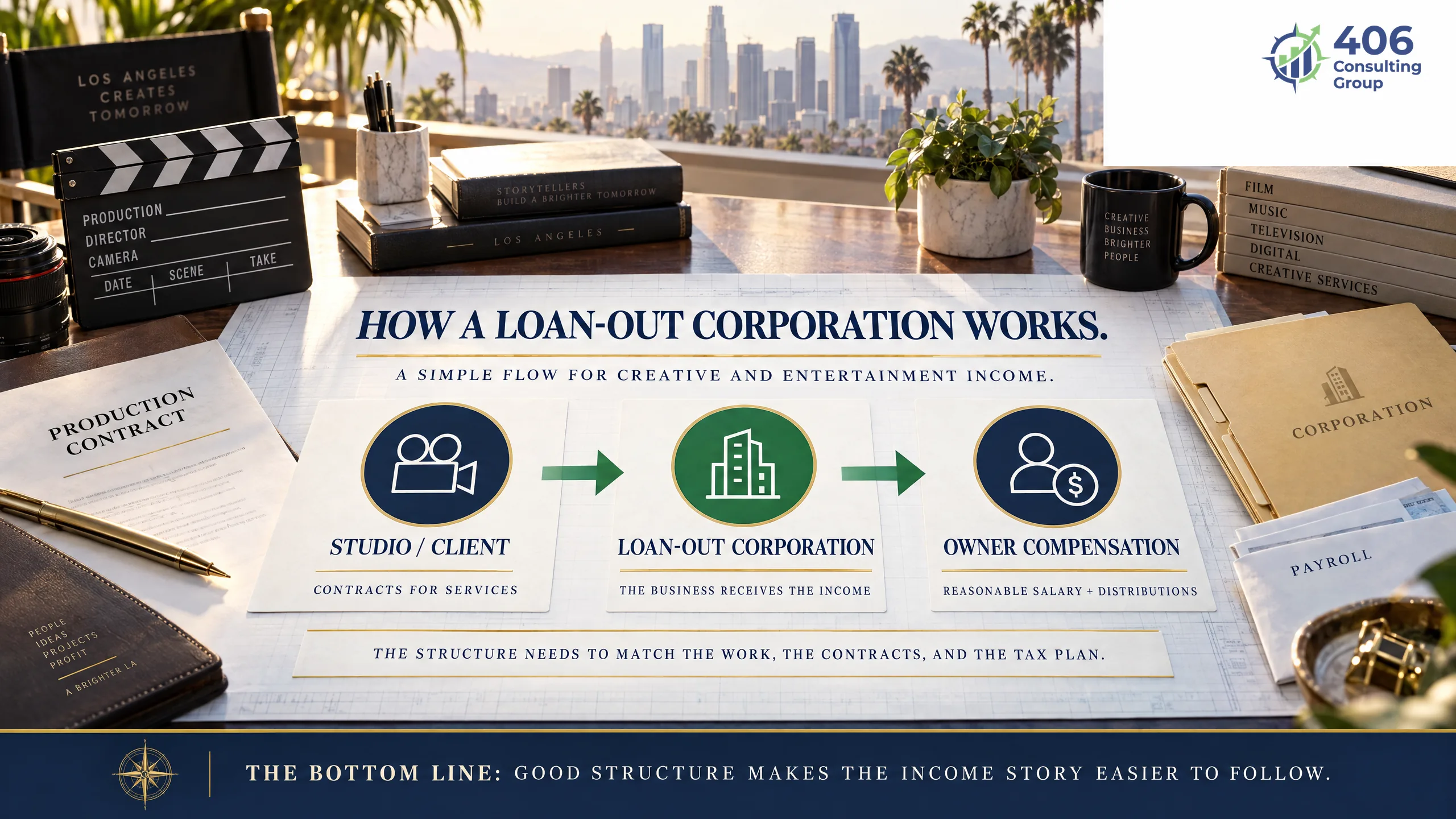
Whether an S-corp or loan-out pencils out depends on your income level and profile — run your own numbers in the S-Corp Calculator, then plan the salary with us. And if your career or income is moving across state lines, the next lever — residency — becomes just as important.
FTB Residency & Nexus — Leaving, Remote Work, Part-Year
California taxes residents on their worldwide income, and the Franchise Tax Board is one of the most aggressive state agencies in the country about who counts as a resident and what counts as California-source income. If you move away but keep a home, a business, family ties, or professional connections in California, the FTB can argue you never truly changed domicile — and the burden is largely on you to prove otherwise. Part-year residents, remote workers earning California-source income, and owners who relocate a business all sit squarely in the FTB's sightline.
Leaving California is a documentation project, not a moving-truck event. The FTB looks at where you actually live your life — and a clean, contemporaneous paper trail is your best defense against a residency audit.

If you're planning a move or splitting time, plan it with a tax professional before the year you leave, and confirm current residency guidance with the FTB. Even if you stay put, California charges you for the privilege of existing — which brings us to the franchise tax.
The $800 Minimum Franchise Tax & the LLC Gross-Receipts Fee
Almost every entity registered in California owes an $800 minimum annual franchise tax — LLCs, corporations, LPs, LLPs — whether or not it made a dime. It is the cost of the entity existing. On top of that, LLCs owe a separate gross-receipts fee that scales with total California revenue, and critically, it is charged on revenue, not profit. A break-even or even money-losing LLC can still owe both the $800 and a four- or five-figure fee.
| California LLC Total Income | Approx. LLC Gross-Receipts Fee |
|---|---|
| Under $250,000 | $0 |
| $250,000 – $499,999 | $900 |
| $500,000 – $999,999 | $2,500 |
| $1,000,000 – $4,999,999 | $6,000 |
| $5,000,000 and above | $11,790 |
This fee is on top ofthe $800 minimum and is not reduced by expenses — which is why the LLC-versus-S-corp decision in California isn't only about self-employment tax. Confirm current thresholds and amounts with the FTB, since they are periodically adjusted.
Measure ULA — the LA Real-Estate "Mansion Tax"
If you own or plan to sell higher-value real estate in the City of Los Angeles — including commercial and multifamily property, not just mansions — Measure ULA is a lever you cannot ignore. It is a City of LA real-property transfer tax layered on top of the existing base transfer tax, and it applies to the full sale price, not the gain. Roughly 4% applies to sales in the ~$5.3M–$10.6M band and about 5.5%on sales of ~$10.6M and up (thresholds started at $5M/$10M and adjust annually). On a $6M sale, that is around $240,000 — owed even if the property barely appreciated.
~4% / ~5.5%
of the full sale price — not the gain
Measure ULA applies on top of the base LA transfer tax above ~$5.3M and ~$10.6M thresholds.

Because ULA hits the gross price, the timing and structure of a sale — and even whether it's worth selling at all — deserve a planning conversation well ahead of a closing. Confirm current thresholds and rates with the City of Los Angeles, since they reset each year.
Sales & Use Tax at ~9.75% (City of LA)
If you sell tangible goods in the City of Los Angeles, you collect and remit sales tax at a combined rate of 9.75% (effective April 1, 2025), one of the higher metro rates in the country. Just as important and more often missed: use tax. When you buy equipment, furniture, or supplies from an out-of-state seller who didn't charge California tax, you owe use tax on that purchase yourself. The CDTFA actively looks for it, and a business that never files a use-tax line is a visible target.

Rates vary by district even within LA County, so verify your exact location rate with the California CDTFA. Sales tax is collected from customers; payroll taxes come straight off your own labor cost — the next lever.
EDD Payroll Taxes — UI, ETT, SDI (Now Uncapped)
California employers file payroll taxes with the Employment Development Department (EDD), and there are several moving parts: Unemployment Insurance (UI) and the small Employment Training Tax (ETT), both employer-paid on a wage base, plus State Disability Insurance (SDI), which is withheld from employees. The change that matters most right now: the SDI wage cap was removed, so SDI is now withheld on allwages. For high earners — common in LA — that quietly raises the effective top rate on wage income toward 14.4% and increases the cost of paying yourself a large salary.
Uncapped SDI changes the math on owner compensation. When every wage dollar now carries SDI, the salary-versus-distribution split inside an S-corp or loan-out deserves a fresh look.
Confirm current UI, ETT, and SDI rates and wage bases with the EDD each year, since they change. And how you classify the people doing the work — employee or contractor — drives both payroll tax and a California-specific legal test.
AB 5 Tax Implications — 1099 vs. W-2
California's AB 5 made it far harder to treat a worker as an independent contractor. The law applies the "ABC test": a worker is presumed to be an employee unless the business proves all three prongs — the worker is free from control, performs work outside the usual course of the business, and is customarily engaged in an independent trade. Misclassify someone as a 1099 contractor who should be a W-2 employee and the exposure is steep: back payroll taxes, unpaid UI and SDI, penalties, and interest, assessed by both the EDD and the FTB.
The tax defense here is documentation. Whether someone is a contractor or an employee is proven with contracts, invoices, evidence of an independent business, and a clean payment record — which is exactly the kind of record trail your books are supposed to create. Get the classification right in the books and the tax return simply reflects it.
That record trail starts in the books — see LA bookkeeping services for how we build the classification and payment documentation that survives an EDD or FTB review.
Illustrative Example: An LA Owner's PTE Election
The example below is a hypothetical, composite illustration— not a real client — built to show how the levers interact. Figures are rounded and illustrative; your result depends on your facts. Confirm the numbers with a tax professional and the FTB.
Imagine an LA-based design studio organized as an S-corp with $600,000 of qualified net income flowing to its two owners. Without planning, that income hits the owners' personal returns, and their state tax is largely non-deductible federally because of the SALT cap. The studio elects the AB 150 PTE tax: the entity pays roughly 9.3% × $600,000 = about $55,800 in California PTE tax. Because the entity pays it, that ~$55,800 becomes a deductible business expense on the federal return, reducing federal taxable income; the owners then claim a California credit for the PTE tax paid, so they aren't taxed twice by the state. At a combined federal marginal rate in the mid-30s, the federal deduction alone can be worth roughly $18,000–$20,000in real savings — money that would have evaporated under the SALT cap without the election.
Same income, same business — one timely election converts a non-deductible state tax into a deductible expense. That is the California Tax Offense in a single move.
The savings only exist because the election was made — with the prepayment in by the mid-year deadline and the balance by the due date. Miss the window and the whole benefit is gone for the year. That is why the cadence matters.
Proactive vs. Reactive: the Annual Planning Cadence
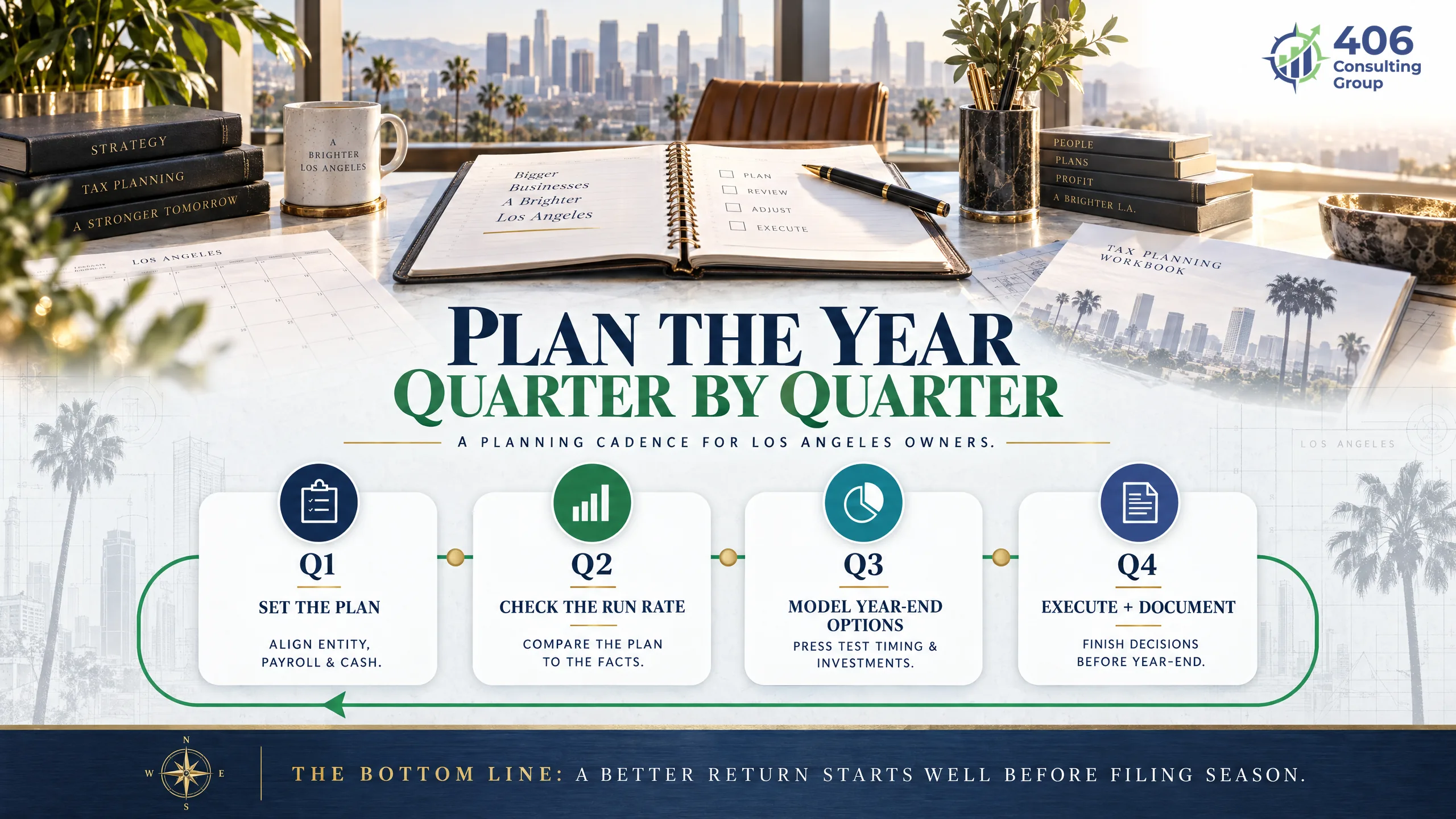
Reactive tax work happens once a year, after the year is over, when nothing can be changed. Proactive tax work happens on a cadence— a rhythm of decisions made while you can still affect the outcome. For an LA business or high earner, the year has a shape: entity and compensation set early, the PTE prepayment mid-year, a real projection in the fall, and income-and-deduction timing before December 31. Miss the rhythm and you file whatever happened; keep it and you file what you planned.
Q1 — Structure
Confirm entity, reasonable salary, and whether the PTE election fits this year. Set the plan before the year runs away.
Q2 — PTE Prepayment
Make the AB 150 prepayment by the mid-year deadline. Miss it and the election is off the table for the whole year.
Q3 — Projection
Run a real income projection while there's still time to act — adjust salary, timing, and retirement contributions.
Q4 — Execute
Time income and deductions, finalize the PTE balance, fund retirement, and document residency before December 31.
This is where our banking lens helps: we plan taxes alongside how they hit your cash and your ability to borrow. See CFO & controller services for the year-round version, and talk to 406 to build your cadence. We serve LA entirely remotely.
FAQ: Los Angeles Tax Questions
How much state income tax does an LA business owner pay?
It depends on income and entity, but California carries the highest top individual rate in the nation at 13.3% — and about 14.4% on wage income once the uncapped 1.1% SDI charge is counted. C-corporations pay an 8.84% corporate rate. Most small businesses are pass-throughs, so their California income flows to the owner's personal return at graduated rates topping out at 13.3%. Add the federal top bracket and a successful LA owner can face a combined marginal rate above 50%, which is precisely why proactive planning — the PTE election, entity structure, timing — matters so much here. Confirm current brackets with the California Franchise Tax Board.
What is the CA PTE elective tax and should I elect it?
The AB 150 pass-through entity (PTE) elective tax lets your S-corp or partnership pay a 9.3% tax on qualified net income at the entity level. Because the entity pays it, it becomes a deductible business expense federally, working around the federal SALT cap, and you get a California credit for what the entity paid. It's available for tax years 2021 through 2025, elected annually, with a required mid-year prepayment and the balance by the return due date. For a profitable pass-through it often saves real money, but it doesn't fit every situation and the timing is strict — model it before you elect and confirm current rules with the FTB.
What is a loan-out corporation?
A loan-out corporation is a corporation — usually an S-corp — that an entertainer, athlete, or creator owns and that 'loans out' their services to studios, labels, leagues, or brands. Instead of being paid personally, you're paid through the entity. Done correctly it separates business from personal income, unlocks legitimate business deductions, provides liability separation, and can reduce self-employment tax by splitting income between a reasonable salary and distributions. The key requirement is paying yourself a defensible reasonable salary for the work performed before taking distributions — set it too low and you invite IRS or FTB reclassification.
Does the $800 franchise tax apply to me?
Almost certainly, if you operate through an entity in California. The $800 minimum annual franchise tax applies to LLCs, corporations, LPs, and LLPs regardless of profit — it's the cost of the entity existing. LLCs owe an additional gross-receipts fee that scales with total California revenue (roughly $900 at $250K, $2,500 at $500K, $6,000 at $1M, and $11,790 at $5M and above), charged on revenue rather than profit. A break-even LLC can still owe both. Sole proprietors without an entity don't owe the $800. Confirm current amounts and any first-year rules with the FTB.
What is Measure ULA?
Measure ULA is a City of Los Angeles real-property transfer tax layered on top of the existing base transfer tax, often called the 'mansion tax' though it applies to commercial and multifamily property too. It's charged on the full sale price — not the gain — at roughly 4% on sales in the ~$5.3M–$10.6M range and about 5.5% on ~$10.6M and up. The thresholds started at $5M and $10M and adjust annually. Because it hits the gross price, the timing and structure of a higher-value LA property sale deserve planning well before closing. Confirm current thresholds and rates with the City of Los Angeles.
What sales tax applies in LA?
The combined sales-tax rate in the City of Los Angeles is 9.75% (effective April 1, 2025), among the higher metro rates in the country, though it varies by district within LA County. If you sell tangible goods you collect and remit it. Just as important is use tax: when you buy equipment or supplies from an out-of-state seller who didn't charge California tax, you owe use tax on that purchase yourself, and the CDTFA looks for businesses that never report it. Verify your exact location rate with the California CDTFA.
Can you handle my LA taxes remotely?
Yes — we provide proactive tax planning and preparation for Los Angeles businesses, owners, and creators entirely remotely. California's rules are what matter — the PTE election, S-corps and loan-outs, FTB residency, the franchise tax and LLC fee, Measure ULA, sales and use tax, EDD payroll, and AB 5 — not whether your planner is down the street. A great remote firm that knows California and plans year-round beats an okay local one that only files in April. Our commercial-banking background means we plan your taxes alongside your cash and your ability to borrow, and design your financial systems from a whole-company view.
California Tax Snapshot
What an LA owner faces
LA Tax Planning
Proactive, California-aware, remote.
About the Author
Carrie Anderson
Co-Founder, 406 Consulting Group
Carrie spent her career in commercial banking and underwriting, reviewing 300+ loans. She reads a California tax structure the way a lender does — for what it does to your cash, your borrowing, and your after-tax profit — and plans it proactively for LA businesses, remotely.
Read the Full Story